



Abstract
The consensus problem is a very important aspect of group decision making (GDM). In order to deal with the multiple criteria group decision consensus problem in the interval type-2 fuzzy environment, a consensus measure based on similarity measurement is proposed in this paper. In this paper, first, a new similarity measure of two interval type-2 fuzzy sets (IT2FSs) is defined and the consensus measure is defined by the similarity measure between two IT2FSs. Then, a new consensus feedback mechanism is proposed. In the stage of alternatives selection, the entropy of IT2FSs is defined, and the entropy weight method is used to determine the weights of the criteria. Finally, the feasibility of the method proposed in this paper is illustrated by a comprehensive evaluation of old-age institutions.
Introduction
Due to the high complexity of the socioeconomic environment, it is difficult and infeasible for a single decision maker to consider all important aspects in realistic decision-making problems. Therefore, the problem of multiple criteria group decision making (MCGDM) has become an important subject in the field of decision science [1–3]. In MCGDM, attribute values and criteria weights play a very important role. In the decision-making process, information about attribute values and the importance of criteria are usually uncertain or fuzzy due to the increasing complexity of the economic and social environment and the vagueness of the subjectivity inherent in human thinking. For this reason, many scholars use fuzzy set theory to model the uncertainty and fuzziness of the decision-making process [48]. In the past decades, there have been many achievements in the research of multi-criteria group decision making in fuzzy environment.
In the process of group decision-making, the lack of acceptable consensus will lead to unsatisfactory or even incorrect results in GDM problems [49]. Therefore, whether or not consensus is reached between experts plays a very critical role in the decision-making results. In general, the group decision making process is divided into two stages. The first stage is to reach consensus among individuals; the second stage is to choose the best alternative(s) based on consensus. The consensus process in the GDM model is defined as a dynamic, iterative group discussion process, which can reduce the differences between decision makers [4–8].
In the past few decades, more and more studies have focused on consensus models in GDM problems [9–15, 50–54]. There are generally two ways to reach consensus. One is whether the decision maker can reach consensus on the preference relations of alternatives plan. The other is whether decision maker can reach a consensus on the evaluation of alternatives. For example, in [10], based on different preference structures and individual selection methods, feedback and adjustment rules were combined with different preference representation structures to help decision makers reach a consensus. Literature [13], established a consensus support system model based on the multi-granular languages, and proposed two consensus standards and guidance and suggestion system to help experts reach consensus at all stages of group decision-making problems with multi-granular language preference relations. In the literature [14], linguistic term sets with different criteria were used to express the preferences of experts, and a model to reach consensus on the preferences of experts was established in GDM problems. The consensus model proposed by Zhang e al. [15] considers whether the preference relations of multiple experts can reach consensus under the probabilistic linguistic environment, and the consensus process was designated based on consistency and consensus criteria. The other way is reaching a consensus on the evaluation of the alternative. At present, there are mainly two methods to measure consensus. The first method is to reach a consensus between any two experts. Such as, Wu et al. [18] proposed a hesitation fuzzy linguistic information MCGDM method based on probability distribution. The other method is to reach a consensus between the experts and the comprehensive evaluation value. Such as, Dong [16, 50] proposed a method for managing consensus and weight in iterative multi-attribute group decision making.
Although fuzzy set theory has been applied to the MCGDM problem and has achieved fruitful results, as the complexity of the socio-economic environment increases, the uncertainty in reality can no longer be represented by the fuzzy set of low-order uncertainty. A type-2 fuzzy sets (T2FSs) is an extension of type-1 fuzzy sets (T1FSs). Compared with T1FSs, T2FSs has one more dimension of uncertainty. Therefore, T2FSs can be used to build models of uncertainty and fuzziness. However, T2FSs cannot be applied in problems in real life due to the large amount of calculation of T2FSs. Therefore, the special case of T2FSs, namely interval type-2 fuzzy set (IT2FSs) is often used in real problems. Many scholars have studied the problem of multiple criteria group decision making under interval type-2 fuzzy environment, such as Chen et al. [19] proposed an interval type 2 fuzzy TOPSIS method based on interval type 2 fuzzy sets to deal with fuzzy multiple attribute group decision making, and in the literature [20], in order to solve the problem of large-scale multiple criteria group decision-making based on IT2FSs, a combination of cluster analysis and information aggregation operators was proposed. As everyone knows, for group decision-making, whether experts can reach consensus is very important to choose the optimal solution. The group decision-making method proposed in reference [19, 20] has the following shortcomings: The evaluation given by experts is not considered as to whether a consensus is reached. As we all know, whether a consensus is reached is important for making correct decisions; The weights of experts and criteria are subjectively given. The consensus on multiple criteria group decision-making based on IT2FSs has not been studied so far.
The main contributions of this paper are as follows: This paper proposes a method to determine the weight of experts and designs a consensus feedback mechanism. At the stage of alternative selection, the fuzzy entropy of IT2FSs is defined and the weight of the criterion is determined by entropy weight method. The expectation and variance of IT2FSs are defined, and the order of IT2FSs is determined by expectation and variance.
The basic framework of this paper is as follows: In section 2, the basic concepts and operations of IT2FSs and the aggregation method of multiple IT2FSs are introduced. A new method for comparing two IT2FSs is defined. In section 3, a new similarity measure of IT2FSs is defined. In section 4, a consensus feedback mechanism based on the new similarity measure is proposed and adjustment rules are introduced. In section 5, in the stage of selecting alternatives, the entropy of IT2FSs is defined, and the entropy of the criterion is determined by the entropy weight method. In section 6, the feasibility of the proposed method is illustrated by an example and is compared with the existing TOPSIS group decision-making method and other methods to illustrate its effectiveness.
In section 7, some shortcomings of this paper are pointed out, and the research direction of the later period is determined according to these shortcomings.
Preliminaries
In this section, we introduce the concept of IT2FSs, operational laws of IT2FSs, IT2FSs weighted arithmetic average operator and how to sort the IT2FSs.
Interval type-2 fuzzy set
Because the calculation process of T2FSs is too complicated, it is not suitable for practical application. Therefore, interval type-2 fuzzy sets (IT2FSs) is often used as a special form of T2FS in application.
Interval type-2 trapezoidal fuzzy number (IT2TFN) is one of the most popular tools in fuzzy decision making. It can be expressed as follow:
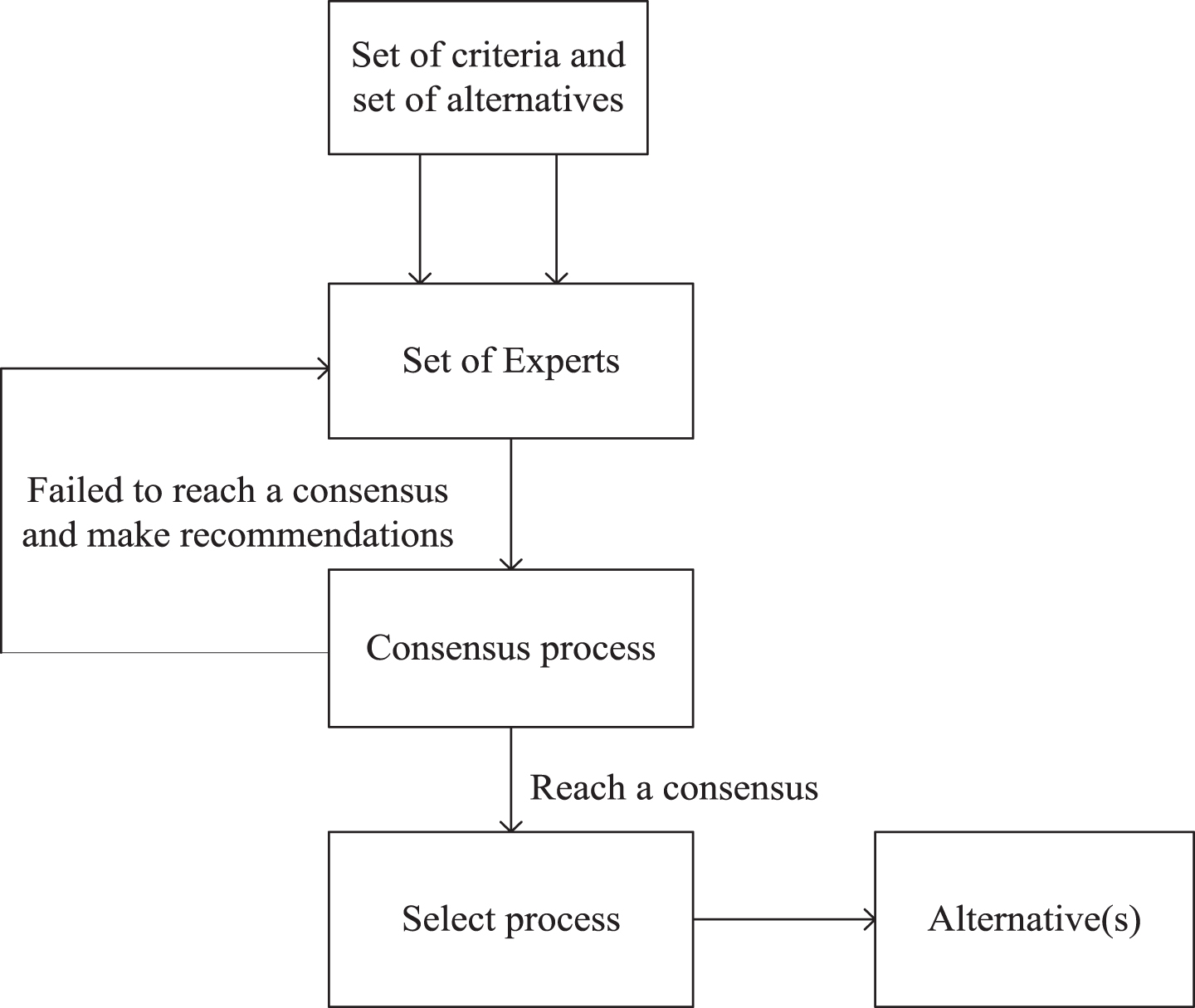
Group decision –making process.

Interval type-2 fuzzy set.
Let Addition operation
Multiplication operation:
Multiplication operation with real number k (k > 0):
Information aggregation is the process of using appropriate techniques to solve decision-making problems. To aggregate the interval type-2 fuzzy numbers (IT2FNs), Hu and Zhang [25] developed an IT2FN weighted arithmetic averaging (IT2FN-WAA) operator, which is defined as follows:
In order to rank the IT2FSs, the definition of the expectation and variance of the IT2FSs are defined.
According to Eq. (9), the preference order is determined by the value of the
For any two IT2FSs If If if if if
A similarity measure can be used as a quantitative measure to describe the degree of similarity between IT2FSs [26–29]. The similarity measure should be considered in MCGDM in an IT2FSs environment, and many scholars have applied the IT2FSs similarity measure to MCGDM problems. However, the existing definition of similarity measure is not comprehensive considering the factors that affect similarity measure. Therefore, the concept of similarity measure is redefined in this paper.
The new similarity measure of IT2FSs
In this section, a new formula for calculating the similarity measure of IT2FSs is proposed by using the cosine of the angle between the hypotenuse of the trapezoid and the distance between the endpoints.
Where
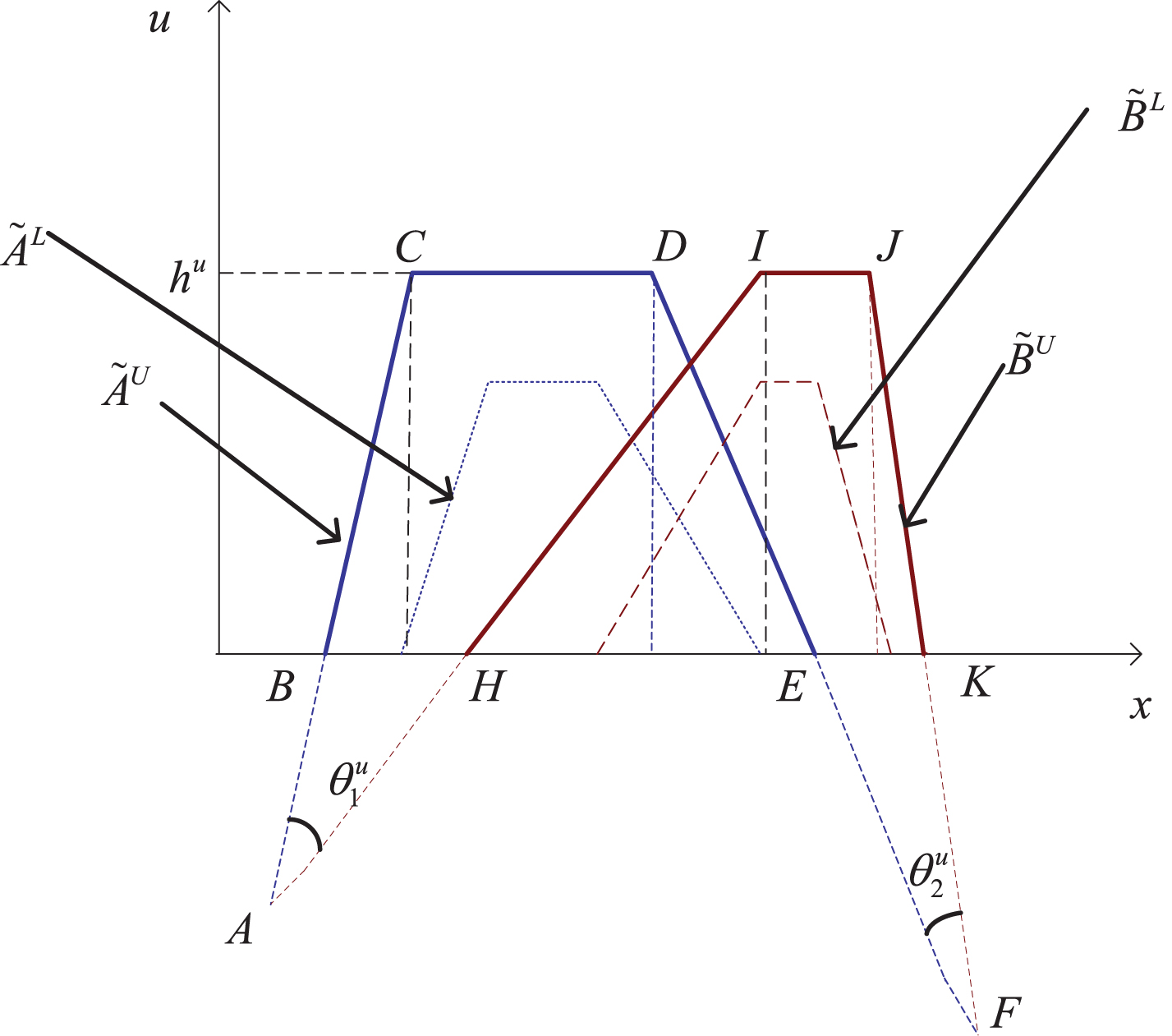

According to the similarity measure defined above, the degree of difference between any two IT2FSs can be defined as follows:
Hence, it can be known from Eq. (14)
Due to
This implies that
That is
In this section, we compare the calculation formula of IT2FSs similarity measure defined in this paper with the existing similarity measure of IT2FSs [26–29]. Detailed data of the case refer to the literature [28]. The specific calculation results are shown in the Table 1.
Comparison of similarity measures for IT2FSs
Comparison of similarity measures for IT2FSs
Compared to Mitchell’s method and Zeng and Li’s method, the characteristics of the proposed similarity measure are as follows: When using Mitchell’s method to calculate the similarity measure of two IT2FSs, when the two IT2FSs are identical, their similarity is not equal to 1. However, the method proposed in this paper can avoid this situation. For example, When using Zeng and Li’s method to calculate the similarity measure of two IT2FSs, the results are contrary to human intuition in some special cases. For example,
In the MCGDM problem, two processes are required before the optimal alternative is selected [7, 30–36]. The first process is how to make the expert group reach the greatest degree of consensus on the alternative solution. This process is called the consensus process. Usually, this step by figure of moderator. After reaching a consensus, in the selection process, the optimal alternative is finally determined by analyzing the opinions of experts on alternatives [37–39]. This is also the ultimate goal of the MCGDM problem. Obviously, it is important that experts achieve a high degree of consensus before performing the selection process [37–39]. Consensus is one of important tools to measure effectiveness of GDM. Therefore, in this paper, we focus on the consensus process. The evaluations given by the experts can only be effectively integrated after a satisfactory or acceptable consensus is reached. Inspired by the reference [18], this paper mainly considers the consensus problem of MCGDM in the interval type-2 fuzzy environment, the consensus measure is established based on IT2FSs similarity measure and dynamic adjustment mechanisms are established to reach consensus. In this section, a new consensus reaching process is developed based on the new similarity measure, which consists of following stages: First, the DMs provide their evaluation of the alternative with each criterion. Second, consensus measure is calculated by the proposed similarity measure.
Consensus measure
In MCGDM problems, alternative set, criterion set and expert set can be expressed as X = {x1, x2, ⋯ , x n }, C = {c1, c2, ⋯ , c m }, E = {e1, e2, ⋯ , e t }. Each expert’s evaluation of the alternatives for each criterion are expressed as an IT2FSs. Consensus measures can be calculated in two ways: 1) similarity to collective preference. 2) similarity between experts. This paper uses the latter method to calculate the consensus measure.
and t is the number of experts.
The consensus degrees are discussed from the following three aspects.
(1) Criterion Level: The consensus degree of an alternative x
i
with criterion c
j
is defined as a measure of the level of consensus among all experts on a given criterion for that alternative, denoted ca
ij
.
The closer ca ij is to 1, the higher the consensus of experts on the evaluation of alternative x i with criterion c j . This measure can be used to identify the position in the decision matrix at which the level of consensus is below the threshold.
(2) Alternative Level: Consensus on alternative x
i
, the consensus of alternative x
i
is used to measure the level of consensus among all experts on alternative x
i
.
According to cx i , alternatives whose consensus are below the threshold are identified.
(3) Decision Matrix Level: Consensus degree of the decision matrix is denoted with gcd and is used to measure the level of global consensus among experts and to control the process of reaching consensus. It is calculated as
In order to reach a consensus, there have been many literatures on the study of dynamic feedback mechanism. For example, in reference [50], a dynamic feedback mechanism model is established based on the minimum adjustment cost, and in reference [51], a group minimum adjustment model is established based on the finite confidence effect. reference [53], dynamic feedback mechanism is established based on trust relationship. Based on the semantic similarity and distance between opposing decision-makers, the feedback mechanism of decision-makers who have not reached consensus is designed in literature [54]. And, the dynamic feedback mechanism established in this paper is based on the similarity degree between the evaluations given by experts. As long as different levels of consensus are obtained, a comparison between the actual consensus level and the priori defined consensus threshold ρ ∈ [0, 1] can be performed. If gcd ⩾ ρ, then the dynamic feedback mechanism ends and the decision process enters the selection phase; otherwise, further discussion is required. The value of ρ depends on the particular problem to be solved. If the selected parameter ρ is too large, the number of iterations may increase; on the contrary, if the selected parameter ρ is too small, the evaluation of all alternatives may reach consensus without adjustment. Therefore, this value must be carefully chosen to avoid needing too many iterations.
The expert’s decision matrix which needs to be improved can be obtained according to the recommendations generated by the dynamic feedback mechanism, furthermore, the specific position where the evaluation value needs to be improved in the decision matrix can also be obtained by dynamic feedback mechanism. As mentioned earlier, the dynamic feedback mechanism approach proposed by Herera-Viedma et al. [11] employs proximity to distinguish who are most likely to modify their evaluations. According to dynamic feedback mechanism, the first goal is to identify the evaluation that needs to be adjusted, in other words, the first goal is to determine which evaluation of which alternative need to be adjusted under which criteria. The second goal is to determine the matrix needing to be adjusted. The identifications are listed as follows:
1) Identification rule for alternatives (IR. 1): Let Ω be a set of alternatives that need to be adjusted. The elements in Ω can be determined by the following rule:
Using this rule, the row that needs to be adjusted in the decision matrix can be determined. According to this rule, there are several rows of elements in the matrix that need to be adjusted. At this time, the smaller cx
i
corresponds to the evaluation of alternative will be adjusted in priority. Therefore, if only one row of the decision matrix is adjusted at a time, Eq. (21) can be replaced by the following formula.
2) Identification rule for criteria (IR.2): In the following, we should determine the criteria that need to be improved with alternative x
i
0
.
According to IR1 and IR2, the specific position of the evaluation that needs to be adjusted in the decision matrix can be determined. Binary ordered real pair indicates the position of the evaluation that needs to be modified. The position on which the evaluation needs to be adjusted can be determined by the following formula
3) Identification rule for experts (IR.3): After the positions that the evaluations need to be adjusted are determined, then the expert’s decision matrix that needs to be adjusted is determined. Similarly,
where
For convenience, the elements in the set Eloc indicate which experts’ evaluations need to be adjusted and where they need to be adjusted.
By the three rules mentioned above, the evaluations provided by experts and the positions that need to be adjusted can be determined. The next question is how to adjust. The following adjustment rules are established.
Step 1. According to Eq. (8), the decision matrices given by experts are assembled into a comprehensive decision matrix
Step 2. Taking the matrix G as a reference, the element that need to be adjusted at the (i, j) position of the rating matrix given by the k-th expert is compared with the element at the same position of the matrix G. If If If
The convergence of the proposed iterative method is analyzed as follows. It is assumed that, the evaluation of the k-th expert at the position (i, j) is adjusted for T times, but the similarity measure at the position (i, j) still fails to reach the threshold, so the next step is to make the (T + 1)-th adjustment for evaluation of the k-th expert at the position (i, j). In this case, the following two situations will occur. The first situation is that the evaluation value of the comprehensive judgment matrix at (i, j) is less than the evaluation given by the k-th expert at (i, j). In this case, the evaluation of the k-th expert at (i, j) should be adjusted in a larger direction. The second situation is that the evaluation value of the comprehensive judgment matrix at (i, j) is greater than the evaluation given by the k-th expert at (i, j). In this case, the evaluation of the k-th expert at (i, j) should be adjusted in a smaller direction.
After all experts reaching a consensus, this method enters the process of selecting the best alternative. In the consensus adjustment phase, the reference point is the comprehensive evaluation of all experts. According to Eqs. (8) and (23), the adjusted decision matrix of each expert can be aggregated into a new comprehensive decision matrix. Assume that the adjusted decision matrix of k-th expert is recorded as
Because of the different importance of criteria, the weight of the criteria varies. In [18], the non-reduction fuzzy quantifier ‘Q’ is used to calculate the weights of criteria, while in [13], the subjective method is adopted to determine the weights of criteria. Similarly, AHP is also a subjective weighting method, and it is a common method to determine the weight of criteria. However, the AHP is a subjective weighting method with less quantitative data and many qualitative components, which is not easy to be convincing. At the same time, if the number of criteria increases, it will be more difficult to compare the importance of any two criteria, and it will even affect the consistency of the single ranking and the overall ranking, making the consistency test fail. Due to the complexity of objective things or one-sided understanding of things, the weights obtained through the constructed judgment matrix may not be reasonable. Because there are some defects in subjective weighting, entropy weighting method, an objective weighting method, is adopted in this paper to determine the weight of criteria.
The larger the entropy value, the less information the evaluation value contains, that is, the smaller the effect of the criterion on the ordering of the alternative, the relatively small weight value should be given. If the entropy of the evaluation
In order to reflect the ambiguity of an IT2FSs, the concept of entropy is introduced in the follows. Since the secondary membership of an IT2FSs is always equal to 1, the ambiguity is reflected in the primary membership degree. Therefore, the entropy of an IT2FSs can be defined as follows:
Obviously, the fuzzy entropy defined by Eq. (28) satisfies the three axioms of fuzzy entropy [47]. If
The selection process is as follows:
Step 1. By Eq. (28), the entropy matrix Sh = (sh
ij
) n×m of the adjusted comprehensive evaluation matrix
Step 2. According to the Eq. (29), to calculate the comprehensive entropy of criterion c
j
. And the weight of criterion c
j
is computed by Eq. (30).
Step 3. According to the comprehensive evaluation matrix obtained after reaching consensus and Eq. (8), the comprehensive evaluation of each alternative x
i
can be obtained.
Step 4. The alternatives are sorted according to Eqs. (9) and (10). Thus, the best alternative(s) can be selected.
The flow chart of multi-criteria group decision making under IT2FSs is shown in Fig. 6.

Examples used in the comparative study:
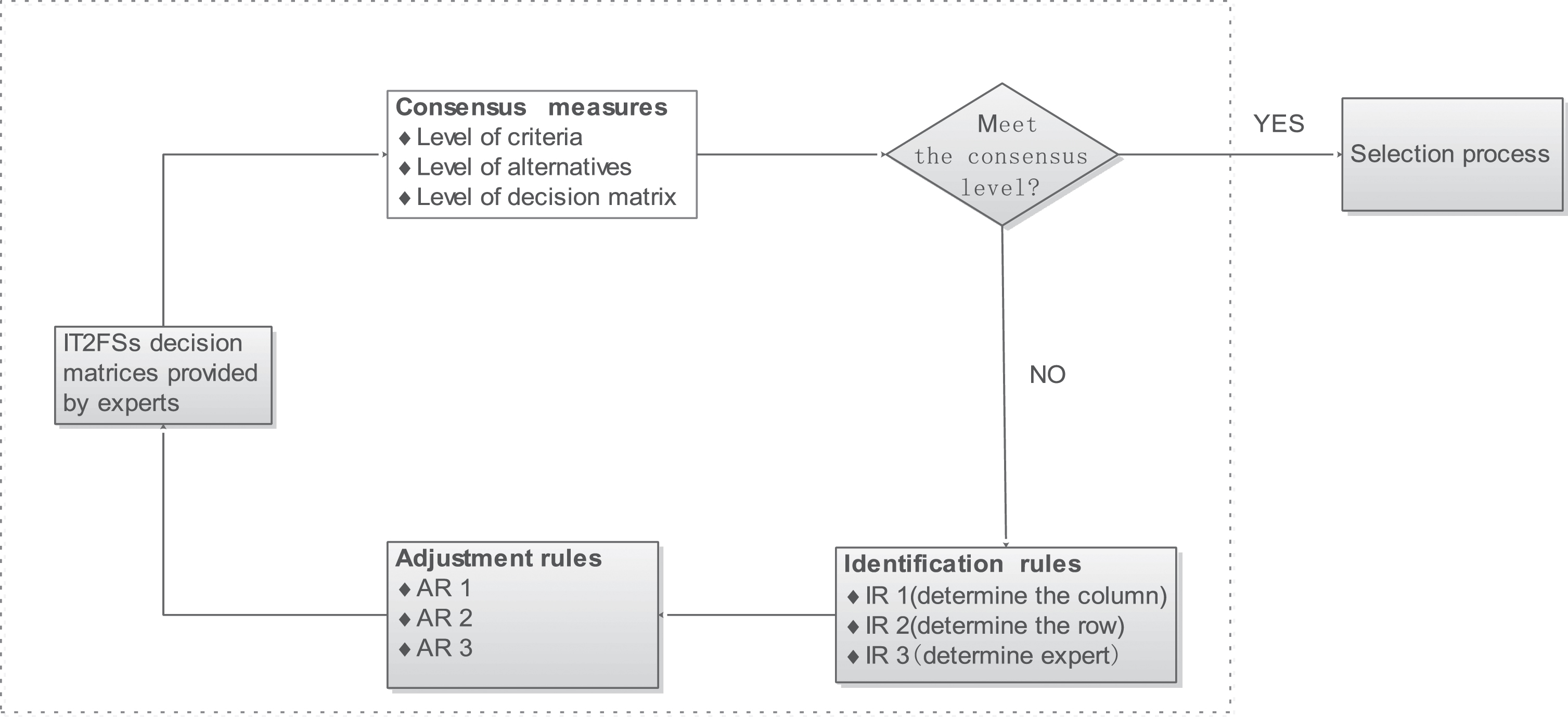
Multi-criteria group decision flow chart.
In this section, an application of the proposed method is given. With an increasing number of elderly people in China, the issue of old-age care has become the focus of social attention. Many office workers can’t take care of the elderly normally, so many children send their parents to the old-age care institutions to support the elderly. How to choose the appropriate old-age care institutions becomes the focus of their children. Under normal circumstances, when choosing an old-age care institution, we will pay attention to the following four aspects: the service level of the staff (c1), the charges are clear and reasonable (c2), the design is suitable for the elderly (c3), and the living is pleasant and enjoyable (c4). There are four old-age care institutions (x1, x2, x3, x4), and four experts (e1, e2, e3, e4) giving evaluations to the four institutions under the above four criteria. The four experts gave the evaluation of the four institutions under the above four criteria in linguistic form. The reference [40] was used to convert the linguistic into IT2FSs. The corresponding relationship between language and IT2FSs is shown in Table 2.
Fuzzy linguistic evaluation variable
Fuzzy linguistic evaluation variable
Step 1 Build the similarity matrix. According to the Eq. (12), the similarity matrices of any two experts’ evaluations of the alternatives (S
lk
)can be obtained. Then, consensus matrix (CO) can be obtained according to Eq. (17).
Step 2. According to consensus matrix, the consensus degree can be determined.
First, according to the Eq.(18) consensus level of criterion can be determined, then, the consensus level of the alternative (cx
i
, i = 1, 2, 3, 4) and the consensus of decision matrix (gcd) can be determined according to Eq. (19) and (20) respectively.
cx1 = 0.9505, cx2 = 0.8448, cx3 = 0.8385, cx4 = 0.8844, gcd = 0.8385
Due to the different knowledge reserves and backgrounds of experts, the evaluation of alternatives cannot be exactly the same. In general, as long as the consensus reaches a certain value, there is no major deviation in the evaluation of all experts. In this paper, the consensus threshold is set as 0.85. According to the results obtained above, the consensus threshold is not reached, so the evaluation of some experts needs to be adjusted.
The set of alternative evaluation that need to be adjusted is determined by Eq. (22), then a set of criteria is identified under the evaluation of alternatives needs to be adjusted by Eq. (23). Finally, the locations of the evaluations need to be adjusted are identified by Eq. (24).
Step 3. Identify experts whose evaluations need to be adjusted.
The evaluation of the third alternative under the first criterion needs to be adjusted. According to Eqs. (15) and (25), experts whose evaluations need to be adjusted can be determined.
Step 4. According to Eq. (27), experts’ weights can be obtained.
Step 5. According to Eq. (8), the comprehensive decision matrix
Step 6. In order to reach a consensus, the evaluation needs to be adjusted. The specific results are shown in the Table 3.
The results of the first round need to be adjusted
The results of the first round need to be adjusted
Specific adjustments are shown in Table 4.
Details of the adjustment
Step 7. The adjusted results were used to calculate the average consensus level of the alternatives again. The average consensus of the evaluation of the adjusted alternative is as follows:
Since the average level of consensus for each alternative is already above the threshold, all experts have reached consensus. Then we go into the process of choosing the best alternative.
Step 8. Determine the new comprehensive matrix and the weights of criteria.
According to the adjusted expert evaluation matrix and experts’ weights, the new comprehensive judgment matrix
ω1 = 0.2516, ω2 = 0.2444, ω3 = 0.2530, ω4 = 0.2510.
Step 8. The comprehensive evaluation of alternatives can be obtained.
Step 9. The expected value of each alternative can be obtained by Eq. (9), and the alternatives are ranked according to the expected value, so that the best solution can be obtained.
From the above results, it can be concluded that the first old-age care institution is the best.
In this section, the proposed method is compared with TOPSIS method [41, 42] and the proposed method in literature [40].
Compare with TOPSIS method
The IT2FS-TOPSIS, which is widely used in MCGDM problems [41, 42], aims to minimize the distance between the alternatives and the positive ideal point and to maximize the distance between the alternatives and the negative ideal point. In this section, the proposed method is compared with IT2FS-TOPSIS. Assume that the weights of each criterion are equal and the weights of each expert are equal, i.e ω1 = ω2 = ω3 = ω4 = 0.25, λ1 = λ2 = λ3 = λ4 = 0.25. IT2FS-TOPSIS method proposed by Chen et al. [41] was used to make decisions on the cases in this paper. The detailed calculation process can be referred to literature [41]. The method proposed in literature [41] was used to analyze the cases in this paper, the main steps are described. Step 1. Compute the weighted evaluative matrix
Step 2. Determine the negative ideal and the positive ideal.
The distance between the alternative and the positive ideal point
The distance between the alternative and the positive ideal point
The distance between the value of alternative and the negative ideal
Step 4. Compute the average distances between each alternative x
i
and the positive ideal point
The average distance between the alternative and the positive ideal point
The average distance between the alternative and the negative ideal point
Step 5. Calculate the closeness coefficient according the Eq. (34).
Results are listed in Table 9.
The closeness coefficient
Step 6. Based on Table 9,
It follows that x1 ≻ x2 ≻ x4 ≻ x3, which means that the best alternative is x1.
In order to demonstrate the effectiveness of the method proposed in this paper, the method proposed in this paper is applied to the case in literature [40]. All decision information can refer to the literature [40]. The detailed calculation process is omitted, and according to the information in literature [40] and using the method proposed in this paper, the main results are as follows:
According to the identification rules and the adjustment rules, the second expert’s evaluation of alternative x4 respect to criterion c1 needs to be adjusted in the direction of greater expectations. After the adjustment, the previous calculation steps are repeated. According to the obtained results, the first expert’s evaluation of alternative x1 respect to the criterion c2 also needs to be adjusted to the direction of greater expected value. After the adjustment, the result of recalculation shows that the consensus degree of all experts reaches the preset threshold, then enter the selection phase. The weight vector of experts and criteria can be obtained according to Eqs (27) and (30) respectively. The weight vector of experts is λ = (0.329, 0.3326, 0.3384) and the weight vector of criteria is w = (0.2681, 0.2423, 0.2499, 0.2397). In the end, the alternatives are ranked as follows:
The method proposed in reference [40] is compared with the method proposed in [25, 56]. The method proposed in this paper can also be compared with the methods proposed in [25, 56]. The rankings obtained using the method proposed in reference [25, 56] are shown in Table 10.
Comparisons with other methods
Comparisons with other methods
It can be seen from Table 10 that the ranking of the alternatives obtained by the method proposed in this paper is somewhat different from the rankings obtained by other methods, but the optimal alternatives obtained are the same as other methods.
In multiple criteria group decision making problems, decision results are strongly influenced by the weights of experts and criteria. In the TOPSIS method, the weights of experts are subjectively given. In addition, in Chen’s et al. method, the weights of DMs are assumed equal and the author did not consider the importance of the criteria. Obviously, this assumption is unreasonable. In this paper, the weights of experts are determined by the degree of consensus among experts. This kind of objective empowerment is often more popular. Compared with possibility degree method in [25], the proposed method is based on the expected value, and the method proposed by Hu et al. is based on possibility degree. In actual decision-making, it is difficult for decision makers to give exact weights on criteria. In our method, we determine the weight of criteria based on the entropy weight method. Making a choice before reaching a consensus is conducive to the comprehensive evaluation and to prevent extreme phenomena. For example, suppose that an expert has great power, but his evaluation of an alternative under a certain criterion is higher than that of other experts. If consensus processing is not done, the comprehensive evaluation will be higher. According to the proposed feedback mechanism in this paper, suggestions are constructed on the basis of consensus measure. First, determine the location of the elements that need to be adjusted, and then the experts who need to modify their evaluation are determined. This approach is more acceptable because under this method, the evaluation values of all experts are not absolutely authoritative, therefore, each expert may be asked to make some adjustments about their evaluation values in the reaching consensus process. Compared with the method [56], the main advantages of the proposed method are as follows: the results obtained are more credible and can make up for the shortcomings of the single decision-making method, and the calculation is more convenient. The method proposed in [56] has been affected by different initial parameter conditions. Although the ranking of alternatives obtained by our proposed method is slightly different from that obtained by other methods, the optimal alternative is the same, indicating that our proposed method is effective. The reasons for the different ranking are as follows: First, the determination methods of expert weight and criterion weight are different; Second, the consensus was considered. In order to make the consensus degree among experts reach the threshold, we adjusted the initial evaluation accordingly, which led to the difference in the ranking of alternative schemes, but the best alternative was still the same.
Conclusion
Multiple criteria decision making has been a very useful tool in dealing with some management issues. When dealing with multiple criteria group decision problems with IT2FSs information, models dealing with consensus process and selection process are proposed. An example is given to illustrate the effectiveness of the proposed method. The main work of this paper is as follows. The expectation and variance, entropy and similarity measure of IT2FSs are defined. Based on the defined similarity measure and Herrera-Viedma et al’s method [13], the consensus feedback mechanism is established and rules for adjustment are laid down.
Since many similarity measures have been defined, different similarity measures are obtained for the same set of IT2FSs according to different definitions of similarity measures. If the feedback mechanism proposed in this paper is used to achieve consensus among experts, the similarity measure has great influence on the decision result, and improper decision may be made if the definition of similarity measure is improperly chosen. In addition, the selection of consensus threshold is subjective, so how to choose the consensus threshold? If the threshold is too large, it will lead to the convergence of expert evaluation and increase the number of adjusted iterations. If the threshold is too small, a consensus may be reached without adjustment. As for the decision making in the interval type-2 fuzzy environment, the data analysis in many articles is to convert a single language into IT2FSs, and then carry out the operation on IT2FSs. In the future work, it is worth paying attention to how to choose the similarity measure definition and threshold reasonably. In addition, when some high levels of uncertainty exist and experts hesitate between several different terms, single terms may not reflect exactly the experts’ real knowledge. The existing method of converting natural language into IT2FSs does not consider the degree of hesitation of the respondents. Therefore, in future work, according to the method proposed in [49], a new idea for the transformation of natural language into IT2FSs is provided. This is the focus of my future research.
Footnotes
Acknowledgments
The work was supported by National Natural Science Foundation of China (Nos. 71771001,71701001, 71871001, 71901001, 71901088), College Excellent Youth Talent Support Program (gxyq2019236), Natural Science Foundation for Distinguished Young Scholars of Anhui Province (No. 1908085J03), Research Funding Project of Academic and technical leaders and reserve candidates in Anhui Province (No. 2018H179), Top Talent Academic Foundation for University Discipline of Anhui Province (No. gxbjZD2020056), Anhui Provincial Philosophy and Social Science Program (AHSKQ2020D10) and Provincial Natural Science Research Project of Anhui Colleges (KJ2020A0004), Anhui Provincial Natural Science Foundation (No. 1808085QG211), Major Project of Humanities and Social Sciences of Anhui Provincial Education Department (SK2019ZD55).