



Abstract
In the social business platform, continuous marketing to consumers can fully explore the consumer purchasing potential. However, since consumers can be influenced by their social friends, their tastes often change, which resulting in the cold start problem of familiar users (CSPFU), and the traditional product recommendation methods are difficult to achieve satisfactory results because they focus on identifying the preferable new products instead of boring familiar products. Therefore, a consumer multi-stage compensation product evaluation model (CMCPEM) based on the multidimensional correlation of products and customers to identify the products that consumers may feel tired is proposed. Specifically, the multidimensional correlation indexes are firstly proposed to depict the preferences of the consumer for the target product to be identified, other consumers who have social contagion and structural equivalence relationships with the consumer and other consumers of homogeneous products. After the direct linear, non-linear and indirect fusion of these multidimensional correlation indexes, the compensation indexes (CIs) are proposed to comprehensively describe the first stage of product evaluation process of consumers. Then, J test in the non-nested model is used to screen out the non-nested CIs that consumers focus on. Finally, in the third stage, the final decision result is given by comprehensively considering CIs that consumers focus on and the indexes that represent consumers’ favorite. Experiment results on YELP data confirm the effectiveness of CMCPEM in successfully launching the continuous marketing campaign.
Introduction
In the social business platform, consumers’ preferences for products are constantly changing due to the influence of social friends. Consequently, the consumer interest in their familiar products gradually subsides, and these products become consumer boring products. In order to fully explore the consumer purchasing potential, it is necessary to meet the psychological needs of consumers, continually recommend consumer non-boring products, and stimulate consumers’ purchasing desire through continuous marketing. For example, consumers were no longer satisfied with the single time function of watches, the watch industry was declining, and Apple watch was also in trouble. To get out of the situation, Apple quickly and acutely obtained the immediate needs of consumers. In 2015, it launched smart Apple watches and corresponding wearable devices, which attracted consumer attention, rekindled consumer interest and triggered a wave of consumption [1]. Therefore, identifying the consumer boring products is a key step to grasp the dynamic evolution of consumer interest and consistently sell the profitable products.
At present, most of the research focuses on whether consumers are interested, and ignores predicting the time point and direction of changes in consumer interest (i.e. when consumer interest changes, whether the interest is rising, stable, declining, or tiring). For example, Poisson decomposition model of collaborative filtering (CF) recommendation usually assumes that consumers’ preferences for products are static over time [2], but in actual scenarios, consumers’ interest is not invariable as time goes by, so the traditional marketing model of continuous recommendation of a single product will not achieve satisfactory results [3, 4]. Timely predicting the consumer boring products can help enterprises effectively change marketing strategies, improve consumer experience, and ultimately stimulate new consumer demand, improve consumer satisfaction, and cultivate consumer loyalty. Therefore, predicting the evolution pattern of consumer interest and identifying the consumer boring products can help find the right direction and provide correct decision-making support for continuous marketing in the social business platform.
Because of the dynamic changes in consumer interest in the social business platform, continuous marketing always encounters the cold start problem of familiar users (CSPFU) which leads to the phenomenon that the directly related available information is insufficient although more information can be obtained. Therefore, when mining the long-term dynamic change pattern of consumer interest, the existing similar or related interest recommendation algorithms cannot solve CSPFU, so the recommendation results are often unsatisfactory. For example, U, Chai and Chen [5] improved the scalability of CF through clustering technology, which alleviated the problem of data sparsity. However, due to the influence of neighbor search space, the low similarity between users resulted in the formation of a new sparse matrix, which could not really solve the problem of cold start. Bai et al. [6] used a grey prediction model to simulate the evolution process of consumer interest, but it could only analyze consumer interest for a period of time. These methods pay more attention to the similarity between users or items, and often ignore the mechanism of changes in consumer interest. At the same time, these ways only focus on the current interest preferences of consumers, ignoring that consumer interest is dynamic. Moreover, the existing interest prediction studies often make predictions directly through data fitting, neglecting decision-making mechanism of consumer evaluation, so they will not receive satisfactory results. For instance, Zhang et al. [7] proposed a three-way recommendation system based on regression model. Although it could effectively solve the problem of data sparsity, it sometimes led to the inferior recommendation performance, because the K-Nearest Neighbor (KNN) algorithm was more sensitive to the data structure.
To make up for the existing shortcomings, this paper comprehensively considers the multidimensional correlation factors such as the consumer’ social relationships and homogeneous products, describes the consumer interest evaluation based on decision-making mechanism of consumer evaluation, and proposes a consumer multi-stage compensation product evaluation model (CMCPEM) to identify the consumer boring products and support the successful continuous marketing campaign in the social business platform. In order to reduce the amount and types of external information needed to predict the changes in consumer interest and fully expand the existing information, we build CMCPEM, and comprehensively tap the interest trend of consumers from three stages: in the first stage, for the sake of overcoming the lack of available information, that is, CSPFU, three kinds of the multidimensional correlation indexes are put forward to represent the consumer’ personal preferences for the target product, preferences of other consumers who have social contagion relationship and structural equivalence relationships with the consumer, and other consumers’ preferences of homogeneous products, which describes the evolution process of consumer interest. Through the direct linear, non-linear and indirect fusion of the multidimensional correlation indexes, compensation indexes (CIs) that can comprehensively describe the changes of interest are proposed; in the second stage, CIs that consumers focus on are selected by J test in the non-nested model; in the third stage, CIs that consumers focus on and the indexes that represent consumers’ favorite for the target product are comprehensively considered to depict the final evaluation decision of consumers. Finally, the effectiveness of the proposed model in overcoming CSPFU is verified by the actual data of YELP. Therefore, CMCPEM in this paper can effectively support enterprises to accurately identify the consumer boring products and successfully launch the continuous marketing campaign in the social business platform.
The main contributions of this paper are as follows: (1) Continuous marketing, a new marketing strategy, is proposed, that is, stimulating consumers’ desire to buy by constantly recommending consumers non-boring products to consumers, compared with the traditional marketing model that only continuously recommends a single product, it is an innovation; (2) CMCPEM is proposed, which can fully expand the existing information needed to predict the changes in consumer interest and solve CSPFU based on social network relationships, and it is new attempt.
The structure of the remaining sections is as follows: Section 2 describes the related research works; Section 3 introduces the research framework of this paper; Section 4 describes how to build CMCPEM; Section 5 verifies the effectiveness of this model; we summarize and discuss the future research direction in Section 6.
Related works
This paper mainly studies consumer behavior in the social business platform, using social network relationships to describe the decision-making mechanism of consumer evaluation, based on which to recommend the consumer non-boring products to consumers. Therefore, this section introduces the research related to social network relationships to distinguish consumer behavior and product dynamic recommendation.
Social network relationships to distinguish consumer behavior
In the process of information dissemination, social network relationships directly or indirectly affect user behavior. Therefore, we mainly focus on the impact of social network relationships such as social contagion relationship, structural equivalence relationship, and homogeneous relationship on consumer decision-making behavior in the social business platform.
Social contagion relationship refers to the process in which users constantly imitate the behavior of their friends in the community under the infection of social partners, and such behavior spreads like an epidemic in the social circle [8, 9]. Through a large amount of data analysis, Aral and Nicolaides [10] found that there was a strong social contagion relationship effect between users and friends, and the behavior of users changed with the strength of the contagion relationship. And users were infected by peers in the interactive process, and gradually had similar behavior with friends. Loïc and Demangeot [11] discovered that the behavior of online users could lead to similar behavior of other users in the future under the influence of social contagion relationship.
Structural equivalence relationship refers to that when two unfamiliar nodes in social networks reach a certain number of common friends, the two nodes are more likely to connect [12]. The equivalent structure increases the connection among nodes and makes it easier to transfer knowledge, thus forming synchronous behavior [13]. As a result, users with structural equivalence relationship will show similar behavior or idea in the future. In addition, Friedkin detected that in social networks of groups, when two nodes with structural equivalence relationship established connection with other nodes, they would select nodes with similar structure, and generated consensus and coordination behavior [14].
Homogeneous relationship refers to the similarity of products in terms of performance and characteristics. In the items-based CF recommendation algorithm, the basic assumption is that if users have similar scores for some items, they have similar scores for other similar items [15]. Items with similarity are homogeneous products. Some studies had shown that online consumers had similar behavior decisions for similar or related products, that is, products with homogeneous relationship [16, 17].
Social network relationships subtly affect user behavior, and ultimately influence user interest evaluation to different extent. Therefore, in order to solve CSPFU, we use the social network relationships to describe the decision-making mechanism of consumer evaluation. Compared with the previous studies, we not only pay attention to the social relationships between users, but also concentrate on the homogeneous relationship for specific products.
Product dynamic recommendation
The common recommendation algorithms include content-based recommendation [18], CF recommendation [19], association rule-based recommendation [20] and so on, among which CF recommendation algorithm is currently more popular. The main idea of CF recommendation algorithm is to calculate the similarity between consumers or products, and then products with high similarity are recommended to consumers. The common problem of this algorithm is that it is difficult to solve the cold start problem, thereby resulting in poor recommendation [21, 22]. Therefore, scholars improved CF recommendation algorithm by the method of improving similarity [23], the information entropy approach [24], and the content information means [25], etc. But these methods still had some limitations. For example, Liu et al. creatively combined recommendation and opinion mining to infer users’ preferences, but due to the limitations of context-aware recommendation methods, the accuracy of recommendation was low, and the problem of data cold start was not really solved [26].
In addition, users in social networks are disturbed by different factors and their interest is constantly changing, so the dynamic recommendation model is a more popular recommendation method in the current recommendation system. Compared with CF recommendation algorithm, the dynamic recommendation model uses deep learning method to mine the dynamic information of users, which is more sensitive to capture user interest. Doan et al. [27] presented a deep Long Short-Term Memory recurrent neural network model, which had the characteristics of memory and attention mechanism, and could effectively predict user interest in the next stage. Taking full account of the dynamic interest of users, Wei et al. [28] proposed a recommendation model based on tightly coupled CF method and deep learning neural network, which could effectively solve the cold start problem of new items.
Although the above two mainstream recommendation algorithms can predict consumer interest and solve the cold start problem of new items, they cannot solve CSPFU. For example, they cannot identify the consumer boring products. In order to reduce the amount and types of external information needed to predict the changes in consumer interest, and fully expand the existing information, we propose CMCPEM to solve CSPFU. Based on the description of the consumers’ decision-making process, this model can excavate the changes in consumer interest from strong to weak, and then being bored with the product.
Identification of the consumer boring products for continuous marketing
This section introduces the research framework of this paper. The conceptual model of consumer product evaluation is put forward. The social relationships and homogeneous product factors that affect consumer product evaluation are presented, and different types of correlation indexes to comprehensively depict consumers’ preferences are proposed from three dimensions of consumer individual, social relationships and homogeneous products.
The model of consumer product evaluation
In the social business platform, as time goes on, consumer interest for products is constantly changing. As shown in Fig. 1, consumer interest is on the rise from time 0 to T, reaching the maximum satisfaction at time T. And then, the consumers’ satisfaction for products drops sharply, that is, their interest deviates from the original trend, and suddenly changes from rising or maintaining the high level to decreasing or maintaining the low level. In this situation, the users’ original information is much, but it cannot be used to accurately identify the users’ current interest, which belongs to CSPFU. Therefore, we define this kind of products that consumer is no longer interested in at time T as the consumer boring products.
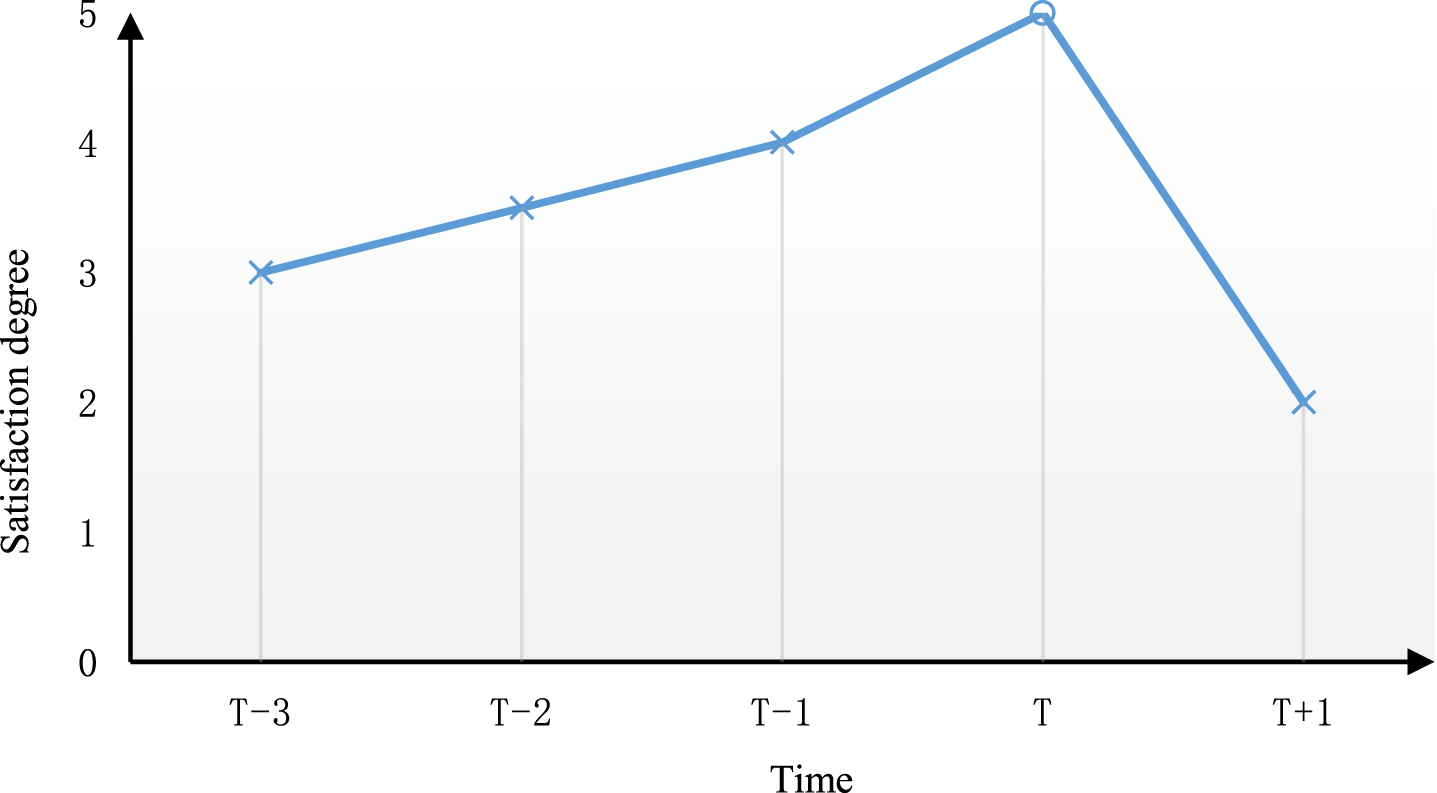
Dynamic changes in consumer interest.
Consumer decision-making is a complex and mul-level process, especially the consumer evaluation decision-making, which is even more difficult to describe. According to the Howard-Sheth model [29], a conceptual model of consumer product evaluation is proposed, as shown in Fig. 2. By collecting historical data of consumer individual for the rget product, other consumers who have social relationships with the consumer, and other consumers of homogeneous products, we extract the multidimensional correlation indexes of consumer individual, social relationships and homogeneous products, and construct CMCPEM which depicts the process of consumer product evaluation from three stages, and then predicts the development trend of interest. Based on the prediction results of CMCPEM, the consumer boring products are identified and different continuous marketing strategies are proposed.
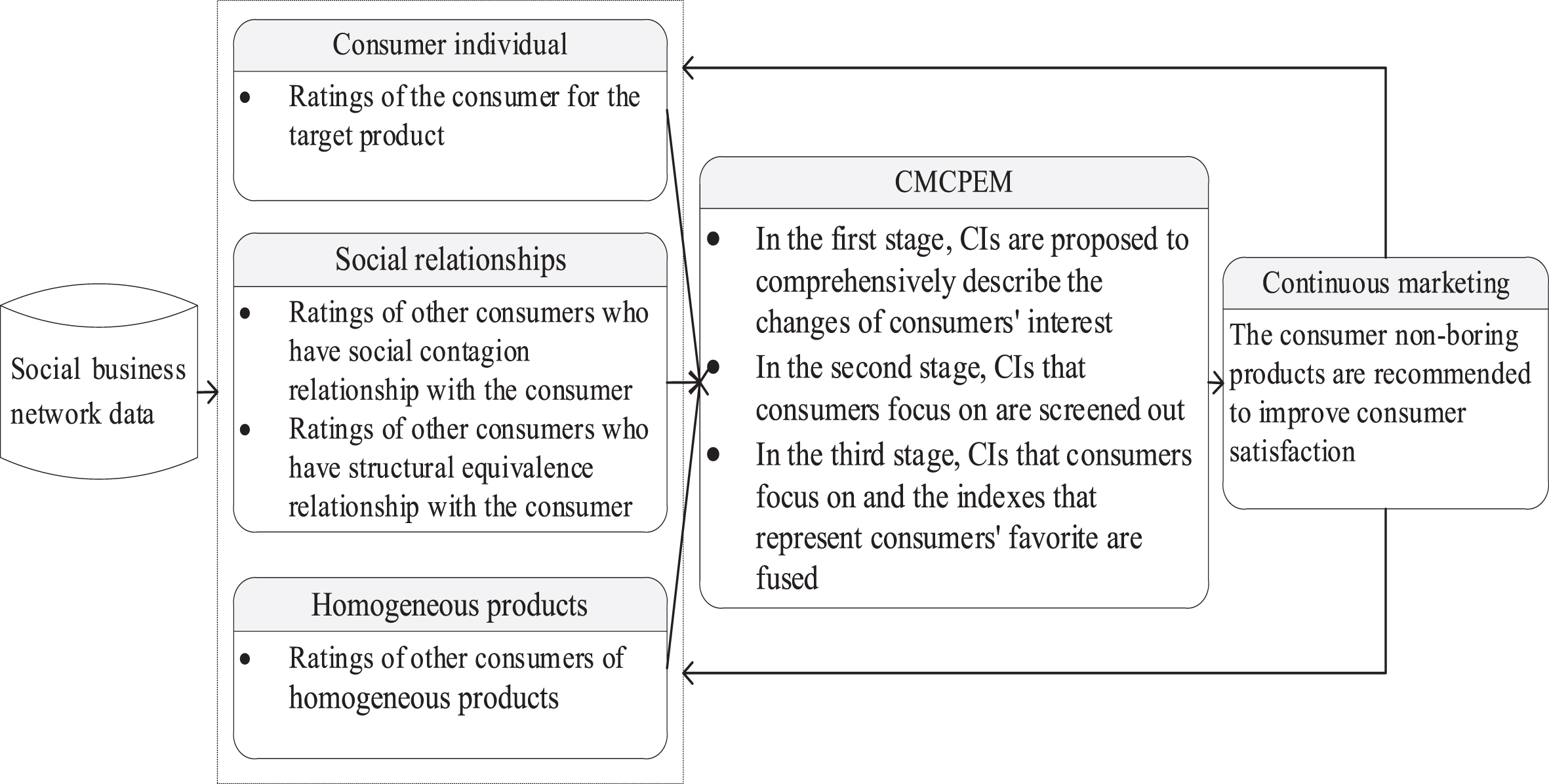
Conceptual model of consumer product evaluation.
Social contagion relationship
Under the influence of social contagion relationship, users imitate the behavior of their friends around them, making this behavior spread in social circles like infectious diseases. In terms of trust, the comments of family members or friends are more trustworthy, and their decision-making behavior can greatly affect the performance of consumers [30, 31]. In addition, the higher the frequency of interaction between friends, the higher their intimacy, and the more likely they are to have similar thinking, and thus affecting consumers’ decision-making behavior [32].
Figure 3 shows consumers with social contagion relationship, where consumers e and f are the common friends of consumers u and v. Consumers u and v form a triadic closure with friends e or f to establish a connection. The behavior information of friends e and f continues to spread through this structure, and consumers u and v gradually produce similar behavior with friends under constant learning or imitating.
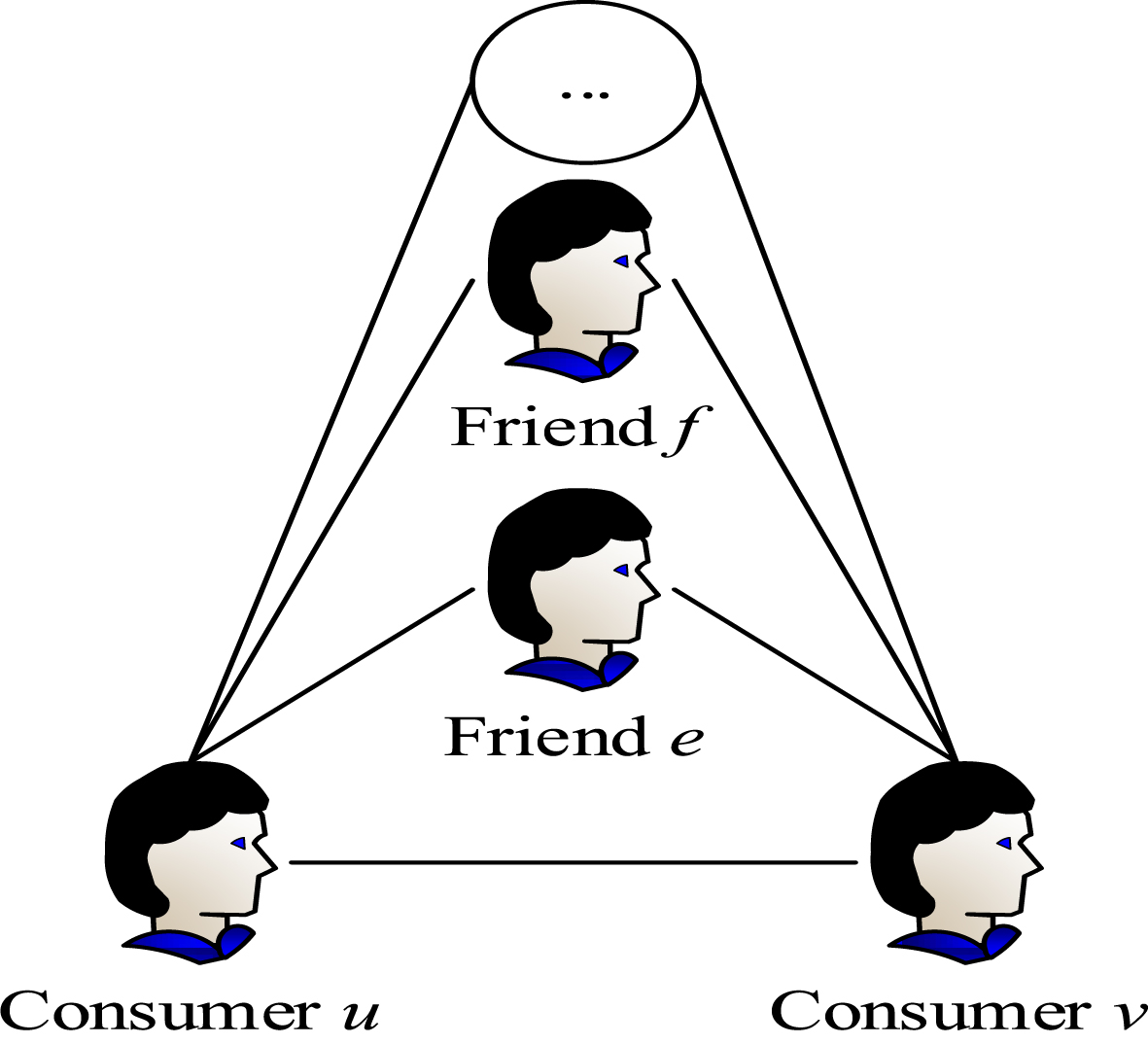
Consumers with social contagion relationship.
Consumers with structural equivalence relationship have stronger identification with each other, and they have similar cognition and behavior. Similar consumers in the same community have certain similarity in behavior path, behavior characteristics, and interest preferences due to their sense of belonging and convergence [33].
Figure 4 shows consumers with structural equivalence relationship, where u and v refer to consumers who have evaluated several products together such as p and q in the same community, but there is no friendship among them. Although they are not friends, they have evaluated the same or similar products for many times, so their inten a certn kind of products gradually becomes similar in the process of network evolution.

Consumers with structural equivalence relationship.
For consumers with a sense of belonging to the Internet, it is no doubt that they want to find effective reference comments from a large number of comments before making final decisions. Therefore, the reference value of products with homogeneous relationship is greater and more helpful for consumers to evaluate. When judging the target product, consumers always refer to the comments of homogeneous products [34, 35].
Figure 5 shows products with homogeneous relationship, where p1 and p2 belong to the same category of products, namely homogeneous products. Consumer u gives target product p2 similar evaluation on the basis of having evaluated homogeneous product p1.
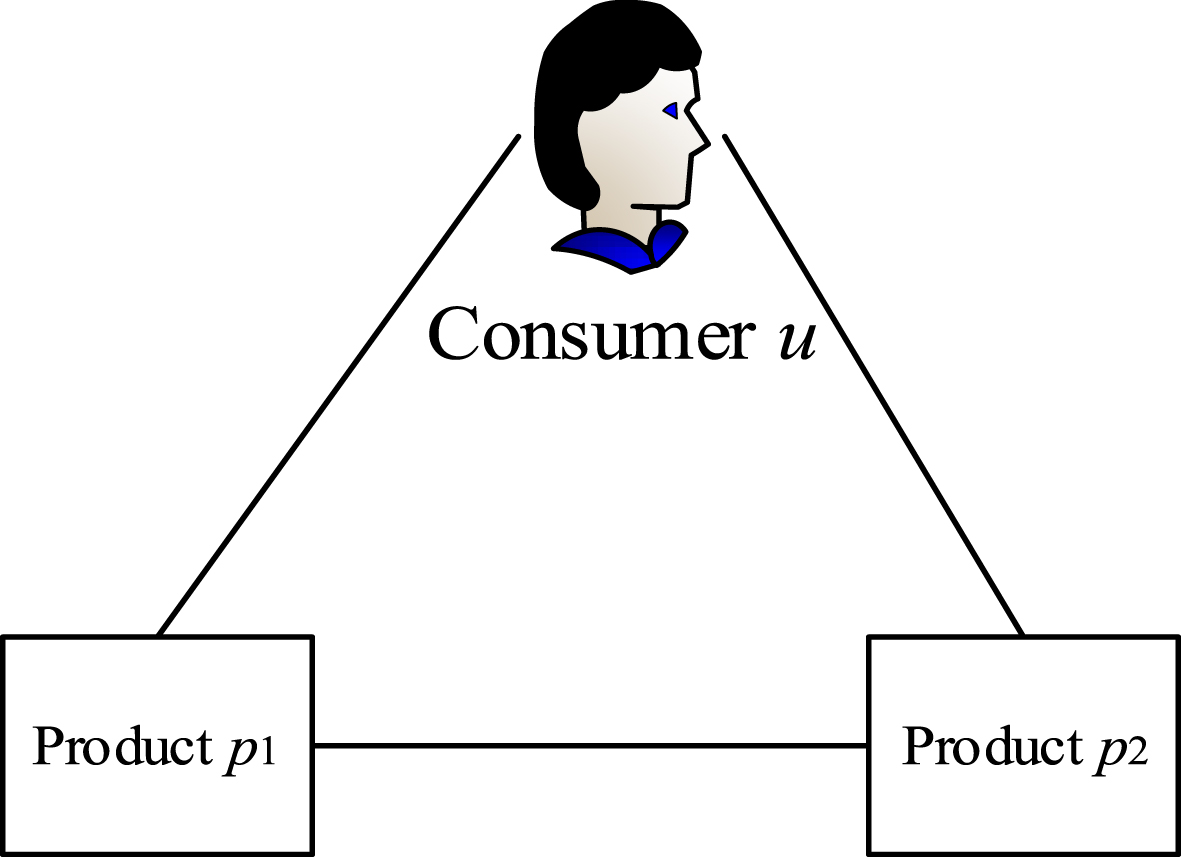
Products with homogenelationship.
According to the above analysis, we extract a correlation index set
Different types of correlation indexes
Different types of correlation indexes
Where, α (0.1 ⩽ α ⩽ 1) is the time coefficient, the larger the value of α is, the closer it is to the current time, and its specific value depends on the situation; i represents the dimension of the correlation indexes; T refers the time to judge whe it soring product, n represents the sample size.
This section discusses the architecture of CMCPEM, ch describes the consumer evaluation process from three stages. In CMCPEM, using different thods to integrate multi-dimensional correlation indexes can obtain CIs to enrich and expand available information and the introduction of J test can effectively filter out non-nested CIs that consumers focus on.
In order to reduce the external information needed to predict the changes in consumer interest and make full use of the existing information, this paper proposes CMCPEM considering the collaborative effect of various factors in the social business network. The framework of the model mainly includes three stages: (1) Multidimensional correlation indexes proposed from the dimensions of consumer individual, social relationships and homogeneous products are directly linearly, non-linearly, and indirectly fused, so as to propose CIs to describe the changes in consumer interest in the first stage; (2) In the second stage, J test in the non-nested model is used to screen out the non-nested CIs that consumers focus on; (3) In the third stage, CIs that consumers focus on and the indexes that represent consumers’ favorite for the target product are considered comprehensively, and the final decision result is obtained. Figure 6 shows the architecture of constructing CMCPEM.
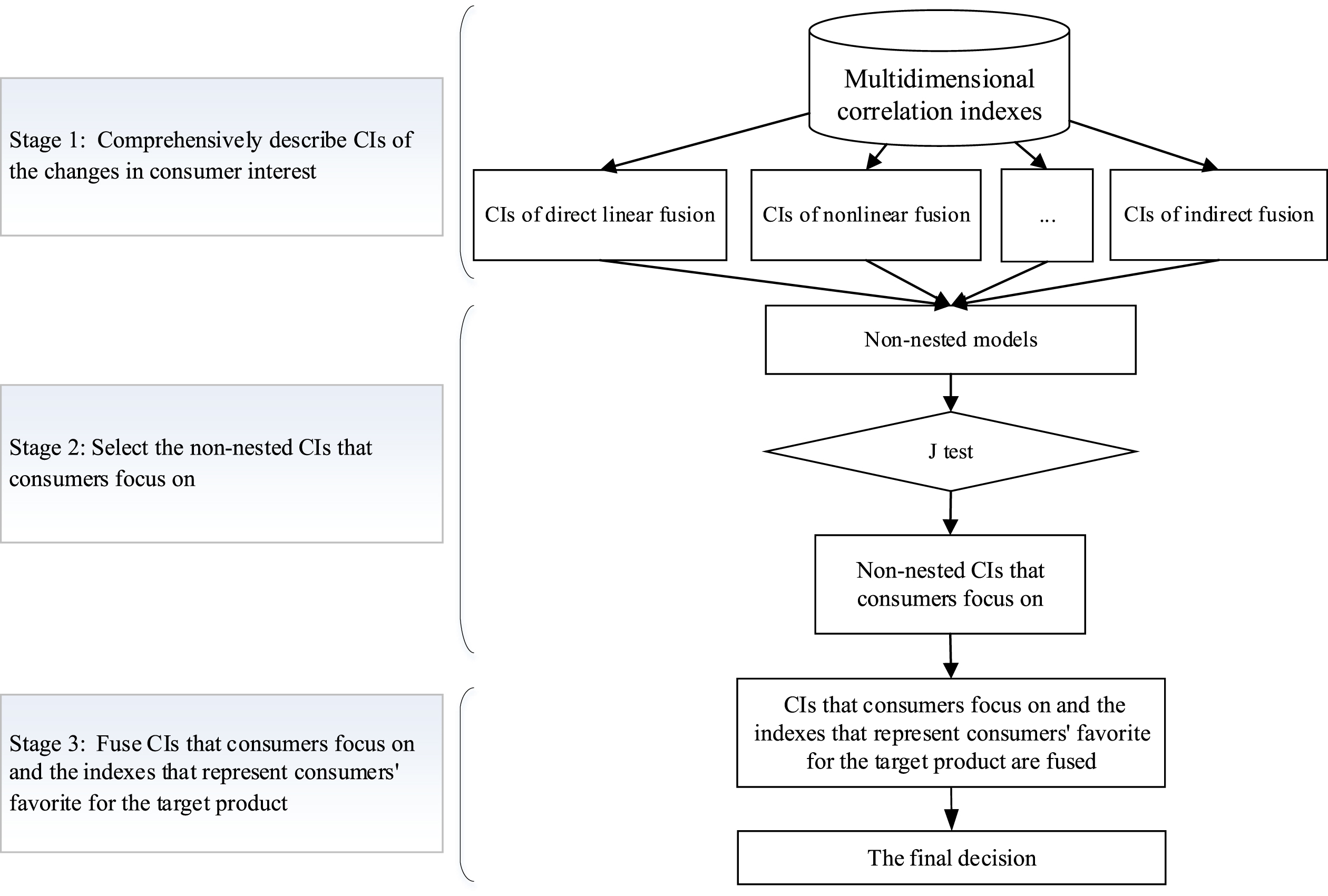
The architecture of CMCPEM.
The different kinds of correlation indexes in Table 1 are classified into three dimensions: consumer individual, social relationships and homogeneous products, and the multidimensional correlation indexes that can fully depict the changes in consumer interest are proposed. The multidimensional correlation indexes of consumer individual are defined as follows: when the consumer is evaluating a product, he/she not only refers to his/her own preferences for the target product and homogeneous products (i.e.
In CMCPEM, the first stage is to build CIs of consumer product evaluation: multidimensional correlation indexes are directly linearly, non-linearly, and indirectly fused. The various CIs are conducive to fully depicting the evolution of consumer interest and reducing the difference. According to different ways of fusion, 12 CIs of consumer product evaluation are generated, as shown in Table 2, where X is multidimensional correlation indexes set, y refers to the output of the model, a, b, c, d are constants, S (X) , P i , R (X p - c i ) , K (X i , X h ) are the kernel functions.
CIs set
CIs set
To describe the process of consumer product evaluation maccurately, we use J test in the non-nested model to screen out the non-nested CIs that con focus on in different dimensions. The selecting process of these indexes includes the constrtion othe non-nested model and the selection of the non-nested CIs by J test. The traditional test mhods of the non-nested model cannot directly judge the alternative hypothesis, and the mixed delclude too many explanatory variables that are difficult to estimate. Davidson and MacKinnon proposed J test to overcome the above shortcomings, that is, added the estimated value of unique explanatory variables of another alternative hypothesis into one alternative hypothesis, and then tested its significance [38, 39].
In this paper, for the correlation indexes of the ith dimension, the main idea of constructing the non-nested model and using J test to screen out the non-nested CIs that consumers focus on is as follows: first of all, a unitary linear regression model is established with a single compensation index as the independent variable and y as the dependent variable; what’s more, any two linear regression models are selected as the non-nested models and H i 1 and J test is conducted to select the supported H i 0 or H i 1; and then all the supported variables in H i 0 or H i 1 are screened out, which are the non-nested CIs that consumers focus on.
The specific inspection ideas of J test are as follows:
Step 1: Let f0 (y|data, βi0) be the assumed density der the null hypothesis H
i
0, and similarly define f1 (y|data, βi1). A comprehensive function of all densities is constructed as below,
Where, βi0, βi1 are the parameter vectors.
Step 2: Construct the null hypothesis H
i
0:
and the alternative hypothesis H
i
1:
Where, W i , Z i are the i th CI, and W i ≠ Z i , ɛi0, ɛi1 are random disturbance terms.
And the alternative model is set as below,
Step 3: In H
i
1, use the least square regression to get the estimated value
Step 4: In H
i
0, the least squares regression of y, W
i
and
Step 5: Exchange the roles of H
i
0 and H
i
1, repeat Steps (3) and (4), and get the estimated value
Step 6: Set the significance level to 0.05. If
The third stage is to comprehensively consider the fusion of the selected CIs and the indexes that represent consumers’ favorite for the target product, andobtain the final decision. Under the influence of multiple index variables, linear regression model can analyze the relationship of multiple variables more simply and stably, and improve the predccuracy. Therefore, in order to better describe the consumer’ evaluation process, direct linear fusion of the selected CIs that consumers focus on and the indexes that represent consumers’ favorite for the target product is used to get the decision results of whether consumers are interested in the product, as shown in Equation (7).
Where E is the set of the selected CIs that consumers focund
This section comprehensively verifies the performance of CMCPEM based on the real data of YELP website, and gives application recommendations for continuous marketing.
The data set
The experimental data of this paper comes from YELP website, which emphasizes social marketing and encourages the interaction between consumers. Consumers can rate stores, submit comments and exchange shopping experience on YELP website.
Online ratings are the most direct evaluation of online stores by consumers, which can reflect the degree of consumers’ preferences. They not only affect other consumers’ trust in the online stores, but also influence their purchasing behavior, and also are the best way to predict and explain consumers’ behavior. Therefore, we selected an online store with a large number of consumers’ registration and ratings, chose the seafood product in this online store as the target product and collected the ratings of all consumers who had evaluated the product in the online stores. A total of 1074 consumer data were effectively collected, and 41550 consumer data having social relationships with them were obtained on YELP website. The experiments were based on MATLAB. In each experiment, we randomly selected 80%sample as the training set and 20%sample as the test set. The time coefficient α was set as 0.9.
Comparison of model accuracy
Analyzing the effect of the selected CIs that consumers focus on
In the second stage of consumer decision-making, the selected CIs that consumers focus on contribute to accurately identifying the current interest preferences of consumers. In order to verify the effectiveness and necessity of these indexes and the effect of the time coefficient α on the model accuracy, the experiments with and without J test under different time coefficients were designed, and the mean-square error (MSE) of CMCPEM was compared.
It can be seen from Table 3 that under different time coefficients, the prediction accuracy of CMCPEM with J test is always significantly better than that without J test, which shows that the selected CIs with J test enhance the prediction accuracy of CMCPEM. In addition, it can be seen that when α = 0.9, whether J test exists or not, the MSE of CMCPEM is the smallest, so the time coefficient α of the proposed model is set to 0.9.
Comparison of the MSE of CMCPEM with and without J test
Comparison of the MSE of CMCPEM with and without J test
Figure 7 shows the MSE of CMCPEM with different time coefficients. With the increment of α, the MSE of the model decreases, which shows that the closer the time is, the higher the accuracy of prediction is. When α = 0.9, the MSE of the model reaches the minimum, which means that the prediction accuracy of the model is the best. Howeverwn α = 1, the MSE of the proposed model increases, indicating that consumers’ preferences fot consumer boring products deviate from the latest trend and show the outlier characteristics, which affects the prediction accuracy of the model. In order to improve the accuracy of the model, the trend of consumer preferences in the latest time should be considered.
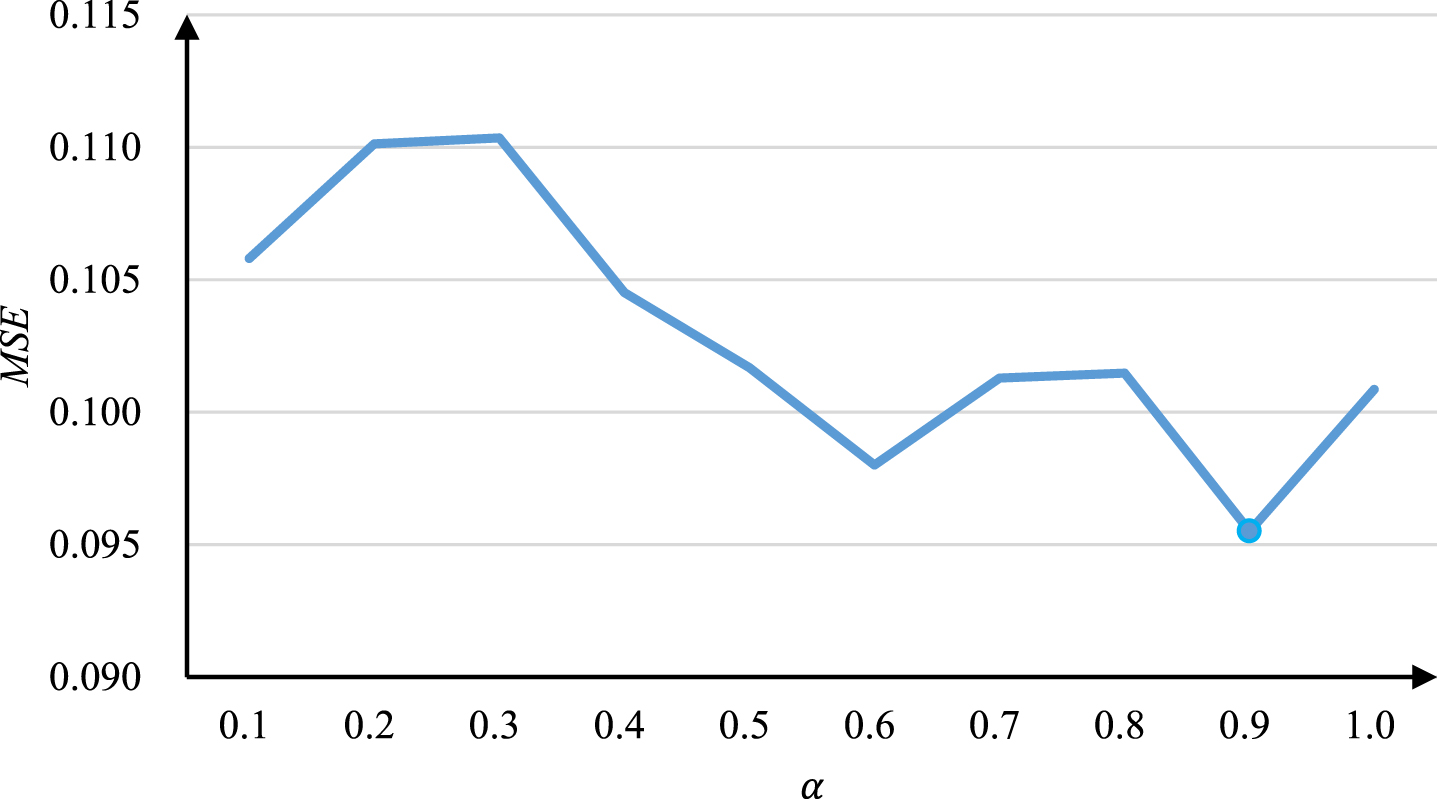
Sensitivity analysis of the time coefficient α.
In order to verify the effect of CMCPEM, the performance comparison experiments between the model and other similar data mining models in Table 2 were designed. In data mining models, multidimensional correlation indexes were used as the input of each model to directly predict the consumers’ ratings. The comparison results are shown in Table 4.
The MSE of data mining models and CMCPEM
The MSE of data mining models and CMCPEM
It can be seen from Table 4, compared with other data mining models, the MSE of CMCPEM is the lowest, which indicates that the prediction performance of the proposed model is better. It proves that the proposed model has certain practicability in predicting consumer interest, and also verifies that the fusion model has stronger generalization ability, which can effectively improve the prediction accuracy.
We define the products with ratings less than or equal to 2 as the consumer boring products, which means that consumer interest in the products decreases; on the contrary, the products with ratings greater than or equal to 3 are the consumer non-boring products, which implies that consumer interest in the products increases. In order to accurately judge the effectiveness of CMCPEM on identifying the consumer boring products, the precision and recall measures are adopted, as shown in the following:
Through the precision and recall measures, we can see that the model has a high precision, which shows that CMCPEM can accurately identify the consumer boring products; and the higher recall also proves that CMCPEM can comprehensively identify the consumer boring products. Therefore, the superior precision and recall prove that the proposedodel has the validity and universality in identifying the consumer boring products. Accordingly, on the basis of prediction results of CMCPEM, the new consumer non-boring products should be recommended to consumers, which can stimulate consumers’ new purchasing potential, increase enterprise revenue, and realize continuous marketing.
Conclusion and future works
In the social business platform, consumer interest is constantly changing. Continuous marketing that considers the fluctuation of consumer interest can fully explore the consumer purchasing potential by continually recommending consumer non-boring products. However, continuous marketing faces CSPFU, that is, the consumer data is huge, but the directly available information is insufficient. The traditional interest recommendation often focuses on whether consumers are interested, ignores the dynamic changes in consumer interest, overlooks that consumer interest in the products cannot increase indefinitely and consumers will produce tired psychology. Therefore, the existing interest recommendation algorithms cannot overcome CSPFU, and are unable to accurately describe the decision-making mechanism of consumer evaluation, and cannot obtain satisfactory results of recommendation. In order to reduce the external information needed to predict the changes in consumer interest, fully expand the existing information, accurately grasp the trend of consumer interest, and achieve accurate and continuous marketing, this paper comprehensively considers the correlation factors such as consumer individual, social relationships and homogeneous products, and proposes CMCPEM, which describes the decision-making mechanism of consumer evaluation. First of all, three kinds of multidimensional correlation indexes are proposed, which represent the consumer’s preferences for the target product, preferences of other consumers who have social relationships with the consumer for the target product, and other consumers’ preferences of homogeneous products. Secondly, different fusion methods are adopted to generate CIs of consumer product evaluation, and J test in the non-nested model is used to screen out the non-nested CIs that consumers focus on. Last but not least, the final decision is predicted by considering CIs that consumers focus on and the indexes that represent consumers’ favorite for the target product.
The experimental results with YELP data prove the validity and efficiency of the proposed CMCPEM in overcoming CSPFU. Therefore, CMCPEM in this paper can effectively identify the consumer boring products, and then help enterprises take full advantage of the decision-making mechanism of consumer evaluation in the social business platform to successfully launch the continuous marketing campaign.
Although CMCPEM can accurately predict the changes in consumer interest, there are still some deficiencies, which need to be improved in the future research. For example, in the screening process of CIs, it takes a lot of time to screen out the non-nested CIs that consumers focus on. In the future, we hope to find a new method to simplify the screening process of these indexes. In addition, it ignores the influence of the consumers’ online comments, and does not make specific emotional analysis on consumers’ comments. In the future research, we will analyze the consumers’ comments and explore the consumers’ emotional attitude towards the target product. The model also has some limitations in application. It is only suitable for continuous marketing of fast moving consumer goods (e.g., food, beverage, tobacco, etc.) in a short period of time, but does not apply to continuous marketing of consumer durables (e.g., refrigerators, television sets, bicycles, etc.) with long purchase intervals.
Footnotes
Acknowledgments
This work was supported by the Chinese National Natural Science Foundation (No. 71871135).