



Abstract
The partition dimension is a variant of metric dimension in graphs. It has arising applications in the fields of network designing, robot navigation, pattern recognition and image processing. Let G (V (G) , E (G)) be a connected graph and Γ = {P1, P2, …, P m } be an ordered m-partition of V (G). The partition representation of vertex v with respect to Γ is an m-vector r (v|Γ) = (d (v, P1) , d (v, P2) , …, d (v, P m )), where d (v, P) = min {d (v, x) |x ∈ P} is the distance between v and P. If the m-vectors r (v|Γ) differ in at least 2 positions for all v ∈ V (G), then the m-partition is called a 2-partition generator of G. A 2-partition generator of G with minimum cardinality is called a 2-partition basis of G and its cardinality is known as the 2-partition dimension of G. Circulant graphs outperform other network topologies due to their low message delay, high connectivity and survivability, therefore are widely used in telecommunication networks, computer networks, parallel processing systems and social networks. In this paper, we computed partition dimension of circulant graphs C n (1, 2) for n ≡ 2 (mod 4), n ≥ 18 and hence corrected the result given by Salman et al. [Acta Math. Sin. Engl. Ser. 2012, 28, 1851-1864]. We further computed the 2-partition dimension of C n (1, 2) for n ≥ 6.
Introduction and preliminaries
Ever growing telecommunication networks sizes make it difficult to get an exact map of worldwide network so local measurements are made on smaller subsets of networks to evaluate the actual network and hence optimize the computational cost. A subset of nodes with smallest cardinality such that each node in the network is at a unique distance from the nodes in the subset helps us to identify the whole network. The process is same as computing the metric dimension of the graph and its generalized version called the partition dimension. A network topology is the graphic description of a network, connecting various nodes through lines of connection. Network topology designs play a key role in network planning. Circulant graphs outperform other network topologies due to their low message delay, high connectivity and survivability, therefore are widely used in telecommunication networks, computer networks, parallel processing systems and social networks [8, 35]. Furthermore, the applications of fuzzy graphs and graph labeling can be seen in computer science, decision making, telecommunication networks, parallel processing and social networks related problems (see [2–6, 49]).
Slater and Melter et al. presented the notion of metric dimension of graphs independently in [46] and [23] respectively. Its application can be seen in robotics [30], chemistry [10] and optimization [44]. In [12], Chartrand et al. introduced a variant of metric dimension of graph which is called partition dimension of graph. In [19], Garey et al. proved that the computation of metric dimension is an NP-hard problem which implies that the problem of finding the partition dimension is also NP-hard.
Consider a connected graph G of order n with the vertex set V (G) and edge set E (G). If all the vertices of a graph have degree r, where 0 ≤ r ≤ n - 1, then it is known as a r-regular graph. The distance d (u, v) between the vertices is the length of a shortest path connecting the two vertices u, v ∈ V (G). The distance between a vertex v and a subset P of V (G) is d (v, P) = min {d (v, x) |x ∈ P} and neighborhood of v in G is N (v) = {u ∈ V (G) |uv ∈ E (G)}. For an ordered set Ω = {v1, v2, …, v m } of vertices, the representation of a vertex v with respect to Ω is an m-vector r (v|Ω) = (d (v, v1) , d (v, v2) , …, d (v, v m )). If the m-vectors r (v|Ω) are distinct, for all v ∈ V (G), then Ω is called a resolving set of G. The minimum value of m for which there is a resolving set is called the metric dimension of G, denoted by dim (G). Let Γ = {P1, P2, …, P m } be an ordered m-partition of the vertex set of a connected graph G. The partition representation of vertex v with respect to Γ is an m-vector r (v|Γ) = (d (v, P1) , d (v, P2) , …, d (v, P m )). If the m-vectors r (v|Γ) are distinct, for all v ∈ V (G), then m-partition is called a resolving partition of G. The minimum value of m for which there is a resolving m-partition is called the partition dimension of G, denoted by pd (G). In [12], Chartrand et al. compared metric dimension and partition dimension of graphs and also characterized all the graphs with partition dimension 2 or n. The following results are important for us.
pd (G) ≤ dim(G) +1; pd (G) =2 if and only if G = P
n
where P
n
is a path of order n ≥ 2; pd (G) = n if and only if G = K
n
where K
n
is the complete graph.
In [13], Dewi et al. calculated the partition dimension of the lollipop graph and the Jahangir graph. In [18], Fredlina et al. computed the partition dimension of homogeneous caterpillars and homogeneous banana trees. In [17], Fernau et al. discussed the partition dimension of unicyclic graphs. The partition dimension of fullerene graphs, cycle books graph and nanotubes has been studied in [34], [43] and [45] respectively. For more results and discussion on partition dimension of graphs, we refer to articles [1, 26].
In [16], Estrado - Moreno et al. generalized the notion of metric dimension to k-metric dimension which is defined as follows: Let Ω = {v1, v2, …, v m } be an ordered set of vertices, the representation of a vertex v with respect to Ω is an m-vector r (v|Ω) = (d (v, v1) , d (v, v2) , …, d (v, v m )). If the m-vectors r (v|Ω) differ in at least k coordinates for all v ∈ V (G), then Ω is called a k-metric generator for G. A metric generator of minimum cardinality is called a k-metric basis and its cardinality the k-metric dimension of G, denoted by dim k (G). For k = 1, it is metric dimension of G and for k = 2, it is known as fault tolerant metric dimension of G. The fault tolerant dimension of a graph was first introduced by Hernando et al. in [25]. For more results and discussion on k-metric dimension, we refer to articles [29, 47].
In [15], Estrado - Moreno further generalized the notion of partition dimension of graph to k-partition dimension of graph. Let Γ = {P1, P2, …, P
m
} be an ordered m-partition of V (G). The partition representation of vertex v with respect to Γ is an m-vector r (v|Γ) = (d (v, P1) , d (v, P2) , …, d (v, P
m
)). If the m-vectors r (v|Γ) differ in at least k coordinates for all v ∈ V (G), then Γ is called a k-partition generator of G. A partition generator of minimum cardinality is called a k-partition basis and its cardinality the k-partition dimension of G, denoted by pd
k
(G). For k = 2, 2-partition dimension for certain classes of graphs have been discussed in [7] and [11]. For u, v ∈ V (G), let D
G
(u, v) = {w ∈ G : d (w, u) ≠ d (w, v)} and
In this paper, we discuss the special class of circulant graphs C n (1, 2, …, t) which consists of vertices v0, v1, …, vn-1 and the connection set {1, 2, …, t} for 1≤ t ≤ ⌊ n/2 ⌋. The circulant graph C n (1, 2, …, t) is formed by cyclically arranging the vertices in such a way that, for (0 ≤ i ≤ n - 1), join v i to vi+k and vi-k, where 1 ≤ k ≤ t. The graph C6 (1, 2) is shown in Figure 1. For v i and v j in the vertex set of C n (1, 2, …, t), where 0 ≤ i < j < n, d (v i , v j ) is defined in [33] as follows:
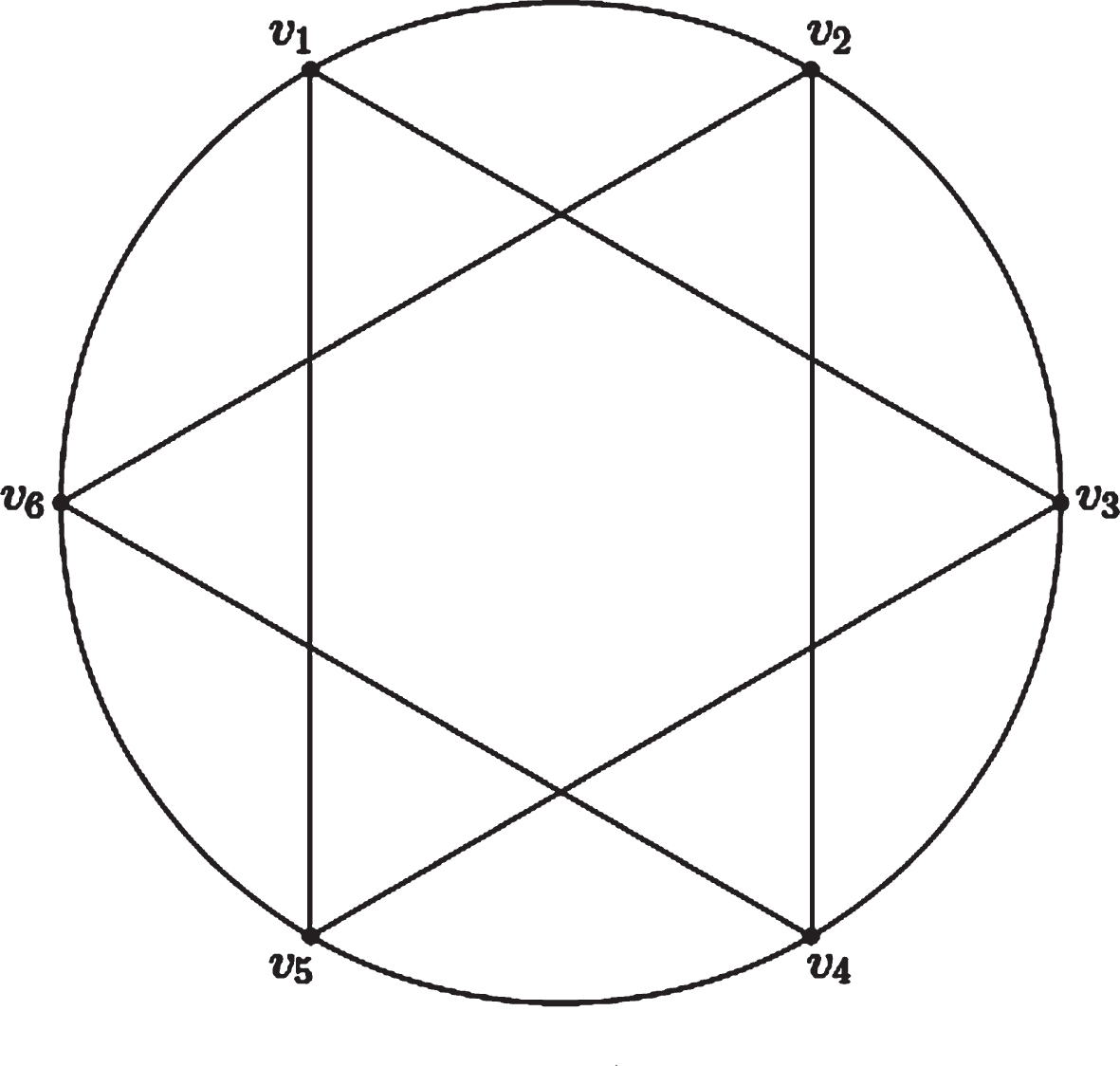
The circulant graph C6 (1, 2).
The discussion on metric dimension of circulant graphs can be seen in [20, 42].
The rest of the paper is structured as follows. In Section 2, we give known results of circulant graphs and compute the partition dimension of circulant graphs C n (1, 2). In Section 3, we compute the 2-partition dimension of circulant graphs C n (1, 2).
In this section, partition dimension is discussed for circulant graphs C n (1, 2). Many authors have discussed the partition dimension of circulant graphs in [21, 42]. Javaid et al. in [28] discussed the partition of circulant graphs with connection sets {1, 3} and {1, 4}. Salman et al. in [42] proved the following theorem.
Grigorious et al. in [22] disproved the claims in Theorem 2 for n ≡ 0 (mod 4) and n ≥ 12. Their result is stated in Theorem 2.
In the following theorem, we computed the partition dimension of C n (1, 2) for n ≡ 2 (mod 4) and n ≥ 18 and hence corrected the result given in Theorem 2.
Partition representations of the vertices for C
n
(1, 2)
Partition representations of the vertices for C n (1, 2)
It is easy to check that all the partition representations are distinct. This shows that pd (C n (1, 2)) ≤3 for n ≡ 2 (mod 4) and n ≥ 18. Since C n (1, 2) is not a path so Proposition 1 implies that pd (C n (1, 2)) ≥3 for n ≡ 2 (mod 4) and n ≥ 18, which completes the proof.■
Finally, we conclude the above discussion for the partition dimension of C n (1, 2) in the following theorem for n ≥ 6.
The partition dimension of circulant graphs C n (1, 2) has been discussed by Salman et al. in [42] and by Grigorious et al. in [22]. In this section firstly, we will prove that the upper bound of pd2 (C n (1, 2)) is 4 and elaborate it with an example. Secondly, we will compute the 2-partition dimension of the circulant graphs C n (1, 2) for n ≠ 11. Finally, it will be shown that the pd2 (C11 (1, 2)) is 5.
All the vertices of N (v
t
) are in the same set P1 or P2. Assume that N (v
t
) ⊆ P1, then r (v
t
|Γ) = (0, a0, b0) and for u
j
∈ N (v
t
), r (u
j
|Γ) = (0, a
j
, b
j
). Hence, a0 - 1 ≤ a1, a2, a3, a4 ≤ a0 + 1. So by Pigeonhole principle at least two of the vertices v
t
and u
j
will have the same distances from P1 and P2. This leads to a contradiction. Assume that N (v
t
) ⊆ P2, then r (v
t
|Γ) = (0, 1, b0) and for u
j
∈ N (v
t
), r (u
j
|Γ) = (1, 0, b
j
). This clearly shows that the partition representations are not distinct at two places. If three vertices from the set N (v
t
) are in P1 or P2. Let u
p
, u
q
, u
r
∈ N (v
t
) ∩ P1 and u
t
∈ N (v
t
) ∩ P2 then r (v
t
|Γ) = (0, 1, b0), r (u
p
|Γ) = (0, a1, b1), r (u
q
|Γ) = (0, a2, b2) and r (u
r
|Γ) = (0, a3, b3) In this case we have, 1 ≤ a1, a2, a3 ≤ 2. Again by Pigeonhole principle at least two of the vertices v
t
, u
p
, u
q
and u
r
will have the same distances from P1 and P2. This leads to a contradiction. Assume that u
p
∈ N (v
t
) ∩ P1 and u
q
, u
r
, u
t
∈ N (v
t
) ∩ P2 then r (v
t
|Γ) = (0, 1, b0) , r (u
p
|Γ) = (0, a1, b1), r (u
q
|Γ) = (1, 0, b2) , r (u
r
|Γ) = (1, 0, b3) and r (u
t
|Γ) = (1, 0, b4). Clearly representations of u
q
, u
r
and u
t
are same at two places. This leads to a contradiction. If two vertices from the set N (v
t
) are in P1 and two in P2. Let u
p
, u
q
∈ N (v
t
) ∩ P1 and u
r
, u
t
∈ N (v
t
) ∩ P2 then r (v
t
|Γ) = (0, 1, b0) , r (u
p
|Γ) = (0, a1, b1), r (u
q
|Γ) = (0, a2, b2) , r (u
r
|Γ) = (1, 0, b3) and r (u
t
|Γ) = (1, 0, b4). Clearly representations of u
r
and u
t
are same at two places. This leads to a contradiction. Hence, pd2 (C
n
(1, 2)) ≥4 for n ≥ 6.■
The following example is presented in support of the above result.
Example 3.2.
Consider a circulant graph C6 (1, 2), shown in Figure 1. Let Γ = {P1, P2, P3, P4} be a partition of V (C6 (1, 2)), where, P1 = {v1, v3, v5} , P2 = {v2}, P3 = {v4} and P4 = {v6}. Then the representations of vertices with respect to Γ are: r (v1|Γ) = (0, 1, 2, 1), r (v2|Γ) = (1, 0, 1, 1), r (v3|Γ) = (0, 1, 1, 2), r (v4|Γ) = (1, 1, 0, 1), r (v5|Γ) = (0, 2, 1, 1) and r (v6|Γ) = (1, 1, 1, 0). It can easily be seen from the partition representations of vertices of C6 (1, 2), that Γ is a 2-partition generator.
In the following theorem, we compute the pd2 (C n (1, 2)) for n ≥ 6 and n ≠ 11.
(For n = 6α and α ≥ 1). Let P1 = {v1, v3, …, v6α-1} , P2 = {v2, v4, …, v2α}, P3 = {v2α+2, v2α+4, …, v4α} and P4 = {v4α+2, v4α+4, …, v6α}. The r (v
t
|Γ) are given in Table 2. (For n = 6α + 1 and α ≥ 1). Let P1 = {v1, v3, …, v6α-1} , P2 = {v2, v4, …, v2α}, P3 = {v2α+2, v2α+4, …, v4α} and P4 = {v4α+2, v4α+4, …, v6α, v6α+1}. The r (v
t
|Γ) are given in Table 3. (For n = 6α + 2 and α ≥ 1). Let P1 = {v1, v3, …, v6α-3, v6α}, P2 = {v4α, v4α+2, …, v6α-2, v6α-1}, P3 = {v2, v4, …, v2(α-1), v6α+1, v6α+2} and P4 = {v2α, v2α+2, …, v4α-2)}. The r (v
t
|Γ) are given in Table 4. (For n = 6α + 3 and α ≥ 1). Let P1 = {v1, v2, v3, v6, v8, …, v2α, v2α+2, v2α+3, v2α+4, v2α+7, v2α+9, …v4α+1, v4α+3, v4α+4, v4α+5, v4α+8, v4α+10, …, v6α+2}, P2 = {v4, v5, v7, …, v2α+1}, P3 = {v2α+5, v2α+6, v2α+8 … , v4α+2} and P4 = {v4α+6, v4α+7, v4α+9, …, v6α+3} The r (v
t
|Γ) are given in Table 5. (For n = 6α + 4 and α ≥ 1). The partition Γ for α ∈ {1, 2, 3, 4, 5} are given in Table 6 which clearly proves that Γ is the 2-partition generator. For α ≥ 6, we have the following sub-cases: (For n = 16 + 24p and p ≥ 1) Let P1 = {v1, v2, v3, v5, v7, …, v6p+5, vn-6p-1, vn-6p+1, …, vn-1},
(For n = 22 + 24p and p ≥ 1) Let P1 = {v1, v2, v3, v5, v7, …, v6p+5, vn-6p-3, vn-6p-1, …, vn-1}, P2 = {v4, v6, v8, …, v6p+4, v6p+6, v6p+7, v6p+8, v6p+10, v6p+12, …, v12p+10}, P3 = {v6p+9, v6p+11, …, v12p+9, v12p+11, v12p+12, v12p+13, v12p+15, v12p+17, …, vn-6p-5} and P4 = {v12p+14, v12p+16, …, v
n
}. The r (v
t
|Γ) are given in Table 8. (For n = 28 + 24p and p ≥ 1) Let P1 = {v1, v2, v3, v5, v7, …, v6p+7, vn-6p-3, vn-6p-1, …, vn-1}, P2 = {v4, v6, …, v6p+6, v6p+8, v6p+9, P3 = {v6p+11, v6p+13, …, v12p+13, v12p+15, v12p+16, v12p+17, v12p+19, v12p+21, …, v18p+21} and P4 = {v12p+18, v12p+20, …, v18p+20, v18p+22, v18p+23, v18p+24, v18p+26, v18p+28, …, v
n
}. The r (v
t
|Γ) are given in Table 9. (For n = 34 + 24p and p ≥ 1) Let P1 = {v1, v2, v3, v5, v7, …, v6p+9, vn-6p-5, vn-6p-3, …, vn-1},
P3 = {v6p+11, v6p+13, …, v34p+11} and
The r (v
t
|Γ) are given in Table 10. (For n = 6α + 5 and α ≥ 2). Let P1 = {v1, v2, v3, v6, v8, …, v2α+4, v2α+7, v2α+9, …, v4α+3, v4α+5, v4α+6, v4α+7, v4α+10, v4α+12, …, v6α+4}, P2 = {v4, v5, v7, …, v2α+3}, P3 = {v2α+5, v2α+6, v2α+8, …, v4α+4} and P4 = {v4α+8, v4α+9, v4α+11, …, v6α+5}. The r (v
t
|Γ) are given in Table 11. It is clear from Table 2-11 that Γ is a 2-resolving generator of C
n
(1, 2) for n ≥ 6, n ≠ 11, therefore, pd2 (C
n
(1, 2)) ≤4 for n ≥ 6, n ≠ 11. Lemma 3 implies that pd2 (C
n
(1, 2)) ≥4 for n ≥ 6. This establishes our claim.■
Representation of v
t
for n = 6α
Representation of v t for n = 6α
Representation of v t for n = 6α + 1
Representation of v t for n = 6α + 2
Representation of v t for n = 6α + 3
Partitions for n = 6α + 4 and α = 1, 2, 3, 4, 5
Representation of v t for n = 16 + 24p and p ≥ 1
Representation of v t for n = 22 + 24p and p ≥ 1
Representation of v t for n = 28 + 24p and p ≥ 1
Representation of v t for n = 34 + 24p and p ≥ 1
Representation of v t for n = 6α + 5
Now the only case left is C11 (1, 2). To prove its 2-partition dimension, we first give an important result on C11 (1, 2).
If |P
i
|=1 for some 1 ≤ i ≤ 4, then d (v, P
i
) =3 for exactly two v ∈ V (C11 (1, 2)). If |P
i
|=2 for some 1 ≤ i ≤ 4, then d (v, P
i
) =3 for at most one v ∈ V (C11 (1, 2)). If |P
i
|≥3 for some 1 ≤ i ≤ 4, then d (v, P
i
) ≤2 for all v ∈ V (C11 (1, 2)).
If P
i
= {v
j
} for some 1 ≤ i ≤ 4, then d (vj+1, P
i
) = d (vj+2, P
i
) = d (vj-1, P
i
) = d (vj-2, P
i
) =1 and d (vj+3, P
i
) = d (vj+4, P
i
) = d (vj-3, P
i
) = d (vj-4, P
i
) =2. Hence exactly two vertices are left which are at distance three from v
j
, namely vj+5 and vj-5. If |P
i
| = {vj-1, v
j
} containing two consecutive vertices of V (C11 (1, 2)), then there is only one vertex namely, vj+5 at distance three from P
i
. In all other cases distance would be less than three. The result follows from part (ii) as |P
i
|≥3 then no vertex would be at distance three from P
i
.■
In the next theorem, we compute the 2-partition dimension of C11 (1, 2).
It is easy to check that Γ = {P1, P2, P3, P4, P5} of V (C11 (1, 2)) where P1 = {v1, v2, v3, v4}, P2 = {v5, v6, v7} , P3 = {v8} , P4 = {v9, v11} and P5 = {v10} is a 2-partition generator of C11 (1, 2).
By Lemma 3 we know that pd2 (C11 (1, 2)) ≥4. We only need to show that pd2 (C11 (1, 2)) ≠4. Assume that pd2 (C11 (1, 2)) =4. Let Γ = {P1, P2, P3, P4} be a 2-partition basis of V (C11 (1, 2)). If we take |P1| ≥ |P2| ≥ |P3| ≥ |P4|, then P1 will have at least three vertices. i.e. |P1|≥3.
Let v
t
∈ V (C11 (1, 2)) then r (v
t
|Γ) = (a
i
, b
i
, c
i
, d
i
) where a
i
, b
i
, c
i
, and d
i
are the distances of v
t
from P1, P2, P3 and P4 respectively. When |P1|=8, |P2| = |P3| = |P4|=1. Here Lemma 3 implies that 0 ≤ a
i
≤ 2 and 1 ≤ b
i
, c
i
, d
i
≤ 3. Lemma 3 also implies that exactly two b
i
, two c
i
and two d
i
have value 3. The seven out of eight representations of vertices in P1 can be chosen as follows: (0, 1, 1, 1) , (0, 1, 2, 2) , (0, 1, 3, 3) , (0, 2, 2, 1), (0, 2, 1, 2), (0, 3, 3, 2) and (0, 3, 2, 3). But the representation of 8
th
vertex cannot be chosen in a way that make all representations distinct in at least two places. This leads to a contradiction. When |P1|=7, |P2|=2, |P3| = |P4|=1. Here Lemma 3 implies that 0 ≤ a
i
≤ 2 and 1 ≤ b
i
, c
i
, d
i
≤ 3 with at most one b
i
can be 3. Lemma 3 also implies that exactly two c
i
and two d
i
have value 3. The six out of seven representations of vertices in P1 can be chosen as follows: (0, 1, 1, 1) , (0, 1, 2, 2) , (0, 1, 3, 3), (0, 2, 2, 1), (0, 2, 1, 2) and (0, 3, 3, 2). But the representation of 7
th
vertex cannot be chosen in a way that make all representations distinct in at least two places. This leads to a contradiction. When |P1|=6. |P2|=3, |P3| = |P4|=1. Here Lemma 3 implies that 0 ≤ a
i
, b
i
≤ 2 and 1 ≤ c
i
, d
i
≤ 3. Lemma 3 also implies that exactly two c
i
and two d
i
have value 3. The five out of six representations of vertices in P1 can be chosen as follows: (0, 1, 1, 1) , (0, 1, 2, 2) , (0, 1, 3, 3), (0, 2, 2, 1) and (0, 2, 1, 2). But the representation of 6
th
vertex cannot be chosen in a way that make all representations distinct in at least two places. This leads to a contradic-tion. |P2|=2, |P3|=2, |P4|=1. This case is similar to Case 3.1. When |P1|=5. |P2|=3, |P3|=2, |P4|=1. Here Lemma 3 implies that 0 ≤ a
i
, b
i
≤ 2 and 1 ≤ c
i
, d
i
≤ 3. Lemma 3 also implies that at most one c
i
and exactly two d
i
have value 3. The four out of five representations of vertices in P1 can be chosen from one of the following sets of representations: {(0, 1, 1, 1) , (0, 1, 2, 2) , (0, 2, 2, 1) , (0, 2, 1, 2)} or {(0, 1, 1, 1) , (0, 1, 2, 2) , (0, 2, 1, 2) , (0, 2, 3, 1)} or {(0, 1, 1, 1) , (0, 1, 3, 2) , (0, 1, 2, 3) , (0, 2, 1, 3)}. Now the 5
th
vertex cannot be chosen in a way that make all representations distinct in at least two places. This leads to a contradiction. |P2|=4, |P3| = |P4|=1. This case is similar to Case 4.1. |P2|=2, |P3|=2, |P4|=2. This case is also similar to Case 4.1. When |P1|=4. |P2|=4, |P3|=2, |P4|=1. Here Lemma 3 implies that 0 ≤ a
i
, b
i
≤ 2 and 1 ≤ c
i
, d
i
≤ 3. Lemma 3 also implies that at most one c
i
and exactly two d
i
have value 3. The four representations of vertices in P1 can be chosen from one of the following sets of representations: {(0, 1, 1, 1) , (0, 1, 2, 2) , (0, 2, 2, 1) , (0, 2, 1, 2)} or {(0, 1, 1, 1) , (0, 1, 2, 2) , (0, 2, 1, 2) , (0, 2, 3, 1)} or {(0, 1, 1, 1) , (0, 1, 3, 2) , (0, 1, 2, 3) , (0, 2, 1, 3)}. Now the representations of vertices in P2 cannot be chosen in a way that make all representations distinct in at least two places. This leads to a contradiction. |P2|=3, |P3|=3, |P4|=1. This case is similar to Case 5.1. |P2|=3, |P3|=3, |P4|=2. This case is also similar to Case 5.1. When |P1|=3, |P2|=3, |P3|=3, |P4|=2. Here Lemma 3 implies that 0 ≤ a
i
, b
i
, c
i
, ≤ 2 and 1 ≤ d
i
≤ 3. Lemma 3 also implies that at most one d
i
has value 3. The three representations of vertices in P1 can be chosen from one of the following sets of representations: {(0, 2, 1, 3) , (0, 1, 2, 1) , (0, 1, 1, 2)} or {(0, 1, 1, 1) , (0, 1, 2, 2) , (0, 2, 2, 1)} or {(0, 1, 1, 1) , (0, 1, 2, 2) , (0, 2, 1, 2)} or {(0, 1, 1, 1) , (0, 2, 1, 3) , (0, 1, 2, 2)} or {(0, 1, 2, 2) , (0, 2, 2, 1) , (0, 2, 1, 2)}. If we consider the first set then P4 coordinate of the representation can only be 3 if vertices in P4 are consecutive. But then representations of vertices in P2 cannot be chosen in a way that make all representations distinct in at least two places. This leads to a contradiction. Similar arguments can be given for other sets.
Thus in all the cases we proved that pd2 (C11 (1, 2)) ≠4. Hence pd2 (C11 (1, 2)) =5.■
Finally, we conclude the above discussion for the 2-partition dimension of C n (1, 2) in the following theorem for n ≥ 6.
In this paper, we computed partition dimension of circulant graphs C n (1, 2) for n ≡ 2 (mod 4), n ≥ 18 and hence corrected the result given by Salman et al. in [42]. Further, it is proved that 2-partition dimension of C n (1, 2) for n ≥ 6, n ≠ 11 is 4 and for n = 11 it is 5. Hence the partition dimension and 2-partition dimension of C n (1, 2) for n ≥ 6 does not dependent on the number of vertices of the graph. The paper is concluded by the following open problem.
Footnotes
Acknowledgment
The authors are grateful to the reviewer’s valuable comments that improved the manuscript.