



Abstract
It is impossible for agents on both sides to achieve complete rationality in the decision-making process of two-sided matching (TSM). The TODIM (an acronym in Portuguese of interactive and multi-criteria decision-making) method considering the psychological behavior of decision-makers is well applied in the multiple criteria decision making (MCDM) problems. The TSM is a MCDM problem. Therefore, in this paper, a method based on TODIM technique is introduced to solve the TSM problem, in which the intuitionistic linguistic numbers are utilized to describe the mutual evaluation between candidates and hiring managers. The focus of this paper is to develop a method for the multi-criteria TSM problem under intuitionistic linguistic environment. First, the evaluation matrices of each agent with respect to each criterion are provided by agents on the opposite side, and the weight assigned to each criterion is determined according to the importance of the evaluation criterion to the matching agent. Then, the dominance measurement of each agent over another one can be calculated based on the intuitionistic linguistic TODIM method. Next, a bi-objective optimization model which aims to maximize the overall satisfaction degree of agents on both sides is constructed to attain the optimal matching pair. Furthermore, the feasibility of the solution method is verified by a case study of person-position matching (PPM), and the matching result demonstrates that the proposed method is effective in dealing with multi-criteria PPM problem. Finally, the sensitivity of parameters and some comparative studies are discussed.
Introduction
Human resource is the most valuable resource in the enterprises, and its role cannot be ignored in the operation of enterprises. To maximize the value of employees, the matching between persons and positions has attracted much attention from both business managers and job seekers [1]. The research of person-position matching (PPM) originated from that of person-environment fit theory [2]. Since then, fuzzy set theory [3], multi-valued neutrosophic set [4], and fuzzy analytic hierarchy process [5] are used for evaluation of the matching between persons and positions under certain constraints. Besides, the decision-making method is another important direction in the research of PPM problem, such as the TOPSIS method [6] and extended VIKOR method [7]. It should be noted that the PPM studies mentioned above are mainly from the perspective of the company, and the preferences of job seekers are ignored. Therefore, the two-sided matching (TSM) decision process which considers the satisfaction of both sides is introduced to deal with the PPM problem. For example, Fan et al. [8] studied the PPM problem with uncertain preference ordinal and considered the psychological behavior of two-side matching agents. Yu and Xu [9] developed a TSM model with intuitionistic fuzzy numbers and Choquet integral to deal with PPM problem.
The TSM problem was first proposed by Gale and Shapley [10], and the stable marriage problem was investigated. Followed by this work, the TSM problem has been widely discussed in many different application areas, such as sequential admissions procedure at universities (student-college matching) [11], surgery assignment plan (surgeon-patient matching) [12], task distribution in ridesharing (driver-rider matching) [13], destination advertising (advertising language-destination type matching) [14] and knowledge supplier-demander matching [15, 16]. Since it is difficult for agents give a global and accurate evaluation toward matching agents on the opposite side, the multi-criteria decision making (MCDM) approach and fuzzy preference information are often used in dealing with the TSM problem [17–20]. For instance, Liang et al. [21] expressed evaluation criteria and multiple criteria information with hesitant fuzzy set, and proposed a model to select the matching of public and private sectors for infrastructure projects. To deal with the same problem, Wang et al. [22] utilized Choquet integral to match the evaluation vectors provided by public and private sectors, and the intuitionistic fuzzy number was used in the satisfaction matrices. Lin et al. [23] proposed a method with hesitant fuzzy set to deal with the multi-criteria TSM problem with uncertain relative weights. Chen et al. [24] presented a genetic algorithm to solve the multi-criteria TSM problem with evaluation information in three formats. Yue et al. [25] presented a TSM model for executive-position matching with interval-valued intuitionistic fuzzy sets, and developed a linear weighted method for solving the proposed model. Moreover, some studies deal with TSM problem taking into account the psychological behavior of matching agents. For instance, Fan et al. [8] developed a method for the PPM problem based on the disappointment theory, and the preference information given by both evaluation parties was presented by uncertain preference ordinals. Similarly, Zhang et al. [26] considering the disappointment of matching agents introduced a method for stable TSM with incomplete fuzzy preference. Lin et al. [23] built a multi-criteria TSM model based on regret theory, and a practical case was employed to illustrate the feasibility of the matching approach. Based on prospect theory, Chen et al. [24] constructed a TSM model by maximizing the prospect values of matching agents on both sides.
For some practical TSM problems, the decision-making environment of both sides is quite complex. Some evaluation information provided by matching agents can only be expressed in a qualitative form [27]. Since it is convenient for decision makers to express their evaluation in nature language, fuzzy linguistic approach is considered to be an effective technique to handle the imprecise or uncertain situations [28]. For instance, Chen et al. [29] introduced a method for calculating matching degree between knowledge suppliers and demanders by using the linguistic information. Lin et al. [30] developed a multistage matching with 2-tuple linguistic, and obtained the final matching results by balancing the benefits of individuals and groups.
The above literatures provide theoretical basis and methodological support for solving the multi-criteria TSM problem discussed in this paper, but there are some limitations. Most studies believe that the TSM is a MCDM problem, and the matching results will be affected by the psychological behavior of matching agents. At this point, we need to further consider the influence of the risk preference and reference dependence of agents on the matching results. For example, for investment projects with the same rate of return, investors will first choose the project with less risk. Furthermore, some investors choose to invest in high-risk projects, meanwhile, these projects may have high returns. On the contrary, risk-averse decision-makers usually choose projects with low risk, but the returns of these projects are relatively low [31]. In addition, since the gain and loss are assessed based on reference point/alternative, the choice of reference point will also affect the decision results [32]. And this type of psychological behavior of decision-makers is called reference dependence in Prospect Theory [33]. Although Chen et al. [24] investigated TSM problem based on prospect theory, they did not pay attention to the psychological characteristics of risk preference of decision makers. Moreover, it is worth noting that some literatures about PPM problem have considered the psychological behavior of agents on both sides, for example disappointment and elation of agents in [8], but the risk preference and reference dependence of agents have not been investigated, which will be studied in this paper. Most of the existing TSM studies were in numerical way. In fact, some evaluation information provided by agents is difficult to be expressed quantitatively. It is convenient for matching agents to express their evaluation in nature language when facing uncertainty [34–36]. Although the TSM problem with fuzzy linguistic assessment and 2-tuple linguistic information were discussed in literatures [29, 30], respectively, these two types of linguistic expression ignore the membership degree and hesitation degree of the element to a given linguistic term set. In practical application, we usually cannot select a linguistic term to accurately express the evaluation information. In this situation, the intuitionistic linguistic variables can be used. For example, suppose that the performance evaluation is higher than “nice” and lower than “very nice”. Then, we can give a linguistic term “very nice”, and further give the membership degree (0.7) and non-membership degree (0.1) to the linguistic term to express it more accurately. That is to say, the intuitionistic linguistic set (ILS) can identify and character the evaluation information provided by agents more exquisitely [37], and the ILS has been successfully applied in the field of MCDM [38–40]. Therefore, the intuitionistic linguistic approach, which is an effective technique to handle the imprecise or uncertain situations, is necessary to be studied in TSM problem. This paper aims to propose a method to solve the multi-criteria TSM problem under intuitionistic linguistic environment by considering the reference dependence and risk preferences of matching agents.
The remaining of this paper is arranged as follows. Some related concepts of ILS and the intuitionistic linguistic TODIM method are introduced in Section 2. Section 3 describes the multi-criteria PPM problem and the decision framework. Section 4 addresses the optimization matching model and the solution process. Section 5 illustrates a case study of multi-criteria PPM in detail. Furthermore, the sensitivity of parameters and some comparative studies are also discussed in Section 5. Finally, the concluding remarks in given in Section 6.
Preliminaries
Intuitionistic linguistic set (ILS)
The ILS based on intuitionistic fuzzy set and linguistic term set was proposed by Wang and Li [37]. And it can be regarded as a set of the intuitionistic linguistic numbers (ILNs). The ILNs can express the membership degree and hesitation degree of the element to a given linguistic term set, which are suitable for describing the uncertain or fuzzy evaluation information provided by decision-makers. Therefore, the ILNs are utilized to express the mutual evaluation between job seekers and hiring managers in this paper.
For each τ ∈ Ω, let π (τ) = 1 - μA (τ) - vA (τ) , ∀ τ ∈ Ω, then π (τ) can be called the hesitancy degree of τ to hθ(τ).
The TODIM (an acronym in Portuguese of interactive and multiple-criteria decision-making) technique, which can effectively solve the problem that people make decisions when facing risks, is a useful MCDM technique on the basis of prospect theory [44, 45]. Since the application of TODIM method is based on measuring the dominance of each alternative over another one, the TODIM technique can also deal with the phenomenon of reference dependence of decision-makers in the decision process. Based on the above advantages, the TODIM method and its extension have been widely applied in dealing with MCDM problems under various environments [46], such as logistics outsourcing evaluation [47], emergency response [48], portfolio allocation [49], and selecting commodities through online commodity reviews [50]. However, to date, the TODIM method and its extension have less applications in the TSM problem, especially for solving the PPM problem.
Since the traditional TODIM technique cannot tackle MCDM problems under fuzzy environments, Wang and Liu [51] proposed an intuitionistic linguistic TODIM (IL-TODIM) method, which extended the TODIM technique to handle intuitionistic linguistic information. The main procedures of the IL-TODIM method are described as below:
–Step 1
Evaluate the i th alternative according to the c th criterion, and construct the decision matrix X = [x ic ]n × m (i = 1, ... , n; c = 1, ... , m), where n and m denote the numbers of alternatives and criteria, respectively, and x ic which is an ILN represents the performance of alternative A i with respect to criterion C c . Then, normalize the matrix X into Y = [y ic ]n × m so that all the elements in the decision matrix can be compared.
–Step 2
Compute the relative weight:
–Step 3
Employ the following expression to calculate the dominance of each alternative A
i
over A
j
concerning criterion Cc (c = 1, ... , m):
Normalize the gross dominance measurements of alternative Ai applying the following formula:
–Step 5
Rank the alternatives by means of dominance scores.
The multi-criteria person–position matching problem
The TSM problem can be represented by two disjoint sets, where agents in one set seek a match with agents in the opposite set. In general, we can categorize the TSM problem into three types: the matching model of one-to-one, many-to-one and many-to-many. PPM problem can be the example of one-to-one matching model. In this matching problem, each person matches to one position, and vice versa.
μ (p
i
) ∈ Q μ (q
j
)∈ P ∪ { q
j
} μ (p
i
) = q
j
if and only if μ (q
j
) = p
i
if μ (p
i
) = q
j
, then μ (p
i
) ≠ qj′, ∀qj′ ∈ Q, qj′ ≠ q
j
if μ (p i ) = q j , then (p i , q j ) is called a μ-matching pair. (p i , q j ) denotes that p i is matched with q j in μ. Especially, if μ (q j ) = q j , then μ-matching pair (q j , q j ) denotes that q j is unmatched in μ.
To illustrate the multi-criteria PPM problem clearly, an example is given in Fig. 1. It can be seen from Fig. 1 that five persons need to be arranged to three positions, and each agent on both sides is evaluated by multiple criteria. It should be noted that agents of one side are assumed to have the same evaluation criteria, and the evaluation information given by agents on both sides are in the form of ILNs. Therefore, the problem discussed in this paper is how to get an optimal matching pair, on which persons and positions from an overall optimization perspective will obtain the maximum global satisfaction. The following notations are used throughout the paper:

Illustration of multi-criteria PPM.
m: Number of positions, m ⩾ 2. n: Number of persons, n ⩾ 2. x
i
: Position identification, i = 1, 2, . . . , m, and X ={ x1, x2, …, xm } denotes the set of positions. y
j
: Person identification, j = 1, 2, . . . , n, and Y ={ y1, y2, …, y
n
} denotes the set of persons. Without loss of generality, suppose that m ⩽ n. O: Criterion set O ={ o1, o2, …, o
q
} of positions, where o
q
denotes the q
th
criterion of positions. C: Criterion set C ={ c1, c2, …, c
p
} of persons, where c
p
denotes the p
th
criterion of persons.
U: Matching matrix U = [u
ij
], where u
ij
is a 0-1 variable. If the person x
i
is matched with position y
j
, u
ij
= 1, otherwise, uij = 0.
To solve the multi-criteria PPM problem with ILNs mentioned above, a method based on TODIM technique which considers the risk preferences and reference dependence of matching agents is introduced. The decision framework of the proposed method is illustrated in Fig. 2. It can be seen from Fig. 2 that each agent on both sides is evaluated by multiple criteria. First, the evaluation matrices for each criterion are provided by agents on the opposite side. That is, the agents on one side need to assess agents on the opposite side with respect to each criterion using ILNs. Next, the weight assigned to each criterion is according to the important degree of the criterion to the evaluation agent. Then, the gross dominance measurements of each agent over another one can be calculated using the IL-TODIM technique. Furthermore, a bi-objective optimization model is constructed based on the normalized gross dominance measurement matrices, which aims to maximize the global satisfaction degree of persons and positions from an overall optimization perspective. Finally, the optimal person-position matching pair can be get by solving the proposed model.
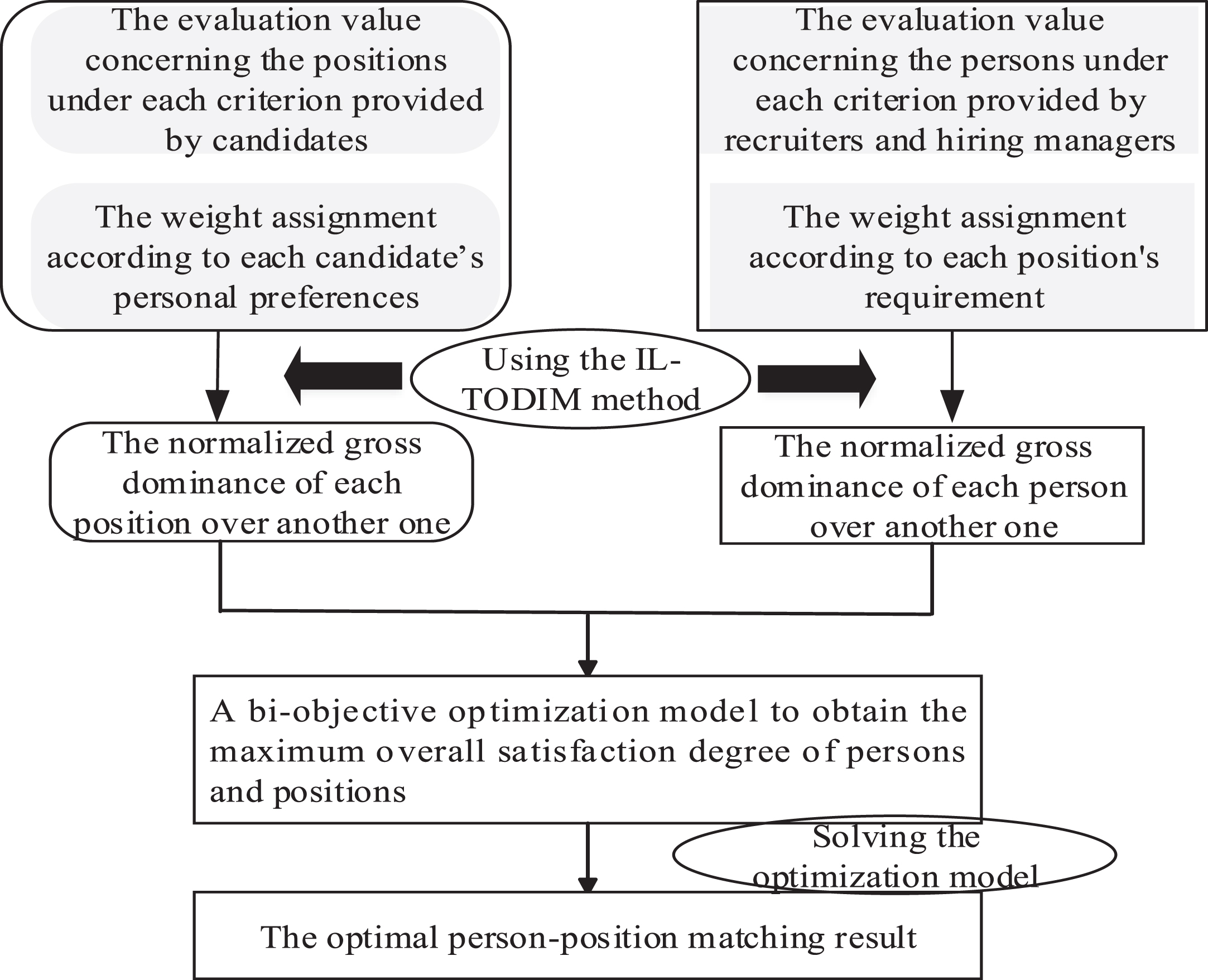
The decision framework of the proposed method.
Constructing the optimization matching model
To maximize the global satisfaction degree of persons and positions from an overall optimization perspective, a bi-objective optimization model is constructed as follows:
s.t.
The model (7) is a two objective linear programming mathematic model. Objective (7a) is to maximize the satisfaction degree of persons. Objective (7b) is to maximize the satisfaction of positions from companies’ perspective. Constraint (7c) and (7d) ensure that each agent of one side can be matched with one agent on the opposite side at most, as only one person can be the optimal match for a position. Equation (7e) denotes that if position x i is matched with person y j , u ij = 1, otherwise, u ij = 0.
The linear weighting method is utilized to solve the bi-objective model (7). Let α1 and α2 be the weights of objective f1 and f2, respectively, such that 0 ⩽ α1, α2 ⩽ 1 and α1 + α2 = 1, then the single-objective model (8) can be constructed.
s.t.
Weights α1 and α2 are regarded as the importance degrees of objectives f1 and f2, respectively. In multi-criteria PPM problem, the weights can be determined by the company manager(s) concerning the gross satisfaction degree of persons and positions from an overall optimization perspective. Besides, the model (8) is a single-objective linear programming model, which can be solved by LINGO, MATLAB and other software.
In summary, the detail description of the proposed method for solving the multi-criteria PPM problem with ILNs is given below:
–Step 1
Identify the agents of both sides (X and Y) and their evaluation criteria (O and C), respectively.
–Step 2
Construct and normalize the evaluation matrix
–Step 3
Construct the sets of weighing vector
–Step 4
Calculate the partial dominance matrices ϕ
k
(x
i
, x
j
) , i, j = 1, …, m ; k = 1, …, q and ϕ
k
(y
i
, y
j
) , i, j = 1, …, n ; k = 1, …, p using Equations (2)–(4), respectively, i.e., for positions x1 and x2 concerning criterion o3 provided by person y4, the partial dominance matrix can be obtained by:
Accordingly, for each person the partial dominance matrices ϕ k (x i , x j ) , i, j = 1, …, m ; k = 1, …, q can be obtained. Similarly, for each position the partial dominance matrices ϕ k (y i , y j ) , i, j = 1, …, n ; k = 1, …, p can be obtained.
–Step 5
Calculate the gross dominance matrices δ (x i , x j ) , i, j = 1, …, m and δ (y i , y j ) , i, j = 1, …, n using Equation (5), respectively, i.e., for positions x1 and x2 provided by person y4, the gross dominance matrix can be obtained by:
Accordingly, for each person the gross dominance matrices δ (x i , x j ) , i, j = 1, …, m can be obtained. Similarly, for each position the gross dominance matrices δ (y i , y j ) , i, j = 1, …, n can be obtained.
–Step 6
Normalize the gross dominance matrices of agents on each side to get the overall preference value matrices
Accordingly, for each person the normalized gross dominance matrix ξ (x
i
) (i = 1, …, m) can be obtained. And then the overall preference value matrix
–Step 7
Construct the model (7) based on the overall preference value matrices
–Step 8
Convert the model (7) into model (8), and solve model (8) to generate the matching result u*.
Case illustration
Human resource is a valuable asset for enterprises, and PPM problem is the key to human resource management. PPM process is not only a TSM problem, but also a MCDM problem. In this subsection, a case of PPM in the Engineering Department of LW Landscape Company is provided.
To expand the size of company and increase the strength of enterprise, the Engineering Department of the LW Landscape Company intends to recruit three high-tech staffs to serve as project manager (x1), civil engineer (x2), and quality engineer (x3), respectively. After preliminary screening, five job seekers (y1, y2, …, y5) enter the final selection stage. And the assessment of candidates are from team work spirit (c1), communication and expression skill (c2), physical quality (c3), work experience (c4), and professional knowledge (c5). The recruitment executives and candidates believe that the natural linguistic can express their judgments easily, and the ILNs can express the evaluation information more accurately by means of the membership degree and hesitation degree of the element to a given linguistic term set. Therefore, the evaluations of the five candidates under each criterion given by recruitment executives are listed in Table 1. In addition, each criterion for evaluating candidates is of different importance to different positions. Thus, the weights of evaluation criteria for candidates are assigned different values according to the requirements of the three positions, respectively (Table 2). Furthermore, in order to facilitate the candidates to know more about the actual situation of each position in terms of salary and welfare (o1), development space (o2), rest and vacation(o3), and working environment (o4), the recruitment executives provide the evaluation on each position concerning the four aspects (Table 3). Then, the five candidates assign importance weights to the four criteria of position according to their own preferences in Table 4.
The evaluations with regard to five candidates
The evaluations with regard to five candidates
The weights of candidates’ evaluation criteria given by each position
The evaluations with regard to three positions
The weights of positions’ evaluation criteria given by each candidate
To obtain the optimal person-position matching pair, the method illustrated in Section 4 is employed, and the calculation steps and results are given below.
Step 1: Construct and normalize the decision matrices.
In this case, it is not necessary to normalize the evaluation matrices, since all the criteria of both sides are benefit ones.
Step 2: Calculate the relative weight.
The weights of candidates’ evaluation criteria given by position x1 is (0.3, 0.3, 0.1, 0.2, 0.1) T. By Equation (3), the relative weight can be calculated as (1, 1, 1/3, 2/3, 1/3) T. Then, other relative weights given by positions x i (i = 2, 3) and candidates y j (j = 1, 2, ... , 5) can be obtained by the same method.
Step 3: Compute the partial and gross dominance measurement of each agent over another one.
According to Equations (4)–(5), the gross dominance matrices of candidates and positions can be obtained, which are listed in Tables 5 and 6, respectively. Parameter θ is the attenuation factor of the losses, which indicates the loss aversion degree of the agents. The smaller the value of parameter θ is, the greater the loss aversion degree of the agents are.
The gross dominance matrices of candidates given by (a) position x1, (b) position x2, and (c) position x3
The gross dominance matrices of candidates given by (a) position x1, (b) position x2, and (c) position x3
The gross dominance matrices of positions given by (a) person y1, (b) person y2, (c) person y3, (d) person y4, and (e) person y5
Step 4: Normalize the gross dominance degree.
By Equation (6) (suppose parameter θ is 1), the normalized gross dominance measurement of each agent can be obtained. And the overall preference value matrices of both sides are shown in Table 7.
The overall preference value matrices by (a) position x i (i = 1, 2, 3), and (b) person y j (j = 1, 2, ... , 5)
Step 5: Construct and solve the mathematical optimization model.
According to model (7), the bi-objective optimization model can be built as:
s.t.
Since the status of both sides is fair, the weights of the two objective functions are equal (α1 = α2 = 0.5). Then, a single-objective model can be obtained:
s.t.
The Lingo 15.0 is utilized to solve the model, and the optimal solution is obtained:
Therefore, the optimal person-position matching result is u* ={ (x1, y2) , (x2, y5) , (x3, y1) }, i.e., positions x1, x2, and x3 should be matched with persons y2, y5, and y1, respectively, and no position can be matched with persons y3 and y4.
In the above case analysis, the parameter θ is equal to 1, which means the losses are reflected in the gross value by their real value. The value of θ implies the risk preferences of the matching agents. As the value of θ changes from 0.1 to 5, the matching results can be obtained (Table 8). It can be seen from Table 8 that when θ ⩽ 2 the matching results is always { (x1, y2) , (x2, y5) , (x3, y1)}, but when θ > 2 the matching results will change with the change of θ value. That indicates the risk preferences of matching agents will actually affect the matching results. Furthermore, when θ < 1 the losses are amplified, otherwise the losses are attenuated. In this case study, when 1 ⩽ θ ⩽ 2, the degree of loss attenuation is not big enough to change the matching result.
The matching results with different values of θ
The matching results with different values of θ
In the above case study, it is assumed that there is fairness between persons and positions. In this subsection, a sensitivity analysis is carried out to examine the impacts on matching pairs when the weights assigned to the two sides change. As shown in Table 9, if only the satisfaction of positions is considered, the matching result is { (x1, y1) , (x2, y5) , (x3, y2)} and the maximum satisfaction is 2.64. With the increase of the weight of person’s satisfaction, the matching result changes to { (x1, y2) , (x2, y5) , (x3, y1)} and remains unchanged. In addition, the optimal objective value increases with the increase of the weight of person’s perception.
The matching results with different weight assigned between the two sides
The matching results with different weight assigned between the two sides
The comparison of the proposed method with some existing methods is given in this subsection.
(1) For solving the MCDM problem under intuitionistic linguistic environment, Ju et al. [40] developed a weighted intuitionistic linguistic Maclaurin symmetric mean (MILMSM) operator to aggregate the intuitionistic linguistic information. The multi-criteria PPM problem is also a MCDM problem, therefore, the MILMSM operator can be used to solve the problem discussed in this case study. If we apply the MILMSM operator in Ju et al. [40], the overall preference value matrices
Based on matrices
(2) Considering the psychological behaviors of agents on both sides, Fan, et al. [8] also studied the matching of persons and positions. In the existing method proposed by Fan, et al. [8], the evaluation information is expressed by uncertain preference ordinals. The preference format of our paper is different from that of Fan, et al. [8]. In this paper, considering that it is more convenient to describe uncertain or imprecise information in nature language, we use the ILNs to represent the preference information. Furthermore, considering the elation and disappointment of matching agents, Fan et al. [8] introduced a method based on disappointment theory, while we focus on the matching agents’ reference dependence and risk preference in the decision process. Although the theoretical backgrounds of the two papers are different, we have the same view on the influence of the psychological behaviors on the choice of matching agents.
Conclusion
This paper presents a method based on TODIM technique for solving the multi-criteria PPM problem under intuitionistic linguistic environment. In the proposed method, the reference dependence and risk preferences of matching agents are considered, and the ILNs are utilized to express the mutual evaluation between candidates and hiring managers. Based on the evaluation information and multi-criteria weights provided by agents on both sides, the gross dominance measurement of each agent over another one can be obtained. Then, a bi-objective optimization model which aims to maximize the gross satisfaction degree of agents on both sides is constructed to attain the optimal matching pair. The feasibility of the solution method is verified by a case study of PPM, and the matching result demonstrates that the proposed method is effective in dealing with multi-criteria PPM problem. In addition, the influence of parameter θ and weights assignment between bi-objectives are discussed, respectively.
The major contributions of this paper are as follows. First, this paper utilized ILNs to depict the evaluation in the course of person and position matching. The ILNs are not only convenient for matching agents to express their evaluation in nature language, but also can reduce the loss of information during preference expression. Second, the proposed method based on TODIM technique considers the reference dependence and risk preferences of matching agents. It is a valuable attempt and expansion for solving the multi-criteria PPM problem based on prospect theory. Third, the method proposed in this paper considers the satisfaction degree of agents on both sides, that is, it considers from an overall optimization perspective. It can give the recruiters and hiring managers one more choice in the methods for PPM under intuitionistic linguistic environment.
There are several directions for future research. First, this paper proposed a method based on TODIM technique to solve the TSM problem, in which the ILNs are utilized to describe the mutual evaluation between candidates and hiring managers. In addition to the PPM problem, some MCDM problems in other fields can also be solved by using this method, including student-college matching, and supplier-demander matching. Second, the ILNs are utilized to describe the mutual evaluation between two-sided matching agents, while other types of fuzzy linguistic preference information and consensus issue[53–55] in TSM problem are ignored. Third, this paper considered the psychological behavior of the two-sided matching agents, and the setting of criteria weights is subjective. However, objective and other types of approaches to determine criteria weights are ignored. In future research, more suitable weight assigned methods should be considered.