



Abstract
Complex fuzzy aggregation operation (CFAO) is a formalized definition of combining several complex fuzzy sets into a single complex fuzzy set. It extends classical fuzzy aggregation operation (FAO) to the complex-valued domain retaining classical real-valued weight. CFAO was initially defined with complex weight by Ramot et al. However, there has been virtually no progress in developing CFAO with complex weight. In this paper, we study the CFAOs with complex weight. We first discuss how to define complex weights meeting the restriction that the sum of weights is equal to 1. We give a new natural type of complex weight which is different from Ramot et al.’s complex weight. Then we study various properties which include idempotency, homogeneity, rotational invariance and shift invariance for CFAOs with both types of complex weights.
Introduction
The notion of complex fuzzy aggregation operation (CFAO) was presented by Ramot et al. [1, 2], which combines several complex fuzzy sets (CFSs) in order to create a single CFS. It is an effective tool to handle uncertainty and periodicity in different fields. Apparently, aggregation operation under complex fuzzy environment has gradually become an important theme in CFS theory and application. Based on Ramot et al.’ idea, Ma et al. [3] developed a product-sum aggregation operator under CFSs environment. Bi et al. [4–6] studied complex fuzzy geometric, arithmetric and power aggregation operators. Akram and Bashir [7] presented complex fuzzy quadratic averaging operators. Moreover, aggregation operation under complex intuitionistic fuzzy [8–12], complex Pythagorean fuzzy [13–15], Interval-valued complex fuzzy [16] and complex q-rung orthopair fuzzy [17, 18] environments have been presented. In recent years, these complex fuzzy aggregation operators are widely used in time series prediction [3], signal processing [2] and decision making [8–15].
In the aforementioned CFAOs, weights were considered to be real numbers. For instance, the weighted arithmetric operator
Both w
i
and a
i
are real numbers; w
i
is a complex number and a
i
is a real number; Both w
i
and a
i
are complex numbers.
Case (i) is the traditional weighted arithmetric operator, case (ii) has been investigated by Bi et al. [5], but case (iii) has not been investigated. On the reality point of view, weights using real numbers are very suitable in aforementioned practical applications. However, in Ramot et al.’s initial definition [2], weights of CFAOs were initially considered to be complex numbers. As mentioned in [2], Ramot et al. used complex weights for the purpose of making it a more general definition. But no investigation has been made on CFAOs with complex weights after that. On the theory point of view, CFAO with complex weights is a more general concept than that with real weights. It is advisable not to neglect the research on CFAOs with complex weights that might be useful later, even if they are unused.
Since the codomain of CFSs is the unit disc of the complex plane, some researchers studied geometric properties of CFSs and complex fuzzy operations. Hu et al. [19, 20] introduced the orthogonality and approximate orthogonality relation of CFSs, and studied (approximately) orthogonality preserving with respect to various CFAOs. Bi et al. [21, 22] introduced the parallelity and approximate parallelity relation of CFSs, and studied (approximately) parallelity preserving with respect to various CFAOs. Dick [23] introduced the concept of rotational invariance for complex fuzzy operations. Dai [24] generalized Dick’s rotational invariance. The idea of rotational invariance has been used in order [25], distance [26–28], similarty measures [29], entropy [30] and operators [31, 32] of CFSs. Therefore, this paper also studies some geometric properties of CFAOs with complex weights.
The aim of this paper is to study the CFAOs with complex weights and their properties. The remainder of this paper is constructed as follows: Section 2 reviews Ramot et al.’s concept of CFAOs. Section 3 discusses two types of complex weights. Section 4 studies CFAOs with different types of complex weights and investigates their corresponding properties. Section 5 gives the conclusions.
Let
Ramot et al. [2] defined the CFAO
Clearly, it is a generalization of weighted arithmetic aggregation (WAA) on
As mentioned in [2], Ramot et al. used complex weights in Equation (2) for the purpose of making it a more general definition. However, no thorough investigation has been made on CFAOs with complex weights after that.
The concept of rotational invariance was introduced by Dick [23] and generalized by Dai [24]. Bi et al. used this concept to study the properties of CFAOs. Here, we also give other concepts from [33] for CFAOs:
A CFAO
A CFAO
A CFAO
We say a CFAO is a linear aggregation operator if it is shift-invariant and homogeneous. Moreover, we consider the following properties: idempotency, amplitude boundedness and amplitude monotonicity.
A CFAO
A CFAO
A CFAO
Nondecreasing monotonicity is a basic property for aggregation operators [33]. When we extend the real number to complex number for the region of aggregation information, we get different results. WAA is nondecreasing, but Bi et al. [5] showed that CWAA with real weight is not amplitude nondecreasing.
In the traditional weight design, the real number 1 is split into several positive real numbers.
When weights are extended from real numbers to complex numbers. It breaks conventional definition of weights. Ramot et al.’s complex weight concept [2] is to split the real number 1 into several complex numbers with the limitation that the sum of their modules is 1.
Figures 1 and 2 respectively give a real weight vector and a Ramot et al.’s complex weight vector for n = 3. Traditionally, each real weight is one-dimensional, but each complex weight is two-dimensional. Clearly, traditional real weight vector is a special case of Ramot et al.’s complex weight vector that the phase term of each complex weight is limited to zero.
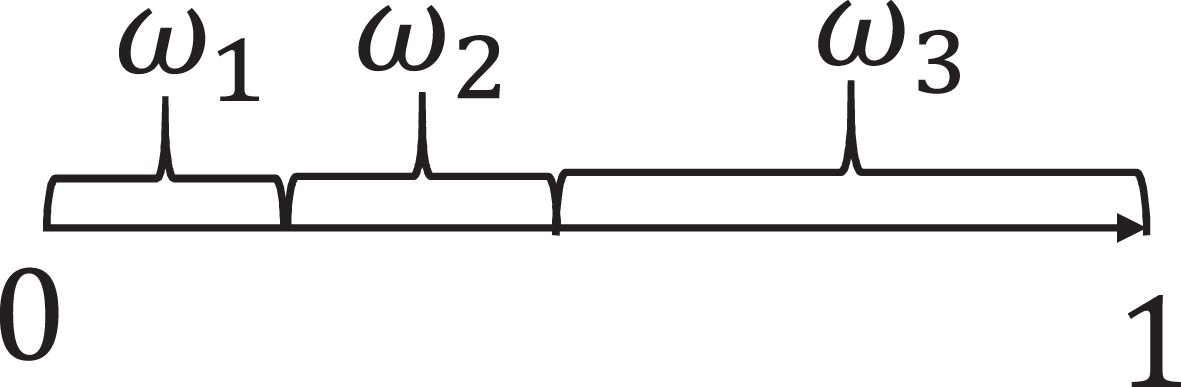
A real weight vector for n = 3.
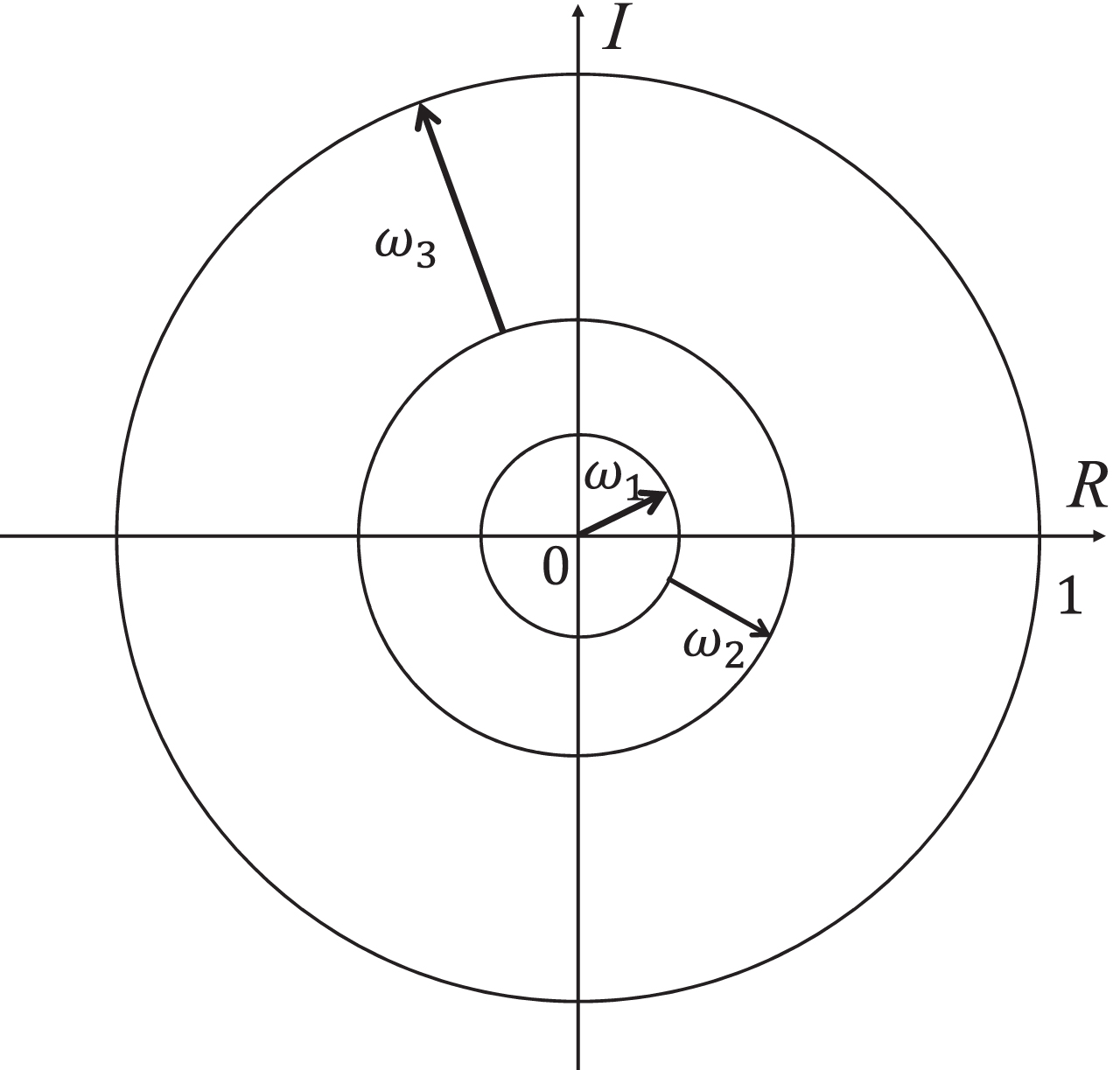
A Ramot et al.’s complex weight vector for n = 3.
However, there is no restriction on the phase term of Ramot et al.’s complex weight vector. We can modify the value of the phase term of each complex weight with no restrictions, i.e., if (w1, w2, . . . , w
n
) is a Ramot et al.’s complex weight vector, then (w1 · e
jδ
1
, w2 · e
jδ
2
, . . . , w
n
· e
jδ
n
) also is a Ramot et al.’s complex weight vector for any
So we introduce a new concept of complex weight vector as follow:
In the new concept, the real number 1 is viewed as a unit vector in complex plane. We split the unit vector into several complex vectors with the length less than or equal to 1 and their sum is the unit vector, as shown in Fig. 3. We can not modify the value of the phase term of each complex weight with no restrictions. For example, (0.3 · ejπ/2, 0.3 · ejπ/2, 0.4 · ejπ/4) is a Ramot et al.’s complex weight vector, but (0.3 · ejπ/2, 0.3 · e jπ , 0.4 · e jπ ) is not a complex weight vector according to Definition 3.

A complex weight vector of Definition 3 for n = 3.
Moreover, there exists a complex weight vector according to Definition 3, but not a Ramot et al.’s complex weight vector. For example, (1 · ejπ/3, 1 · ej5π/3) is a complex weight vector according to Definition 3, but not a Ramot et al.’s complex weight vector, as shown in Fig. 4. They are two different types of complex weight vectors.

A complex weight vector of Definition 3 for n = 2.
We listed the comparison of these types of weights as follows. Both types of complex weight vectors are extensions of real weight vector. But they are two different types of complex weight vectors; Ramot et al.’s complex weight vector meets the limitation that the sum of their modules is 1. There is no restriction on the phase term of Ramot et al.’s complex weight vector; Our complex weight vector meets the limitation that the sum of weights is 1. But the sum of their modules is greater than or equal to 1.
New we study CFAOs with above two tpyes of complex weights. We first study Ramot et al.’s CFAOs. Then we study CFAOs with complex weight vector of Definition 3.
Ramot et al.’s CFAOs
Ramot et al.’s CFAO is a complex weighted arithmetic aggregation (CWAA) operator. It is a function
Now we study CWAA with Ramot et al.’s complex weight vector.
there exists
there exists
Proof. (1) Let
Proof. (1) For any
Now we study CWAA with complex weight of Definition 3.
CWAA (o1, o1, ⋯ , o1) = o1 for any
there exists
Proof. (1) Let
Proof. (1) For any
Comparative analysis
We summarize the marked characteristics of CWAA with different types of weights, which are displayed in Table 1. It is easy to see that CWAAs with these types of weights have different properties. We listed the comparison of CWAAs with these types of weights as follows. CWAAs with both types of complex weights are extensions of CWAA with real weight. When complex weights are limited to real numbers, we have the results on [5]. CWAA with Ramot et al.’s complex weight does not have the properties of idempotency and shift-invariance. But CWAA with our complex weight possesses the properties of idempotency and shift-invariance. From this point, our notion of complex weight is better than that of Ramot et al.
A comparison of CWAA with different types of complex weights
A comparison of CWAA with different types of complex weights
In this paper, we study the complex fuzzy aggregation operators with complex weights. We give some properties of Ramot et al.’s complex fuzzy aggregation operator. In particular, Ramot et al.’s complex fuzzy aggregation operator does not have the properties of idempotency and shift-invariance. We introduce a new type of complex weight (See Definition 3). We show that complex fuzzy aggregation operator with new type of complex weight have the properties of idempotency and shift-invariance.
We should note that this paper considers CWAA with complex weights just from the theoretical level, lack of practical application case validate the complex weights the reasonability and validity. As we know, complex data are often applied in image processing and signal processing. Complex weight vector is useful in these applications. For instance, Widrow, McCool and Ball [34] derived a least-mean-square adaptive algorithm for complex signals by using complex weight vector. In the future, we will consider complex weights of complex fuzzy information aggregation in the level of application.
Footnotes
Acknowledgments
This research was supported by the National Natural Science Foundation of China under Grant No. 62006168, the Zhejiang Provincial Natural Science Foundation of China under Grant No. LQ21A010001, and the National Natural Science Foundation of Heilongjiang Province of China (Outstanding Youth Foundation) under Grants No. JJ2019YX0922.