



Abstract
Network-based incubation has undergone rapid developments and the incubation mechanism has begun to change recently. To incentive the start-ups on the basis of ensuring its own interests, the incubator needs to design a feasible contract. According to network theory, a single network cannot adequately describe the heterogeneous alliances of incubated start-ups in the business incubator. Therefore, by constructing super-network structure of incubated start-ups, this paper designs two types of linear incentive contracts and uses numerical simulation to further discuss the model. The results indicate that the business incubator should design the contract according to the different capability levels and risk preference degree of start-ups: linear screening contract (LSC) is more effective to motivate the incubated start-ups to improve the capability, while the incentive effect will be weakened by the increasing proportion of high-capability start-ups; for high risk-preference start-ups, linear pooling contract (LPC) is superior than LSC. The results can serve as a theoretical direction for the business incubator to effectively distinguish different capability levels of start-ups and make better decision on contract design to motivate start-ups on the basis of ensuring the maximization of its own utility.
Keywords
Business incubators (BIs) are viewed as a prominent way to assist emerging start-ups and have becoming a ubiquitous phenomenon all around the world [1, 2]. BIs aim to fledge start-ups in the hope they will later develop into self-sufficient, high survival companies by providing a comprehensive range of services [3, 4]. Over the last decades, business incubators have changed the way of supporting start-ups [3]: the incubation mechanism changes from concentrating on providing infrastructure to facilitating networks of start-ups [5] as well as cultivate the dynamic capabilities of incubated firms [6], and the profit model changes from government subsidy-led to build a back-feeding mechanism with incubated start-ups [7].
Recently, researchers have been trying to keep pace with changes in incubation mechanisms [8], and the network-based view has been widely used and gained considerable interest in research of incubators. Although researchers have studied knowledge networks between incubated start-ups, these studies are mainly limited to knowledge learning and diffusion within homogeneous networks [9]. Some argue that homogeneous networks cannot adequately describe the heterogeneity of incubated firms in different types of business incubators, and put forward super-network to construct the relationships of incubated firms in different level [9]. With the rapid development of modern science and technology, the knowledge or resources required to complete products or services is becoming more and more extensive, involving multiple organizations and knowledge in multiple disciplines. Start-ups need to share knowledge and cooperate across organizations to form cross-organization and knowledge-innovation networks (super-network) [10] which can help finish complex product development and innovation. The innovation activities of start-ups have developed from “one-to-one” simple cooperation to “many-to-many” complex multi-task network cooperation. Therefore, it has become an important issue to study the multiple incentive model of regional collaborative innovation from the perspective of super-network.
Most of the existing researchers focus on the single behavior incentive mode of multi-agent entity innovation (such as technology, raw materials, logistics, marketing, performance) in the regional innovation network. For example, Zhou et al. [11] establish an optimal contract model with brand retailers as principals and information media as agents, and two uncertain contract models with revenue sharing and commission payment are proposed to maximize the expected utility of brand retailers. Aiming at the dynamic knowledge sharing of construction project team, Lin et al. [12] construct a dynamic incentive model framework, and applies differential game theory to solve the problem of knowledge sharing incentive of different organization agents in project team. However, the multi-incentive model for the multi-task attribute of super-network has not been widely concerned by scholars, which means cross-organizational borders have received less attention in terms of corporate innovation, and there is a lack of in-depth discussions on the super-network of start-ups.
In addition, related studies show that that network-based incubation can influence the capabilities of the start-ups including innovative capabilities, managerial capabilities, and network capabilities etc. [13, 14]. As the complement of resource-based view (RBV), dynamic capabilities are regarded as a transformer for converting resources into improved performance [15]. The central tenant of dynamic capability theory is that a firm can adapt, integrate, renew and reconfigure its competitive advantages to better capture and exploit the opportunities presented by a changing environment [16]. Firms, especially nascent, emerging ventures, with fewer resources and more challenges, need dynamic capabilities that allow them to leverage and reconfigure existing resources in the high variety industrial environments [6]. Therefore, improving the dynamic capabilities of incubated firms can promote the sustainable survival and development of start-ups instead of directly providing various resources.
In current practice, most business incubators rely on government funding and subsidies and do not have a reasonable profit model [17]. Some researchers have put forward a profit-sharing scheme for incubators that sharing the profit of the incubatees with technology providers to share the risk of technology innovation [18]. Incubators in the United States have changed from the landlord model to a second generation model of incubation, providing start-up capital to their more promising incubatees with the expectation of a profitable exit [18]. It is also mentioned that the Brazilian incubators have formed the “partnership” model that they invested their own money to take a financial stake of the incubatees in lieu of rental fee and shared profit as the payoff [17]. To sum up, the business incubator needs to draw on some of the outstanding experience of business incubators and use its entrepreneurial resources to cooperate with incubated start-ups effectively [19]. They are suggested to sign a contract with the incubatees which will become dynamic partners of incubators [20, 21], and to provide reasonable and effective incentives to help start-ups solve the problem of early-stage resource deficits [22].
In this case, how can the business incubator design an effective incentive contract to motivate start-ups and cultivate the dynamic capabilities of them is the focus of this article. Thus, this study builds a super-network-based business incubator profit-sharing model for the incentive contract, which encourages incubated start-ups to continuously improve their knowledge innovation based on efficient cooperation with other start-ups, to have the capability and opportunity to complete higher-level business as well as promote the development of incubator.
Super-network construction
Scholars have long studied that the relationship of network structure [23, 24] and entrepreneurial performance. Some researchers have focus on firms doubly embedded in a social network of collaborations and a knowledge network [25, 26]. The studies indicate that the knowledge networks and the collaboration networks of firms are decoupled and that they have different degrees of integration [25]. Wang et al. (2014) [26] proposed that the characteristics of knowledge network and cooperative network are not the same, so they should be studied separately. Yu, Dang, Xu, & Yu (2008) [27] and Li & Wang (2009) [28] recognize a super-network model of knowledge resources that includes a social network, a material network and a knowledge network. H. Zhang et al. (2016) [9] constructed a knowledge interaction mechanism between incubated firms based on knowledge super-network and used simulation method to show the emergence of knowledge and networks from a micro perspective.
From the previous literature, it is clear that, enterprises and knowledge elements are two heterogeneous nodes in a cooperative-innovation network [29], and super-network model can adequately describe the complex network relationship of start-ups in the business incubator which contains two sub-network: cooperation-level network and knowledge-level network. These two layers of networks also form the basis of the construction of this research model. The specific super-network model is as follows.
In business incubator, each start-up has one or more related knowledge elements, which are usually manifested in business practice as various patents, technologies, processes and papers required in the process of designing or manufacturing enterprise products (such as chips, instruments, etc.) or services [30]. The distribution of knowledge elements among each innovation subject is uneven, and these elements become a knowledge network through diversified combinations and connections [31]. The other layer of the super-network, namely the cooperative network, is composed of the relationship links between enterprises and their social-level collaborative activities [32]. The position of a start-up in the cooperative network is different from the position of the knowledge elements it owns in the knowledge network. Moreover, the position of the knowledge elements in the knowledge network is not determined by an individual firm, but a result of the joint efforts of the start-ups. Therefore, these two networks are both relatively independent and interconnected [26].
The schematic diagram of the super-network model constructed in this study is shown in Fig. 1. Some nodes and connecting lines are drawn in the figure. In the cooperative network, nodes represent start-ups, and connections between nodes represent the path of collaboration between start-ups; nodes in the knowledge network represent knowledge elements, and connections between nodes represent the relationship path between knowledge elements. Besides, these knowledge elements actually belong to certain start-ups, so the connection between the two networks represents the affiliation between knowledge elements and the firms that own the knowledge. The specific network model will be explained in the next section.
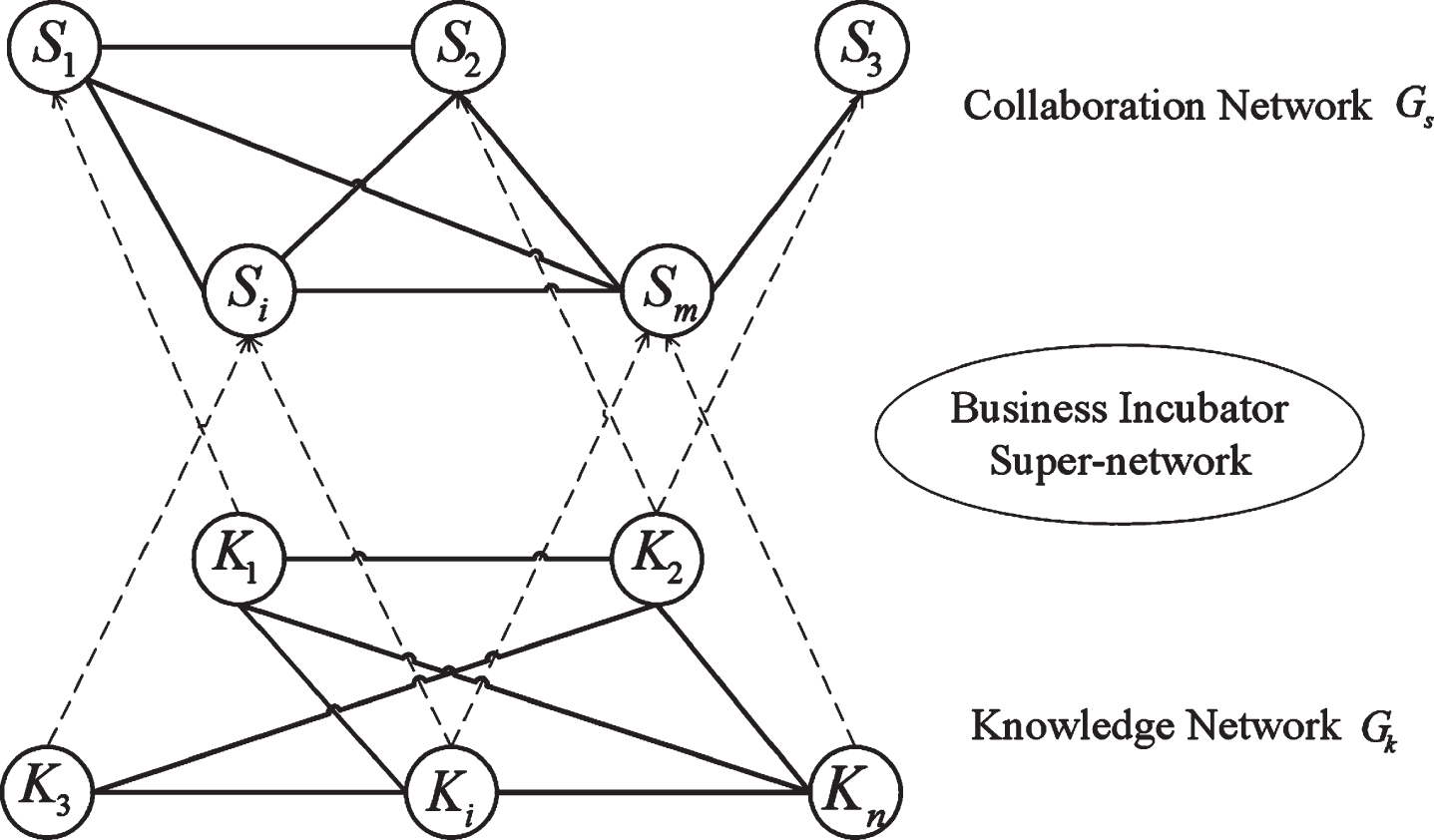
schematic diagram of initial super-network.
In such a super-network environment, start-up performance cannot be measured from only one perspective, but should be divided into cooperative performance and knowledge innovation performance. Cooperative performance refers to the comprehensive benefits achieved through the formation and development of cooperative relationships to achieve cooperative goals. Geringer & Hebert (1991) [33] used cooperation indicators such as satisfaction, survival rate, stability, and duration to evaluate cooperative performance. McGee, Dowling, & Megginson (1995) [34] divides cooperative performance into absolute performance and relative performance, where relative performance is measured by goal achievement, profitability, and profit growth rate; absolute performance is measured by customer satisfaction, logistics costs, profitability, and relationship sustainability. The achievements of enterprises in knowledge innovation are most directly reflected in patent applications and paper publications, hence knowledge innovation performance usually refers to the quantity and quality of enterprises’ invention patents and papers [35]. It is clearly noted that cooperative performance and knowledge performance are two different kinds of performance. Therefore, in a super-network environment, the incentive contract design for incubators and start-ups cannot be analyzed from a single level, but from the two levels of cooperative network and knowledge network.
The nature of super-network
The super-network model (see Fig. 1) of start-ups in business incubator is represented by:
In formula (1), G s = (S, Rs∼s) refers to the cooperative network formed between start-ups, which represents a kind of social relationship; G k = (K, Rk∼k) represents a knowledge network composed of all the knowledge points of the business incubator; S ={ S1, S2, ⋯ S m } represents a collection of start-ups, m is the number of start-ups in the business incubator; Rs∼s refers to a collection of cooperative paths, and the cooperative network of business incubator is formed by the cooperative paths of these start-ups. K ={ K1, K2, ⋯ K n } represents a collection of knowledge points, and n indicates the total number of business incubator knowledge points; Rk∼k refers to the a collection of relation paths of knowledge elements, and the knowledge network between start-ups in business incubator can be regarded as consisting of all knowledge elements and their relationships. These two relationships connect two sub-networks of different natures, eventually forming a super-network structure of a business incubator. Rs∼k represents the affiliation between knowledge elements and entrepreneurial firms, which means that knowledge innovation activities are actually completed by the start-ups that possess these knowledge elements.
Compared to Figs. 1, 2(a) shows a new knowledge path created. The process of knowledge innovation activity puts the knowledge point K1 and knowledge point K3 together and creates a new knowledge path r. Besides, in the collaboration network in Fig. 2(b), start-up S2 and start-up S3 conduct a collaboration through a new cooperative path r (but with nothing to do with the knowledge network, such as jointly completing a production order or a marketing activity). Each creation of knowledge path r need cost, which is expressed by C rk , and e rk is the effort level to build the knowledge network path. However, the knowledge innovation activities are actually completed by the start-ups that own the knowledge elements (patents, products and technologies etc.), so the cost of knowledge innovation is actually paid by the start-ups (points S1 and S4 in Fig. 2(a)) that perform this innovation activity. Similarly, each new cooperative path r need cost form the start-ups who conduct the cooperative activity which is expressed by C rs , and e rs is the effort level in building cooperative path r in the cooperative network.

Super-network model.
According to the analysis above, we design the profit-sharing contract model based on two different networks. This study combines the previous research of start-up capabilities, effort level and firm performance and makes the following assumptions about the model as follows:
(1) The cooperative network performance V s has the following characteristics:
R means a collection of paths r.
The knowledge network performance V
k
has the following characteristics:
(2) Suppose that the cost of establishing and maintaining a cooperative relationship is
(3) In order to motivate incubated firms to finish the contract effectively, in addition to provide infrastructure, business support and financial investment for start-ups, the business incubator also shares a certain proportion of profits with the incubated firms. Thus, the start-up can get: a. business support and investment I1 provided by the business incubator including initial investment for collaboration m s and for knowledge innovation m k ; b. share of total payoff I2 including n s share of the cooperative payoff and n k share of the knowledge innovation payoff.
We assume that the business incubator is risk-neutral, i.e., the income equals to the expected payoff. And the expected payoff of the business incubator is:
And the clean payoff of the incubated start-up is
We assume that the start-up is risk preference and r* is the risk factor (r * =0, r * <0, r * >0 represent risk-neutral, risk-aversion and risk preference). The expected payoff of the start-up is
The business incubator is not clear about the specific network capability and knowledge innovation capability of each start-up. It is only known that the network capabilities of start-up in the incubator are divided into two types: high-level
Linear pooling contract (LPC)
Linear pooling contract (LPC) refers to the contract made by the business incubator without distinguishing the capability level of the start-up. Since it is not necessary to consider the different types of firms, the formulation of the LPC does not involve the problem of adverse selection, but only related to the moral hazard caused by the observable efforts of the start-ups. In this case, the objective function of contract design can be expressed as
The premise of maximizing the overall profit must ensure that all types of participants can maximize their own interests under the condition of unified incentive rules. Therefore, the start-ups of different capability types will choose the effort level according to the optimization strategy and the incentive compatibility constraint (IC) is as follows:
Solve the expression (6) and we get the optimal effort level of different types of start-up:
Besides, only when expected payoff of the start-ups greater than or equal to their external opportunity cost, will they actively complete the contract:
The Ep. (8) is the participation constraint (PC) where ω is the external opportunity cost of the start-up. By substituting Ep. (7) into Ep. (8), we get
It is obvious that only the fourth term is compact constraint and it can be split as follow (ω
s
+ ω
k
⩾ ω)
Substituting Ep. (7) into the objective function Ep. (5), we calculate the optimal value of n
s
, n
k
and substitute them into the Ep. (10) and the value of m
s
, m
k
are obtained as follows:
The results of LPC model indicate that on the basis of the profit maximization of the incubator, the start-ups with any type of dynamic capability can get half share of the total payoff. Besides, the improvement of the start-up’s dynamic capability does not help it obtain more cooperative incentives and knowledge innovation incentives, and start-ups with high risk-preference will get fewer incentives.
Other than LPC, the linear screening contract (LSC) means that the business incubator considers the differences of capabilities t
s
and t
k
between different start-ups and designs multilevel contract
Similarly, the incentive compatibility constraint (IC) is as follows:
Solve the Ep. (14) and we get the optimal effort level of different types of start-ups:
Similarly, the participation constraint (PC) is
In addition, the expected payoff of high-capability firms under the optimal effort level must be higher than the maximum payoff of low-capability firms, otherwise, these start-ups cannot realize the principle of individual optimization, and will not be willing to be divided into the scope of this capability type, as shown in Ep. (17):
Substituting Ep. (15) into Ep. (16) and Ep. (17), the above problems are transformed into the following equivalent planning problem:
It is noted that in the Ep. (18) only the last three terms are compact constraints and the fourth term can be split as follow (ω
s
+ ω
k
⩾ ω):
Constructing Lagrange function:
Solve the function and we get the results of the solution: λ1 = 1, λ2 = 1, λ3 = α, λ4 = β;
Where
Note that the results show that when the dynamic capability level of start-ups increases, the share of profit will also increase. Compared with the LPC, in the case of LSC, the payoff of start-up is positively linked to their dynamic capability, that is to say, they could be fully encouraged to improve their network capability and knowledge innovation capability in the situation of LSC.
It is clear that when the risk factor of the start-up increases, the start-ups share of total profit goes down, which indicates that the increase of risk factor will offset the incentive from business incubator. Besides, from Ep. (25)–(28), we note that in the LSC model, the relationship between cooperative incentive
Parameters setting
From the above analysis, we design the two types of linear contracts (LPC and LSC) and compare the solutions of each contract under the condition of the optimal incubator payoff Eπ BI . In this section, we use numerical simulation to discuss the relationship between relevant parameters and the expected payoff of the start-up Eπ I , in order to put forward useful theoretical suggestions to guide the decision-making of the incubator incentive mechanism. In terms of parameter setting, this research refers to the experimental data of related literature, and after multiple rounds of simulation experiments, a set of data with the most obvious contrast is determined for display. The parameters setting is as Table 1 [38]:
Simulation parameters
Simulation parameters
On the basis of setting basic parameter values, this paper simulates the impact of some parameter values on the start-up’s expected payoff Eπ I when it changes within a certain range under the condition that other parameter values remain unchanged.
To analysis the difference of the two types of contracts, we conduct numerical simulations of the impact of the high-level network capability
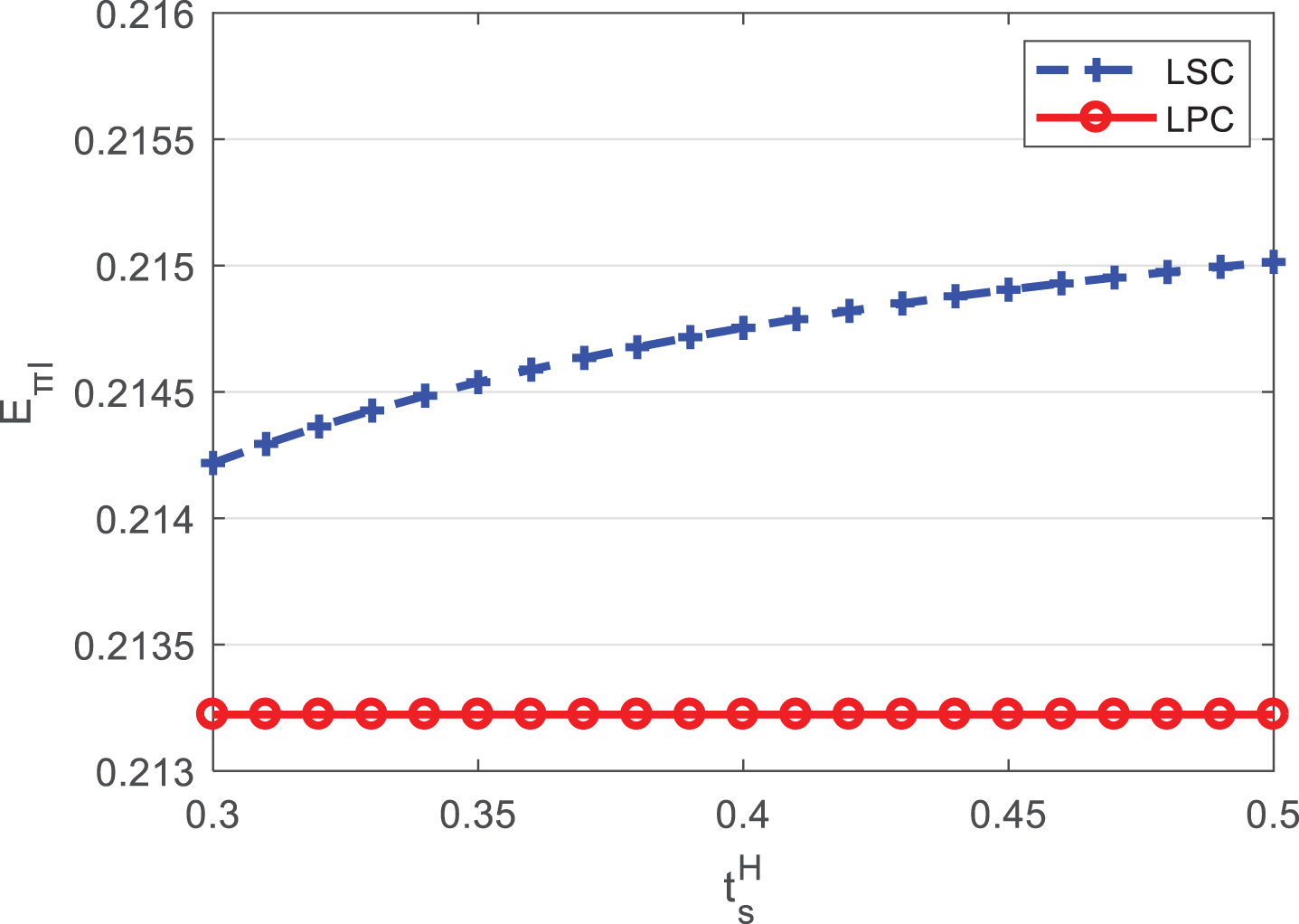
Effect of

Effect of
From Fig. 3, we can clearly observe that the expected payoff Eπ
I
constantly grows with the increase of high-level network capability
In our model, the risk factor r* is also related to the share retained by the start-up

Effect of r* on high-level capability Eπ I .
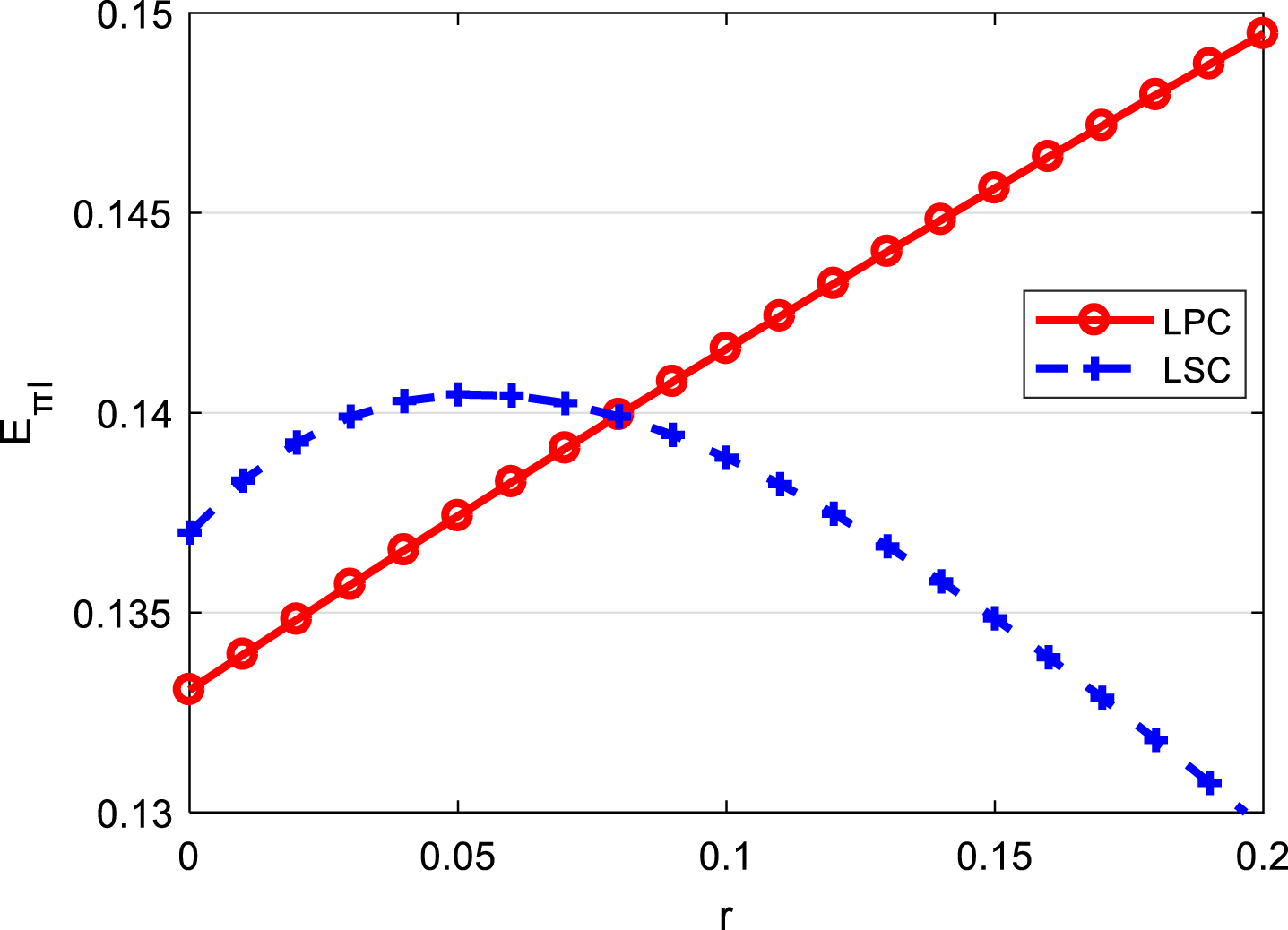
Effect of r* on low-level capability Eπ I .
The asymmetric information, as mentioned above, that often occurs in practice makes it impossible for the business incubator to distinguish the specific network capability or knowledge innovation capability of each start-up, and only have a rough idea of whether the start-up belongs to the high-level dynamic capability category or the low-level dynamic capability category. Therefore, the proportion of the start-up high-level network capability α and high-level knowledge innovation capability β are also significant impact factors for contract design. To identify the influence of α and β on expected payoff of the start-up, we expand the range of the two parameters to α, β ∈ (0, 0.9) and plot their relationship with high-level capability start-up expected payoff as Figs. 7 and 8.
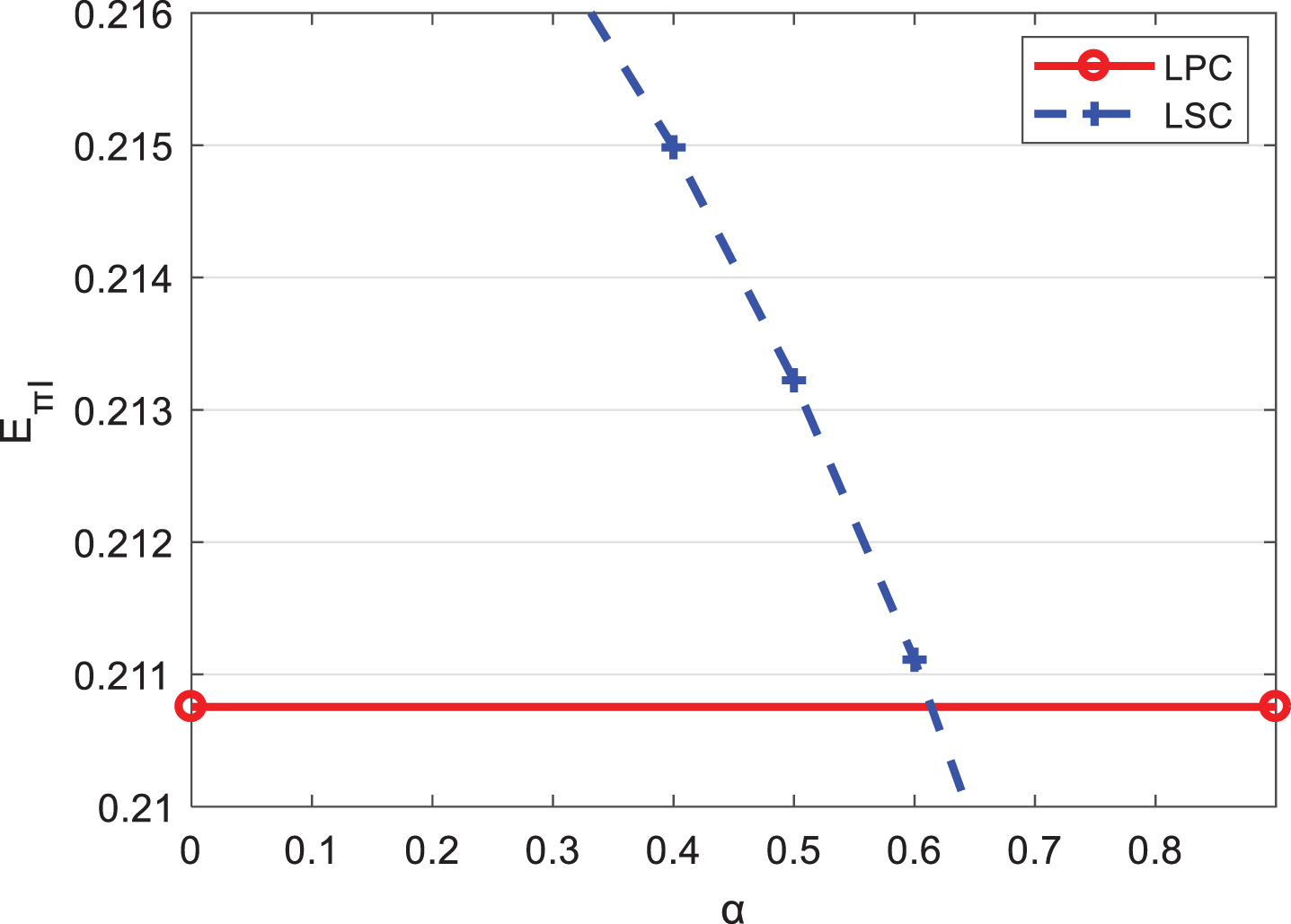
Effect of α on high-level capability start-up Eπ I .
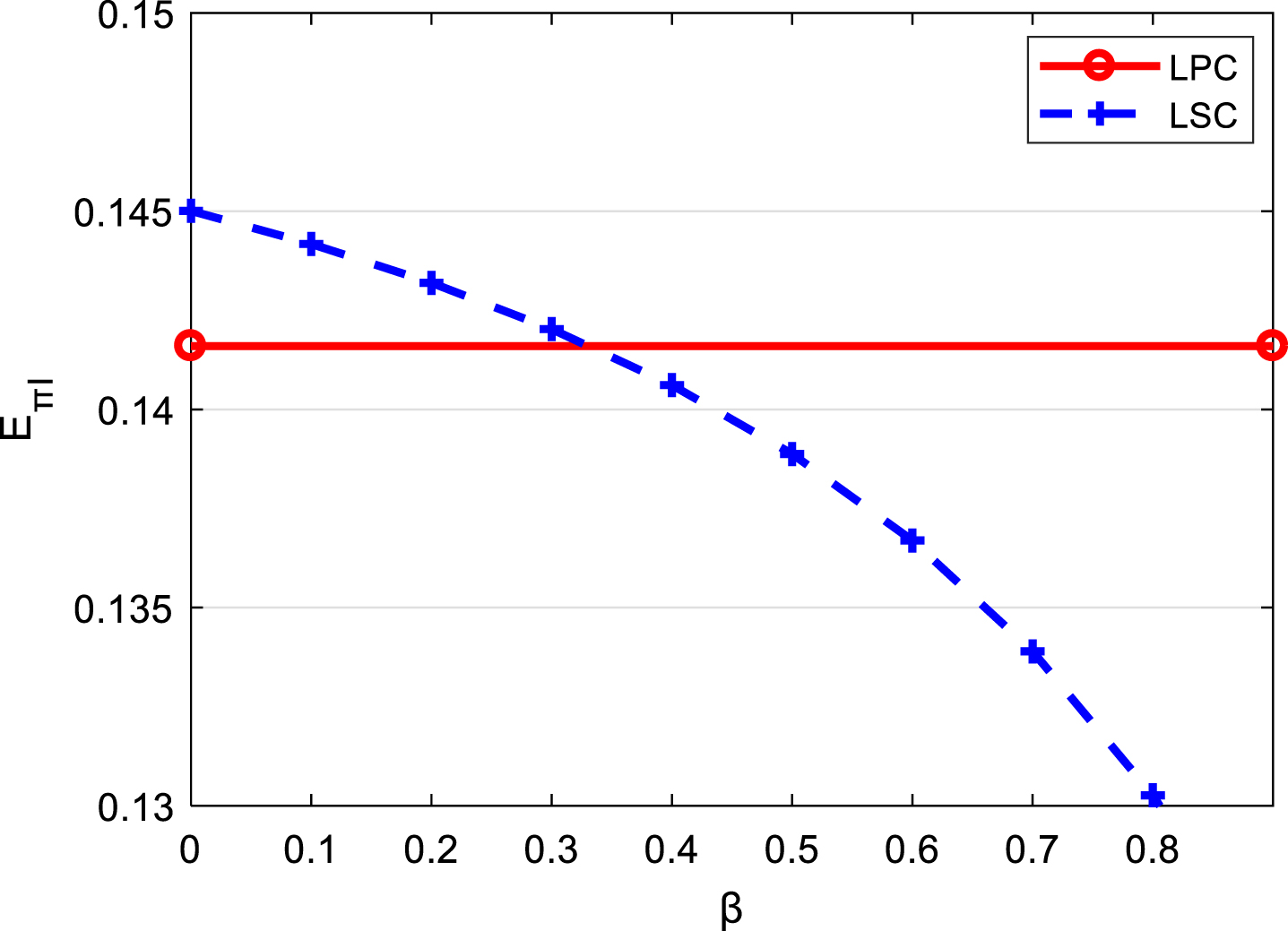
Effect of β on high-level capability start-up Eπ I .
From Figs. 7 and 8, it is noted that the different proportion of high-level capability of the start-ups has a negligible effect on the expected payoff of LPC, while it of LSC goes down with the increase of α and β. This result reveals that for LSC, high-level capability start-ups are under competitive pressure, which means the more high-level capability start-ups, the less profit they will distribute. In other words, for the business incubator with a large number of high-level capability firms, LPC is a more advantageous choice. Therefore, it is required that the business incubator consciously change the design criteria of the incentive contract according to the different proportions of the start-up’s capability category to motivate the incubated firms.
Reasonable contract design is helpful to build an atmosphere of collaborative innovation with start-ups for the network-based business incubator, improve the performance of the incubator while promoting the construction of their high-level dynamic capabilities. Based on super- network theory, this paper designs two types of linear incentive contracts. Under the condition of the coexistence of adverse selection and moral hazard, the model helps the business incubator to effectively distinguish different types of start-ups and make decision on inventive contract design on the basis of ensuring the maximization of its own utility.
Under the super-network environment, the cooperative network and the knowledge network are two different types of networks, and their performance measures are also different, so the costs and performances of different network system tasks are independent of each other. This paper designs two types of contracts according to the construction of super-network in the business incubator which few scholars have focus on. The difference between the two types of contracts in this paper is whether the incubator sets multi-task principal-agent model for incubated firms with different levels of dynamic capabilities.
The results of this study indicate that the two contracts have their own applicable situations, and the business incubator should design the contract differently according to the various capability levels and risk preference degree of its incubator firms:
(a) The LSC model enables the business incubator to focus on cultivating the network capabilities and knowledge innovation capabilities of start-ups. By comparing the results of the optimal solutions of the two contracts, it is concluded that the start-up with high-level dynamic capability under the LSC model can obtain more payoff, hence LSC has a better incentive to motivate the incubated start-ups to improve the capability and get more return. Dynamic capabilities can help start-ups fully identify, seize and utilize resources and grow rapidly, so the LSC model is more suitable for BI to cultivate corporate dynamic capabilities.
(b) Entrepreneurship is a high risk activity, and most entrepreneurs are risk-preferred. The analysis of this paper suggests that for high risk-preference start-ups, they tend to carry out high-risk activities to chase volatility rather than stable payoffs, so the business incubator is expected to motivate startups without the need to develop a multi-level incentive scheme; but for start-ups with low risk-preference, it is necessary to distinguish the dynamic capability level of the firms to design the contract. Only in this way can the relative fairness be guaranteed, so that the start-ups can obtain higher income and the incentive effect is achieved. In short, for start-ups with high risk-preference, LPC is a better choice; for start-ups with low risk-preference, LSC is more suitable.
(c) Although LSC can provide a more effective incentive for an individual star-up with high-level capability, the more start-ups with high-level capabilities in the incubator, the worse the incentive effect could be. That is to say, when the level of dynamic capabilities of start-ups is all very high, LSC will lose the function of cultivating corporate capabilities, and LPC is maybe a more suitable choice. Therefore, the business incubator should identify the proportion of its incubated firm’s capability level, and combine these influencing factors together and design feasible incentive contract, enhancing the enthusiasm of the start-ups to complete the contract on the basis of ensuring its own profit maximization. Besides, start-ups with high-level dynamic capabilities will no longer need the help of business incubator as before. In this case, business incubator managers need not only to consider how to motivate start-ups, but also to improve the graduation and elimination mechanism, and make start-ups that can operate independently leave BI and introduce potential nascent firms that need incubated resources.
This research is not out of its limits. On the one hand, this study focuses on the dynamic capability perspective of the start-ups when designing the contracts. Actually, in the super-network environment, the dynamic network structure may also affect the incubator performance and the contract design. We suggest the future research should account of some network structure influencing factors, i.e. structural hole, network density etc. On the other hand, we mainly studied how the business incubator adopts two types of contracts to motivate the start-ups. We found that the optimal contract design is determined by the profit maximization of the business incubator and the start-ups without considering the social effects. In practice, the business incubators should not only consider their own benefits, but also shoulder the responsibility of promoting the transformation of scientific and technological achievements and improving regional economy.
Footnotes
Acknowledgments
This work was supported by the National Social Science Fund of China (Project numbers: 18FGL020, 18BGL082) and the Short-term Visiting Program of Nanjing University of Aeronautics and Astronautics (Project number: 190612DF09).
Disclosure statement
The authors have no competing financial, professional, or personal interests from other parties.