



Abstract
An innovative method, namely modified slice-sum method using the principle of zero point method is proposed for finding an optimal solution to fully rough interval integer solid transportation problems (FRIISTP). The proposed method yields an optimal solution to the fully rough interval integer solid transportation problem directly. In this method, there is no necessity to find an initial basic feasible solution to FRIISTP and also need not to use the existing MODI and stepping stone methods for testing the optimality to improve the basic feasible solution to the FRIISTP but directly obtain an optimal solution to the given FRIISTP by using the proposed method. The optimal values of decision variables and the objective function of the fully rough interval integer solid transportation problems provided by the proposed method are rough interval integers. The advantages of the proposed method over existing method are discussed in the context of an application example. The modified slice-sum method has been applied to calculate the optimal compromise solutions of FRIISTP, and then it was solved by using TORA software. The proposed method can be served as an appropriate tool for the decision makers when they are handling logistic models of real life situations involving three items with rough interval integer parameters.
Introduction
The solid transportation problem (STP) may be considered as a special case of linear programming problem. In STP, bounds are given on three items, namely; supply, demand and conveyance. In many industrial problems, a homogeneous product is delivered from an origin to a destination by means of different modes of transport called conveyances, such as trucks, cargo flights, goods trains, ships, etc. The STP was proposed by Shell [1]. Haley [2] introduced the solution procedure of STP which is an extension of the modified distribution method. For m + n + l–2 non-zero values of the decision variables to start with a basic feasible solution. Jana and Jana [3] developed two types of hybrid random type-2 uncertain variables such as random type-2 triangular and random type-2 Gaussian fuzzy variables are used to express the uncertain parameters in a four-dimensional transportation problem. Jia et al. [4] considered a production-distribution problem on parallel batch processing machines with multiple vehicles and solved it by a deterministic heuristic and two hybrid meta-heuristic algorithms based on ant colony optimization. Patel and Tripathy [5] developed a computationally superior method for an STP with mixed constraints. Bit et al. [6] developed the fuzzy programming model for a multi-objective STP. Ebrahimnejad [7] proposed a new method for solving fuzzy transportation problems in which the transportation costs, supply and demand are represented by non-negative LR flat fuzzy numbers. Vajda [8] proposed an algorithm for a multi-index transportation problem which is an extension of the modified distribution method. Mohamed and Mohamed [9] studied a stochastic transmission switching integrated interval robust chance-constrained approach to assess the operation of a wind park-energy storage system in a day ahead electricity market considering the system technical constraints. Abdelhamid et al. [10] proposed the political optimization algorithm to coordinate the directional overcurrent relays where optimal coordination of directional overcurrent relays that used for protecting electrical networks is a nonlinear constrained optimization problem. Akilbasha et al. [11] proposed a new method, namely; the split and separation method for finding an optimal solution for integer transportation problems with a rough environment. Basu et al. [12] provided an algorithm for finding the optimum solution of a solid fixed charge linear transportation problem. Elmbach et al. [13] presented a maximum ergonomic burden in intra-hospital patient transportation problem as a mathematical model and solved with the help of a tailored tabu search algorithm. Gen et al. [14] gave a genetic algorithm for solving a bicriteria STP with fuzzy numbers. Li et al. [15] designed a neural network approach for a multicriteria STP. Li et al. [16] improved the genetic algorithm to solve the fuzzy multiobjective STP with fuzzy numbers. Mollanoori et al. [17] developed a new mathematical model for a capacitated solid step fixed-charge transportation problem where the problem is formulated as a two-stage transportation network and considers the option of shipping multiple items from the plants to the distribution centers and afterwards from distribution centers to customers. Muralidaran and Venkateswarlu [18] have proposed a new ranking function for solving a symmetric fuzzy linear programming problem. Jimenez and Verdegay [19] investigated interval multi-objective STP via genetic algorithms. Jimenez and Verdegay [20] obtained a solution procedure for uncertain STP. Jimenez and Verdegay [21] developed a parametric approach for solving fuzzy solid transportation problems by an evolutionary algorithm. Pandian and Natarajan [22] introduced the zero point method for finding an optimal solution to a classical transportation problem. Pandian and Anuradha [23] proposed a new method for finding an optimal solution of solid transportation problems. Pandian et al. [24] have been developed a new method, namely; slice-sum method for solving fully rough integer interval transportation problems. Recently, Akilbasha et al. [25] proposed an innovative, exact method for solving fully interval integer transportation problems. Zhang and Hu [26] have studied the full truckload transportation service procurement problem with transit time and also developed a two-phase multi-objective evolutionary algorithm to explore the Pareto front of the problem.
The rest of this paper is framed as follows: a few known definitions, basic arithmetic operators and partial ordering related to rough intervals are presented in Section 2. In Section 3, presents the mathematical formulation of the fully rough interval integer solid transportation problems. The proposed method namely, modified slice-sum method for optimizing the fully RIIST problem is discussed in Section 4. The numerical example is illustrated in Section 5. In Section 6, the results and discussion part have been included then the last Section concludes the article.
Preliminaries
Need the following definitions of the basic arithmetic operators and partial ordering on a set of all rough intervals which can be found in Pandian et al. [24].
Let D denote the set of all rough intervals on the real line R. That is, D = {[[b, c] , [a, d]] , a ⩽ b ⩽ c ⩽ d textand a, b, c and dare in R}.
Note that, (i) if a = b and c = d in D, then D becomes the set of all real intervals and
(ii) if a = b = c = d in D, then D becomes the set of all real numbers.
Definition
Let A = [[a2, a3] , [a1, a4]] and B = [[b2, b3] , [b1, b4]] be in D. Then, A⊕ B = [[a2 + b2, a3 + b3] , [a1 + b1, a4 + b4]] ; kA=[[ka2, ka3] , [ka1, ka4]] if k is a positive real interval and A ⊗ B = [[a2, a3] [b2, b3] , [a1, a4] [b1, b4]].
Definition
Let A = [[a2, a3] , [a1, a4]] and B = [[b2, b3] , [b1, b4]] be in D. Then, A ⩽ B if a
i
⩽ b
i
, i = 1, 2, 3, 4 and A = B if A ⩽ B and B ⩽ A, that is, a
i
= b
i
, i = 1, 2, 3, 4.
Definition
Let A = [[a2, a3] , [a1, a4]] be in D. Then, A is said to be non-negative, that is, A ⩾ 0 if a1 ⩾ 0 .
Remark
If A = [[a2, a3] , [a1, a4]] and B = [[b2, b3] , [b1, b4]] in D are non-negative, then, A ⊗ B = [[a2b2, a3b3] , [a1b1, a4b4]].
Definition
Let A = [[a2, a3] , [a1, a4]] be in D. Then, A is said to be rough integer if a i , i = 1, 2, 3, 4 are integers.
Fully rough interval integer solid transportation problems
Consider the following fully rough interval integer solid transportation problem:
Subject to
Any set of non-negative allocations to a FRIISTP which satisfies the Equations (1), (2), (3) and (4) is called a feasible solution of the FRIISTP.
A feasible solution of FRIISTP which minimizes the total shipping cost, that is,
A set of solid rough intervals {
Definition
A feasible solution {
Now, the problem (P) is partitioned into four sub problems namely, upper approximation upper bound integer solid transportation (UAUBIST) problem, lower approximation upper bound integer solid transportation (LAUBIST) problem, lower approximation lower bound integer solid transportation (LALBIST) problem and upper approximation lower bound integer solid transportation (UALBIST) problem which are given below:
(UAUBIST) Minimize
Subject to
(LAUBIST) Minimize
Subject to
(LALBIST) Minimize
Subject to
Subject to
Now, establish a relation between optimal solutions of the fully rough interval integer solid transportation problem (P) and its four induced integer solid transportation sub problems (UAUBIST) (LAUBIST) (LALBIST) and (UALBIST). The established relation is used in the proposed method, namely, modified slice-sum method.
If the set {
Let {
Therefore,
Since {
This implies that,
Therefore, the set of solid rough integer intervals {
Hence, the theorem is proved.
The above theorem is an extension of the Theorem 3.1 in Pandian et al. [24].
Modified slice-sum method
Now, propose a new method, namely; modified slice-sum method for solving the fully rough interval integer solid transportation problem (P).
The modified slice-sum method proceeds as follows:
This developed method is based on the method proposed by Pandian et al. [24].
Numerical example
A manufacturing company produces a product in its three factories O1, O2 and O3. The product will be sent to three destinations D1, D2 and D3 from the three factories by means of the three conveyances E1, E2 and E3. Determine a shipping plan for the company from factories to the destination by means of the conveyances such that the total shipping cost should be minimized using the following data.
The minimum supply ranges of O1, O2 and O3 are [12, 14], [14, 16] and [11, 13] respectively, and the maximum supply ranges of O1, O2 and O3 are [11, 17], [13, 19] and [10, 16] respectively. The minimum demand ranges of D1, D2 and D3 are [8, 10], [16, 18] and [13, 15] respectively, and the maximum demand ranges of D1, D2 and D3 are [7, 13], [15, 21] and [12, 18] respectively. And, the minimum capacity ranges of E1, E2 and E3 are [12, 14], [15, 17] and [10, 12] respectively, and the maximum capacity ranges of E1, E2 and E3 are [11, 17], [14, 20] and [9, 15] respectively.
The minimum and maximum unit shipping cost range from each supply point to each demand point by means of the conveyance is given below:
Where, f111 = [[5, 7] , [4, 10]]; f112 = [[8, 10] , [7, 13]]; f113 = [[9, 11] , [8, 14]]; f121 = [[4, 6] , [3, 9]]; f122 = [[10, 12] , [9, 15]]; f123 = [[8, 10] , [7, 13]]; f131 = [[7, 9] , [6, 12]]; f132 = [[8, 10] , [7, 13]]; f133 = [[3, 5] , [2, 8]]; f211 = [[5, 7] , [4, 10]]; f212 = [[3, 5] , [2, 8]]; f213 = [[7, 9] , [6, 12]]; f221 = [[2, 4] , [1, 7]]; f222 = [[4, 6] , [3, 9]]; f223 = [[9, 11] , [8, 14]]; f231 = [[9, 11] , [8, 14]]; f232 = [[5, 7] , [4, 10]]; f233 = [[6, 8] , [5, 11]]; f311 = [[9, 11] , [8, 14]]; f312 = [[2, 4] , [1, 7]]; f323 = [[4, 6] , [3, 9]]; f321 = [[5, 7] , [4, 10]]; f322 = [[8, 10] , [7, 13]]; f323 = [[4, 6] , [3, 9]]; f331 = [[6, 8] , [5, 11]]; f332 = [[7, 9] , [6, 12]]; f333 = [[5, 7] , [4, 10]].
Now, the given problem can be modeled as a fully rough interval integer solid transportation problem as follows:
Where, f111 = [[5, 7] , [4, 10]]; f112 = [[8, 10] , [7, 13]]; f113 = [[9, 11] , [8, 14]]; f121 = [[4, 6] , [3, 9]]; f122 = [[10, 12] , [9, 15]]; f123 = [[8, 10] , [7, 13]]; f131 = [[7, 9] , [6, 12]]; f132 = [[8, 10] , [7, 13]]; f133 = [[3, 5] , [2, 8]]; f211 = [[5, 7] , [4, 10]]; f212 = [[3, 5] , [2, 8]]; f213 = [[7, 9] , [6, 12]]; f221 = [[2, 4] , [1, 7]]; f222 = [[4, 6] , [3, 9]]; f223 = [[9, 11] , [8, 14]]; f231 = [[9, 11] , [8, 14]]; f232 = [[5, 7] , [4, 10]]; f233 = [[6, 8] , [5, 11]]; f311 = [[9, 11] , [8, 14]]; f312 = [[2, 4] , [1, 7]]; f323 = [[4, 6] , [3, 9]]; f321 = [[5, 7] , [4, 10]]; f322 = [[8, 10] , [7, 13]]; f323 = [[4, 6] , [3, 9]]; f331 = [[6, 8] , [5, 11]]; f332 = [[7, 9] , [6, 12]]; f333 = [[5, 7] , [4, 10]]
Now, since the total supply = the total demand = the total conveyance = [[37,43],[34,52]], the given problem is balanced.
Now, by using the Steps 2 and 3., the optimal allotted table and optimal solution to the (UAUBIST) problem is given below:
The minimum and maximum unit shipping cost range from each supply point to each demand point by means of the conveyance
The minimum and maximum unit shipping cost range from each supply point to each demand point by means of the conveyance
Fully rough interval integer solid transportation problem
The optimal allotted table and optimal solution to the (UAUBIST) problem
The optimal allotted table and optimal solution to the (LAUBIST) problem
The optimal allotted table and optimal solution to the (LALBIST) problem
The optimal allotted table and optimal solution to the (UALBIST) problem
Comparison on optimal solutions of crisp solid TP and fully rough interval integer solid TP
Now, using the Steps 4 and 5., the optimal allotted table and optimal solution to the (LAUBIST) problem with the upper bound constraints
Now, by the Steps 6 and 7., the optimal allotted table and optimal solution to the (LALBIST) problem with the upper bound constraints
Now, by using the Steps 8 and 9., the optimal allotted table and optimal solution to the (UALBIST) problem with the upper bound constraints
Now, by the Step 10., the optimal solution of the given problem is given below:
From the above four figures can be observing that the following results:
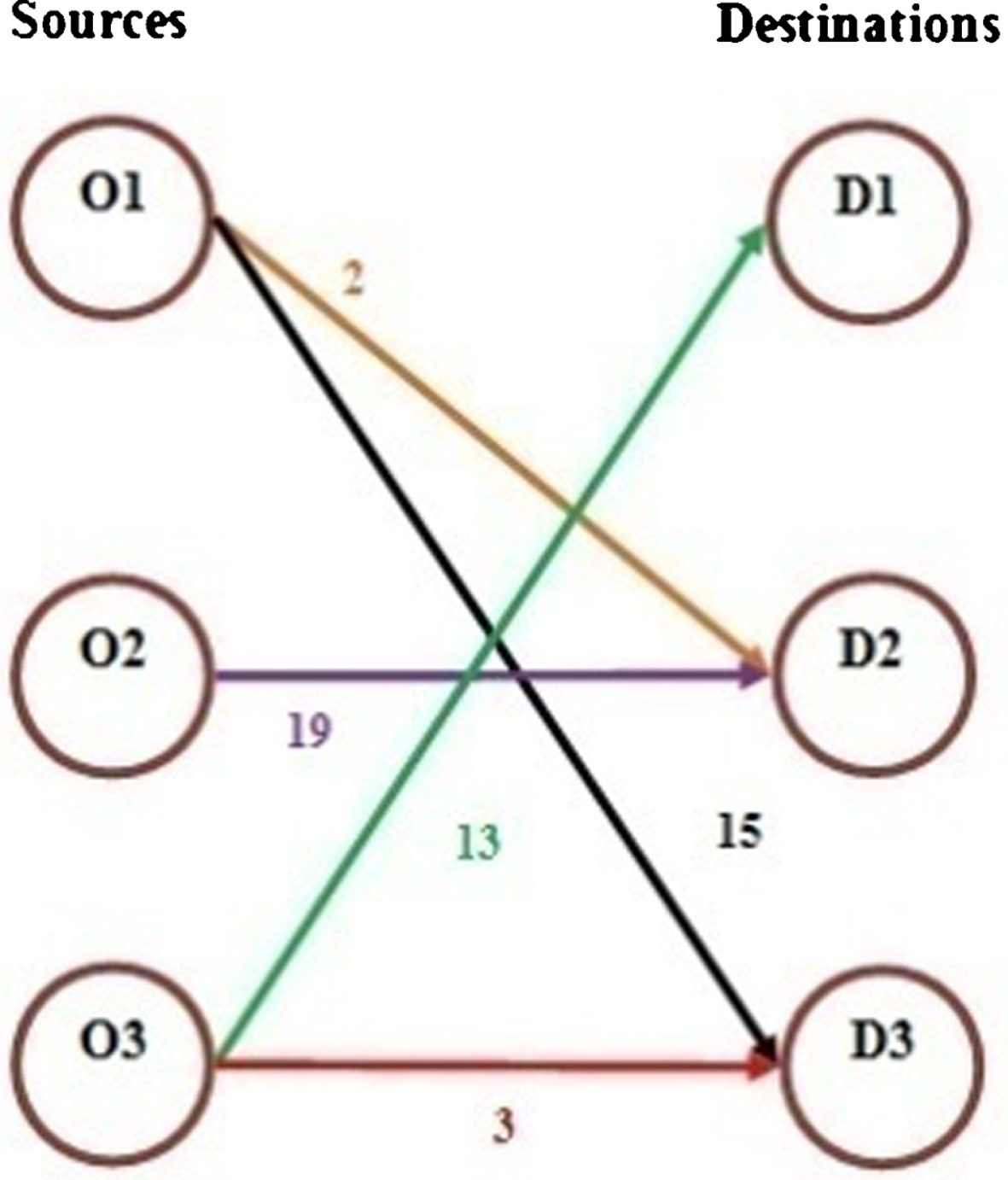
Transportation plan of the (UAUBIST) problem.

Transportation plan of the (LAUBIST) problem.

Transportation plan of the (LALBIST) problem.
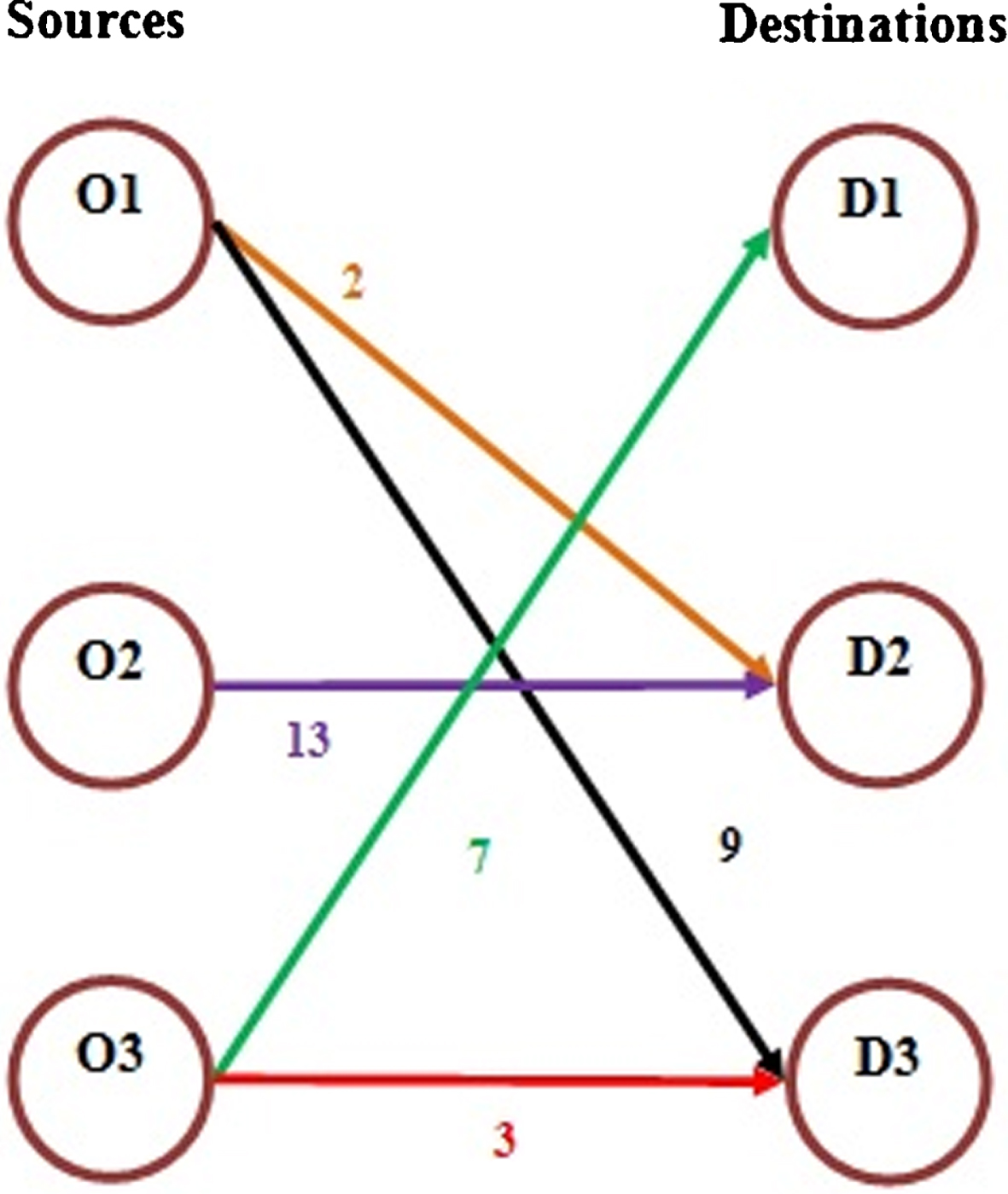
Transportation plan of the (UALBIST) problem.
The main objective of this study is to find an optimal transportation plan for the given FRIISTP problem. This will provide the best transportation plan to decision-makers when they are handling logistic problems for real life situations involving three items with rough interval integer parameters. This will help the upcoming researchers to extend this problem into the other problems with parameters involving interval, rough interval with fuzzy numbers (triangular, trapezoidal etc.) and so on. The proposed modified slice-sum method yields an optimal solution to fully rough interval integer solid transportation problem directly.
Comparison
Results comparison between the existing and proposed method is given below:
Although the results obtained using the existing method Pandian and Anuradha [23] and the proposed method are the same for the crisp solid TP where as there is no solution in [23] to fully rough interval integer solid TP but it has in the proposed method.
Remark
In this example, the solid unit transportation cost and values of the supply, demand and conveyance are decided by trader based on his/her professional knowledge, experience, and available information. Linguistic values characterized by rough interval integers are utilized to describe the uncertainty with the available information. For example, the solid unit transportation cost between source O2 to the destination D2 by means of the conveyance E1, which is the minimum and maximum ranges approximately between 2 to 4 and 1 to 7 respectively can be represented by rough interval integers [[2,4],[1,7]]. This means that the most probable cost is between 2 and 4. The least probable costs are 1 (optimistic value) and 7 (pessimistic value). The cost is unlikely to be less than 1 or larger than 7, in the opinion of the trader.
Conclusion
Transportation problem having all or some parameters as rough interval integers is considered in this paper. A new method, namely; modified slice-sum method is proposed to solve a fully rough interval integer solid transportation problem in which all or some of the parameters, that is, cost of transportation, supply, demand and conveyance are rough interval integers. The proposed method is a systematic procedure, both easy to understand and to apply and also, it is a crisp method and provides an exact optimal solution to the given problem. The necessity of FRIISTP arises when heterogeneous conveyances are available for shipment of products in public distribution system. The proposed method yields an optimal solution to the given FRIISTP directly without finding an initial basic feasible solution with m + n + l-2 non-zero values of the decision variables and the existing MODI and stepping stone methods for testing the optimality to improve the basic feasible solution to the FRIISTP. The solution procedure of the proposed method is illustrated with a numerical example. The modified slice-sum method has been applied to calculate the optimal compromise solutions of FRIISTP, and then it was solved by using TORA software. The proposed method can be served an important tool for the decision makers when they are handling various types of logistic models for real life situations involving three items with rough interval integer parameters.