



Abstract
Pythagorean fuzzy sets and interval-valued Pythagorean fuzzy sets are more proficient in handling uncertain and imprecise information than intuitionistic fuzzy sets and fuzzy sets. In this article, we put forward a chance-constraint programming method to solve linear programming network problems with interval-valued Pythagorean fuzzy constraints. This practice is developed using score function and upper and lower membership functions of interval-valued Pythagorean fuzzy numbers. The feasibility of the anticipated approach is illustrated by solving an airway network application and shown to be used to solve different types of network problems with objective function having interval-valued Pythagorean fuzzy numbers by employing it on shortest path problem and minimum spanning tree problem. Furthermore, a comparative examination was performed to validate the effectiveness and usefulness of the projected methodology.
Keywords
Introduction
In various real-world problems, owing to several uncertain, vague and inaccurate factors, it is comparatively complicated for experts to present their outlook on performance ratings and attribute weights with exact and accurate values. In Statistical methods, a probability theory has been introduced whose principle is to capture uncertainty of a certain type. Though, numerous decision-making (DM) problems either deals with probabilistic or non-probabilistic uncertainty. Weaver [43] declared that we have the tools for solving disorganized and complex problems so we are superior at them but we need to get better with solving organized and complex problems also. He labeled them problems of organized complexity.
Zadeh’s fuzzy set (FS) theory [49] is a successful and effectual tool for solving many related problems. In the meantime, many different extensions of FSs have been put forward to portray DM objects. As a generalization of FSs, Zadeh introduced the idea of interval-valued fuzzy set (IVFS) [50] that can deal with the situations where assigning an exact and accurate membership grade is too restrictive but the assignment of interval of values is considered more realistic and convenient.
Intuitionistic fuzzy sets (IFS) [1, 2] as an extension of FSs is introduced by Atanassov [1]. Many researchers have employed IFSs in DM problems due to their ability to handle imprecise information. Later on, Yager introduced Pythagorean fuzzy sets (PFS) [46] as a constructive generalization of IFSs that is a new tool used to model imprecise and ambiguous information in multi-attribute DM problems. PFSs provide a wider space to associate membership and non-membership grades to the elements of the set. This helps in representing and managing vagueness, impreciseness, and uncertainties than IFS in different DM processes. The distinguishing attribute of the PFSs is to relax the condition that the sum of its membership and non-membership degree is not greater than one with the square sum of its membership and non-membership degree not being greater than one as shown in Figure 1. When the values of the membership and non-membership function in a PFSs are hard to express as exact real numbers in many real-world problems, interval-valued Pythagorean fuzzy sets (IVPFS) [48] can be used to portray the uncertain information more adequately and accurately.

Comparison Between Intuitionistic Fuzzy Set and Pythagorean Fuzzy Set
DM is one of the most widely used phenomena in our day-today life. One of the most powerful theories is that of the multi-attribute decision-making (MADM) for handling problems that extensively impact the human real-life problems. Fuzzy sets have been employed to solve MADM problems for example please see [6, 41]. There are many optimization techniques for DM problems which involve different kinds of constraints. Among these approaches “chance-constraint programming" (CCP) method is very useful where uncertainties are associated with the constraints [26]. Vasant [42] presented a widespread literature analysis and projected a technique to solve such fuzzy constrained optimization problems considering a real-life application. Qin et al. [34] put forward an approach to deal with data envelopment analysis (DEA) models in type-2 fuzzy environment using a CV-based reduction technique. Maali et al. [30] established a multi-objective linear programming model involving type-2 membership functions and presented a solution procedure. Figueroa et al. [15] presented an approach for solving linear programming problems (LPP) concerning interval type-2 fuzzy constraints where IT2FSs are defined on a closed interval. Kundu et al. [21, 23] proposed a method to solve LPP using type-2 and interval type-2 fuzzy parameters. As there does not exist any suitable approach to handle LPPs relating interval-valued parameters. Therefore, we extended the approach presented by Kundu et al. [21] to a new technique for solving constrained optimization problems in the PFS framework.
In the presented article, we have proposed a CCP method to tackle with LPP involving interval-valued Pythagorean fuzzy number (IVPFN) constraints. The focus of constrained optimization problems with IVPFN information has not been yet thoroughly explored. Since people often find it difficult to exactly quantify their opinions when facing incomplete fuzzy DM problems, interval-valued fuzzy elements can provide a better solving way because when the values of membership and non-membership function in PFSs are hard to express as exact real numbers in many real-world problems, IVPFSs can be used to portray the uncertain information more adequately and accurately. Hence, we focused on IVPFSs whose ideas are similar to interval-valued intuitionistic fuzzy sets (IVIFS).
As FSs only deal with the membership function and plays no role on the non-membership function therefore, they are not capable of dealing with haziness and non-deterministic situations. In PFS theory, we have hold on the uncertainty and indeterminacy as well. Thus, we have extended the existing approach in PFS environment to overcome the deficiency of certain information and ambiguous and vague conditions by using IVPFNs. Based on IVPFN structure, this paper utilizes a well-known Pythagorean number having trapezoidal appearance called an interval-valued trapezoidal Pythagorean fuzzy number (IVTrPFN). Also, this technique is developed using score function and upper and lower membership functions of IVTrPFNs where score function is used for defuzzyfying the IVTrPFN values. The proposed approach is subsequently applied to an airway network application efficiently. Moreover, two different network problems considering minimum spanning tree problem (MSTP) and shortest path problem (SPP) having coefficients of the objective function characterized as IVPFNs are also solved by the proposed approach.
The rest of the paper is structured as follows: Section 2 briefly reviews various notions about PFS and IVPFSs. Section 3 demonstrates some results about IVTrPFNs. In Section 4 a CCP method to solve LPP having constraints represented as IVPFNs is developed. In Section 5 the anticipated method is implemented to an airway network having constraints represented as IVTrPFNs. In Section 6 SPP with coefficients of objective function represented as IVTrPFNs are constructed and their solution procedure is presented. In Section 7 MSTP is discussed. Section 8 presents the numerical illustrations to the proposed method. In section 9 a comparative analysis of the proposed technique with previous methods is presented and lastly Section 10 concludes the paper.
This section recalls some fundamental definitions of PFS and IVPFS.
If If [(a)] If [(b)] If
This section presents the concept of IVTrPFNs along with some of its basic operations.
The number
The CCP method is one of the major approaches for solving optimization problems under various uncertainties. It is a formulation of an optimization problem that make sures that the probability of meeting a certain constraint is above a certain level. In 1959, Charnes et al. [10] first introduced it. Subsequently, in 1965, Miller et al. [31] re-evaluated the approach and looked into the ways of boosting the competence of solving chance-constraint optimization problems. Many studies in the early 2000s have looked into more effective ways of investigating chance-constraint optimization and increasing the efficiencies of such problems.
In this section, we have extended the existing approach in PFS environment to overcome the deficiency of certain information and ambiguous and vague conditions by using IVPFNs.
An LPP with constraints represented as IVPFNs is considered.
The resulting deterministic model is:
Thus,
Assume that after solving above deterministic model (13), we have min Z = Z′.
Assuming that, after solving the deterministic model (15), we have min Z = Z′′.
Now, we define a membership function for finding an optimum compromise solution (for minimization problem) as follows:
The maximum the χ (Z) the better the solution of the minimization problem.
Ensuring the maximum feasible satisfaction of the constraints, now we acquire the optimum compromise solution considering an auxiliary variable ζ (0 ≤ ζ ≤ 1) by constructing the linear programming model as follows:
With passenger air travel growing from year to year and the high fuel burn associated with it, dropping fuel consumption is one of the main objectives in the aviation industry. Scheduling a route is the element of the course of flying, correspondent figures and submits a route to air traffic control (ATC), who afterwards accepts or rejects it. If accepted, the pilots must stick on to the intended route and any departures need to be accepted by ATC. Normally, a route is intended several hours earlier than the flight takes place and many factors are taken into consideration, the most crucial one is the fuel consumption in route. The influence of wind also plays a vital role in flight planning. Aircrafts take off more rapidly and more professionally when they are being pushed by tailwinds whereas crosswinds hinder an aircraft’s departure. Therefore, always those routes are chosen that exhibit these favorable circumstances whilst aiming to discover the most proficient path. For passengers, another important characteristic is that the flight time should be as short as possible. In the way we model the problem, less fuel consumption also means shorter flight time.
The objective is to minimize the fuel consumption required in flying from one route to another. We formulate a airway network with demands, availabilities and resources as IVTrPFN and solve it by intended CCP technique.
By solving model (20), we get min Z = Z′.
Model (20) satisfies the solution only if:
By solving model (22), we get min Z = Z′′.
Model (22) gives satisfactory solution only if:
max(Z′, Z′′) = Zmax,
For finding an optimum compromise solution, a membership function is defined (for minimization problem) as follows:
For optimum compromise solution, an auxiliary variable ζ (0 ≤ ζ ≤ 1) is considered by constructing the following linear programming model:
We can find the path of least length between two vertices in a network by using the shortest path approach. SPP is very helpful and widely applied in various fields of science and engineering. It is one of the most important combinatorial optimization problem in graph theory due to its many applications. In this article, we solve SPP by constructing a CCP model with related costs represented as IVTrPFNs.
A connected directed graph having no self loops be represented by G = (V
G
, E
G
) where V
G
is the finite set of n vertices or nodes of G and E
G
is the finite edge set of G of size m. Every edge e
pq
represents 〈v
p
, v
q
〉 i.e. a vertex pair which connects v
p
and v
q
and is directed from v
p
to v
q
. SPP surveys the shortest path connecting two terminal nodes named as source(s) and sink(t). Its formulation is given as follows:
The deterministic form is obtained as:
Minimum spanning tree is an acyclic connected graphical structure that spans all the vertices of the undirected graph in such a way that it has the smallest possible sum of weights of its edges. A spanning tree with a minimum cost can be explored by MSTP. It is a well known optimization problem that has been used to model many real life, science and engineering problems including road network application, transportation network, routing and water supply networks,etc. In this article, CCP model of MSTP has been taken into consideration.
Let G = (V
G
, E
G
) be a weighted undirected network having no self loops, where where V
G
is the finite set of n vertices or nodes and E
G
is the finite edge set of G of size m. Each edge e
pq
represents 〈v
p
, v
q
〉 i.e. a vertex pair which connects v
p
and v
q
. The MSTP is formulated as follows
Same procedure as demonstrated in Section 6 is followed to solve MSTP (30). The CCP models can be constructed by using the UMFs and LMFs of all d
pq
linked with the model (30) and then their deterministic forms can be found as discussed in Section 3. Finally the compromise model can be obtained as:
This section discusses the numerical illustration of proposed models and methods. Flowchart of the proposed methodology is shown in Fig. 3.

A Trapezoidal Pythagorean Fuzzy Number
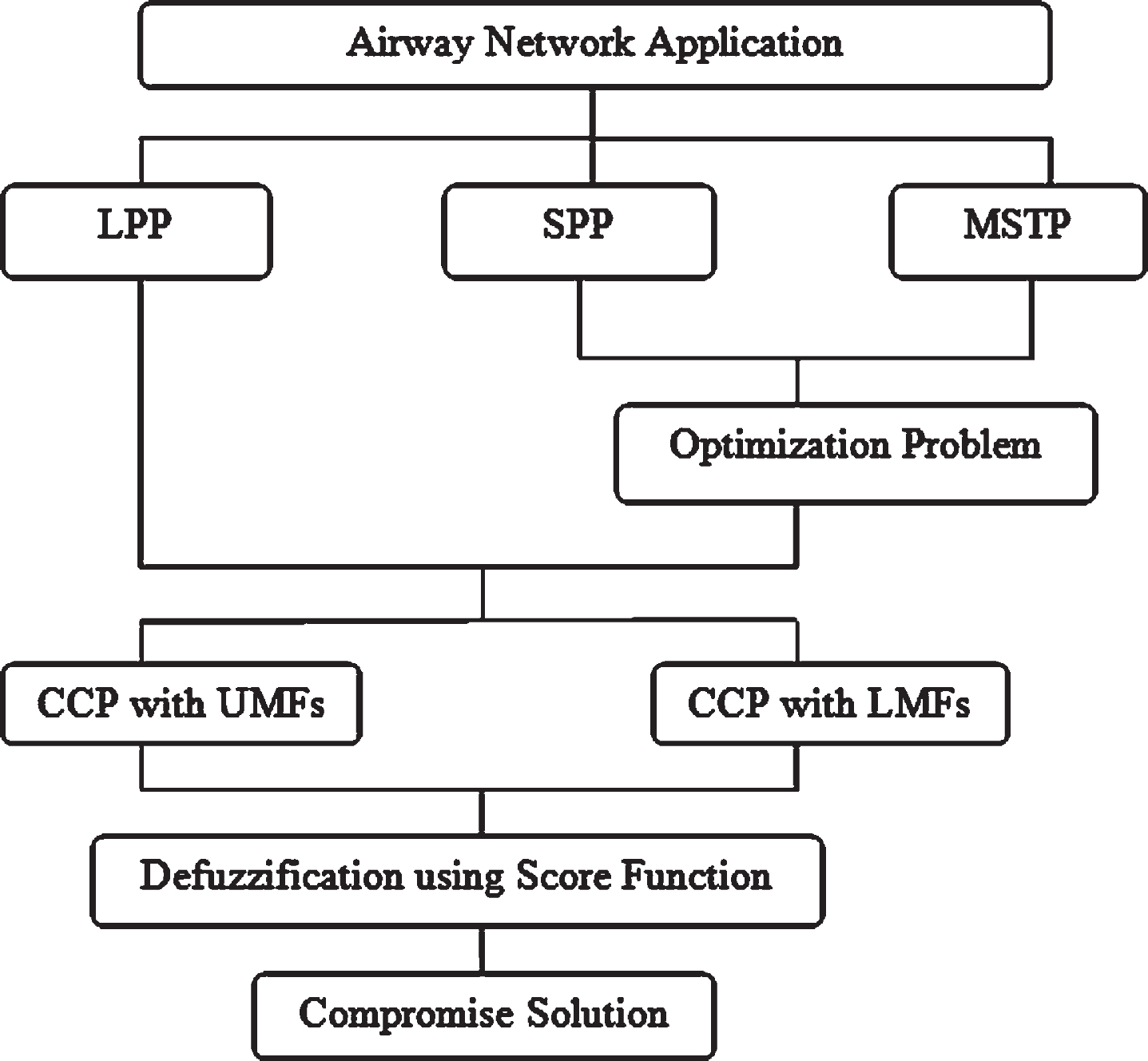
Flowchart of the Proposed Method
Consider an airway network with two sources, destinations and resources, i.e, s, t, u = 1, 2. In Table 1, we define each of the linguistic terms associated with the above input parameters as follows:
Linguistic Variables Associated with Different Input Parameters
Linguistic Variables Associated with Different Input Parameters
Availability:Adequate ≤ 2, 3 < Abundant ≤ 6 and Abundant > 7.
Demand:Low ≤ 3, 4 < High ≤ 9 and Abundant > 6.
Capacity:Low ≤ 3, 1 < Adequate ≤ 10 and High > 4.
Here the decision-makers represents the values as linguistic variables and are listed as follows:
Consequently, by considering the DM’s outlook, these linguistically defined values are numerically represented as IVTrPFNs and are scheduled in Table 2.
Linguistic Variables Represented as IVTrPFNs
The unit transportation costs cst1 and cst2 are considered as follows:
c111 = 10, c121 = 8, c211 = 13, c221 = 9, c112 = 11, c122 = 14, c212 = 15, c222 = 12.
For solving this problem, a CCP model considering UMFs of IVTrPFNs can be constructed as in model (19). Then following (20) its deterministic form becomes:
Upper Crisp Values Using Score Function
Solving the problem, we get min Z = Z′ = 26.7325.
Now, a CCP considering LMFs can be constructed. Its crisp form becomes:
Lower Crisp Values Using Score Function
Solving the problem, we get min Z = Z′′ = 9.0241.
Following linear programming model can be constructed by considering auxiliary variable ζ (0 ≤ ζ ≤ 1) and using (24) as follows:
Above problem can be solved by using standard optimization solver-LINGO and the compromise solution is given in Table 5.
Optimum compromise Solution
A weighted directed network G1 (as shown in Fig. 4) with 12 edges and 8 vertices having source and sink vertex i.e. v1 and v8 named as s and t respectively is considered.
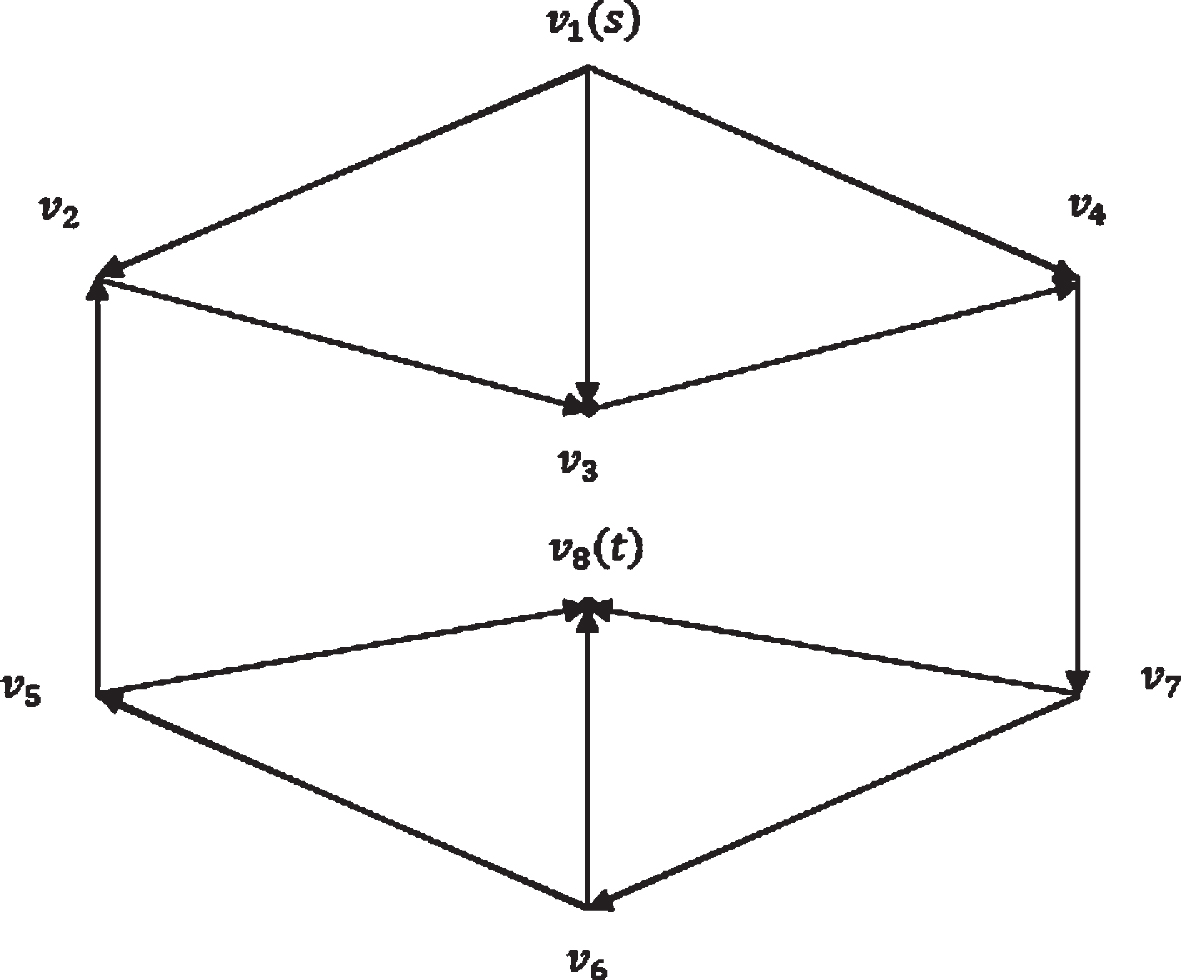
Weighted Connected Directed Network G1
Linked edge costs of G1 are listed in Table 6.The shortest path of G1 can be explored by solving the model (22). Moreover, standard optimization solver-LINGO is used to obtain the solution which is presented in Table 7.
IVTrPFNs Representing Edge Weights of G1
SPP Optimal Results
A MSTP is considered for a weighted undirected connected network G2 (as shown in Fig. 5) with 10 edges and 6 vertices.
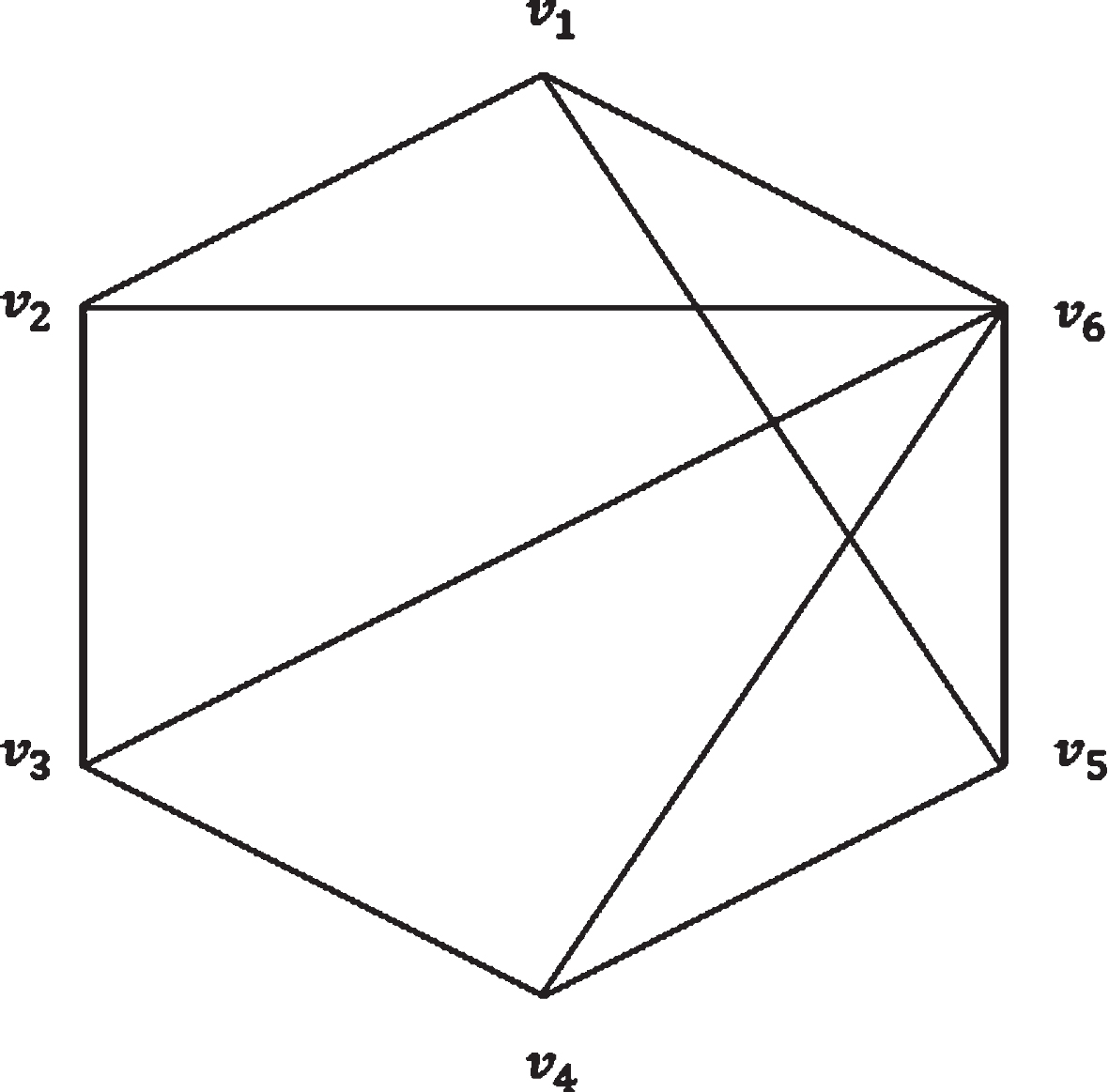
Weighted Connected Undirected Network G2
Edge costs of G2 are presented in Table 8. Minimum spanning tree for G2 can be determined by solving the model (21). Solution of this model is listed in Table 9 which is eventually solved by LINGO.
IVTrPFNs Representing Edge Weights of G2
MSTP Optimal Results
A comparative examination is carried out to exhibit the merit of proposed approach with other existing technique.
There are many productive and practical methods that have been practiced to deal with constrained optimization problems under fuzzy surroundings. Many investigators have proposed extensive investigation and anticipated different techniques to solve fuzzy constrained optimization problems under a range of uncertainties. One of the major approaches considered is CCP method. Formerly, this approach had been proposed to solve LPP with constraints represented as interval type-2 fuzzy parameters and applied to a solid transportation problem (STP). STP with type-1 and type-2 fuzzy parameters was discussed by Jimenez et al. [20], Kundu et al. [21, 23], Yang et al. [47] and Garcia et al. [15].
A comparison is made with a CCP technique involving interval type-2 fuzzy variables (IT2FV) where credibility measure on generalized trapezoidal fuzzy variables (TrFV) ζ = (a, b, c, d ; w) , Cr {ζ ≤ ɛ} is obtained in the following manner:
That is;
For proof of (1) and (2), please see [21].
We consider the same airway network application as stated in Section 5 but in the context of IT2FVs. First we formulate an airway network with two sources, destinations and resources. The linguistic terms associated with the above input parameters are given in Table 1 as in Section 8 and these linguistically defined values are numerically represented as IT2FVs in Table 10.
Linguistic Variables Represented as IT2FVs
Same unit transportation costs are considered as in Section 8.
where
Then its deterministic form is as follows:
Upper Crisp Values Using Generalized Credibility
From Theorem 1 and its corollary, each of
Lower Crisp Values Using Generalized Credibility
Following linear programming model can be constructed by considering auxiliary variable ζ (0 ≤ ζ ≤ 1) and using (24) as follows:
Above problem can be solved by using standard optimization solver-LINGO and the compromise solution is given in Table 13. Other two network problems can also be solved using the same approach with IT2FVs.
Optimum Compromise Solution
Linked edge costs of G1 are listed in Table 14.The shortest path of G1 can be explored by solving the model (22). Moreover, standard optimization solver-LINGO is used to obtain the solution which is presented in Table 15.
IT2FVs Representing Edge Weights of G1
IT2FVs Representing Edge Weights of G1
SPP Optimal Results
Edge costs of G2 are presented in Table 16. Minimum spanning tree for G2 can be determined by solving the model (21). Solution of this model is listed in Table 17 which is eventually solved by LINGO.
IT2FVs Representing Edge Weights of G2
IT2FVs Representing Edge Weights of G2
MSTP Optimal Results
It is shown that both the projected methodology and the comparative study gives the same results about the paths calculated in both SPP and MSTP, however in the comparative investigation, generalized credibility is used to convert the IT2FVs into crisp form whereas in the anticipated approach, we have used the concept of score function for defuzzyfying the IVPFN values into their deterministic form. The anticipated concept is easier and more efficient than the previously used concept as it is more complex. Moreover, the basis of all of these practices is FS theory that is not capable of handling the abnormality and indeterminacy engaged during such observations. Furthermore, they cannot capture the uncertainty more precisely. Hence, we have extended the approach presented by Kundu et al. [21] to a new technique for solving constrained optimization problems in the PFS structure.
Nevertheless, the focus of constrained optimization problems with IVPFN information has not been yet thoroughly investigated. Since people often find it difficult to exactly quantify their opinions facing with incomplete fuzzy DM problems, interval-valued fuzzy elements can provide a better solving way. Thus, we focused on IVPFSs, whose ideas are similar to interval-valued intuitionistic fuzzy sets (IVIFS). As FSs only deal with the membership function and plays no role on the non-membership functions therefore, they are not capable of dealing with haziness and non-deterministic situations. In PFS theory, we have hold on the uncertainty and indeterminacy as well. Thus, we have extended the existing approach in PFS environment to overcome the deficiency of certain information and ambiguous and vague conditions by using IVPFNs. Moreover, an application of airway network with constraints represented as IVPFNs is presented and solved by proposed CCP method. Besides, two different network problems: SPP and MSTP are considered and solved by proposed approach under IVPFN framework. However, the anticipated technique under IVPFN atmosphere is presented for the very first time and is more proficient and capable in handling constrained optimization problems than the FSs environment.
Conclusion
In this article, we have proposed a method to solve LPP with constraints involving IVPFNs. Compared with the related works, the main contribution of our work is that we have proposed a novel CCP method for solving LPP with IVPFN constraints and afterwards applied it to an airway network where the constraints are represented as IVTrPFNs. Moreover, we have solved a linear optimization problem with coefficients of the objective function as IVPFNs by considering two network problems i.e. MSTP and SPP.
This analysis fills up the gap for the deficiency of suitable method in literature to solve LPP with IVPFNs as there does not exist any suitable approach to handle LPPs relating interval-valued parameters. Moreover, interval-valued fuzzy elements can provide a better solving way because when the values of membership and non-membership function in a PFS are hard to express as exact real numbers in many real-world problems, IVPFS can be used to portray the uncertain information more adequately and accurately.
In the future, we plan to extend our study in some other directions as well. Since the whole investigation in this article has been done with IVPFNs, therefore the study in this paper can also be extended using Hamacher power aggregation operators [44] and Einstein interactive operations based on the weighted averaging operator [28] to solve different DM problems. As PFSs provide a wider space to associate membership and non-membership grades to the elements of the set so, this approach [28] can be extended in PFS framework as it helps in representing and managing vagueness, impreciseness, and uncertainties than IFS in different DM processes. Also, the projected method is computationally proficient and capable to solve such DM problems and provides a flexible way in handling problems concerning with LPPs and linear optimization problems.