



Abstract
In the recent years, several new construction methods of fuzzy implications have been proposed. However, these construction methods actually care about that the new implication could preserve more properties. In this paper, we introduce a new method for constructing fuzzy implications based on an aggregation function with F (1, 0) =1, a fuzzy implication I and a non-decreasing function φ, called FIφ-construction. Specifically, some logical properties of fuzzy implications preserved by this construction are studied. Moreover, it is studied how to use the FIφ-construction to produce a new implication satisfying a specific property. Furthermore, we produce two new subclasses of fuzzy implications such as UIφ-implications and GpIφ-implications by this method and discuss some additional properties. Finally, we provide a way to generate fuzzy subsethood measures by means of FIφ-implications.
Introduction
Fuzzy implications attract wide attention of researches occupied in fuzzy logic both because of their interesting properties and many applications, not only in fuzzy control and approximate reasoning, but also in many other areas they have proved to be valuable like composition of fuzzy relations [7, 20], fuzzy relational equations [22, 23], fuzzy mathematical morphology [11, 14], fuzzy neural networks [38, 39], fuzzy rough sets [12, 41] and data mining [43].
This fact has led more and more people to a systematic research of many fuzzy implication functions in theory (see the recent survey [4] and the book [3]). However, in these theoretical studies, the new methods of constructing fuzzy implications have become a hot topic.
From these studies, more and more construction methods have been introduced over time, some interesting methods construct fuzzy implications from given ones. Specifically, there are many well-known construction methods, for which we highlight the following ones: The classical ones like for instance the φ-conjugate or the N-reciprocal, lower and medium contrapositivisations, and the minimum, maximum or any convex linear combinations of fuzzy implication functions (see [3] for details). Other construction methods such as the horizontal and vertical threshold generation methods [30–32], some new types of contrapositivisations [2] and the ⊛-composition [40]. More recent construction methods for fuzzy implications have been introduced like the rotation construction [36], the FNI-method [1], the quadratic construction method [26] and the n increasing functions and n + 1 negations-composition [35].
In fact, when finding new construction methods to generate fuzzy implication functions, we need to consider two main important points. Firstly, the new construction method of implication functions should be as simple as possible so that the new ones can be easily express and compute. Secondly, the new obtained implication functions should preserve as many desired properties as possible.
In this sense, we introduce a new method for constructing fuzzy implications based on an aggregation function F with F (1, 0) =1, an implication function I and a non-decreasing function φ, called FIφ-construction. On the one hand, we will show how to use this method to modify a given implication such that the new obtained implication function can be satisfied some desired properties. On the other hand, we find our method can be applied to generate fuzzy subsethood measures, which is useful in several areas, such as fuzzy decision making [27], fuzzy relational databases [28], image processing [9], clustering [44] and intelligent systems [34].
The importance of our research can be divided into the following two aspects: The first aspect is that the importance of new construction methods is related to the preservation of the properties of the initial fuzzy implications to the final one. Although all the construction methods can preserve certain properties, none of the previous construction methods from two implications ensure a resulting implication satisfying the exchange principle even when the two initial ones satisfy it. Therefore, it is necessary and interesting to study how to modify a given fuzzy implication such that the new obtained implication can be satisfied some desired properties, such as, identity principle, exchange principle and strong negation principle. The second one is that the construction methods of fuzzy implications have been used in many practical applications. For instance, Dimuro et al. [16] generated fuzzy subsethood and entropy measures by means of QL-implications constructed from tuples (O, G, N⊤), where O is an overlap function, G is an grouping function and N⊤ is the greatest fuzzy negation. Later, Pinheiro et al. [33] introduced a method to construct fuzzy subsethood measures using (T, N)-implications. Su et al. [36] proposed the rotation construction, which provides a wide spectrum of choices for fuzzy connectives. Recently, Zanotelli et al. [45] introduced n-Dimensional fuzzy (S, N)- implication and explored it in approximate reasoning.
The paper is organized as follows: In Section 2, we recall some basic definitions and related properties which are necessary for the development of this paper. In Section 3, we study the new construction method for fuzzy implications. Firstly, we analyse the logical properties of the newly constructed fuzzy implications, and then we discuss how to use the FIφ-construction to modify a given implication and we also compare our method with several existing methods. In Section 4, we produce two subclasses of fuzzy implications such as UIφ- and GpIφ-implications through this method and discuss some additional properties. In Section 5, we provide a way to generate fuzzy subsethood measures using FIφ-implications. Section 6 concludes the paper with our final remarks, and outlines some further work.
Preliminaries
In this section, we recall here some basic definitions and related properties which are necessary for the development of this paper. More details about t-norms and t-conorms can be found in [24].
Commutativity: T (x, y) = T (y, x) ; Associativity: T (T (x, y) , z) = T (x, T (y, z)) ; Monotonicity: T (x, y) ⩽ T (x, z) for y⩽ z ; 1-identity: T (x, 1) =1.
Commutativity: S (x, y) = S (y, x) ; Associativity: S (S (x, y) , z) = S (x, S (y, z)) ; Monotonicity: S (x, y) ⩽ S (x, z) for y⩽ z ; 0-identity: S (x, 0) = x.
F is increasing in each variable; F (0, 0) =0 and F (1, 1) =1.
Commutativity: U (x, y) = U (y, x) ; Associativity: U (U (x, y) , z) = U (x, U (y, z)) ; There is a neutral element e ∈ [0, 1], such that U (x, e) = x for all x ∈ [0, 1].
It is clear that U is a t-norm if e = 1 and is a t-conorm if e = 0. Moreover, for any e ∈ (0, 1), the uninorm U works as a t-norm in the [0, e] 2 square, and as a t-conorm in [e, 1] 2. We usually denote a uninorm U with neutral element e, underlying t-norm T U , and underlying t-conorm S U by U ≡ 〈T U , e, S U 〉.
Commutativity: G (x, y) = G (y, x) ; Associativity: G (G (x, y) , z) = G (x, G (y, z)) ; There is an absorbing element k ∈ [0, 1], such that G (k, x) = k for all x ∈ [0, 1], G (0, x) = x for all x ∈ [0, k] and G (1, x) = x for all x ∈ [k, 1].
Evidently, when k = 0 and 1, then G is respectively a t-norm and a t-conorm. It is worth noting that the absorbing element k is given by k = G (0, 1) = G (1, 0). Similarly, for any nullnorm G, we usually denote it by G ≡ 〈S G , k, T G 〉.
N (0) =1 and N (1) =0 ; If x ⩽ y, then N (x) ⩾ N (y) for all x, y ∈ [0, 1]. In addition, we highlight several properties of fuzzy negation: strict, if it is continuous and strict decreasing; strong, if it is an involution, i.e., N (N (x)) = x for all x ∈ [0, 1].
The most frequently used strong negation is the standard negation Ns (x) =1–x for all x ∈ [0, 1].
I is non-increasing with respect to the first variable; I is non-decreasing with respect to the second variable; I (0, 0) = I (1, 1) =1 and I (1, 0) =0.
It is worth noting that from the above definition, we can deduce that I (0, x) =1 and I (x, 1) =1 for all x ∈ [0, 1]. The family of all fuzzy implications will be denoted by
The identity principle, if
The consequent boundary, if
The neutrality property, if
The continuity condition, if
The order principle, if
The strong negation principle, if
The exchange principle, if
The lowest falsity property, if
The lowest truth property, if
In this section, we introduce a new method, called FIφ-construction, to produce implication functions. Firstly, we give the definition of new generated fuzzy implications and then we examine the logical properties preserved by this construction. Finally, we compare the results of the FIφ-construction with several existing methods.
Fuzzy implications generated by the FIφ-construction
I
FIφ
satisfies (I2) since for all x, y1, y2 ∈ [0, 1] with
I
FIφ
satisfies (I3) since
Therefore,
Next, let us give some interesting examples of the FIφ-construction to produce fuzzy implications.
(i) Consider the probabilistic sum t-conorm, that is, SP (x, y) = x + y - xy, I the Goguen implication
(ii) Take a t-conorm S, φ a non-decreasing function, and I the Rescher implication
Then we generate the following SIφ-implications:
(iii) Taking a t-conorm S, I arbitrary implication function, and φ a non-decreasing function given by
Then we obtain I SIφ (x, y) = I (x, y) for all x, y ∈ [0, 1].
(iv) Taking a t-conorm S, φ a non-decreasing function, and I the Gödel implication
Then we obtain the SIφ-implications are given by
On the other hand, if we take S = max and φ (y) = y, then we retrieve the Gödel implication.
(v) Similarly, take again a t-conorm S, a non-decreasing function φ (y) = y, and I the Reichenbach implication, that is, IRC (x, y) =1 - x + xy, then we obtain
If we take again S = max, then we retrieve Reichenbach implication.
(vi) Take I = IRC, φ any non-decreasing function such that φ (y) ⩽ y for all y ∈ [0, 1], and F the aggregation function is given by
Then we obtain the FIφ-implications are given by
The structure of the corresponding FIφ-implication can be viewed in Fig. 1.
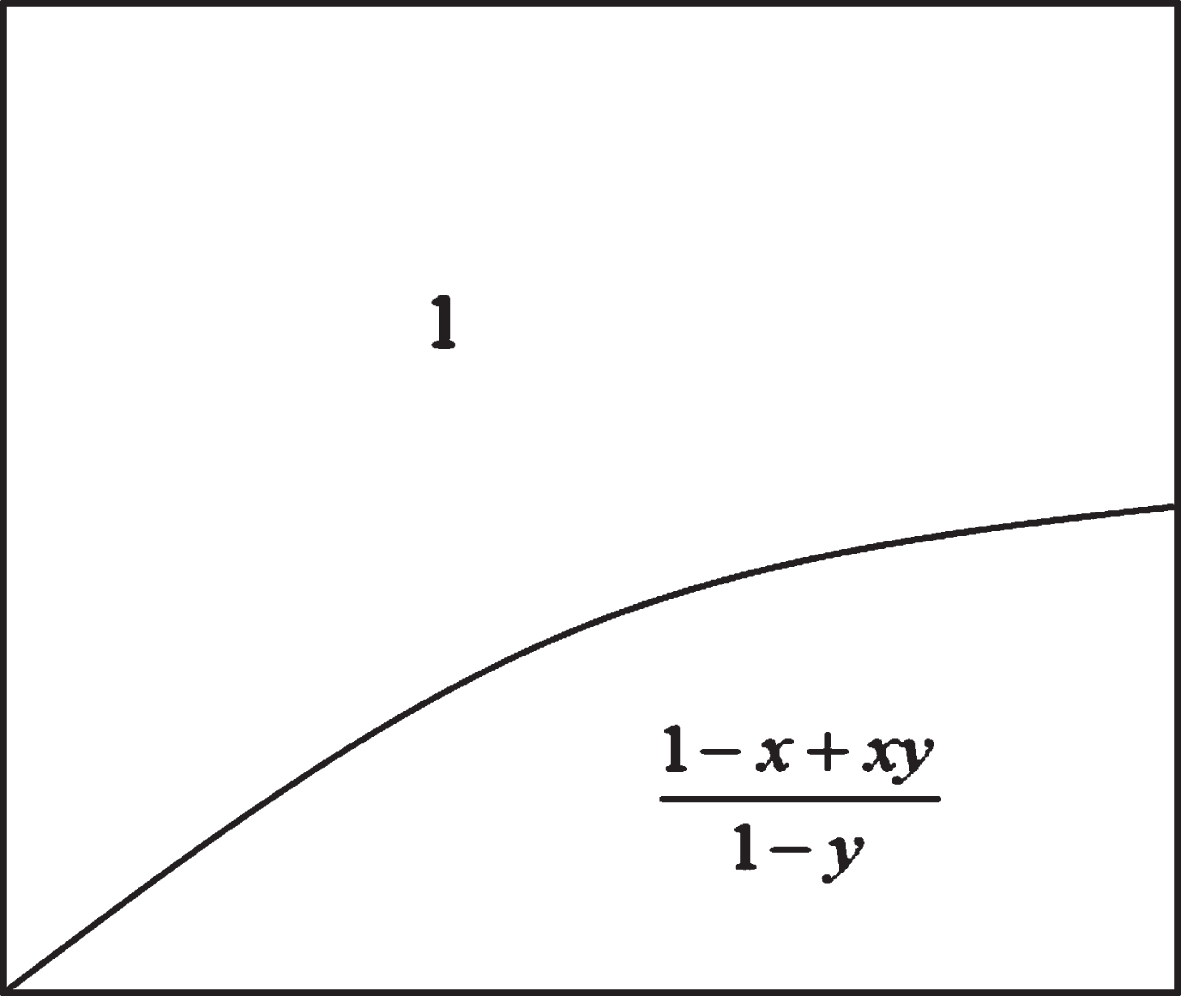
The structure of implication given in (12).
(vii) Take a disjunctive uninorm U with e = 0.5, and it is given by
Take again I = IRC, and φ any non-decreasing function such that φ (y) ⩽ y for all y ∈ [0, 1]. Then we have the corresponding FIφ-implications are given by
The structure of the corresponding FIφ-implication can be viewed in Fig. 2.
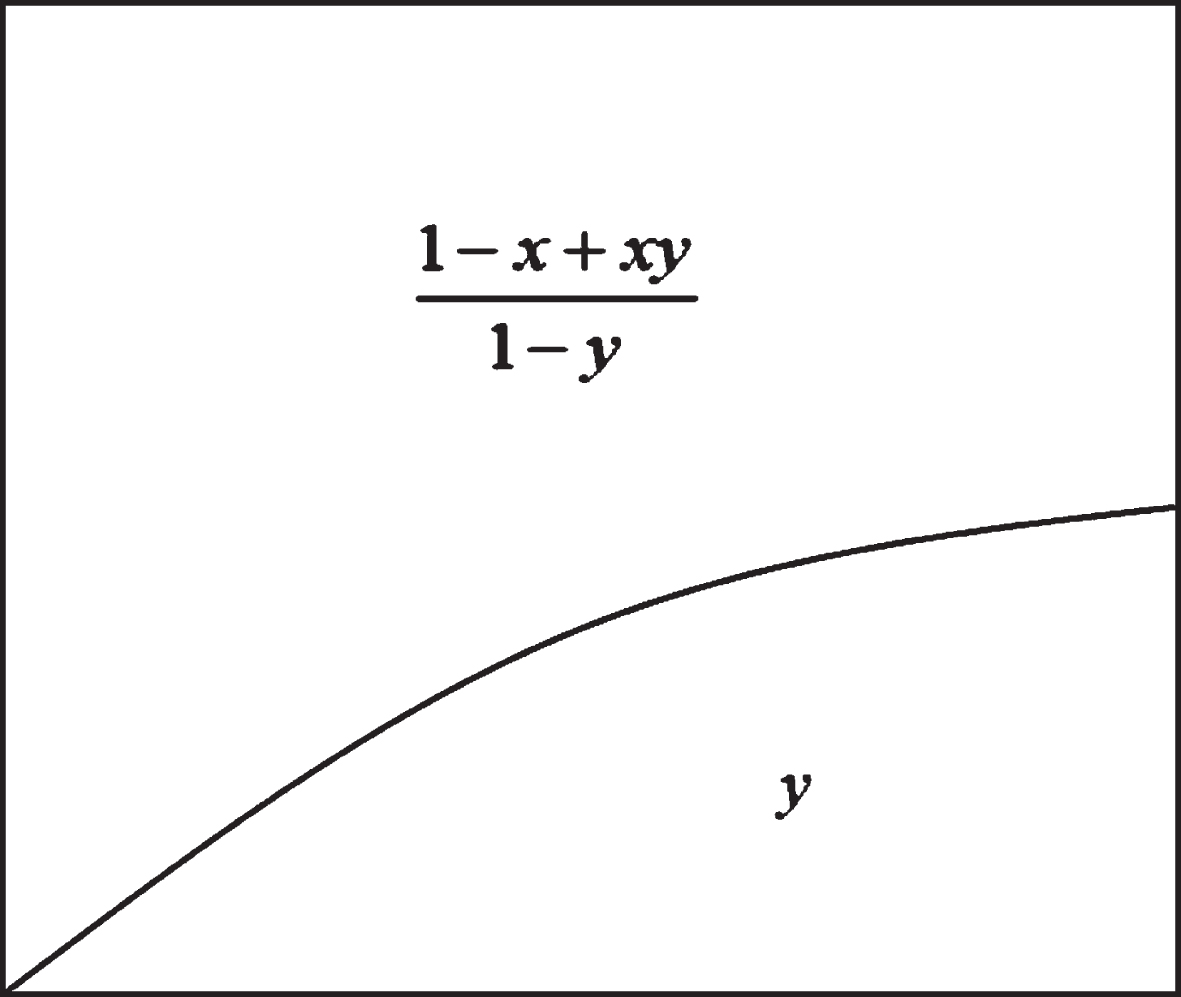
The structure of implication given in (14).
Inspired by the FIφ-construction, it is proved that all fuzzy implications are FIφ-implications as the following result.
Thus, we have I FIφ = I. □
By Theorem 3.4, we know that there exist a case such that I FIφ = I. Thus, an open problem arises:
In this subsection, we study the logical properties that are preserved by the FIφ-construction, and we obtain the following results.
Moreover, by (F1) and (F2), it follows that:
Thus, I satisfies (4) iff I FIφ satisfies (4). □
Next, we further study the identity principle (2) and the order principle (6). Note that from the monotonicity of F and the condition F (1, 0) =1, we deduce that F (1, y) =1 for all y ∈ [0, 1].
I satisfies (2) if and only if I
FIφ
satisfies (2).
I satisfies (6) if and only if I
FIφ
satisfies (6).
(ii) If I satisfies (6), then for all x, y ∈ [0, 1], we have the following equivalence:
Consider the aggregation function F
mM
in Example 3.3 (vi), the non-decreasing function φ (y) = y, and the Reichenbach implication I = IRC. It is well known that IRC does not satisfy (2), but we generate the corresponding I
FIφ
given in Equation (12) can satisfy (2). Consider the Łukasiewicz t-conorm, given by SLK (x, y) = min(x + y, 1), the non-decreasing function φ (y) = y, and the Gödel implication I = IGD. It is known that IGD satisfies (6), but we generate
Thus, I satisfies (7) if and only if I FIφ satisfies (7). □
Again, note that without the precondition stated in the proposition above, the corresponding I FIφ does not satisfy (7) even when the initial fuzzy implication I satisfies (7) as it is presented to the following example.
It is clear that the least fuzzy negation N⊥ is not a strong negation, and thus I FIφ does not satisfy (7).
However, if we consider other non-decreasing functions φ, then it is not ensured that the corresponding I FIφ satisfies (8) even when the initial fuzzy implication I satisfies (8) as it is shown in the following example.
In this subsection, we study how to use the FIφ-construction to produce a new fuzzy implication satisfying a concrete property like (2), (3) or (5) even when the original implication I does not satisfy them. In this direction, we must consider adequate aggregation functions F and non-decreasing functions φ to get the objective. Firstly, let us further study the identity principle (2).
It is clear that S such that S (x, φ (x)) =1 for every x ∈ (0, 1]. Consider now I = IKD the Kleene-Dienes implication which satisfies IKD (x, x) ⩾ x, but it does not satisfy the identity principle (2). The corresponding I
SIφ
is given by
Then we have I SIφ (x, x) =1 for all x ∈ [0, 1], and thus I SIφ satisfies (2).
If F and φ are continuous, then we have
Comparing with the existing construction methods
In this subsection, we compare our method with the existing methods from two aspects, including the main characteristics and application areas of the construction methods. Especially, we provide Table 1 to show the differences between the existing construction methods and our method.
Comparisons with existing construction methods
Comparisons with existing construction methods
In this suction, we will use uninorms and nullnorms in the FIφ-construction to produce two subclasses of fuzzy implications such as UIφ- and GpIφ-implications and discuss some additional properties.
UIφ-implications and GpIφ-implications
Note that the last equivalence holds, and thus I UIφ satisfies (2) (resp. (6)) if and only if I satisfies it. □
In this subsection, we want to study a property of fuzzy implications: I (x, e) = e for all x > 0, introduced in [31] and in the same paper, they were named e-threshold generated implication with e ∈ (0, 1). In particular, this kind of implication functions take values depending on the threshold e. In this case, we will see that the corresponding UIφ- and GpIφ-implications can satisfy this property.
Case 1, if y ⩽ e, then by (I2) we deduce that I (x, y) ⩽ e. Moreover, note that in this case, φ (y) ⩽ e. Thus, in points (I (x, y) , φ (y)), the uninorm U is given by T U .
Case 2, if y > e, then by (I2) we deduce that I (x, y) ⩾ e. Moreover, note that in this case, φ (y) ⩾ e. Thus, in points (I (x, y) , φ (y)), the uninorm U is given by S U . □
The property: I (x, N (x)) = N (x)
In this subsection, we consider an important property: I (x, N (x)) = N (x) for all x ∈ [0, 1], studied in [8] and recently received a lot of attention because it proved to be valuable in the fuzzy indices. In this case, we will see that the corresponding UIφ- and GpIφ-implications can be used in this property as follows.
Furthermore, since U is idempotent and φ (y) = y, thus we have I UIφ (x, N (x)) = U (N (x) , N (x)) = N (x). □
Now, we shall consider the following two cases:
Case 1, if x ⩽ k, then by (N2), it is N (x) ⩾ N (k) = k. Moreover, by (I1) we deduce that I (x, N (x)) ⩾ N (x). So in this case, we have that Gp (I (x, N (x)) , N (x)) = min {I (x, N (x)) , N (x)} = N (x).
Case 2, if x ⩾ k, then by (N2), it is N (x) ⩽ N (k) = k. Moreover, by (I1) we deduce that I (x, N (x)) ⩽ N (x). So in this case, we have that Gp (I (x, N (x)) , N (x)) = max {I (x, N (x)) , N (x)} = N (x).
Therefore, the corresponding I G p Iφ satisfies the property I G p Iφ (x, N (x)) = N (x) for all x ∈ [0, 1]. □
Applying FIφ-implications to construct fuzzy subsethood measures
Fuzzy subsethood measures [44] allow one to determine up what extent a given fuzzy set included into another one, which is useful in some applications, such as fuzzy decision making [27], fuzzy relational databases [28], image processing [9], clustering [44] and intelligent systems [34].
Fuzzy subsethood measures can be applied to generate fuzzy entropy measures, which determine the amount of fuzziness, or vagueness in a given fuzzy set [13, 25].
It is well known that fuzzy implications play an important role in the generation of fuzzy subsethood measures. In this section, we provide a way to construct fuzzy subsethood measures by means of FIφ-implications. In order to achieve our goals, first we recall Pinheiro-Bedregal’s fuzzy subsethood measure, which is defined as follows:
σ
PB
(A, B) =1 ⇔ A (x) =0 or B (x) =1, ∀ x ∈ X ; σ
PB
(A, B) =0 ⇔ A = X and B =∅ ; (i) If A ⩽ B ⩽ C, then σ
PB
(C, A)⩽ σ
PB
(B, A) ; (ii) If A ⩽ B, then σ
PB
(C, A) ⩽ σ
PB
(C, B).
In [33], Pinheiro et al. provided a way to construct fuzzy subsethood measures in the sense of Definition 5.1 by means of (T, N)-implications. Following this line, we study how to generate Pinheiro-Bedregal’s fuzzy subsethood measures using FIφ-implications. It is necessary here to recall the notions of n-ary aggregation functions.
In the following, we present a proposition that generates Pinheiro-Bedregal’s fuzzy subsethood measure by aggregating the FIφ-implication I FIφ .
(PB1) For all A, B ∈ F (X), since A is 1-positive, F satisfies that F (x, y) =1 ⇔ x = 1 and I satisfies that I (x, y) =1 ⇔ x = 0 or y = 1, then it follows that:
(PB2) For all A, B ∈ F (X), since
(PB3) (i) For any A, B, C ∈ F (X) with A ⩽ B ⩽ C, it follows from the monotonicity of I, F and
(ii) Similarly, for any A, B ∈ F (X) with A ⩽ B, it follows from the monotonicity of I, φ, F and A that
Therefore, σ FIφ is a Pinheiro-Bedregal’s fuzzy subsethood measure. □
Then, for all A, B ∈ F (X), we have
Conclusion
It is necessary and interesting to study how to modify a given fuzzy implication such that the new obtained implication can be satisfied some desired properties. In this sense, a new method for constructing fuzzy implications based on an aggregation function with F (1, 0) =1, a fuzzy implication I and a non-decreasing function φ, called FIφ-construction, is introduced. Our method can be used to generate a new implication satisfying a specific property. Moreover, the logical properties preserved by the new fuzzy implications generated by the FIφ-construction are studied. However, an open problem is still unsolved:
As further work, we intend to further study the FIφ-construction method, and we believe that many different directions related to this construction also deserve to be investigated. For instance, one can use the FIφ-construction to generate a new fuzzy implication, which depending on only one operator. If we consider the probabilistic sum t-conorm and the non-decreasing function φ (y) = y, then we generate
Footnotes
Acknowledgments
The authors would like to express gratitude to the Editor-in-Chief and anonymous reviewers for their valuable comments and suggestions. This research is partially supported by the Natural Science Foundation of Hebei Province (Grant No. F2018201060).