



Abstract
Prediction of structural damage prior to earthquake occurrence provides an early warning for stakeholders of building such as owners and urban managers and can lead to necessary decisions for retrofitting of structures before a disaster occurs, legislating urban provisions of execution of building particularly in earthquake prone areas and also management of critical situations and managing of relief and rescue. For proper prediction, an effective model should be produced according to field data that can predict damage degree of local buildings. In this paper in accordance with field data and Fuzzy logic, damage degree of building is evaluated.
Effective parameters of this model as an input data of model consist of height and age of the building, shear wave velocity of soil, plan equivalent moment of inertia, fault distance, earthquake acceleration, the number of residents, the width of the street for 527 buildings in the city. The output parameter of the model, which was the damage degree of the buildings, was also classified as five groups of no damage, slight damage, moderate damage, extensive damage, and complete damage. The ranges of input and output classification were obtained based on the supervised center classification (SCC-FCM) method in accordance with field data.
Introduction
Earthquake is one of the most important and destructive natural disasters, which threaten the lives of many people all over the world every year. The prediction of possible damages before the occurrence of earthquakes is always a widespread concern, which can provide the required readiness to ameliorate the occurred effects. It is natural that as this readiness is accompanied by a more accurate prediction of realities proportional to the occurred damages, the affected people would be rescued in a faster and safer way. Therefore, achieving a model according to the realities of each region can provide crisis managers with more accurate information and make any prediction or preparation before the crisis more realistic and effective. Before an earthquake in a city, a model should be found for prediction of damages to structures and other parameters effective in the quality of emergency aids, based on the statistical information of the effective parameters in the structural damage, as well as the faster and more efficient rescue of the affected people. This can facilitate the planning for crisis management and emergency aids to the damaged people according to the realities of that city and the local data, along with decision-making about required predictive operations. Furthermore, these operations can be planned more effectively and efficiently, while the retrofit and optimum changes in the effective parameters of damage can be implemented before the earthquake.
There are various methods for analyzing constructed structures. Buildings have been constructed in different periods with different design and execution qualities. Therefore, the solution of numerical analysis according to all of the parameters effective in the strength of a structure in a city is not practical to reach an appropriate model for the behavior of entire buildings in a city. The simulation of a building during the earthquake and considering of uncertainties of effective parameters need to a lot of statistical data and fragility curves of structure [1, 19]. Moreover, attaining the numerical information required for structural analysis and assessment of the possible damages is a time-consuming, costly, and nonoperational task [4]. Thus, considering the qualitative methods of assessment of structures and conclusion of effective parameters in a structure, a technique can be found, using which a qualitative model for prediction of structural damage can be created with suitable speed and accuracy based on the field assessments and data in the city [10, 24], and the crisis management operations can be planned based on the available data [18, 26]. With creating an appropriate pattern for this model, municipalities can be informed of the level of caused damages in the cities before earthquakes and take measures to reduce the damages of possible earthquakes through step-by-step retrofit programs [14, 25]. If municipalities are aware of the number of buildings in each area, the level of possible structural damages, and consequently casualties and financial losses, they can prioritize the retrofit of buildings with higher risks of damages and urge their owners to do so before any disaster. It is evident that any predictive measure in this regard is incomparable with the future costs after possible crises, and the adverse economic consequences caused by destructive earthquakes are much greater than those of any retrofit. qualitative methods for earthquake damage evaluation should be considered the direct and indirect financial effect [6].
Moreover, insurance companies need to have a suitable and reliable model to have the required estimations of probable damages to a building. If the model is not in accordance with the local conditions of the region, the estimations will not have sufficient accuracy, which can cause irreversible damages to the insurance companies. the outputs of these models evaluate the cost and time of renovation [23] and also predicting of injured people after occurrence of earthquake [12]. Numerous parameters affect the level of structural damages [20], financial losses [6], and casualties in the failure of a building [12]. Most of these factors depend on the local conditions of construction [7], type of structures [5] and quality of their execution, age and height of constructed buildings, geographical conditions of structures, such as soil type and distance from faults [16], the population density of the city, and even the streets to have access for emergency aids [3]. The crisp numerical models cannot respond to many of qualitative parameters effective in such damages since considering such parameters in the numerical analyses based on the crisp logic requires considerable time and cost, and it is not practical. Always a result with acceptable accuracy can be obtained by suggesting a suitable qualitative model with suitable accuracy, high speed, and low cost [2].
In order to plan and predict the vulnerability level of a city during accidents like earthquakes, many humanitarian aid organizations, such as Red Crescent Society and Crisis Management Organization, require appropriate information of the city in terms of the severity of damages to buildings, their performance with vital conditions, and especially the access streets after [3, 11]. They need information, patterns, and models that are in accordance with the realities of the city and region so that they can develop a definite plan during crises like earthquakes [22]. During such events, the presence of a defined program for the organizations results in a faster and more effective emergency aid, which reflects the importance of modeling [13]. Since in the cases of severe earthquakes, the prevention and retrofit are always less costly than rehabilitation [21, 23], the governments and municipalities can prevent many social and economic consequences by giving financial and supportive aids even to buildings with a probability of considerable financial losses and casualties, which has much lower costs for the city [8, 23]. A notable example is the conflagration accident of the 17 story Plasco building in Tehran, Iran in 2016 which took the lives of many people and led to irreversible consequences for the retailers and people of the region. If more appropriate planning was done and the municipality urged to rehabilitate or renovate it, such a disaster would not happen. The city of Tehran is located in a region subjected to severe earthquakes, and its construction has special conditions. Moreover, history has shown that in 743, 855, 958, 1177, 1283, 1665, 1815, and last time in 1830, a severe earthquake has happened, resulting in the significant destruction of the city. Moreover, in 1830 earthquake a huge part of Shemiran and Damavand were destroyed and now about 190 years that a severe earthquake has not happened and this subject reveal the sensitivity of discuss about this model. Therefore, an appropriate pattern should be worked on for the prediction of the structural damages, financial losses, and casualties. Considering the repeating period of high-intensity earthquakes, every moment, we may witness an earthquake with considerable intensity, and a humanitarian, financial, and economic disaster. This indicates the need for a comprehensive program based on field conditions.
Modeling logic and evaluation of effective parameters
Since this research is aimed at achieving a qualitative model for the damage level of buildings based on field conditions and the parameters effective in this modeling are qualitative, the model development method is based on the fuzzy logic. Compared to the crisp logic, which is based on the zero or one values of Aristotle, this logic can be very useful, effective, and efficient for the parameters with qualitative, not solely quantitative nature. The fuzzy logic is a method to evaluate the linguistic and information uncertainties, whose qualitative conditions may not be correctly considered if constant numerical values are assigned to them. In terms of qualitative assessment, some issues of fuzzy logic can provide more realistic results compared to crisp logic.
The fuzzy logic and the classification methods presented in this model can express each of the parameters effective in the modeling as acceptable linguistic parameters. By using the conducted field research, the boundary ranges can be determined, and using the fuzzy c-mean method, the parameters can be classified, and classification ranges can be provided for them [17].
In this method, data are classified in two ways: Unsupervised classification methods Supervised center classification
In the second method, the classification is based on the information obtained from field research; so, it is more realistic, and its results have minimum errors. Therefore, the second method is used in this study, and the following parameters are separately considered for steel and concrete structures based on the field research through the city. One of the most important factors in evaluating the damage to a building is the availability or lack of a seismic code during construction. Since the first edition of the Iranian code for the seismic-resistant design of buildings “Standard 2800” was enforced in 1988, the buildings constructed before that year had no calculation about seismic forces, so such buildings should be investigated. The next editions of the Standard 2800 were endorsed in 1999, 2005, and 2014 as the 2nd to 4th editions. Therefore, the buildings’ ages and the seismic design classification of each building should be surveyed in the field research to be taken into account in the related calculations. The natural period, ductility, and damping of structures are among the effective factors in calculating the lateral loads of earthquakes. All these factors are proportional to the number of stories of the buildings. Thus, the number of stories and heights of constructed buildings should be separately surveyed to be considered in the modeling and calculation of structural damages and casualties [6]. The shear wave velocity and base soil type of structures are the other factors affecting the amount of seismic load imposed on each building. Based on the shear wave velocity, the number of standard penetration blows (SPT number), and undrained shear strength in cohesive soils, the base soil of each building is classified as four types of I, II, III, and IV. The shear wave velocity is considered in calculations based on the Standard 2800. The acceleration of a structure during an earthquake depends on the parameters design base acceleration, natural period, reflection factor, importance factor, and behavior factor of the structure. Therefore, each of the mentioned parameters should be calculated to determine the acceleration of the structure [7, 9]. During earthquakes, the equivalent moment of inertia of each story is one of the factors affecting the torsional stiffness of a structure. In this study, the moment of inertia about the weak axis of each story is considered the equivalent moment of inertia of the building and as a criterion about the lateral stiffness and torsion in the structure, as an input parameter in the fuzzy model. One of the factors effective in the force applied to a structure during an earthquake is the distance of the structure from the activated fault in the earthquake. It is evident that as this distance is lower, the amount of the force applied to the structure, and finally, the damage to it would be greater. Therefore, this distance is considered as one of the effective input parameters in the model. After an earthquake, one of the very important factors for emergency aid and easy access to the damaged buildings and rescue of the affected people is the lack of access to those areas due to the debris caused by the destruction of buildings in the access streets, in which the most intensifying factor is the width of the street. The lower width of the street and the higher height of constructed buildings in it increase the blockage probability of the street, raising the problems of rescue teams to access the damaged people. Hence, the ratio of building height to street width is considered as one of the input parameters of the model. The number of casualties of each building during an earthquake is directly proportional to the number of its residents. Therefore, the number of residents and units of each building should be determined in the conducted field research so that the obtained data are an appropriate and reliable representative in the modeling analyses [19].
Field research and data analysis
Since the method used in this study is through the statistical field information, the effective parameters in the modeling for 527 buildings in the city were collected. Samples of the collected information for the steel and concrete structures are respectively presented in Tables 1and 2 .
A sample of field research of steel structures
A sample of field research of steel structures
A sample of field research of concrete structure
The information about structure age, structure height, structure type, building length and width, street width, and the number of residents in the buildings was collected through the drawings and field surveying. The information on soil types was acquired from the soil type zoning map of the Tehran municipality’s study center for geo-technics and strength of materials. In the conducted field research, the distances of buildings to the existing faults were surveyed according to the seismic history of the seismogenic source using the fault maps of Tehran made by the International Institute of Earthquake Engineering and Seismology in Tehran, Iran. The frequency histograms of the parameters effective in the steel and concrete structures are presented in Figs. 1, 2.

The frequency histograms of the parameters effective in the steel and concrete structures.
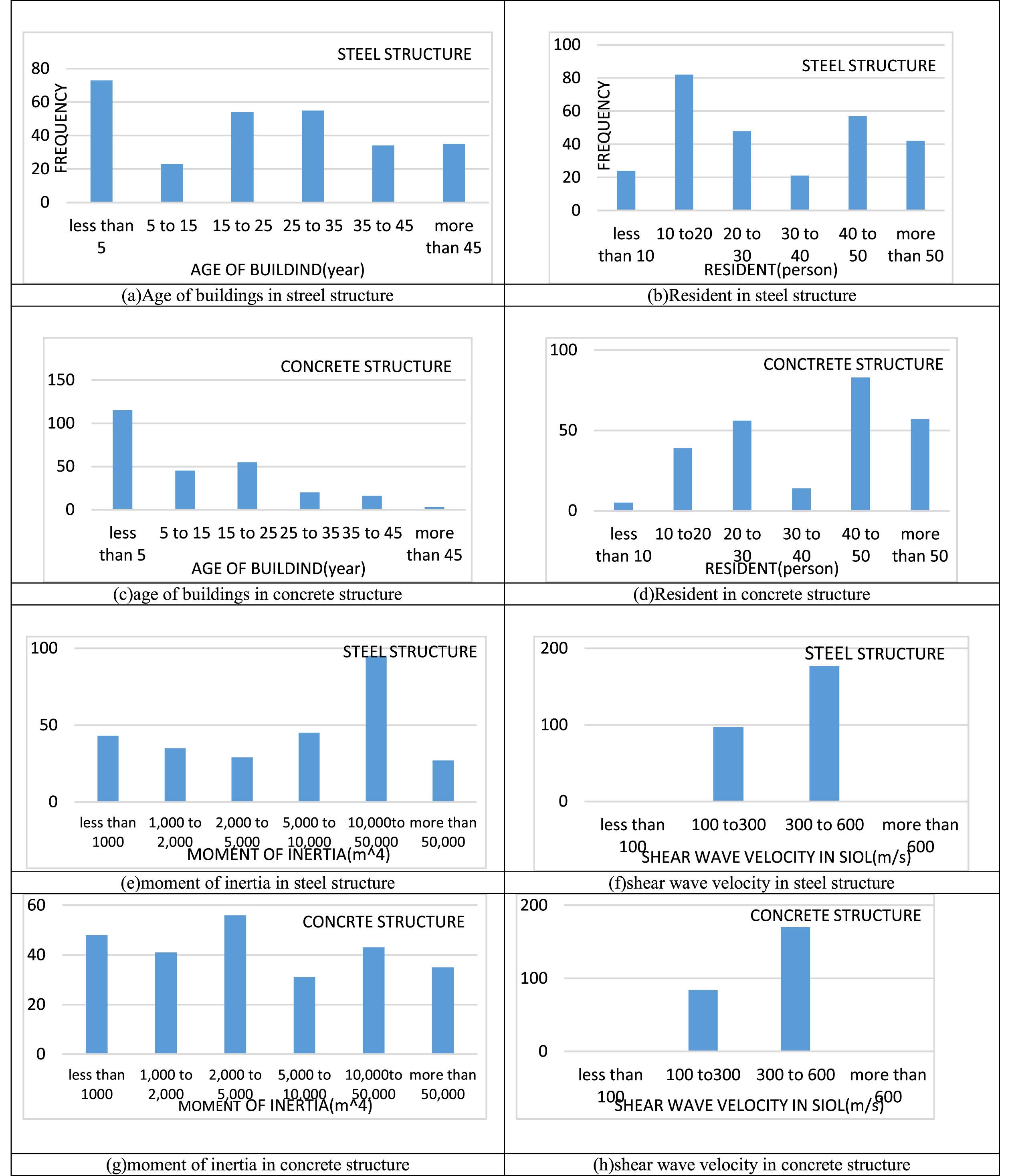
Frequency histograms of the parameters effective in the steel and concrete structures.
Each fuzzy model consists of three fully separate sections. The first section is the input parameters, the second section is the fuzzy inference or fuzzy rule base, and the last section is the output parameters. The input parameters include structure age, structure height, shear wave velocity in soil, earthquake factor, the equivalent moment of inertia of plan, distance to the fault, the ratio of structure height to street width, and the number of the residents in the building.
The inference is the internal section of the fuzzy model, in which the model rules are expressed as if-then statements. Finally, the last section, which is the model output, indicates the damage degree of buildings (Fig. 3), [4].
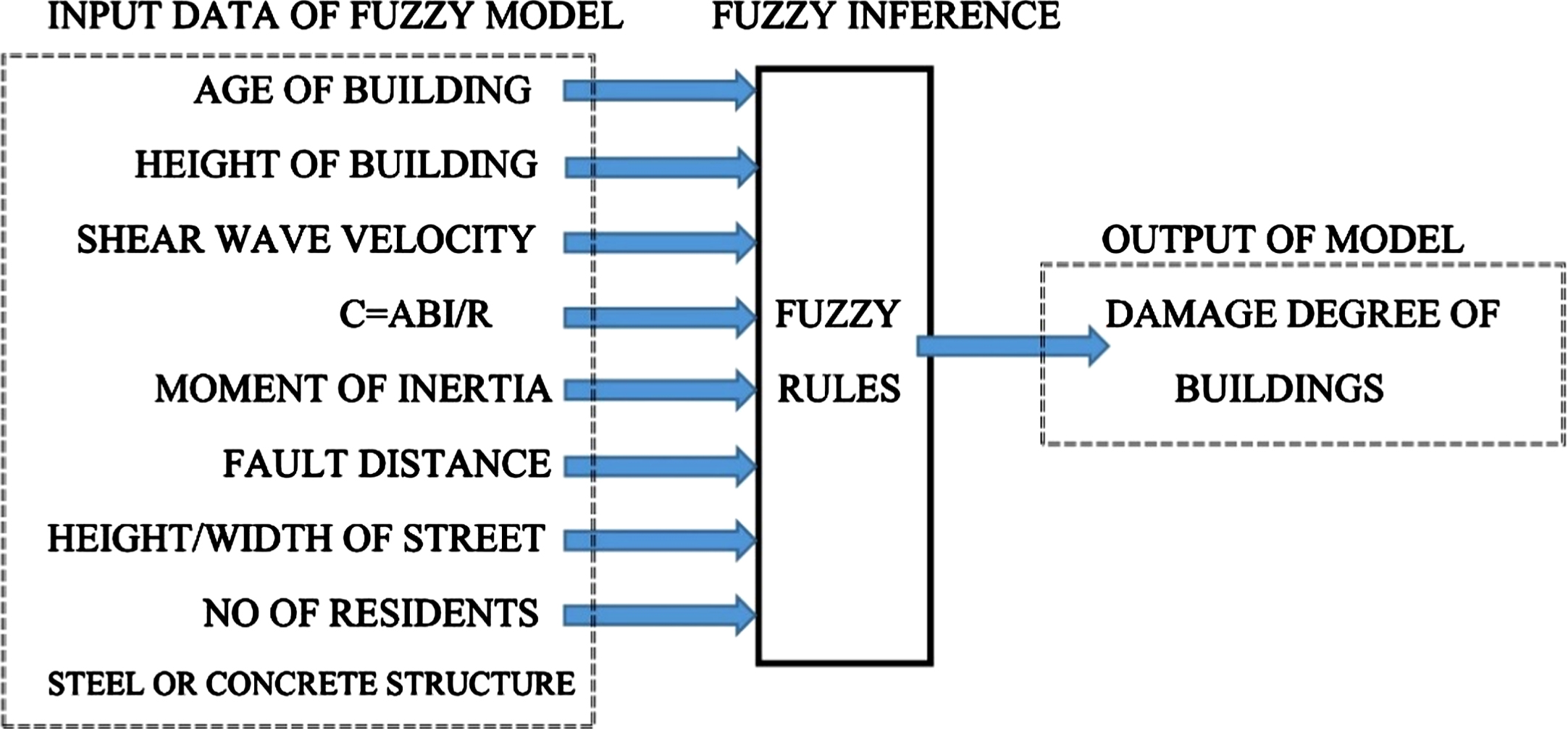
Components of fuzzy modeling.
In order to display the input and output parameters of the Mamdani fuzzy model, their membership functions were used. The membership functions used in this study were the five membership functions whose ranges were obtained based on the statistical data of the field research using the method described in the supervised center classification or the second method of FCM. In this method, the input parameters are divided into five groups of bad (B), relatively bad (RB), medium (M), relatively good (RG), and good (G) [15].
The ranges of this classification were obtained based on the supervised center classification (SCC-FCM) method [17].
The output parameter of the model, which was the damage degree of buildings, was also classified as five groups of no damage (ND), slight damage (SM), moderate damage (MD), extensive damage(ED), and complete damage (CD) (Allali et al. 2018). The range of the membership function of this fuzzy parameter was determined based on the method mentioned above and the data obtained from the field research [3, 10].
The following rules were used to determine the membership functions of the input parameters with the SCC-FCM method [20]. The minimum of the surveyed values in the field research for the parameters whose lower values are desirable is in the G range and for those whose higher values are desirable is in the B range. For example, the age of a building is a parameter whose lower values are desirable. However, the higher values of the parameter fault distance are desirable. The maximum of the surveyed values in the field research for the parameters whose lower values are desirable is in the B range, and for those whose higher values are desirable is in the G range. The average of surveyed values in the research, whether their lower or higher values are desirable, are in the M range. The average of the minimum value and mean of the surveyed values in the field research for the parameters whose lower values are desirable is in the RG range, and for those whose higher values are desirable is in the RB range. The average of the maximum value and mean of the surveyed values in the field research for the parameters whose lower values are desirable is in the RB range, while for those whose higher values are desirable is in the RG range.
According to these rules, Tables 3 4 were obtained for steel and concrete structures, which were the criteria for the ranges of membership functions in the input parameters of the model, shown in Fig. 4
Range of the membership function for the input of steel structures
Range of the membership function for the input of steel structures
Range of the membership function for the input of concrete structures
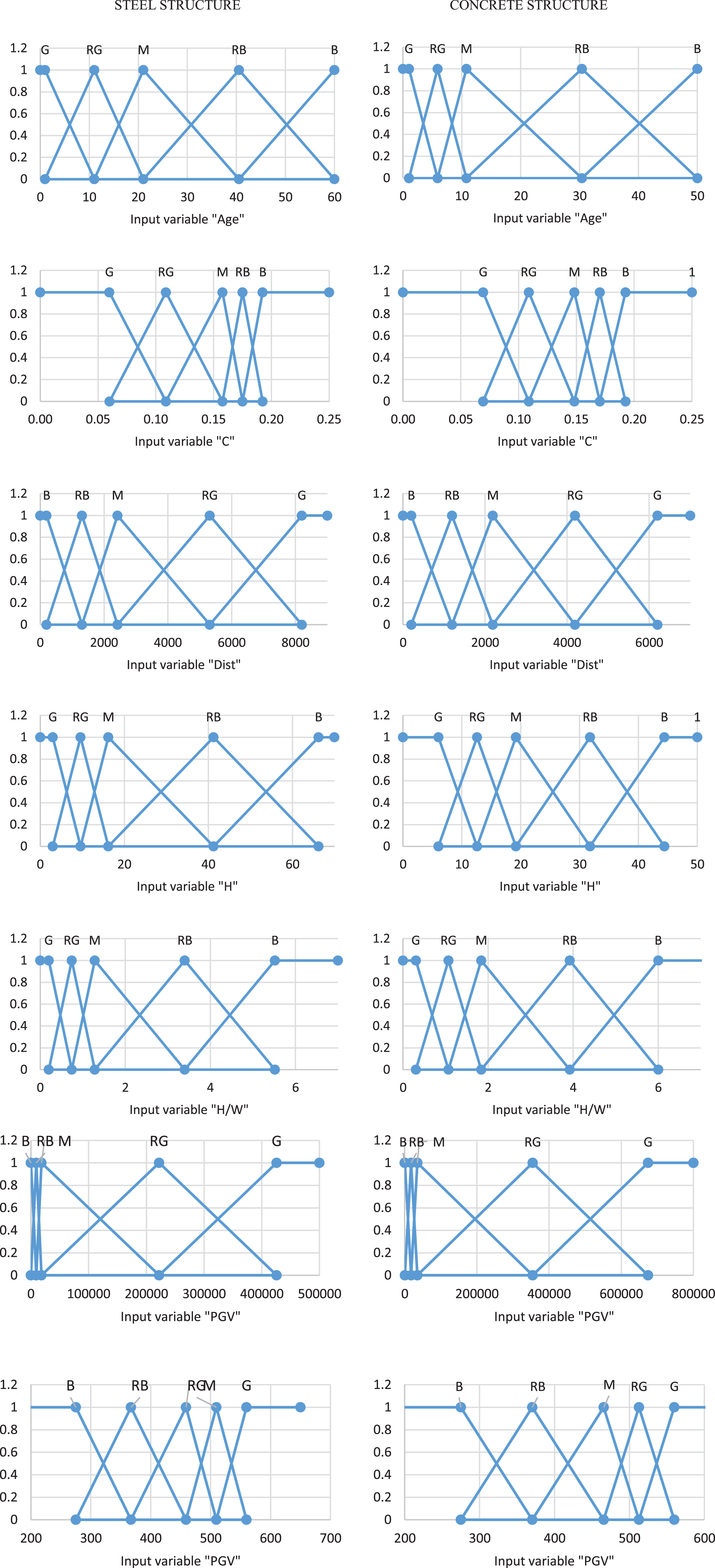
Membership functions of the input parameters of the fuzzy model.
In order to determine the range of membership function of the output parameter based on the field research using the SCC-FCM method, the distance between the damage degrees of the buildings should be calculated using the equation (1) [17]. Then, the cumulative sum of the distances should be obtained. This cumulative distance is the damage egree of building, while its qualitative range is the hazard degree.
Equation (1):
According to the values obtained in Table 5, the membership function of the output parameter in the steel and concrete structures was obtained, as shown in Fig. 5.
The range of membership function for the output parameter
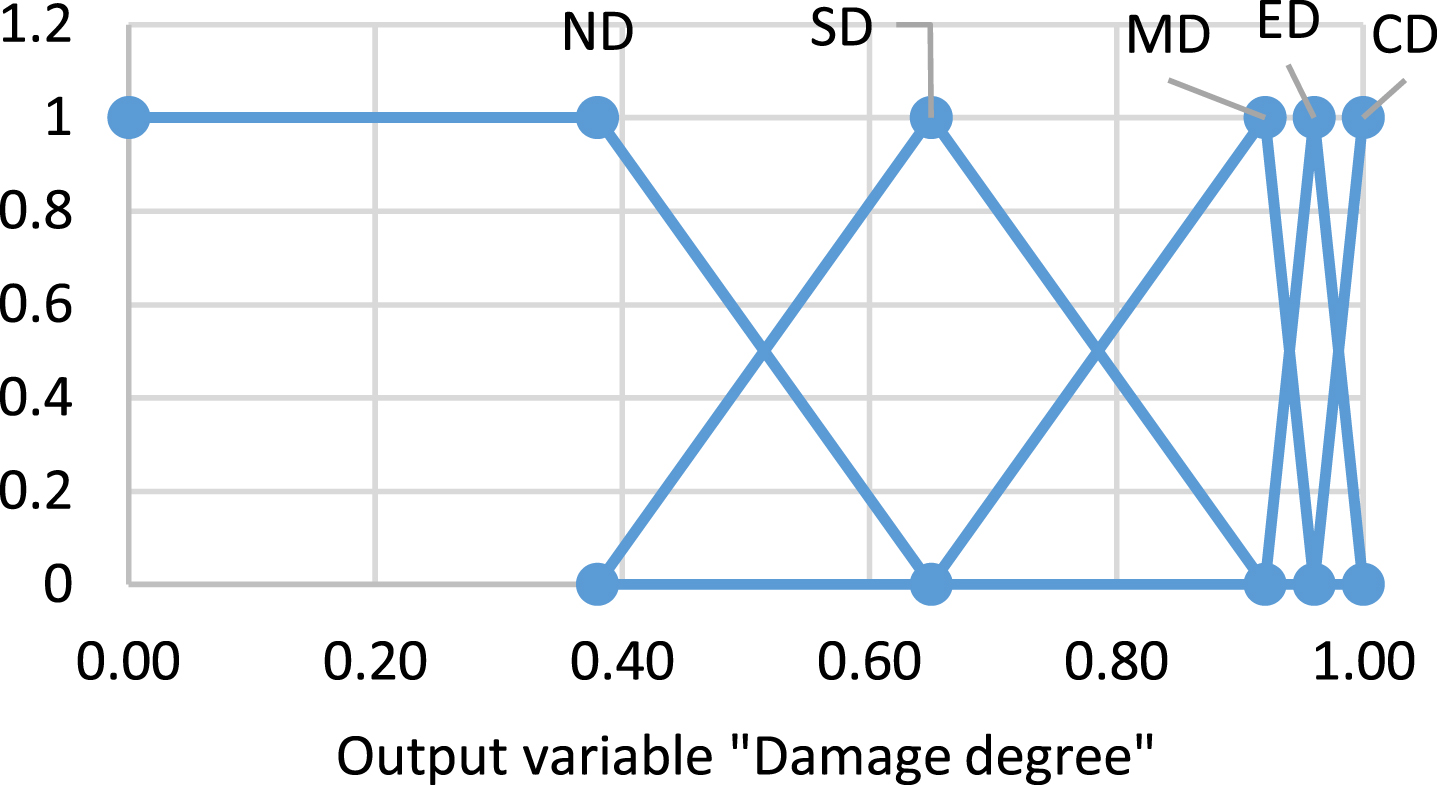
The membership function of damage degree of concrete structures.
By calculating the mentioned distances, the damage degree in the output parameters of steel and concrete structures was obtained, as shown in Table 5.
One of the most important sections of a fuzzy model is the section associated with its rules. The rules of a model make connections between input and output parameters through if-then statements. By using these rules, the required inference is made, and the desired result is achieved. The possible rules between the input and output parameters are large in number, but many of them are not reliable. Given that the current study had eight input parameters with the quintet classification of membership functions, the number of equivalent possible rules was 58. In other words, the number of whole possible rules was 390625, but not all of them were reliable and logical. In studies, a limited number of rules are employed, which is equal to several tens of reliableand logical rules. Therefore, based on the following principles, 92 rules were used for the fuzzy model. If all values of the input membership function are simultaneously B, the output parameter will be classified as complete damage (CD). If all values of the input membership function are simultaneously G, the output parameter will be classified as no damage (ND). If all values of the input membership function are simultaneously M, the output parameter will be classified as moderate damage (MD). If the values of the input membership function are not B, G, or M, and they are in the RB range, the output parameter will be classified as extensive damage (ED). If the values of the input membership function are not B, G, or M, and they are in the RG range, the output parameter will be classified as slight damage (SD). If all values of the input membership function, except one of them, are G, the output parameter will be classified as no damage (ND). If all values of the input membership function, except one of them, are RG, the output parameter will be classified as slight damage (SD). If all values of the input membership function, except one of them, are M, the output parameter will be classified as moderate damage (MD). If all values of the input membership function, except one of them, are RB, the output parameter will be classified as extensive damage (ED). If all values of the input membership function, except one of them, are B, the output parameter will be classified as complete damage (CD).

The membership function of damage degree of steel structures.
The MATLAB software was used to conduct the fuzzy model. By defining the membership functions of the eight input parameters and the membership function of damage degree as the output, as well as the model rules, a fuzzy model was achieved in the MATLAB software. As a result, by having the input parameters, including the age of the building, height of building, earthquake factor, soil type, number of residents, the ratio of the height of building to the width of the street, equivalent moment of inertia of the plan, and distance to fault, for any building, its damage degree can be predicted based on the qualitative model and the collected field data. A concrete structure with an age of 25 years, PGV = 425, a height of 25 m, C = 0.125, 200 residents, the moment of inertia = 4e+05, a distance of 3500 m to fault, and building height/ street width ratio of 3.5, as input parameters, was modeled as a sample, and the damage degree of 0.774 was obtained as the output parameter.
By changing each input parameter, the damage degree of the new structure is calculated according to the nature of that parameter and the rules of the fuzzy model. This model allows for predicting the damage degree of a structure before an earthquake by entering the eight input parameters. By obtaining the damage degree, it is classified as one of the fuzzy concepts of the structural damage, including complete damage (CD), extensive damage (ED), moderate damage (MD), slight damage (SD), and no damage (ND), to have a prediction for each structure against future earthquakes.
According to the ranges of the output parameter of damage degree, shown in Fig. 5, this model, with a damage degree of 0.774, was included in the ranges of 46%MD and 54%SD. Moreover, the changes in the behavior of the model caused by the changes in input parameters can be investigated. Figures 7, 8 illustrate a few cases of changes in the input parameters and damage degree of a structure.

Curves of changes in the input parameters and damage degree of structure.

3D curves of changes in the input parameters and damage degree of structure.
Figure 7 indicates the changes in the age and damage degree. Based on this curve, it can be found that the damage degree of buildings with early ages up to 8 years increases, it is constant within the ages of 8–18 years, and at the ages of 18 to 50 years, it increases again with a low slope. This curve shows that assuming constant values for other effective parameters, buildings with ages of 8 to 18 years have a similar performance. Figure 7 demonstrates the changes in damage degree with the moment of inertia of buildings. As can be seen in the figure, at the moments of inertia of 4e+5 m4 to 5e+4 m4, the buildings have similar behaviors, but at the moments of inertia of higher than 4e+5 m4, the damage degree of buildings significantly decrease. The changes in the damage degree with the height of buildings are evaluated in Fig. 7. In this figure, the buildings, 12 m to 28 m in height, behave identically, showing similar damages. However, at the building heights of more than 28 m, while other parameters being constant, the structural damage increases. In Fig. 7, the distances to faults can be divided into three groups. Assuming constant values for other parameters, if the distance to fault is lower than 1500 m, the degree of damages will increase. Meanwhile, at the distances of 1500 m to 4800 m, no significant change is observed in the degree of damages to structures, and at the distances of higher than 4800 m, the damage degree reduces, while other parameters being constant.
Figure 8 evaluate the interaction effect of two input parameters of the model on the damage degree of structures. As can be seen in Fig. 8, in buildings with ages of less than 15 years and heights of lower than 18 m, the damage degree is considerably lowered.
Figure 8 evaluates the interaction effect of distance to fault and height of the building. This figure shows that at the heights of higher than 10 m and distances of lower than 4000 m to fault, the degree of structural damage significantly grows.
The interaction effect of age of building and distance to fault in Fig. 8 also shows that at fault distances of 2000 to 4000 m and constant ages of buildings, the structural damage degree has no change, but at distances of lower than 2000 m, the damage degree remarkably increases with the age of buildings.
Evaluating the buildings existing in a city and determining the degree of damage to each of them in possible future earthquakes are always of great importance in terms of planning for emergency aid to the damaged people and developing urban retrofitting plans to reduce the future casualties and financial losses. In order to achieve this goal, either the classic models and numerical methods should be used, which have various assumptions and require considerable time and cost, or the qualitative methods should be employed based on field research, using fuzzy logic with the linguistic expression of uncertainties in a shorter time. In this research, by using the field research and conventional methods for determining the ranges of membership functions of uncertainties of linguistic data, a fuzzy model was developed. Therefore, the damage degree was classified as five groups of complete damage (CD), extensive damage (ED), moderate damage (MD), slight damage (SM), and no damage (ND). The evaluation of the model’s outputs and behavior by changing the input parameters, such as the age of the building, height of the building, distance to fault, and equivalent moment of inertia of plan, revealed that the damage degree is so sensitive to any increase or decrease in each of the parameters. The degree of damage to buildings caused by earthquakes remarkably varies with any change in each of the parameters. Therefore, the initial result of this research led to a fuzzy model, which provides a pattern to calculate the damage degree of structures. For any structure, the age of the building, height of the building, distance to fault, and other input parameters can be entered into the model whose output is the damage degree of structure. By calculating the damage degree of structure and applying it to the membership function, the output parameter of the percentage of damage probability can be classified as the groups of complete damage, extensive damage, moderate damage, slight damage, and no damage. For example, a building with the mentioned properties as the input parameters was applied to the model, and the damage degree of 0.774 was obtained. By applying it to the membership function, it was found that occurrence of an earthquake with an acceleration of 0.35 g, as mentioned in the Standard 2800 of Iran, for Tehran, which was considered in parameter C, there was 46%probability of moderate damage (MD) and 54%probability of slight damage SD. By changing the input parameters of other buildings, the damage degree of structure and probability of damage in the quintet classification can be obtained. This is an appropriate pattern to predict the degree of structural damage to a building during earthquakes based on the data obtained from the field research.
The other outcome of this study, which is shown in Figs. 7, 8, was in the analysis of this model by changing the parameters effective in the modeling, both separately and in interaction effect on each other. This analysis revealed that in buildings with ages of 8–18 years while assuming constant values for other effective parameters in the model, the caused damage had no considerable change, but at the ages of more than 18 years, it increased significantly. Therefore, retrofitting the structures with ages of more than 18 years is of great importance and should be prioritized. The evaluation of the effect of height of building showed that by increasing the height from 12 m to 28 m, the damage degree had no change, but at the constant values of other parameters, heights of more than 28 m resulted in a considerable increase in the damage degree of building.
The analysis of the equivalent moment of inertia of plan showed that buildings with moments of inertia between 50000 m4 and 400000 m4 had almost uniform behaviors in the model. However, at the moments of inertia of higher than 400000 m4, the damage degree significantly reduced, while assuming constant values for other parameters. Moreover, for the buildings with distances of less than 1500 m to faults, the damage degree increased remarkably, but at the distances of 1500 m to 4800 m, the changes were not considerable. In this research, considering the interaction effect of the parameters of the age of the building, height of the building, distance to fault, and equivalent moment of inertia of plan, it was found that at the ages of more than 15 years, heights of more than 18 m, distances of less than 4000 m, and moments of inertia of lower than 50000 m4, the damage degree of structures considerably increase. Therefore, buildings with such conditions should be retrofitted as fast as possible. With respect to the severity of structural damages to buildings with distances of less than 1500 m to faults, their building permits should be approved with required limitations and considerations.