In this paper, we investigate the necessary and sufficient conditions for existence of solutions for initial value problem of fuzzy Bagley-Torvik equation and the solution representation by using the multivariate Mittag-Leffler function. First we convert fuzzy initial value problem into the cut problem (system of fractional differential equations with inequality constraints) and obtain existence results for the solution of the cut problem under (1,1)- differentiability. Next we study the conditions for the solutions of the cut problem to constitute the solution of a fuzzy initial value problem and suggest a necessary and sufficient condition for the (1,1)-solution. Also, some examples are given to verify the effectiveness of our proposed method. The necessary and sufficient condition, solution representation for (1,2)-solution of initial value problem of fuzzy fractional Bagley-Torvik equation are shown in Appendix.
As fractional differential equations (FDEs) play the important roles in modeling the real world, such as physics, chemistry, biology, viscous flow, acoustics, electromagnetic flow, economics, and so on, many researchers have focused on FDEs.
In [8], Bagley and Torvik modeled the motion of large and thin plates moving in Newtonian liquids by the initial value problem of the following fractional differential equations.
Thereafter numerical methods for the Bagley-Torvik equation have been extensively studied. The scientists obtained numerical solutions of the Bagley-Torvik equations by using generalized Taylor collocation method, hybridizable discontinuous Galerkin methods, hybrid functions approximation, fractional Legendre collocation method, fractional neural network model, Haar wavelet operation matrix method, Adomian decomposition method, discrete spline method, etc. ([5, 27– 30]).
Other hand, the uniqueness and existence of the positive solution for the boundary value problem of the generalized Bagley-Torvik equation using the Leray-Schauder principle was studied in [25] and the existence of solution for the Neumann problem of the generalized Bagley-Torvik equation was considered in [26].
As the real-world is modeled by the initial value problem of the differential equation, the initial conditions and the parameters of the equation can usually be uncertainty
Therefore, many researchers have considered the existence of solution and numerical methods for fuzzy differential equations. ([2, 31– 33]).
In [37], the concreted solutions of the fuzzy linear fractional differential equations with the fuzzy initial condition under Riemann-Liouville-differentiability have been studied and in [38], the method for find exact fuzzy solution of the fuzzy wave-like equations in one and two dimensions have been introduced.
Also the concept of Caputo fuzzy type fractional derivative in the case of the order α ∈ (1, 2) has been introduced in [12] and the existence and uniqueness of solution for an initial value problem of fuzzy fractional differential equations has been studied.
The fuzzy fractional Volterra integro-differential equation in [34] and fuzzy fractional differential equation in [35] have been introduced in case which fractional order is 0 < β ≤ 1. First they have converted the proposed problems into the system of ordinary fractional differential equations and revealed the numerical method to solve the system of ordinary fractional differential equations, obtained the numerical results for r-cut function of (1)-solution and (2)-solution.
Currently, there are few results for the fuzzy Bagley-Torvik equation and we could not find the results except in [10]. In [10], they obtained the numerical solution of (1,1)-solution for following fuzzy fractional Bagley-Torvik equation by using homotopy perturbation method.
However, they did not consider the fact that the existence of a solution for the initial value problem of constant coefficient fuzzy linear differential equations depends on the coefficients, initial values and non-homogeneous terms.(see Example 5.1.)
In contrast to the crisp case, for fuzzy fractional differential equations the existence of a solution is not fully clarified even for the constant coefficient linear case, which can be said to be a theoretical gap.
In [14], they have noted that in general a solution of a fractional fuzzy integral equation is not a solution of a fractional fuzzy differential equation.
In other words, the traditional approach used in crisp fractional differential equations cannot be applied. Therefore, the study of the existence of solutions of fuzzy fractional differential equations requires a new method.
The aim of this paper is to propose a new method for the existence of solutions of fuzzy fractional differential equations and to fill the gaps on the uniqueness and existence of the solutions.
In this paper, we investigate the uniqueness and existence of the solution for the initial value problem of the fuzzy Bagley-Torvik equation
where .
We obtain a cut problem with inequality constraints corresponding to the fuzzy initial value problem Definition 2.3and a necessary and sufficient condition for the existence of a (1,1)-solution of the fuzzy Bagley-Torvik equation by using the solution of cut problem. Also we suggest the representation of (1,1)-solution. Next the results of (1,2)-solution are considered.
We think that our method are applicable to general types of constant coefficient fractional fuzzy linear differential equations.
Our paper organized as follows. We introduce the basic concepts and some results used in this paper in Section 2. Section 3 are proposed the necessary and sufficient condition for the existence of a (1,1)-solution of the fuzzy fractional Bagley-Torvik equation. By using multivariate Mittag-Leffler function, the representation of (1,1)-solution of the fuzzy fractional Bagley-Torvik equation is suggested in Section4. Through several examples, we evaluate the effectiveness of our method in Section 5. Conclusions are given in Section 6 and the results for (1,2)-solution are shown in Appendix.
Preliminaries
Definition 2.1 [4] A fuzzy number is a function u : R → [0, 1] satisfying the following properties:
i) u is normal,
ii) u is a convex fuzzy set,
iii) u is upper semi-continuous,
iv) The set is compact on R (where Supp (u) : = {x ∈ R|u (x) >0}).
Denote the set of fuzzy numbers RF.
For u, v, w ∈ RF, if there exists w ∈ RF such that u = v ⊕ w, then w is called the H-difference of u and v, and it is denoted by w : = u ⊖ Hv.
Definition 2.2. [20] Let y : (a, b) → RF and t0 ∈ (a, b).
i) We say that y is (1)-differentiable at t0, if there exists an element y′ (t0) ∈ RF such that for all h > 0 sufficiently small, ∃y (t0 + h) ⊖ Hy (t0), y (t0) ⊖ Hy (t0 - h) and the limits
exist.
ii) We say that y is (2)-differentiable at t0, if there exists an element y′ (t0) ∈ RF such that for all h > 0 sufficiently small, ∃y (t0) ⊖ Hy (t0 + h), y (t0 - h) ⊖ Hy (t0) and limits
exist.
When y is (1)-differentiable or (2)-differentiable at t0, y′ (t0) is denoted by or .
Definition 2.3. [1] Let y : (a, b) → RF, t0 ∈ (a, b). If there exists for , we say that y is (n, m)-differentiable and (t0) is denoted by , where n, m ∈ {1, 2} .
Definition 2.4. [20] Let y : (a, b) → RF, β ≥ 0. Then
is called fuzzy Riemann-Liouville fractional integral of order β of y.
Lemma 2.1[20] Let y : (a, b) → RF, [y (t)] r : = [y1 (t, r) , y2 (t, r)]. Then
Definition 2.5. Let y : (a, b) → RF be a fuzzy function such that
exists. Then, the fuzzy Caputo fractional derivatives of order β of y is defined as follows: .
We say that y is c [(1, n) - β]-differentiable if there exist n ∈ {1, 2} .
Definition 2.6. [15] For u ∈ RF and r ∈ (0, 1], denote [u] r = {t ∈ R|u (t) ≥ r}. We call this set an r-cut of the fuzzy number u.
Lemma 2.2.Let y : (a, b) → RF, 1 < β < 2 and [y (t)] r : = [y1 (t, r) , y2 (t, r)]. Then
i) If y is c [(1, 1) - β]-differentiable,
,
ii) If y is c [(1, 2) - β]-differentiable,
.
Proof. First we prove i) of Lemma 2.2 when y is c [(1, 1) - β]-differentiable. From Definition 2.5, . Let [G1 (t)] r = [G1,1 (t, r) , G1,1 (t, r)]. Then from [39],
holds.
Also let . If exists, then
Therefore, we get
We proved for case i) of the Lemma 2.2 when y is c [(1, 1) - β]-differentiable. For the case which y is c [(1, 2) - β]-differentiable, the proof is similar to the above one.
Lemma 2.3.[9] Let {Ur|r ∈ [0, 1]} be a family of real intervals such that the following three conditions are satisfied
i) For all r ∈ [0, 1], Ur is a non-empty compact interval,
ii) If 0 < α < β ≤ 1, then Uβ ⊆ Uα,
iii) For given any non-decreasing sequence rn ∈ (0, 1] with , .
Then there exists a unique fuzzy number u ∈ RF such that [u] r = Ur for all r ∈ (0, 1] and [u] 0 = cl (⋃ r∈(0,1]Ur).
Definition 2.7. [3] Let u ∈ RF, r ∈ [0, 1] , [u] r = [u1, u2]. Then the diameter of a fuzzy number u is defined by d ([u] r) : = u2 - u1.
In paper, we promise the following symbols. For f : (a, b) → RF, [f (t)] r : = [f1 (t, r) , f2 (t, r)] ,
Necessary and sufficient condition for the existence of solution for initial value problem of fuzzy Bagley-Torvik type equation
Definition 3.1. We say that y (t) is (n, m)-solution of the initial value problem (1), (2) if y ∈ C (J, RF) satisfies (1), (2) and
C (J, RF) is a space of fuzzy-valued functions, which are continuous on J. In this section, we consider the existence of the (1,1)-solution of the following initial value problem:
where
First of all, we consider the fractional integral equation:
where V, p, q ∈ C (J) , λ1, λ2 > 0.
Lemma 3.1.The integral equation (5) has a unique solution U (t) in C (J) and the solution U (t) satisfies the following inequality
where k* is a positive number with and || · ||C(J) is max-norm on C (J).
Proof. Let denote, equation (5) present as follows
We discuss by using following k-norm equivalent with max-norm in C (J)
For X, Y ∈ C (J), we get
Estimating in above right side, from definition of fractional integral and Gamma function, we obtain
Similarity . That is, for ∀X, Y ∈ C (J), it holds
therefore we have
By choosing a constant satisfying
the following fact holds
From the completeness of C (J), the equivalent of max-norm and -norm, we get
So the integral equation (5) has a unique solution U = U (t) in C (J).
Now let proceed upper estimate of solution. Because U (t) is the solution of Eq. (5), we have
By choosing a constant in the same way as above, the following inequality holds.
□
The cut equation of (3) is as follows for r ∈ [0, 1]:
Based on the operation of the intervals, we can rewrite this equation as follows:
Using [y (t)] r : = [y1 (t, r) , y2 (t, r)] and (iii) of Lemma 2.2, cuts of are as follows:
Also using[f (t)] r : = [f1 (t, r) , f2 (t, r)], we obtain the following:
Therefore, we obtain the cut-problem (7) corresponding to the problem (3)
Let , then the initial conditions of (7) are as follows:
Definition 3.2. We say that (y1 (t, r) , y2 (t, r)) is the solution of the cut-problem (7), (8) if y1 (t, r) , y2 (t, r) satisfies (7), (8) and .
We introduce the following symbol:
Theorem 3.1. (Necessary condition)Let y (t) be the (1,1)-solution of (3), (4) and its cut be [y (t)] r : = [y1 (t, r) , y2 (t, r)], then (y1 (t, r) , y2 (t, r)) is the solution of (7) and (8) and the following facts are true.
(C1) If The integral equation
has a unique solution U ∈ C (J).
(C2) If r1, r2 ∈ [0, 1] , r1 ≤ r2, , then the integral equation
has a unique non-negative solution V1 ∈ C (J).
(C3) If r1, r2 ∈ [0, 1] , r1 ≤ r2, then the integral equation
has a unique non-positive solution V2 ∈ C (J).
Proof. The fact that (y1 (t, r) , y2 (t, r)) is the solution of (7) and (8) is obvious by the definition.
Next, we prove (C1).
We obtain the following system of cut-equation:
and initial condition
Denote
then by the definition of the solution, z1, z2 ∈ C (J) and
Therefore, the following equations hold.
Thus we obtain
From (11), (13), (14), we obtain
Thus, we get
where U (t) : = z2 (t, r) - z1 (t, r).
On the other hand, by the Lemma 3.1, the equation (33) has a unique solution and by (30), the solution of (33) is non-negative. Thus, (C1) is proved.
Next, we prove (C2).
Since and , for the fixed t ∈ J, is increasing with respect to r, is decreasing with respect to r.
Thus, for any r1, r2 ∈ [0, 1] , r1 ≤ r2, the following inequalities hold:
On the other hand, from the first equation in (9), we obtain the following system of differential equations:
Now, let us denote Δy1 (t) : = y1 (t, r2) - y1 (t, r1). Then we get the following equation:
Here, the initial condition of function Δ(r1,r2)y1 (t) is as follows:
Let us denote in the initial value problem (36), (37). Then we obtain the integral equation which is equivalent to (36):
By Lemma 3.1, above integral equation has a unique solution and from (34), V1 (t) ≥0, t ∈ J. Thus, (C2) is proved. In a similar manner to above proof, we can prove (C3). This completes the proof of the Theorem 3.1. □
Now, let us consider the sufficient conditions for the existence of (1,1)-solution of fuzzy initial value problem (3) and (4).
Lemma 3.2.Let be the solution of (7) and (8). Then given by
is the solution of following problem:
in C (J). Conversely, if is the solution of problem (38), then given by
is the solution of cut-problem (7), (8).
Lemma 3.2 can be easily proved by transforming (9) into integral equation considering its initial condition (10).
The existence and uniqueness of solution of the integral equations in (38) are guaranteed by Lemma 3.1. Now let us consider the sufficient condition for the unique solution to satisfy the inequality in (38).
Lemma 3.3.If the integral equation
has a non-negative solution U ∈ C (J), then
holds.
Proof. By the Lemma 3.1, above integral equation has unique solution. Therefore, by the assumption-U ∈ C (J) is non-negative, we can see that . □
By above consideration, we can draw the conclusions that if b, c ∈ R+, f ∈ C (I, RF) and the function
satisfies the assumption of Lemma 3.3, then the problem (38) has a unique solution. Therefore, the cut-problem (7), (8) has a unique solution.
By Lemma 3.2 and Lemma 3.3, we obtain the following inequalities:
Also, using (39) and (40), we have
Hence, the intervals are valid:
Now, we will prove that the above families of intervals constitute fuzzy valued functions.
Theorem 3.2.Suppose that the following two assumptions are satisfied:
i) Let r1, r2 ∈ [0, 1] , r1 ≤ r2. Then the integral equation
has a unique non-negative solution U ∈ C (J).
ii) Let r1, r2 ∈ [0, 1] , r1 ≤ r2. Then the integral equation
has a unique non-positive solution U ∈ C (J).
Then the families of the intervals
constitute fuzzy valued functions.
Proof. It is sufficient to prove that the families of the intervals satisfy the second and third condition of Lemma 2.3. First, let us prove that {U2 (t, r) , r ∈ [0, 1]} satisfies the second condition of Lemma 2.3.
For fixed r1, r2 ∈ [0, 1] (0 < r1 < r2 ≤ 1), denote as
Using the first equation of (38), we have
and by Lemma 3.1 and assumption i), we have
That is,
Analogously, using the second equation of (38), we have the following equality:
and by assumption ii), we get
that is,
Therefore, the family of intervals {U2 (t, r) : r ∈ [0, 1]} satisfies the second condition of the Lemma 2.3.
On the other hand, from the first equation of (39), we have the following equations:
From (26), we get the following inequalities.
Analogously, from the second equation of (39), we can get the following inequalities:
Thus, from (46), (47), we can see that the families of the intervals
also satisfy the second condition of the Lemma 2.3.
Next, let us prove that the families of the intervals satisfy the third condition of Lemma 2.3. In other words, we will prove that the following results hold for any non-decreasing sequence rn ∈ (0, 1] with .
Denote as . Then, using (38) we get
By Lemma 3.1, there exists w > 0 such that
By the left-hand continuity of with respect to variable r, we get
hence,
that is,
In the similar manner, we can prove
holds.
From (21), (31) and (32), we get the followings:
Therefore, the families of the intervals satisfy the third condition of the Lemma 2.3. □
Denote by the fuzzy valued functions, which are constituted by the families of intervals
Then the following result holds.
Theorem 3.3. Fuzzy valued functions and are continuous on J.
Proof. First, Let us prove for any t* ∈ J. Since
it is sufficient to prove the continuity of with respect to t. Since y1 (t, r) , y2 (t, r) are the solutions of (7) and (8), continuity of and with respect to t are guaranteed. Similarly, from (39), we can see that and are continuous. □
Lemma 3.4.For any t ∈ J, the following holds:
It is obvious from the definition of (1)-derivative.
Theorem 3.4.The following relations hold:
Proof. By the Theorem 3.3, is continuous, hence is valid. From (39) and (51)-(54), we can get (56), (57). Now, let us prove (58).
By Lemma 3.4 and (56), (58) can be written as
Using the definition of H-difference, it can be rewritten as
Thus, we obtain □
Remark 3.1. From Theorem 3.4, we can see that is the (1,1)-solution of (3), (4) in the sense of Definition 3.1. Therefore the following facts hold
We can get the sufficient condition for the existence of solution for (3) and (4) from Theorem 3.2-3.4.
Theorem 3.5. (Sufficient condition)Suppose that (y1 (t, r) , y2 (t, r)) is the solution of (7) and (8) and (C1)-(C3) hold. Then the fuzzy initial value problem (3), (4) has a unique (1,1)-solution.
Based on Theorem 3.1 and Theorem 3.5, there exist solution to (7) and (8) and (C1)-(C3) hold.
Solution representation for initial value problem of fuzzy Bagley-Torvik equation
In this section, we study the solution representation for fuzzy initial value problem (3) and (4).
Theorem 4.1. ((1,1)-solution representation)(1,1)-solution representation for fuzzy initial value problem (3) and (4) is as follows:
Proof. The solution of first equations of (7) and (8) represent as follows from [36]
On the other hand, we obtain the following facts for two variable Mittag-Leffler function
where
Now, we can rewrite (41) as follows:
Analogously, we have the following solution for second equations of (7) and (8)
From (42) and (43), we have the solution representation:
□
Several examples
In this section, we show some examples to illustrate our results.
Example 5.1. We consider the following initial value problem for fuzzy Bagley-Torvik equation studied in [10].
where b, c ∈ R+, y ∈ C (J, RF).
Considering the numerical results by homotopy perturbation method proposed in [10], we can easily validate that y (t) is not (1,1)-solution due to the fact that for b = c = 1. We show the numerical results for r = 0.5 in the Table 1.
Numerical results for r = 0.5 in case of b = c = 1
t
y1 (t, 0.5)
y2 (t, 0.5)
0.0625
-0.034271
0.071904
7.240051
7.211261
0.1875
0.071029
0.189252
6.634774
6.605010
0.3125
0.280573
0.410377
6.250728
6.219395
0.4375
0.587938
0.728833
5.925749
5.892792
0.5625
0.987960
1.139432
5.626365
5.591833
0.6875
1.475925
1.637433
5.338676
5.302665
0.8125
2.047318
2.218302
5.055754
5.018378
0.9375
2.697711
2.877585
4.773843
4.735232
Example 5.2. We consider the following problem:
where b, c ∈ R+, y ∈ C (J, RF) and initial values and coefficient of nonhomogeneous term (7.9, 8, 8.1) are triangular fuzzy numbers.
First, we verify the (C1). For any fixed r ∈ [0, 1], we have
so we should illuminate the integral equation
has nonnegative solution. Denoting operator , for any b, c, (I + L) is reversible and continuous, and
It is sufficient to prove (I - L) (0.2 (1 - r) (1 - c) (1 + t)) ≥0. For the simple consideration, we only consider the case of 1 - c ≥ 0.
Therefore, if 1 - c ≥ 0 and , then equation (49) has nonnegative solution.
Next, we verify the (C2).
For r1, r2 ∈ [0, 1] , r1 ≤ r2, we have f1 (t, r) = (1 + t) (7.9 + 0.1r). So
and
we get .
Therefore, we should prove that has nonnegative solution. From equation (49), it is sufficient if . After all, (C2) is proved.
Finally, we verify the (C3). For r1, r2 ∈ [0, 1] , r1 ≤ r2, we have f2 (t, r) = (1 + t) (8.1 - 0.1r). Since f2 (t, r2) - f2 (t, r1) = -0.1 (1 + t) (r2 - r1) and
so we get . After all, we should prove
has a unique non-positive solution.
For that, we consider the condition for .
Therefore, in the case of 1 - c ≥ 0, if , then (47), (48) has a unique (1,1)-solution. Numerical results computed by Mathematica 9.0 are shown in Table 2 and 3 in case of b = 0.4, c = 0.3.
Numerical results for r = 1 in case of b = 0.4, c = 0.3
t
y1 (t, 1)
y2 (t, 1)
0.0625
0.01999
0.01999
7.67726
7.67726
0.1875
0.14062
0.14062
7.93684
7.93684
0.3125
0.38568
0.38568
8.35545
8.35545
0.4375
0.76133
0.76133
8.78868
8.78868
0.5625
1.27428
1.27428
9.2084
9.2084
0.6875
1.93104
1.93104
9.60309
9.60309
0.8125
2.73776
2.73776
9.96684
9.96684
0.9375
3.70013
3.70013
10.2963
10.2963
Numerical results for r = 0.5 in case of b = 0.4, c = 0.3
t
y1 (t, 0.5)
y2 (t, 0.5)
0.0625
-0.033212
0.073205
7.64367
7.71085
0.1875
0.080636
0.200616
7.90212
7.97157
0.3125
0.318374
0.452999
8.31889
8.392
0.4375
0.686133
0.836545
8.75023
8.82713
0.5625
1.19058
1.35798
9.16812
9.24869
0.6875
1.83821
2.02386
9.56107
9.6451
0.8125
2.63516
2.84036
9.92323
10.0104
0.9375
3.58706
3.81319
10.2512
10.3413
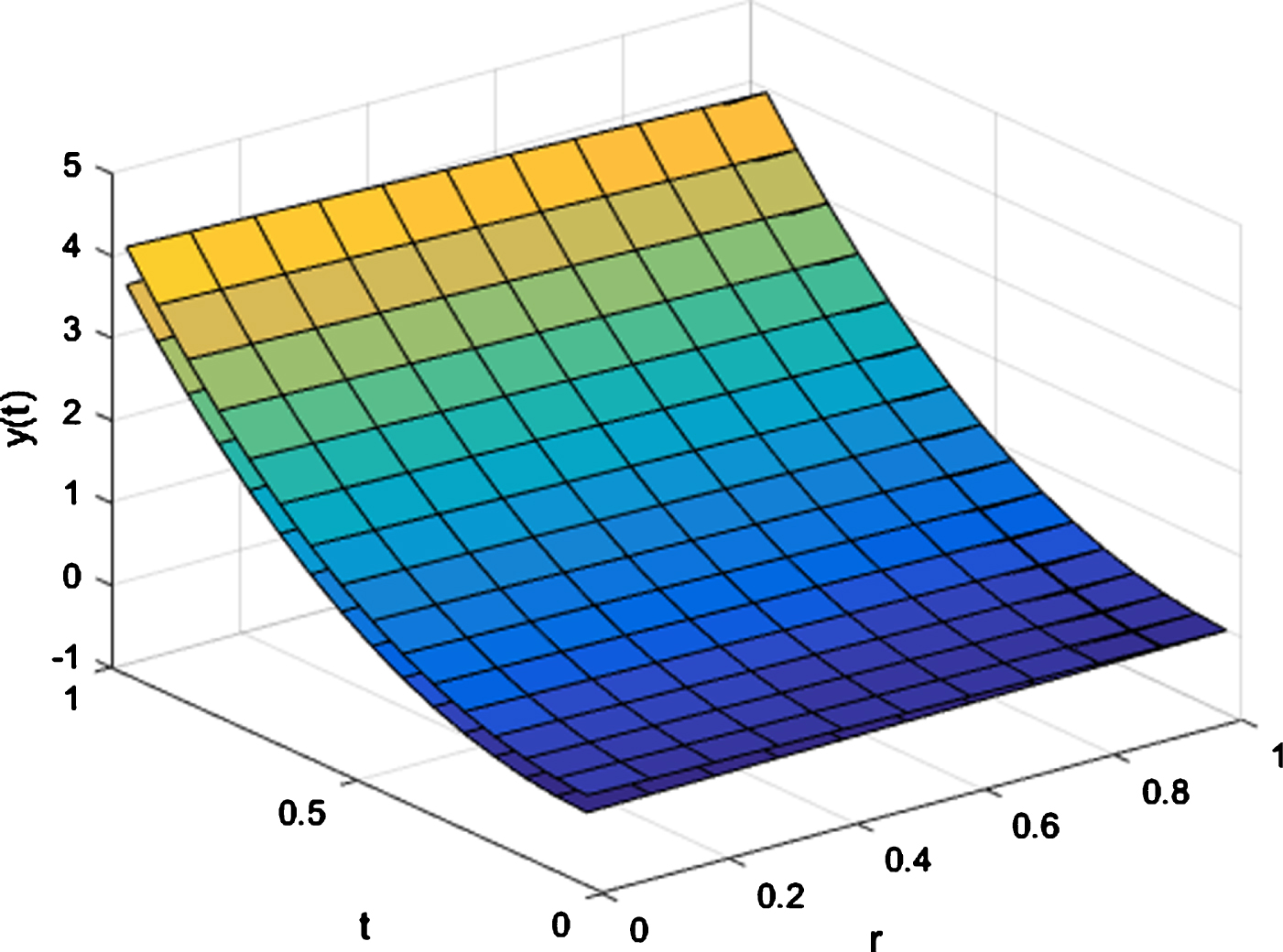
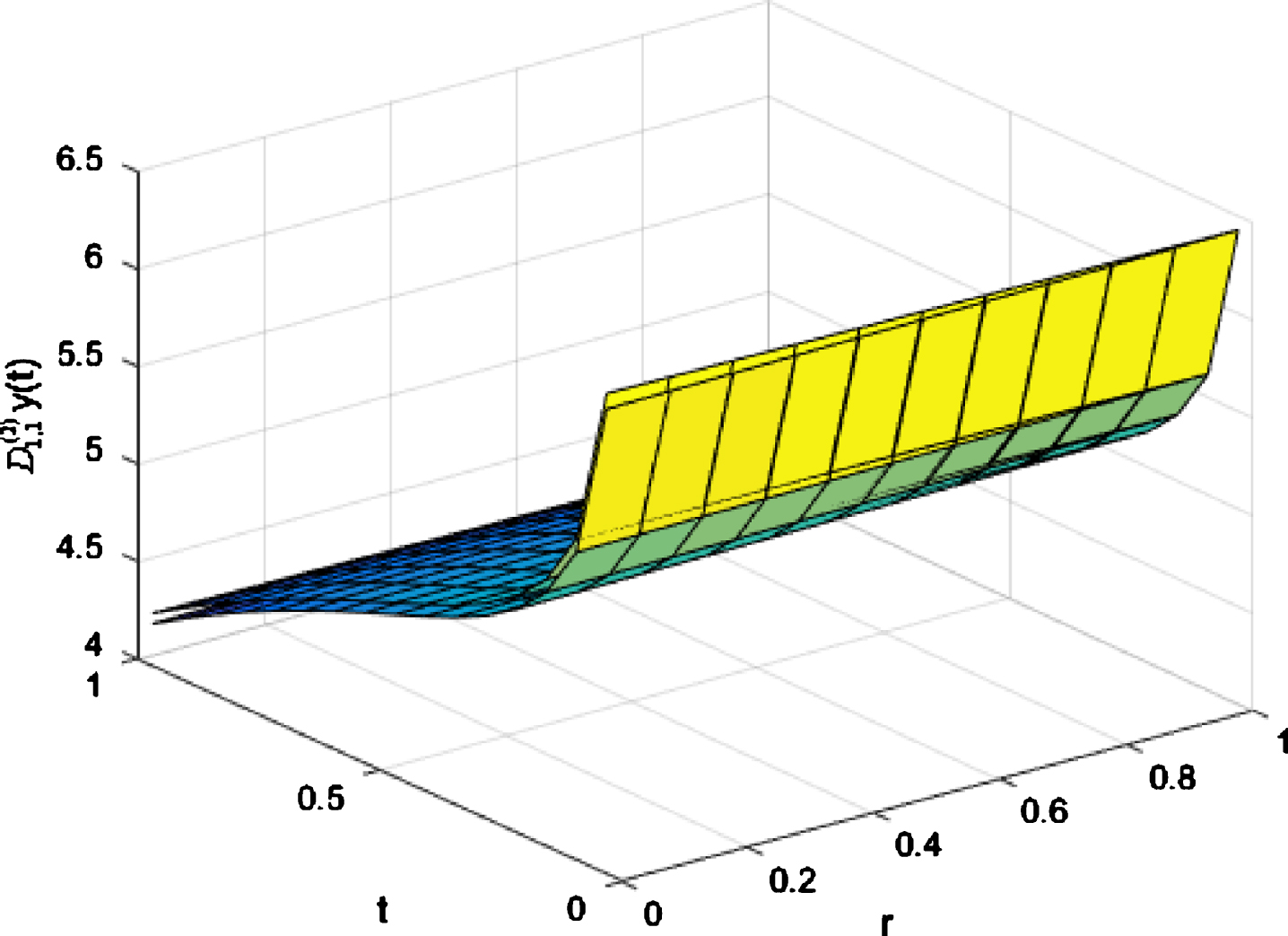
Fig 1 is shown the graph of (1, 1)-solution y (t) and Fig 2 is shown the graph of for Example 5.2 Finally, we consider the problem which has not (1,1)-solution.
Graph of solution y (t) for Example 5.2.
Graph of for Example 5.2.
Example 5.3. We find the case that (47), (48) has not (1,1)-solution. It is sufficient to find the case that equation (49) has negative solution. By using multivariate Mittag-Leffelr function, the solution of (49) is expressed as follows:
The solution does not exist if there exists t such that
Indeed, we see that computing by Mathematica 9.0, T (0.5, 1.5, 1.5) = -0.302214. Table 4 shows that (47), (48) has not (1,1)-solution for b = c = 1.5 by numerical results. In this table, does not hold for t ∈ J. Fig 3 is shown the graph of y (t) and Fig 4 is shown the graph of for Example 5.3. In Fig 4, , ∀t ∈ J, r ∈ [0, 1]. From Fig 3 and 4, y (t) is not (1,1)-solution of Example 5.3.
Numerical results for r = 0.5 in case of b = c = 1.5
t
y1 (t, 0.5)
y2 (t, 0.5)
0.0625
-0.037297
0.068855
6.07804
6.04017
0.1875
0.049291
0.167364
5.25964
5.22687
0.3125
0.219636
0.349109
5.04592
5.01449
0.4375
0.469024
0.609404
4.9093
4.87871
0.5625
0.79515
0.945959
4.78433
4.75452
0.6875
1.196
1.35677
4.64703
4.61808
0.8125
1.6694
1.83969
4.48822
4.46025
0.9375
2.21287
2.39223
4.3048
4.27798
Graph of solution y (t) for Example 5.3.
Graph of for Example 5.3.
Conclusion
In this paper, we obtain necessary and sufficient condition for the existence of (1,1) and (1,2)-solution to initial value problem for fuzzy Bagley-Torvik equation, and derive the solution representation. Our results show that existence of fuzzy solution depends on the coefficients, nonhomogeneous term and initial value. Our method can be applied to many other types of fuzzy linear multi-term fractional differential equations.
Appendix
We can obtain the results of existence and representation for (1,2)-solution in the similar way to section 3 and 4. We omit proof and only show the results in Appendix.
We discuss the following initial value problem for fuzzy Bagley-Torvik equation:
where .
We get the following cut system by using cut.
Definition A.1. (y1 (t, r) , y2 (t, r)) is called solution of problem (52 and (53) if it satisfies (52), (53) and .
Theorem A.1. (Necessary condition for the existence of (1,2)-solution)
If y (t) is a (1,2)-solution of (50), (51), then its cut y1 (t, r) , y2 (t, r) are solutions of (52), (53) and the followings hold.
(C4) Integral equation with inequality conditions
has a unique nonnegative solution.
(C5) For any r1, r2 ∈ [0, 1] (r1 ≤ r2), the following system of integral equations with inequality conditions has solution (V (t) , U (t)) satisfying V (t) ≥0, U (t) ≤0:
Theorem A.2. (Sufficient condition for the existence of (1,2)-solution)
If y1 (t, r) , y2 (t, r) are the solutions of (52), (53) and (C3), (C4) are satisfied, then fuzzy initial value problem (50), (51) has a unique (1,2)-solution.
Theorem A.3. (Representation of (1,2)-solution)
The representation of (1,2)-solution for fuzzy initial value problem (A.1), (A.2) is as follows:
where α, β > 0,
References
1.
AgarwalR.P., LakshmikanthamV. and NietoJ.J., On the concept of solution for fractional differential equations with uncertainty, Nonlinear Analysis72 (2010), 2859–2862.
2.
AhmadianA., SalahshourS., Ali-AkbariM., IsmailF. and BaleanuD., A novel approach to approximate fractional derivative with uncertain conditions, Fract Calc Appl Anal104 (2017), 68–76.
3.
AllahviranlooT., GouyandehZ. and ArmandA., Fuzzy fractional differential equations under generalized fuzzy Caputo derivative, J Intell Fuzzy Syst26 (2014), 1481–1490.
4.
AnastassiouG.A., Fuzzy Mathematics: Approximation Theory, Studies in Fuzziness and Soft Computing251, Springer-Verlag, Berlin, Heidelberg, (2010).
5.
ArqubO.A. and MaayahB., Solutions of Bagley– Torvik and Painleve equations of fractional order using iterative reproducing kernel algorithm with error estimates, Neural Comput Appl29 (2018), 1465–1479.
6.
ArqubO.A. and SmadiM.A., Atangana– Baleanu fractional approach to the solutions of Bagley– Torvik and Painlevé equations in Hilbert space, Chaos Solitons Fractals117 (2018), 161–167.
7.
ArshadS., On existence and uniqueness of solutions of fuzzy fractional differential equations, Iran J Fuzzy Syst10 (2013), 137–151.
8.
BagleyR.L. and TorvikP.J., On the appearance of the fractional derivative in the behavior of real materials, ASME Trans J Appl Mech51 (1984), 294–298.
9.
BedeB. and StefaniniL., Generalized differentiability of fuzzyvalued functions, Fuzzy Sets Syst230 (2013), 119–141.
10.
ChakravertyS., TapaswiniS. and BeheraD., Fuzzy Arbitrary Order System: Fuzzy Fractional Differential Equations and Applications, John Wiley & Sons, Inc., Hoboken, New Jersey, (2016).
11.
CenesizY., KeskinY. and KurnazA., The solution of the Bagley– Torvik equation with the generalized Taylor collocation method, J Franklin I347 (2010), 452–466.
12.
HoaN.V., On the initial value problem for fuzzy differential equations of non-integer order α ∈ (1, 2), Soft Comput https://doi.org/10.1007/s00500-019-04619-7.
13.
HoaN.V., Fuzzy fractional functional integral and differential equations, Fuzzy Sets Syst280 (2015), 58–90.
14.
HoaN.V., LupulescuV. and O’ReganD., A note on initial value problems for fractional fuzzy differential equations, Fuzzy Sets Syst347 (2018), 54–69.
15.
HoaN.V., TriP.V., DaoT.T. and ZelinkaI., Some global existence results and stability theorem for fuzzy functional differential equations, J Intell Fuzzy Syst28 (2015), 393–409.
16.
KaraaslanaM.F., CelikerF. and KurulayM., Approximate solution of the Bagley– Torvik equation by hybridizable discontinuous Galerkin methods, Appl Math Comput285 (2016), 51–58.
17.
MashayekhiS. and RazzaghiM., Numerical solution of the fractional Bagley-Torvik equation by using hybrid functions approximation, Math Method Appl Sci39 (2016), 353–365.
18.
MoghaddamB.P., MachadoJ.A.T. and BehforoozH., An integro quadratic spline approach for a class of variable-order fractional initial value problems, Chaos Solitons Fractals102 (2017), 354–360.
19.
MohammadiF. and Mohyud-DinS.T., A fractional-order Legendre collocation method for solving the Bagley-Torvik equations, Adv Differ Equ2016 (2016), 269.
20.
PrakashP., NietoJ.J., SenthilvelavanS. and Sudha PriyaG., Fuzzy fractional initial value problem, J Intell Fuzzy Syst28 (2015), 2691–2704.
21.
RajaM.A.Z., SamarR., ManzarM.A. and ShahS.M. Design of unsupervised fractional neural network model optimized with interior point algorithm for solving Bagley-Torvik equation, Math Comput Simulat https://dx-doi-org.web.bisu.edu.cn/10.1016/j.matcom.2016.08.002.
22.
RayS.S., On Haar wavelet operational matrix of general order and its application for the numerical solution of fractional Bagley Torvik equation, Appl Math Comput218 (2012), 5239–5248.
23.
RayS.S. and BeraR.K., Analytical solution of the Bagley Torvik equation by Adomian decomposition method, Appl Math Comput168 (2005), 398–410.
24.
SalahshourS., AllahviranlooT., AbbasbandyS. and BaleanuD., Existence and uniqueness results for fractional differential equations with uncertainty, Adv Differ Equ2012 (2012), 112.
25.
StanekS., Two-point boundary value problems for the generalized Bagley– Torvik fractional di?erential equation, Cent Eur J Math11 (2013), 574–593.
26.
StanekS., The Neumann problem for the generalized Bagley-Torvik fractional differential equation, Fract Calc Appl Anal19 (2016), 907–920.
27.
WangZ.H. and WangX., General solution of the Bagley– Torvik equation with fractional-order derivative, Commun Nonlinear Sci Numer Simulat15 (2010), 1279–1285.
28.
YoussriY.H., A new operational matrix of Caputo fractional derivatives of Fermat polynomials: an application for solving the Bagley-Torvik equation, Adv Differ Equ2017 (2017), 73.
29.
ZahoorR.M.A., KhanJ.A. and QureshiI.M., Solution of Fractional Order System of Bagley-Torvik Equation Using Evolutionary Computational Intelligence, Math Probl Eng 18. doi:10.1155/2011/675075
30.
ZahraW.K. and DaeleM.V., Discrete spline methods for solving two point fractional Bagley– Torvik equation, Appl Math Comput296 (2017), 42–56.
SinK., ChenM., WuC., RK. and ChoiH., Application of a spectral method to fractional diferential equations under un certainty, J Intell Fuzzy Syst35 (2018), 4821–4835.
33.
ChoiH., KwonS., SinK., PakS. and SoS., Constructive Existence of (1,1)-Solutions to Two-Point Value Problems for Fuzzy Linear Multiterm Fractional Differential Equations, Abstr Appl Anal (2019), Article ID 5129013.
34.
AlaroudM., Al-SmadiM., AhmadR.R. and DinU.K.S., An Analytical Numerical Method for Solving Fuzzy Fractional Volterra Integro-Differential Equations, Symmetry11 (2019), 205.
35.
AlaroudaM., AhmadaR.R. and DinU.K.S., An Efficient Analytical Numerical Technique for Handling Model of Fuzzy Differential Equations of Fractional-Order, Filomat33(2) (2019), 617–632.
36.
LuchkoY. and GorenfloR., An Operational Method for Solving Fractional Differential Equations with the Caputo Derivatives, Acta Mathematica Vietnamica24(2) (1999), 207–233.
37.
ChehlabiM. and AllahviranlooT., Concreted solutions to fuzzy linear fractional differential equations, Appl Soft Comput44 (2016), 108–116.
38.
AllahviranlooT., AbbasbandyS. and RouhparvarH., The exact solutions of fuzzy wave-like equations with variable coefficients by a variational iteration method, Appl Soft Comput11 (2011), 2186–2192.
39.
HaydarA.K. and HassanR.H., Generalization of Fuzzy Laplace Transforms of Fuzzy Fractional Derivatives about the General Fractional Order n – 1 β < n, Math Probl Eng Article ID 6380978, (2016), 13.