



Abstract
In Today’s pandemic situation, ‘Spectrum accessing and smart usage’ is the sacred Mantra uttered by every individual citizen in the world. Work from home for techies, online classes for students, games for kids, webinar for teaching fraternity etc., are going almost on indoor coverage without any limit in pace because of the smart spectrum coverage by the network service providers. This paper provides an add-on facility to the existing wireless infrastructure to provide a better user experience in this highly regrettable routine. In this paper, a cognitive domain unused spectrum holes are efficiently handled by (i) adaptive spectrum management technique; (ii) Fuzzy Inference System based spectrum administration and (iii) Hybrid Cognitive Femtocell approaches based on the user demand and their applications. The proposed integrated cognitive femtocell and Fuzzy-based approach reduces the indoor coverage problems and enhances the throughput of the macrocell users by allowing adaptive spectrum management based on the demand, thereby eliminating spectrum underlay and overlay problems during critical conditions. In cognitive femtocell networks, the access points are prepared and installed with Cognitive Radio which can determine spectrum dynamically by macrocells and nearby Femto Access Points. It adjusts its radiating parameters to evade the macrocells’ interferences and the neighbouring femtocells, thereby maximising the spectrum band’s overall utility.
Introduction
Due to the rapid growth in wireless communication systems, the spectrum is overcrowded all the time. Sometimes, even during emergencies, communication cannot be established immediately due to the spectrum’s unavailability. Cognitive Radio is an intelligent, smart, software-defined radio used to improve the spectrum’s efficiency, as the allocated spectrum to the licensed users is not appropriately utilised. This network can act as an Emergency medium because even during the busiest time, it can also sense the spectrum intelligently without human intervention and adjust its transmission parameters like bandwidth, power, modulation type, etc., automatically according to the network environment [1]. There exist several methods to scan the spectrum; they are Energy Detection, Matched filter detection, cyclo- stationary feature detection, wavelet-based detection, Eigen value-based detection, etc.,
The licensed channel can be accessed by the cognitive radio users and are separated into two states, viz. idle or busy. The time interval is also classified as sensing time and operating time. Before transmission, the Secondary User (SU) dedicates some time to find the licensed user’s occupancy status during sensing. If the spectrum is detected as idle, the SU spent the residual time duration for transmission purposes [2, 3].
Simultaneously, most cellular traffics are generated from the indoor environment only, mostly affected by non-line of sight and fading problems due to partition wall diffusion resulting in weak signal strength [4–8]. Femtocells are small, lightweight, low-cost, and low-power Base Stations that indoor users mostly use, and it is an exciting and growing technology in next-generation wireless cellular networks. Because of the short transmission distance coverage, Femtocells can provide excellent signal strength (RSS- Received Signal Strength) to indoor users. Compared with macro base stations (BSs), femtocells minimise network providers’ operational expenditures [9].
Now a combination of femtocell with cognitive Radio has attracted very much by researchers. First, the femtocell network operates on the primary band to faultlessly combine with the wireless network. Due to severe data traffic and underutilisation of the spectrum of wireless cellular networks, the spectrum demand is rising. The Femtocell Access Points (FAP) are mostly adopted for indoor coverage, and the FAPs are not monitored and maintained by the wireless cellular network service provider [10].
Managing interference among macro users is the most formidable challenge faced by any femtocell network.
To handle emergencies and to resist disasters, the current wireless technologies should be efficient in optimising the solutions in decision making in critical success factors [11–15]. Areas like Fuzzy, Machine learning and neural networks have to be incorporated with the current wireless technologies to yield better next-generation wireless network. The existing learning algorithms should consider complexity, dimensionality, and uncertainty to integrate the spectrum with real-world problems [16–18].
From the literature study, in the existing system, when the number of primary licensed user increases in the network, the secondary users cannot send any information signal. Because of the parallel sensing and transmission, the energy expenditure also increases, which reduces the wireless network’s lifetime and leads to the most terrible indoor coverage problem.
The current wireless technologies should be efficient in optimising decision-making in critical success factors to handle emergencies and resist disasters. Areas like Fuzzy, Machine learning and neural networks have to be incorporated with the current wireless technologies to yield better next-generation wireless network. The existing learning algorithms should consider complexity, dimensionality, and uncertainty to integrate the spectrum with real-world problems [19–26]. This paper provides an Adaptive spectrum management technique, and FIS (Fuzzy Inference System) based spectrum administration using CR networks by considering the importance and necessity of spectrum management.
The proposed system focuses on the following points: Proposes a variable spectrum allotment technique for the hybrid access of cognitive femtocell. Macrocell base station assigns Femto Access Points (FAP) to Femto users to serve Macrocell Users (MUs). FAP allows the subchannels and energy to increase the femtocell network occupancy, which increases the throughput of MUs. Accommodates Adaptive Spectrum Management. Allows the Fuzzy Inference System(FIS) based spectrum management.
The paper is organised as follows: Section 2 elaborates the proposed methodology, section 3 presents the results and discussion part and conclusion in section 4.
Proposed system
The proposed system is divided into three modules: Adaptive spectrum management technique. Fuzzy Inference System based spectrum administration. Hybrid Cognitive Femtocell approach.
Adaptive spectrum management technique
In the proposed adaptive spectrum management technique, the energy detection (Fig. 1) method uses a bin by bin test to sense the vacant channel, consuming more time. The batch sensing method is proposed to reduce the sensing time, which uses a group of bins for sensing.
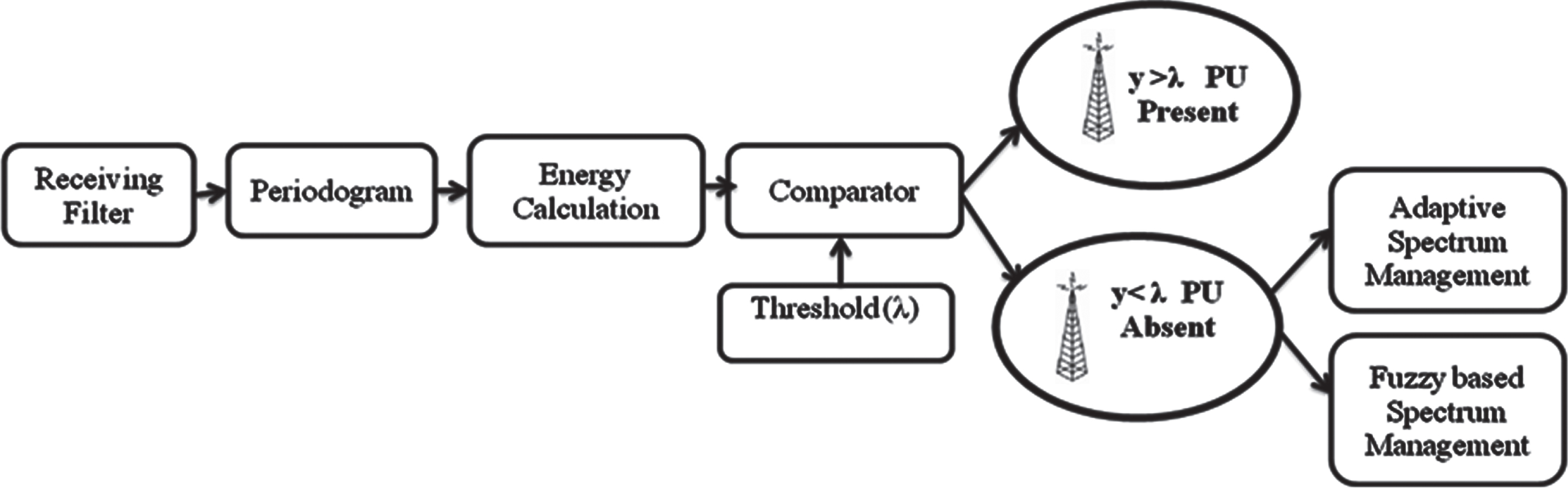
Proposed Energy Detection technique to manage the spectrum.
E.g., Assume in a wireless medium, if sensing is carried out for 16 slots by Bin by Bin test: Sensing time be very high, and before completing the sensing, the slots may be occupied by Primary users. Batch test: Sensing is done for batches of slot rather than bin by bin which significantly reduces the sensing time.
Figure 2 explains the concept of group testing. Here, 16 slots are considered, and ‘x’s denotes the occupancy of the primary user. Initially, the slots are divided into four groups. Further, the energy detection procedure be carried out. In a sense, the presence of the primary user in a group be denoted as H1 and the absence as H0. In the next stage of sensing, H0 be excluded, and the procedure be repeated until the primary user is located. In Fig. 2, the primary user’s location is identified at the third stage of sensing, significantly reducing the sensing time compared to the bin by bin test.

Batch sensing technique to identify free slots.
In adaptive spectrum management, the sensed idle channel is allocated to the CR users without considering the best available channel.
Fuzzy Inference System control overcomes the drawbacks of both formulae based and table-based techniques. FIS can make development and implementations are straightforward and provide greater accuracy as it does not require colossal memory and complicated formulas to arrive at the best possible solution. Here, four parameters, like signal strength, node velocity, spectral efficiency and distance, were utilised to select the best available free channel, as shown in Fig. 3.

FIS based Spectrum Management.
This method is well suited for indoor coverage. In the conventional Femtocell approach, cross-tier interference and intra tier interference are the two main drawback issues in the two-tier femtocell access networks. In the proposed cognitive femtocell network, the access points are prepared and installed with Cognitive Radio, which determines the spectrum dynamically by macro cell and nearby Femto Access Points. Further, it evades the interferences mentioned earlier generated on adjusting its radiating parameters, maximising the spectrum band’s overall utility.
In this proposed centralised two-tier network architecture, throughput, network utility, sub-channels used, and the data rates are the various performance evaluation metrics taken into consideration while sensing and managing the spectrum as shown in Fig. 4. Macrocell users BS and several Femto users and the associated FAPs are shown in Fig. 4.1. FAPs are connected to the macro BS via fibres/cables, and it operates on the licensed band of wireless spectrum.
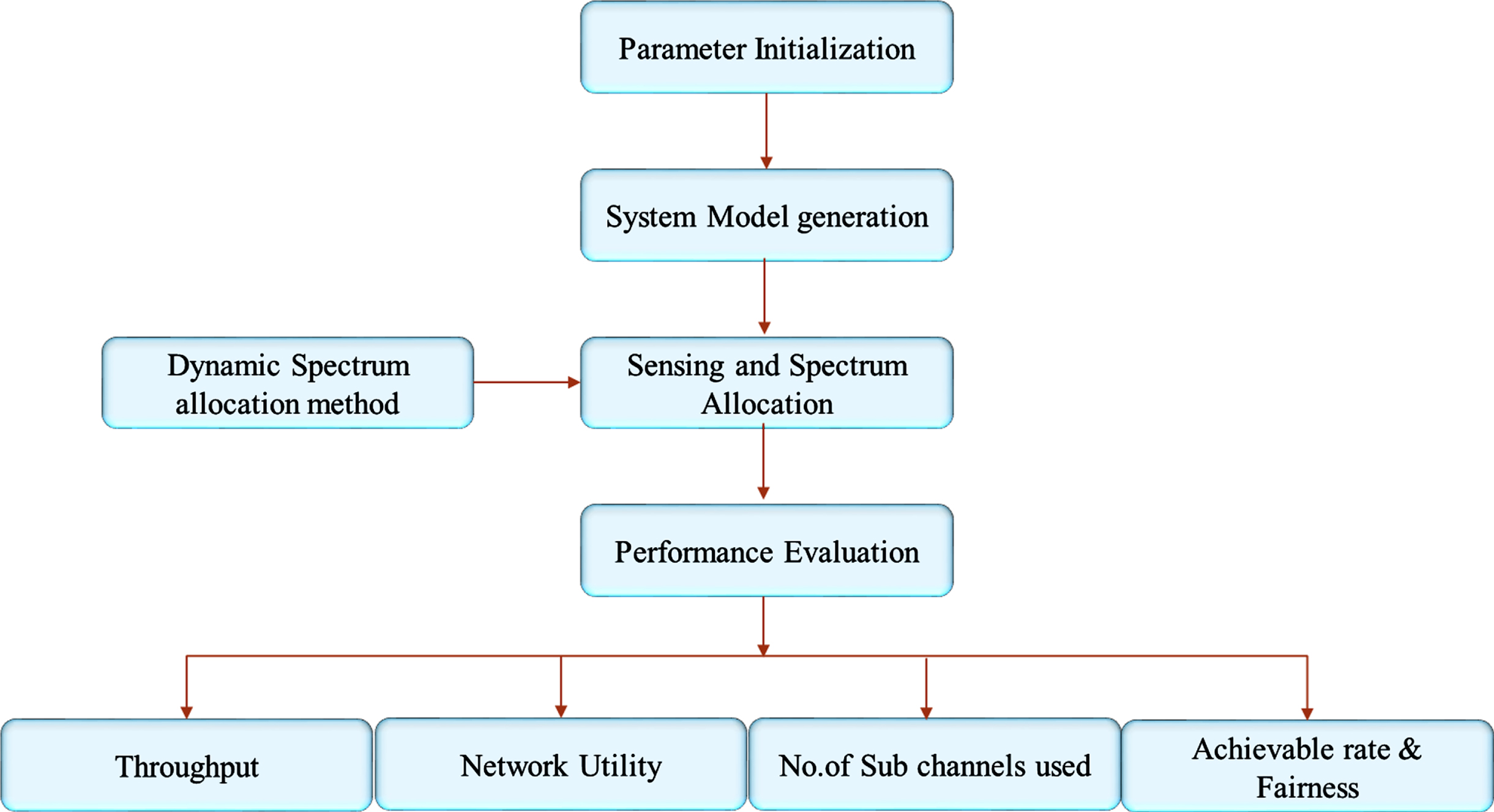
Block diagram of the proposed System.

Schematic representation of a) Connection establishment from Macro BS to MU b) BS-MU-FAP.
In the sensing and spectrum allocation stage, the demand/dynamic spectrum allotment model is used to fix the customer’s channel in the femtocell network, as shown in Fig. 5. The FAP initialises the part of available sub-channels by scanning the spectrum in every slot. The demand/dynamic spectrum allotment system is planned to utilise the data provided by the mobile network provider. Femtocell have amalgam access in femtocell cognitive radio network. The FAP could offer enhanced service to the FUs because of available supplementary sub-channels. Alternatively, the macro BS can progress its spectrum efficiency by consuming a fraction of the spectrum.

Functions and usage of the various blocks in the proposed System.
In this technique, the wireless cellular network provider consumes a fraction of sub-channels by maximising Macrocell users’ performance. Figure 6 depicts the sequence of events that were carried out to achieve maximum performance.

Flow diagram depicting the sequence of operation.
In the proposed scheme, initially, an energy detection procedure is carried to identify the vacant channel. Once identified, it will be allocated to the secondary users either using adaptive or FIS based techniques. The vacant channel’s detection probability for various false alarm probabilities and SNR estimation were carried out and shown in Figs. 7 and 8. By comparing the adaptive and FIS system. The observed values confirmed that the detection probability is high for low probability false alarm as it is the complementary curve. Also, as the SNR value increases, the detection probability curve shows gradual improvement.

Probability of detection a) with False Alarm Probability b) with SNR
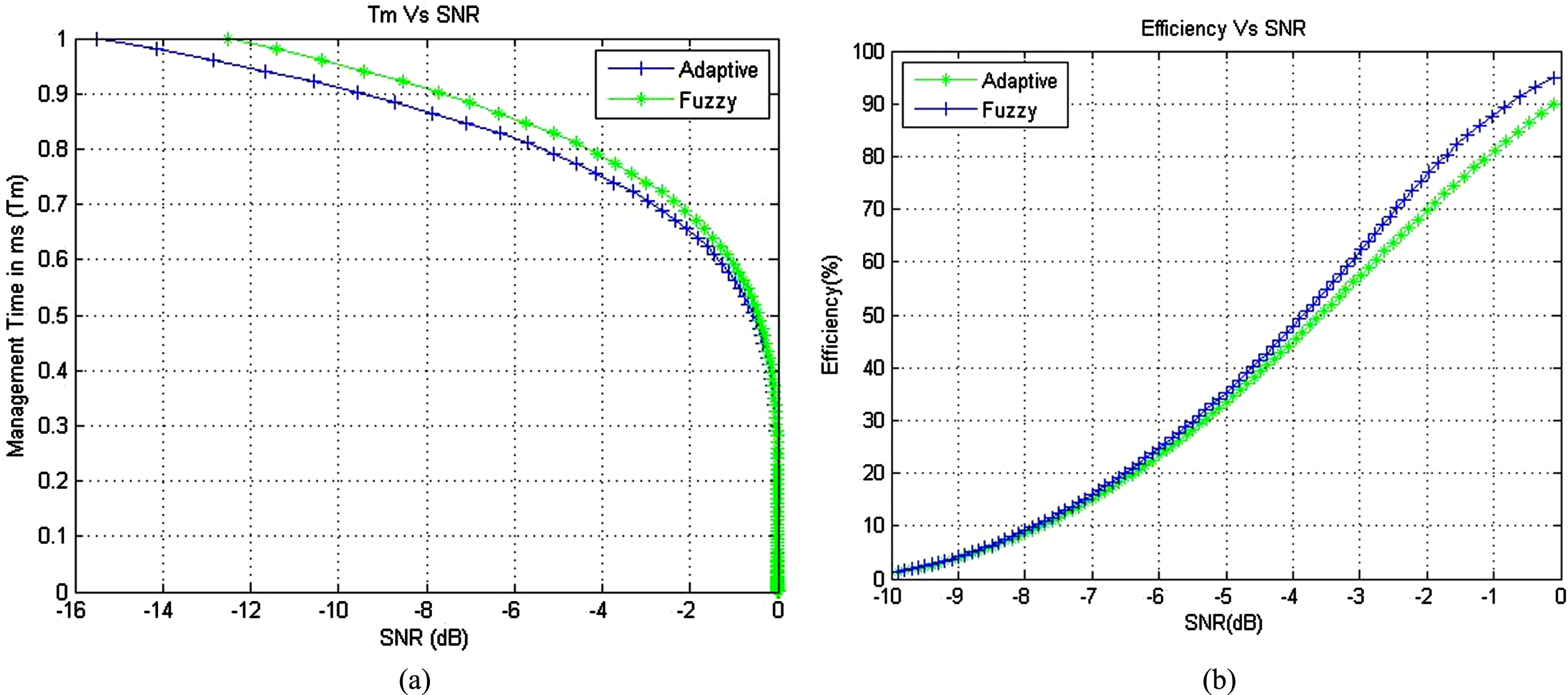
SNR estimation a) with Time b) with Efficiency
From Fig. 7a, for pfa = 0.2, the probability of detecting the best channel by adaptive spectrum management is 0.68 and for FIS is nearly 0.82, which proves the superiority of the fuzzy-based spectrum allocation system over the conventional adaptive system. The detection probability of adaptive management for a particular SNR 8 dB is 0.7, but for the FIS, the SNR is increased to 0.84. From the reported values of SNR, nearly 20% improvement is achieved in detection by employing the FIS system, as shown in Fig. 7b.
When the SNR increases, the spectrum allocation/management time decreases because of low noise. Management time of fuzzy occupies more time than adaptive because it spends more time selecting the best channel. Figure 8a, at - 8 dB, the adaptive system’s time is 0.87 S, whereas it took around 0.9 seconds in fuzzy. From the estimation, it is clear that FIS took almost 3.5% time to select the best channel compared to the adaptive management system. The system’s overall efficiency is plotted for different SNR values, as shown in Fig. 8b. As SNR increases the performance of both the management system increases at low noise. At SNR = -1 dB, the adaptive efficiency is 80%, and the FIS system outperforms adaptive by 8%.
For indoor coverage, the Demand/Dynamic Spectrum Allocation method is preferred where the network usage of the Femto Access Points(FAP) are significantly increased, and the following factors achieve the throughput of the served Macrocell:
*
*
*
Figure 9 (a and b) represents the calculation of network throughput and utility by varying the number of sensed channels allotted to each user. From the results, the varying network throughputs and utility measures for the respective number of sensed channels are significantly high as compared to the conventional system [16]. Similarly, Fig. 9 c and d represents the calculation of network throughput and utility by varying the number of negotiation channels allotted to each user. From the results, the varying network throughputs and utility measures for the respective number of negotiation channels are radically improved as compared to the existing system [16].

a) Network Throughput Vs Sensed channels b) Network Utility Vs Sensed channels c) Network utility Vs Negotiation channel d) Network Throughput Vs Negotiation channel.
Figure 10a and b shows the network utility and throughput estimation of the proposed scheme. From 10a, the utility of the FUs increases once the achievable rate exceeds the target. Figure 10b signifies the maximum data throughput in bits per second of the established link in accessing the network [16]. Figures 11 and b represent the proposed scheme’s fairness and achievable data rates compared with the existing literature technique. In overcrowded cellular networks, the number of vacant sub-channels is very low. Hence, each FU’s achievable data rate is comparatively low, making the proposed scheme more suitable for the femtocell enabled environment [16].
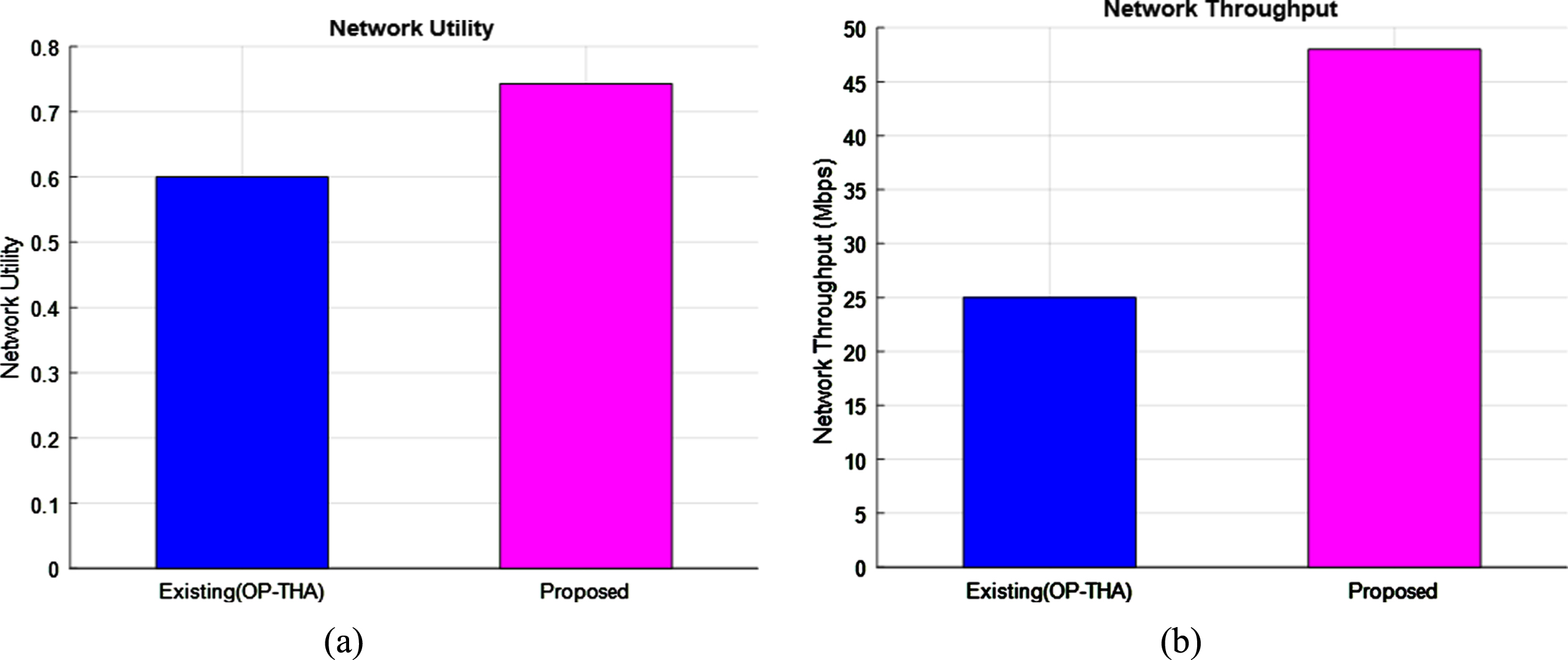
Comparison of a) Network utility and b) throughput of the proposed scheme with the existing method.
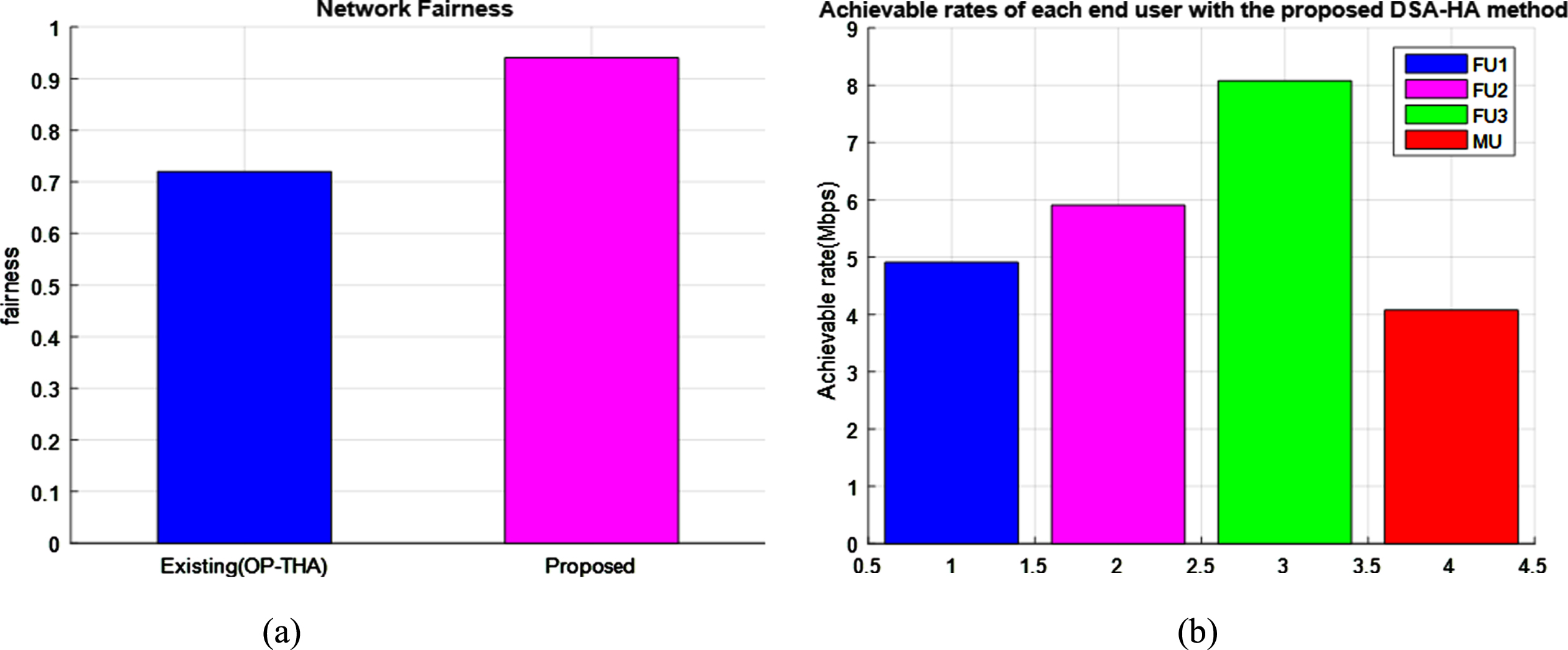
Comparison of a) Network fairness and b) Achievable rates of the proposed scheme with the existing methodology.
In the proposed system, the spectrum allocation for the network users is done using the dynamic spectrum allocation in the cognitive femtocell network for indoor coverage. The proposed Femto network provides better spectrum allocation while the primary user is in the idle state by saving 39% of the spectrum for the secondary users by achieving better utility range, data rate and maximum throughput level. Based on the secondary user’s requirements, an adaptive-based management system or FIS-based techniques will allocate the spectrum to the secondary users. FIS system provides a 20% improvement in SNR and an 8% increase in efficiency than the conventional adaptive spectrum management system. Factors like effective spectrum utilisation, speed, power of the received signal and remoteness to the primary user have been considered while managing the spectrum. The projected scheme reduces the average sensing time and management time as a function of SNR. From the comparison analysis of adaptive and FIS spectrum Management system by analysing the number of users, batch length, efficiency and SNR, FIS outperforms adaptive spectrum management system. Adaptive management is also equally good, and it is well suitable when time management is a key factor. Femtocells installed in macrocell infrastructure considerably perk up the coverage area in indoor environments. Femtocell Access Point (FAP) reduces the overall infrastructure requirements and the cost by providing and maintaining the highest service to the end-users
Conflict of interest statement
The authors of the paper do not have a direct financial relationship with the commercial identity mentioned in this paper that might lead to a conflict of interests for any of the authors and declare that there is no conflict of interests regarding this paper’s publication.
Footnotes
Acknowledgments
Authors thank the Department of Science & Technology, New Delhi, for the FIST funding (SR/FST/ET-II/2018/221). Also, the authors wish to thank the Intrusion Detection Lab at the School of Electrical & Electronics Engineering, SASTRA Deemed University, for providing infrastructural support to carry out this research work.