



Abstract
Fierce competition in the global markets forced companies to improve the design and management of supply chains, because companies are always looking for more profit and higher customer satisfaction. The emergence of the green supply chain is one of the most important developments of the last decade. It provides an opportunity for companies to adjust their supply chains according to environmental goals and sustainability. The integrated production-inventory-routing is a new field that aims to optimize these three decision-making levels. It can be described as follow: a factory produces one or more products, and sells them to several customers (by direct delivery or a specific customer chain). The current study aims to model a production-inventory-routing system using a system dynamics approach to design a green supply chain under uncertain conditions. For this purpose, first, the association between selected variables was determined. Then, the proposed model was validated. Finally, to identify variables with the highest influence, four scenarios were developed. The results indicated that minimum total transportation cost, the total warehouse capacity of the supply chain, and the maximum production rate are the most influential strategies to achieve ideal condition.
Introduction
Due to the considerations related to production and the environment as well as environmental impacts of consumption, investigating the Production-Consumption-Environment (PCE) cycle led to significant changes in recent times. The supply and distribution of products is an important concern for business [1, 2]. Recently the importance of environmental factors increased substantially and there is a global demand for accountability about environmental impacts of production. Therefore, nowadays firms should simultaneously meet consumer needs and respond to their environmental concerns, and while minimizing the environmental costs, they have to control the costs of the PCE cycle [3, 4]. The simple structure of the supply chain which once was limited to the transfer of products from factories to the consumption point, now has evolved to a chain with various levels, that each level has its role. Managing such chains, at both macro and micro levels, is a challenge for manufacturing units. It strategically requires efficient management and operationally requires an effective design [5–7]. Today, the supply of resources such as energy, manpower, and raw materials is a challenging issue that affects the production chain. The management of production and the cycle that delivers the product to the consumers need special attention [8, 9]. Management of such structures requires a change in managerial decisions, but decisions should not be limited to production and producers, and the whole process should be considered, so that through providing appropriate information, managerial mistakes be minimized. Decision-making requires a variety of tools, one of the most important of which is modeling and optimization science. Supply chain management of consumer products is of great importance, high complexity, and sensitivity. Optimization comprises of factors that affect profit maximization or cost minimization, for example, customer satisfaction, both in terms of product quality and timely supply of products, substantially increases the costs [10]. Given the abovementioned issues, the current study aimed to develop a holistic framework for production, inventory, and routing planning.
According to the explanations mentioned above, the purpose of this study is to design an integrated framework for production planning, inventory and vehicle routing problem, and considering the green supply chain in conditions of uncertainty.
The study is structured as follow. In section 2 a review of literature is provided. In section 3 the methodology is described. And in sections 4 the results and conclusion are provided, respectively.
Literature review
Previous studies and researches dealt with various factors that influence the PCE cycle in a section of a particular industry and/or a service, and by conducting statistical analyses on data obtained through questionnaires tried to provide results. Few studies used decision-making methods. However, not paying attention to all-round factors will not yield a complete plan for decision-makers. Previous studies investigated various issues. For example, for optimization in the green supply chain, Garai and Roy [11] developed a customer-centric closed-loop supply chain management model based on real-life. Zhang [12] investigated developing a multi-objective model for the trade-off between total cost and environmental performance in a dual-channel network of a supply chain. Vafaeenejhad et al., [13] developed a multi-linear linear programming model for a multi-cycle and multi-product supply chain. Rad and Nahavandi [14] developed an integrated mathematical model for a closed, multi-product green closed supply chain. Sarkar et al. [15] developed a multi-purposes supply chain management model for the manufacture of auto parts to optimize production lines. Manupati [16] proposed a new approach for designing a supply chain regarding the trade-offs between environmental and financial issues to reduce negative consequences on the environment caused by increased industrialization. For the System Dynamics (SD) of the green supply chain, Cao et al. [3] developed a model for estimating direct costs of CO2 emissions, and then developed a SD model to simulate CO2 emission reduction scenarios for the entire life cycle of the coal supply chain. Rebs et al. [4] developed a SD model that includes the effects of government’s, shareholder’s, and other external stakeholder’s pressures. Song et al. [17] used the SD approach to simulate the process of technologic, energy, environment, and economic development in Shandong Province from 2003 to 2020. Yan et al. [18] through analyzing the SD simulations and statistical validation of experimental data, developed a case study from the system perspective. Xue et al. [19] investigated the performance of a green supply chain in a producer and retailer unit. In terms of multipurpose production-inventory-routing optimization in the green supply chain, studies such as that conducted by Alinaghian and Zamani [1] developed a two-purpose model for the green inventory routing using a heterogeneous fleet. Banasik et al. [20] developed a two-step random programming model for analysis and evaluating economic and environmental impacts in the food supply chains. Niu et al. [21] developed an integrated supply chain model, by using a multi-purpose, multi-product, and multi-cycle system, and procurement requirements, and partnerships. Manupati et al. [22] by using three policies regarding the carbon production and time limitations of the leaders, examined various issues of production-distribution and inventory in a multi-level supply chain. Mohammed & Duffuaa [23] proposed a new solution based on a simulated annealing algorithm for obtaining near-optimal solutions to solve the problem of designing a multi-purpose supply chain. Badhotiya et al. [24] investigated an integrated production and distribution planning for a two-tier supply chain network consisting of several manufacturers in several areas. Gharaei & Jolai [25] investigated a multi-factor programming problem with distribution decisions in a multi-factory supply chain.
Given the aforementioned, an integrated framework for production-inventory-routing planning is necessary to meet customer satisfaction expectations. It is obvious that such a framework should be economical. However, previous studies investigated these three issues separately. On one hand, the traditional production planning, while ignoring inventory and routing, is focused on planning and meeting various production criteria. One the other hand, generally studies on inventory and routing planning were focused on minimizing transportation costs, and ignored the impacts of production planning on such plans. Therefore, the current study: Investigated factors that influence production-inventory-routing planning in the green supply chain; Employed the SD approach to determine important and influential indicators for production-inventory-routing planning in the green supply chain; Developed an integrated framework for production-inventory-routing planning while paying special attention to the greenness of the supply chain, so that another step be taken toward closing to the reality; Uncertainty and disruption of production-inventory-routing planning in the green supply chain are considered.
Methodology
Taking into account the purpose of the current study (i.e. modeling the dynamics of the production-inventory-routine system in the green supply chain using a SD approach according to three factors: production rate, total inventory, and total transportation costs) its an applied research. Also, this is a descriptive-exploratory study, because it intended to develop an optimization model. Based on what mentioned above, first a literature review should be conducted. The next step is designing the model using the collected information. The third step is to develop the model using the collected information and the SD approach. Steps of the research process:
In the following each step is described in detail.
The simple structure of the supply chain which once was limited to the transfer of products from factories to the consumption point, now has evolved to a chain with various levels, that each level has its role. Managing such chains, at both macro and micro levels, is a challenge for manufacturing units. It strategically requires efficient management and operationally requires an effective design. Today, the supply of resources such as energy, manpower, and raw materials is a challenging issue that affects the production chain. The production management and delivery cycle should be considered. Managing such structures requires a change in the managerial decisions, but decision-making is not limited to the producers and suppliers, and decision-makers that monitor the whole process should also be included into the cycle, so that mistakes be minimized. Decision-making requires a variety of tools, one of the most important of which is modeling and optimization science. Optimization comprises factors that affect profit maximization or cost minimization. For example, customer satisfaction, both in terms of product quality and timely supply of the product, substantially increases the costs. Multi-facet provision chains (production-inventory-routing) intend to achieve necessary coordination between different levels. In general, supply chain planning involves planning to demand materials, inventory, transportation, and so on. As mentioned, one of the most important problems in the supply chain is how operational decisions are made, including planning for production, inventory, and routing. In addition to the product’s quality, which is one of the most important factors in customer satisfaction, timely delivery also has an undeniable role [3], [26]. Failure to coordinate these factors, not only influences in-time delivery of products, but also has impacts on the quality of the product, inventory planning, and finally the customer’s satisfaction. Multi-faceted supply chains are known for their difficulty and complexity, therefore, coordination between production and routing can have a significant impact on reducing the delivery time. Increasing the quality of products enhances the profit [20]. Most studies conducted on the uncertainty of supply chains considered demand as an uncertain factor. Better assessment of demand can lead to a more accurate plan. Given the nature of the demand and information on selling goods, using random demand can be useful for modeling this type of uncertainty [27]. Interruption is one of the most critical conditions that causes problems with natural workflow [28]. An integrated framework is essential for planning and scheduling the production as well as addressing problems regarding the routing. Of course, such a framework should be economical. According to the literature, traditional production planning is focused on appropriate scheduling and producing various goods, and less attention is paid on in-time delivery, which is the most important factor in minimizing transportation costs. Several complex associations between variables from different environments as well as existence of feedback and delay loops, cause a high level of complexity in macro issues. SD approach uses to model complex macro problems based on certain principles. One of the most important features of the SD approach is its ability to consider the immediate and long-term intra effects of variables. In the current study, the SD methodology is used to simulate the system behavior. Casual loops and flow diagrams are the main elements of the SD methodology. Casual loop diagrams can either be negative or positive. In the current study, the SD is used for the simultaneous planning of production-inventory-routing. To achieve this goal, a SD model of simultaneous planning for production-inventory-routing which intends to minimize the delivery time and maximization of profit, and increasing customer’s satisfaction while considering the uncertainty of demand, is developed.
Review of previous studies revealed that to achieve goals of the current study 30 variables should be considered. In the Table 1 a list of primary variables is provided.
Key influencing variables on production-inventory-routing in the green supply chain
Key influencing variables on production-inventory-routing in the green supply chain
These variables have been collected through previous research and experts’ opinions, and the most important reason for their different use from other researches is that in previous researches, one or more variables have been used in research, and in any research, all These variables have not been used simultaneously to examine their effects. It can also be seen that the study of the effect of these variables on each other and on the objectives of the research as a whole has not been done in any of the previous researches, but in this research using system dynamics, this has been evaluated. The method of data collection is library studies and the method of data collection is field. The statistical population of this study is managers and supply chain and green supply chain specialists who were selected by snowball method and all of them were interviewed openly and all of them participated in the Delphi focus group and panel and used them in filling decision matrices Has been. The demographic characteristics of the statistical community of experts participating in this study are shown in Table 2.
Demographic profile of research experts
Since the statistical population of this study is a group of experts, so we will not have a statistical sample. As mentioned, the statistical population in this study includes 15 managers and green supply chain specialists who were selected for screening, selection criteria and participation in other stages of the study.
The SD investigates the behaviours of the systems over time. This is a matter of time (i.e. choosing approprite time horizon for model). The length of the time horizon affects outputs of the model, but there is no unified set of rules for choosing the time horizon. Problems related to the time horizon of models affect the practical application of SD in policy management [41]. Many researchers reported that a time horizon of three to five years is usually reasonable to assess the results. So, by considering this issue, and regarding the high number of variables, expert’s opinions, and the literature review, as well as model calculations, a time horizon of five years was selected. Accordingly, processes, feedback loops, delays in strategy, and time are important elements of the SD modeling, which are investigated in a time horizon of five years. Model variables are described in Table 1. Then, after interviewing with experts and reviewing studies it was found that some variables are more important than others, and to simplify the model, some variables with similar impacts were removed. Finally, by considering all of the abovementioned issues, three main hypothesizes were defined: First hypothesis: by developing a SD model, the optimized production rate can be estimated; Second hypothesis: by developing a SD model, the optimized amount of inventory can be estimated; Third hypothesis: by developing a SD model, an optimized route (in terms of both cost and time) can be estimated.
As shown in Fig. 2, the model comprises three-mode variables: the amount of output; total inventory; and total transportation cost. All three variables affect other variables. To achieve integration in the production-inventory-routing, the impacts of various variables on these mode variables are examined simultaneously. As mentioned earlier, by analyzing factors described in Table 1, cause-and-effect relationships are identified, and loops were also determined, which are shown in Figs. 3 and 4 as mode variable for production level, total chain inventory, and total transportation costs.

Steps of the research process.

Model of the research problem.

The first corrective loop for mode variable of production rate.

Second corrective loop for total inventory and total transportation cost.
This is the first corrective loop of the model. Various studies conducted by Qureshi et al. [42] reported that production lines cause more pollution when the equipment are not up-to-date and fossil fuels are the main source of energy, which results in increased emission of greenhouse gases. They also noted that the emissions are associated with the amount of production, and hence are associated with the duration of the production (i.e. the longer the production duration, the higher the emission). Yang et al. [43] noted that with the expansion of industrial activities and resulted increase in the emission of greenhouse gases, legal and social pressures to reduce pollutions will increase, which forces the factories to move toward green production systems. To create such a system, production lines should change, which increases the initial cost of establishing production lines. That in turn, results in increased use of organizational resources, and intensification of resource limitations. The production rate also will decrease. It is clear that lower production rates result in decreased production. As shown in Fig. 4, increasing the amount of production will reduce the amount of production through the defined loop.
The second loop is also corrective. Manerba & Perboli [44] found that increasing the cost of product distribution (total transportation cost is an important factor) results in decreased demand. Decreased demand results in decreased delivery time, due to the lower number of items that should be delivered, and reduced distribution routes. Which in turn causes increasing the output rate, because vehicles can back to the factory more quickly. Increased output results in lower inventory, which in turn increases the inventory costs per each unit, because now fixed costs divide to a lower number of products. That increases the annual total costs. The annual cost of establishment, due to the distance between the factory and distribution centers, directly affects the average cost of each transportation unit. In other words, the shorter the distance, the faster will return vehicles, and decreased transportation time results in lower inventory, and therefore increased inventory costs. Typically, places that are closer to the consumer due to the short distance from urban areas have higher expenditures. Increased in costs indicates two issues: first, lower inventory, and second, shorter distance between the factory and the consumer, which both reduce transportation costs. This reduction ultimately decreases the cost of transportation routes. Cause-and-effect relationships of mode variables are as follow:
Cause-and-effect relationships of mode variables of total transportation costs, total inventory, and production level are shown in Fig. 5. So, the variables affect each other from left to right.

Cause-and-effect relationships of mode variables.
The validity of the results in a model-based SD study depends on the validity of the model. A model must provide a simplification of a real-world problem and thus eliminate some variables or structures in the real world to achieve this goal. Identifying the appropriate structure responsible for “correct” behavior is a multidimensional process: problem representation, logical structures, and mathematical and causal relationships. After simulating the SD model and before senario making and relying on the results, the developed model validation should be done on it. Sterman (2000) introduces several methods for validating these models in his book Business Dynamics. Using these methods, it can be found out whether the considered variables have a good effect on the model and whether the model is designed to respond to the problem under study or not? A series of tests are developed to validate models, that most of them are used in the current study.
To examine the impacts of variables on the outputs of the model, in the next step, they were removed one-by-one. The impact of removing the total warehouse capacity is shown in Fig. 6. It has an indirect impact on the production level. Deleting a variable means ignoring its impact on the final outputs of the model (not the absence of the variable in the real world). Removing the variable revealed that variables are strongly influenced by each other, and removing this variable has substantial impacts on the final results.

The impact of removing total warehouse capacity on the production level.
In Fig. 7 the impact of removing total warehouse capacity on the total chain capacity is shown. Ignoring this variable results in decreased total chain capacity. It’s obvious the lower the warehouse capacity, the lower will be the capacity of the chain, because there would be no place for storing.
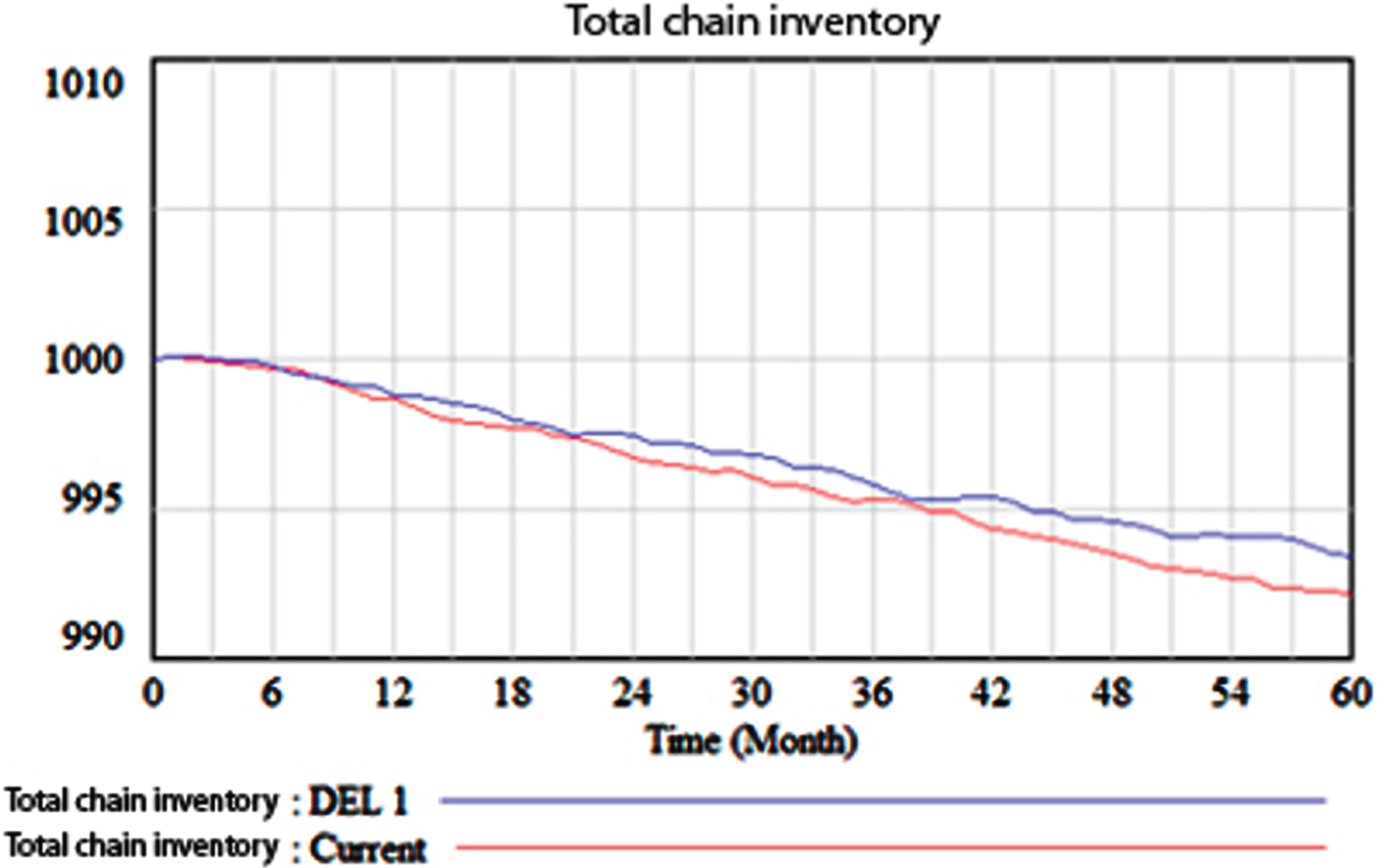
The impacts of removing total warehouse capacity on Total chain inventory.
The impact of the level of the nascency of transportation technology on total transportation cost is shown in Fig. 8. As Fig. 8 shows, the extend of the impact of removing the level of the nascency of transportation technology variable on the total transportation costs was high and increased the total costs. In other words, traditional transportation systems increase the total transportation costs, because they have lower capacity, lower speed, and lower security, all of which result in increased transportation costs.
The relationships used in the model should be a realistic representation of the real world. Since the Vensim software is used to develop the model, all equations are endorsed by the software.
It examines the behavior of the model when variables are set to extreme values (i.e. using the minimum and maximum values). Extreme conditions validity indicates whether the model behaves realistically or not. In the section about boundary adequacy, extreme values were used for all variables. If the warehouse capacity goes down, as shown in the figure, the total inventory of the chain moves downward tremendously, which can lead to the shortage. Total transportation cost in the case of extreme value for the level of the nascency of transportation technology is shown in Fig. 12.
The model should be able to replicate historical data from the real world. Given that before developing the model an extensive literature review was conducted, variables affecting production, total warehouse capacity of the chain, and total transportation cost are included, therefore the model can reproduce the historical data. As shown in Figs. 13 15, if marginal costs are reduced, the production rate and total warehouse capacity of the chain will increase, and the total transportation cost will decline, respectively.

The impact of removing the level of the nascency of transportation technology on total transportation cost.

Accuracy of the structure of equations in Vensim software.

Model behavior when warehouse capacity is set to zero.

Model behavior in a scenario with extreme value for warehouse capacity.
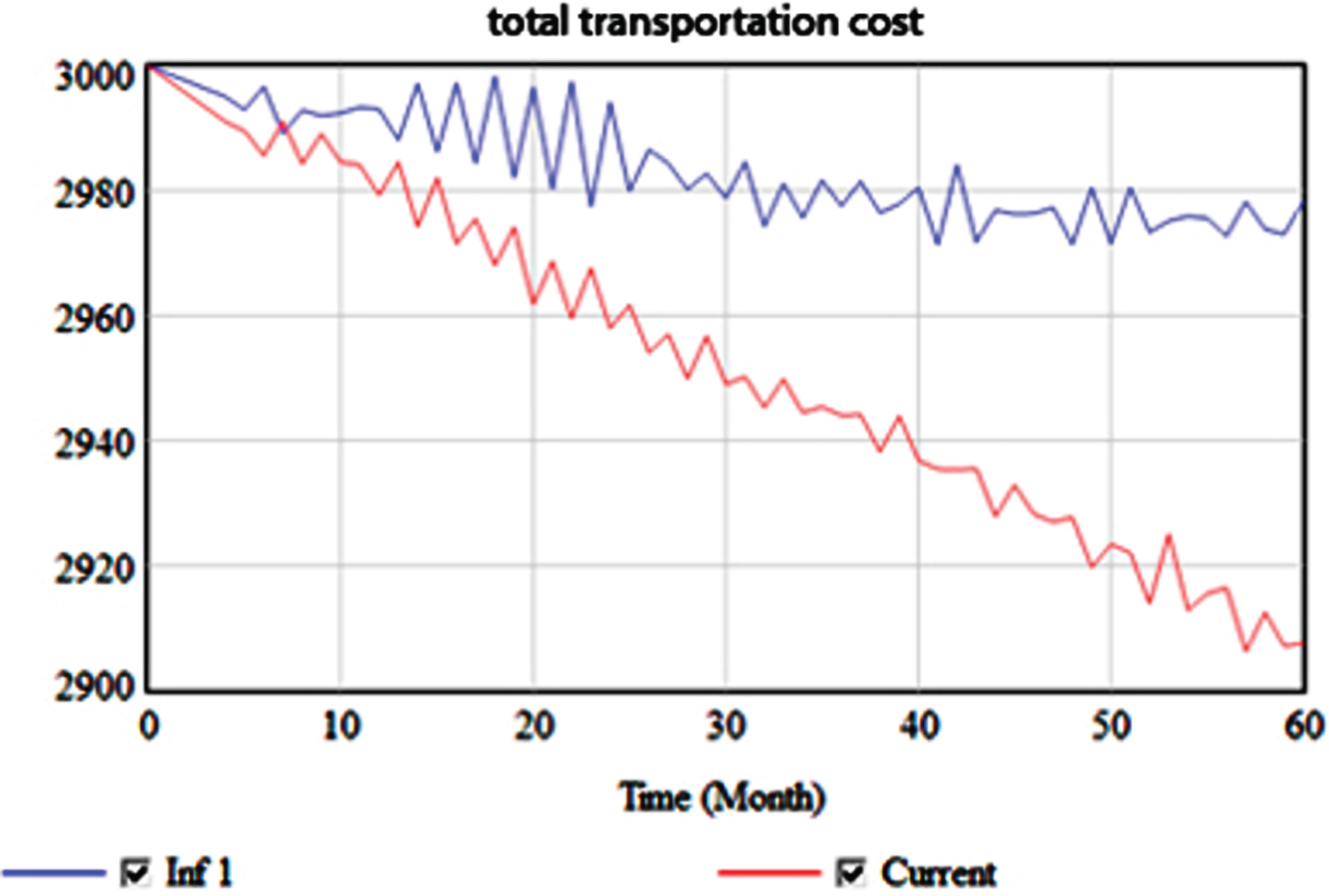
Behavior of the model in the case of extreme values for the level of the nascency of transportation technology.

Production Level.

Total warehouse capacity of the chain.
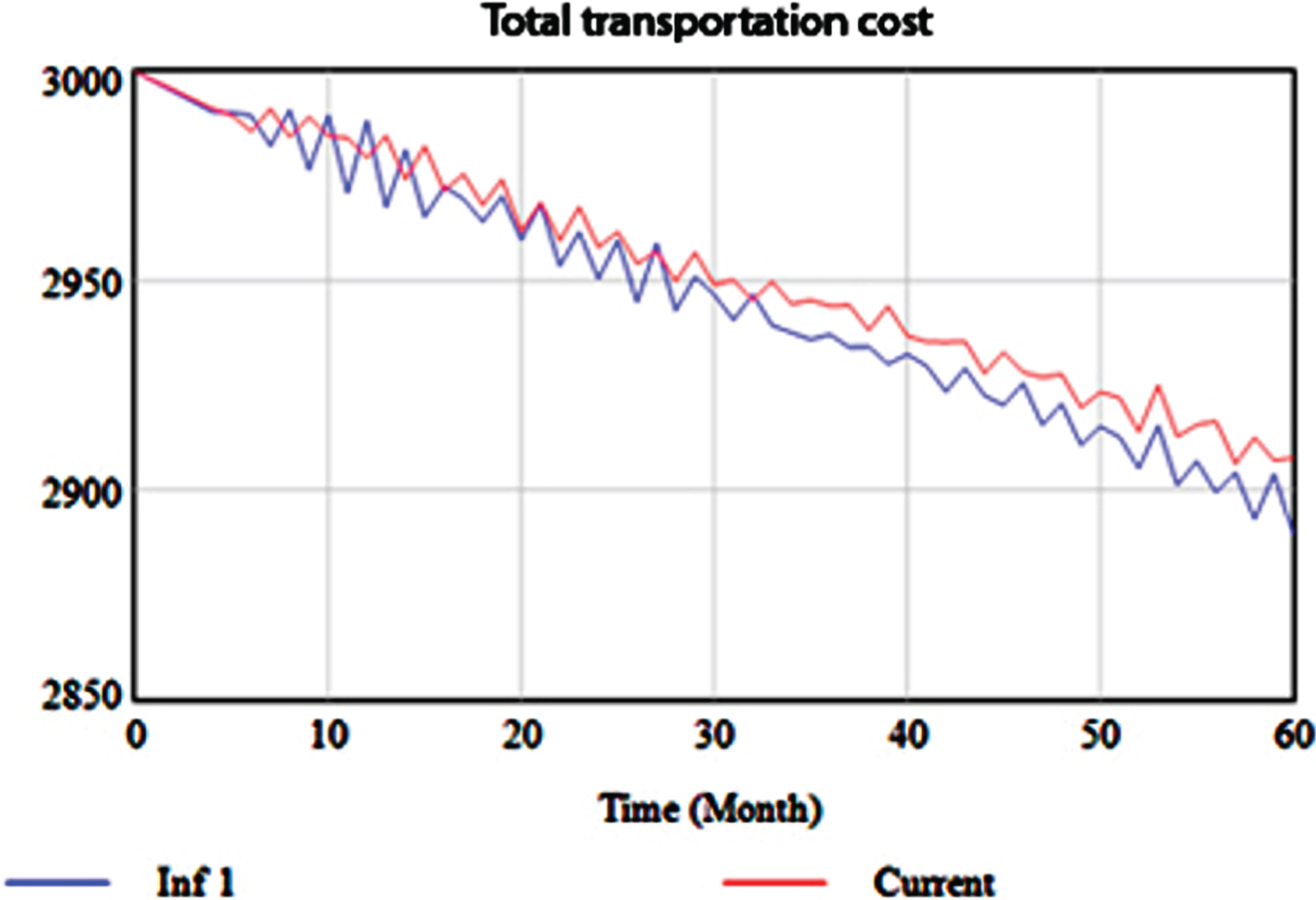
Total transportation cost.
In the last step, after analyzing variables of the model and determining the amount and type of their effects on other variables, scenarios should be developed. Each scenario contains different values for various variables of the model. In total four scenarios were developed (Figs. 16, 17, and 18). Then, based on the expert’s opinions and previous studies, different values were obtained for various variables of the model (both those that can be controlled by the organization, and those cannot). The scenarios contain variables that the system is currently able to change, variables that the system does not decide on (i.e. external variables), and a combination of values that decisionmakers mentioned as applicable.
In this scenario the impacts of changing the level of the nascency of transportation technology and marginal costs are investigated. Technological advancements transform the day-to-day processes of the supply chain. Real-time tracking and accurate delivery systems are the main parts of the supply chain that requires technological transformation. Mobile technology plays the same role for logistics. Regarding the continuous advancement of technology, synchronization with new technologies and best practices can be difficult for large companies with deep investments in old technologies. Indeed, technological advancement is an endless process. Although technological adjustment takes time, but using new technologies is an important part of competitive industries. Transportation organizations are under pressure to reduce logistic costs as a part of the company’s cost-saving initiatives. In turn, managers of transportation organizations expect supply chain managers to provide more services and increase transparency. Since the inception of wireless communications, many third-party providers and supply chain managers adopted wireless communications and cloud services to automate systems and improve accuracy. Automated systems not only are faster and more efficient than their manual predecessors, but also provide better data recording, which in itself can improve processes, and store and analyze the data in target areas. Using such technologies is the first strategy of the current scenario. The cost of production is the value of the total consumed resources to produce a product. Continuous innovation occurs in production methods. Monthly reviews of production processes are necessary to identify deficiencies. There may be some additional processes in the production cycle that are no longer needed and impose high costs. In this scenario, as with the previous strategy, the strategy of eliminating redundant processes is also considered.
Inventory cost contains maintenance and storage of goods over time. Inventory comprises of raw materials and materials under construction. To avoid inventory surplus, the application of a just-in-time (JIT) strategy is considered in this scenario. JIT means to sort inventory, that is necessary for production. The JIT avoids unnecessary inventory accumulation, thus reduces costs. As well, the required capacity of the inventory declines, which results in decreased warehousing expenditures. In this scenario, this strategy is used simultaneously with the strategy stated in the first scenario.
In this scenario, the focus is the optimization of transportation fleet and using the last technologies for the fleet. Smart transportation systems are increasingly considering as cost-effective strategies. Resource reduction is carefully under supervision. Therefore, ‘performance measurement’ is an important component in justifying operational plans. In this scenario, this strategy is considered, so that the costs and benefits of using smart transportation systems are assessed. The lean production approach was also considered as the other strategy. A lean production is a managerial approach that focuses on eliminating waste, while ensuring quality. It can be used for all aspects of a business, from designing and production to distribution. This approach is designed to reduce or minimize activities that do not add value to the production process, such as inventory retention, defect correction, and unnecessary movement of personnel or transportation of products. It affects the marginal cost of production, production rate, and the level of production. Besides, it both affects warehouse capacity and the marginal cost. In addition to these two strategies, the application of the JIT strategy is also considered in this scenario.
In the last scenario, the strategies stated in the first scenario are considered along with those of the third strategy. This strategy is about allocating space. Allocation of space refers to the application of algorithms that are primarily used in the geographic information system to determine the optimal location, which determines the demand in different locations. Algorithms can allocate the demand to one or more facilities, and consider factors such as the number of available facilities, their costs, and the maximum impedance from one building to another. In this scenario, as mentioned before, strategies noted in the first scenario along with the optimal space allocation strategy are used.

Different scenarios of the level of production variable.

Different scenarios of the total chain inventory.

Different scenarios of the total transportation cost variable.
Stream management in a supply chain is a business opportunity for many companies. Today, due to various reasons, including growing concerns about increased energy consumption, fierce competition, environmental concerns, governmental restrictions, and laws regarding the green products and waste disposal, firms began to integrate the notion of logistic in the decision-making systems related to the production, inventory, and distribution. Integration of these three decisions in the supply chain decisions provides opportunities for companies to significantly reduce costs. In addition, integrating decisions related to distribution, inventory, and production into a single structure is an essential measure and is related to the sensitivity about timing. Planning for production, effective management of inventory, and routing are among important and interwoven problems in the design of closed-loop supply chain networks. In the current study, an integrated production-inventory-routing problem (IPIRP) is investigated, because the green supply chain is considered as a sustainable aspect. A SD model is developed for this problem. The goal is to determine both the optimal amount of production and total warehouse capacity of the supply chain, while responding to customer demand with the minimum transportation cost. This model is about analyzing the associations between components. After designing four scenarios and simulating the model, it was observed that scenario 4 had better results than others in terms of total transportation costs, and had the lowest transportation costs. This suggests that, if the optimal space allocation strategies, intelligent transportation systems, lean production, and JIT be implemented, the total transportation cost will reach its lowest. Besides, total production and inventory of the supply chain had their ideal in scenario 3. Therefore, regarding the policies of high-level managers of the organization, scenario 3 can be the most appropriate scenarios for the future of the organization. Based on the results, the followings are recommended: Implementation of smart transportation systems and new technologies for faster and cheaper delivery; Implementation of lean production systems and the JIT strategy to reduce production costs, which affects various issues such as reducing marginal cost, liberalization of financial resources, and thus the ability to increase production. That in turn results in increased profitability; Implementation of optimized space allocation systems, to reduce the distance between nodes, and thus the delivery time and transportation costs.
According to research by Zhang et al. [12] Creating a multi-objective model for the exchange between total cost and environmental performance in the supply chain network is critical to the green supply chain. In this study, by simultaneously examining variables such as production pollution, carbon and greenhouse gas emissions and fuel pollution, production cost, productivity level of transportation technology and total travel cost, a significant part of important and effective criteria was reviewed.
Also, considering the desired level of environmental conditions, by using and implementing the items raised in the third and fourth scenarios, the cost is reduced to a minimum and this balance is created. In addition, since most of the previous studies presented in this study show that it is more exclusively focused on production planning despite the neglect of inventory and routing or vice versa, this researcher has been able to Consider all three topics simultaneously to cover the intended goals.
Since the ultimate goal of any job determines by its policies, the best choice among these scenarios would be based on pre-determined goals and obtained results. In this regard, to achieve values determined for various variables, organizations should develop strategies. In future studies, researchers can develop the necessary approaches to achieve these values for each of the variables, and examine managerial strategies for implementing the current model. On the other hand, when externtal variables (i.e. those cannot be controlled by the organization) are volatile, crisis management strategies can be examined. Besides, economic evaluation can be used to assess various proposed strategies, which can be a complementary study for the current research.
- research limitations Variety of effective factors in the field of integrated production-inventory-routing problem Time constraints and impossibility of examining the issue in different industries and comparing the results together. In terms of the applicability of the research topic, in terms of reviewing both selection and performance, a lot of time was spent to gather information and understand the topic, which in some cases can be improved by more time or repetition of the research by the experts. Lack of transparency in reporting performance status and information required to conduct research. Low access to books, resources and experts in this field. Lack of adequate access to information for execute different scenarios.
- Practical suggestions
As mentioned in the results section, based on the results of this research to achieve the lowest cost and reach the ideal point of production and inventory of the whole chain, the best decision to implement three strategies of optimal location allocation, use of intelligent transportation and production systems Lean and JIT. Therefore, it is suggested that organizations using the results of this research, first by examining the conditions and conducting specialized research, find the best place for their facilities and allocate their facilities there. To do this, meta-heuristic algorithms can be used. On the other hand, to implement lean production, first the amount of waste or fashion, ie the same activity that creates costs for the organization, but does not bring added value, is measured based on the manpower model, in the second step, the organization according to the amount of waste in each The lean part of the system deals with it, considers and benefits from an educational solution in the model for human resources. For JIT production, it is recommended to use Kanban easy and simple system in the first stage and then improve JIT production planning step by step.
In addition to the issues raised in the Conclusion section, it is suggested that future research move more towards reality. For example, due to greater adaptation to real-world conditions, capacity constraints for facilities can be considered in future studies. Also, in order to achieve the desired and real situation, this study should be done based on several different products and their different conditions.