



Abstract
In this work, bipolar fuzzy parameterized sets in conjunction with soft sets are studied. This research focuses on the application of bipolar fuzzy parameterized soft sets (BFPSS), arising from association of bipolar fuzzy parameterized sets with soft sets. Some useful operations and fundamental properties of BFPSS are presented. Mainly, we aim to design a novel and comparatively labour-saving algorithm to see the efficacy of BFPSS. We discuss an application of our algorithm in pharmaceutical decision making problem based on effectiveness and harmfulness of certain drugs. However, the algorithm is equally applicable in other decision making environments as well where BFPSS arise. By preserving the structural implication of BFPSS, we compare our technique with a most recent algorithm to prove the significance of our method.
Introduction
Decision making is a process which stands on cogent human decree for identifying and selecting substitutes based on human predilections that mainly applied in the management level in any organization. Every decision environment is outlined as a pool of statistics, possible replacements, values, and preferences on hand at the time of the verdict. Since both information and their substitutes are constrained as the time and labor to gain statistics or identify alternatives are restricted, so findings made must be within this constrained setting.
Now a days, the foremost challenge of decision making is vagueness, and a major target of decision makers is to trim down haziness. As a result of such type of ambiguity and subjectivity involved in decision making, fuzziness came into picture. Handling decision making in such kind of blurred and elusive situations, (Zadeh, 1965) [1] introduced fuzzy set theory to develop thinking as a human normally does. The phrase “decision making in fuzzy environment” connotes a decision making procedure in which objectives and/or the conditions are fuzzy in nature. This signifies that the objectives and/or the constraints makeup classes of alternatives/substitutes whose boundaries are not eye-catchingly demarcated [2]. Fuzziness is a kind of imprecision associated with the usage of fuzzy sets i.e. the classification in which there is no clear-cut transition from non-membership to membership or vice versa.
As the time moved on, in order to deal with imprecisions and uncertainties in sociology, engineering, medical science etc., (Pawlak, 1982) introduced rough sets [3], (Atanassov, 1983) [4] intuitionistic fuzzy sets, (Gau, 1993) [5] vague sets but each notion has its own weaknesses as pointed out by Molodtsov. Then, (Molodtsov, 1999) [6] propositioned a new theory called it the soft sets theory to model elusiveness and uncertainty, which was possibly at that time free from the shortcomings of existing fuzzy algebraic structures. In the mean while, (Maji, 2001) presented two new concepts, one of fuzzy soft set [7] and other is of intuitionistic fuzzy soft set [8]. Due to the intrinsic nature of these structures, over the period of time, they came up as a handy and robust tool in almost every prevailing critical decision making situations arising in economics, engineering, medical and social sciences etc. Some notable contributions that used soft sets [9], intuitionistic fuzzy sets [10–12], fuzzy soft sets [13–18], and intuitionistic fuzzy soft sets [19–28] in decision making problems.
Bipolarity of information is a crux factor to be taken in consideration while probing the information and creating mathematical models of real life challenges. Bipolarity enunciates about two opposite traits of information. The affirmative information exemplifies what is sure fired to be viable, while the adverse information symbolizes what is unviable, proscribed, or surely untrue. A wide range of human decisions is built on bipolar dire thinking, for example, hope and fear in future appraisal; sympathy and cruelty in social life; hate and love in psychoanalysis; contentment and disappointment in an event based activity; modesty and arrogance in self-appraisal; patience and frustration etc. The synchronization, balance and agreement of these twofold aspect are necessary for the sound footings of any social approach.
With the passage of time it is further clarified that the theory of fuzzy and soft sets is no more appropriate tool to control bipolarity; like, a food which is not sweet, need not be sour. To avoid these problems, the conceptualization of bipolar fuzzy sets is instigated by (Zhang, 1994) [29] as generality of fuzzy sets. Theory of fuzzy bipolar soft sets [30] has strong capability to cope with bipolarity besides fuzziness of the information. A lot of decision making in bipolar fuzzy soft sets environment is done by [31–37].
Quite recently (Deli, 2020) [38] the concept of bipolar fuzzy parameterized soft sets. The authors used the soft level sets and proposed parameter reduction method for decision making. However they didn’t define any criterion to choose the threshold value for the k-level soft sets. Further, presentation of BFPSS using these k-level soft sets, as in [38], converts them in to crisp soft sets which limits the accuracy of decision and enhances computational labour. To overcome this issue, we propose a more precise and efficient algorithm for decision making, which relies on the structural uniqueness of BFPSS. Our technique is quite simple however it leads to more accurate solution. Besides this, we model a pharmaceutical problem based on effectiveness and harmfulness of certain drugs and relate the study with BFPSS. Then with the help of the proposed algorithm, we solve the under study problem by reaching the optimal solution based on the properties of BFPSS.
The formal layout of the presented material follows the order; Section 2 provides necessary background for this study. Section 3 presents some well-known operations on the bipolar fuzzy parameterized soft sets. In Section 4, application of BFPSS in decision making problems is discussed. In this regard, an algorithm is developed and applied for decision making regarding pharmaceutical composition of drugs. Besides this, a detailed comparative analysis is given in section 4. Lastly section 5 states the conclusion.
Preliminaries
This section presents detailed background material based on fuzzy sets and their generalization along with soft sets. We incorporate the requisite definitions related with the current framework. Throughout the article, χ will be universe of discourse, P (χ) will represent the set of all subsets of χ, and E will be set of parameters.
Let B = {(α1, 0.3, 0.5) , (α2, 0.8, 0.2)} be a bipolar fuzzy set over
E
1
, as defined by Eq. (1). Then the following is a BFPSS
Here
This section deals with some of the primarily important and applicable operations, which are regarded as direct outcome of the definition of BFPSS. For the convenience of the readers, we state some of the operations and the most significant results below, one can see further details and proofs of the stated results in [38].
E1 = {α1, α2}, E2 = {α1, α2, α3}, such that
ω E 1 = {(α1, 0.6, 0.4, {x2, x3}) , (α2, 0.5, 0.4, {x1})},
ω E 2 = {(α1, 0.7, 0.3, {x1, x2, x3}) , (α2, 0.6, 0.2, {x1, x5}) , (α3, 0.5, 0.3, {x2})} . Then ω E 1 ⊆ ω E 2 .
i) ω E 1 ⊆ ω E 2 and ω E 2 ⊆ ω E 1 ⇔ ω E 1 = ω E 2 .
ii) ω E 1 ⊆ ω E 2 and ω E 2 ⊆ ω E 3 , then ω E 1 ⊆ ω E 3 .
We define
i) ω E 1 ∪ ω E 2 = ω E 2 ∪ ω E 1
ii) (ω E 1 ∪ ω E 2 ) ∪ ω E 3 = ω E 1 ∪ (ω E 2 ∪ ω E 3 )
iii) ω E 1 ∩ ω E 2 = ω E 2 ∩ ω E 1
iv) (ω E 1 ∩ ω E 2 ) ∩ ω E 3 = ω E 1 ∩ (ω E 2 ∩ ω E 3 )
i)
ii)
iii)
iv)
E = {α1, α2, α3, α4}, E1 = {α1, α2}, E2 = {α1, α3},
ω E 1 = {(α1, 0.6, 0.4, {x2, x3}) , (α2, 0.5, 0.4, {x1})},
ω E 2 = {(α1, 0.5, 0.3, {x2, x3, x4}) , (α3, 0.6 , 0.4 , {x1, x5})}.
Then
ω E 1 ∪ ω E 2 = {(α1, 0.6, 0.4, {x2, x3, x4}) , (α2, 0.5, 0.4, {x1}) , (α3, 0.6, 0.4, {x1, x5})},
ω E 1 ∩ ω E 2 = {(α1, 0.5, 0.3, {x2, x3}) , (α2, 0.5, 0.4, {x1}) , (α3, 0.6, 0.4, {x1, x5})},
ω E 1 ⊔ ω E 2 = {(α1 , 0.6, 0.4, {x2, x3, x4})},
ω E 1 ⊓ ω E 2 = {(α1, 0.5, 0.3 , {x2, x3})},
(ω E 1 ⊔ ω E 2 ) c = {(α1, 0.6, 0.4, {x1, x5})},
Similarly,
(ω E 1 ⊓ ω E 2 ) c = {(α1, 0.5, 0.7, {x1, x4, x5})}, and
i) ω E 1 ∨ ⊕ω E 2 = ω E 2 ∨ ⊕ω E 1
ii) ω E 1 ∧ ⊕ω E 2 = ω E 2 ∧ ⊕ω E 1
iii) (ω E 1 ∨ ⊕ω E 2 ) ∨ ⊕ω E 3 = ω E 1 ∨ ⊕ (ω E 2 ∨ ⊕ω E 3 )
iv) (ω E 1 ∧ ⊕ω E 2 ) ∧ ⊕ω E 3 = ω E 1 ∧ ⊕ (ω E 2 ∧ ⊕ω E 3 ).
i) ω E 1 ∨ ⊗ω E 2 = ω E 2 ∨ ⊗ω E 1
ii) ω E 1 ∧ ⊗ω E 2 = ω E 2 ∧ ⊗ω E 1
iii) (ω E 1 ∨ ⊗ω E 2 ) ∨ ⊗ω E 3 = ω E 1 ∨ ⊗ (ω E 2 ∨ ⊗ω E 3 )
iv) (ω E 1 ∧ ⊗ω E 2 ) ∧ ⊗ω E 3 = ω E 1 ∧ ⊗ (ω E 2 ∧ ⊗ω E 3 ).
Application of BFPSS in decision making
In this section we propose a detailed algorithm used for decision making based on bipolar fuzzy parameterized soft sets and state a practical example that illustrates the algorithm.
Decision making based on BFPSS
Let χ = {x
i
: 1 ≤ i ≤ n} and E1 ⊆ E be given by E1 = {α
j
: 1 ≤ j ≤ m}. The following steps are carried.
Figure 1 depicting the whole process carried out through Step 1 to Step 5
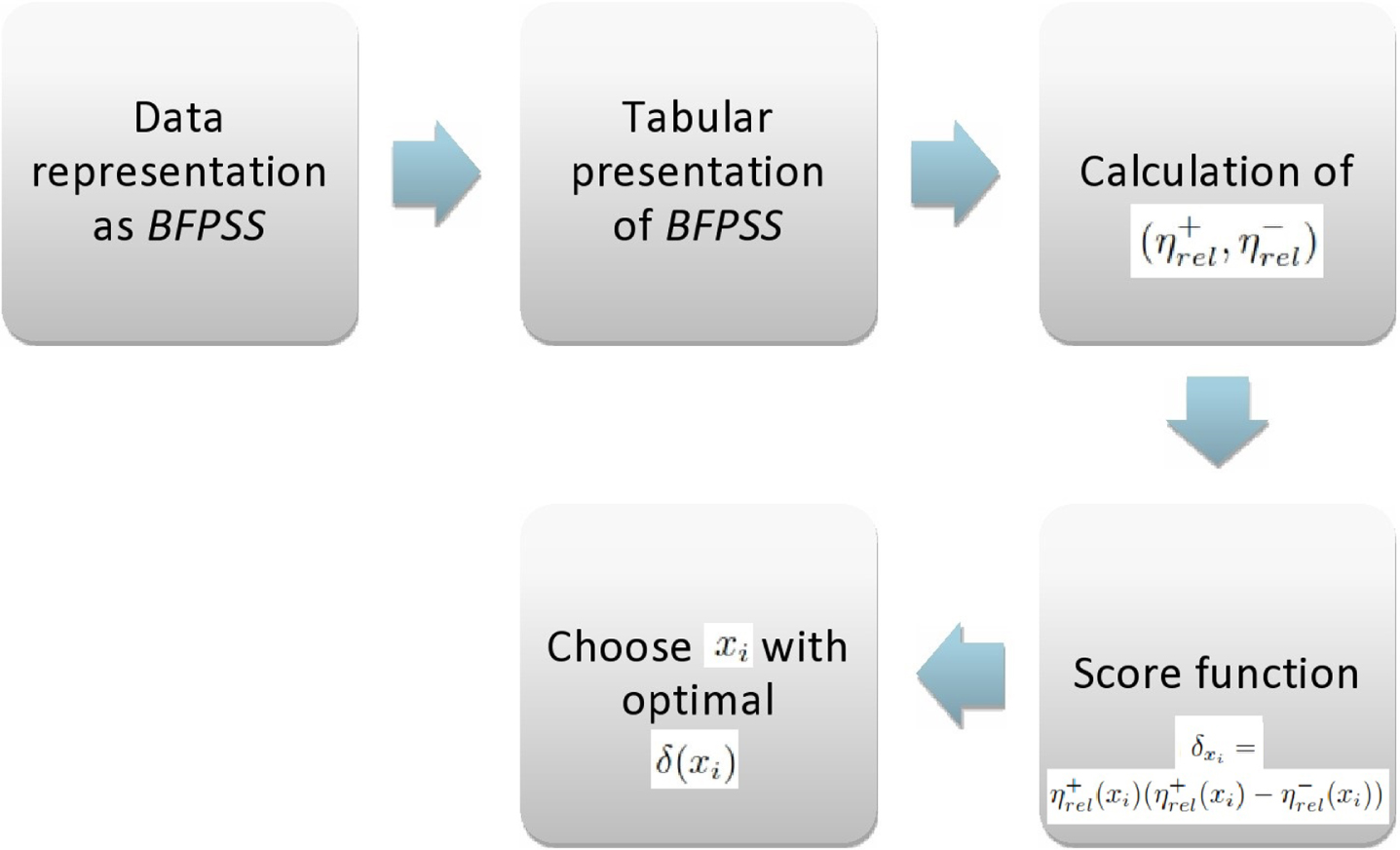
Process Flow Diagram.
Tabular Presentation of BFPSS
In this subsection we discuss in detail the similarities and differences of our proposed method by comparing it with the existing techniques. At first level, we examine why the notion of BFPSS is important to be used in presenting this kind of data (as in Example 6) and what are the drawbacks if some previously studied presentations and algorithms are deployed. At second level, we prove the significance of our algorithm by comparing the outcome with a recent method based on BFPSS.
If we don’t use the concept the bipolar fuzzy parameterized soft sets, then the most relevant possible presentation of data as in Example 6 is in terms of bipolar fuzzy soft sets [39] as follows.
In the literature, there is only one algorithm regarding decision making by BFPSS. Now we solve the same problem by applying the technique which is based on BFPSS. In this regard, we use the mid-level soft set, constructed by choosing the average values of η+ and η- from Eq. (4), as the threshold values (s
mid
, t
mid
) given by
For the corresponding mid-level soft set, we assign 1 to each x1, having the values (η+, η-) greater than or equal to the threshold values (s mid , t mid ) and 0 to the rest, as shown in Table 2. Calculate c i by adding the entries corresponding to each x i , i.e. c1 = 1, c2 = 1 and c3 = 0. Now x i with the optimal value of c i is chosen as the best outcome. We therefore choose both x1 and x2 as the drugs with highest level of effectiveness and the least level of harmfulness.
Parameter reduction method on BFPSS
If we compare both of the above techniques, we may clearly observe that in parameter reduction method, individual values of η+ (x i ) and η- (x i ) are absolutely ignored and all the values lying above the threshold value are teated same by assigning 1 to all of them. Similarly, all the values lying below the threshold value are equally assigned 0. This causes confusion and might lead to a misperceiving conclusion. We may try other threshold values of max-level or min-level as well, again we come across the same confusing outcome. However, in our proposed method, the precision and accuracy can be witnessed in the decision at a very low computational cost.
Fuzzy sets and their applications have made a substantial contribution is almost all practical areas. Recently bipolar fuzzy sets and soft sets appeared as emerging tools to engender improved outcomes in theory of fuzzy sets. However, there are several real life situations (such as the one discussed in Example 6), that can’t be covered by the aforementioned notions and tools. This article instigates a novel application of bipolar fuzzy parameterized soft sets (BFPSS) and introduces a more applicable and proficient approach to deal with numerous decision making issues. We study some of the indispensable features and properties of such sets and establish a highly significant algorithm to introduce the application of BFPSS. A practical example of decision making is presented in pharmaceutical environment. The implication visibly exhibits that involvement of BFPSS helps reaching the appropriate decision without laborious calculations and tedious techniques. The proposed algorithm can help in handling complex engineering problems wherever a bipolarity effect is present. The study can be further expanded by deploying the proposed method in association with the existing structures and techniques to reach desirable outcomes in more efficacious applications related to the decision making challenges.
Footnotes
Acknowledgments
The research was supported by the Taif University Researches Supporting Project number (TURSP-2020/16), Taif university, Taif, Saudi Arabia.