



Abstract
The purpose of this paper is to solve the prediction problem of nonlinear sequences with multiperiodic features, and a multiperiod grey prediction model based on grey theory and Fourier series is established. For nonlinear sequences with both trend and periodic features, the empirical mode decomposition method is used to decompose the sequences into several periodic terms and a trend term; then, a grey model is used to fit the trend term, and the Fourier series method is used to fit the periodic terms. Finally, the optimization parameters of the model are solved with the objective of obtaining a minimum mean square error. The novel model is applied to research on the loss rate of agricultural droughts in Henan Province. The average absolute error and root mean square error of the empirical analysis are 0.3960 and 0.5086, respectively. The predicted results show that the novel model can effectively fit the loss rate sequence. Compared with other models, the novel model has higher prediction accuracy and is suitable for the prediction of multiperiod sequences.
Nomenclature
First-order grey model with one variable Optimized GM(1,1) model based on the sine function First-order accumulated generation operation Empirical mode decomposition Autoregressive moving average model Multiperiod grey prediction model
Introduction
As the first industry developed in China, agriculture is an important industrial sector in the national economy. It takes land resources as the production objective and supports the construction and development of the national economy. Agricultural production is obviously affected by climate change, and the climate changes periodically with the seasons. Furthermore, the growth of crops also has periodic characteristics, which leads to the sequence of factors in the agricultural production system having multiperiodic characteristics, such as the grain yield and disaster area. With the development of production technology and environmental changes, the sequence of agriculture-relevant factors also exhibits trend and random characteristics. It is very difficult to predict the development trend accurately. Due to the complex nonlinear characteristics of the sequence of factors in agricultural production, the sequence of random and irregular fluctuations on the whole is usually called a nonlinear sequence. Due to the existence of nonlinear sequences in production and life and the lack of effective methods for predicting them, research on characteristic analyses and prediction methods for nonlinear sequences is of positive significance.
In the literature on prediction methods for nonlinear sequences, the time series analysis method from probability statistics is a classic method. By analysing the probability distribution of data through statistical data rules and identifying the period in a given sequence, this method can be used to fit the trend of the sequence effectively. The main research methods include trend extrapolation, movement smoothing, and seasonal index methods [12, 16]. Recently, the autoregressive moving average (ARMA) and generalized autoregressive conditional heteroskedasticity (GARCH) methods have been widely used [2, 19]. The methods of probabilistic statistics require a large amount of original data and need to determine the distribution of the sequence. As a branch of prediction theory, grey system prediction is a unique method of modelling with small data that provides an effective way to predict small-sample sequences. The basic principle of traditional grey system theory is that the random uncertainty in the given sequence is reduced by the buffer operator, and then the sequence obeys an exponential law through the accumulation of data. Finally, the trend of the sequence is described by a differential equation. Because the basic GM(1,1) model can only describe the development trend of a homogeneous index sequence, there are more limitations on the grey prediction model than on other approaches. To overcome these limitations, much research on the optimization of GM(1,1) is underway, and the main research topics are as follows: extension models of GM(1,1), a new buffer operator generation method, and a comprehensive model for GM(1,1) [18]. The focus of small-sample nonlinear sequence research is detailed below.
The research on extending the model of GM(1,1)as follows: Professor Deng [10] proposed the GM(1,1|tan (k-π)p, sin(k-π)p) model, where tan (k-π)p is the development coefficient, and sin (k-π)p is the input variable. This model is useful for the prediction of nonlinear sequences. Due to the lack of a rigorous theoretical basis for parameter selection for the model, it is not widely used. Mao et al. [17] proposed a GM(1,1|sin) model based on a trigonometric function that can reflect the nonlinearity of a sequence, and it has high prediction accuracy. Subsequently, Zhou et al. [6] constructed an optimized GM(0,1|sin) model to fit a small-sample nonlinear sequence. Li [22] introduced b1sinpk+b2 as the grey control variable and constructed the grey GM(1,1|sin) model based on fractional order accumulation. Zeng [11] took (sinpk) r as the grey action quantity and constructed the power model of GM(1,1|sin). Luo et al. [4, 5] introduced polynomials and trigonometric functions into the grey prediction model to construct the DGMP(1,1,N) and GM(1,1,T) models for the prediction of small sample nonlinear sequences and achieved high fitness and prediction accuracy with regard to the original sequence.
The research on smoothing an original nonlinear sequence by the data transformation technique is as follows: Guan and Liu [23] proposed a power-trigonometric function transformation method for the standardized data of the GM(1,1) model, and this approach can effectively improve the smoothness of the modelled data sequence. According to the periodicity of seasonal variations in time series, Wang et al. [8] established the SFGM(1,1) model by using a seasonal fluctuation sequence and the grey GM(1,1) model. Xiao et al. [20] proposed the SFGM(1,1) model based on similar seasonal periodicity in traffic flows, and an improved periodic truncation and accumulation generation operator was proposed to smooth the original sequence. Wang et al. [26] established a grey season prediction model SGM(1,1) by constructing a season accumulation generation operator.
The comprehensive research on the GM(1,1) model is as follows: One such research method is based on the idea of using sequence decomposition to build an appropriate prediction model according to the features of the sequence under study. Wu et al. [7] constructed an EEMD-WA model and analysed the fluctuation characteristics of the BDI index in the international dry bulk market by decomposing a BDI sequence into a random fluctuation term, periodic fluctuation term and trend term. Zhao et al. [9], based on the characteristics of sea level changes with nonlinear, nonstationary and multiple time scale changes, set up an EEMD-BP model to forecast the trend and periodic fluctuations. The other method of this type is to modify the residual period term of the grey prediction model. Huang et al. [21], based on the nonlinear characteristics of a sequence, used the sum of multiple sinusoids to describe the periodic term in the sequence. Wang et al. [15] corrected the residual error of the GM(1,1) model by using generalized trigonometric functions. Wang [25] proposed the method of using Fourier series to modify the periodic term in the residual error of the GM(1,1) power model, thereby improving its prediction accuracy for small-sample nonlinear sequences. Bezuglov et al. [1] studied the residual terms of the GM(1,1) model and grey Verhulst model based on Fourier series modification.
The studies above provide abundant theories and methods for the prediction of nonlinear sequences with periodic terms. In the studies on the grey prediction method, many achievements have been made in terms of the prediction of nonlinear sequences with periodic terms by means of model expansion and operator construction, but some problems still need to be solved. In the research on model expansion, the method of adding a trigonometric function to the model can obtain good prediction accuracy for a single period, but it is not effective for sequence prediction with multiperiodic superposition. When constructing an additive operator to increase the smoothness of a sequence or using the SGM(1,1) model for a truncated sequence generation operator, both methods need to determine the period in advance. In addition, complex data changing technology is associated with the problem of reduction error. In practice, sequences in a system usually have fluctuating features that combine trends and multiple periods. At different time scales, there are different periods, so a single periodic prediction model cannot solve this problem. A Fourier series is a kind of special trigonometric series that can fit any periodic function by the accumulation of trigonometric functions; this method provides us with a research direction.
In this paper, focusing on the prediction of nonlinear sequences with tendencies and multiple periods, based on the ideas of decomposition sequences, a multiperiod grey prediction model (MPGM(1,1)) is established. The GM(1,1) model is used to predict the trend terms, and the Fourier series method is used to fit the trend of the multiperiodic terms. Finally, a nonlinear optimization model is established based on the minimum residual, and the model parameters are solved. The model is applied to the prediction of agricultural drought disasters in Henan Province to test the effect of the model in practice. The novel model provides an effective method for predicting nonlinear sequences with multiple periods.
The rest of the paper is organized as follows: Section 2 introduces the multiperiod GM(1,1) model in detail and analyses the properties of the model. The experimental results are reported and analysed in Section 3, and a discussion of the results is presented in Section 4. Finally, conclusions and future work are presented in Section 5.
Methodology
The MPGM(1,1) model
According to the prediction problem of nonlinear sequences with both trends and multiple periods, a multiperiod grey prediction model is constructed by combining Fourier series and the GM(1,1) model; the new model is called MPGM(1,1). Based on the results of sequence decomposition, the GM(1,1) model is used to fit the trend term, and a Fourier series is used to describe the characteristics of the periodic terms. With optimization theory, the parameters of the model are obtained with the minimum average relative error, and the final prediction result of the model is calculated. The novel model can be transformed into the GM(1,1) model and GM(1,1|sin) model by changing the parameters in the model. The GM(1,1) model has a good prediction effect on smooth sequences but a poor prediction ability on fluctuating sequences, and the GM(1,1|sin) model has a good prediction effect on single-period sequences but not for multiperiod sequences. The new model is an extension of these two models, so it expands the applicability of the grey model.
The trend term:
The periodic terms:
Therefore, the original sequence can be expressed as
This model, which can fit the mixed trend term and multiple periodic terms, is called the MPGM(1,1) model. The principle of the novel model is as follows:
(1) Identify the trend term and periodic terms
The method of empirical mode decomposition (EMD) based on the eigenmode function component can effectively reflect the physical meanings of various types of signals, and it has been widely used in engineering practice. The EMD method can decompose any signal into the sum of intrinsic mode function (IMF) components and a residual term. In this paper, the original sequence is decomposed into several IMF terms and a residual term through the multiscale decomposition of the EMD screening process according to the characteristics of the data [13, 24].
The residual term of the decomposed sequence is taken as the trend term, and several IMF terms are taken as periodic terms. Through decomposition, the trend term and periodic terms can be obtained as follows:
The trend term:X t = r n (t)
The period terms:
(2) Analysis of the MPGM(1,1) model
If l = 0, there is no periodic term in the sequence, and the model becomes the GM(1,1) model.
The trend term sequence is
The GM(1,1) model is constructed as follows:
If l = 1, it means that there is only one periodic term in the sequence, and the model becomes the GM(1,1|sin) model.
The equation of the GM(1,1|sin) model is as follows:
If X
t
= 0andl > 1, the sequence only contains periodic terms, and the equation of X
p
is as follows:
The parameters C are obtained using the ordinary least-squares method, resulting in the following equation:
(3) Finding the optimal parameters
Performing parameter optimization for the model can effectively improve its prediction accuracy. The optimization model is constructed with the goal of minimizing the error. The residual error is
The model testing method and the general statistical error testing method are used to evaluate the modelling effect and the accuracy of the prediction results. The steps of these two methods are as follows:
(1) Grey model evaluation criteria
The posterior difference ratio (C) and small error probability (P) are usually used to test the accuracy of the grey model. C = s2/s1 and
(2) General statistical evaluation criteria
The absolute error (AE), average absolute error (MAE) and root mean square error (RMSE) can be used to check the accuracy of the predicted results. The calculation formulas are shown as follows:
For the prediction problem regarding nonlinear sequences, the EMD method is used to decompose the original data into a trend term and several periodic terms, and then the trend term and periodic terms are predicted separately. Finally, the optimal prediction model is constructed with the goal of obtaining the minimum mean square error (as shown in Fig. 1). The modelling steps are as follows:

The steps of MPGM(1,1) model.
Step 1: The EMD method is used to decompose the original sequence into a trend term and several periodic terms.
Step 2: The GM(1,1) model is used to predict the trend term. The prediction sequence is formed by the 1-AGO of the original sequence. A whitening equation is constructed to solve the time response formula. The parameters a and b are obtained by the least-squares method, and finally, the prediction formula is obtained.
Step 3: A Fourier series is used to expand the sequence of periodic terms and determine the period T. The coefficient C is obtained by the least-squares method, and the prediction formula is obtained.
Step 4: Under the optimization objective of obtaining the minimum mean square error, the formula acquired in the previous step is used to solve the coefficient and make predictions.
Step 5: The accuracy of predicted results is tested.
To test the prediction effect and accuracy of the MPGM(1,1) model, this study adopts the comprehensive agricultural loss rate to conduct an empirical analysis. The comprehensive agricultural loss rate due to drought is used to characterize the situation of agricultural drought. Data on the affected area, disaster area, non-harvestable area and agricultural planting area of the agricultural drought region in Henan Province from 2001 to 2018 were collected. The data mainly came from the disaster database of the National Bureau of Statistics and the Department of Market and Informatization of the Ministry of Agriculture and Rural Affairs. According to the national drought assessment standards, the data are processed, and the comprehensive loss rate of agricultural drought is used to represent the degree of damage caused by the drought. The calculation method is as follows:
Through the analysis of the original data sequence, it is found that the loss rate of the agricultural drought has both periodic and trend characteristics, and the EMD method is used to decompose the original sequence and obtain a trend term and several multiperiodic fluctuation terms (as shown in Fig. 2).
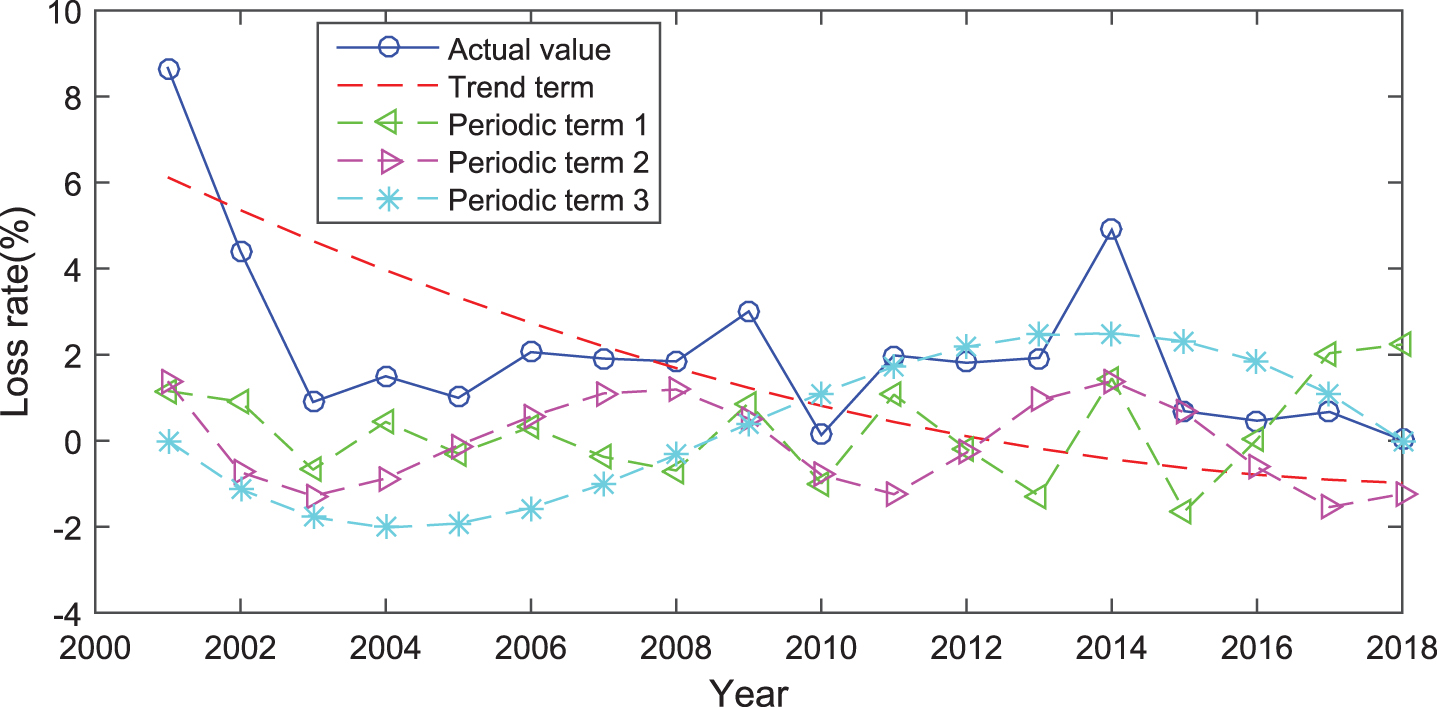
The decomposition results of the original sequence.
With the agricultural drought loss rate data from 2001 to 2018 calculated above, the GM(1,1), GM(1,1|sin) and MPGM(1,1) models are used for loss rate sequence prediction, and the time response functions are further calculated. The results are as follows:
(1) GM(1,1)
The structural parameters are a = -0.034 and b = 1.3601, and the solution equation can be expressed as follows:
(2) GM(1,1|sin)
The structural parameters are a = 0.1203, b1 = -1.6014, b2 = 5.0526 and p = 0.3230, while the time response function can be expressed as follows:
(3) MPGM(1,1)
The structural parameters of the trend term are a = 0.1614, b = 8.3487 and r = 0.5325, the structural parameters of the periodic terms and the solution equation are as follows:
The predicted values and errors of the GM(1,1), GM(1,1|sin), ARMA and MPGM(1,1) models are shown in Table 2. To compare the prediction accuracies of the models, the test criteria in Table 1 are used. The test result criteria for the models are as follows (as shown in Table 3): variance ratio (C), small error probability (P) and accuracy level. From the variance ratio results, it is found that MPGM(1,1) has the best prediction effect; its variance ratio is 0.01, the variance ratio of ARMA is 0.2401 the variance ratio of GM(1,1|sin) is 0.3154, and the variance ratio of GM(1,1) is 0.3338; It can be found that the prediction accuracies of the three models are GM(1,1)≺ GM(1,1|sin)≺ ARMA≺MPGM(1,1). From the results of the small error probability criterion, the test values for all models are found to be 1. Furthermore, the accuracy levels of all models are 1. The root mean square error (RMSE) is used to test the accuracy of the prediction results for each model; from the test results (as shown in Table 4), MPGM(1,1) has the highest simulation and prediction accuracy, and the accuracy of GM(1,1|sin) is better than those of GM(1,1) and ARMA. Based on the results of the above two testing criteria, the MPGM(1,1) model is proven to be superior to the other three models.
The criteria for model accuracy
The predicted values and AEs of the models (2001 to 2018)
The test results of the models
The MAEs and RMSEs of the models
From the predicted results in Fig. 3, it is found that the MPGM(1,1) model has the highest accuracy and the best coincidence degree with the original sequence. The trend of the prediction results from 2015 to 2018 is consistent with the original sequence. The GM(1,1|sin) and ARMA methods can reflect the trend of the periodic fluctuations in the sequence as a whole, but their accuracies are lower than that of the MPGM(1,1) model. The GM(1,1) model can only roughly reflect the trend of the sequence.

The prediction results of the models.
(4) Error analysis
To reflect the overall accuracy of each model, the mean absolute error (MAE) is used to analyse the error magnitude of each model. MPGM(1,1) has the smallest average error (as shown in Table 4); the MAE for 2001-2014 is 0.1755, and the MAE for 2015-2018 is 0.3960. From the forecasting results for 2015-2018, the GM(1,1) model has largest average error; the value is 2.3243. The MAE of GM(1,1|sin) is better than that of ARMA. The MAE of GM(1,1|sin) is between those of MPGM(1,1) and ARMA. The MAEs of the models are shown in Fig. 4.
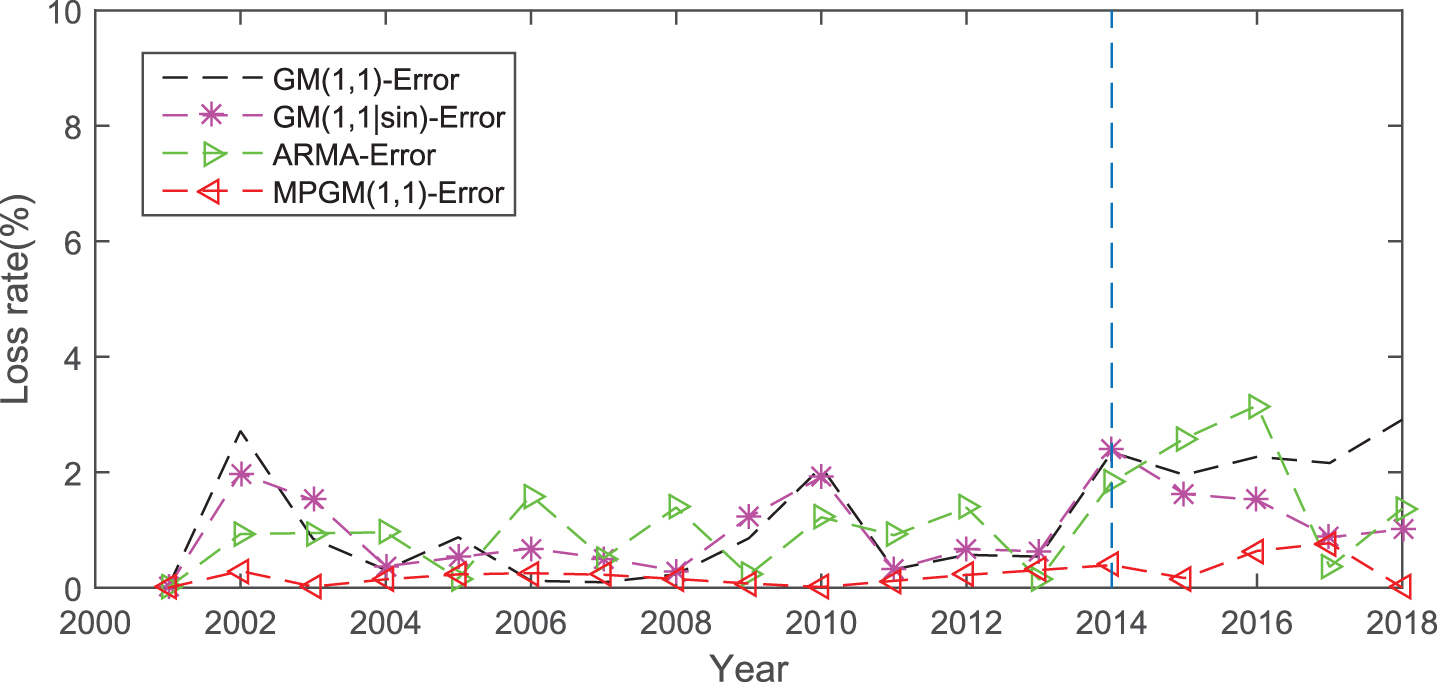
The MAEs of the models.
From the results above, the novel model has a higher prediction accuracy than those of the GM(1,1) and GM(1,1|sin) models. The MPGM(1,1) model is built by combining the GM(1,1) model and a Fourier series, so it can realize the prediction of the tested sequence with trend and periodic features at the same time. To prove the advantages of the novel model, the GM(1,1) and GM(1,1|sin) models are used to conduct a comparative study. Through the analysis of the prediction results of each model, it is found that the GM(1,1) model has a good prediction result for the smooth sequence with an exponential law. The model can predict the overall development trend, but it cannot predict the sequence with fluctuation characteristics well, and the overall prediction accuracy is poor. The GM(1,1 |sin) model is an extended version of the GM(1,1) model, in which a sine function is added to the original model to fit the periodic sequence. From the prediction results, this model can reflect the fluctuation characteristics of the sequence to some extent, and the prediction accuracy is higher than that of the GM(1,1) model. The ARMA method has a good fitting effect during the training stage and has a large error during the verification stage, so it is suitable for the prediction of stationary sequences. The MPGM(1,1) model takes advantage of the trend term prediction advantage of the GM(1,1) model and the good fitting property of Fourier series to predict the periodic sequence. Through an application study of the agricultural loss rate in Henan Province, it is seen that MPGM(1,1) simulates the periodic variation characteristics of the sequence well, with a good fitting effect and a higher prediction accuracy than those of GM(1,1) and GM(1,1|sin). Through a model test analysis, it is found that the simulation accuracy of the new model is best, and the RMSE test result regarding the prediction accuracy is also best. The model error mainly comes from the fact that agricultural disasters are affected by many factors and that the disaster sequence is not a strict, standard period. If there is a high demand for prediction accuracy, a sequence with a large simulation error can be decomposed twice. Through further decomposition, the new periodic sequence can be fitted with a Fourier series to improve the prediction accuracy.
Conclusion
The grey system has obtained many achievements in the production of nonlinear sequences through data processing technology and the expansion of the GM(1,1) model, but it has not paid much attention to the multiperiod prediction problem. Aiming at the prediction problem of nonlinear sequences with multiperiodic features, a multiperiod grey prediction model based on grey theory and Fourier series is established, and the novel model is applied to an empirical analysis of the agricultural drought loss rate. From the study, the following results are found:
For nonlinear sequences with trends and multiple periods, the fluctuation features and development trend of the sequence can be found accurately through sequence decomposition, and the prediction of the decomposition sequence can improve the prediction accuracy of the utilized model.
Among the sequences with periodic features, the periodic term is often not a standard single period; it usually shows the superposition of multiple periods on different time scales. The single-period analysis model cannot accurately predict the development trend of such a sequence. A Fourier series has the characteristic of being able to fit arbitrary periodic sequences, and its essence is to fit arbitrary periodic sequences by adding trigonometric functions. The MPGM(1,1) model based on a Fourier series and GM(1,1) can effectively solve the prediction problem of multiperiodic sequences.
The formation of an agricultural drought disaster is affected by a variety of factors, and a sequence of disaster loss rates has complex nonlinear characteristics. Through the sequence decomposition method, the trend of disaster development can be predicted accurately. According to the research results, the sequence of agricultural disasters in Henan Province shows a downward trend overall and has multiperiodic characteristics on different time scales. The level of agricultural disasters is generally low.
The nonlinear sequence usually contains the characteristics of trend, periodicity and randomness. The model in this paper only considers the trend and periodicity, which is the main reason for the errors in this paper. How to solve the randomness in the sequence to improve the prediction accuracy of the proposed model is a problem worthy of further study.In my opinion, using intelligent prediction methods such as neural network and support vector machine to describe the randomness in the sequence can effectively improve the accuracy of prediction.