



Abstract
The aim of this paper is to investigate a profit-maximization firm how to determine the composition and prices of multiple bundles. Bundles are sets of components that must meet some technical constraints; furthermore, customers differ in their quality valuations and choose the bundle that maximizes their utility. A mixed integer non-linear program is proposed to solve this problem. First, a two-step approach is employed to obtain the firm’s optimal decision. The result indicates that when the firm faces deterministic demand, the optimal set of bundles it offers is independent of the distribution of customer valuations and does not contain any dominated bundle. In addition, dominated components cannot be used to construct the optimal bundles. Second, the impact of demand uncertainty on the firm’s performance is explored. The results suggest that disregarding the demand risk may result in broader assortment and suboptimal prices. Finally, numerical experiments and sensitive analysis are conducted to provide managerial insights for the pricing and composition of multiple bundles.
Introduction
Bundling is the strategy of marketing two or more products or services as a specially priced package [1]. Example includes bundles of vacation package (airline ticket, hotel accommodation, transportation service), telecommunication package (Internet, TV, phone), electronic products (processor, screen, hard drive, memory), etc. There are several reasons why bundling is profitable in many industries, which include reducing production and trade costs, extracting more consumer surplus, offering economies of scale, and raising entry barriers for competing firms [2].
Much of the current literature on bundling and pricing pays particular attention to the choice of three main bundling strategies: itpure bundling (offer only bundles), itpure components (offer only components), and itmixed bundling (offer components and bundles) (see [2-9]). However, only few published studies the optimization of bundle design and pricing simultaneously. Pérez et al. [10] studied the impact of consumer’s maximum willingness to pay (MWTP) on the telecommunication company’s bundle design and pricing decision. Cataldo and Ferrer [11] discussed the optimal composition and pricing strategy of multiple bundles for a cable TV company. Overall, these literature focuses on bundling decision of horizontally differentiated products. However, the nature of differentiation among products can be grouped into two main categories (horizontal itvs. vertical). Horizontally differentiated products are different in features that cannot be ordered; on the other hand, vertically differentiated products can be ordered according to their feature. [23].
This paper addresses the problem of a firm managing a category of vertically differentiated bundles, or itproducts, formed by putting several components together. In general, the vertically differentiated bundles refer to bundles that satisfy the same customer demand and can be ordered according to some characteristics, such as quality, that is, every customer prefers a high-quality bundle to a low-quality bundle if both bundles are offered at the same price. Indeed, there are many firms providing the products that fit the above description, such as cars, air conditioners, but perhaps the most prototypical example is laptops: a customer purchases personal computer from a set of variants with different speed processors, memory sizes, screen resolution, etc. As consumers are sensitive to prices, the company’s pricing strategy plays a vital role in customer choice decision. It is assumed that each customer chooses a bundle that maximizes his/her net utility, which is an increasing function of quality and quality valuations but a decreasing function of price; furthermore, customers are heterogenous in their quality valuations. The firm is able to estimate the distribution of consumer valuations by conducting market surveys and analyzing sales information. The main research question is how the firm can decide the composition, prices, and inventory levels of multiple bundles to maximize its profits when it faces deterministic demand and stochastic demand.
Our key contributions, to this critical problem of composition, pricing, and assortment of vertically differentiated bundles, are as follows: The proposed non-linear mixed integer program is difficult to solve (i.e., an exponential number of decision variables). Nevertheless, the problem’s mathematical structure indicates that it can be addressed in two steps. In the first step, the optimal price for each bundle can be obtained on the assumption that the component of bundles supplied by the company is already known. In the second step, structural properties of the optimal variety are derived by using the optimal price and the concept of dominance. We apply the optimality structural properties to develop a Graphically Motivated Algorithm to obtain the optimal variety as well as closed form expressions for the optimal prices. In particular, when the demand of each bundle is deterministic, the result demonstrates that: (i) The optimal price of each bundle depends on it cost, quality, and the distribution of customer valuations. This result is partial different with the result concluded in Deb [21] and Shao [24], who demonstrated that the optimal price of each product depends only on its quality and cost. Our result is more general, and the same conclusion can be obtained when F (θ) follows uniform distribution; (ii) The optimal assortment, formed by a part of the lower envelope curve of the quality-cost plot, is independent of the distribution of customer valuations; (iii) The components that comprise the optimal bundles are also on their lower envelope curve of the quality-cost plot. In contrast, the results reveal that when the firm faces demand risk, the optimal assortment supplied by the firm is a subset of that in face of deterministic demand, which can be used to reduce the search space of the optimal assortment. Numerical experiments are conducted to investigate the impact of the distribution of customer valuation and the magnitude of demand risk on the firm’s bundle-pricing decisions. The results show that: (i) The optimal price in the risky case is higher than that in the riskless case; (ii) The expected profits and market share of the firm decrease in b under both the deterministic and stochastic demand circumstances; (iii) The optimal set of bundles is independent of the distribution of customer valuations for quality when the firm faces deterministic demand, but this result does not validate when the firm faces stochastic demand.
This research is most closely related to that of Honhon and Pan [13] who investigated a firm how to determine the optimal bundling strategy for a category of vertically differentiated goods. However, our work differs from theirs in numerous ways. First, bundles are sets of components that must meet some technical constraints rather than sets of different quality levels of the same product category. Second, we explore the impact of demand uncertainty on the firm’s optimal decision. In contrast to the most literature on assortment planning of vertically differentiated products, we find that the distribution of customer valuations plays a critical role in the determination of the optimal variety of bundles when the firm faces demand uncertainty. This result makes a theoretical contribution to the assortment planning problem since existing assortment planning literature concluded that the optimal variety does not vary with the distribution of customer valuations when there is no fixed cost (see Honhon and Pan [13], Bhargava and Choudhary [17], Pan and Honhon [20], and Deb [21]). This study is also related to that of Pérez et al. [10], Cataldo and Ferrer [11], and Bitran and Ferrer [14], who optimized the composition and pricing problem of bundles. Unlike us, they described a customer’s choice process by the MNL model, in which the customer’s utility is defined by the nominal utility and a random variable. Despite the fact that they also proposed a non-linear mixed integer programming to model the problem, there is a significant gap between the results due to choosing different utility model to define customer behavior. Hence, compared to their study, our contribution lies in new insight into bundle design literature as well as the new theoretical analysis.
The remainder of this article is organized as follows. Section 2 reviews the related literature. We state the problem addressed to this paper: to maximize total expected profits, identifying the optimal components constituting the optimal bundles and the optimal selling prices in section 3, where we also introduce the consumer choice model for the vertically differentiated bundles and the aggregate demand model. The firm’s optimal decisions of two demand cases are presented in section 4. Section 5 conducts several numerical experiments and sensitive analysis, and provides some managerial insights. Section 6 states conclusions and provides directions for future research. All proofs are presented in the Appendix.
Literature review
This work falls at the intersection between two streams of research: the work on vertically differentiated products, the work on pricing and composition of bundles. We first provide a brief review of the work on vertically differentiated products, and then discuss the previous studies on the pricing and composition of bundles. To the best of our knowledge, this study is the first that considers the problem of defining and pricing a set of bundles that are constituted by a set of vertically differentiated components.
Vertically differentiated products
To our knowledge, Mussa and Rosen [15] were the first to consider consumer self-selection of vertically differentiated products, who captured the intensity of a customer’s taste for quality by a parameter θ which follows a continuous distribution with support
The previous literature simply assumed quality is a continuous variable, i.e., the decision makers can pick any quality level for their products. Unfortunately, this assumption may not hold true for some Original Equipment Manufacturers (OEMs) who assemble the components offered by suppliers and then sell the finished products to the end customers. In such a case, the quality levels are a set of discrete exogenous variables. Therefore, this paper takes the point of such OEMs and assumes there exist several discrete sets of quality levels from which the OEMs can choose. Like these articles, we use a linear utility function and make only limited assumptions on the distribution of customer valuations.
There have been several other streams of research on product differentiation problems incorporate issues that we do not explore here, such as the optimal assortment under the exogenous and endogenous price cases (see Pan and Honhon [20]; Deb [21]; Mayorga et al. [22]); incorporating consumer choice process into product differentiation design (e.g., Lacourbe et al. [23]; Shao [24]); dynamic pricing in a competition context (e.g., Liu and Zhang [25]); inventory management under substitution (see Transchel [26]); and the resource portfolio (see Bish et al. [27]; Bish and Chen [28]). Finally, several studies focued on price and quality decisions in the context of the supply chain (e.g., Hua et al. [29]; Shi et al. [30]; Chen et al. [31]; Wang et al. [32]).
Pricing and composition of bundles
The pricing and composition of bundles have received growing attention in marketing and operation management literature for the past few decades. Studies such as Mccardle et al. [6], Olderog and Skiera [9], Brynjolfsson and Bakos [33], and Hui et al. [34] examined the role of marginal costs played in the attractiveness of bundling strategies. Their research showed that mixed bundling strategy is optimal when marginal costs are low to moderate, pure bundling strategy is optimal when marginal costs can be neglectable, and pure component strategy is optimal when marginal costs are high. These papers primarily focus on the analysis when goods have independent customer valuations; however, this assumption may result in mis-specified models, and thus leading to a loss of revenue.
Some recently works on this topic attempt to capture the nature and extent of correlation in reservation prices across consumers for bundles carried by the firm. Venkatesh and Kamakura [35] demonstrated that the optimality of three bundling strategies depends to a large extent on the combination of marginal cost levels and the degree of complementarity or substitutability. Yan and Bandyopadhyay [36] concluded that there exist optimum bundles and price strategies for complementary products. Banciu and Ødegaard [37] described the joint distribution of consumer valuations by a two-dimensional copula function. They found that there will be an arbitrarily large gap between profitability when the valuations are dependent in fact. In the later articles, bundling is explored under the circumstance of the supply chain. Bhargava [38] suggested that bundling is more profitable for integrated firms; however, it is no longer so in the decentralized channel. Avenali et al. [39] showed that a monopolist may prefer bundling, because it either extracts surplus from the rival’s investment or forces the competitor to provide a low-quality product. Xie et al. [40] studied the impact of stochastic demand and manufacturers’ decisions on the retailer’s bundling strategy. They suggested that retailers should adopt an unbundling strategy in the dynamic game system.
For tractability, the literature on bundling in economics and marketing primarily examined two products since the full mixed bundling strategy involves an exponential number of decision variables. However, there are notable exceptions. Hanson and Martin [41] presented a mixed integer linear model to determine optimal prices of bundles and identify which bundle should be offered. Proano et al. [42] proposed a mixed integer non-linear programming model to identify the number of vaccines in bundles of antigens and the range of feasible prices that maximize the sum of producer benefits and consumer surplus. Fang et al. [43] built a non-linear mixed integer program on the basis of the framework of Stackelberg game to derive a retailer’s bundle-pricing decisions. The approache applied in these papers has several liminations, such as “it is difficult to identify the sources of interdependence among components in a bundle”, “it is impossible to use the model for forecasting the demand for bundles with new components”, etc. Chung and Rao [44] developed a general bundle utility model based on attributes and applied this model to find market segments for multiple-category product bundles. Bitran and Ferrer [14] studied the issue of how to determine the composition and price of a bundle to maximize the total expected profit in a competitive environment where consumers are utility maximizers. The problem was formulated as a non-linear mixed integer programming model and solved by a two-step approach. Pérez et al. [10] extended the study of Bitran and Ferrer [14], making an explicit inclusion of the consumers’ maximum willingness to pay (MWTP) employing the constrained multinomial logit (CMNL) model. Cataldo and Ferrer [11] also proposed an extension of Bitran and Ferrer [14], developing a model and a solution approach for the multiple bundles case.
The majority of bundling literature assumes non-vertically differentiated products and/or deterministic demand. In this paper, we provide an approach for designing and pricing vertically differentiated bundles and examine the role of demand uncertainty played in the firm’s optimal decision.
Model description
Consider a monopoly firm faced with the problem of determining the composition and prices of multiple bundles to maximize its profits. Each bundle is comprised of a set of components, and for each component there is a group of known alternatives. The primary consideration that determines the composition of a feasible bundle is technological feasibility, which refers to certain technical specifications and requirements that every bundle must meet such as “must contain a certain component,” “must contain a certain component in certain quality.”
Following Bitran and Ferrer [14], let m be the number of components in a bundle and A
j
={ A1j, A2j, . . . , A
nj
} denote the set of alternatives of component j from which only one element will be a portion of a bundle. Thus, there will be n
m
feasible bundles. Let the n × m binary matrix X
k
represent the composition of bundle k, if the alternative i of the set of component j is chosen for the composition of bundle k, then x
ijk
= 1, else x
ijk
= 0. Let Q
X
k
and C
X
k
denote the quality and cost of bundle X
k
, where
The choice model
Consider the firm offering an assortment S ={ X
l
1
, . . . , X
l
h
}, such that Q
X
l
1
< . . . < Q
X
l
h
and S ⊆ Ω. It is assumed that customers are heterogeneous and are characterized by their willingness to pay for one unit of quality in the product category, or itvaluation, which is measured by θ. Let f (θ) and F (θ) with the support
Most of the economic and marketing literature assume demand is deterministic. However, the demand for each bundle is affected by consumer choice behavior, and thus is stochastic. To substantiate this, we make three assumptions concerning the consumer choice process (these assumptions are also made in Ryzin and Mahajan [51] and Deb [21]). First, it is assumed that individuals make their choice decisions based on the information of bundles set, but they are uninformed about the inventory status of each bundle in S. Second, consumers decide to purchase which one according to the prices and quality levels of offered bundles. If their preferred bundle is out of stock, customers do not buy another alternative and unmet sale is lost. Hence the bundles are not substitutes in the sense that customers will dynamically substitute one variant for another if their first choice bundle runs out of stock. Finally, consumers make their choice decision independently.
With the aforementioned assumptions on consumer choice process, individual item demands can be presented as follows. Let D be the number of customers making choice decisions in the market during the selling season, and the mean and standard variance of D are μ and σ. Let D
X
l
k
(
Where Pr(T = D) is the p.m.f of the store traffic. Smith and Agrawal [52] noted that if D is a Poisson rate with λ, then D
X
l
k
(
Where ɛ
X
l
k
follows a normal distribution; each ɛ
X
l
k
has unit mean and finite variance σ
X
l
k
(e.g., Ryzin and Mahajan [51], Li [53], and Maddah and Bish [54]). Observe in (5) that the realized demand for a bundle is a multiplicative random disturbance of the expected demand μα
X
l
k
(
The firm is a multi-item newsvendor, who purchases components from upstream suppliers, combines these components together according to the technological constraints, and then sells the bundles to customers in a single selling period. The decision maker’s aim is to maximize its profit by determining the composition, prices, and inventory levels of multiple bundles. Thus, the firm’s optimisation problem is
In this section, we characterize the structure of optimal decisions by a two-step approach and develop a Graphically Motivated Algorithm to recognize the optimal solutions for both the riskless and risky cases.
The riskless case
The itriskless case mentions situation when the firm faces deterministic demand for each bundle, and thus inventory is no longer a decision variable. This setting implies that the information about each individual’s sensitivity to quality can be acquired by the firm, in the sense that the firm knows precisely the probability with which each consumer will choose a bundle. In such a case, the demand for each bundle can be expressed as D
X
l
k
(
In such a case, the firm’s optimisation problem can be written as
The firm’s optimisation problem proposed above can be solved in two steps. First, the optimal prices
On the assumption that the composition and assortment of bundles are known, the problem as mentioned earlier can be written as the following price optimization problem:
This leads to the following proposition:
Theorem 1 shows that the optimal price for a given bundle not only depends on its cost and quality, but also on the distribution of customer valuations. This result is partial different with the result concluded in Deb [21] and Shao [24], who indicated that the optimal price of each product depends only on its quality and cost. Our result is more general, and the same conclusion can be obtained when F (θ) follows uniform distribution. In addition, the price markup of any bundle over the price of the bundle with next lower quality level increases in the quality difference between the two bundles.
The following corollary can be obtained by substituting the optimal price into the revenue function.
Since the optimal prices of multiple bundles in a given assortment have been obtained, we now turn to the problem of how the firm determines the composition of multiple bundles and chooses its assortment.
Consider the definition of itdominated product presented in Pan and Honhon [20]. For any two products i and j, j is said to be dominated by i if Q i ≥ Q j and C i ≤ C j and at least one of the two inequalities is strict, which suggests that one can confine the search for the solution to a set of bundles that are not dominated instead of all feasible bundles. However, this definition is hard to detect the dominance among bundles with different quality levels and costs. The following proposition makes a crucial contribution to evaluate that bundles.
Theorem 2 can be used to investigate dominance among different assortments that could be carried by the firm. For any two assortments with the same cardinality, S1 and S2, it is evident that the company will benefit more from offering assortment S1 if the quality-cost plot of S1 is below that of S2. Consequently, we can confine our search to Ω*, which is comprised of bundles on the itlower envelope curve on the quality-cost plot of the bundles in Ω. This idea is summarized in the following definition, which is very useful for later analysis.
Condition (18) indicates that
Lets consider an example of 4 sets of components (e.g., processor, hard disk, internal storage, and graphics card) with four variants in each one. Assuming that the quality of each component ranges from 50 to 200, and the cost of each component is between 20 and 130. Figure 1 shows all available bundles and its lower envelope curve on the quality-cost plot of this particular instance.
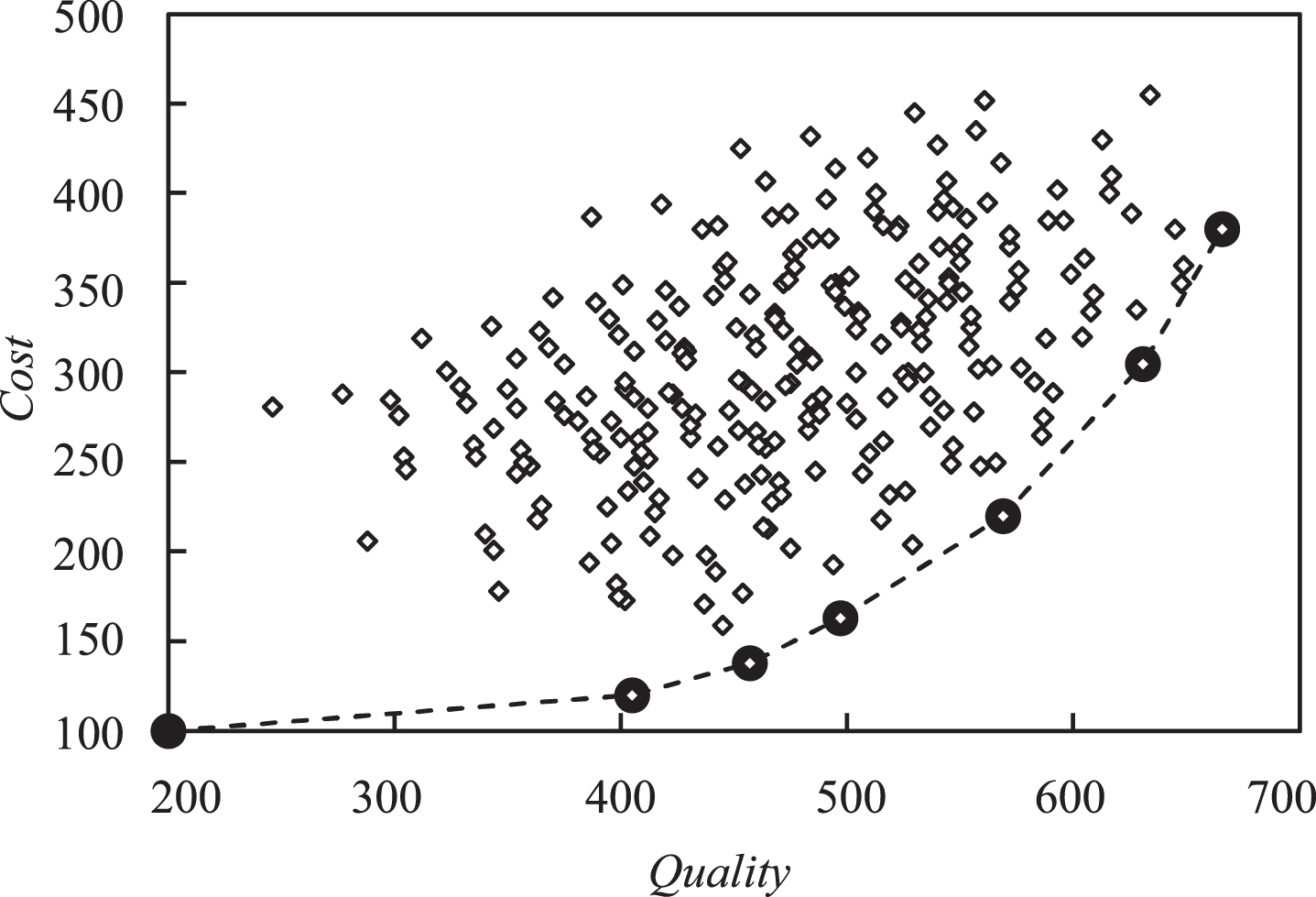
All possible bundles and its lower envelope curve on the quality-cost plot for a given instance
Theorem 3 reveals that the optimal assortment of bundles supplied by the firm does not vary with the distribution of consumer valuations and can be obtained according to the cost and quality levels of all possible bundles. Theorem 3 also provides a graphically motivated approach to find the optimal bundles of the riskless case. Firstly, the algorithm generates all feasible bundles Ω and ranks them in order of quality. Secondly, let
On the basis of Eqs. (16) and (17) in combination with Theorem 3, the algorithm proposed in this section ensures the optimal composition and prices for the assortment supplied by the firm will be obtained. This algorithm has the notable advantage of obviating the need to evaluate all possible sets of bundles. The firm’s optimal decisions can be calculated in O (N log N) if the lower envelope curve on the quality-cost plot can be divided into N line segments (see Hershberger [45]). The built algorithm will function well as long as the component sets A j are correctly defined, that is the costs and quality levels of components are non-negative.
It can be seen from corollary 2 that a dominated component may not be part of an optimal bundle, that is, the quality of the bundle could be improved, or the cost of the bundle could be reduced by replacing the dominated component with the one dominates it. However, this result is not consistent with that in Honhon and Pan [13], who stated that dominated and undesirable components may still be offered as part of a bundle. In this paper, the component cannot be sold individually and the bundles have the same cardinality. Therefore, the conclusion obtained by Honhon and Pan [13] is not applicable to this research. The properties from Corollary 2 is particularly efficient if there exists a great deal of variants for each component, since the number of feasible bundles will be reduced by eliminating the dominated components.
Generally, the mixed integer non-linear program can be solved by several commercial software such as Lingo, Cplex, BONMIN (Basic Open Source Nonlinear Mixed Integer programming), and GAMS (General Algebraic Modeling System), etc. (e.g., Hariga et al. [46], Murray et al. [47], and Syauqi and Purwanto [48]). However, these commercial software may be time consuming due to the complexity of the bundle design and pricing problem grows exponentially as the number of single components offered by the suppliers. Hence, it is necessary to improve the speed and performance of the algorithm. A numerical analysis is conducted to verify its effectiveness by comparing the running time of the solution proposed in this paper with that of SciPy. Note that SciPy is a module of Python and can be applied to solve the non-linear mixed integer programming.
The running time of different solution methods for this instance are presented in Table 1. The running time is influenced primarily by two factors. One factor is the number of options of each component, the more options are, the more time the firm needs to obtain its optimal assortment. The other factor is the configuration of a bundle, i.e., the less of components a bundle has, the less time it needs. It is noteworthy that the problem of pricing and design of bundles is reduced to the assortment planning for a category of vertically differentiated products when m = 1. Pan and Honhon [20] proposed a shortest path algorithm to solve this problem. They showed that the complexity of the shortest path algorithm is O (n2) when the fixed cost is zero. The mean and coefficient variation of running time using the shortest path algorithm are 0.00692 s and 0.55199, respectively. Compared with the operational time by the shortest path algorithm and SciPy module, our algorithm can save up at most 99 %. The bundles are comprised of two components when m = 2, it appears that the running time of the SciPy module increases dramatically with the increase of n. In the case of m = 3, each bundle consists of three components, the result shows that the computational time of the SciPy module is totally impractical for n large than 15, for example, over 2 hours when n = 15, while our algorithm gives the optimal solution in <1 second.
Computational Time (in seconds) of SciPy module and Graphically Motivated Algorithm
Computational Time (in seconds) of SciPy module and Graphically Motivated Algorithm
In the risky case, the demand for each bundle is stochastic as given by (5). As with the most literature on assortment and inventory management, for example Maddah and Bish [54, 55], and Akçay et al. [56], we assume there is no salvage value and unmet demands become lost sales. The company jointly determines the composition of multiple bundles, the optimal price
Solving the bundling problem
As with the method used in the riskless case, the bundling problem, when the firm faces stochastic demand, can also be solved by a two-phase solution approach. In the first phase, the firm makes on the decision on the optimal price
This subsection, now, starts by the firm’s prices and inventory levels decision problem on the assumption of given composition and assortment, which can be formulated as:
The objective function (21) is the usual multi-item newsvendor profit. According to Khouja [57], the joint price and inventory problem of multi-item can be solved by using the properties of single item newsvendor. By employing the well-known results of the newsvendor model on the assumption of a normal demand (see Ryzin and Mahajan [51]; Maddah and Bish [54]), the optimal stock level
where
Then the following proposition can be induced.
Theorem 4 implies that the optimal price of each bundle in the risky case not only depends on factors itself, but also on surrounding environment concerned, such as the prices and quality levels of other bundles provided by the manager, customer preference for quality as well as the magnitude of demand risk. There are two reasons for this. On the one hand, consumers make their choice decisions based on the quality and price information of the assortment offered by the firm. In the riskless case, the firm is able to acquired complete information about each individual’s sensitivity to quality. Thus, customers can be separated into different segments accurately by applying the second-degree price discrimination with different segments consuming different variants and paying different prices. However, in the risky case, the potential market size is uncertain; and therefore the decision maker does not know the precisely segments with which each consumer belongs to. As a result, the firm should take other bundles’ quality and price into account when a new bundle is added into the current assortment so as to separate consumers into different segments accurately as possible. On the other hand, the prices of bundles in an assortment have an impact on the firm’s total market share as well as demand allocation among bundles, thereby driving inventory decision. Thus, the manager should take the magnitude of demand risk into consideration when setting optimal prices in order to relieve the impact of inventory cost.
This result suggests that the optimal set of bundles never includes a dominated bundle alongside the bundle that dominates it and the cannibalization of a more profitable bundle will be weaken by eliminating the dominated bundle. Moreover, this result is efficient if there is a huge quantity of possible bundles, since the firm can remove the dominated bundles before making a decision.
Since the price and inventory optimization problem for a given set of bundles have been solved, we currently deal with the second subproblem, i.e., the determination of the composition of bundles and the assortment carried by the firm.
Theorem 6 allows for a narrower search space to find the optimal assortment. It is noticed from the equation (25) that the optimal assortment is composed of bundles with non-negative demand. Furthermore, Theorem 6 declares that
Example 2 is used to explain the efficiency of Theorem 6 in reduction of computation time to find the optimal bundles.
Figure 2 displays the percentage difference of the running time consumed by Method 1 compared with that of Method 2, i.e.,
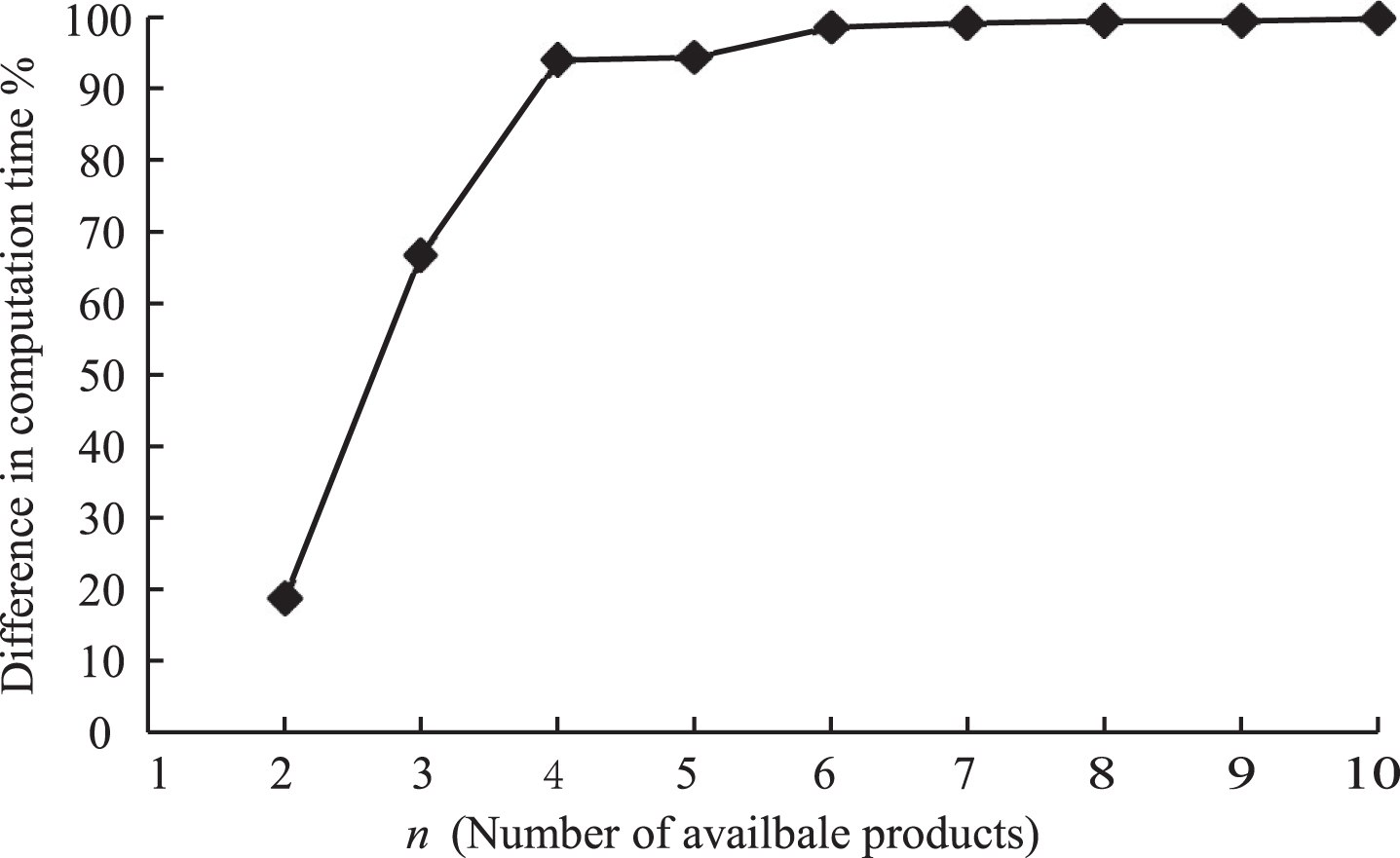
Saving in computation time itvs. n.
In this section, the aims of numerical analysis are dual: (i) to demonstrate the application of our model and (ii) to recognize the management highlights regarding pricing, composition, and assortment of bundles in both the deterministic and stochastic demand cases.
Considering that the firm combines three categories of vertically differentiated components together; and there exist seven choices in each category. Each bundle must contain exactly one alternative of each component; otherwise, it will not work well. In such an instance, the number of all possible bundles is 343. Table 2 depicts the cost and quality of each component.
Data for numerical experiment
Data for numerical experiment
Suppose that the distribution of customer valuations is F (θ) = 1 - (1 - θ) b with b > 0 and 0 ≤ θ ≤ 1, which is widely used to model customer preference (see Pan and Honhon [13, 20]). Let b = 1, it means the distribution of customer valuations follows a uniform distribution. Figure 3 presents all feasible bundles of this particular instance.
Firstly, we obtain the optimal composition and prices of multiple bundles for the riskless case. The algorithm starts with
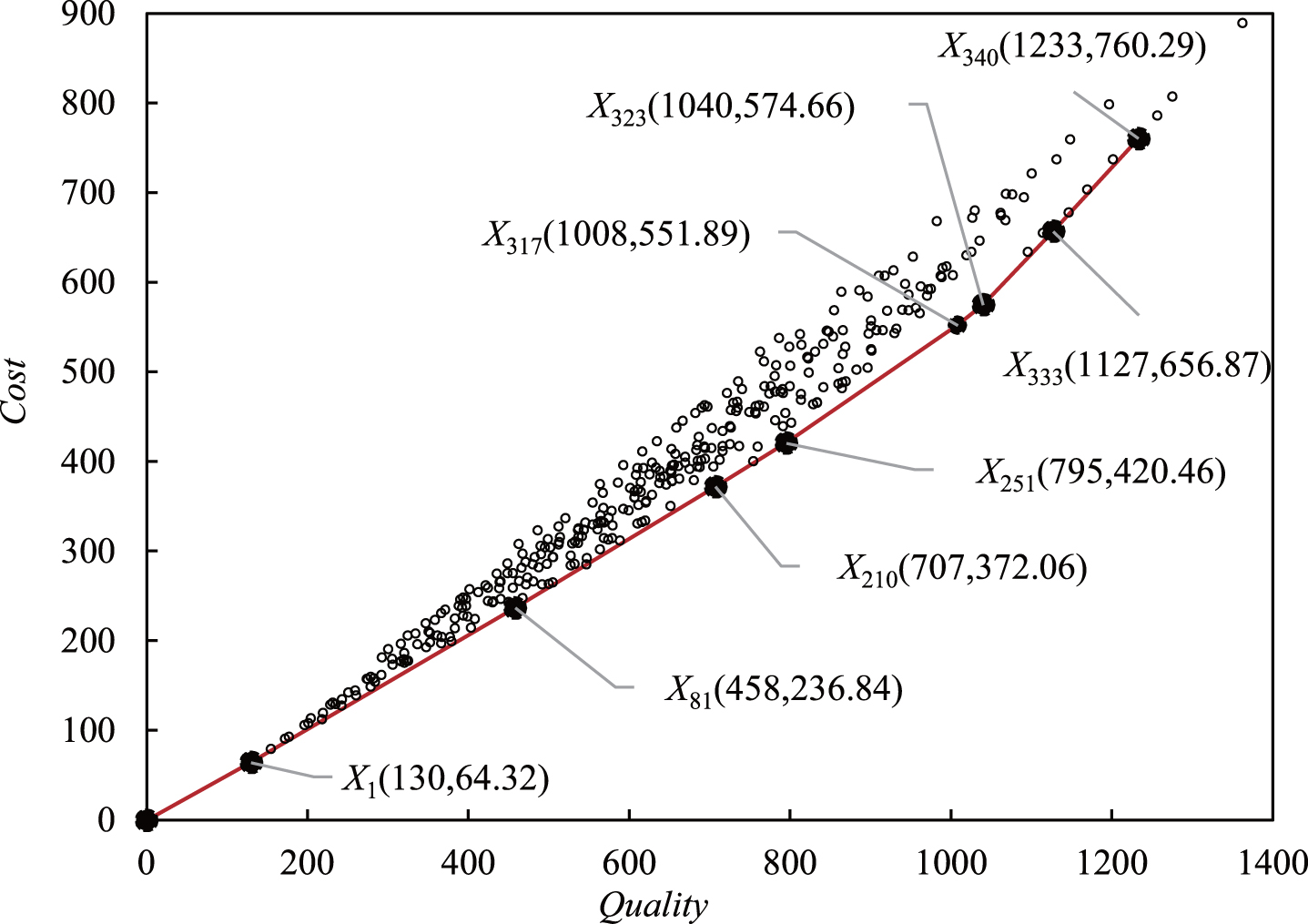
Optimal bundles obtained by the algorithm.
The optimal assortment of bundles and their prices for the risky case can be obtained according to the above analysis. In section 4.2, Theorem 6 shows that the optimal variety of bundles offered by the decision maker in the risky case is a subset of that in the riskless case and can be derived by applying the optimal risky prices of bundles in
In this section, a numerical analysis is conducted to examine the role of customer valuations played in the firm’s optimal prices, assortment, market share, and profit. To isolate the impact of demand variability, we assume the multiplicative random error ɛ X k follows a norm distribution with unit mean and standard deviation σ X k = 0.243 for X k ∈ S.
Table 3 presents the numerical results when the firm faces deterministic demand. It can be observed from Table 3 that the optimal price for each bundle offered by the firm is decreasing in b. The intuition behind this lower prices is as follows: Quality is highly evaluated by most customers when b < 1, the firm thus can price higher to extract more customer surplus to maximize its profits. When b > 1, there will be more customers with low valuation for quality, the company would decrease the price to stimulate consumption.
Effect of customer valuations on firm’s optimal solutions in the riskless case
Effect of customer valuations on firm’s optimal solutions in the riskless case
However, the price discount does not result in higher market share since the number of consumers with high quality valuations decreases with b. A consumer who has intended to purchase a high-quality bundle may switch to a bundle with lower quality or purchase nothing. Although the market share of low-quality bundle increases, the increase of low-end product market cannot offset the lose of high-end product market. As a result, the firm’s market share is decreasing in b. The lower prices in combination with smaller market share leads to less profit.
The impact of customer valuations on firm’s optimal solutions in the risky case is displayed in Table 4. The optimal prices of bundles, market share, and profits are decreasing in b, which is in good agreement with the result of deterministic demand case. Nevertheless, there is a gap between the optimal assortment provided in the risky case and that in the riskless case. It can be seen from Tables 3 and 4 that the optimal assortment is independent of the distribution of consumer valuations when the firm faces deterministic demand, but this result is not true when the demand is stochastic. One reason for this is that the demand for high-quality bundles decreases with more customers having low quality valuations. The other reason is that more choice alternatives increase the variability of demand for each bundle stemming from the substitutable, cannibalization among existing bundles, and in turn increase inventory cost; as a result, the firm drops the high-quality bundle from the current assortment once the profit margin (which equals selling price minus procurement cost) is less than inventory cost. Ryzin and Mahajan [51] and Li [53] model the trade-off between product variety and inventory cost.
Effect of customer valuations on firm’s optimal solutions in the risky case
Comparing the optimal prices in the two scenarios, it is apparent that the firm would price higher when it faces uncertain demand, which validates the previous results by Karlin and Carr [58], who demonstrated that the optimal price in the case of stochastic demand is higher than that under the deterministic demand circumstance in terms of multiplicative? demand model. In contrast, Mills [59] proved that
In addition, as shown in Tables 3 and 4, the firm’s market share and profit in the risky case are both lower than that in the riskless case for any given distribution of customer valuations. The reason behind this result is as follows: The optimal set of bundles offered in the risky case is a subset of that in the riskless case. The firm, therefore, does not benefit from the high end of the market.
In this section, a numerical analysis is conducted to investigate the impact of demand risk on the firm’s bundle-pricing decisions, market share and profit. To isolate the impact of customer valuation, we assume F (θ) follows uniform distribution, that is, b = 1. This distribution is widely used to model customer preference, for example, Deb [21], Shao [24].
Table 5 presents the role of demand risk played in the firm’s optimal assortment and prices. When σ is extremely low, such as σ ≤ 1, the revenue benefited from high-quality bundle dominates the inventory cost, thus the optimal set of bundles offered by the firm is the same as that in the riskless case. However, as σ rises, the inventory levels of bundles tend to increase. In such a case, the firm may remove some high-quality bundles from current assortment once the revenue obtained from these bundles cannot offset their inventory cost. Thus, the trade-off between variety and inventory cost derives this result. In addition, the optimal price for any bundle provided by the firm increases in σ. The reason for pricing higher is that the firm’s expected profit can be maximized by lessening the impact of inventory cost. The firm should thus price higher in order to decrease demand variance, in turn leading to lower inventory cost.
Effect of demand risk on firm’s bundle-pricing decision
Effect of demand risk on firm’s bundle-pricing decision
Figure 4 illustrates the impact of demand uncertainty on the firm’s market share and profit. It can be observed from Fig. 4 that market share and profit both decrease as σ increases. As the demand variability increases, the firm prices higher in order to weaken the impact of inventory cost, which results in lower demand for offered bundles. On the other hand, customers on the higher end of the spectrum no longer have a bundle that satisfies their demand since the firm removes some high-quality bundles from current assortment as σ rises. Overall, the lower demand for each offered bundle in combination with shrinking assortment size leads to this result.
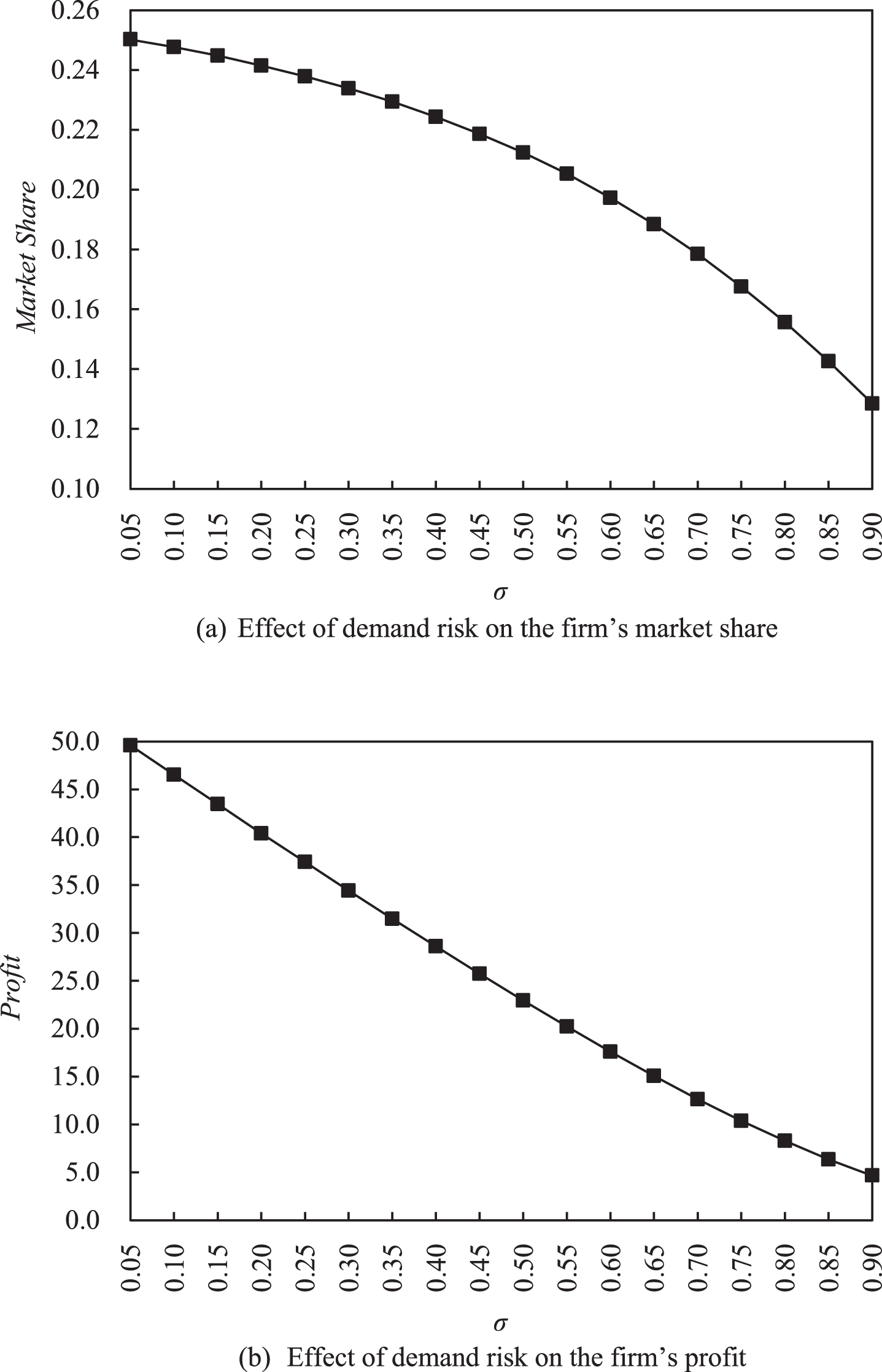
Effect of demand risk on the firm’s market share and profit.
Several researchers have addressed the optimization problem of bundle design and pricing. Unfortunately, these methods do not always perform well due to incapable of capturing a customer’s preference for quality. This paper considers the problem of a firm determining the composition and prices of multiple vertically differentiated bundles in the presence of quality valuation. To motivate this problem, it is assumed that consumers are utility maximizers; and a linear utility function is used to model an individual’s choice for quality level. It is further assumed that demand risk comes from the uncertainty of market size, i.e., the demand for each bundle can be presented as a multiplicative demand model.
A mixed integer non-linear programming model is proposed to solve the problem. Even though such model is normally difficult to solve, in this case studied the problem’s mathematical structure is such that it can be addressed in two steps. In the first step, the optimal price for each bundle can be obtained on the assumption that the component of bundles supplied by the company is already known. In the second step, the optimal structure of bundles is derived by substituting the optimal prices into the profit function.
The result reveals that, when the firm faces deterministic demand, the optimal price of each bundle depends on its quality, cost, and the distribution of customer valuations. This result is generally agreement with that in Pan and Honhon [20], who investigated the assortment planning for vertically differentiated product. In addition, the optimal assortment of bundles is independent of the distribution of customer valuations and is comprised of bundles on the lower envelope curve on the quality-cost plot where the slope is less than 1. Using this result, a Graphically Motivated Algorithm is proposed to gain the optimal assortment of bundles. The noticeable advantage of the algorithm lies in obviating the need to value all possible assortment. Employing this algorithm enables the firm solves the bundle-pricing problem with an exponential number of decision variables in O (N log N) time.
In contrast, when the firm faces stochastic demand, the optimal assortment supplied by the decision maker is a subset of that in face of deterministic demand. This result makes a significant contribution to the reduction in computation time. Furthermore, the optimal assortment is affected by customer valuations for quality, which suggests that the firm with make-to-stock manufacturing process may not offer high-quality bundles when most of consumers have low quality valuations in the market.
Most notably, this is the first study to our knowledge to provide practitioners with optimization approaches for designing and pricing vertically differentiated bundles. Our results provide compelling insight for OEMs, who assemble the components supplied by the producers and then sell the finished products to the end customers, and suggest that this approach appears to be effective in solving the bundle-pricing problem. However, some limitations are worth noting. A Customer may substitute dynamically if his/her first choice is out of stock, in such a case, preliminary analysis suggests that the decision derived by the approach proposed here may be suboptimal. A task for future research is to solve the problem of optimal composition and prices of multiple bundles under stockout-based substitution. Moreover, most of products are characterized by both horizontal and vertical differentiation dimensions (e.g., Laptops with different combinations of colors and CPUs). The model built in this paper cannot capture a customer’s preference for horizontal differentiation attributes. Other avenues for further research are to detect the impact of two dimensions on the optimal composition, pricing, and assortment decisions.