



Abstract
In Dempster-Shafer theory, belief structure plays a key role, which provides a useful framework for information representation of uncertain variables. Basic Probability Assignment (BPA) is the most important component, which is difficult to be determined due to the uncertainty of information. Generally, there are two ways to get BPA of evidential theory: One is a subjective judgment of the expert’s experience, Interval Belief Structure (IBS) can solve the fuzziness and uncertainty of expert’s judgment. The other is an objective calculation by sampling existing data, in which BPA is viewed as the point estimate. Therefore, one of the contributions of this paper is that the definitions and theories of Confidential Interval Belief Structure (CIBS) is developed to describe BPA in Dempster-Shafer theory, which can give a range of population parameter values and contain more information to deal with the uncertainty and fuzziness of existing data. And then, based on evidential reasoning rule for counter-intuitive behavior, another contribution of this paper is that the extended evidential reasoning approach with CIBS is proposed to obtain the combined belief degree. The proposed method can be flexibly adjusted by appropriate errors and confidence levels, which is the main advantage. Finally, a case of sustainable operation of Shanghai rail transit system to verify the feasibility of proposed method and great performance of the extended method is shown.
Introduction
From all the databases, the word Evidential Reasoning (ER) first appeared in a paper published in artificial intelligence in [1]. Gordon and Shortliffe proposed Dempster-Shafer (D-S) scheme for evidence aggregation processes in a hypothesis space. Peal shown in [2] that evidential reasoning could be conducted in the same hypothesis space using a Bayesian scheme. Lee analyzed in [3] that the differences of the two scheme. D-S theory is identified as an efficient model to deal with uncertainty information in intelligent systems in [4], which can handle uncertainty more preferable than probability theory in [5]. Nowadays, D-S theory is applied widely in many fields, such as decision-making ([6, 7]), supplier selection ([8, 9]), reliability analysis ([10, 11]), and optimization under uncertain environment ([12, 13]), stochastic modeling ([14]), safety analysis ([15]), stock portfolio selection ([16]), voice activity detection ([17]), financial investment ([18]), supply chain ([19]).
In D-S theory, a piece of evidence is described by a Belief Structure (BS) defined on the power set of the frame of discernment, of which an important component is BPA. Basic probabilities can be assigned to not only singleton propositions, but also any of their subsets. However, due to the uncertainty of Decision Makers’ (DMs) subjective judgments, linguistic ambiguity ([20]) and the lack of information, probability masses assigned to propositions can be uncertain or imprecise ([21]). Group Decision Making (GDM) is characterized as a situation in which individuals collectively make a choice from a set of possible choices ([22–24]). As the group members participating in the decision-making have differences in knowledge, experience, judgment ability and other personal characteristics, they have different understandings of the pros and cons of the alternatives. In the problem of GDM, belief degrees may be provided by different DMs or experts, although these belief degrees can be synthesized to get a precise point estimate, it will inevitably lead to information loss. To better express the uncertainty of information in D-S theory, the concept of IBS has been proposed ([25]).
IBS, as an extension of BS in D-S theory, the basic probabilities of which is designed by an interval value to better express uncertain and imprecise information ([26]). But in many cases, the basic probability of each evidence is usually objectively calculated by the number of times it occurs through multiple experiments. In this case, IBS ignores the probability law of random variable. The BPA obtained in this way can be viewed as a point estimate. In most cases, each evidence is subject to a certain distribution of the proposition. Therefore, this paper argues that the basic probability of each evidence under propositions can be described by interval estimation instead of point estimation, and the interval estimation of the population samples can be carried out by means of confidence interval. Therefore, by introducing the concept of confidence interval estimation to describe BPA in D-S theory, this paper proposed the concept of CIBS, which extends the IBS.
In the research of D-S theory, combining and normalizing of BS is the most important research directions. As the core of D-S theory, Dempster’s rule plays a key role to extend Bayes’ rule and popularize as the only Evidence Combination Rule (ECR) to combine evidence in D-S theory originally ([27, 28]). However, one concern about Dempster’s rule is that proposition will be ruled out completely when a piece of evidence is not supported a proposition at all. Although it could be supported in some cases, it is generally the case that each piece of evidence has been limited or varying degrees of reliability in supporting and opposing propositions ([29, 30]). Moreover, Dempster’s rule cannot be used when two pieces of evidence are in complete conflict, which has led to a counter-intuitive problem in [31]. In order to solve the problem of counter-intuitive problem, the evidence combination rules have been proposed to take the place of Dempster’s rule for handling the counter-intuitive problem ([32, 33]). At the same time, the methods of combining and normalizing of IBS are also developed ([34, 35]). Sevastianov et al. in [34] developed a new combination approach for the interval evidence combination and normalization; Song et al. in [36] proposed a novel approach to combine evidence based on the operation on intuitionistic fuzzy set. However, these methods cannot be applied to the combination of conflicting interval evidence. Therefore, Zhang et al. developed a new approach to consider the conflicting interval evidence combination in [21]. This method considers both evidence weight and reliability in a more general framework to solve the problems of conflicting IBS combination and normalization. Therefore, by Zhang’s combination method, this paper developed an extended evidential combination approach with CIBS, which can be flexibly adjusted by an appropriate error and confidence level. This has not been considered in the existing studies.
The main contributions of this paper can be summarized as follows:
(1) The concept of CIBS is proposed to characterize BPA obtained from objective calculation.
(2) Three theorems of CIBS are given in this paper, which makes computing easier.
(3) Based on CIBS, the evidence combination method, which is a pair of programming models, is developed to calculate the combined belief degree of pieces of evidence.
(4) The extended evidence reasoning method is applied in the evaluation of the sustainable operation of Shanghai rail transit system. And the implementation steps are as follows:
The rest of the paper is organized as follows. In Section 2, the introduction of D-S theory, the ER rule for counter-intuitive behavior, the ER rule of IBS and the confidence interval of sample ratio are given briefly. In Section 3, the concept of CIBS is developed and a pair of programming models are proposed to calculate the combined probability masses. And then, a simple example shows the feasibility of proposed programming models. In Section 4, the proposed combined models are applied to the actual problem, and the feasibility is further verified. Finally, different parameters are selected for sensitivity analysis.
Preliminaries
In this section, we will briefly introduce the basic concepts of D-S Theory, the ER rule for counter-intuitive behavior, ER rule with IBS and confidence interval of sample ratio.
D-S Theory
D-S theory is based on a frame of discernment, which composed of a set of mutually exclusive and collectively exhaustive propositions ([27]). And the set denoted by Θ. What’s more, 2 Θ contains all propositions and denoted as 2 Θ = {ϕ, θ1, . . . , θ N , {θ1, θ2} , . . . , {θ1, θ N } , . . . , {θ1, θN-1} , Θ}.
[m1 ⊕ m2] (C) =
It is obvious in the above equation that Dempster’s rule provides a process for combining two pieces of non-compensatory evidence, in the sense that if either of them completely opposes a proposition, the proposition will not be supported at all, no matter how strongly it may be supported by the other piece of evidence.
∑A
i
⋂A
j
=ϕm1 (A
i
) m2 (A
j
) = 0.9996, and the combined result of evidence m1 and m2 as follows:
To deal with the counter-intuitive problem of Dempster’s rule, based on the review of Shafer’s book ([27]), Yang and Xu proposed a new ER rule to deal with evidence weight in an evidence combination process in [29]. What’s more, due to the difference between evidence importance and reliability, a new ER rule has been developed by Yang and Xu ([29]) to combine evidence with weight and reliability. For example, the importance of an information source in information fusion is expressed by the weight given to the information source by the fusion system designer; the reliability of it indicates its ability to provide a correct assessment or solution to a given problem ([39]).
m1 (H1) =0.49, m1 (H2) =0.01,
To make better use of uncertain and imprecise information, IBS is developed to describe the fuzziness and uncertainty made by experts’ subjective judgments ([25, 26]). Therefore, we will introduce the concepts of IBS based on the literature [40, 41] and [21].
(1) a i ≤ m (F i ) ≤ b i , where 0 ≤ a i ≤ b i ≤ 1 (i = 1, . . . , n);
(2)
(3) m (A) =0,∀A ∉ {F1, F2, . . . , F n }.
The final combined results can be obtained by different methods, which are presented in Table 1.
The index system
Point estimation and interval estimation are two methods of sampling inference. Point estimation is an inferential method without considering sampling error in sampling inference. It is inevitable that there will be errors. Interval estimation is an inference method to estimate the possible range of the total index. When inferring the total index from the sampling index, a certain probability is used to ensure that the error does not exceed a given range.
That is to say, we want to define an interval so that we believe with a high degree of reliability that it contains an unknown population parameter. The degree of reliability is measured in terms of probability, which is called confidence probability or CI.
In this paper, we only use the CI estimation of sample ratio.
The sampling distribution of p is the probability distribution of all possible values for the sample ratio
The possible values of p* (1 - p*)
When p* = 0.5, the relationships between the sample size n and error E, confidence level 1 - α are shown in Table 3.
The sample size n
In this paper, we will introduce above concepts to ER method.
In the ER theory, the BPA of empty set is 0, the BPA in the whole set represents the global ignorance uncertainty, the BPA over a subclass of a single proposition represents local ignorance uncertainty. If a BPA contains neither the global ignorance uncertainty nor the local ignorance uncertainty, then the BPA function is reduced to the traditional probability function.
In this section, let H = {H1, H2, . . . , H
N
} be the frame of discernment, F1, F2, . . . , F
n
be the subsets of H. Let X be the set of samples and T samples are taken from that as observations. Suppose that
(1) m CI (F i ) =
(2) m CI (A) =0, ∀ A ∉ {F1, F2, . . . , F n } .
Where, 1 - α is the confidence level,
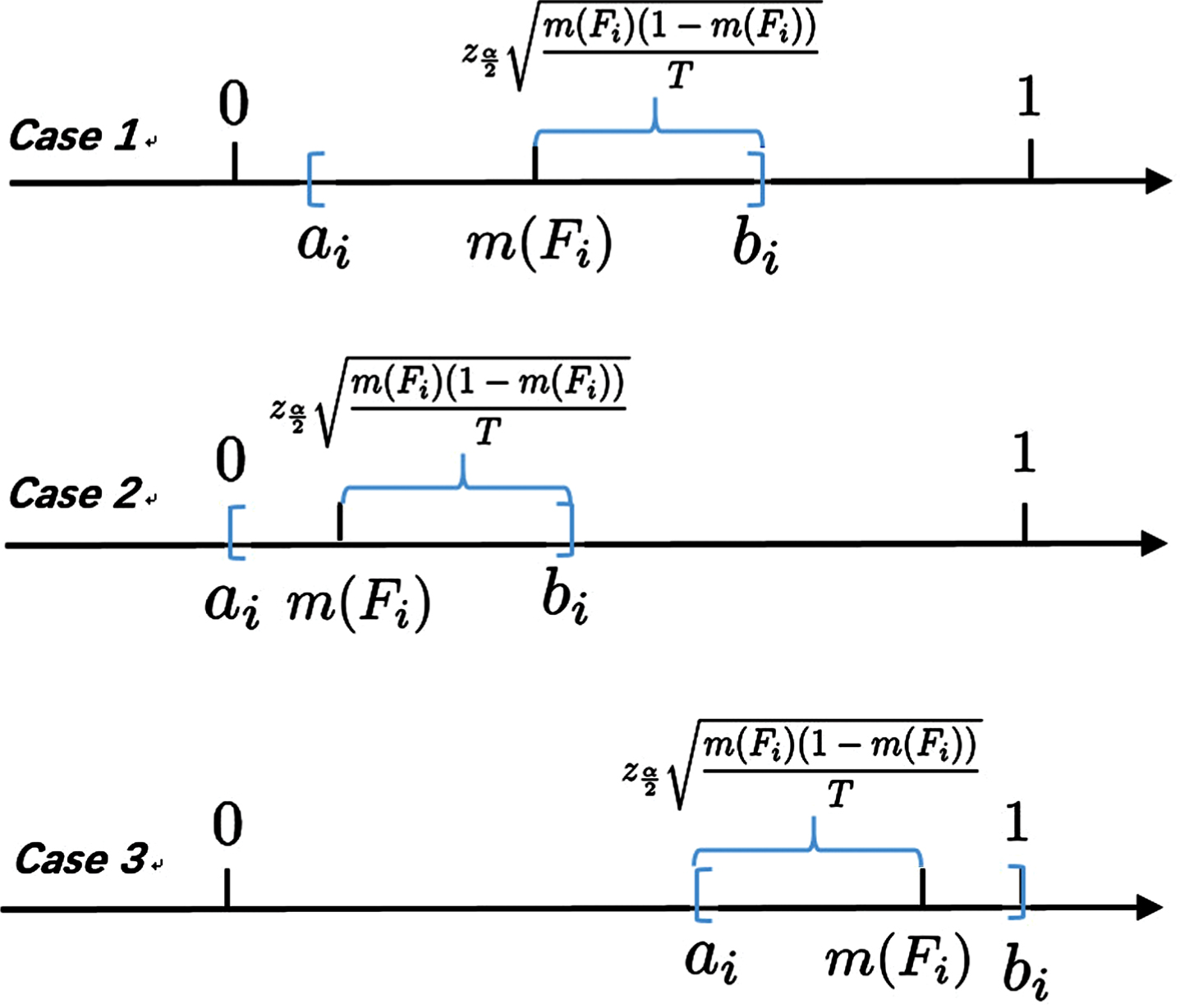
Three cases of CIBS m CI (F i ) on H.
Case 1:
Case 2:
Case 3:
Based on Definition 3.1 and Fig. 1, three theorems of CIBS are given as follows. In order to simplify, let
Proof. Since
This theorem is the condition Of Definition 2.6, which shows that CIBS has the better properties.
(1) If m (F i ) =0, then m CI (F i ) = [a i , b i ] =0;
(2) If m (F
i
) =1, then m
CI
(F
i
) = [a
i
, b
i
] =1 and mj≠i (F
j
) =0, that is
Proof. (1) If m (F
i
) =0, we have that
Thus, m CI (F i ) = [a i , b i ] = [0, 0] =0.
(2) If m (F
i
) =1, one has
What’s more, since
BS or IBS needs to be standardized of each evidence in the combination of evidences. In fact, CIBS is a special IBS, which is standardized. To proof that, the following two lemmas are given.
Proof. Due to
In general, based on the actual situation,
Proof. It follows from m (F
j
) ∈ [0, 1] and
(1) For n = 2, it is clear that m (F1) (1 - m (F1)) = m (F2) (1 - m (F2)), the formula of (3.6) holds.
(2) Suppose that (3.7) holds for some n - 1 >2.
(3) Consider the case of n, for all k ∈ {1, 2, . . . , n - 1}, by induction, the formula of (3.7) holds for all n. And we can get that
Next, based on above two lemmas, the normalized m CI is proved as follows:
Proof. Since
(a). For some i ∈ {1, 2, . . . , n}, m (F i ) =1. It follows from (3.7)-(3.8) that
(b). For all i ∈ {1, 2, . . . , n}, m (F
i
) ≠1 . Firstly, we have that
Based on Lemma 1, there are three results for b i - a i .
(b1) If
It follows from Lemma 2 and
(b2) If
It follows from Lemma 2 and
(b3) If
It follows from Lemma 2 and
From above results, in any case, let m
CI
(F
i
) = [a
i
, b
i
] (i = 1, 2, . . . , n), which is satisfy
Let
(1) Addition: m CI (F i ) + m CI (F j ) = [a i + a j , b i + b j ];
(2) Subtraction: m CI (F i ) - m CI (F j ) = [a i - a j , b i - b j ];
(3) Multiplication: m CI (F i ) × m CI (F j ) = [a i × a j , b i × b j ];
(4) Division: m CI (F i ) ÷ m CI (F j ) = [a i ÷ b j , a j ÷ b i ].
The interval operation above applies only to one piece of evidence, where the interval operation is between different propositions. Subsequently, based on the ER rule for counter-intuitive behavior, the pair of programming models to calculate the combined probability masses of two pieces of CI evidence.
Where, mθ,e(1) = mθ,1 and mP(Θ),e(1) = mP(Θ),1. The objective functions of the above models indicate the respective maximum and minimum final combined belief degree with respect to proposition θ by n pieces of evidence based on e (i). Unlike the literature Definition 2.9, m CI is normalized and there is no need to standardize it before we solve the pair of models.
To illustrate the implementation process of (3.9), we re-examine the example in [21]:
From the literature [21], the belief degree denoted by a single number (Example 1). In this paper, each belief degree in [21] is seen as a point estimation, which is modified into the following example (Example 3).
Let
Next, the different confidence level 1 - α and the error E will be given, and the sample size t1 and t2 will be determined by Table 3. For example, suppose their confidence level and the error are given by 1 - α = 99.9% and E = 0.01 respectively, and their sample size by t1 = t2 = 27225; suppose confidence level and the error are given by 1 - α = 99% and E = 0.02 respectively, and their sample size by t1 = t2 = 4148, etc.
When the sample size t1, t2 and confidence level 1 - α are different, the error E are different. Therefore, the sample size can be taken according to the tolerance error E. Let t1 = t2, based on Table 3, the different results can be shown in Table 4. And then, the figures of
The combined belief degree m12
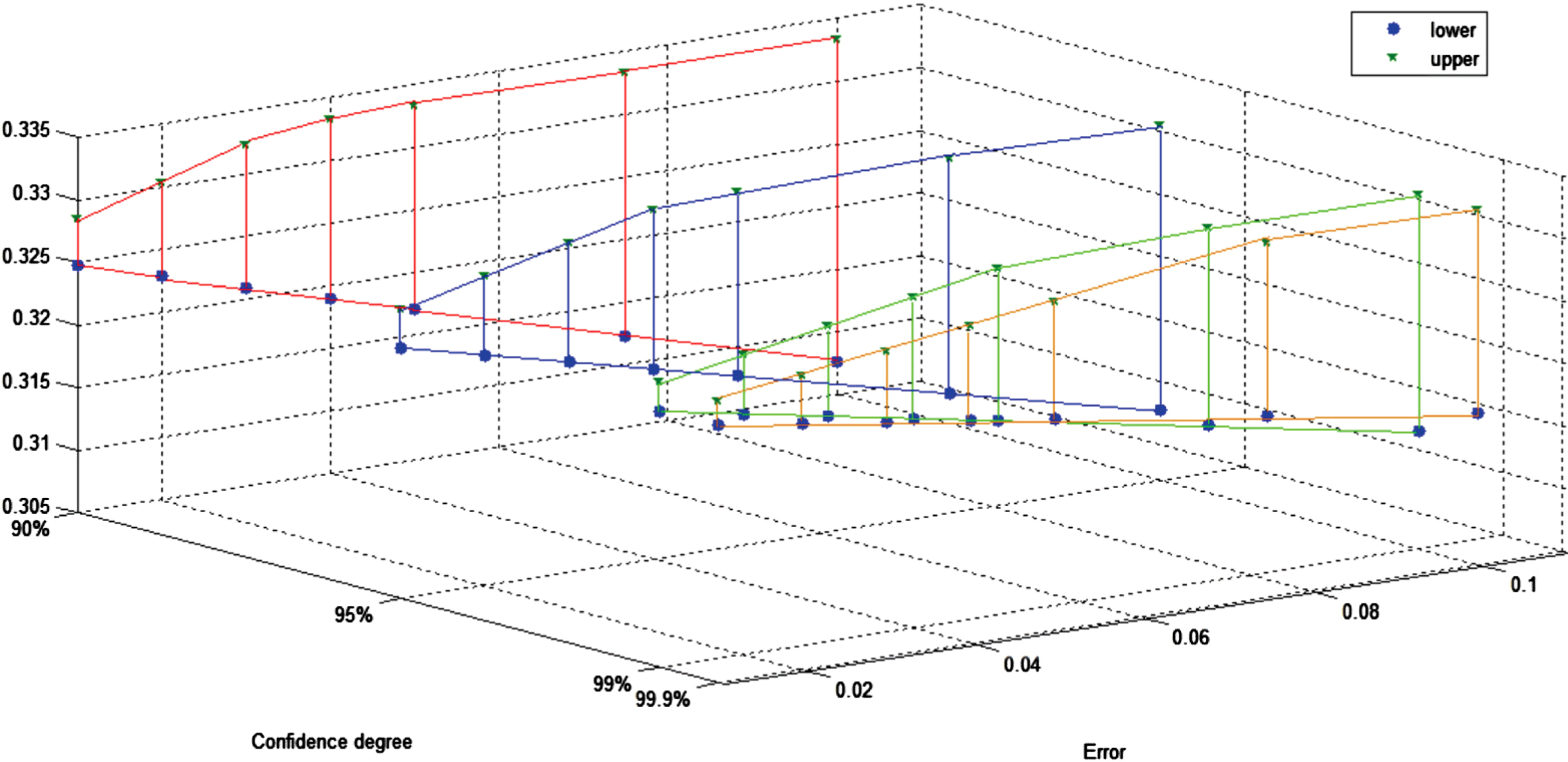
The combination belief degree m12 (H1) and m12 (H3).

The combination belief degree m12 (H2).
Compared with the results in Revised Example 1, (
Compared with the method in Example 2, the method proposed in this paper considers the preferences of decision makers. From Table 4 and Figs. 2 and 3, we can get the following two conclusions: (1) If the error E is constant, the interval of combined CI belief degree is narrower as the confidence level 1 - α is bigger. For example, when E = 0.01 and 1 - α = 99.9%, m12 (H1) = [0.3257, 0.3276] , m12 (H2) = [0.0116, 0.0154] , m12 (H3) = [0.3257, 0.3276]; when E = 0.01 and 1 - α = 90%, m12 (H1) = [0.3247, 0.3285], m12 (H2) = [0.0097, 0.0173] , m12 (H3) = [0.3247, 0.3285]. The reason for this phenomenon is that the sample size t1 and t2 keep getting bigger and bigger as confidence level 1 - α gets bigger. (Generally, the confidence interval is wider as the confidence degree 1 - α is bigger.) (2) If the confidence level 1 - α is constant, the interval of combined CI belief degree is narrower as the error E is bigger. For example, when E = 0.01 and 1 - α = 99.9%, m12 (H1) = [0.3257, 0.3276] , m12 (H2) = [0.0116, 0.0154] , m12 (H3) = [0.3257, 0.3276]; when E = 0.1 and 1 - α = 99.9%, m12 (H1) = [0.3171, 0.3333], m12 (H2) = [0.0000, 0.0327] , m12 (H3) = [0.3171, 0.3333]. Therefore, the new method, which can adjust by different errors and confidence degrees, is more flexile than the previous method in Example 2.
In general, the proposed evidence combination method with CIBS is feasible. Based on it, the extended evidential reasoning approach is proposed to apply in evaluating sustainable operation of Shanghai rail transit system in the following case. And it can show better performance.
In this section, a case study of evaluating sustainable operation of Shanghai rail transit system ([44]) are shown to verify the feasibility of the proposed method in real world. The aim of this study is to obtain combined belief degree of first-level indicators by Definition 3.4, which is to prepare for calculating the weights of first-level indicators.
Implementation
Based on Definition 3.4, the implementation steps of this extended evidential reasoning approach are as follows:
A integrated, efficient and economical rail transit system, which is an important condition for sustainable development of urbanization. And in the researches of sustainable operation of rail transit, customer requirements should be concerned. Therefore, the index system of customer requirements in this case is established, which contains 5 first-level indicators and 13 secondary indicators (see in Fig. 4). Where, e ij denotes a secondary indicator and R i denotes a first-level indicator.

The index system of CRs in rail transit system.
In the data collection phase, 18091 useful questionnaires are used to evaluate customer requirements. Let H be the frame of discernment with five propositions {H1, H2, H3, H4, H5}, which are different grades, described by very important, important, moderate, less important and unimportant. The original belief degrees of secondary indictors are as shown in Table 5. mR i ,j (H k ) denotes the probability that the index e ij supports the proposition H k by customers in 18091 questionnaires.
The original basic probability assignment
Next, the original belief degrees of secondary indictors will be converted to confidence interval belief degrees. Since
The proposed evidential combination models with CIBS (3.9) is applied in this step. We assume that all pieces of evidence are completely reliable, namely, rR1,1 = rR1,2 = rR1,3 = rR1,4 = rR2,1 = rR2,2 = rR3,1 = rR3,2 = rR4,1 = rR4,2 = rR5,1 = rR5,2 = rR5,3 = 1 (Where, rR
i
,j denotes the reliability of the index e
ij
). In addition, we assume that the relative importance of each evidence is equal, that is
The basic probability assignment based on confidence interval (CI)(1 - α = 95%)
Where, Θ be the frame of discernment with five propositions {H1, H2, H3, H4, H5}.
The combined belief degree m CI can be obtained by the proposed evidential combination method in this paper (referred as "A"). And it is compared with the results obtained by the methods in [44] (referred as "B"), which are shown in Table 7 (In Table 7, m R i (H k ) denotes the combined belief degree of the index R i (i = 1, 2, . . . , 5) in the proposition H k (k = 1, 2, 3 .)). Taking the index S1 as an example, mR1,1 (H1) =0.5268, mR1,2 (H1) =0.4422, mR1,3 (H1) =0.4974 and mR1,4 (H1) =0.3008, which are dominant in the proposition of H1. By the proposed method in this paper, the combined belief degree of the index S1 with the proposition H1 are obtained, which are denoted by m R 1 (H1) = [0.8594, 0.8970]. And it is obvious that mR1,j (H1) ≺ m R 1 (H1) (j = 1, 2, 3, 4) . As well as, mS1,1 (H4) =0.0143, mR1,2 (H4) =0.0333, mR1,3 (H4) =0.0165 and mR1,4 (H4) =0.2220, most of which are the smallest in the proposition of H4. By the proposed method in this paper, the combined belief degree of the index R1 with the proposition H4 are obtained, which are denoted by m R 1 (H4) = [0.0000, 0.0001]. And it is obvious that mR1,j (H4) > m R 1 (H4) (j = 1, 2, 3, 4) .
The combined belief degree of R i
Therefore, we can get that the combined support of the proposition should be higher than the single support of each piece of evidence for the proposition if the proposition is supported by each piece of evidence and each piece of evidence is dominant in this proposition. On the contrary, the combined support of the proposition should be lower than the single support of each piece of evidence for the proposition if most of evidences for the proposition is supported by the least probability. That is reasonable and reflects the advantages of the method in this paper. But the results by the method in [44] are not shown that. In the following description, this phenomenon is simply called intuitive phenomenon.
After the combined belief degree of the first-level indictors, their weights can be obtained easily.
In this part, a sensitivity analysis is conducted to determine the sensitivity of the final results with respect to changes in parameters, including index weights (ω) and reliability (r).
We design 24 experiments and take the index of Reliability (R2) as an example, which are presented in Table 8. Among 24 experiments, Experience 1-13 (Exp. 1-13) are given by ωR2,1 = ωR2,2 = 0.5. Where, Exp.1 provides rR2,1 = rR2,2 = 1; Exp.2 provides rR2,1 = rR2,2 = 0.8; Exp.3 provides rR2,1 = rR2,2 = 0.6; Exp.4 provides rR2,1 = rR2,2 = 0.4; Exp.5 provides rR2,1 = rR2,2 = 0.2; Exp.6 provides rR2,1 = 1 and rR2,2 = 0.8; Exp.7 provides rR2,1 = 1 and rR2,2 = 0.6; Exp.8 provides rR2,1 = 1 and rR2,2 = 0.4; Exp.9 provides rR2,1 = 1 and rR2,2 = 0.2; Exp.10 provides rR2,1 = 0.8 and rR2,2 = 1; Exp.11 provides rR2,1 = 0.6 and rR2,2 = 1; Exp.12 provides rR2,1 = 0.4 and rS2,2 = 1; Exp.13 provides rR2,1 = 0.2 and rS2,2 = 1.
The combined belief degree of R2 in different ω and r
The combined belief degree of R2 in different ω and r
Furthermore, Experience 14-24 (Exp.14-24) are given by rR2,1 = rR2,2 = 1. Where, Exp.14 provides ωR2,1 = 1 and ωR2,2 = 0; Exp.15 provides ωR2,1 = 0.9 and ωR2,2 = 0.1; Exp.16 provides ωR2,1 = 0.8 and ωR2,2 = 0.2; Exp.17 provides ωR2,1 = 0.7 and ωR2,2 = 0.3; Exp.18 provides ωR2,1 = 0.6 and ωR2,2 = 0.4; Exp.19 provides ωR2,1 = 0.5 and ωR2,2 = 0.5; Exp.20 provides ωR2,1 = 0.4 and ωR2,2 = 0.6; Exp.21 provides ωR2,1 = 0.3 and ωR2,2 = 0.7; Exp.22 provides ωR2,1 = 0.2 and ωR2,2 = 0.8; Exp.23 provides ωR2,1 = 0.1 and ωR2,2 = 0.9; Exp.24 provides ωR2,1 = 0 and ωR2,2 = 1.
It is seen from Table 8 that, due to the change in reliability r or weight ω of e21 and e22, the combined belief structure m R 2 also changed.
From Table 5, the evidence e21 and e22 are both dominate in H1, so their combined belief degree m R 2 (H1) should be higher than mR2,1 (H1) and mR2,2 (H1), which called the intuitive phenomenon. As shown from Exp.1-5, the larger reliability (r) is and the more obvious that intuitive phenomenon is. And due to mR2,1 (H1) =0.3807 < mR2,2 (H1) =0.4594 (in Table 5), compared with Exp.6-9 and Exp.10-13, it is seen that the combined belief degree m R 2 (H1) in the reliability of evidence e22 is fully trusted (that is rR2,2 = 1) is higher than in the reliability of evidence e21 is fully trusted (that is rR2,1 = 1). Furthermore, it is observed from Experience 14-24 that, the results vary with ωR2,1 and ωS2,2. And obviously, the combined BS is closer to the single BS with the greater the weight of evidence.
In the existing research of evidential reasoning, researchers developed the concepts of IBS to deal with the uncertainty of information ([25, 26]). As well as, the method of combination and normalization of IBS are proposed ([21]). However, IBS ignores the probability law of random variables in the case of objective calculation of experimental data and the method of combination of IBS is not flexible. This paper has extended the concept of IBS and proposed a new combination of CIBS to make up for these deficiencies of IBS. The extended approach has been used to aggregate the belief degree of indicators in evaluating sustainable operation of the Shanghai rail transit system, which can prepare for weights of first-level customer requirements indicators.
The major advantage of the new method is that it can be flexibly adjusted by appropriate errors and confidence levels. Furthermore, the proposed method has great performances in Example 3 and the case of implementation and sensitivity analysis. Its performance mainly embodies in the following aspects: (1) If the error E is a constant, the interval of combined belief degree is narrower as the confidence level is bigger; as well as, the interval of combined belief degree is narrower as the error is bigger if the confidence level is a content; (2) The combined support of the proposition is higher than the single support of each piece of evidence for the proposition if the proposition is supported by each piece of evidence and each piece of evidence is dominant in this proposition, which is called intuitive phenomenon; (3) Due to the change in reliability or weight of evidences, the combined belief degree also be changed. The lager reliability is and the more obvious that intuitive phenomenon is; And the combined belief degree is closer to the single belief degree with the greater the weight of evidence.
Nowadays, evidential reasoning is applied widely in many fields, such as supplier selection, safety analysis, stock portfolio selection, financial investment, etc. What’s more, evidential reasoning approach has been used in most decision-making methods ([48]), but few researchers have applied it to model consensus in group decision making. In the future, the extended approach will be applied to used to model consensus ([49–52]).
Footnotes
Acknowledgments
The authors thank the reviewers for their careful reading and providing some pertinent suggestions. And this work was supported by the General Program of National Natural Science Foundation of China (No. 11671250, 12071280).