




Abstract
The financial products selection in the financial services sector is a traditional multi-attribute group decision making (MAGDM) problem. Probabilistic uncertain linguistic sets (PULTSs) could be used to evaluate the financial products with uncertain linguistic terms and corresponding weights (probabilistic). The bidirectional projection (BP) method could take the bidirectional projection values into account. In this paper, we develop an integration model of information entropy and BP method under PULTSs. First of all, utilizing information entropy derives the priority weights of attributes. Next, utilizing the BP method of the PULTSs to obtain the final ranking of the alternatives. To depict the BP method, the formative vectors of two alternatives are defined, and a weighted vector model and inner product are improved under the PULTSs. In addition, through giving the case of financial products selection and some existing MAGDM methods for comparative analysis, it is proved that the method is practical and effective. The proposed approach also contributes to the effective selection of appropriate options in other decision-making matters.
Keywords
Introduction
Since objective things are intricacy, most decision-making problems are uncertain and vague [1–5], and decision-making information is more appropriate to be expressed for linguistic term [6–9]. Evaluation of qualitative variables by linguistic term [10] is a flexible method that makes human thinking and expression consistent. Herrera and Martinez [11] proposed the linguistic term sets (LTSs) in their developed computational technique. Then, scholars have come up with uncertain linguistic set [12, 13] and multi-granularity uncertain linguistic set [14]. By combining hesitant fuzzy sets and linguistic term sets, Rodriguez, Martinez [15] put forward hesitant fuzzy linguistic item sets (HFLTS) and provide several possible linguistic variables. When expressing preferences in a qualitative environment, several linguistic terms may have different weights (expressed in probability) and be considered at the same time. Thus, Pang, Wang [16] put forword the notion of probabilistic linguistic term sets (PLTS) in 2016, and proposed some PLTS basic laws of operation and aggregation operators. Based on which, an extended TOPSIS approch was gived and applied to practical cases. Liao, Jiang, Xu, Xu and Herrera [17] proposed linear programming method for solving the MADM with PLTSs. Lin, Chen, Liao and Xu [18] developed the probabilistic linguistic ELECTRE II method and applied it for edge computing. Lei, Wei, Lu, Wei and Wu [19] gave the GRA method for incomplete weight information MAGDM in the PLTS. Zhai, Xu and Liao [20] proposed the vector-term sets of probabilistic linguistic to be applied for MAGDM with multi-granular linguistic information. Feng, Liu and Wei [21] proposed a QUALIFLEX method with possibility degree comparison of probabilistic linguistic information. Wang, Wei, Wu, Wei and Guo [22] defined the probabilistic linguistic GRP method. Chen, Wang and Wang [23] applied the MULTIMOORA method for PLTSs to select cloud-based ERP. When uncertain linguistic terms are used to express evaluation information, these evaluation information is different, and the weights (probabilities) that occur for each evaluation are different. Based on the ideological inspiration of PLTS and uncertain linguistic terms,Lin, Xu [24] proposed the concept of probabilistic uncertain linguistic item sets (PULTS) and studied its basic laws of operation and aggregation operators,which is used for modeling and operating uncertain linguistic variable in decision-making. Probabilistic uncertain linguistic preference relationship was established by Xie, Ren [25], and they devised similarity degree measure and distance measure to improve consistency. Wei, He [26] proposed the probabilistic uncertain linguistic MABAC method to deal with MAGDM problem. Lei, Wei, Wu, Wei and Guo [27] defined the QUALIFLEX method for MAGDM with PULTSs. Wei, He, Lei, Wu, Wei and Guo [28] defined the uncertain probabilistic linguistic MABAC method. Wei, Lin, Lu, Wu and Wei [29] defined the generalized Dice similarity measures for probabilistic uncertain linguistic MAGDM.
There existed another similar concept called linguistic distribution for solving the corresponding problem. Zhang, Dong and Xu [30] presented the concept of distribution assessments in a linguistic term set. Zhang, Guo and Martinez [31] presented the linguistic hierarchies. Zhang, Yu, Martinez and Gao [32] presented the linguistic distribution to cope with the multigranular unbalanced HFLTSs in GDM. Wu, Dong, Qin and Pedrycz [33] presented the linguistic distribution and priority based approximation to flexible linguistic expressions. Zhang, Xiao, Palomares, Liang and Dong [34] presented the linguistic distribution for large-scale GDM with comparative linguistic information. Tang, Peng, Zhang, Pedrycz and Yang [35] presented consensus-driven models to personalize individual semantics with distribution linguistic preference relations. Dong, Wu, Zhang and Zhang [36] presented the linguistic distribution assessments with interval symbolic proportions.
The projection method is a very good method to deal with MAGDM problems [37, 38]. It can use the length and angle of the alternatives to calculate the projection value of the alternatives on the positive and negative ideal solutions, so as to sort the alternatives. But when the projection value is the same, the alternatives cannot be distinguished. So Ye [39] proposed a BP method to overcome this shortcoming, applied it to single-valued neutrosophic sets, and proved its superiority through studying instance. Because the BP method can consider bidirectional projection values, when the projection values on the ideal solution are the same, alternatives can also be distinguished. Therefore, compared with the projection method, the BP method is more comprehensive and more reasonable [40]. The BP method has been widely applied for decision making. A BP measure of interval numbers is proposed by Ye [41] and it is extended to the BP measure of neutrosophic numbers. Zang, Zhao [42] proposed a grey relational BP approach to solve IVHFLNs MCDM problems. The Power average operator is combined with the bidirectional projection, which is extended to the PLTS [40]. Liu and You [43] improved the BP method of linguistic neutrosophic numbers for MCGDM. Qu, An [44] established the bidirectional projection models to study dual hesitant fuzzy MADM problems. Wei, Zhang [45] established the picture fuzzy BP method to deal with MAGDM problem. Li, Huang [46] designed the grey relational BP method to solve MAGDM problem of the TrT2IFN. Yang, Wang [47] proposed the normal wiggly Pythagorean hesitant fuzzy BP approach for MADM problems. However, so far, there are still no studies on the BP method for MAGDM under PULTSs.
The PULTSs could well depict uncertain information with uncertain linguistic term and the probabilities of each uncertain linguistic term. and the BP method could not only consider the distance and angle of the alternatives, but also consider the bidirectional projection values. Combining the BP method and the PULTSs will better solve the problem of MAGDM.
In our study, the BP method of probability uncertain linguistic is used in the MAGDM with the completely unknown weight information. The innovation is as follows: (1) First use of BP method in probabilistic uncertain linguistic group decision; (2) A probabilistic uncertain linguistic BP group decision method is established, in which the entropy is used to determine the attribute priority weight; (3) Give an example studies on financial products selection to demonstrate the developed approach; (4) A number of comparative research methods, including PUL-TOPSIS operator, PULWA method, PUL-EDAS method and ULWA operator, are presented.
Preliminaries
Xu [48] proposed the additive LTSs and Gou, Xu and Liao [49] gave a mathematical transformation function between LTSs and [0, 1].
Evidently, they are equivalent in mathematical information. Moreover, β could also be expressed as the linguistic term γ
α
, which is derived by the mathematical function g-1:
Pang, Wang and Xu [50] proposed the concept of PLTSs.
Lin, Xu, Zhai and Yao [24] designed the probabilistic uncertain linguistic term sets (PULTS) based on ULTSs [51] and PLTS.
For ease of calculation, the PULTS PUL (p) is normalized Lin, Xu, Zhai and Yao [24] as
If there is overlap in a PULTS, the PULTS should be preprocessed by dividing the overlapped ULT into several non-overlapping ULTs which share the probabilities equally. For example, the PULTS {〈 [γ-1, γ1] , 0.6 〉 , 〈 [γ0, γ1] , 0.2 〉 , 〈 [γ1, γ2] , 0.2 〉} should be preprocessed into the PULTS {〈 [γ-1, γ0] , 0.3 〉 , 〈 [γ0, γ1] , 0.5 〉 , 〈 [γ1, γ2] , 0.2 〉}.
According to the Equations (6)-(7), the size relation of two PULTSs is specified as follows: (1) if E (PUL1 (p)) > E (PUL2 (p)), then PUL1 (p) > PUL2 (p); (2) if E (PUL1 (p)) = E (PUL2 (p)), then if D (PUL1 (p)) = D (PUL2 (p)), then PUL1 (p) = PUL2 (p); if D (PUL1 (p)) < D (PUL2 (p)), then, PUL1 (p) > PUL2 (p).
In this section, the probabilistic uncertain linguistic Bidirectional Projection (PUL-BP) method is used to solve the MAGDM problems with completely unknown weight information. Utilizing information entropy to derive the priority weights of attributes, and utilizing the BP method of PULTSs to get the ranking of the alternatives. For the convenience of description, we use the following mathematical symbols to denote relevant content. Suppose there are s chosen alternatives, t qualitative attributes and q qualified experts, A ={ A1, A2, ⋯ , A
s
} denotes the set of s chosen alternatives, C ={ C1, C2, ⋯ , C
t
} represents the set of t qualitative attributes with weight vector ω = (ω1, ω2, ⋯ , ω
t
), where ω
j
∈ [0, 1], j = 1, 2, ⋯ , t,
The specific modeling steps of the PUL-BP method for MAGDM are presented below:
Information entropy can reflect the average of uncertainty information amount contained in each attribute. In a given attribute, the greater value of entropy illustrates the greater similarity. The greater similarity illustrates that this attribute provides less information. So, this attribute should have a smaller weight value [54–56].
First, the normative decision matrix NPULNM ij (p) is obtained by the following expression:
Then, the information entropy E
j
(j = 1, 2, ⋯ t) is calculated by the following:
Finally, the attribute weights vector ω = (ω1, ω2, ⋯ , ω
t
) is calculated:
NPULM = (NPULM
ij
(p)) s×t (i = 1, 2, ⋯ , s ; j = 1, 2, ⋯ , t) is a normalized PUL matrix, the positive ideal alternative is denoted as:
Analogously, the negative ideal alternative is denoted as:
where
The weight vector of each alternative is ω = (ω1, ω2, ⋯ , ω
t
), ω
j
∈ [0, 1], the module of A-A+ is computed below:
Analogously, the modules of A-A
i
and A
i
A+ are computed below:
The inner product of A-A i and A-A+ is computed below:
The inner product of A-A+ and A i A+ is computed below:
The cosine of A-A i and A-A+ is computed below:
The projection value of A-A
i
on A-A+ is calculated as:
Analogously, the projection value of A-A+ on A
i
A+ is calculated as:
As shown in Fig. 1, the larger the value of prj A - A + (A-A i ), the closer the alternative A i is to the positive ideal alternative A+. Similarly, the smaller the value of prj A i A + (A-A+), the farther the alternative A i will be to negative ideal alternative A-. Therefore, the alternative with the largest C (A i ) (i = 1, 2, ⋯ , s) value is the optimal alternative. Thus, the optimal alternative not only is closest to the positive ideal alternative but also should be far away from the negative ideal alternative.
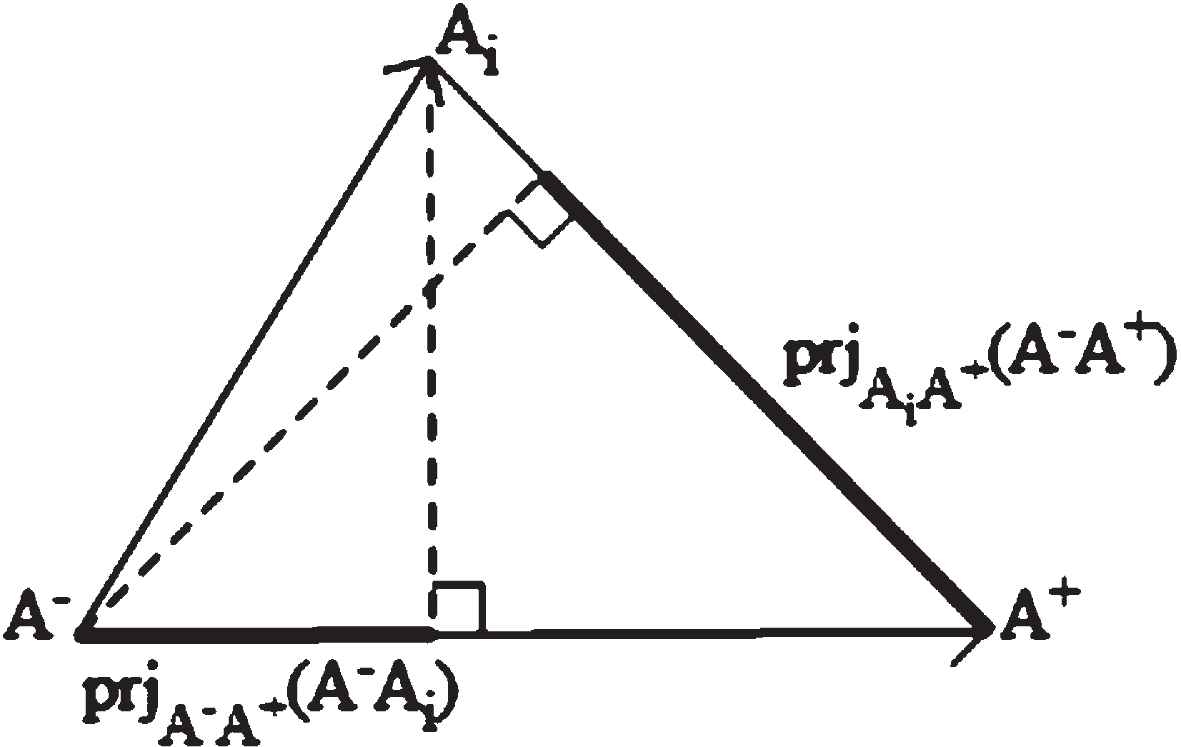
The graphical representation of prj A - A + (A-A i ) and prj A i A + (A-A+).
When the distance of the two alternatives from the positive and negative ideal alternatives are same, the optimal alternative can still be obtained. As shown in Fig. 2, we can see |A-A i | = |A i A+|, |A-A k | = |A k A+|, prj A - A + (A-A i ) = prj A - A + (A-A k ), prj A i A + (A-A+) < prj A k A + (A-A+), C (A i ) > C (A k ) and A i > A k . The reason is that the bidirectional projection method not only considers the relationship between the alternatives and the positive and negative ideal alternatives, but also considers the relative importance between the positive ideal alternative and the negative ideal alternative. Therefore, the research of the PUL-BP method is very meaningful and worth studying. It can solve the problem effectively.

Schematic diagram of Bi-directional projection.
The numerical case
Financial markets are booming in today’s society, and the financial services sector provide many financial products for investors. It is very important to choose the optimal financial products because of the vital interests of investors [57, 58]. The financial products selection in the financial service sectors is a traditional MAGDM problem. Fuzzy linguistic is often used to describe people’s preference of financial products, so some scholars have studied the selection methods of financial products with fuzzy system approaches. Merigo and Lafuente [59] developed a method that the ordered weighted averaging operator was used to select financial products. Liu and Wei [58] developed a weighted averaging operator of dynamic 2-tuple linguistic for the financial products investment. An incomplete additive probabilistic linguistic preference relation was proposed and used to select financial products[60]. When probabilistic uncertain linguistic term is used to be expressed decision information by decision maker, we proposed the BP method of PULTSs to select the optimal financial product.
Thus, we give a numerical case of financial products selection to demonstrate the practicability of the improved method. Five possible financial products A i (i = 1, 2, ⋯ , 5) under four attributes are provided to select for five experts. The four attributes are as: ① C1 is manager; ② C2 is starting point; ③ C3 is seven-day annualized interest rate (%); ④ C4 is Term. The starting point (C2) is cost attribute, the other three attributes are beneficial. The evaluation values of the five potential financial products employ the linguistic term in set:
Under the above four attributes, the evaluation results of five experts are listed in the Tables 1–5.
Decision information of the first decision maker
Decision information of the first decision maker
Decision information of the second decision maker
Decision information of the third decision maker
Decision information of the fourth decision maker
Decision information of the fifth decision maker
Then, the PUL-BP method is used to select the financial products.
Decision information of the first decision maker
Decision information of the second decision maker
Decision information of the third decision maker
Decision information of the fourth decision maker
Decision information of the fifth decision maker
Probabilistic uncertain linguistic decision matrix
The normalized probabilistic uncertain linguistic decision matrix
The ideal alternatives
The formative vectors A-A+ and A-A i
The existing methods PUL-TOPSIS method [24], PULWA operator [24], PUL-EDAS method [53] and ULWA operator [51] are provided to compare with the PUL-BP method in this section.
PUL-TOPSIS method
PUL-TOPSIS method [24] is used to compare with PUL-BP method and the results of computing and sorting are listed in Table 16. Thus, the optimal financial product is A4. It can be seen that the PUL-TOPSIS method and the PUL-BP method obtain the same ranking of the alternatives and the same optimal alternative.
The formative vector A
i
A+
The formative vector A i A+
PUL-TOPSIS method calculating and sorting results
Then, PULWA operator [24] is used to compare with the PUL-BP method, the weight of attributes is obtained as: ω1 = 0.4079, ω2 = 0.2464, ω3 = 0.1228, ω4 = 0.2229, then the Z
i
(ω) (i = 1, 2, ⋯ , 5) is obtained by using PULWA operator.
Next, the score of these alternatives Z
i
(ω) (i = 1, 2, ⋯ , 5) are derived by Definition 9 [24]:
Finally, the order could be derived: A4 ≻ A3 ≻ A1 ≻ A2 ≻ A5. Thus, the optimal financial product is A4. It can be seen that the PULWA operator and the PUL-BP method obtain the decision results.
PUL-EDAS method
PUL-EDAS method [53] is used to compare with the PUL-BP method and the results of computing and sorting could be obtained (Table 17). Thus, the optimal financial product is A4. The same ranking of the alternatives and the same optimal alternative are obtained by these two methods.
PUL-EDAS method calculating and sorting results
PUL-EDAS method calculating and sorting results
In this section, the ULWA operator [51] with same weight information is used to aggregate these ULTSs into a group matrix with ULTSs (See Table 18).
Uncertain linguistic group decision matrix
Uncertain linguistic group decision matrix
The attributes weight is obtained as: ω1 = 0.4079, ω2 = 0.2464, ω3 = 0.1228, ω4 = 0.2229, then the Z i (ω) (i = 1, 2, ⋯ , 5) is derived by using ULWA operator [51].
Next, the score of Z
i
(ω) (i = 1, 2, ⋯ , 5) are derived by Definition 9 [24]:
Finally, the order could be obtained: A4 ≻ A3 ≻ A1 ≻ A2 ≻ A5. Thus, the optimal financial product is A4. It can be seen that the decision results derived from the ULWA operator and the PUL-BP method are also the same.
In this paper, the BP method is improved to probability uncertain linguistic information for dealing with MAGDM problem with completely unknown weight. First of all, the necessary theories and PULTSs’ Hamming distance are simply reviewed. Secondly, the vector of information entropy based on the PULTS is computed to obtain the attribute priority weights. Then, the formative vector of two alternatives is defined and the weighted module of the formative vector and the weighted inner product of two formative vectors are improved under the PULTS. Next, the closeness degree of each alternative to ideal alternatives is derived by computing the bidirectional projection values. Finally, we give a practical numerical example about financial products selection in financial service sectors to elaborate the proposed method and use some existing methods for comparison to proof its applicability in realistic MAGDM problems. The results of the research show that the developed approach is effective and practical for solving uncertain and fuzzy decision-making problems. The PUL-BP method applies the BP method to probability uncertain linguistic environment. It not only considers the distance and angle of the alternatives, but also considers bidirectional projection values. So, it is more comprehensive and reasonable. Future research can consider the use of aggregation operators [61–63] to model the relationship between attributes to improve effectiveness. Similarly, future research can also extend the models and methods designed in this study and apply them to other uncertain and vague decision making [64–67] and other uncertain and vague environment [68–70].