



Abstract
The freezing pipe fracture can cause freezing wall to thaw and even lead to major accidents such as mine flooding easily, which seriously threatens the safety in construction. Therefore, scientific and effective comprehensive risk assessment for freezing pipe fracture is of great significance. In this work, a risk assessment method is put forward based on improved AHP-Cloud model with 19 evaluation indicators. First, the multi-dimension evaluation index system and evaluation model are established, on the basis of in-depth analysis of the risk factors that may lead to accidents. Second, synthesizing the normalization process and the improved analytic hierarchy process (AHP), the evaluation grade cloud and comprehensive evaluation cloud of freezing pipe fracture can be acquired by using the forward cloud generator. Finally, According to the max-subjection principle and the comprehensive evaluation method, we obtain the risk level of freezing pipe fracture. The model is applied to Yangcun Coal Mine. It has been verified that the risk assessment problem of freezing pipe fracture in freezing sinking can be successfully solved by the model we proposed. Above all, the study offers a new research idea for the risk management of freezing pipe fracture in freeze sinking.
Introduction
Artificial ground freezing (AGF) is the most effective special construction method in loose and weak water-rich strata, and widely used in the reinforcement of subway connecting roads and shield tunnels. More than 1,100 vertical shafts and nearly 40 inclined shafts have been built in China using AGF. The freezing pipe is the key to the formation and maintenance of the freezing wall. Once broken, it will cause saline water leakage, melting of the freezing wall, and even mine flooding accidents. In the history of freeze sinking, the accidents of freezing pipe fracture have always been accompanied by frequent mine flooding and other major accidents [1]. Water seepage is one of the most crucial challenges in any AGF process, which has adverse effects on the formation of the freezing wall [2]. Through the research of freezing pipe fracture mechanism and prevention technology, the accident of pipe fracture has been greatly reduced. However, due to the complex influencing factors and difficult to control, the pipe break accident cannot be completely eliminated. Since 2000, the number of broken pipes in the auxiliary shaft of Gubei Mine, the main auxiliary shaft of Huayuan Mine, and the auxiliary shaft of Yangcun Mine reached 43, 46, and 32, respectively, which seriously affected the safety of shaft construction [3]. At present, freezing pipe fractures are always discovered after a large amount of saline water leaks or even floods into the working face of the wellbore, which has caused major safety hazards and economic losses. Therefore, so far, the freezing pipe fracture problem is still a big problem that needs to be solved urgently in mine construction. Under the background that the freezing pipe fracture accident can not be completely eradicated, it is particularly important to assess the risk of it scientifically and effectively. However, during the risk assessment process, tremendous ambiguities and uncertainties always exist. Thus, selecting an appropriate and accurate risk assessment method can contribute to providing reasonable and effective risk management measures to avoid the occurrence of freezing pipe fracture accidents.
Analytic Hierarchy Process (AHP) is a systematic analysis method proposed by Saaty in 1980 [4] that combines qualitative analysis with quantitative analysis to determine the level, structure, and quantification of problems. Due to its advantages of simple structure and no cumbersome mathematics involved, it has been successfully applied in many aspects, such as maintenance policy selection, environmental decision-making, resources planning, conflict management, and risk assessment [5]. Wan analyzed the influence factors of coal mine accidents based on AHP [6] and Podgórski used the typical AHP for assessing the performance of occupational safety and health management systems [7]. Also, Chen applied fuzzy AHP to evaluating teaching performance [8] and Wang used a nonlinear fuzzy analytic hierarchy process to estimate and rank risk factors in safety evaluation of coal mine [9], while Ma used the AHP for calculating the weights of warning index system for coal mine safety [10]. Raviv analyzed the potential risk of safety incidents in the construction industry based on AHP [11], and Li proposed a method of quantitative assessment the risk of gas explosion in underground coal mine using fuzzy AHP and bayesian network [12]. The cloud model theory was proposed by Chinese Academy of Engineering academician Deyi Li, which combines probability theory and fuzzy mathematics theory, establishes qualitative and quantitative mapping through specific language, and implements the transformation of qualitative expression of uncertain concepts and quantitative calculation [13]. The cloud model has been widely used in many different engineering fields. Liu used a cloud model-based approach for comprehensive stability assessment of complicated rock slopes of hydroelectric stations [14] and Zhang used a cloud model for risk assessment of existing pipelines in tunneling environments [15]. Also, Guo applied cloud inference to risk assessment for natural gas pipelines [16], while Wang used cloud inference for reliability analysis of multi-state reconfiguration pipeline system [17]. Lin proposed a method for risk assessment of water inrush in karst tunnels using variable weight function and improved cloud model [18] and Huang analyzed failure mode and effect based on an interval-valued intuitionistic fuzzy cloud theory method [19].
At present, the research on the risk assessment of freezing pipe fracture has not been carried out in the world. In view of the uncertainty, fuzziness and randomness of the risk factors of freezing pipe fracture, and the need to consider qualitative and quantitative data simultaneously, thus, in this study, the improved AHP-Cloud model combined improved AHP method with cloud inference theory for the risk assessment of freezing pipe fracture is proposed. The model optimizes the weight assignment method, which can provide a more scientific and reasonable evaluation method for multi-index fuzzy factors. It makes improvement in terms of weakening the influence of human factors on the evaluation results and the determination of the index weight. The model is successfully applied to risk assessment of freezing pipe fracture under complicated and multiple risk factors, helping decision makers to prevent risks in advance. This work provides a new research idea for the risk management of freezing pipe fracture in artificial ground freezing. And the organization of this paper is as follows. Section 2 is devoted to the fundamental theory of improved AHP method, cloud model and process of risk assessment and analysis based on improved AHP-Cloud model. The risk evaluation index system and risk assessment model of freezing pipe fracture is established in Section 3. Then, a practical case is studied by using the proposed model in Section 4. After that, the results and discussion of application of the proposed method are presented in Section 5. The conclusions are drawn in the final Section.
Methodology
Improved AHP method
In the traditional method of determining the weight of AHP, the judgment of the relative importance degree among the indexes will be different due to the difference of the experts, when constructing the judgment Matrix, which has a certain subjectivity. At the same time, the inadequate application of quantitative indicators is also an obvious deficiency [20].
The specific content of the improved AHP is as follows: for n indicators, the sample standard deviation is calculated respectively, and then compared them in pairs. According to the transitivity rule of relative importance, the values of other elements of the judgment matrix can be obtained in turn [21], that is, if P1,2 = a1, P2,3 = a2, ... P (n–,n = a n–, then
The approximate value of the maximum eigenvalue (λmax) and the eigenvectors (ω) can be solved via Equations (1)–(3).
In view of the complexity of the multi-level judgment matrix, some values in the judgment matrix may be inconsistent. Therefore, it is necessary to check the consistency of the judgment matrix to ensure the consistency of the final evaluation. The calculation formula of the consistency test is:
The random consistency index
Definition of cloud
Cloud model theory is a mathematical model used to work out the uncertainty transformation between qualitative data and quantitative data. Suppose U is a universe of discourse represented by an exact value, and C is a qualitative concept related to U. If a certain value xi∈U, and xi is a random implementation of the qualitative concept C, then the membership degree μ(xi) ∈ [0, 1] for xi belonging to Cis a random variable with a stable tendency, namely:
The distribution of xi in the universe of discourse U is defined a cloud [16], and [xi, μ(xi)] are called cloud droplets. The generation process of cloud droplets shows the uncertainty of the mapping between qualitative concept and quantitative value. The more cloud droplets, the more accurate the overall characteristics of qualitative concept.
The numerical characteristics of cloud reflect the quantitative characteristics of qualitative concepts, which are represented by expectation Ex, entropy En and hyperentropy He. Figure 1 shows a one-dimensional normal cloud diagram. The Ex represents the most representative qualitative concept value of the universe of discourse, reflecting the central value of the universe of discourse; En is a overall measure of fuzziness and randomness of qualitative concepts. On the one hand, it reflects the value range of cloud droplets that can be accepted by qualitative concepts in the universe of discourse, on the other hand, it can also reflect the dispersion degree of cloud droplets; He is the uncertainty degree of entropy, which reflects the degree of aggregation of cloud droplets. The bigger He is, the thicker the cloud droplets are.
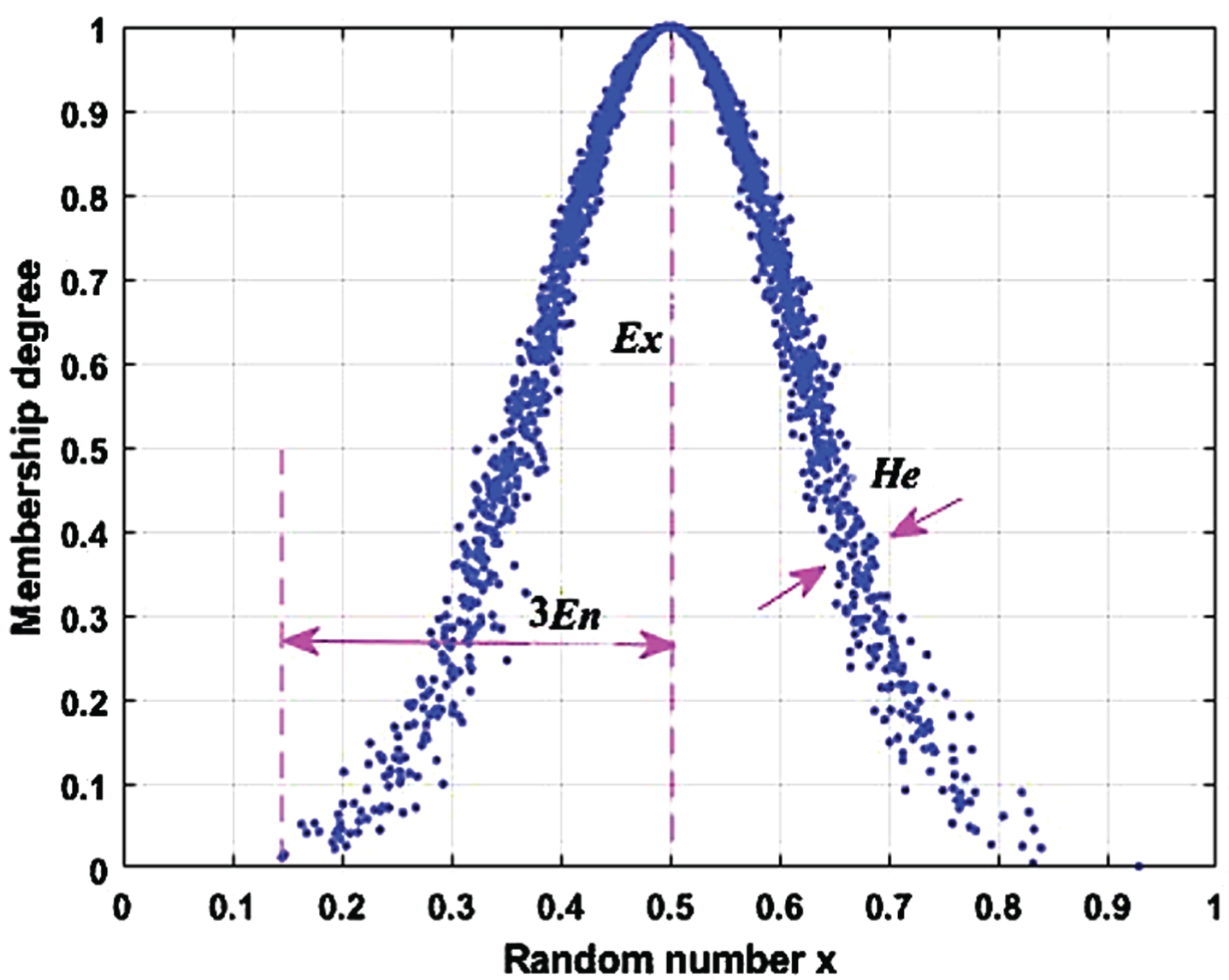
One-dimensional normal cloud model.
The cloud generator forms the basic algorithm of the cloud model by establishing the mapping relationship between qualitative concept and quantitative characteristic [15], which is divided into forward cloud generator and backward one. The forward cloud generator can convert the qualitative characteristics (Ex, En, He) of the evaluation indexes into quantitative values. With the help of MATLAB software, the numerical characteristics of cloud model can be displayed in the form of cloud droplets [23]. As shown in Fig. 2, the algorithm process of the forward cloud generator is as follows [17, 24]:

The algorithm schematic diagram of the forward cloud generator.
Step 1: Generate a normal random number En’:
Step 2: Generate a normal random number xi:
Step 3: Calculate the membership degree μ(xi):
Step 4: Repeat step1 to step 3 until the n cloud droplets required to form the cloud model are generated.
In contrast to the forward cloud generator, the backward cloud generator (CG–1) transform the quantitative characteristics into the qualitative concepts, as shown in Fig. 3. Three quantitative characteristics (Ex, En, and He) can be obtained from known cloud droplet samples to represent the corresponding qualitative concepts [25]. The algorithm process of the backward cloud generator is as follows:

The algorithm schematic diagram of the backward cloud generator.
Step 1: Calculate the sample mean of the set of data on the basis of xi:
Sample variance:
Step 2: Calculate the sample En of the set of data:
Step 3: Calculate the sample He of the set of data:
The risk assessment process based on the improved AHP-Cloud model is summarized as follows:
Step 1: Establish a risk assessment system:
Analyze risk factors of the evaluation object, classify the risks according to the collected information, and build a risk index system.
Step 2: Determination of index weight:
The weight of evaluation index plays a significant role in the result of multi-factor risk assessment, which can be obtained by the improved AHP method and expert scoring, and its consistency is to be checked.
Step 3: Normalization of the evaluation index:
In order to eliminate the impact of indicator dimensions and process data more effectively and reasonably, the value of each evaluation index should be normalized. If the larger a factor value is, the more favorable the factor is, then the data normalization can be calculated according to Equation (14) [14, 22].
Otherwise, if the larger a factor value is, the more adverse the factor is, then the data normalization can be implemented according to Equation (15).
Where
Step 4: Determination of eigenvalue of evaluation index:
Using the normalized values of indicators, the cloud eigenvalues of different risk levels for each index can be calculated by Equations (16)–(18).
Step 5: Generation of evaluation grade cloud:
Combine the cloud eigenvalues with the weight of each index, the numerical characteristics of different risk levels can be calculated by Equations (19)–(21).
Step 6: Generation of comprehensive evaluation cloud:
By using Equations (10)–(13), the eigenvalues of cloud model of each evaluation factor can be acquired from the selected sample data, and then combined with the weight, the numerical characteristics corresponding to the comprehensive evaluation cloud model of the evaluation object can be obtained via Equations (22)–(24). The overall risk characteristics of evaluation object can be deduced from the sample data.
Step 7: Comprehensive membership degree of each sample for different risk levels:
Using the forward cloud generator and the weight of each evaluation factor, the comprehensive membership degree of each sample for different risk levels can be calculated by Equation (25).
Risk evaluation index system of freezing pipe fracture
Suffering various complex adverse factors during the construction of the mine by freezing method, it is inevitable for freezing pipe to have accidents. An accurate and reasonable risk assessment method can not only help us to know the safety status of freezing pipe real-timely, but also help us to take effective measures in time to minimize the losses of the accident when the accident happens [26]. According to the collected information, the main factors incurring accidents of the freezing pipe fracture include the following five indexes: freezing scheme, construction technology, engineering geological condition, factors of freezing pipe and factors of freezing wall. And each risk factor also contains several sub-factors. The risk evaluation index system is established in Fig. 4, which can be seen that the risk evaluation index system of freezing pipe fracture consists of three layers. The left-most level, O-layer, is the first-level index, which aims to achieve the risk assessment value and level of risk of the system. The middle level, A-layer, is the second-level indexes and the right-most level, P-layer, is the third-level indexes.

Risk assessment index system of freezing pipe fracture.
Then, according to the improved determination method of AHP index weight, a consistent judgment matrix with law of transitivity methods is built; the calculated weighted values of the freezing pipe fracture are shown in Table 2. The sequence points out the relative importance weights from the highest level to the lowest, that is, the higher the ranking, the greater the influence on the freezing pipe fracture. It can be seen from Table 2 that the factors of freezing wall play an important role, specifically for maximum displacement of sidewall and Average temperature of freezing wall.
The index weights of risk factors for the freezing pipe fracture
The index weights of risk factors for the freezing pipe fracture
For the purpose of guiding the construction scientifically and effectively, the risk grade is divided into four levels and different colour represents different risk level, namely, green, blue, black and red. The green level means low risk, and construction can be carried out in accordance with the established freezing scheme and construction plan. The blue level indicates a moderate risk of the freezing pipe fracture, in which case construction can proceed normally, but monitoring measurements need to be strengthened. The black level represents high risk, and the red level signifies extremely high risk. In both cases, sufficient and effective measures must be taken to ensure construction safety. According to the relevant data of previous projects and the opinions of 5 experts, the evaluation indexes and corresponding risk level standards can be obtained, as presented in Table 3. For support design, properties of soil layer, maximum earth pressure, stratigraphic complexity and mechanical properties of freezing pipe, five factors are equally quantified. The higher the score, the greater the risk, that is, the highest score of 10 represents the highest risk, and the lowest score of 1 denotes the lowest risk.
Evaluation indexes and risk level standards of freezing pipe fracture
Evaluation indexes and risk level standards of freezing pipe fracture
Normalized values of evaluation indexes in Table 3 can be obtained through Equations (14)–(15). Therefore, using Equations (16)–(18) and the normalized values of each evaluation index, the cloud eigenvalues of different risk levels of 19 evaluation indexes can be figured out. The results are listed in Table 4.
Cloud numerical characteristics for each evaluation index.
Cloud numerical characteristics for each evaluation index.
The risk level of freezing pipe fracture is affected by the above-mentioned factors and evaluation indexes. Combine the cloud eigenvalues with the weight of each index in Table 2, the numerical characteristics of the evaluation grade cloud corresponding to different risk levels can be calculated by Equations (19)–(21). The results are as follows, Low level (Ex = 0.078, En = 0.048, He = 0.01), Moderate level (Ex = 0.31, En = 0.054, He = 0.01), High level (Ex = 0.685, En = 0.062, He = 0.01), Extremely high level (Ex = 0.94, En = 0.059, He = 0.01). After the numerical characteristics of the above cloud model are determined, the forward cloud generator is used to generate cloud model corresponding to the four evaluation levels, as displayed in Fig. 5. The abscissa in the figure represents the evaluation value, and the ordinate indicates the membership degree of the evaluation grade cloud model.

The evaluation grade cloud chart.
General situation of engineering
In order to illustrate the application process and effectiveness of freezing pipe fracture evaluation based on improved AHP-Cloud model, the following specific application example is given.
To prove the correctness of the proposed method, Yangcun Coal Mine, which is located in Yangcun Township, Fengtai County, Huainan City, Anhui Province, is selected as the assessment object. Its designed production capacity is 5.0 Mt/a, with main shaft depth of 986.7 m, designed net diameter of Φ7.5 m, maximum excavated diameter of Φ 12.256 m and frozen depth of 723 m. The topsoil thickness is 538.25 m, which belongs to the extra-thick topsoil layer. Moreover, the geological conditions are complex, sand layer and clay layer overlap each other, and loose layer collapses or shrinks, which makes the construction technology difficult. The Cenozoic loose layer through the wellbore can be correspondingly divided into four aquifers (groups) and three aquicludes (groups). 0∼319.40 m is mainly sand layer, followed by sandy clay and clay. The total sand layer is 223 m, accounting for 69.82% of the thickness of this layer. 319.40∼441.90 m mainly consists of sandy clay and clay layer. The total sand layer is 37.4 m, accounting for 30.53% of the thickness of this layer. 441. 90∼538. 25 m is mainly sand layer, 87.45 m I n total, accounting for 90.76% of the thickness of the layer. The freezing hole is arranged in four circles in the shape of quincunx. The freezing pipe is seamless steel pipe with diameter of 159 mm, and the joint form adopted lined cylinder type. According to geological data, the starting and ending depth of thick clay layer in the deep of the main well is 407.40∼441.90 m, a total of 34.50 m. Calcareous clay has low freezing point, large expansibility after freezing, strong creep, easy disintegration when exposed to water and low frozen strength. In view of the above complexities, a risk assessment must be introduced to avoid severe accidents.
In this paper, combined with the geological conditions around Yangcun Coal Mine and the statistical data of the construction site, according to the risk assessment index system constructed in Fig. 4, the monitoring or experimental data of four samples are selected for calculation and analysis, as shown in Table 5.
Sample quantification value of freezing pipe fracture
Sample quantification value of freezing pipe fracture
First of all, the sample data is normalized by Equations (14)–(15). Then, using Equations (10)–(13), the eigenvalues of cloud model of each evaluation factor can be acquired from the normalized data of the samples. Finally combined with the weight displayed in Table 2, the numerical characteristics (Ex = 0.552, En = 0.222, He = 0.156) corresponding to the comprehensive risk assessment of freezing pipe fracture can be obtained via Equations (22)–(24). The overall risk characteristics of evaluation object can be deduced from the sample data. Moreover, forward cloud generator is employed to get the comprehensive risk assessment cloud chart of freezing pipe fracture, as shown in Fig. 6.

The comprehensive risk assessment cloud chart of freezing pipe fracture.
According to the Equation (9), the data xi of the i-th index is calculated to be subordinate to the membership degree of freezing pipe fracture risk assessment level. The maximum displacement of sidewall P52 in sample 4 is taken as an example to illustrate the calculation process of membership degree. Through forward cloud generator, the membership degree of the index value belonging to the risk grade of freezing pipe fracture is obtained, that is μP52 (Low, Moderate, High, Extremely high) = (0, 0, 0.9714, 0.0215). As a result, the index of sample 4 belongs to moderate risk level on the grounds of the maximum membership principle.
For the 19 influencing factors in sample 4, the weight of each factor should be multiplied by the four levels of membership of the factor, and then the membership values of the corresponding levels should be added to get the comprehensive evaluation result. The advantage of this method is that the degree to which the sample indicators belong to each level is fully considered, and each membership degree is transferred to the comprehensive evaluation result, which can fully reflect the characteristics of the sample belonging to different levels. For example, the comprehensive membership degrees of sample 4 to the four risk levels was calculated to be 0.0001, 0.1146, 0.4136 and 0.1289 respectively, and the largest membership degree of 0.4136 is High level, so the comprehensive evaluation risk level of freezing pipe fracture of sample 4 is High level. The synthetic membership degree of each sample is presented in Table 6.
Evaluation grade of freezing pipe fracture in Yangcun Coal Mine
Evaluation grade of freezing pipe fracture in Yangcun Coal Mine
According to the principle of maximum certainty degree and the risk evaluation grade, the risk levels for the sample 1 and the sample 2 are moderate, and that for sample 4 is high, while the value of β (Extremely high) in Table 6 is relatively large, which indicates that it has a tendency to develop into a higher risk level. It can be seen from Fig. 6 that the cloud droplets are mainly distributed between 0.3 and 0.8, and some of them are in the range of red level. It manifests that freezing pipe fracture in Yangcun Coal Mine has reached a relatively high risk level, and there is a risk of large-scale freezing pipe fracture in some sections. Moreover, we can see that the range of the abscissa is relatively wide and that the comprehensive risk assessment cloud is thicker, indicating that the concept is relatively fuzzy and random, and deterministic quantification is difficult. Figure 6 shows that the comprehensive risk assessment result is a range instead of a number, which reflects the ambiguity and randomness of the evaluation process faultlessly, and more accurately expresses the actual situation. Furthermore, the results of the comprehensive risk assessment are displayed graphically, which is more clear and intuitive, and perfectly unifies the qualitative and quantitative concepts.
Using Equation (9), it can be concluded that the membership degrees of the comprehensive risk assessment cloud to each risk level are 0, 0, 0.1002 and 0 respectively. On the basis of the principle of maximum membership degree, the comprehensive evaluation cloud has the greatest membership degree for High level. However, the value of the maximum membership degree of 0.1002 is not so large, because the cloud droplets of the comprehensive evaluation cloud are not completely distributed in the high risk range, as depicted in Fig. 6. As a consequence, combined with the comprehensive risk assessment cloud chart and the calculation results of the membership degree, it can be comprehensively determined that the comprehensive evaluation conclusion of freezing pipe fracture in Yangcun Coal Mine is “High level". Therefore, it is necessary to strengthen monitoring, while taking adequate and effective measures to ensure construction safety.
Based on the improved AHP-Cloud model, the risk assessment results are consistent with the on-site construction situation that freezing pipe fracture occurred in multiple freezing holes during the actual construction of the project. It can be seen from Table 2 that the six factors maximum displacement of sidewall, Average temperature of freezing wall, joint form and strength, stratigraphic complexity, Shaft sinking section and maximum exposure duration of sidewall have the highest weights, which are also the main factors affecting the fracture of the freezing pipe. Therefore, we can take the following measures to ensure construction safety and prevent the occurrence of freezing pipe fracture accidents. (a) Strengthen freezing and reduce the Average temperature of freezing wall. (b) Control Shaft sinking section strictly and cut down the maximum exposure duration of sidewall. (c) During construction, reinforce information management, strengthen the monitoring of the temperature of sidewall in freezing section, displacement of sidewall and frost heaving pressure to obtain reliable data for guiding the construction and evaluating the safety performance.
It is worth noting that the freezing pipe fracture is caused by many complicated reasons, and in practical applications, it is still necessary to pay attention to the influence of low-weight indicators on the evaluation system. If the value of a low-weight indicator is particularly low, it will not have a great impact on the overall assessment results of the system [5], but it may affect the changes of other factors in the evaluation system, which will lead to deviations between the comprehensive assessment results and the actual situation. This effect is implicit and invisible on the surface, and further research is needed in the future.
Conclusions
This study analyzes the basic elements of freezing pipe fracture from multi-dimensional, establishes the evaluation index system and evaluation model, describes the evaluation criteria and results with the help of improved AHP-Cloud model, determines the freezing pipe fracture risk level according to the maximum membership degree, and searches and identifies the main impact indicators. The conclusions can be summarized as follows: Based on the improved AHP-Cloud model, the risk evaluation system and evaluation model of freezing pipe fracture are established, 19 evaluation indexes and their grading standards are determined, the numerical characteristics of the improved AHP-Cloud model are calculated, and the index weights of each level and the evaluation grade cloud of freezing pipe fracture are obtained. Based on the sample evaluation conclusions, a comparison chart of the comprehensive risk assessment cloud for freezing pipe fracture and the evaluation grade cloud is obtained, and combined with the calculation results of the membership degree of the comprehensive evaluation cloud for each risk level, the overall freezing pipe fracture risk level of the coal mine is determined to be “high risk", which is consistent with the actual situation. The normalization process and the improved AHP method are employed to establish the novel Cloud model for evaluating freezing pipe fracture. The improved AHP method has effectively improved the accuracy and rationality of weight calculation, and the normalization process makes it possible to make a comparison among the evaluation indexes with different dimensions. Maximum displacement of sidewall, Average temperature of freezing wall, joint form and strength, stratigraphic complexity, Shaft sinking section and maximum exposure duration of sidewall have the highest weights, which are also the main factors affecting the fracture of the freezing pipe. During the construction process, special construction program should be formulated, monitoring and construction process management should be strengthened, and construction quality and progress should be strictly controlled to ensure project quality and construction safety. Moreover, by using the improved AHP-Cloud model, the qualitative and quantitative transformation of evaluation index information can be realized to the greatest extent, and the influence of subjective tendency of evaluators on the evaluation results can be avoided, so as to ensure the reliability and effectiveness of the evaluation process. It is verified that the improved AHP-Cloud model can be used for the risk evaluation of freezing pipe fracture and provide decision support for the risk management of freezing pipe fracture, which has certain theoretical significance and practical value. The risk assessment of freezing pipe fracture can be studied in-depth from the following two aspects. On the one hand, methods such as BP neural network and deep learning can be introduced to improve the evaluation system; on the other hand, it is necessary to develop a set of software for risk assessment of freezing pipe fracture to make the evaluation more professional, accurate and efficient.
Conflicts of interest
The authors declare that there are no conflicts of interest regarding the publication of this paper.
Footnotes
Acknowledgments
This research work was financially supported by the National Natural Science Foundation of China (grant no. 52074264), National Key Research and Development Program of China (grant no.2016YFC0600903), and the Fundamental Research Funds for the Central Universities (grant no.2018ZZCX04).