Pawlak’s rough set theory based on single granulation has been extended to multi-granulation rough set structure in recent years. Multi-granulation rough set theory has become a flouring research direction in rough set theory. In this paper, we propose the notion of (α, β)-multi-granulation bipolar fuzzified rough set ((α, β)-MGBFRSs). For this purpose, a collection of bipolar fuzzy tolerance relations has been used. In the framework of multi-granulation, we proposed two types of (α, β)-multi-granulation bipolar fuzzified rough sets model. One is called the optimistic (α, β)-multi-granulation bipolar fuzzified rough sets ((α, β) o-MGBFRSs) and the other is called the pessimistic (α, β)-multi-granulation bipolar fuzzified rough sets ((α, β) p-MGBFRSs). Subsequently, a number of important structural properties and results of proposed models are investigated in detail. The relationships among the (α, β)-MGBFRSs, (α, β) o-MGBFRSs and (α, β) p-MGBFRSs are also established. In order to illustrate our proposed models, some examples are considered, which are helpful for applying this theory in practical issues. Moreover, several important measures associated with (α, β)-multi-granulation bipolar fuzzified rough set like the measure of accuracy, the measure of precision, and accuracy of approximation are presented. Finally, we construct a new approach to multi-criteria group decision-making method based on (α, β)-MGBFRSs, and the validity of this technique is illustrated by a practical application. Compared with the existing results, we also expound its advantages.
The rough set theory proposed by Pawlak [32, 33], has become a well-established mechanism for dealing with vagueness, imprecision and uncertainty in data analysis. The theory has found its successive applications in several fields such as medical diagnosis, engineering, economics, management sciences, pattern recognition, image processing, feature selection, conflict analysis, artificial intelligence, decision making, data mining, machine learning, neural computing, knowledge discovery, data analysis, algebra and many more.
The fuzzy set theory [62] is another important and successful approach to cope with uncertainties. It depends on the fuzzy membership function, with the help of which we can determine the membership degree of an element with respect to a set. The higher the membership degree, the greater the belongingness of that element to the corresponding set. There are several generalizations of the fuzzy set such as vague set, neutrosophic fuzzy set, intuitionistic fuzzy set, interval valued fuzzy set etc.
Bipolar fuzzy set [64] is another extension of the fuzzy set given by Zhang in 1994. In this theory, the membership degree is enlarged from the interval [0, 1] to the interval [-1, 1]. In a bipolar fuzzy set, the membership degree 0 of an element implies that the element is irrelevant to the corresponding property, the membership degree in (0, 1] of an element shows that the element somewhat satisfies the property and the membership degree in [-1, 0) of an element demonstrates that the element somewhat satisfies the implicit counter-property.
The rough set theory proposed by Pawlak [32, 33] is another important and successful mathematical tool to examine the uncertainty in data analysis. In this theory, uncertainty is represented by a boundary region (area of uncertainty) of a set. Pawlak used the upper and the lower approximations of a collection of objects to investigate how close the objects are to the information attached to them. The theory of rough sets was based upon a single equivalence relation, which is too restrictive for many practical applications, especially in handling real-valued or symbolic attribute values. The theory was further extended by using binary relations (serial, reflexive or tolerance), a set-valued map, a soft equivalence relation, similarity relation, soft binary relation instead of an equivalence relation to getting more generalized models of rough set theory. These theories were based on single granulation, that is, they used single binary relation to find the required approximations. In many real-world problems, where data may be distributed across multiple locations, Hu et al. [15] considered distributed information systems. When we deal with distributed information systems or high dimensional data, single granulation rough set faces some difficulties. In order to overcome these difficulties, Qian et al. [35] generalized Pawlak’s approach by using more than one equivalence relation and name this as multi-granulation rough set theory, which provides a new field of vision from the angle of granular computing. It has become an attractive topic in artificial intelligence and management science and has attracted a broad range of studies from both theoretical and application aspects.
Now multi-granulation rough set approach has proved to provide a new type of information fusion strategy compared to the single granulation rough set. With regard to some special information systems, such as multi-source information systems, distributive information systems, groups of intelligent agents and multiple attribute group decision making, the existing single granularity rough sets can not be used to deal with data from these information systems and uncertainty decision making, but the multi-granulation rough set can. In multi-granulation rough set theory, optimistic multi-granulation and pessimistic multi-granulation are two fundamental ways of research. For the lower approximation of a multi-granulation rough set, the view of optimistic multi-granulation reflects that there exists at least one granular structure such that elements surely belong to a given concept, and the view of pessimistic multi-granulation shows that elements surely belong to a given concept in each granular structure.
Related work and motivation. So for, multi-granulation rough set has become a hot topic in artificial intelligence and management sciences and has attracted a broad range of studies from both theoretical and applied points of view. In literature, many researchers have extended the multi-granulation rough set theory. Xu et al. [53] proposed two new types of multiple granulation rough set. Xu et al. [51] proposed a multigranulation fuzzy rough set model, multigranulation rough sets based on tolerance relations (Xu et al. [52]), a multigranulation rough set model in ordered information systems (Xu et al. [49]) and a multigranulation fuzzy rough set in a fuzzy tolerance approximation space (Xu et al. [54]). Zhan and Xu [63] proposed two types of coverings based multigranulation rough fuzzy sets and discuss their applications to decision making. Yang et al. introduced the hierarchical structure properties of the multigranulation rough sets (Yang et al. [58]) and a test cost sensitive multigranulation rough set model (Yang et al. [56]). Lin et al. [24] presented a neighborhood-based multigranulation rough set. Xu et al. [50] proposed the notion of generalized multigranulation rough sets. Sun et al. [46] proposed multigranulation vague rough set over two universes and discuss its application to group decision making. She et al. [45] explored the topological structures and the properties of multigranulation rough sets. Qian et al. [37] introduced three kinds of multigranulation decision- theoretic rough set models. Feng and Mi [11] studied variable precision multigranulation fuzzy decision-theoretic rough sets in an information system. A novel membership degree based on single granulation rough sets and two operators based on this membership degree were investigated in their study. Li et al. [19] proposed a double-quantitative multigranulation decision-theoretic rough fuzzy set model. Zhang et al. [65] established four kinds of constructive methods of rough approximation operators from existing rough sets and studied the non-dual multigranulation rough sets and hybrid multigranulation rough sets. Tan et al. [48] employed the belief and plausibility functions from evidence theory to characterize the set approximations and attribute reductions in multigranulation rough set theory in incomplete information systems, and an attribute reduction algorithm for multigranulation rough sets was proposed based on evidence theory. Lin et al. [23] proposed a two-grade fusion approach involved in the evidence theory and multigranulation rough set theory based on a well-defined distance function among granulation structures, and presented three types of covering based multigranulation rough sets whose set approximations were defined by different covering approximation operators. Pan et al. [31] proposed multi-granulation preference relation rough set for ordinal system. Zhang et al. [66] proposed multi-granulation hesitant fuzzy rough sets and their corresponding application in decision making. Huang et al. [16] developed a new multigranulation rough set model that was called intuitionistic fuzzy multigranulation rough set (IFMGRS) and three types of IFMGRSs that are generalizations of three existing intuitionistic fuzzy rough set models built. Yang et al. [57] first explored the updating of the multigranulation rough approximations. Liang et al. [21] proposed an efficient rough feature selection algorithm for large-scale data sets, which was stimulated from multi-granulation rough sets. Ali et al. [2] proposed new types of dominance based multi-granulation rough sets and discuss their applications in conflict analysis problems. Rehman et al. [38] put forward the notion of soft dominance based multi granulation rough sets and discussed their applications in conflict analysis problems. You et al. [60] proposed relative reduction of neighborhood-covering pessimistic multigranulation rough set based on evidence theory. W. Yu et al. [61] proposed a consensus model for MAGDM based on multi-granular hesitant fuzzy linguistic term sets.
It is well known that the existing multi-granulation rough set models, including multi-granulation bipolar fuzzy rough sets, can handle some group decision-making problems to quantify the ideas of decision-makers by using a crisp number. However, when facing the problem, where the basic features of decision-making activities are described by several bipolar fuzzy relations to depict the information of decision-makers, we cannot offer a comprehensive, accurate, and flexible solution by using the existing multi-granulation bipolar fuzzy rough sets. Therefore, on the basis of the preceding analysis, it is natural for us to explore a novel multi-granulation rough set model under bipolar fuzzy environment according to the above discussion from a practical aspect. In this context, we introduce the novel idea of (α, β)-multi-granulation bipolar fuzzified rough sets, as well as discuss their applications in multi-criteria group decision making.
Aim and organization of the paper. The main purpose of this article is to extend the notion of (α, β)-bipolar fuzzified rough set theory to a new type of model using a collection of bipolar fuzzy tolerance relations. We call this new model “(α, β)-multi-granulation bipolar fuzzified rough set ((α, β)-MGBFRSs)”. In this approach, approximation operators have been constructed with a viewpoint of clustering objects of the universe with respect to bipolar fuzzy tolerance relations. The parameters α and β have been introduced which allows us to choose positive and negative degrees among the elements of the universe as close as we wish to without being exactly similar. Furthermore, two types of (α, β)-multi-granulation bipolar fuzzified rough sets model, called the (α, β) o-MGBFRSs and the (α, β) p-MGBFRSs are constructed. Finally, in view of the above-mentioned needs of practical applications of the (α, β)-MGBFRSs, we attempt to build up a general framework of the decision methodology based on the (α, β)-MGBFRSs. The validity of this approach is also verified by a practical example.
The remaining part of this article is organized as follows. Section 2 gives a brief review of some preliminary ideas related to rough set, multi-granulation rough set, fuzzy set, bipolar fuzzy set and (α, β)-bipolar fuzzified rough set. In section 3, the notion of (α, β)-multi-granulation bipolar fuzzified rough sets ((α, β)-MGBFRSs) is introduced, where set approximations are described by a family of bipolar fuzzy tolerance relations. Then, some of their basic structural properties are investigated. In section 4, we discuss some important measures associated with (α, β)-multi-granulation bipolar fuzzified rough sets. Section 5 introduces optimistic (α, β)-multi-granulation bipolar fuzzified rough sets ((α, β) o-MGBFRSs) and their structural properties. In section 6, we introduce the notion of pessimistic (α, β)-multi-granulation bipolar fuzzified rough sets ((α, β) p-MGBFRSs) and investigate their structural properties. In section 7, we establish the relationships among the (α, β)-MGBFRSs, (α, β) o-MGBFRSs and (α, β) p-MGBFRSs. Section 8 establishes a decision-making technique based on (α, β)-MGBFRSs and verifies the main steps of the decision-making technique by using a practical example. In section 9, we describe a sensitivity analysis of our proposed model. Finally, in section 10 we conclude our contribution with a summary and an outlook for further research.
Preliminaries
In this section, we review several fundamental definitions and notions related to our research. Throughout this paper, we will use for an initial universe, E for the set of parameters, A for a finite non-empty subset of the parameters setE and for thepower set of , unless stated otherwise.
Definition 2.1. [32] Let be a non-empty finite universe, and R be an equivalence relation on . Then the pair is called a Pawlak approximation space.
If , then X may or may not be written as a union of some equivalence classes of . If X is written as a union of some equivalence classes, then X is said to be R-definable; otherwise it is called R-undefinable. If X is R-undefinable then it can be approximated with the help of the following two definable (crisp) subsets:
Equations (1) and (2) are called lower and upper approximations of X with respect to the Pawlak approximation space respectively, where the equivalence class [x] R of an element is the set consists of all objects such that (x, y) ∈ R, that is,
Moreover, the set
is called as the R-boundary region of X.
Thus set X is said to be crisp (definable with respect to R) if and only if R* (X) = R* (X); equivalently . And set X is said to be rough (undefinable with respect to R) if and only if R* (X) ≠ R* (X); equivalently .
Pawlak’s rough set theory is based on a single granulation. Using more than one binary relations, Qian et al. [35] proposed the notion of the multi-granulation rough set which is stated below.
Definition 2.2. [35] Let R1, R2, ⋯ , Rn be n independent equivalence relations over a universe and . The lower and upper multi-granulation rough approximations of X in U are defined respectively as:
The boundary region of under multi-granulation rough set environment is defined as:
The properties satisfied by lower and upper multi-granulation rough approximations can be seen in [35].
Definition 2.3. [62] Let be a non-empty finite set, called the universe. A fuzzy set (or fuzzy subset) λ on is a function from into the unit closed interval [0, 1], that is,
The value λ (u) of λ at denotes the membership degree of u in λ.
λ (u) =1 means full membership.
λ (u) =0 means non-membership.
0 < λ (u) <1 means partial membership.
For the two extreme cases ∅ (the empty fuzzy set) and (the fuzzy entire set), the membership degree functions are defined by , ∅ (u) =0 and , respectively.
The bipolar fuzzy set is an extension of Zadeh’s fuzzy set. The bipolar fuzzy models deliver more accuracy, flexibility and comparability to the system as compared to the classical and fuzzy models.
Definition 2.4. [40] Let be a finite non-empty universe. A bipolar fuzzy set λ over is defined as:
where and are mappings, which are called positive membership degree and negative membership degree, respectively.
The positive membership degree λP (x) denotes the satisfaction degree of an element x to the property and the negative membership degree λN (x) denotes the satisfaction degree of x to somewhat implicit counter-property.
In bipolar fuzzy sets λ,
If λP (x) ≠0 and λN (x) =0, is the situation that x is regarded as having only positive satisfaction for λ.
If λP (x) =0 and λN (x) ≠0, is the situation that x does not satisfy the property of λ but somewhat satisfies the counter property.
It is possible for an element x to have λP (x) ≠0 and λN (x) ≠0 when the membership function of the property overlaps that of its counter property over some portion of .
If λP (x) =0 and λN (x) =0, then it is an indeterministic situation to investigate the property of x in λ.
The collection of all bipolar fuzzy sets over the universe is represented by .
Definition 2.5. [40] Let . Then, λ is said to be contained in ξ, that is, λ ⊆ ξ if and only if λP (x) ≤ ξP (x) and λN (x) ≥ ξN (x) for all .
Definition 2.6. [40] Let be a bipolar fuzzy set over the universe , α ∈ (0, 1] and β ∈ [-1, 0). Then we define (α, β) - cutlevelset of λ to be the crisp set
Definition 2.7. [58] Let be a non-empty finite universe and be a bipolar fuzzy set over , that is,
is said to be a bipolar fuzzy relation (or bipolar fuzzy binary relation) over , where λP (x, y) ∈ [0, 1] and λN (x, y) ∈ [-1, 0] for all .
Definition 2.8. [58] A bipolar fuzzy relation R = (λP, λN) over the universe is said to be bipolar fuzzy reflexive relation if λP (x, x) =1 and λN (x, x) = -1 for each .
Definition 2.9. [58] A bipolar fuzzy relation R = (λP, λN) over the universe is said to be bipolar fuzzy symmetric relation if λP (x, y) = λP (y, x) and λN (x, y) = λN (y, x) for all .
Definition 2.10. A bipolar fuzzy reflexive and bipolar fuzzy symmetric relation over is called a bipolar fuzzy tolerance relation (also called bipolar fuzzy proximity relation or bipolar fuzzy compatibility relation).
Definition 2.11. Let be a non-empty finite universe and R be a bipolar fuzzy relation over . Then the pair is called a bipolar fuzzy approximation space).
Definition 2.12. [13] Let R = (λP (x, y) , λN (x, y)) be a bipolar fuzzy relation over , where . By considering aij = λP (xi, yj) and bij = λN (xi, yj), i = 1, 2, . . . , n; j = 1, 2, . . . , n, the bipolar fuzzy relation R can be represented with the help of a pair of matrices given as: and
These matrices are called the positive membership matrix and the negative membership matrix, respectively.
Remark 2.13.
Let R = (λP (x, y) , λN (x, y)) be a bipolar fuzzy relation over , where is a finite universe. If and , then bipolar fuzzy reflexivity implies that aii = 1 and bii = -1. As a result, we can observe the numbers on the principal diagonal of λP and λN to judge whether R is bipolar fuzzy reflexive or not.
R is bipolar fuzzy symmetric relation if and only if λP and λN are symmetric as a matrix.
Recently, Gul and Shabir [13] proposed the notion of (α, β)-bipolar fuzzified rough set based on bipolar fuzzy tolerance relation which is stated below.
Definition 2.14. [13] Let be a bipolar fuzzy approximation space, where is a non-empty finite set of objects and R is a bipolar fuzzy tolerance relation characterized by its positive and negative membership functions given as and . For any α ∈ (0, 1] and β ∈ [-1, 0), the fuzzifiedlowerα - positive, upperα - positive, lowerβ - negative and upperβ - negativebipolarroughapproximations of are defined as:
The two pairs given as:
are called (α, β)-bipolar fuzzified rough approximations of X with respect to -space .
Moreover, the boundary region (area of uncertainty) of under (α, β)-bipolar fuzzified rough approximations environment is defined as:
The knowledge regarding an element x of depicted by the above-defined operators is as follows:
represents a crisp set that contains elements equivalent to all elements y ∈ Xc with a positive membership degree less than to a certain α ∈ [0, 1].
represents a crisp set that contains elements equivalent to at least one element y ∈ X with a positive membership degree greater than or equal to a certain α ∈ [0, 1].
represents a crisp set that contains elements equivalent to at least one element y ∈ X with a negative membership degree less than or equal to a certain β ∈ [-1, 0].
represents a crisp set that contains elements equivalent to all elements y ∈ Xc with a negative membership degree greater than to a certain β ∈ [-1, 0].
Some properties satisfied by the fuzzified lower α-positive, upper α- positive, lower β-negative, and upper β- negative bipolarroughapproximations of have listed in the following theorem the proofs of which can be seen in [13].
Theorem 2.15.Let be a bipolar fuzzy approximation space, α ∈ (0, 1] and β ∈ [-1, 0). Then for we have
In this section, we extend the multi-granulation rough set theory to (α, β)-multi-granulation bipolar fuzzified rough set. This extension is based on using a collection of bipolar fuzzy tolerance relations instead of a single bipolar fuzzy tolerance relation in (α, β)-bipolar fuzzified rough approximations. We introduce the notion of (α, β)-multi-granulation indiscernible objects. Also, we discuss some fundamental structural properties of (α, β)-multi-granulation bipolar fuzzified rough set in detail with some constructive examples.
Throughout this section {Ri} i∈I will be considered as bipolar fuzzy tolerance relations until otherwise specified.
Definition 3.1. Let {Ri} i∈I be a collection of bipolar fuzzy tolerance relations over the universe characterized by its positive and negative membership functions given as and . For any α ∈ (0, 1] and β ∈ [-1, 0), the multi - granulationfuzzifiedlowerα - positive, upperα - positive, lowerβ - negative and upperβ - negativebipolarroughapproximations of are defined as:
The pairs
are referred to as (α, β)-multi-granulation bipolar fuzzified lower approximation and (α, β)- multi-granulation bipolar fuzzified upper approximation of X, respectively.
Generally, we call and as (α, β)-multi-granulation bipolar fuzzified rough approximations of X. Moreover, if , then X is said to be (α, β)-multi-granulation bipolar fuzzified rough set with respect to {Ri} i∈I. Otherwise, X is called (α, β)-multi-granulation bipolar fuzzified definable set with respect to {Ri} i∈I.
The information regarding an object x of interpreted by the above-defined operators is as follows:
represents a crisp set that contains objects equivalent to all objects y ∈ Xc with a positive membership degree less than to a specific α ∈ [0, 1] for some i ∈ I.
represents a crisp set that contains objects equivalent to at least one object y ∈ X with a positive membership degree greater than or equal to a specific α ∈ [0, 1] for all i ∈ I.
represents a crisp set that contains objects equivalent to at least one object y ∈ X with a negative membership degree less than or equal to a specific β ∈ [-1, 0] for all i ∈ I.
represents a crisp set that contains objects equivalent to all objects y ∈ Xc with a negative membership degree greater than to a specific β ∈ [-1, 0] for some i ∈ I.
Definition 3.2. Let and be the (α, β)-multi-granulation bipolar fuzzified rough approximations of . Then the sets,
are known as the (α, β)-multi-granulation bipolar fuzzified positive region, (α, β)-multi-granulation bipolar fuzzified boundary region and (α, β)-multi-granulation bipolar fuzzified negative region of X, respectively.
Remark 3.3.
From Definition 3.1, we immediately have that is (α, β)-multi-granulation bipolar fuzzified definable set with respect to {Ri} i∈I if and only if BND∑i=1Ri (X) = (∅ , ∅) .
If R1 = R2 = ⋯ = Ri, then the four operators defined in Definition 3.1 degenerates into (α, β)-bipolar fuzzified rough approximations of a set X proposed by Gul and Shabir [13].
Here, we employ an example to understand the concepts (α, β)-multi-granulation bipolar fuzzified lower and upper approximations of .
Example 3.4. As an illustration, let R1 = (λP (x, y) , λN (x, y)) be a bipolar fuzzy tolerance relation over , where defined by the following pair of matrices:
and .
Also, assume that R2 = (ξP (x, y) , ξN (x, y)) ia a bipolar fuzzy tolerance relation over , defined by the following pair of matrices:
and .
Multi-granulation fuzzified lower α-positive approximations for X = {u1, u4, u5} with α = 0.8 will be
Also, multi-granulation fuzzified upper α- positive approximations for X = {u1, u4, u5} with α = 0.8 will be
Now, multi-granulation fuzzified lower β-negative approximations for X = {u1, u4, u5} with β = -0.3 will be
Similarly, multi-granulation fuzzified upper β-negative approximations for X = {u1, u4, u5} with β = -0.3 will be
Thus (α, β)-multi-granulation bipolar fuzzified rough approximations of X with α = 0.8 and β = -0.3 are:
Since, , so X is a (α, β)-multi-granulation bipolar fuzzified rough set with respect to R1 and R2.
Moreover, (α, β)-multi-granulation bipolar fuzzified positive region, boundary region and negative region of X are respectively given as follows:
Definition 3.5. Let α ∈ (0, 1] and β ∈ [-1, 0) and {Ri} i∈I be a collection of bipolar fuzzy tolerance relations over the universe characterized by its positive and negative membership functions given as and . Then the objects u and v in will be called (α, β)- multi-granulation indiscernible if
□
In order to discover the relationship of containment between the multi-granulation fuzzified lower and upper α-positive bipolar rough approximations of , whenever α1, α2 ∈ (0, 1] is such that α1 ≤ α2, the following properties are given.
Proposition 3.6.Let {Ri} i∈I be a collection of bipolar fuzzy tolerance relations over the universe and α1, α2 ∈ (0, 1] be such that α1 ≤ α2. Then,
;
.
Proof.
Let . Then by Definition 3.1, we have
Since α1 ≤ α2, we have
This implies that . Hence, .
Let . Then by Definition 3.1, we have
But since α1 ≤ α2, we have
Thus, so that .
In order to discover the relationship of containment between the multi-granulation fuzzified lower and upper β-negative bipolar rough approximations of , whenever β1, β2 ∈ [-1, 0) is such that β1 ≤ β2, the following properties are given.
Proposition 3.7.Let {Ri} i∈I be a collection of bipolar fuzzy tolerance relations over the universe and β1, β2 ∈ [-1, 0) be such that β1 ≤ β2. Then,
;
.
Proof.
Let . Then by Definition 3.1, we have
But since β1 ≤ β2, we have
This implies that . Hence, .
Let . Then by Definition 3.1, we have
Since β1 ≤ β2, we have
Thus, so that .
□
Example 3.8. To illustrate Proposition 3.6 and Proposition 3.7, let us consider bipolar fuzzy tolerance relations R1 = (λP (x, y) , λN (x, y)) and R2 = (ξP (x, y) , ξN (x, y)) as given in Example 3.4. Let . Then Xc = {u2, u3}. For α1 = 0.8 and α2 = 0.9, we have
Clearly we can see that and .
Similarly for β1 = -0.7 and β2 = -0.3, we have
Clearly we can see that and .□
In order to discover the relationship between the multi-granulation fuzzified lower and upper α-positive bipolar rough approximations of , such that X ⊆ Y, the following properties are given.
Proposition 3.9.Let {Ri} i∈I be a collection of bipolar fuzzy tolerance relations over the universe and α ∈ (0, 1]. Then for any , we have
;
.
Proof.
For any , by Definition 3.1, it follows that
Since X ⊆ Y implies Yc ⊆ Xc. Thus in particular, we have
This implies that . Hence, .
Let . Then by Definition 3.1, we have
Since X ⊆ Y and y ∈ X implies y ∈ Y. Thus it follows that,
which shows that, . Hence, .
In order to discover the relationship between the multi-granulation fuzzified lower and upper β-negative bipolar rough approximations of , such that X ⊆ Y, the following properties are given.
Proposition 3.10.Let {Ri} i∈I be a collection of bipolar fuzzy tolerance relations over the universe and β ∈ [-1, 0). Then for any , we have
;
.
Proof.
For any , by Definition 3.1 we have
As X ⊆ Y, so
This implies that . Hence, .
Let . Then by Definition 3.1,
Since X ⊆ Y, so Yc ⊆ Xc. Thus in particular,
which shows that, . Hence, .
□
Example 3.11. To illustrate Proposition 3.9 and Proposition 3.10, let us consider bipolar fuzzy tolerance relations R1 = (λP (x, y) , λN (x, y)) and R2 = (ξP (x, y) , ξN (x, y)) as given in Example 3.4. Let be such that X = {u1, u4, u5} and Y = {u1, u2, u4, u5}. Then for α = 0.8, we have
Clearly we can see that and .
Similarly by taking β = -0.7, we have
Clearly we can see that and .
Remark 3.12. The purpose of introducing degree of relationship α and β is to give the margin to the data sets in which no two objects has exactly the same attribute values, instead of taking them to be exactly similar.
One can obtain the following properties of the multi-granulation fuzzified lower and upper α-positive bipolar rough approximations of .
Theorem 3.13.Let {Ri} i∈I be a collection of bipolar fuzzy tolerance relations over the universe and α ∈ (0, 1]. Then for any , we have
;
;
;
;
;
;
;
;
.
Proof.
By definition, is trivial. For the other inclusion, suppose . Then
This shows that . Thus, .
Direct consequence of Definition 3.1.
The proof is analogous to the proof of part (1).
For any ,
Hence, .
For any ,
Hence, .
Since we know that X ∩ Y ⊆ X and X ∩ Y ⊆ Y, so it follows from part (i) of Proposition 3.9 that and . Thus, it follows that .
Since we know that X ∩ Y ⊆ X and X ∩ Y ⊆ Y, so it follows from part (ii) of Proposition 3.9 that and . Hence, we have
.
As we know that X ⊆ X ∪ Y and Y ⊆ X ∪ Y, so it follows from part (i) of Proposition 3.9 that and . Thus, we have .
Since we know that X ⊆ X ∪ Y and Y ⊆ X ∪ Y, so it follows from part (ii) of Proposition 3.9 that and . Thus, we have .
□
One can obtain the following properties of the multi-granulation fuzzified lower and upper β-negative bipolar rough approximations of .
Theorem 3.14.Let {Ri} i∈I be a collection of bipolar fuzzy tolerance relations over the universe and β ∈ [-1, 0). Then for any , we have
;
;
;
;
;
;
;
;
.
Proof.
By definition, is obvious. For the other inclusion, suppose . Then
This shows that . Hence, .
Direct consequence of Definition 3.1.
The proof is analogous to the proof of part (1).
For any ,
Hence, .
For any ,
Hence, .
As we know that X ∩ Y ⊆ X and X ∩ Y ⊆ Y, so it follows from part (i) of Proposition 3.10 that and . Hence, we have .
As we know that X ∩ Y ⊆ X and X ∩ Y ⊆ Y, so it follows from part (ii) of Proposition 3.10 that and . Thus, we have .
Since we know that X ⊆ X ∪ Y and Y ⊆ X ∪ Y, so from part (i) of Proposition 3.10 it implies that and . Hence we get .
As we know that X ⊆ X ∪ Y and Y ⊆ X ∪ Y, so from part (ii) of Proposition 3.10 it implies that
and . Hence we get .
□
Corollary 3.1.If α = 1 and β = -1, then
;
.
Proof.
From part (1) of Theorem 3.13 for any , we have .
Also for any x ∈ X, we know that ,
which implies that and thus it follows that
Similarly, for any , we have .
But since , so we obtain . This implies x = y. Thus x ∈ X as x ∈ Y, which further implies that . Therefore we have
Hence from Equations (12) and (13), it follows that , as required.
From part (1) of Theorem 3.14 for any , we have .
Also we know that for any x ∈ X, ,
which implies that and therefore it follows that
Similarly, for any , we have .
But since , so we get . This implies x = y. Therefore x ∈ X as x ∈ Y, which further implies that . Therefore we have
Thus from Equation (14) and (15), it follows that , as required.□
The following example shows that the inclusion in parts (6), (7), (8) and (9) of Theorem 3.13 and Theorem 3.14 might be strict.
Example 3.15. Consider the bipolar fuzzy tolerance relations R1 = (λP (x, y) , λN (x, y)) and R2 = (ξP (x, y) , ξN (x, y)) over as given in Example 3.4. Let be such that X = {u1, u4, u5} and Y = {u2, u4}. Then X ∩ Y = {u4} and X ∪ Y = {u1, u2, u4, u5}. For α = 0.7, we have
Clearly we can observe that and . So , which shows that the inclusion in part (6) of Theorem 3.13 may hold strictly.
Similarly, we have and . So we have , which shows that the inclusion in part (7) of Theorem 3.13 might be strict.
Also, and . So , which shows that the inclusion in part (8) of Theorem 3.13 may hold strictly.
Moreover, and . So , which shows that the inclusion in part (9) of Theorem 3.13 may hold strictly.
Again consider be such that X = {u1, u4, u5} and Y = {u2, u4}. Then X ∩ Y = {u4}.
Taking β = -0.3, we have
Clearly we can observe that and . So , which shows that the inclusion in part (6) of Theorem 3.14 might be strict.
Similarly, for the same X and Y, taking β = -0.2, we have
Clearly we can see that and . So , which shows that the inclusion in part (9) of Theorem 3.14 might be strict.
Again consider be such that X = {u1, u2, u5} and Y = {u1, u3, u4}. Then X ∩ Y = {u1}.
Taking β = -0.7, we have
Clearly we can see that and . So , which shows that the inclusion in part (7) of Theorem 3.14 may hold strictly.
Again consider be such that X = {u1} and Y = {u2}. Then X ∪ Y = {u1, u2}. By taking β = -0.5, we have
Clearly we can see that and . So , which shows that the inclusion in part (8) of Theorem 3.14 might be strict.
Proposition 3.16.Let {Ri} i∈I be a collection of bipolar fuzzy tolerance relations over the universe , α ∈ (0, 1] and β ∈ [-1, 0). Then for any , we have
;
;
;
.
Proof. Straightforward.□
Proposition 3.17.Let {Ri} i∈I be a collection of bipolar fuzzy tolerance relations over the universe , α ∈ (0, 1] and β ∈ [-1, 0). Then for any , we have
;
;
;
.
Proof.
From part (1) of Proposition 3.16, we have .
From part (2) Proposition 3.16, we get .
From part (3) of Proposition 3.16, we have .
From part (4) of Proposition 3.16, it implies that .
□
Measures associated with (α, β)-multi-granulation bipolar fuzzified rough sets
Generally speaking, the uncertainty of a set is due to the existence of the boundary region. The wider the boundary region of a set is, the lower the accuracy of the set is. To express the idea precisely, in this section, we present some important measures associated with (α, β)-multi-granulation bipolar fuzzified rough sets, like the measure of accuracy, the measure of precision, and the accuracy of an approximation. The main concern is to measure completeness of knowledge provided by a given bipolar fuzzy tolerance relation.
Pawlak [32] presented the accuracy and roughness measures associated with rough set approximations. The accuracy measure is the ratio of the cardinality of lower approximation to the cardinality of upper approximation while the roughness measure is the complement of the accuracy measure. The purpose of introducing this measure is to capture the degree of completeness of knowledge about the set X or to express the quality of an approximation. The roughness measure which is a complement of accuracy measure is interpreted as the degree of incompleteness of knowledge about the set X. As a generalization of these measures, we introduce accuracy measure and roughness measure using (α, β)-Multi-granulation bipolar fuzzified rough sets as follows:
Definition 4.1. Let {Ri} i∈I be a collection of bipolar fuzzy tolerance relations over the universe , α ∈ (0, 1], β ∈ [-1, 0) and . Then measure of accuracy for (α, β)-multi-granulation bipolar fuzzified rough set with respect to X is defined by an ordered pair:
where
and
Here | • | denote the cardinality of the set.
Similarly, measure of roughness for (α, β)-multi-granulation bipolar fuzzified rough set with respect to X is defined as:
From the above definition, we conclude that;
0 ≤ Xα+ ≤ 1 and 0 ≤ Xβ- ≤ 1 for any non-empty subset X of .
Also it can be seen that .
if and only if .
When α = 1 and β = -1 then for any , and .
If such that X ⊆ Y, then .
If α1 ≤ α2 and β1 ≤ β2 then and .
Remark 4.2. is (α, β)-multi-granulation bipolar fuzzified definable set with respect to {Ri} i∈I if and only if
The following example shows that measure of accuracy of a set defined by using (α, β)-multi-granulation bipolar fuzzified rough set is always much better than that defined by using a single granulation.
Example 4.3. Consider the bipolar fuzzy tolerance relations R1 = (λP (x, y) , λN (x, y)) and R2 = (ξP (x, y) , ξN (x, y)) over as given in Example 3.4. Let . Then for α = 0.7 and β = -0.8, measure of accuracy for (α, β)-bipolar fuzzified rough set with respect to R1, R2 and R1 + R2 are respectively given as:
Clearly, it follows from the above calculations that
Proposition 4.4.Let . Then
and .
and .
Proof. Straightforward.□
Gediga and Düntsch [12] defined the notion of measure of precision of approximation of , which is the ratio of the cardinality of lower approximation of X to the cardinality of X. In the sense of (α, β)-multi-granulation bipolar fuzzified rough approximations it can be extended as follows:
Definition 4.5. Let {Ri} i∈I be a collection of bipolar fuzzy tolerance relations over the universe , α ∈ (0, 1], β ∈ [-1, 0) and . Then measure of precision for (α, β)-multi-granulation bipolar fuzzified rough set with respect to X is defined by an order pair:
where
and
From the above definition, we conclude that;
and for any non-empty subset X of .
, that is, and .
Also it can be seen that .
Πα,β (X, Ri) = (0, 0) if and only if .
When α = 1 and β = -1 then for any , Πα,β (X, Ri) = (1, 1).
If α1 ≤ α2 and β1 ≤ β2 then and .
If such that X ⊆ Y, then Πα,β (X, Ri) ≤ Πα,β (Y, Ri).
It may be noted that measure of precision requires complete information about the set X, whereas measure of accuracy does not.
Proposition 4.6.Let . Then
Πα,β (X, Ri) ≤ Πα,β (X ∪ Y, Ri) and Πα,β (Y, Ri) ≤ Πα,β (X ∪ Y, Ri).
Πα,β (X, Ri) ≥ Πα,β (X ∩ Y, Ri) and Πα,β (Y, Ri) ≥ Πα,β (X ∩ Y, Ri).
Proof. Straightforward.□
Yao [56] pointed out that the term “accuracy” should be defined and interpreted accurately as it might be misleading in some cases. He revised some of the properties of the accuracy measure given by Pawlak [32, 33] and proposed another measure is known as the completeness of knowledge, or the accuracy of approximations, which is given as follows:
In (α, β)-multi-granulation bipolar fuzzified rough approximations environment it can be extended as follows:
Definition 4.7. Let {Ri} i∈I be a collection of bipolar fuzzy tolerance relations over the universe , α ∈ (0, 1], β ∈ [-1, 0) and . Then accuracy of approximation for (α, β)-multi-granulation bipolar fuzzified rough set with respect to X is defined by an order pair:
where
and
The corresponding measure of roughness is defined as:
From the above definition, we conclude that;
and for any non-empty subset X of .
When α = 1 and β = -1 then for any , ϒα,β (X, Ri) = (1, 1) and Γα,β (X, Ri) = (0, 0).
ϒα,β (X, Ri) cannot be zero for any .
If α1 ≤ α2 and β1 ≤ β2 then and .
If such that X ⊆ Y, then ϒα,β (X, Ri) ≤ ϒα,β (Y, Ri).
Proposition 4.8.ϒα,β (X, Ri) = (1, 1) if and only if X =∅ or .
Proof. We prove the required result in two cases.□
When X =∅, then
Similarly, we have
Thus, it follows that ϒα,β (X, Ri) = (1, 1).
When , then
Similarly,
This implies that ϒα,β (X, Ri) = (1, 1).
Hence, in both cases we get ϒα,β (X, Ri) = (1, 1).
□
Proposition 4.9.Let . Then
ϒα,β (X, Ri) ≤ ϒα,β (X ∪ Y, Ri) and ϒα,β (Y, Ri) ≤ ϒα,β (X ∪ Y, Ri).
ϒα,β (X, Ri) ≥ ϒα,β (X ∩ Y, Ri) and ϒα,β (Y, Ri) ≥ ϒα,β (X ∩ Y, Ri).
Proof. Straightforward.□
Here, we employ an example to illustrate the concepts of the measure of accuracy, the measure of precision and the accuracy of approximation of (α, β)-multi-granulation bipolar fuzzified rough set.
Example 4.10. Let us consider R1 = (λP (x, y) , λN (x, y)), R2 = (ξP (x, y) , ξN (x, y)) and R3 = (ηP (x, y) , ηN (x, y)) be three bipolar fuzzy tolerance relations over defined by the following pair of matrices, respectively:
and .
and .
and .
Take , then for α = 0.8 and β = -0.7, we have
So the values of the measure of accuracy, the measure of precision, and accuracy of approximation for (α, β)-multi-granulation bipolar fuzzified rough set with respect to X are respectively given as:
Hence, Xα+ and Xβ- describes the objects of the universe accurately up to degrees 1 and 0.66, respectively. Similarly and describes the objects of the universe accurately up to degrees 1 and 0.66, respectively. Moreover, and describes the objects of the universe accurately up to degrees 1 and 0.8, respectively.
According to two different approximations, Qian et al. [34, 35] developed two different multi-granulation rough sets including optimistic and pessimistic ones. In this section, based on the idea of optimistic multi-granulation rough set, we propose the notion of optimistic (α, β)-multi-granulation bipolar fuzzified rough sets and investigate some of their important structural properties.
Definition 5.1. Let {Ri} i∈I be a collection of bipolar fuzzy tolerance relations over the universe characterized by its positive and negative membership functions given as and . For any α ∈ (0, 1] and β ∈ [-1, 0), the optimistic lower and upper (α, β)-multi-granulation bipolar fuzzified rough approximations of are defined in the following manners, respectively.
where
Moreover, if , then X is said to be optimistic (α, β)-multi-granulation bipolar fuzzified rough set with respect to {Ri} i∈I. Otherwise, X is called optimistic (α, β)-multi-granulation bipolar fuzzified definable set with respect to {Ri} i∈I.
The boundary region (area of uncertainty) of under optimistic (α, β)-multi-granulation bipolar fuzzified rough sets environment is defined as:
Remark 5.2. From Definition 5.1, we immediately have that is optimistic (α, β)-multi-granulation bipolar fuzzified definable set with respect to {Ri} i∈I if and only if
Here, we employ an example in order to understand the concepts of the optimistic lower and upper (α, β)-multi-granulation bipolar fuzzified rough approximations of .
Example 5.3. As an illustration, consider the bipolar fuzzy tolerance relations R1 = (λP (x, y) , λN (x, y)) and R2 = (ξP (x, y) , ξN (x, y)) over as given in Example 3.4. Let . Then for α = 0.8 and β = -0.7, the optimistic lower and upper (α, β)-multi-granulation bipolar fuzzified rough approximations of are given as follows:
Thus optimistic lower and upper (α, β)-multi-granulation bipolar fuzzified rough approximations of with α = 0.8 and β = -0.7 are:
Since, , so X is an optimistic (α, β)-multi-granulation bipolar fuzzified rough set with respect to R1 and R2. Moreover, the boundary region of under optimistic (α, β)-multi-granulation bipolar fuzzified rough approximations is:
In order to discover the relationship between the optimistic lower and upper (α, β)-multi-granulation bipolar fuzzified rough approximations of a single set and the optimistic lower and upper (α, β)-multi-granulation bipolar fuzzified roug approximations of two sets described on the universe , the following properties are given.
Theorem 5.4.Let {Ri} i∈I be a collection of bipolar fuzzy tolerance relations over the universe and α ∈ (0, 1]. Then for any , the optimistic (α, β)-multi-granulation bipolar fuzzified rough approximation satisfy the following properties.
;
;
;
;
;
;
;
;
;
;
;
;
;
;
;
;
;
;
;
;
;
.
Proof. It can be directly derived from Definition 5.1.□
In order to discover the relationship of containment between the optimistic lower and upper (α, β)-multi-granulation bipolar fuzzified rough approximations of , whenever α1, α2 ∈ (0, 1] and β1, β2 ∈ [-1, 0) are such that α1 ≤ α2 and β1 ≤ β2, the following properties are given.
Proposition 5.5.Let {Ri} i∈I be a collection of bipolar fuzzy tolerance relations over the universe and . If α1, α2 ∈ (0, 1] and β1, β2 ∈ [-1, 0) are such that α1 ≤ α2 and β1 ≤ β2, then,
;
;
;
.
Proof. Straightforward.□
Definition 5.6. Let {Ri} i∈I be a collection of bipolar fuzzy tolerance relations over the universe , α ∈ (0, 1], β ∈ [-1, 0) and . Then the measure of accuracy for optimistic (α, β)-multi-granulation bipolar fuzzified rough set with respect to X is defined by an ordered pair:
where
and
Here | • | denote the cardinality of the set.
Similarly, the measure of roughness for optimistic (α, β)-multi-granulation bipolar fuzzified rough set with respect to X is defined as:
Example 5.7. (Continued from Example 5.3) We can calculate the measure of accuracy and the measure of roughness for optimistic (α, β)-multi-granulation bipolar fuzzified rough set with respect to X as follows:
Proposition 5.8.Let {Ri} i∈I be a collection of bipolar fuzzy tolerance relations over the universe , α ∈ (0, 1], β ∈ [-1, 0) and . Then, the measure of accuracy satisfies the following properties:
In this section, based on the idea of the pessimistic multi-granulation rough set, we propose the notion of pessimistic (α, β)-multi-granulation bipolar fuzzified rough sets and investigate some of their important structural properties.
Definition 6.1. Let {Ri} i∈I be a collection of bipolar fuzzy tolerance relations over the universe characterized by its positive and negative membership functions given as and . For any α ∈ (0, 1] and β ∈ [-1, 0), the pessimistic lower and upper (α, β)-multi-granulation bipolar fuzzified rough approximations of are defined in the following manners, respectively.
where
Moreover, if , then X is said to be pessimistic (α, β)-multi-granulation bipolar fuzzified rough set with respect to {Ri} i∈I. Otherwise, X is called pessimistic (α, β)-multi-granulation bipolar fuzzified definable set with respect to {Ri} i∈I.
The boundary region (area of uncertainty) of under optimistic (α, β)-multi-granulation bipolar fuzzified rough sets environment is defined as:
Remark 6.2. From Definition 6.1, we immediately have that is pessimistic (α, β)-multi-granulation bipolar fuzzified definable set with respect to {Ri} i∈I if and only if
Here, we employ an example in order to understand the concepts of the pessimistic lower and upper (α, β)-multi-granulation bipolar fuzzified rough approximations of .
Example 6.3. As an illustration, consider the bipolar fuzzy tolerance relations R1 = (λP (x, y) , λN (x, y)) and R2 = (ξP (x, y) , ξN (x, y)) over as given in Example 3.4. Let . Then for α = 0.8 and β = -0.7, the pessimistic lower and upper (α, β)-multi-granulation bipolar fuzzified rough approximations of are given as follows:
Thus pessimistic lower and upper (α, β)-multi-granulation bipolar fuzzified rough approximations of with α = 0.8 and β = -0.7 are:
Since, , so X is a pessimistic (α, β)-multi-granulation bipolar fuzzified rough set with respect to R1 and R2. Moreover, the boundary region of under pessimistic (α, β)-multi-granulation bipolar fuzzified rough approximations is:
In order to discover the relationship between the pessimistic lower and upper (α, β)-multi-granulation bipolar fuzzified rough approximations of a single set and the pessimistic lower and upper (α, β)-multi-granulation bipolar fuzzified roug approximations of two sets described on the universe , the following properties are given.
Theorem 6.4.Let {Ri} i∈I be a collection of bipolar fuzzy tolerance relations over the universe and α ∈ (0, 1]. Then for any , the pessimistic (α, β)-multi-granulation bipolar fuzzified rough approximation satisfy the following properties.
;
;
;
;
;
;
;
;
;
;
;
;
;
;
;
;
;
;
;
;
;
.
Proof. It can be directly derived from Definition 6.1.□
In order to discover the relationship of containment between the pessimistic lower and upper (α, β)-multi-granulation bipolar fuzzified rough approximations of , whenever α1, α2 ∈ (0, 1] and β1, β2 ∈ [-1, 0) are such that α1 ≤ α2 and β1 ≤ β2, the following properties are given.
Proposition 6.5.Let {Ri} i∈I be a collection of bipolar fuzzy tolerance relations over the universe and . If α1, α2 ∈ (0, 1] and β1, β2 ∈ [-1, 0) are such that α1 ≤ α2 and β1 ≤ β2, then,
;
;
;
.
Proof. Straightforward.□
Definition 6.6. Let {Ri} i∈I be a collection of bipolar fuzzy tolerance relations over the universe , α ∈ (0, 1], β ∈ [-1, 0) and . Then the measure of accuracy for pessimistic (α, β)-multi-granulation bipolar fuzzified rough set with respect to X is defined by an ordered pair:
where
and
Here | • | denote the cardinality of the set.
Similarly, the measure of roughness for pessimistic (α, β)-multi-granulation bipolar fuzzified rough set with respect to X is defined as:
Example 6.7. (Continued from Example 6.3) We can calculate the measure of accuracy and the measure of roughness for pessimistic (α, β)-multi-granulation bipolar fuzzified rough set with respect to X as follows:
Proposition 6.8.Let {Ri} i∈I be a collection of bipolar fuzzy tolerance relations over the universe , α ∈ (0, 1], β ∈ [-1, 0) and . Then, the measure of accuracy satisfies the following properties:
for any non-empty subset X of .
.
if and only if .
When α = 1 and β = -1 then for any , .
If such that X ⊆ Y, then .
If α1 ≤ α2 and β1 ≤ β2 then, and .
Proof. Straightforward.□
Relationships among the (α, β)-MGBFRSs, (α, β) o-MGBFRSs and (α, β) p-MGBFRSs
In sections 5 and 6, we mainly discuss the properties of the (α, β) o-MGBFRSs and (α, β) p-MGBFRSs. Now in this section, the relationships among the (α, β)-MGBFRSs, (α, β) o-MGBFRSs and (α, β) p-MGBFRSs will be further established.
Proposition 7.1.Let {Ri} i∈I be a collection of bipolar fuzzy tolerance relations over the universe , α ∈ (0, 1] and β ∈ [-1, 0). Then, the following properties hold:
;
;
;
.
Proof. Direct consequence of Definition 3.1, Definition 5.1 and Definition 6.1.□
Proposition 7.2.Let {Ri} i∈I be a collection of bipolar fuzzy tolerance relations over the universe , α ∈ (0, 1] and β ∈ [-1, 0). Then, for the following properties hold:
;
.
Proof. Straightforward.□
Proposition 7.2 shows the relationship of containment between the (α, β)-MGBFRSs and (α, β) o-MGBFRSs. In other words, the multi-granulation fuzzified upper α-positive bipolar rough approximation of is contained in the optimistic upper α-positive multi-granulation bipolar fuzzified rough approximation of . But for the multi-granulation fuzzified upper β-negative bipolar rough approximation of , the order of the inclusion is just reversed. The properties also reveal that the optimistic upper α-positive multi-granulation bipolar fuzzified rough approximation of is finer than the multi-granulation fuzzified upper α-positive bipolar rough approximation of . Similarly, the multi-granulation fuzzified upper β-negative bipolar rough approximation of is finer than the optimistic upper β-negative multi-granulation bipolar fuzzified rough approximation of .
Proposition 7.3.Let {Ri} i∈I be a collection of bipolar fuzzy tolerance relations over the universe , α ∈ (0, 1] and β ∈ [-1, 0). Then, for the following properties hold:
;
.
Proof. Straightforward.□
The above proposition shows that, the multi-granulation fuzzified lower α-positive bipolar rough approximation of is finer than the optimistic lower α-positive multi-granulation bipolar fuzzified rough approximation of . Similarly, the multi-granulation fuzzified lower β-negative bipolar rough approximation of is coarser than the optimistic lower β-negative multi-granulation bipolar fuzzified rough approximation of .
The following theorem shows the relationship of containment among the optimistic and the pessimistic lower and upper (α, β)-multi-granulation bipolar fuzzified rough approximations of .
Theorem 7.4.Let {Ri} i∈I be a collection of bipolar fuzzy tolerance relations over the universe , α ∈ (0, 1] and β ∈ [-1, 0). Then, for the following properties hold:
;
;
;
.
Proof. Straightforward.□
The following theorem shows the relationship among the measures accuracy of (α, β)-MGBFRSs, (α, β) o-MGBFRSs and (α, β) p-MGBFRSs.
Theorem 7.5.Let , and be the measures of accuracy of (α, β)-MGBFRSs, (α, β) o-MGBFRSs and (α, β) p-MGBFRSs, respectively. Then,
and ;
and ;
and .
Proof. Straightforward.□
Example 7.6. As an illustration, we revisit Example 3.4, where R1 = (λP (x, y) , λN (x, y)) and R2 = (ξP (x, y) , ξN (x, y)) are two bipolar fuzzy tolerance relations over and . Then for α = 0.8 and β = -0.7, we have
Similarly,
And,
Now the measure of accuracy for the (α, β)-MGBFRSs, (α, β) o-MGBFRSs and (α, β) p-MGBFRSs with respect to R1 and R2 are respectively given as;
Clearly, we can see that, and . Also, and . Moreover, and .
Proposition 7.7.Let {Ri} i∈I be a collection of bipolar fuzzy tolerance relations over the universe , α ∈ (0, 1] and β ∈ [-1, 0). If α = 1 and β = -1. Then, for any we have
;
;
;
.
Proof. Straightforward.□
The above proposition tells us that, the optimistic lower and upper (α, β)-multi-granulation bipolar fuzzified rough approximations, the pessimistic lower and upper (α, β)-multi-granulation bipolar fuzzified rough approximations and (α, β)-multi-granulation bipolar fuzzified lower and upper approximations of coincide. The properties also reveal that the set X becomes optimistic, pessimistic (α, β)-multi-granulation bipolar fuzzified definable set with respect to {Ri} i∈I if α = 1 and β = -1.
Multi criteria group decision making based on (α, β)-MGBFRSs
The increasing complexity of the socio-economic environment, operational research, and industrial engineering force humans to tackle problems crossing many disciplines. Group decision-making (GDM), as one of the effective approaches to handle complex decision-making problems, is defined as a decision problem in which several experts provide their judgment over a set of alternatives. The aim is to reconcile (or compromise) differences of opinion expressed by individual experts to find an alternative (or set of alternatives) that is most acceptable by the group of experts as a whole. In a complex society, group decision-making (GDM) processes must inevitably take many criteria (or factors) into account. Thus, research on group decision-making (GDM) that explicitly incorporates multiple criteria has been a major direction and has made significant progress with the rapid development of operations research, management science, systems engineering, and other disciplines. Hwang and Lin [17] first study to explore systematically how multiple criteria could be used in group decision making (GDM).
In general, multi-criteria group decision-making problems (MCGDM) involve selecting or ranking from all of the feasible alternatives among multiple, conflicting, and interactive criteria. For example, in a decision recruitment problem for engaging a new young employee, the alternatives are the candidates and the criteria are some characteristics useful to give a comprehensive evaluation of the candidates such as educational degree, professional experience, age, and job interview. At the same time, several experts are invited to give a comprehensive evaluation for all candidates according to the given criteria in advance. Then, aggregating all comprehensive evaluations given by the experts based on a determined method and then obtain the ranking for all candidates. Finally, the expected candidate with the highest ranking will be selected, i.e., the optimal decision making is given for this multiple criteria group decision-making problem.
In this section, we try to establish a new approach to multi-criteria group decision-making problem on (α, β)-multi-granulation bipolar fuzzified rough sets ((α, β)-MGBFRSs). We present the basic description of a multi-criteria group decision-making problem under the framework of the (α, β)-MGBFRSs, and then give a general decision making methodology for multi-criteria group decision-making problem by using the (α, β)-MGBFRSs.
Problem statement
We firstly give the basic description of the considered multi-criteria group decision-making problem in this paper. We present the description by using multi-criteria group decision-making problem in the case of car selection.
Let be the finite universe of n objects (criteria set). Suppose that is a set of k invited experts in the group. Like classical group decision-making, every expert provides his evaluation for all criteria ; (i = 1, 2, …, n). Generally speaking, the evaluations of experts are in the form of R1, R2, …, Rk bipolar fuzzy tolerance relations over the universe . That is, and ; (i = 1, 2, …, n) is the evaluation of criteria xi with evaluation element yi was given by expert k according to their experience and professional knowledge of himself. Let , represents the interest of r customers in certain criteria. Then the decision-making for this multi-criteria group decision-making problem is how to obtain the evaluation of these particular customers so that the selected criteria (alternative) is optimal for all.
Actually, all three models of (α, β)-MGBFRSs, (α, β) o-MGBFRSs and (α, β) p-MGBFRSs established in Sections 3, 5 and 6 can be used to discuss this decision problem. In the following, we give an approach to decision making for this kind of multiple criteria group-decision problem with the above-described characteristics by using the theory of (α, β)-multi-granulation bipolar fuzzified rough sets. In this paper, we use the model of optimistic (α, β)-multi-granulation bipolar fuzzified rough sets to present the decision method for multiple criteria group decision-making.
Decision making methodology
In this subsection, we present the procedure of decision making approach based on optimistic (α, β)-multi-granulation bipolar fuzzified rough sets ((α, β) o-MGBFRSs).
Definition 8.1. Let {Ri} i∈I be a collection of bipolar fuzzy tolerance relations over the universe . Suppose that and be the optimistic (α, β)-multi-granulation bipolar fuzzified lower and upper approximations of Xj ; (j = 1, 2, …, r) with respect to {Ri} i∈I bipolar fuzzy tolerance relations, where α ∈ (0, 1] and β ∈ [-1, 0) can be regarded as the given threshold, which are usually given by decision-makers according to their requirement in practical decision-making applications. Then,
and
are said to be optimistic (α, β)-multi-granulation bipolar fuzzified lower approximation matrix and (α, β)- multi-granulation bipolar fuzzified upper approximation matrix, respectively. Where,
Definition 8.2. Let and be optimistic (α, β)-multi-granulation bipolar fuzzified lower and upper approximation matrices. Then the optimistic (α, β)-multi-granulation bipolar fuzzified lower approximation vector (represented by ) and the optimistic (α, β)-multi-granulation bipolar fuzzified upper approximation vector (represented by ) are respectively defined as follows:
Here the operation ∑ and ⊕ represent the vector addition.
Definition 8.3. Let and be the optimistic (α, β)-multi-granulation bipolar fuzzified lower and upper approximation vectors, respectively. Then,
is called the optimistic (α, β)-multi-granulation bipolar fuzzified vector.
Definition 8.4. Let be the optimistic (α, β)-multi-granulation bipolar fuzzified vector. Then each vi is said to be a weighted number of . An element is called an optimal element of the universe if its weighted number is a maximum of vi for all i = 1, 2, …, n. An element is called the worst element of the universe if its weighted number is a minimum of vi for all i = 1, 2, …, n. If there are more than one optimal elements of the universe , then select any one of them.
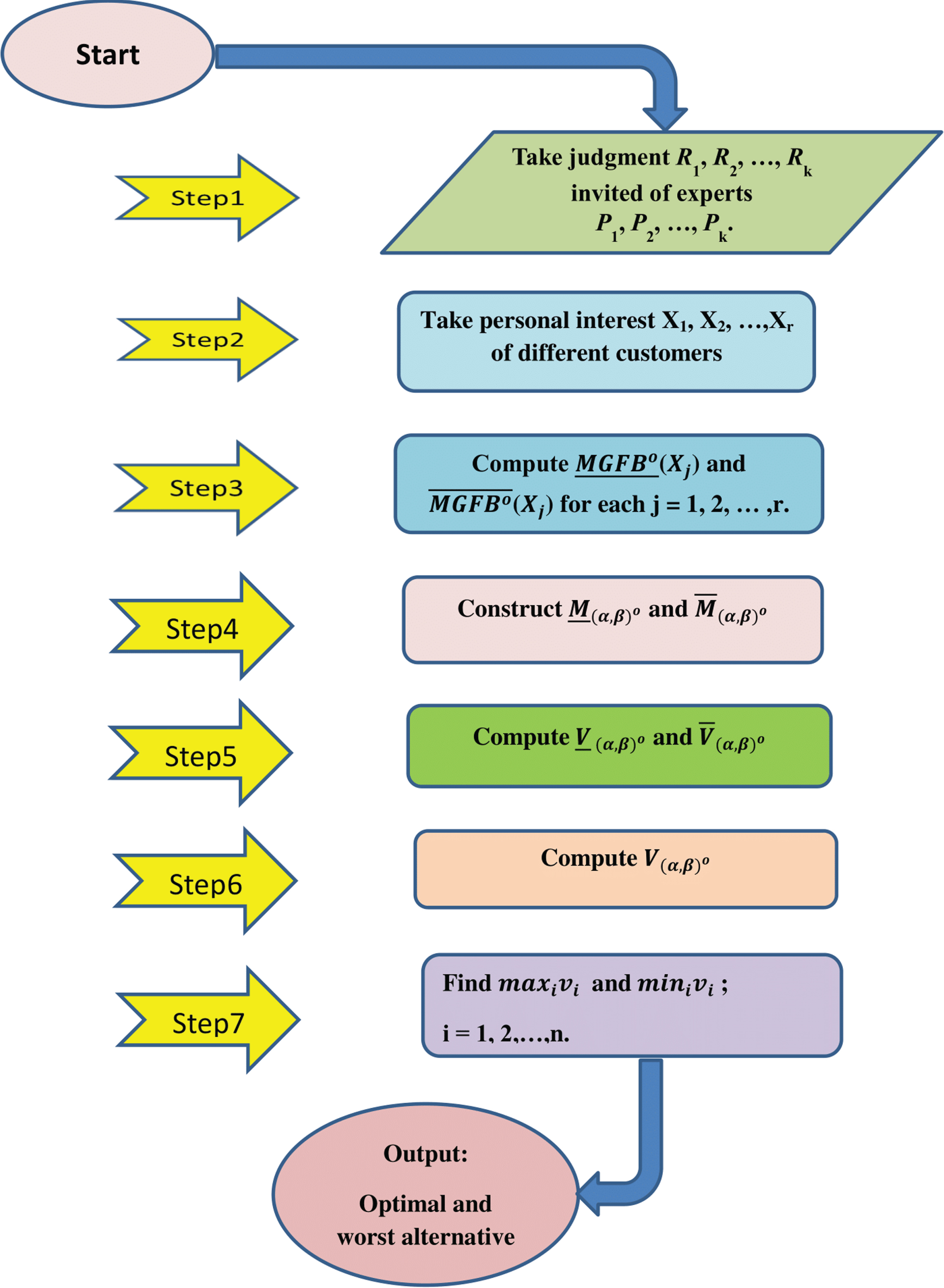
Proposed algorithm
In this subsection, we present the algorithm for the established method of considered multi-criteria group decision-making problem in section 8.1.
Take judgment R1, R2, …, Rk of invited experts P1, P2, …, Pk.
Take personal interest X1, X2, …, Xr of different customers.
Flow chart depiction of the above algorithm is shown in Fig. 1.
(Flow chart of proposed Algorithm).
A design example
Here, we consider a multi-criteria group-decision making problem in the case of the best car selection to illustrate the decision method proposed in subsection 8.2. Let be the universe (showroom) consisting of five different brands of cars, where each ci (i = 1, 2, ⋯ , 5) stands for “Civic”, “Saturn”, “Mazda”, “Toyota” and “Honda” respectively.
Suppose that P1, P2 and P3 are three invited experts. They present their judgment about each brand of car in the form of bipolar fuzzy tolerance relations R1, R2, and R3.
R1 = (λP (x, y) , λN (x, y)), R2 = (ξP (x, y) , ξN (x, y)) and R3 = (ηP (x, y) , ηN (x, y)) are given as follows:
and .
and .
and .
Interest of two different customers car’s brand are:
Taking α = 0.8 and β = -0.5. Then,
Calculate optimistic (α, β)-multi-granulation bipolar fuzzified lower approximation matrix and optimistic (α, β)- multi-granulation bipolar fuzzified upper approximation matrix by using Equations (39) and (40), we have
and
Using Equations (45) and (46), the optimistic (α, β)-multi-granulation bipolar fuzzified lower and upper approximation vector can be calculated as follows:
By using Equation (47), the optimistic (α, β) decision vector is obtained as follows:
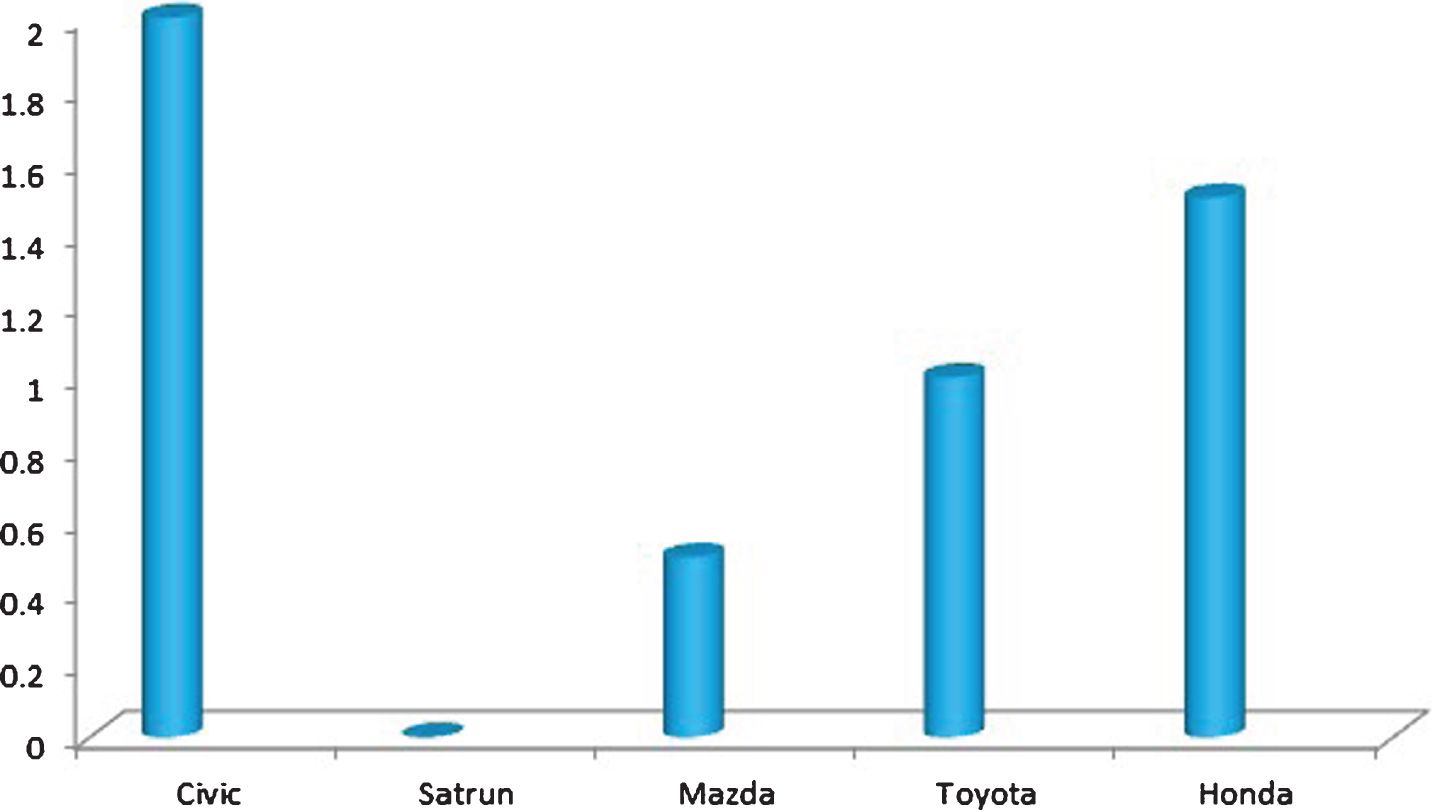
As and . So c1 (Civic) is the optimal element and c2 (Saturn) is the worst element.
The pictorial representation for the ranking of the cars is given in the following Fig. 2.
(Ranking of cars).
Sensitivity analysis
Advantages of the proposed model
Generally, the real-world MCDM and MCGDM problems occur in complex environment under imprecise and uncertain data, which is difficult to handle. The proposed model is highly suitable for the situation when the information is complex, imprecise and uncertain. Specially, when the existing data is based upon the bipolar fuzzy relations by decision-makers. Some advantages of the proposed approach are listed below:
The proposed decision-making technique considers the positive and negative aspects of each individual object in the form of bipolar fuzzy tolerance relation. This hybrid model is more generalized and suitable to handle aggressive decision-making problems.
This method is also preferable because in this method the decision-makers are free from any external conditions and requirements.
As is well known, the opinions or preferences of all decision-makers (or experts) aggregation is the critical step for the traditional group decision-making methods. In our proposed decision-making method, every decision-maker is regarded as a bipolar fuzzy tolerance relation, and then all opinions given by decision-makers are aggregated by using the (α, β)-multi-granulation bipolar fuzzified lower and upper approximations, and then a compromise optimal proposal is obtained. So, the (α, β)-multi-granulation bipolar fuzzified rough set approach to multi-criteria group decision-making provides another way to aggregate the preferences of decision-makers. Therefore, the proposed decision-making method also presents a new tool and perspective to explore group decision-making problems in reality.
Disadvantages of the proposed model
A little bit flaws are there in the proposed model, including its complex structure, the huge data in the form of bipolar information. Such a huge data is difficult to handle, because of the massive calculations, which are not so easy to perform. However, one can generate a computer programming code to make these complex calculations easier.
Comparison with existing models
There are several methods in the literature convenient for solving multi-criteria group decision-making (MCGDM) problems. All these MCGDM approaches have their own pros and cons. The capability of each method is depends upon problem under consideration. In this subsection, we make a set based comparison of the proposed MCGDM method with some existing MCGDM methods in fuzzy and bipolar fuzzy environment, and see the importance of the proposed MCGDM method.
We discuss comparison analysis of proposed technique with multi-granulation hesitant fuzzy rough sets [66], double-quantitative multigranulation decision-theoretic rough fuzzy set model [19], fuzzy multi-granulation decision-theoretic rough sets based on fuzzy preference relation [27], and three-way decisions based on multi-granulation support intuitionistic fuzzy probabilistic rough sets [55]. All these models have their own worth in the literature. If we compare all these methods with our proposed method, we explore the following points.
The above-mentioned methods are unable to capture bipolarity in decision-making which is an essential part of human thinking and behavior.
Secondly, these methods do not guarantee harmony in the decision-maker’s opinions.
The values of α and β have a great impact on the decision result. If the values of α and β are changed, the decision result will be affected.
MCGDM approach connected with the above structure makes perfect sense to handle complex cases of decision-making.
Conclusion
In this article, we have proposed a new model of (α, β)-multi-granulation bipolar fuzzified rough sets ((α, β)-MGBFRSs) using a collection of bipolar fuzzy tolerance relations to define the approximation operators. Some important structural properties of (α, β)-multi-granulation bipolar fuzzified rough approximation operators have also been investigated. Moreover, some important measures associated with (α, β)-MGBFRSs like the measure of accuracy, the measure of precision and the accuracy of approximation are also provided. At the same time, we present two types of (α, β)-MGBFRSs models: one is the (α, β) o-MGBFRSs and the other is the (α, β) p-MGBFRSs. Meanwhile, we build up a general framework of multi-criteria group decision-making based on the (α, β)-MGBFRSs. And the validity of this approach is illustrated by a practical application. Lastly, a sensitivity analysis of the proposed model is performed.
The notions of (α, β)-multi-granulation bipolar fuzzified rough sets are preliminary and may result in more sufficient mathematical tools to approximate reasoning in soft computing. The research results of this paper enrich decision analysis theory and methodology and provide new ideas foe solving complex MCGDM problems. In the future, we will establish the links of (α, β)-multi-granulation bipolar fuzzified rough sets to various algebraic structures and try to develop effective decision making methods. Modeling of supported physical phenomenon is our next goal. Another perspective direction is to study the topological properties and similarity measures of (α, β)-multi-granulation bipolar fuzzified rough sets in order to explore for a solid foundation of the research work and development of working methodologies. Further we will focus on the practical applications of the proposed method in solving a wider range of selection problems, such as TOPSIS, VIKOR, ELECTRE, AHP, and PROMETHEE. We will also be looking at the possible hybridization of the proposed method to get more preciseness in results and applying these techniques to real-world problems with big data sets. In this way, we can obtain and show off the usefulness of our proposed framework.
References
1.
AliM.I., A note on soft sets, rough sets and fuzzy soft sets, Applied Soft Computing11 (2011), 3329–3332.
2.
AliA., AliM.I., RehmanN., New types of dominance based multi-granulation rough sets and their applications in Conflict analysis problems, Journal of Intelligent & Fuzzy Systems35(3) (2018), 3859–3871.
3.
AliM.I., FengF., LiuX., MincW.K., ShabirM., On some new operations in soft set theory, Computers and Mathematics with Applications57 (2009), 1547–1553.
4.
AliM.I., ShabirM., NazM., Algebraic structures of soft sets associated with new operations, Computers and Mathematics with Applications61 (2011), 2647–2654.
5.
ÇağmanN.,
EnginoğluS. and
ErdoğanF., Fuzzy soft set theory and its applications, Iranian Journal of Fuzzy Systems8(3) (2011), 137–147.
6.
ChenZ.-S., ZhangX., RodríguezR.M., PedryczW., MartínezL., Expertise-based bid evaluation for construction-contractor selection with generalized comparative linguistic ELECTRE III, Automation in Construction125 (2021), 103578.
7.
ChenZ.-S., LiuX.-L., ChinK.-S., PedryczW., TsuiK.-L., SkibniewskiM.J., Online-review analysis based large-scale group decision-making for determining passenger demands and evaluating passenger satisfaction: Case study of high-speed rail systemin China, Information Fusion69 (2021), 22–39.
8.
ChenZ.-S., ChinK.-S., LiaY.-L., YangY., Proportional hesitant fuzzy linguistic term set for multiple criteria group decision making, Information sciences357 (2016), 61–87.
9.
FengF., LiC., DavvazB., AliM.I., Soft sets combined with fuzzy sets and rough sets: a tentative approach, Soft Computing14(9) (2010), 899–911.
10.
FengF., LiuX., Leoreanu-FoteaV., JunY.B., Soft sets and soft rough sets, Information Sciences181 (2011), 1125–1137.
GulR., ShabirM., Roughness of a set by (α, β)-indiscernibility of Bipolar fuzzy relation, Computational and Applied Mathematics39 (2020), 160.
14.
HanY., ShiP., ChenS., Bipolar-Valued Rough Fuzzy Set and Its Applications to the Decision Information System, IEEE Transactions on Fuzzy Systems23(6) (2015), 2358–2370.
15.
HuJ., PedryczW., WangG., WangK., Rough sets in distributed decision information systems, Knowledge-Based Systems94 (2016), 13–22.
HwangC., LinM., Group Decision Making Under Multiple Criteria, Lecture Notes in Economics and Mathematical Systems, Springer, Berlin, 1987.
18.
KaraaslanF., ÇağmanN., Bipolar soft rough sets and their applications in decision making, Afrika Matematika29 (2018), 823–839.
19.
LiM., ChenM., XuW., Double-quantitative multigranulation decision-theoretic rough fuzzy set model, International Journal of Machine Learning and Cybernetics10 (2019), 3225–3244.
20.
LiZ., QinB., CaiZ., Soft Rough Approximation Operators and Related Results, Journal of Applied Mathematics (2013), 1–15.
21.
LiangJ., WangF., DangC., QianY., An efficient rough feature selection algorithm with a multi-granulation view, International Journal of Approximate Reasoning53(6) (2012), 912–926.
22.
LiZ., LiuX., ZhangG., XieN., WangS., A multi-granulation decision-theoretic rough set method for distributed fc-decision information systems: An application in medical diagnosis, Applied Soft Computing56 (2017), 233–244.
23.
LinG., LiangJ., QianY., An information fusion approach by combining multigranulation rough sets and evidence theory, Information Sciences314 (2015), 184–199.
24.
LinG., QianY., LiJ., NMGRS: Neighborhood-based multigranulation rough sets, International Journal of Approximate Reasoning53(7) (2012), 1080–1093.
25.
MajiP.K., BiswasR., RoyA.R., Soft Set Theory, Computers and Mathematics with Applications45 (2003), 555–562.
MandalP., RanadiveA.S., Fuzzy multi-granulation decision-theoretic rough sets based on fuzzy preference relation, Soft Computing23 (2019), 85–99.
28.
MengD., ZhangX., QinK., Soft rough fuzzy sets and soft fuzzy rough sets, Computers and Mathematics with Applications62 (2011), 4635–4645.
29.
MolodtsovD., Soft set theory first results, Computers and Mathematics with Applications37 (1999), 19–31.
30.
NazM., ShabirM., On fuzzy bipolar soft sets, their algebraic structures and applications, Journal of Intelligent and Fuzzy Systems26(4) (2014), 555–562.
31.
PanW., SheK., WeiP., Multi-granulation fuzzy preference relation rough set for ordinal decision system, Fuzzy Sets and Systems312 (2017), 87–108.
32.
PawlakZ., Rough sets, International Journal of Computing and Information Science11 (1982), 341–356.
33.
PawlakZ., SkowronA., Rudiments of rough sets, Information Sciences177 (2007), 3–27.
34.
QianY., LiS., LiangJ., ShiZ., WangF., Pessimistic rough set based decision: A multigranulation fusion strategy, Information Sciences264 (2014), 196–210.
35.
QianY., LiangJ., YaoY., DangC., MGRS: A multi-granulation rough set, Information Sciences180 (2010), 949–970.
36.
QianY.H., LiangJ.Y., WeiW., Pessimistic rough decision, Second International Workshop on Rough Sets Theory, Zhoshan, China (2010), 440–449.
37.
QianY., ZhangH., SangY., LiangJ., Multigranulation decision-theoretic rough sets, International Journal of Approximate Reasoning55(1) (2014), 225–237.
38.
RehmanN., AliA., AliM.I., ParkC., SDMGRS: Soft dominance based multi granulation rough sets and their applications in conflict analysis problems, IEEE Access6 (2018), 31399–31416.
39.
RoyS.K., BeraS., Approximation of Rough Soft Set and its application to Lattice, Fuzzy Information and Engineering7 (2015), 379–387.
40.
SamantaS., PalM., Some More Results on Bipolar Fuzzy Sets and Bipolar Fuzzy Intersection Graphs, The Journal of Fuzzy Mathematics4 (2014), 253–262.
41.
ShabirM., AliM.I., ShaheenT., Another apprach to soft rough sets, Knowledge-Based System40 (2013), 72–80.
42.
ShabirM., GulR., Modified Rough Bipolar Soft Sets, Journal of Intelligent & Fuzzy Systems (2020), 4259–4283.
43.
ShabirM., ShaheenT., A new methodology for fuzzification of rough sets based on α-indiscernibility, Fuzzy Sets and System312 (2017), 1–16.
44.
ShaheenT., MianB., ShabirM., FengF., A Novel Approach to Decision Analysis Using Dominance-Based Soft Rough Sets, International Journal of Fuzzy Systems21(3), 954–962.
45.
SheY., HeX., On the structure of the multigranulation rough set model, Knowledge-Based Systems36 (2012), 81–92.
46.
SunB., MaW., ChenX., ZhangX., Multigranulation vague rough set over two universes and its application to group decision making, Soft Computing23 (2019), 8927–8956.
47.
SunB., MaW., QianY., Multigranulation fuzzy rough set over two universes and its application to decision making, Knowledge-Based Systems123 (2017), 61–74.
48.
TanA., WuW., LiJ., LinG., Evidence-theory-based numerical characterization of multigranulation rough sets in incomplete information systems, Fuzzy Sets and Systems294 (2016), 18–35.
49.
XuW., SunW., ZhangX., ZhangW., Multiple granulation rough set approach to ordered information systems, International Journal of General Systems41(5) (2012), 475–501.
XuW., WangQ., ZhangX., Multi-granulation rough sets based on tolerance relations, Soft Computing17 (2013), 1241–1252.
53.
XuW., ZhangX., ZhangW., Two new types of multiple granulation rough set, ISRN Applied Mathematics, 2013.
54.
XuW., WangQ., ZhangX., Multi-granulation Fuzzy Rough Sets in a Fuzzy Tolerance Approximation Space, International Journal of Fuzzy Systems13(4) (2011), 246–259.
55.
XueZ., ZhaoL.-P., ZhangM., SunB.-X., Three-way decisions based on multi-granulation support intuitionistic fuzzy probabilistic rough sets, Journal of Intelligent & Fuzzy Systems38 (2020), 5013–5031.
56.
YangX., QiY., SongX., YangJ., Test cost sensitive multigranulation rough set: model and minimal cost selection, Information Sciences250 (2013), 184–199.
57.
YangX., QiY., YuH., SongX., YangJ., Updating multi granulation rough approximations with increasing of granular structures, Knowlledge-Based Systems64 (2014), 59–69.
58.
YangX.B., QianY.H., YangJ.Y., Hierarchical structures on multigranulation spaces, Journal of Computer Science and Technology27(6) (2012), 1169–1183.
59.
YaoY.Y., Notes on Rough Set Approximations and Associated Measures, Journal of Zhejiang Ocean University (Natural Science)29(5) (2010), 399–410.
60.
YouX., LiJ., WangH., Relative reduction of neighborhood-covering pessimistic multigranulation rough set based on evidence theory, Information10(11) (2019), 334.
61.
YuW., ZhangZ., ZhongQ., Consensus reaching for MAGDM with multi-granular hesitant fuzzy linguistic term sets: a minimum adjustment-based approach, Annals of Operations Research300 (2021), 443–466.
62.
ZadehL.A., Fuzzy sets, Information and Control8 (1965), 338–353.
63.
ZhanJ., XuW., Two types of coverings based multigranulation rough fuzzy sets and applications to decision making, Artificial Intelligence Review53 (2020), 167–198.
64.
ZhangW.R., Bipolar fuzzy sets and relations: A computational framework for cognitive modeling and multiagent decision analysis, In Proceedings of the Industrial Fuzzy Control and Intelligent Systems Conference, and the NASA Joint Technology Workshop on Neural Networks and Fuzzy Logic and Fuzzy Information Processing Society Biannual Conference, San Antonio, TX, USA (1994), 305–309.
65.
ZhangX., MiaoD., LiuC., LeM., Constructive methods of rough approximation operators and multigranulation rough sets, Knowledge-Based Systems91 (2016), 114–125.
ZhangZ., GaoY., LiZ., Consensus reaching for social network group decision making by considering leadership and bounded confidence, Knowledge-Based Systems204 (2020), 106240.