Imprecision in the decision-making process is an essential consideration. In order to navigate the imprecise decision-making framework, measuring tools and methods have been developed. Pythagorean fuzzy soft sets are one of the new methods for dealing with imprecision. Pythagorean fuzzy soft topological spaces is an extension of intuitionistic fuzzy soft topological spaces. These sets generalizes intuitionistic fuzzy sets for a broader variety of implementations. This work is a gateway to study such a problem. The concept of Pythagorean fuzzy soft topological spaces(PyFSTS), interior, closure, boundary, neighborhood of Pythagorean fuzzy soft spaces PyFSS, base and subspace of PyFSTSs are presented and its properties are figured out. We established an algorithm under uncertainty based on PyFSTS for multi-attribute decision-making (MADM) and to validate this algorithm, a numerical example is solved for suitable brand selection. Finally, the benefits, validity, versatility and comparison of our proposed algorithms with current techniques are discussed.The advantage of the proposed work is to detect vagueness with more sizably voluminous valuation space than intuitionistic fuzzy sets.
Economics, medical science researchers and many other areas struggle with the unclear, imprecise and sometimes inadequate knowledge of ambiguous data modeling on a daily basis. To overcome this difficulties, Fuzzy Set (FS) theory was developed by Zadeh [37] to deal the ambiguity. There are proposals for non-classical and higher order fuzzy sets after the proposal of fuzzy set theory for various specialized purposes. Intuitionistic fuzzy set (IFS) is one of the generalization of FS theory, which deals with both membership and non-membership values and it is introduced by Atanassov [4]. Another extension of FS and IFS is Pythagorean fuzzy set (PyFS) and it is developed by Yager [36] in 2013. This set theory established with a new class of non-standard fuzzy subsets and which has got several social and natural science applications [1, 37] Pythagorean fuzzy topological (PyFTS) spaces was proposed and investigated by Olgun et al. [17] in 2019.
Molodtsov [15] introduced the soft set theoretical concept as a fully generic mathematical method free of the parametrization insufficiency ailment of various theories concerning uncertainty concepts. In fact, this principle is very accurate, convenient, comfortable and easy, applicable in the real time problem solving technique. For the case of soft set theory applications, Molodtsov [15] successfully applied it in different fields, like game theory, operation analysis, probability theory, Riemann integration, smoothness of functions, etc. Soft topological spaces were proposed by Shabir and Naz [29] On these general topological spaces and separation axioms, some notions of soft sets were defined and studied. Maji [13, 14] introduced fuzzy & intuitionistic fuzzy soft set by joining two concepts namely, soft set with IFS. Neutrosophic set [30–32], neutrosophic topology [19, 28], neutrosophic soft set [24], complex intuitionistic fuzzy sets (CIFS)[2] and complex neutrosophic set(CNS) [10] are the further extensions of IFS and FS theory.
In the entire manuscript, step by step, the motivation and objectives of this expanded and hybrid work are given. We Create that other fuzzy-set hybrid systems become special Pythagorean fuzzy soft topological space (PyFSTS) with some specific conditions. The flexibility, robustness, simplicity and supremacy of our proposed algorithm and model are discussed. This model is the most common method of use that is applicable in artificial intelligence, agriculture, engineering, medicine, and other everyday living situations to gather data on a broad scale. This study will easily be done with other methods and multiple forms of integrated systems in the future. Pythagorean fuzzy topological space [16], complex Pythagorean fuzzy topological space [3] and soft set [11] motivated us to propose this new concept. MADM played a prominent role in decision making. This methodology helps to choose potential alternative. So we proposed an algorithm which generates Pythagorean fuzzy soft topology and with the aid of score function best alternative has been selected.
The manuscript is arranged in this fashion: In section 2, important preliminary definitions are presented. Definition of PyFSTS, neighborhood, closure and interior of Pythagorean fuzzy soft set(in short PyFSSs) and their properties are discussed in section 3. In section 4, introduces an algorithm with a numerical example and in addition, the advantages, limitations, simplicity, versatility and validation of the proposed algorithm with the existing theories are explained clearly. Section 5, concludes the paper.
Some Basic Notions
Definition 2.1. [35] The set is said to be a fuzzy set on , where be a non void set and is the membership degree function.
Definition 2.2. [34] The set is called an intuitionistic fuzzy set on , where be a non void set and for all and are the membership and non membership degree functions, respectively.
where is called the positive membership function (PMF) and is called the negative membership function (NMF). The condition for a PyFS is that 0 ≤ α2 + β2 ≤ 1 and the refusal degree function is given as γ2 (ζ) =1 - (α2 (ζ) + β2 (ζ)). A Pythagorean fuzzy number (PyFN) is defied as the doublet (α, β).
Definition 2.4. [34] Two objects and are two PyFS described on , the universe of discourse, then
The intersection of and is
The union of and is
iff
Definition 2.5. [34] The PyFSS is not a set, but it is a specified unit of some elements of the set and hence it can be put down as a set of ordered pairs: , where and are the PMFs and NMFs, respectively. If , .
Definition 2.6. [16] If τ is a family of Pythagorean fuzzy subsets of a non empty set and if
,
for any , we have
for any , we have where
then τ is said to be a Pythagorean fuzzy topological space(PyFTS) on and the pair is said to be a Pythagorean fuzzy topological space.
Pythagorean Fuzzy Soft Topological Spaces
The notion of PyFSTS are introduced and further we investigated its properties.
Let and denotes, origination of the universal set and the family of PyFSs on , respectively.
Definition 3.1. A PyFSS over is called a void PyFSS (in short, ), iff ∀ , , where are the value of the PMF and the value of the NMFs, respectively of the null and absolute Pythagorean fuzzy sets over .
Definition 3.2. A PyFSS over is called an absolute PyFSS (in short, ), iff ∀ , , where are MF, and negative MFs respectively of the absolute and null fuzzy sets over .
Definition 3.3. Let , then is said to be a PyFSTS on if
and are member of .
the intersection of any two PyFSS in pertains to .
the union of any number of PyFSS in pertains to ,
The triple is said to be a PyFSTS over .
Every member of is said to be a -open PyFSS.
The complement of a -open is said to be a -closed PyFSS.
If , then is called Pythagorean fuzzy soft strictly coarser (weaker) than (or) is Pythagorean fuzzy soft strict finer than , where and are two topologies on . Besides is a PyFSTS on . A number of topologies on may be there.
Example 3.1. Let be the reference set (candidates who have been nominated for the promotion) and be the parameters or attributes set, where ξ1=intelligent, ξ2=experience, ξ3=attitude, ξ4=competence. Let and . Then we consider two PyFSS and are given by: , and where
Here,
is a PyFST over .
and are two PyFSTs over . It is straightforward that . Thus, is called PyFS-coarser or weaker and is called PyFS-finer or stronger than .
Theorem 3.1.If, where and are two PyFSTSs over , then is also a PyFSTS on .
Proof. (i) Obviously, (ii) Let . This implies that and , ⇒ and , ⇒ .
(iii) Let . This implies that and , ⇒ and , ⇒ .
Hence it is proved that is a PyFSTS on .
Remark 3.1. The union of two PyFSTSs may not be so.
Let be the reference set and be the set of parameters or attributes. Let and . Then we consider two PyFSSs and are given by: , and where , .
Then and are two PyFSTSs over . On the other hand, since . But . Thus, is not a PyFSTS on . But is a PyFSTS on .
Definition 3.4. Let be a PyFSTS on and . Then is said to be a neighbourhood (nbd) of , if there exists a PyFSOS (i.e., ) ∋ .
Theorem 3.2.A PyFSS is a PyFSOS iff is a nbd of each PyFSS .
Proof. Let be a PyFSOS and any PyFSSs in . Since we have , this implies that is a nbd of . Consequently, if suppose is a nbd of every PyFSS . Since , ∃ a PyFSOS ∋ . Therefore, and is open.
Theorem 3.3.Let be a PyFSTS on and . is called the nbd filter or nbd system of , the family of all nbds, up to topology (in short, ).
Theorem 3.4.Let the nbd system of the PyFSS be . Then,
finite intersections of the members of .
each PyFSS containing a member of .
Proof.
Let . Then ∋ and . Since, , we have, . Thus, .
If and be a PyFSS containing , then ∋ . This proves that
Definition 3.5. Let be an arbitrary PyFSS and let be a PyFSTS over . Then
= interior of is PyFSO and ,
= closure of is PyFSC and .
Remark 3.2. For any PyFSS in , we have
= .
= .
is a PyFSCS iff .
is a PyFSOS iff .
is a PyFSCS in .
is a PyFSOS in .
Theorem 3.5.Let be a PyFSTS with respect to . Let and be Pythagorean fuzzy soft subsets of . Then the succeeding assertions holds:
.
is a PyFSCS iff .
= and = .
.
= .
= .
=.
Proof.
From definition 3.5(ii),
If is a Pythagorean fuzzy soft closed set(PyFSCS), then is the littlest Pythagorean fuzzy soft closed set containing itself and hence . The other way around, if = , then is the littlest Pythagorean fuzzy soft closed set containing itself and therefore is a PyTFSCS.
Since and are PyFSCSs in , and .
If PyFSS is a subset of PyFSS , since PyFSS is a subset of , then PyFSS is a subset of . That is, is a PyFSCS containing . But is the littlest PyFSCS containing . Therefore,
Since PyFSS is a ⊂ of union of two PyFSSs and and PyFSS is a ⊂ of union of two PyFSSs and , . Then closure of PyFSS is a subset of closure of union of two PyFSSs and and closure of PyFSS is a subset of closure of union of two PyFSSs and . Hence, union of closure of PyFSSs , is a subset of closure of union of , . By the fact that , and since is the littlest PyFSCS containing , so . Thus, .
Since and , .
Since is a PyFSCS, then .
Theorem 3.6. be a PyFSTS over. Let be a Pythagorean fuzzy soft subset of . Then
= .
= .
Theorem 3.7.Let be a PyFSTS with respect to . Let and be Pythagorean fuzzy soft subsets of . Then the succeeding assertions holds:
is a PyFSOS open iff .
and .
.
.
.
.
Proof.
is a PyFSOS iff is a PyFSCS, iff , iff iff .
As and are PyFSOSs in , and .
If , since , then . That is, is a PyFSOS containing . But is the largest PyFSOS contained in . Therefore,
Since and , and . Therefore, . By the fact that , and since is the largest PyFSOS containing , so . Thus, .
Since and , .
Since is a PyFSOS, then = .
Definition 3.6. Let be a PyFSTS over and . Then PyFS boundary (frontier) of is denoted by and is defined by .
Theorem 3.8.Let be a PyFSTS over and . Then,
iff is both open and closed.
Proof.
.
. Since .
i.e.,.
Also we know that . Thus . This shows that is open.
Further more . Also we know that . Thus . This shows that is closed.
Conversely, if is open and closed, then and . Now,.
Definition 3.7. A collection is said to be a base for , where is a PyFSTS over . If can be put down as the arbitrary Pythagorean fuzzy soft union of some elements of , then is said to be a Pythagorean fuzzy soft basis (PyFSB) for the PyFST . The elements of are said to be Pythagorean fuzzy basic open sets.
Theorem 3.9.Let be a PyFSTS over and a PyFSB for . Then equals the collection of Pythagorean fuzzy soft unions of elements of .
Proof. The proof is straight forward.
Theorem 3.10.Let and be two PyFSTS over and be a PyFSB for and be a PyFSB for . If , then .
Proof. The proof is straight forward.
Algorithm and Numerical Example on MADM using PyFS-topology
This part of the paper, exhibits an application of PyFSSs and PyFSTS in MADM problems by using an algorithm and we compare the results of algorithm with the existing ones.
Proposed Algorithm
Algorithm: (Decision making with PyFSSs and PyFSTSs)
Step-1: Input the PyFSSs and .
Step-2: Frame the PyFSTS , and are two open sets in .
Step-3: Calculate the score values corresponding to each PyFOS in using the formula , where .
Step-4: The decision values for each PyFS-open set can be calculated by taking the average of each PyFS-open set for each ζj and it is denoted as δj
Step-5: Find the sum of the corresponding values of PyFS-open sets and . This will be considered as the final decision values.
Step-6: The optimum alternative ζj will be selected by taking the maximum value in final decision from Step-5.
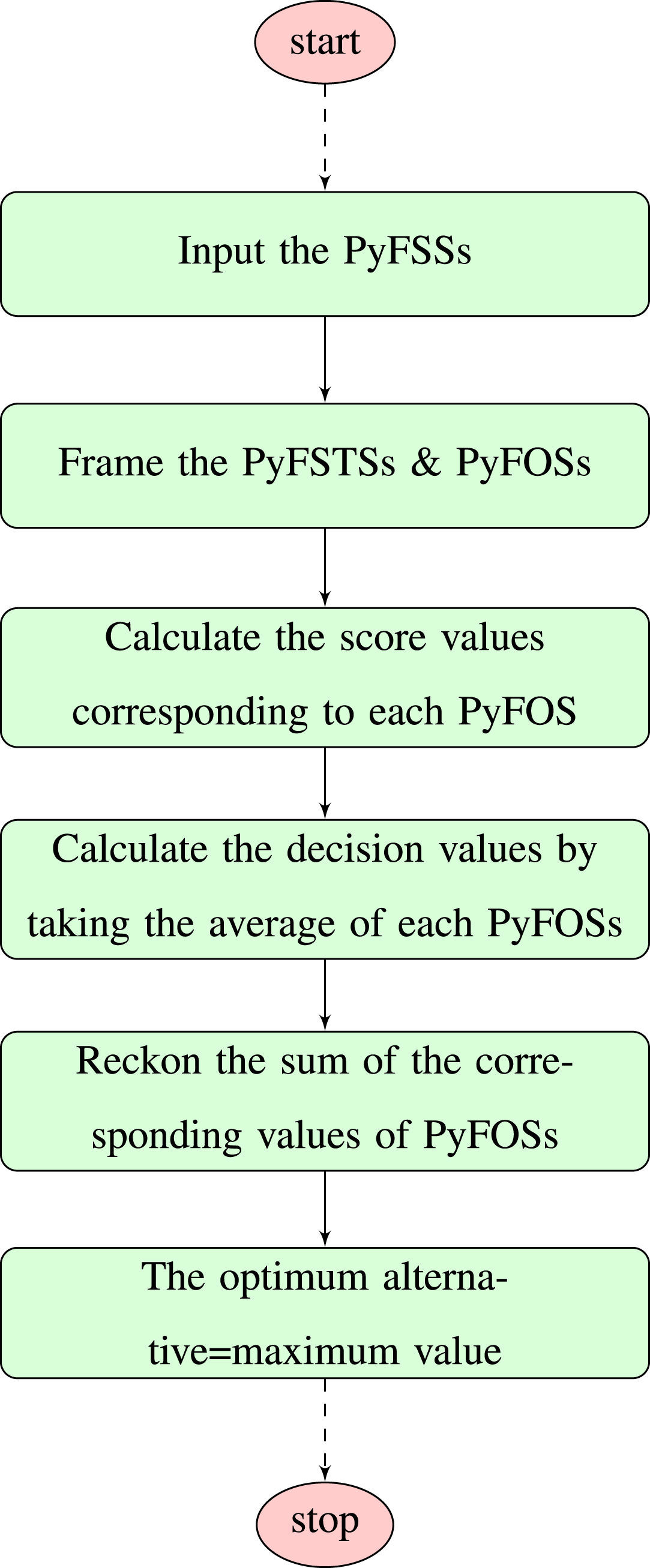
The proposed Algorithm for MADM is represented as a flow chart in the Figure 1.
Flow chart of the proposed Algorithm.
Numerical Example
The owner of a popular store of chennai wants to make a contract with the multi national company to market the wrist watch products. The different popular brands available are , where ζ1=Rolex, ζ2=Casio, ζ3=Omega, ζ4=Citizen, ζ5=Seiko, ζ6=Avant-Garde. Define a set of criteria for the selection of a suitable brand for their store as follows , where ξ1=Delivery Performance, ξ2=Recovery services in damage cases, ξ3=Stability of price, ξ4=Product quality, ξ5=Distribution plans (in-store furniture), ξ6= customer-brand relationship,.
Further the manager divides the criteria into two subsets, (Category-1: Brand service) & (Category-2: Product nature).
Step-1: Input the PyFSSs and , given by and and where .
Step-2: Framing the PyFSTS , where and are PyFS-full and PyFS-null set, respectively.
Step-3: Compute the score values of PyFS-open sets, , and are as follows , , , , , . The score values of and are 1 and 1 for each element of the reference set.
Step-4: Find decision values of , and and no need to find the decision values of and as this will not affect the ranking process.
The decision values of ,
The decision values of ,
Step-5: Computation of the absolute decision values by summing the decision values δj of , and . Hence, The required final decision values are δ1 = 0.38, δ2 = 0.213, δ3 = 0.417, δ4 = 0.423, δ5 = 0.337, δ6 = 0.3.
Step-6: From step-5, we see that brand 4 yields maximum score value(membership degree), i.e. 0.423.
Conclusion: The maximum score value=0.423 which corresponds to the brand 4. Therefore, the owner of the store can choose brand 4 = Citizen as it is the suitable brand for the store.
The results of MADM using the proposed algorithm of PyFSTSs is better than that of FSs or IFSs because of the special structural constrain of PyFSs, its parameterization and its close relationship to human nature. Furthermore, the data clustered by using PyFSTS cannot be aggregated by existing topological operators. The comparison table 1 show the difference between novel Pythagorean fuzzy soft topological spaces with existing work.
Comparative analysis of proposed approach with existing theories
PyFT deals with uncertain information more sufficiently and accurately than IFS
Do not deal with the parameterizations
PyFSTS (proposed)
✓
✓
✓
✓
PyFST deals with uncertain information with parameterization
Effective but calculations are heavy as compared to above existing theories.
Conclusion
Soft Topology is an interesting and significant field of mathematical science and it also provides several relationships among other mathematical models and scientific environment. Recently, abounding number of researchers have implemented and researched the soft set theoretical concepts, which can be easily implemented to umpteen real time situations of uncertainties. We, firstly provided the definition of the "Pythagorean fuzzy soft topology" and then conferred its fundamental properties along with some numerical examples. We also developed an algorithm based on PyFSTS for MADM problems. Therefore, this paper can be considered as the initiation point for the research on "Pythagorean fuzzy soft topology". The proposed algorithm is easily altered and flexible according to the different situations of inputs and outputs. In the future, this work can be extended to Pythagorean fuzzy soft continuity, compactness, connectedness between information systems and soft sets, and the results deduced from the studies on PyFSTS can be used to improve these types of relations and to solve the MADM problems by using AHP, TOPSIS, VIKOR, PROMETHEE family and ELECTRE family using different hybrid structures of fuzzy, soft and rough sets.
References
1.
AkramM., PengX. and SattarA., Multi-criteria decision-making model using complex Pythagorean fuzzy Yager aggregation operators, Arabian Journal for Science and Engineering (2020), 1–27.
AlshammariI., ParimalaM. and OzelC., Topological Structure of Complex Pythagorean Fuzzy Sets, International Journal of Modern Agriculture9(4) (2020), 707–719.
4.
AtanassovK.T., Intuitionstic fuzzy sets, Fuzzy Sets and Systems20 (1986), 87–96.
5.
AtefM., El AtikA.A. and NawarA., Fuzzy topological structures via fuzzy graphs and their applications, Soft Computing25 (2021), 6013–6027.
6.
CokerD., An introduction to fuzzy topological spaces, Fuzzy Sets and Systems88 (1997), 81–89.
7.
GargH., New logarithmic operational laws and their aggregation operators for Pythagorean fuzzy set and their applications, International Journal of Intelligent Systems34(1) (2019), 82–106.
8.
GargH., Generalised Pythagorean fuzzy geometric interactive aggregation operators using Einstein operations and their application to decision making, Journal of Experimental & Theoretical Artificial Intelligence30 (2018), 1–32.
9.
GargH., New exponential operational laws and their aggregation operators for interval-valued Pythagorean fuzzy multi-criteria decision-making, Journal of Intelligent Systems33(3) (2018), 653–683.
10.
KarthikaM., ParimalaM., JafariS., Smarandache Mohammad AlshumraniF., OzelCenap and UdhayakumarR., Neutrosophic complex αψ connectedness in neutrosophic complex topological spaces, Neutrosophic Sets and Systems29 (2019), 158–164.
11.
KozaeA.M., El AtikA.A., ElrokhA. and AtefM., New Types of Graphs Induced by Topological Spaces, Journal of Intelligent & Fuzzy Systems36(6) (2019), 5125–5134.
12.
KuratowskiK., Topology Vol. II (transl.), Academic Press, New York, (1966).
13.
MajiP.K., BiswasR. and RoyA.R., Fuzzy soft sets, Journal of Fuzzy Mathematics9 (2001), 589–602.
14.
MajiP.K., BiswasR. and RoyA.R., Intuitionistic fuzzy soft sets, Journal of Fuzzy Mathematics9 (2001), 677–692.
15.
MolodtsovD., Soft set theory- First results, Computer and Mathematics with Applications37 (1999), 19–31.
16.
NadaS., El AtikA.E.F. and AtefM., New types of topological structures via graphs, Mathematical Methods in the Applied Sciences (2018), 1–10.
17.
OlgunM., UnverM. and YardS., Pythagorean fuzzy topological spaces, Complex & Intelligent Systems (2019), 1–7.
18.
ParimalaM., JafariS. and MuraliS., Nano ideal generalized closed sets in nano ideal topological spaces, Annales Universitatis Scientiarum Budapestinensis60 (2017), 3–11.
19.
ParimalaM., JeevithaR., JafariS., SmarandacheF. and UdhayakumarR., Neutrosophic αψ -homeomorphism in neutrosophic topological spaces”, Information9(187) (2018), 1–10.
20.
ParimalaM., JeevithaR. and SelvakumarA., A new type of weakly closed set in ideal topological spaces, International Journal of Mathematics and its Applications5(4-C) (2017), 301–312.
21.
ParimalaM., KarthikaM., DhavaseelanR. and JafariS., On neutrosophic supra pre-continuous functions in neutrosophic topological spaces, New Trends in Neutrosophic Theory and Applications2 (2018), 371–383.
22.
ParimalaM., KarthikaM., JafariS., SmarandacheF. and El-AtikA.A., Neutrosophic αψ -connectedness, Journal of Intelligent & Fuzzy Systems38 (2020), 853–857.
23.
ParimalaM., KarthikaM., JafariS., SmarandacheF. and UdhayakumarR., Neutrosophic nano ideal topological structures, Neutrosophic Sets and Systems24 (2019), 70–77.
24.
ParimalaM., KarthikaM., JafariS., SmarandacheF. and UdhayakumarR., Decision-making via neutrosophic support soft topological spaces, Symmetry10 (2018), 1–10.
25.
ParimalaM. and PerumalR., Weaker form of open sets in nano ideal topological spaces, Global Journal of Pure and Applied Mathematics12(1) (2016), 302–305.
26.
ParimalaM., SmarandacheF., JafariS. and UdhayakumarR., On neutrosophic αψ-closed sets,103, Information9 (2018), 1–7.
27.
SalamaA.A. and AlblowiS.A., Neutrosophic set and neutrosophic topological spaces, IOSR Journal of Mathematics3 (2012), 31–35.
28.
SalamaA.A., SmarandacheF. and KromovV., Neutrosophic closed set and neutrosophic continuous functions, Neutrosophic Sets and Systems4 (2014), 4–8.
29.
ShabirM. and NazM., On soft topological spaces, Comput Math Appl61 (2011), 1786–1799.
30.
SmarandacheF., Neutrosophy and neutrosophic logic, First International Conference on Neutrosophy, Neutrosophic Logic Set, Probability and Statistics; University of New Mexico, Gallup, NM, USA, (2002).
31.
SmarandacheF., A unifying field in logics: neutrosophic logic. neutrosophy, neutrosophic set, neutrosophic probability, American Research Press, Rehoboth, NM, USA, (1999).
32.
SmarandacheF., Extension of hypergraph to nsuperHypergraph and to plithogenic n-superhypergraph, and extension of hyperalgebra to n-ary (Classical-/Neutro-/Anti-) hyperalgebra, Neutrosophic Sets and Systems33 (2020), 290–296.
33.
TanayB. and KandemirM.B., Topological structure of fuzzy soft sets, Computers and Mathematics with Applications61 (2011), 2952–2957.
34.
WangL., GargH. and LiN., Pythagorean fuzzy interactive Hamacher power aggregation operators for assessment of express service quality with entropy weight, Soft Computing27 (2020), 1–21.
35.
WangL. and LiN., Pythagorean fuzzy interaction power Bonferroni mean aggregation operators in multiple attribute decision making, International Journal of Intelligent Systems35(1) (2020), 150–183.
36.
YagerR.R., Pythagorean fuzzy subsets, In: 2013 joint IFSA world congress and NAFIPS annual meeting (IFSA/NAFIPS), IEEE, Edmonton, AB, Canada, 24–28 June (2013), 57-61.
37.
ZadehL.A., Fuzzy Sets, Information and Control18 (1965), 338–353.