



Abstract
This article deals with an economic order quantity inventory model of imperfect items under non-random uncertain demand. Here we consider the customers screen the imperfect items during the selling period. After a certain period of time, the imperfect items are sold at a discounted price. We split the model into three cases, assuming that the demand rate increases, decreases, and is constant in the discount period. Firstly, we solve the crisp model, and then the model is converted into a fuzzy environment. Here we consider the dense fuzzy, parabolic fuzzy, degree of fuzziness and cloudy fuzzy for a comparative study. The basic novelty of this paper is that a computer-based algorithm and flow chart have been given for the solution of the proposed model. Finally, sensitivity analysis and graphical illustration have been given to check the validity of the model.
Keywords
Introduction
In 1965 Zadeh [8] introduced us to an uncertain world. He claimed that except for some universal truth, there is uncertainty behind every fact. He handled this uncertainty by using the membership value of each element in a set. This type of set is called fuzzy set. After that, Bellman and Zadeh [14] used the fuzzy set concept in operations research decision-making. After that, Atanassov [7] define intuitionistic fuzzy set, which contains not only membership value but also non-membership value of each element in a set. Baez-Sanchez et al. [3] developed a mathematical formalization to define polygonal fuzzy numbers with an extension of fuzzy sets. De and Beg [26] introduced the concept of dense fuzzy set by incorporating learning experiences in fuzzy set. They considered each member of a fuzzy set as a sequence of functions that converge to a crisp number for n→ ∞. They also define a new defuzzification method of triangular dense fuzzy set. Also, De and Beg [25] described the dense fuzzy Neutrosophic set. De and Mahata [24] introduced the concept of cloudy fuzzy number, which converge to a crisp number after infinite times. They used this concept to optimize a backorder economic order quantity (EOQ) model with uncertain demand rate. We know every inventory decision-maker used some strategies to optimize the inventory profit. Keeping this in mind, De [31] introduced the dense fuzzy lock set concept, which is much more helpful for the decision-maker to manage the inventory control problems. Faritha and Priya [2] defined parabolic fuzzy number for optimizing a backorder EOQ model using nearest interval approximation. Then Garg and Ansha [5] defined some arithmetic operations over generalized parabolic fuzzy numbers with its applications. Maity et al. [18] introduced the concept of non-linear heptagonal dense fuzzy set with an application in inventory problems. Maity et al. [20] also defined cloud-type non-linear intuitionistic dense fuzzy set with symmetry and asymmetry cases. De [30] gave a new concept over the degree of fuzziness and its application in decision-making problems. From the above literature review of fuzzy numbers, we see that every researcher considered one type of fuzzy number with an application. None of them didn’t give a comparative study to examine which fuzzy number is more profitable for inventory management. This model provided a comparative study among dense fuzzy, cloudy fuzzy, parabolic fuzzy and degree of fuzziness over the inventory profit function.
Harris [4] first developed the classical inventory model. After that, several researchers produced many research articles on inventory problems. All of them considered the demand rate as a deterministic one. First time Karlin [15] introduced fuzziness in one stage inventory problems. Nowadays, modern researchers are showing their interest in solving inventory problems in fuzzy environments. De [29] developed an EOQ model under daytime non-random uncertain demand. Das et al. [12] solved an EOQ model using a step order fuzzy approach. He considered daytime uncertain demand where demand in the backorder period depends on time. De et al. [28] studied an EOQ model where demand depends on selling price and promotional efforts. The model has been optimized using the intuitionistic fuzzy technique. Kazemi et al. [11] solved an EOQ model for imperfect quality items by considering the learning effect on some fuzzy parameters. In 2016, De and Sana [27] developed an economic production quantity (EPQ) model with variable lead time and stochastic demand. They considered all parameters the intuitionistic fuzzy number and used the intuitionistic fuzzy aggregation Bonferroni mean for defuzzified the model. Karmakar et al. [16, 17] considered an EPQ model and used the dense fuzzy lock set concept to reduce pollution by reusing waste items of sponge iron industry. Maity et al. [19] developed an EOQ model with dense fuzzy demand rate where two decision-makers make a single decision to optimize the model. Maity et al. [21] studied an EOQ model under daytime uncertain demand rate. They made a computer-based algorithm and flowchart to optimize the model by updating key vectors automatically. De and Mahata [22] considered an EOQ model of imperfect-quality items with considerable discounts. They optimized the model using cloudy fuzzy numbers. Liang and Wang [13] presented an integrated decision support model for the customers to buy their desired products online. Traditionally, De and Mahata [23] developed an EOQ model of imperfect quality items where the retailer first screened the items. Then the imperfect items are sold separately at a discount. Several researchers (Khan et al. [9], Lin and Chen [32], Naimi and Tahavori [10], Sofiana and Rosvidi [1], Wangsa and Wee [6] and Zhou et al. [33]) studied over imperfect quality items. Still, none of the researchers has considered the situations where the customers screened the items, although it happens in reality in most cases. They did not also consider all three possible cases of the demand rate in the discount period, which is included in this paper.
In the present study, we consider the low demanded items screened by the customers during the sales. After a certain period, the low demanded items are sold at a discount. Here we have considered three possibilities of demand in the discount period - (i) demand increases exponentially, (ii) demand decreases exponentially, (iii) demand remains same as previous. We have taken a crisp solution first. Then we have solved it in cloudy fuzzy, dense fuzzy, parabolic fuzzy and degree of fuzziness environment. Then we have provided a case study with sensitivity analysis and graphical illustrations to justify our proposed model. The numerical result is determined by LINGO 16.0 software. A computer-based algorithm and flowchart of the proposed method are provided for easy understanding.
The remaining part of this paper is arranged in the following way. In Section 2, we have added some preliminary definitions of different types of fuzzy numbers. The crisp mathematical model has been developed in Section 3. Section 4 contain the cloudy fuzzy model of three different cases. In Section 5, we have discussed other fuzzy models (dense fuzzy model and parabolic fuzzy model). A solution algorithm and flowchart of the proposed model are given in Section 6. A case study of the proposed model is discussed in Section 7. Section 8 contain the graphical illustration of the numerical result and Section 9 contain some advantages and disadvantages of our proposed model. Finally, a brief conclusion has been given in Section 10.
Preliminaries
In this section, the preliminary concept of different types of fuzzy numbers are discussed.
Let us consider b = 100, ρ = 0.4, σ = 0.4. For this value the TDFN is shown in Fig. 1.
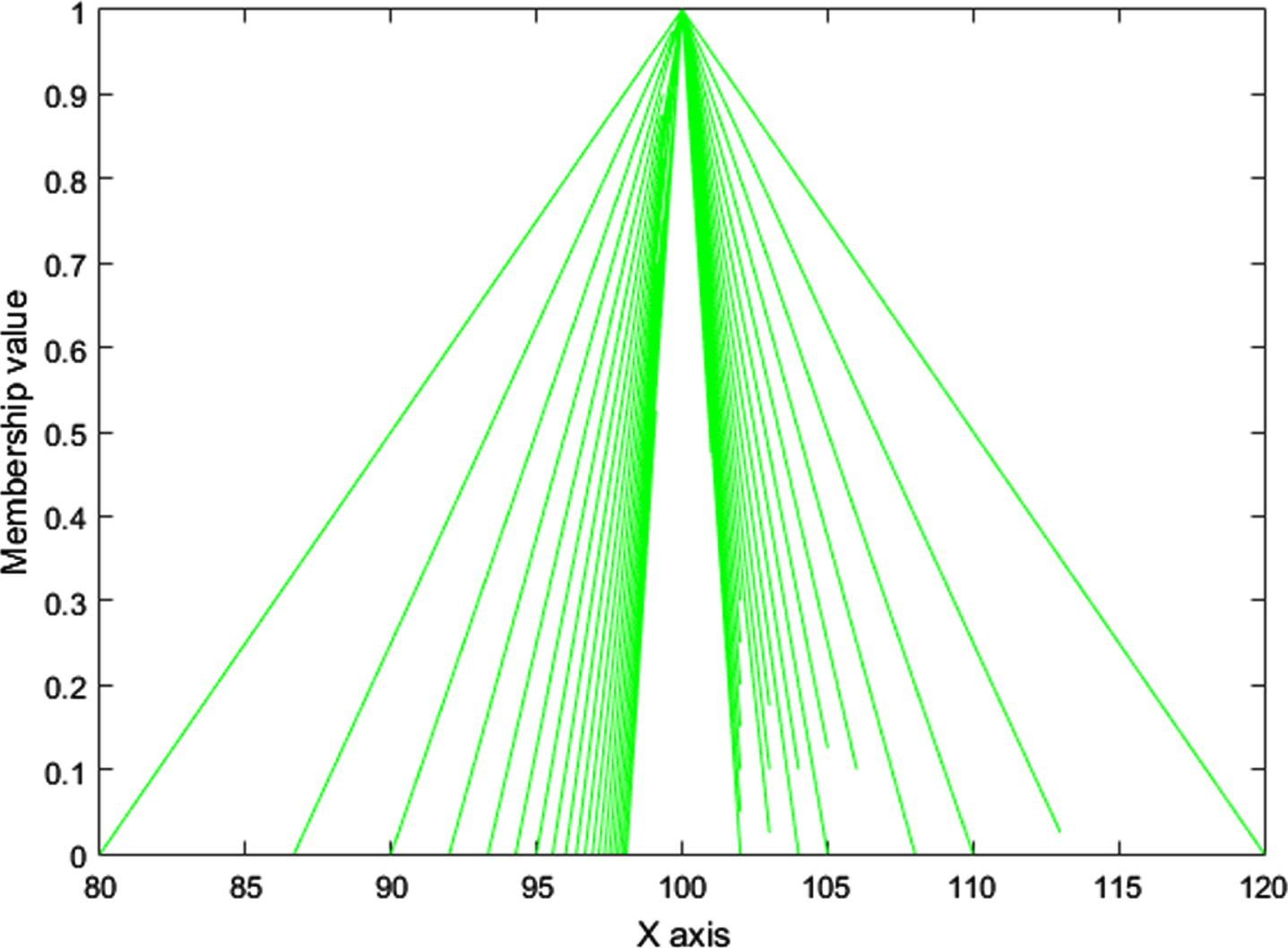
Membership function of TDFN.

Polygonal fuzzy set.
 and that of semi ellipse which covers the polygon is denoted by
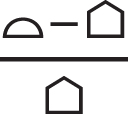
  . Now the degree of fuzziness of the fuzzy set
  .
.
a. Notations and assumptions
The basic assumptions and notations of the model are
Assumptions
Replenishments are instantaneous The time horizon is infinite Shortages are not allowed, and lead time is zero After receiving the products, customers buy their product according to their own choice. After a certain period of time the seller announces the discount for the low-quality products according to the customer’s view. In addition, in the fuzzy model, we consider the demand rate assume dense fuzzy number, parabolic fuzzy number and cloudy fuzzy number.
Notations
q1: Order quantity placed in order in starting of each cycle (decision variable)
q2: The total amount of products sells with a considerable discount (decision variable)
t1: Duration of selling without discount (decision variable)
t2: Duration of selling with discount (t1 > t2) (decision variable)
d1: Demand rate in time t1
d2: Demand rate in time t2 (d2 > d1)
p: Purchasing price per unit item ($)
s: Selling price per unit item ($)
T: Cycle length (months)
c1: Holding cost per unit quantity item per day ($)
c3: Set up cost per cycle ($)
r: Discount rate in percentage
Z: Total profit per cycle ($)
b. Model formulation
Let the products are received instantaneously with purchasing price p per unit item, fixed ordering cost c3 per cycle and holding cost c1 per unit quantity item. Customers buy the products according to their own choice. After selling the good quality products in time t1, the decision-maker will sell the remaining quantity q2 with a considerable discount. The diagrammatic representation of the inventory model is shown in Fig. 3.

Logistic diagram of the EOQ model.
From Fig. 3, total holding cost
According to the above assumptions the total cost of the modified EOQ model is
TC = Holding cost+set up cost+total purchasing price
Total revenue per cycle TR = (q1 - q2) s + q2 (1 - r) s
Total profit per cycle Z = TR - TC
Now, in reality, three cases can happen during the discount period. Due to discount demand can be increase or decrease or same as it is. These three cases are given below.
Case –(i): If d2 = e
t
2
d1 then the profit function becomes
Case –(ii): If d2 = e-t2d1 then the profit function becomes
Case –(iii): If d2 = d1 then the profit function becomes
Case –(i)
We know that demand rate plays a vital role in an inventory, and it can’t be predicted exactly what it is. So, here we consider demand rate as cloud type fuzzy number. Now, we convert the case –(i) to a cloudy fuzzy model. As, the demand rate d1 assumes as cloudy fuzzy number throughout the model, the objective function of the case –(i) reduced to
Now the membership function of the demand rate is given by
The left and right α –cuts of
Now
Now the Equation (8) can be written as
From (15) and (17) we obtain the membership function of the fuzzy objective function as follows
The left and right α –cuts of the above membership function are given by
Now
So, the fuzzy model of case –(i) becomes
Now for case –(ii), d2 = e-t2d1. In the previous way we have find the cloudy fuzzy model for case –(ii) and it is given below.
In the similar way we have also find the cloudy fuzzy model for case –(iii) and it is given below.
Parabolic fuzzy model
Solution algorithm
The solution algorithm of the proposed model is given below.
Input: Values of all parameters (p, s, d1, c1, c3, r, ρ and σ).
Output: Optimum inventory profit Z
max
.
Find inventory profit I1 (Z) , I2 (Z) and I3 (Z). (Crisp) of case –(i), (ii) and (iii) respectively using Equations (8)–(13). Find Z* = Max{ I1 (Z) , I2 (Z) , I3 (Z) }. Apply dense fuzzy or three cases Find corresponding inventory profits J1 (Z) , J2 (Z) and J3 (Z) using Equations (26), (27) and (28) respectively. Find W1 = Max{ J1 (Z) , J2 (Z) , J3 (Z) }. If Z* < W1 then Z
max
= W1 else Z
max
= Z*
Apply parabolic fuzzy over the three cases. Find corresponding inventory profit K1 (Z) , K2 (Z) andK3 (Z) respectively using Equations (23), (24) and (25). Find corresponding inventory profit W2 = Max{ K1 (Z) , K2 (Z) , K3 (Z) }. If Z
max
< W2 then Z
max
= W2. Apply degree of fuzziness over three cases. Find corresponding inventory profit L1 (Z) , L2 (Z) and L3 (Z) using Equations (29), (30) and (31) respectively Find W3 = Max{ L1 (Z) , L2 (Z) , L3 (Z) }. If Z
max
< W3 then Z
max
= W3. Apply cloudy fuzzy over the three cases. Find corresponding inventory profit M1 (Z) , M2 (Z) andM3 (Z) using Equations (20), (21) and (22) respectively Find W4 = Max{ M1 (Z) , M2 (Z) , M3 (Z) }. If Z
max
< W4 then Z
max
= W4. End
Here we give the values of all parameters and get the optimum inventory profit as its output. Using this algorithm, wcan find the optimum inventory profit of our proposed model. Through this algorithm, we can also compare the crisp result with various fuzzy models likdense fuzzy model, parabolic fuzzy model, cloudy fzy model and degree of fuzziness model. Ancomputer program in C language, MATLAB language or in Mathematica can be developed following this algorithm.
Case study
We have visited ‘Mahabir Garments Shop’ situated in Rabindra Sarani Road, Liluah, Howrah —711204, India [(Latitude, Longitude)=(22°37’11.66”N, 88°20’12.2”E)] on 3rd February in 2020. After a long discussion with the manager, we get some data about their business. The data are p = 500, s = 700, d1 = 1500, c1 = 2.5, c3 = 500, r = 40 % , ρ = 0.27, σ = 0.28. Depending on this data we get the following result of the above three cases.
Table 1 shows that among three cases, case –(ii) gives the maximum profit and case –(i) gives the minimum profit. That means if the demand decreases in the discount period, we get the maximum profit.The table also shows that cloudy fuzzy gives the finer optimum value $3244469 compared to crisp, dense fuzzy, parabolic fuzzy and DF throughout the three cases.
Outcome of the model in different methodology
Outcome of the model in different methodology
From Table 1, we see that cloudy fuzzy model of the case –(ii) gives optimum value. So, we take sensitivity analysis on the cloudy fuzzy model of case –(ii). We change parameters ρ, σ, r, c1, c3, p and s from –30%to +30%one by one and get the following result.
Graphical illustration
Several graphs (Figs. 5–7) have been drawn in this section to illustrate the numerical result given in Tables 1 2. Figure 5 has been drawn using the data of Table 1 and Figs. 6, 7 have been drawn using the data of Table 2. The figures are given below.

Flow chart of the proposed model.

Inventory cost vs methodology.

Sensitivity analysis of parameters.
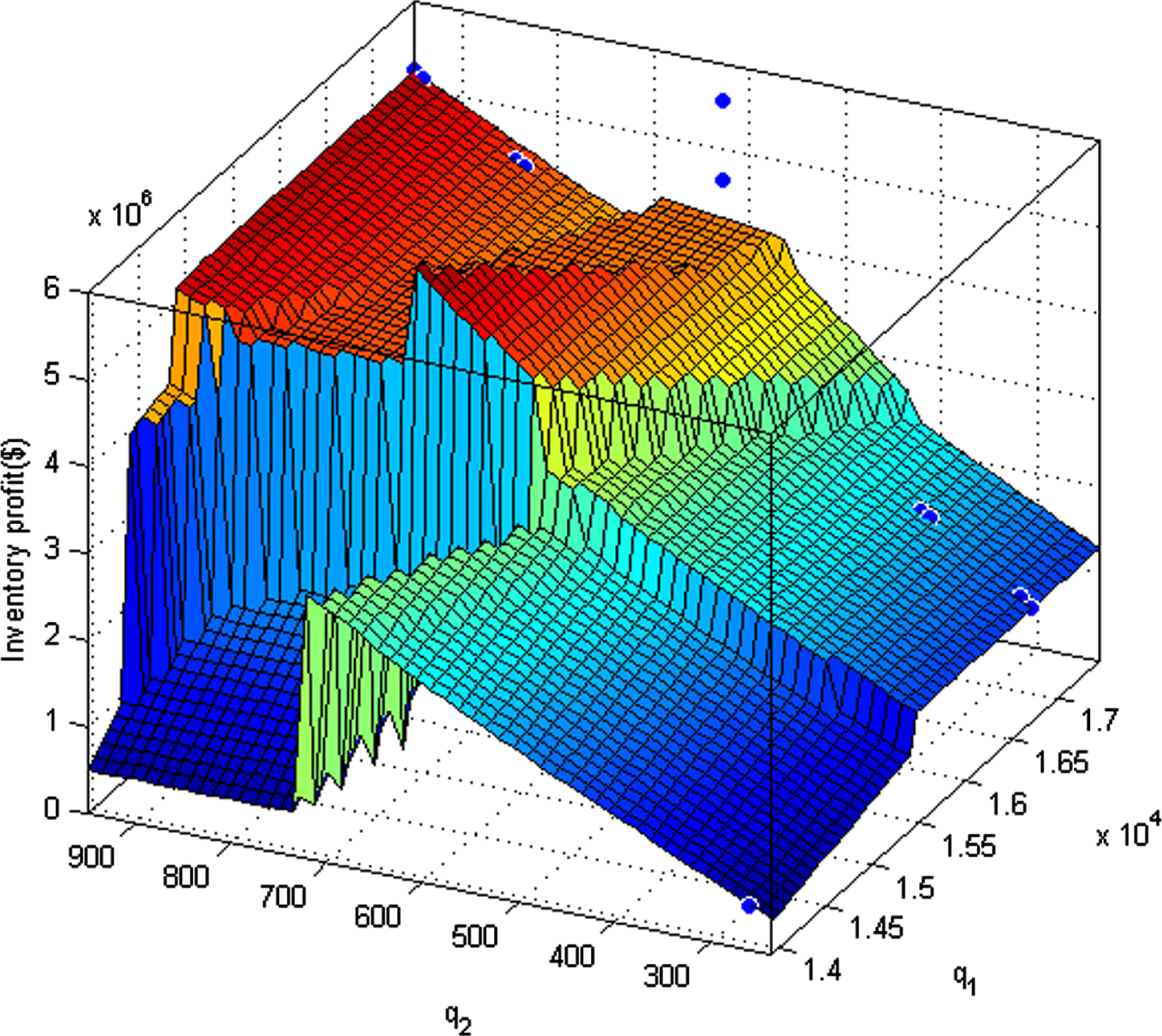
Inventory profit vs q1 and q2.
Sensitivity analysis for the cloudy fuzzy model
Figure 5 illustrate a comparative study of three cases in crisp and others fuzzy environment. From the figure, it is clear that case –(ii) gives the optimum value comparing with case –(i) and case –(iii). Among crisp and all fuzzy environments, cloudy fuzzy gives the optimum profit for all cases.
Figure 6 illustrate the sensitivity analysis of several parameters. From this figure, we see that cost parameters c1, c3 and discount rate r are almost insensitive parameters within this range (–30%to +30%) of variation. Moreover, the inventory profit gets remarkable variation when other parameters ρ, σ, p and s are changes from –30%to +30%. The basic managerial insight is that, inventory profit will not increase much more for increasing holding cost and set up cost up to 30%.
Figure 7 indicates the surface like curve of the inventory profit function with respect to the variation of the normal order quantity (q1) and discount-based order quantity (q2). It is seen that when the normal order quantity assumes values nearly 17094 units and the discounted order quantity assumes values about 900 units, the inventory profit becomes maximum. However, it is observed that when the normal order quantity assumes values nearly 13494 units and the discounted order quantity values nearly 900 units, the inventory profit becomes minimum. The inventory profit gets value within $(3100000–5000000) with respect to the normal order quantity range (16000–17000) units and that of discounted order quantity range (500–700) units. For the other cases, the profit function gets lesser values.
Advantages
Sce the demand rate assumes cloudy fuzzy numbers, so it is more practical to analyse the model. There is no need to incorporate screening cost as the customers themselves screen the items during their purchase. This model is valid with the new defuzzification methods.
Disadvantages
The nature of the model may vary with the assumption of some other fuzzy parameters. The result of the model may differ if the parameters assume different fuzzy numbers.
Conclusion
In this study, we have discussed an EOQ model of imperfect items that customers screened during the purchase. The low demand items are sold at discount rates among the customers. For a comparative study, we also consider demand rate as dense fuzzy number, cloudy fuzzy number, parabolic fuzzy number and degree of fuzziness. Throughout the study the numerical result and graphical illustration claim that the model gives finer optimum for cloudy fuzzy demand rate. So, cloudy fuzzy is much more suitable for decision-makers of an inventory problem to make decisions compared with others existing fuzzy environments. Thus, the basic novelties of this article are Inventory problems should be optimized with the help of cloudy fuzzy rules instead of dense fuzzy, parabolic fuzzy and degree of fuzziness rule. An Optimum solution can be obtained easily by a computer-based algorithm. Increasing demand does not always imply the increase of inventory profit.
Scope of future work
The proposed fuzzy numbers can be used to solve other inventory model to get better solution.
Conflicts of interest
The authors declare that there is no conflict of interest regarding the publication of the article.
Footnotes
Acknowledgments
The authors are thankful to the honourable Editor-in chief, Associate Editors and anonymous reviewers for their valuable comments and suggestions to improve the quality of this article.