



Abstract
Due to the increasingly demand of wireless broadband applications in modern society, the device-to-device (D2D) communication technique plays an important role for improving communication spectrum efficiency and quality of service (QoS). This study focuses on the optimal allocation of link resource in D2D communication systems using intelligent approaches, in order to obtain optimal energy efficiency of D2D-pair users (DP) and also ensure communication QoS. To be specific, the optimal resource allocation (ORA) model for ensuring the cooperation between DP and cellular users (CU) is established, and a novel coding strategy of ORA model is also proposed. Then, for efficiently optimizing the ORA model, a novel swarm-intelligence-based algorithm called the dynamic topology coevolving differential evolution (DTC-DE) is developed, and the efficiency of DTC-DE is also tested by a comprehensive set of benchmark functions. Finally, the DTC-DE algorithm is employed for optimizing the proposed ORA model, and some state-of-the-art algorithms are also employed for comparison. Result of case study shows that the DTC-DE outperforms its competitors significantly, and the optimal resource allocation can be obtained by DTC-DE with robust performance.
Keywords
Introduction
Due to the explosive growth of mobile communication users, the energy consumption of communication terminal and the lack of spectrum resource greatly restrict the sustainable development of network communication service. In order to overcome the problem caused by the growth of communication user quantity and service data volume, the device-to-device (D2D) communication technique is developed and considered as one of the most important techniques in the IMT-2020 (5 G) system [1]. In D2D communication, the user equipment (UE) nearby can directly communicate with each other under the control of enhanced-Node B (eNB) [2–4]. Especially for the UEs with small storage capacities, the UE can be connected to another adjacent equipment using the direct links instead of cellular connections. These direct connections between adjacent UEs bring a considerable offloading potential. In addition, the D2D communication technique can be directly overlaid on traditional cellular networks. Obviously, this can easily maximize the spectral utilization by reusing the resources of non-D2D UEs [5].
In recent years, the D2D communication technique becomes a hot topic and attracts the attentions of worldwide scholars. Due to the potential application in traffic offloading, video content sharing, cellular range extension and some other special engineering cases, the sub-directions of D2D communication like resource allocation, interference management, power control, relay selection are widely developed [6–8]. Due to the growing cellular user quantity and limited spectrum resources in cellular networks, the resource-reused manner is introduced into the high-density communication system as the D2D communication. However, the resource-reused manner may also cause the un-predictable inter-layer interference or co-layer interference, which significantly affects the quality of service (QoS) and lead to the communication performance degradation. As a result, the efficient resource allocation model and algorithm are of great importance for D2D communication system.
This study focuses on the resource allocation methodology of D2D communication for maximizing the system energy efficiency. To be specific, the resource allocation problem is analysed in detail firstly, then the optimal resource allocation (ORA) in D2D communication is modelled as a constrained optimization problem. Secondly, for effectively solving the developed ORA model in real-time, a novel swarm-intelligence-based algorithm called dynamic topology coevolving differential evolution (DTC-DE) is developed, and a coding strategy is proposed for effectively connecting the ORA model and DTC-DE algorithm. Finally, efficiency of the proposed resource allocation methodology based on DTC-DE is comprehensively verified by case studies.
The rest of this paper is organized as follows. In Section 2, the literature review is conducted on resource allocation of D2D communication and swarm-intelligence-based optimization algorithms, respectively. Then, the resource allocation problem in D2D communication is analysed in detail in Section 3, the ORA model and its coding strategy are also discussed in this section. In Section 4, the DTC-DE algorithm is studied, and the efficiency of DTC-DE is also tested and compared by numerical experiments. Simulation experiments and detailed analysis about the optimization of ORA model using DTC-DE are conducted in Section 5. Finally, this paper is concluded in Section 6.
Related works
Resource allocation of D2D communication
In D2D communication system, the two UEs nearby can directly communicate with each other under the control of eNB. In normal conditions, the D2D-pair users (DP) may reuse the uplink resources of cellular users (CU). The transmission of DP transmitter (DT) could cause interference to eNB, and the transmission of CU could also interfere the DP receiver (DR). As a result, optimally allocate the uplink resources of CU to DP is of great importance to the system spectrum efficiency and QoS. In recent years, with the fast development of D2D communication technology, the resource allocation models and optimization algorithms are widely developed. Zhao et al. developed a resource management method by considering both power and channel allocation, in order to overcome the problems of spectrum efficiency promotion and interference controlling caused by spectrum reuse in hybrid communication scenario [9]. Mohamad et al. proposed a dynamic sectorization method in which eNB can vary the number of sectors dynamically and allocated the resource block to D2D users. According to their study, the signal-to-interference-noise-ratio (SINR) and the network overall performance are improved [10]. Sultana et al. introduced the sparse code multiple access (SCMA) technology to a D2D enabled cellular network, in order to utilize the overloading feature of SCMA to support a massive device connectivity while enhancing the overall network performance [11]. Wang et al. proposed a matching-based social-aware resource allocation algorithm for multicast D2D communication underlaying certain cellular network. According to their simulation results, the proposed allocation algorithm achieved promising performance gain compared with some other state-of-the-art algorithms [12]. Amin et al. proposed a resource allocation algorithm based on the so-called Q-learning, in which the multi-agent learners from multiple D2D users were created, and the system throughput was determined by the state-learning of Q value list. According to their study, the system throughput was effectively maximized by controlling the D2D users’ power, and a fine QoS of cellular users was also ensured [13].
In D2D communication, the resource allocation is always considered together with power control strategy for obtaining promising performance on spectrum efficiency. For example, based on the multi-agent reinforcement learning methodology, Wei et al. studied the channel resource allocation and power control strategy for improving the system resource utilization and network throughput [14]. Sobhi-Givi et al. proposed a resource block allocation scheme for reducing the co-channel interference by providing and maintaining adequate distance between D2D UE and CU. According to the experimental results reported in their study, the system spectral efficiency can be significantly improved by optimizing the D2D UE power. Thus, the system throughput was much higher than that of the random resource allocation strategy, and also outperformed some other compared methodologies [15].
In recent years, with the fast development of artificial intelligence (AI), the AI-based techniques were widely introduced into the resource allocation of D2D communication and achieved promising performance. For example, Hamdi et al, studied the resource allocation strategy using the swarm intelligence algorithms, that is, the hybrid genetic algorithm (GA) and particle swarm optimization (PSO) [16]. Takshi et al. proposed a GA-based method to minimize the interference, and maximize the spectral efficiency at the same time [17]. By allowing two DPs to share the same frequency resource of one CU, Sun et al. studied the algorithms for maximizing system throughput based on PSO and hybrid PSO-GA. According to their simulation results, the system performance could be effectively guaranteed with the proposed methods [18].
Swarm intelligence-based optimization
In this study, the swarm intelligence-based optimization algorithms (SIOA) are developed and employed for solving the proposed ORA model. With the development of AI theory and technology, the SIOA attracts attentions of worldwide scholars in recent years, and are also successfully applied in solving real-world engineering problems [19–22]. Some famous SIOA are listed as follows: the PSO [23], GA [24], differential evolution (DE) [25], artificial bee colony algorithm (ABC) [26], ant colony optimization (ACO) [27], woodpecker mating algorithm (WMA) [28–31] and so on. However, due to the increasing complexity of real-world problems, the basic SIOA always loses efficiency and fails to find the global optimum. As a result, a lot of SIOA-variants are widely developed to solve the complex problems with certain characteristics. For example, Tang et al. introduced the human simulated properties in to PSO and proposed a so-called human-brain simulated particle swarm optimization algorithm [32]. For optimizing the binary variables, Nguyen et al. proposed a dynamic sticky binary PSO by developing a dynamic parameter control strategy based on an investigation of exploration and exploitation in the binary search spaces [33]. For the multimodal optimization problem, Lin et al. developed an algorithm named the FBK-DE, in which the formulation, balance and keypoint of species for multimodal optimization problems are considered [34]. Li et al. divided the original population of DE into four sub-populations, and most of the computing resources were allocated to the best one. According to their experimental results, the proposed MPMDE algorithm obtained competitive performance in both optimization accuracy and convergence speed [35].
As discussed above, in order to obtain promising performance on spectrum efficiency improvement in D2D communication, the SIOA-based algorithm is a good choice to solve the resource allocation problem. However, the performance of SIOA-based resource allocation methodology is deeply relied on the allocation model and efficacy of SIOA adopted. In the following sections, the ORA model with certain constraints is established to accurately describe resource allocation problem, and an effective DE-variant is developed to optimize the ORA model to obtain robust allocation performance.
Optimal resource allocation model in D2D communication
System model
In this study, we consider a cellular network of LTE-Advance systems, in which the eNB locates at the center of a hexagonal region (denote the radius as R). The cellular users (i.e., CU) and D2D-pair users (i.e., DP) are randomly distributed within the hexagonal region. Denote C={CU n | n = 1, 2, ... , N} and D={DP m | m = 1, 2, ... , M} as the sets of CU and DP, respectively. Assume that the uplink resource of each CU can be reused by at most one DP, and each DP can reuse more than one CU uplink resource. The system model of the evaluated D2D communication system is illustrated as Fig. 1.

Schematic of D2D communication system.
In the evaluated D2D communication system, the optimization objective is to maximize the entire energy efficiency by effectively allocating the uplink resource of all the CUs. At the same time, the communication QoS of each DP should be also ensured. According to reference [36], the entire energy efficiency (denote as EE) to be maximized is formulized as Equation (1).
The transmission speed Rm,n in Equation (1) is related to the transmission power of DP
m
when reuse CU
n
, the channel gain from DP transmitter DT
m
to DP receiver DR
m
, the transmission power of CU
n
, the channel gain from DT
m
to CU
n
and the channel noise power. According to reference [36], the transmission speed Rm,n can be formulized as
According to Equation (2), xm,n is defined as binary variable. In addition, as the uplink resource of each CU can be reused by at most one DP and each DP can reuse more than one CU uplink resource, the constraints for Equation (1) can be formulized as
As shown in Equation (4), the introduced constraints are used to ensure the allocation solutions satisfy the following conditions: (1) all the variables within a certain solution (i.e., xm,n) are binary variables, in another word, the value of each optimization variable xm,n should be equal to 0 or 1; (2) the uplink resource of each CU can be reused by at most one DP. That is to say, for the variables within a valid solution, at most one variable within x1,n, x2,n, ... , xM,n (n = 1, 2, ... , N) is equal to 1; (3) each DP can reuse more than one CU uplink resource (but at least one). That is to say, in a valid allocation solution, at least one variable within xm,1, xm,2, ... , xm,N (m = 1, 2, ... , M) is equal to 1.
In the resource allocation problem as described above, the variables to be optimized are the relationship between CU
n
(n = 1, 2, ... , N) and DP
m
(m = 1, 2, ... , M). That is to say, to decide each xm,n (n = 1, 2, ... , N; m = 1, 2, ... , M) to be equal to whether 1 or 0, in order to obtain the maximum spectrum efficiency and satisfy the constraints listed in Equation (4). In this study, the optimization vector
Note that in Equation (5), each x
n
is a discrete variable, and x
n
= m (m = 1, 2, ... , M) indicates the uplink resource of CU
n
is reused by DP
m
. For example, assume that the number of cellular users N = 8 and the number of D2D-pair users M = 4. For a certain value of optimization vector, e.g.,
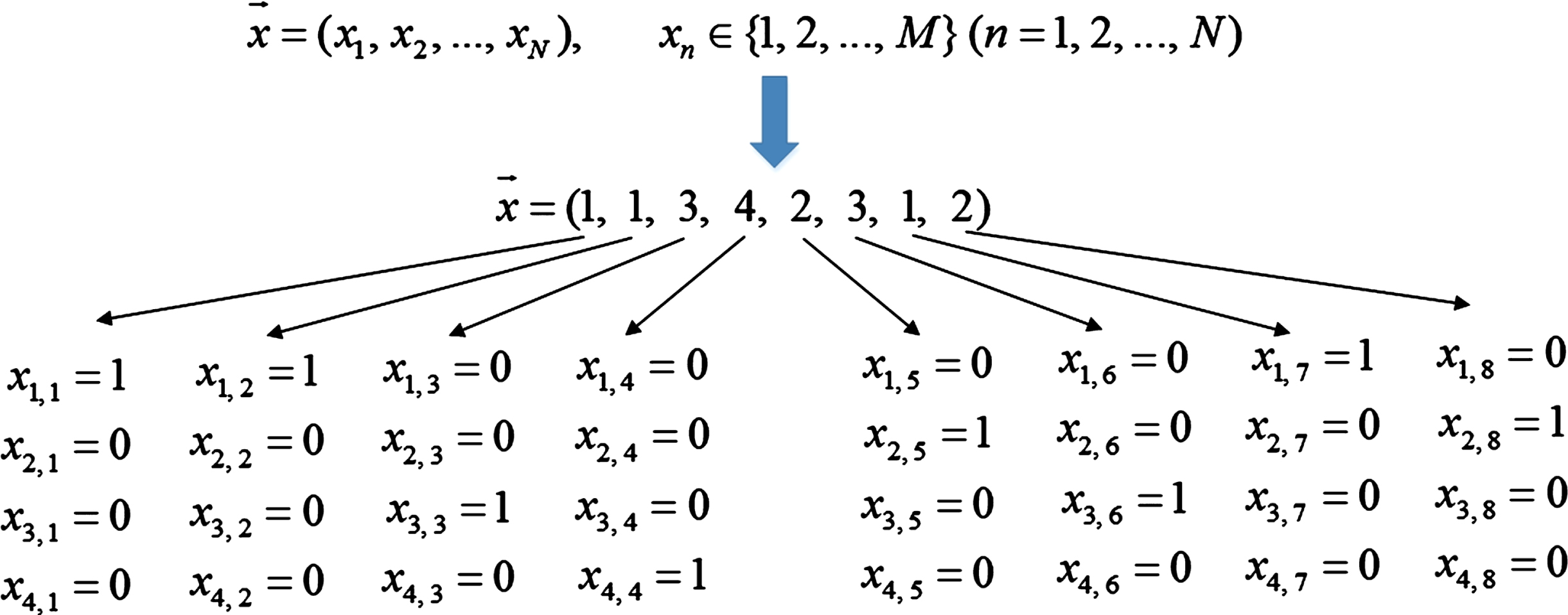
Coding strategy of optimization vector.
Resource allocation strategy of Fig. 2
As shown in Equation (5), the upper and lower boundaries of optimization variable x n are M and 1, respectively. In addition, considering that each x n is a discrete variable, the coding strategy to connect the continuous algorithm and discrete variable x n is defined as
where
In order to optimize the model described in Section 3.1 using swarm-intelligence-based approach, the fitness function should be defined accurately. As discussed in Section 3.1, target of the resource allocation problem is to maximize the entire energy efficiency EE in Equation (1). According to reference [36], the maximization of EE is equal to the minimization of the following equation
Considering that each DP should be allocated with at least one CU uplink resource, the allocation solution that does not satisfy this constraint should be punished. As a result, the punish function is defined as
In order to effectively solve the aforementioned ORA model, a novel swarm-intelligence-based algorithm, namely dynamic topology coevolving differential evolution (DTC-DE) is developed in this section. First of all, the effective cooperative coevolution (CC) framework is adopted in DTC-DE in order to improve the convergence ability for high-dimensional problem. Then, the population in DTC-DE is divided into several sub-populations with a dynamic topology, which means that the structure varies dynamically over iterations. Finally, in the proposed DTC-DE, a novel mutation operator based on the dynamic topology of sub-populations is developed, in order to balance the exploitation and exploration abilities during the coevolving process.
Differential evolution
Differential evolution (DE) is one of the most effective swarm-intelligence-based optimization algorithms [37–39]. In DE, the mutation, crossover and selection operations are adopted to evolve the population and search the global optimum within search space. Individuals in DE are represented by n-dimensional optimization vectors x i , (i = 1, 2,..., N P ), where N P denotes the population size.
1) Mutation operator
2) Crossover operator
3) Selection operator
1) Cooperative coevolution in differential evolution
In DTC-DE, the effective cooperative coevolution (CC) framework is adopted to improve the convergence ability for high-dimensional problem [40]. That is to say, the D-dimensional original problem is decomposed into several sub-problems and each with a certain number of variables. Then, in each cycle of DTC-DE, all the sub-problems are evolved in turn. For computing the fitness function value of the individuals within each sub-problem, a D-dimensional vector is defined as the combination of the best individual in each sub-component, and is used as the so-called “context vector”. The CC framework in DTC-DE can be illustrated as the following steps:
➀ Initialize a D-dimensional swarm P with N p individuals, and then decompose P into K groups P i (i = 1, 2, ... , K), each group represents a sub-problem with D/K dimensionalities. For a D-dimensional individual x=(x1, x2, ... , x K ), where x i represents the ith group of components;
➁ Denote
➂ Proceed another cycle if stopping criteria are not satisfied, otherwise stop the coevolution and output the final result.
2) Dynamic topology
In DTC-DE, we divide the original population P (include N
p
individuals) into N
sp
sub-populations and each with N
p
/N
sp
individuals (denote M
sp
= N
p
/N
sp
). Denote the best individual of the jth sub-population (SP
j
) as Ibest
j
(j = 1, 2, ... , N
sp
). Then, when evolve a certain individual x
i
which belongs to the jth sub-population, the adopted context vector (see CC framework) is randomly selected from Ibest
j
and all the Ibestj - topology. Note that Ibestj - topology denotes the neighbour sub-populations of SP
j
under a certain topology. The concept of “dynamic topology” implies that all the N
sp
sub-populations are connected in ring topology at beginning. Then, randomly connect each pair of non-neighbour sub-populations (denote as NSP-pair) at each iteration while the original ring topology keep constant. In the dynamic topology mechanism, we define a parameter P
dt
∈ [0, 1] to control the connections between each NSP-pair, which is formulized as
The dynamic topology mechanism is illustrated as Fig. 3, in which the neighbour relationships are indicated by solid lines. For example, the neighbour sub-populations of SP4 are SP3, SP5 and SP Nsp .
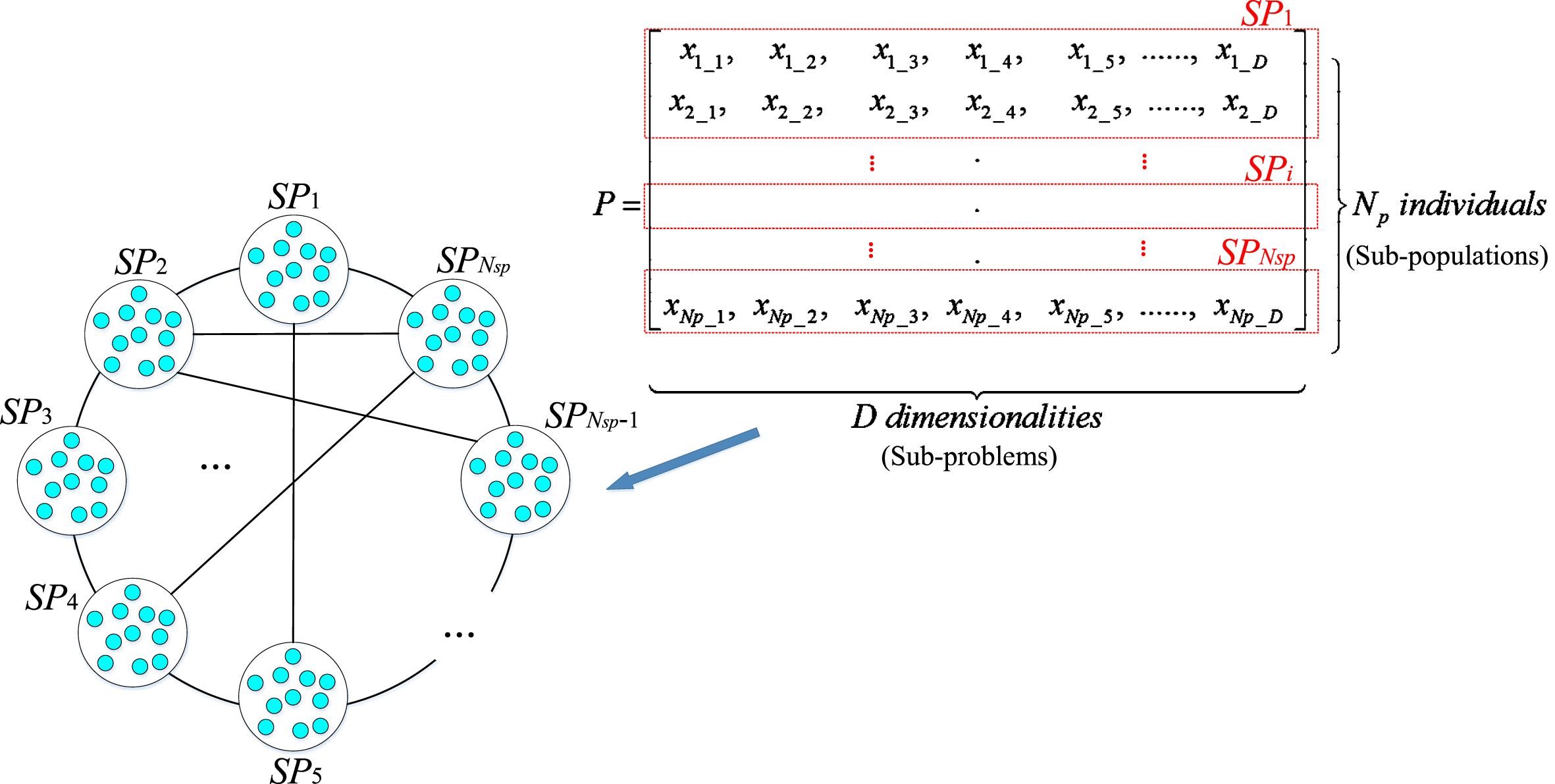
Dynamic topology mechanism in DTC-DE.
3) “DE/current-to-dtbest/1” mutation operator
Mutation operator significantly affects the overall performance of DE. Over the last few years, some mutation operators with different properties are proposed, e.g., the “DE/rand/1”, “DE/best/1”, “DE/current-to-best/1”, “DE/current-to-rand/1”, “DE/current-to-pbest/1”, “DE/current-to-SP-best-ring/1” and so on [38]. In DTC-DE, a novel “DE/current-to-dtbest/1” mutation operator is proposed as
As shown in Equation (14), the proposed “DE/current-to-dtbest/1” is neither too greedy nor too stochastic. The introduction of “dtbest i ” and “x oea ” aims to provide a slower but more extensive communication mode for all the individuals to balance the global exploration and local exploitation.
As discussed above, the pseudo code of DTC-DE is illustrated as Table 2.
Pseudo code of DTC-DE
In this section, the performance of DTC-DE is empirically evaluated on a comprehensive set of benchmark functions, which are listed in Table 3. In the following experiments, the maximum number of fitness evaluations (FE
max
) is set to 1 × 10⁶. Dimensionality of each function is set as D = 100, and the population size is set to 50. The dynamic group size of DTC-DE is set as
Benchmark functions
Benchmark functions

The average convergence graphs on f1 to f6 for 20 independent runs.
Experimental results on f1 to f6 for 20 independent runs
As shown in Fig. 4 and Table 4, the proposed DTC-DE outperforms the other compared algorithms on most of the benchmarks. For f1 and f2, DTC-DE is the best performer on both accuracy and convergence speed. The average errors on f1 and f2 obtained by DTC-DE are 8.38 × 10-55 and 3.55 × 10⁻¹⁵ respectively, which significantly outperform its competitors. For f3, DTC-DE obtains the average optimization error of 2.71 × 10-03, which slightly outperforms 7.63 × 10-03 obtained by CCDE, 3.76 × 10-03 obtained by CPSO-S K - rg - aw, 1.32 × 10-02 obtained by CCPSO2 and 1.45 × 10-02 obtained by AMCCDE, respectively. For f4, the errors of DTC-DE, CCDE and AMCCDE are almost the same, but DTC-DE obtains the fastest convergence speed. For f5, the outperformance of DTC-DE on optimization accuracy and convergence speed is significant: the best performance (1.27 × 10⁻²⁶) is obtained by DTC-DE, which is followed by 2.17 × 10⁻¹⁶ obtained by CCDE. AMCCDE (1.76 × 10⁻¹¹) and CCPSO2 (4.73 × 10⁻¹⁰) are the 3rd and 4th best performers, respectively. However, HSPSO-FI performs the worst on f5 and obtains the optimization error of 9.66 × 10+00. Finally, for the benchmark f6, all the algorithms lose the efficacy and obtain a relatively large error of more than 10 + 05.∥In order to compare the optimization results more clearly, the interval graphs are further plotted in Fig. 5. Note that in Fig. 5 (c), as the results of some algorithms are 0, the ordinate of the figure is the absolute error without logarithmic transformation. As shown in the figures, the developed DTC-DE algorithm obtains promising performance on most of the benchmarks. For example, as shown in Fig. 5 (b), (c) and (d), DTC-DE obtains the best performance on accuracy and robustness for f2, f3 and f4. For the benchmarks f1 and f5, as shown in Fig. 5 (a) and (e), although the robustness of DTC-DE is worse than its performance on f2 to f4, DTC-DE can still obtain the best optimization accuracy. Especially for f5, the outperformance of DTC-DE is very significant.

The interval graphs on f1 to f6 for 20 independent runs.
Parameter setting and simulation analysis
In this section, the proposed DTC-DE is employed to optimize the aforementioned ORA model for obtaining the optimal resource allocation in D2D communication. For evaluating the effectiveness of DTC-DE, the CPSO-SK - rg - aw, CCPSO2, CCDE, CPSO-SK, HSPSO-FI and AMCCDE described in Section 4 are employed for comparison. In the following simulation, the numbers of CU and DP are set to 80 and 20, respectively. Assume all these users are randomly distributed within a hexagon region with a radius of 700 m. The distribution of these 120 users are shown as Fig. 6.
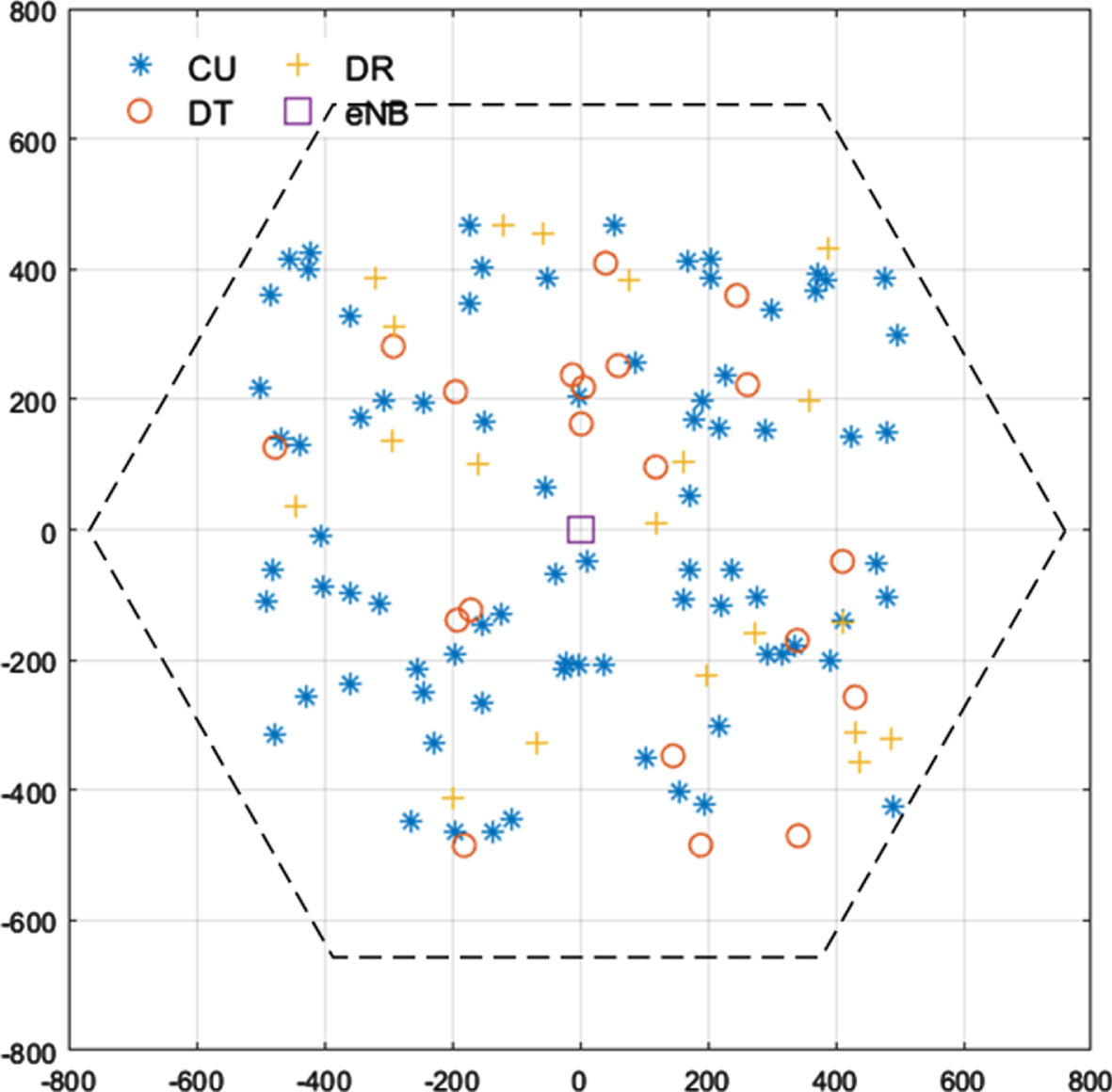
Distribution of CU and DP of the case study.
As suggested in reference [5], the communication model and parameters employed in the following simulation experiments are chosen in accordance with 3GPP LTE regulation for OFDMA system. The pathloss model is defined as Equation (15).
According to the coding strategy described in Section 3.2, the dimensionality of ORA model in this case is 80 as it is equal to the number of CU. As a result, the set of dynamic group size

Convergence graphs for optimizing the ORA model.
Optimization results of the compared algorithms
As shown in Fig. 7 and Table 5, for the aforementioned ORA model in D2D communication system, the DTC-DE algorithm obtains the best optimization performance. To be specific, the average optimization result obtained by DTC-DE is 19.915, which significantly outperforms its competitors. AMCCDE and CCPSO2 are the second-best and third-best performers, which obtain the similar results of 24.197 and 25.814, respectively. Besides, the average results obtained by CCDE, CPSO-SK - rg - aw and HSPSO-FI are 27.427, 32.472 and 46.540, respectively. Finally, CPSO-SK performs the worst and its average optimization result is just 100.663. In addition, the standard deviation of the 20 independent runs obtained by DTC-DE is significantly smaller than the other compared algorithms. This implies that DTC-DE has good robustness performance on ORA model optimization. In addition, it can be seen from Fig. 7 that DTC-DE can also obtain the fastest convergence speed on optimizing the ORA model.
In order to further verify the effectiveness of the proposed methodologies, some comparisons for general cases are conducted in this section. For each case, the parameter settings of ORA model are listed in Table 6. Numerical results of the simulation experiments are listed in Table 7, in which the best performance is set in bold. The convergence graphs for each case are plotted in Fig. 8. Note that the ordinate in Fig. 8 is the fitness function value after logarithmic transformation.
Parameter settings of ORA model for more general cases
Parameter settings of ORA model for more general cases
Experimental results for Case 1 to 6
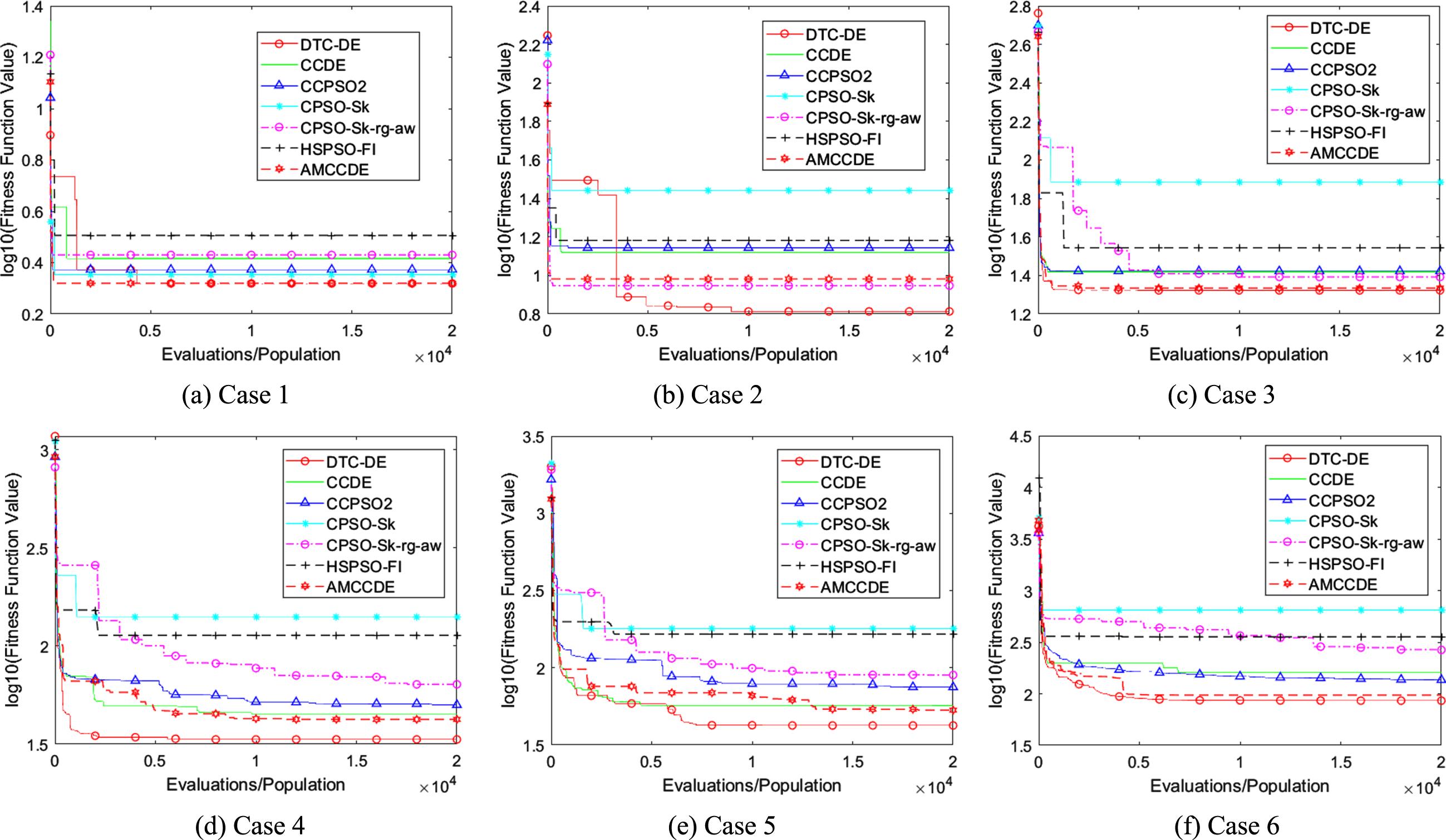
Convergence graphs for Case 1 to 6.
As shown in Table 7 and Fig. 8, performance of the compared algorithms is almost the same when the model dimensionality is low. For example, in Case 1, the final fitness function values (listed in the first column of Table 7) and the convergence speed (reflected in Fig. 8 (a)) for the 7 algorithms are very close. However, the outperformance of DTC-DE increases with the growing of model dimensionality. For example, in Case 2, the final fitness function value obtained by DTC-DE is just 6.502, which is close to 8.847 obtained by CPSO-SK - rg - aw and 9.595 obtained by AMCCDE, but significantly better than that of CCDE, CCPSO2, CPSO-SK and HSPSOFI. Similarly, for Case 3 and Case 4, the final results obtained by DTC-DE are 21.019 and 33.426 respectively, which significantly outperform most of the competitors. Moreover, when the model dimensionality continuously increases to 150 (in Case 5) and 200 (in Case 6), the outperformance of DTC-DE becomes more significant. For example, in Case 6, the final result obtained by DTC-DE is just 85.652, which is significantly less than 160.368 of CCDE, 136.227 of CCPSO2, 265.518 of CPSO-SK - rg - aw, 647.646 of CPSO-SK, 356.111 of HSPSO-FI and 97.082 of AMCCDE. In addition, as shown in Fig. 8, DTC-DE can also obtain the fastest convergence speed in Case 3, 4, 5 and 6. In a word, results of the general case studies further show the effectiveness and robustness of the proposed DTC-DE algorithm, especially when employed in optimizing the high-dimensional ORA model of D2D communication system.
This study focuses on the numerical model and optimization algorithm of link resource allocation in D2D communication, which aims to improve the communication spectrum efficiency and obtain the optimal resource allocation solution between D2D-pair users and cellular users. To be specific, the reuse relationship between CU uplink resource and DP is modelled as numerical ORA model, in which the constraints are described by punish function. Then, a novel dynamic topology coevolving differential evolution algorithm (DTC-DE) is developed for optimizing the proposed ORA model, and the corresponding coding strategy for connecting DTC-DE and ORA model is also developed. Result of simulation experiments shows that the DTC-DE can obtain promising performance on both optimization accuracy and convergence speed for most of the benchmark functions. Finally, the proposed resource allocation methodology based on DTC-DE and ORA model are verified by a comprehensive set of case studies. Experimental results show that compared with several state-of-the-art algorithms like CCDE, CCPSO2, CPSO-Sk, CPSO-Sk - rg - aw, HSPSO-FI and AMCCDE, the developed DTC-DE obtains the best performance on both accuracy and robustness for optimizing the ORA model with 20 to 200 dimensionalities. As a result, the proposed methodology can effectively allocate the link resource for obtaining the D2D communication with high spectrum efficiency and quality of service.
In future, in order to extend the application of our methodology in large-scale D2D communication system, more effort will be made to further improve the performance of DTC-DE, especially for high-dimensional ORA model with more than 200 dimensionalities. In addition, more efficient coding strategy in ORA model will be also concerned in our future work.
Conflict of interest
The authors declare that they have no conflict of interests regarding the publication of this paper.
Footnotes
Acknowledgments
This work is supported by the Science and Technology Project of China Southern Power Grid Co., Ltd (Grant No. 080008KK52190008(GZHKJXM20190097)).