



Abstract
Whether the exact amount of training data is enough for a specific task is an important question in machine learning, since it is always very expensive to label many data while insufficient data lead to underfitting. In this paper, the topic that what is the least amount of training data for a model is discussed from the perspective of sampling theorem. If the target function of supervised learning is taken as a multi-dimensional signal and the labeled data as samples, the training process can be regarded as the process of signal recovery. The main result is that the least amount of training data for a bandlimited task signal corresponds to a sampling rate which is larger than the Nyquist rate. Some numerical experiments are carried out to show the comparison between the learning process and the signal recovery, which demonstrates our result. Based on the equivalence between supervised learning and signal recovery, some spectral methods can be used to reveal underlying mechanisms of various supervised learning models, especially those “black-box” neural networks.
Keywords
Introduction
Deep learning has made great achievements in various applications and became a hot topic in recent years [1–6]. These achievements always can be attributed to the tremendous power of feature representation of deep neural networks (DNNs) [7], since according to the universal approximation theory, a DNN with enough nodes can arbitrarily approximate continuous functions in C (R d ) [8]. However, from a view of the classical theory in machine learning, a complex model is usually difficult to train and tends to generalize not well [9]. To overcome this problem, a larger amount of training data is needed. As a matter of fact, many achievements in recent years were made after big datasets were established, for example, ImageNet [10], which is a large-scale ontology of images built upon the backbone of the WordNet structure has boosted the development of computer vision.
Whether the exact amount of training data is enough for a specific task is an important question. On the one hand, it will lead to underfitting if the dataset is insufficient, where the data augmentation technique is always applied. On the other hand, it is always very expensive to label many data. For those tasks with big labeled datasets, it is not a problem. The commonly used scheme is to first project a DNN with many layers and nodes, then to train it with a big labeled dataset, next to prune or tune the network [11], until a satisfactory result is obtained. But for those lots of industry-specific tasks, labeled training data are always in short. So a key question is what the least amount of training data is for a machine learning network or model?
In this paper, we discuss this topic from the perspectives of sampling theorem and spectral-domain of a signal. If we take the target function of supervised learning as a multi-dimensional signal and the labeled data as samples, the training process can be regarded as a process of signal recovery. Then, the least amount of training data for a bandlimited task signal corresponds to a sampling rate that is larger than 2ω M , i.e. the Nyquist rate, where ω M is the cut-off frequency of the task signal.
The main highlights of this paper include:
(1) Novelty. As far as the authors’ knowledge, this is the first work to discuss the topic that what the least amount of training data is for a machine learning model. Moreover, an important phenomenon named Frequency Principle (F-Principle) [12] is explained in this paper theoretically from the perspective of the sampling theorem.
(2) Universality. The conclusion proposed in this work is not based on any specific network structures, activation functions, training methods, and training datasets. Since it views the target function as a high dimensional signal and analyzes the training process as a signal recovery process, the intermediate specific network structures, activation functions, and training methods are not restricted. In other words, the conclusion is valid for various supervised learning models, whether they are neural networks (NNs), SVM [13], or fuzzy systems [14–16].
The remainder of this paper is organized as follows. In section 2, we introduce related works. In section 3, the sampling theorem and spectrum analysis of the training process of machine learning are discussed. Numerical experiments are shown in section 4. Some discussions are presented in section 5. Finally, in section 6, we summarize the concluding remarks and describe the future extension of this research work.
Related works
The aforementioned theoretical works on the F-Principle mainly concentrate on how to quantitatively characterize the spectral bias in a ReLU DNN [22] or how to rigorously investigate the F-Principle for the training dynamics of a general DNN at different training stages under some reasonable theoretical assumptions [24, 25]. However, an underlying theory to explain why the F-Principle holds, not how the F-Principle expresses, is still missing.
Sampling theorem and spectrum analysis of training process
The sampling theorem
The sampling theorem is pivotal in signal processing and its related application disciplines, which establishes the connection between continuous signals and discrete signals. It has various forms in the mathematics literature, such as the Whittaker-Kotelńikov-Shannon (or WSK) sampling theorem, the Nyquist sampling theorem, etc. A basic form is:
The sampling frequency ω
s
is referred to as the Nyquist frequency while the frequency 2ω
M
is commonly referred to as the Nyquist rate. For example, assume the target signal is
Theorem 1 indicates that a bandlimited signal can be recovered by its samples if the Nyquist frequency is larger than the Nyquist rate. Note that the sampled values f (nT) are given uniformly in Theorem 1. However, a similar result also holds for the nonuniform samples.
Theorems 1 and 2 are all for the 1-D signals. Multi-dimensional signals can also be recovered by their samples under some assumptions, the readers can refer to Ref. [28].
In this paper, only the supervised learning is considered. Practically, supervised learning is to learn a function from the input data space R n to the output data space R m . Usually, some specific network and training methods are chosen to fit the labeled data. For example, in the kernel machines [29] such as SVM [13], the input data and their corresponding output are used to determine the coefficients of kernels, of which the network is the SVM model, and the training method can be chosen the stochastic gradient descent algorithm [30]. Similarly, in deep learning, the labeled data are used to determine the parameters of DNN or CNN, while the network is DNN/CNN, and the training method is usually the gradient descent algorithm or some numerical algorithm like Levenberg-Marquardt (LM) backpropagation method [31].
If we take the target function as a multi-dimensional signal and the labeled data as samples, the training process can be regarded as a process of signal recovery. The samples are given nonuniformly. In this sense, it is natural to explain the training process of machine learning from the perspective of the sampling theorem:
The training process of supervised learning is a process of signal recovery. According to the sampling theorem, if the information of f at its frequency ω needs to be recovered, the amount of 2ω samples needs to be provided. By contrast, with more and more discrete samples are provided, the information of higher and higher frequencies can be extracted. Changed to the words of machine learning, with more and more labeled data are learned, components of the target function are captured from low-frequency to relatively high-frequency. This is just the phenomenon of the F-Principle. A comparative diagram between the learning process and the signal recovery is illustrated in Fig. 1. Meanwhile, it suggests the least amount of training data for a bandlimited task signal corresponds to a sampling rate that is larger than the Nyquist rate.
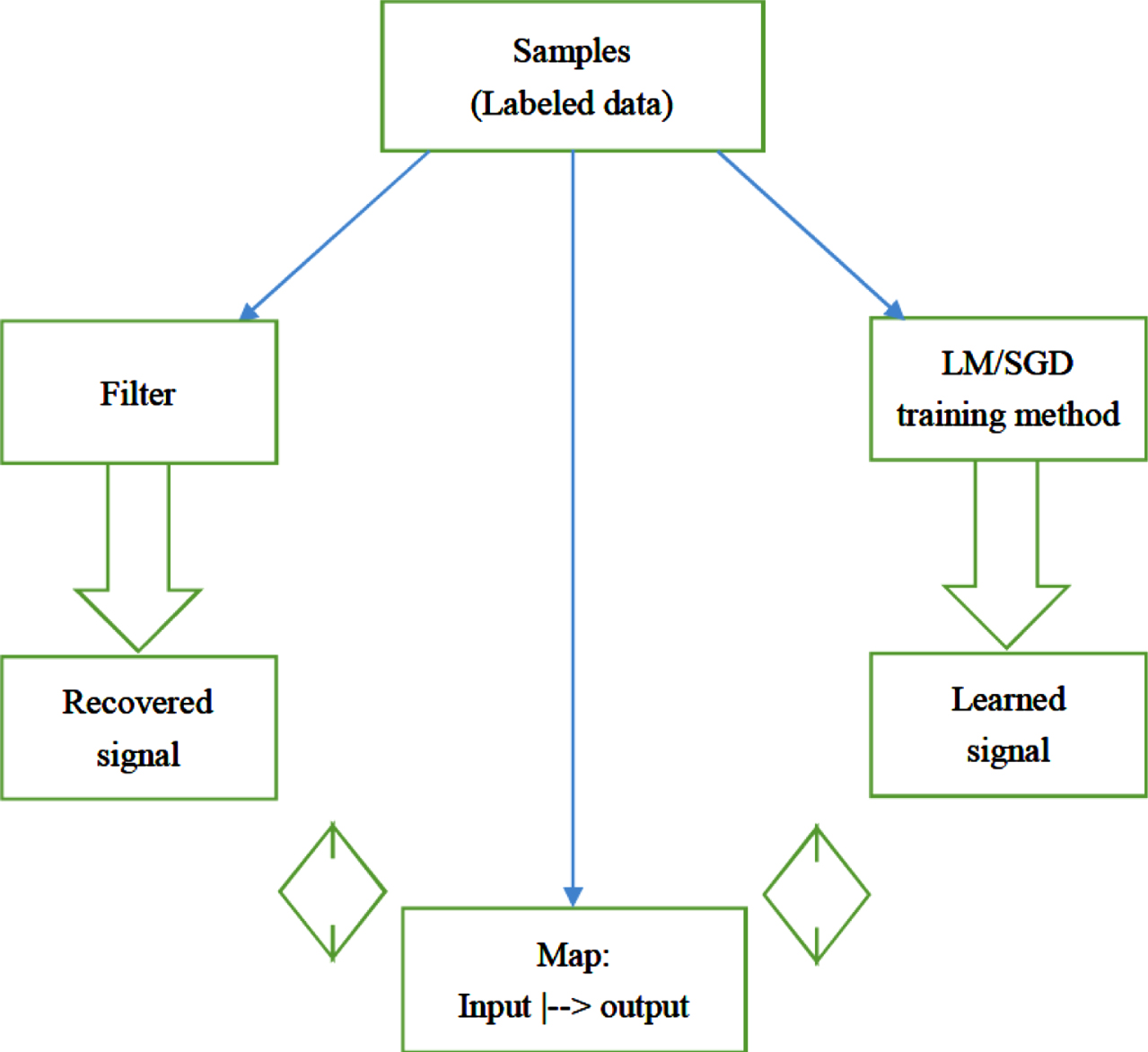
A comparison of signal recovery with supervised learning training.
In the next section, we will give some examples and experiments to show the equivalence between the process of supervised learning training and the process of signal recovery.

A signal with 4 different sampling rates. (a): Signals in the time domain. (b): Signals in the frequency domain.

Recovered signals and their spectrums. (a) The signals recovered by passing through lower pass filters. (b) Spectrums of the recovered signals.

Signals learned by the NN and their spectrums. (a) Signals learned by the NN. (b) Spectrums of the signals learned by the NN.

Average signals learned by the NN and their spectrums. (a) Average signals learned by the NN. (b) Spectrums of the average signals learned by the NN.
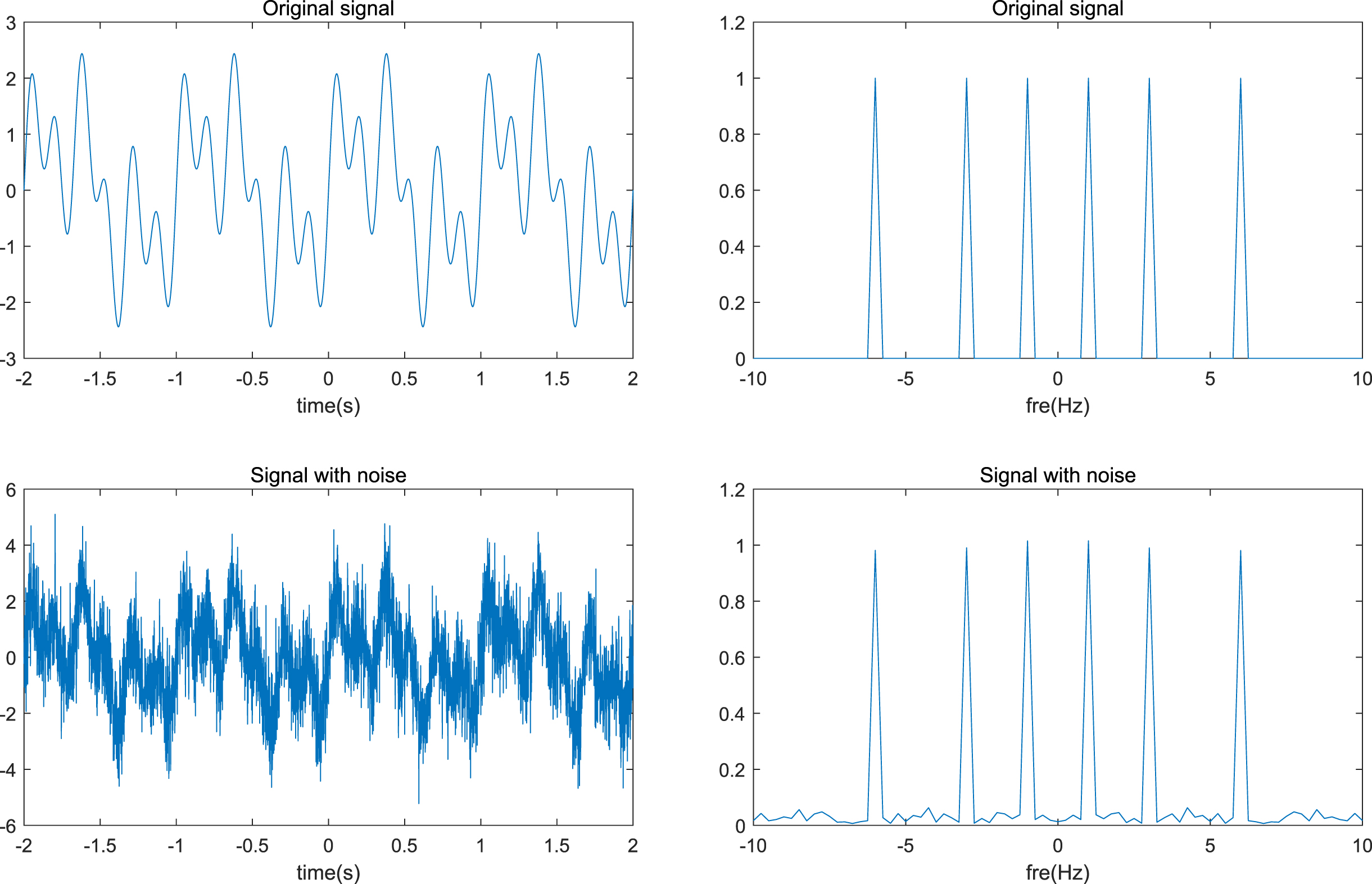
A signal with white noise. Left: the signal in the time domain. Right: the signal in the frequency domain.
The one-dimensional signal recovery and the neural network learning
The target signal is
The recovered signals and their spectrums are shown in Fig. 3(a) and (b), where signals are recovered by passing through lower pass filters [27]. When the sampling rate is 5Hz, only the component of 1Hz of s (t) is recovered. Meanwhile, an aliasing component of 2Hz is watched. This indicates that s (t) can not be recovered from the samples generated by the sampling rate of 5Hz since all the frequencies higher than 2.5Hz are lost and an aliasing component is made incorrectly. It is a similar case when the sampling rate is 8Hz: the components of 1Hz and 3Hz are recovered while the component of 6Hz is lost and an aliasing component of 2Hz is made. When the sampling rates are 13Hz and 15Hz, s (t) is recovered completely since these two sampling rates are larger than the Nyquist rate.
The sampling theorem provides a theoretical requirement of how to recover a signal by its samples. Correspondingly, machine learning methods provide concrete ways to recover the signal.
Establish a 1 × 100 × 1 neural network, and the training data are sampled by the rates of 5Hz, 8Hz, 13Hz, and 15Hz respectively. Parameters are set as: the learning rate lr = 0.002, the max epochs times = 30000 and the error target goal = 0.001. The training is implemented by the LM backpropagation method. Figure 4 shows signals learned by the neural network and spectrums of the signals respectively.
Compared with Fig. 3(b), it is noted that the signals learned by the neural network are nearly the same as the signals recovered by passing through lower pass filters. When the sampling rate is 5Hz, the components of 1Hz and 2Hz of s (t) are learned apparently, of which the 2Hz component is a faked frequency. Meanwhile, some frequencies lower than 4Hz are also learned, but they are also faked. When the sampling rate becomes larger and larger, that is, when the training data set becomes larger and larger, the components of 1Hz, 3Hz, and 6Hz are all learned while those faked lower frequencies disappear or become to nearly zero.
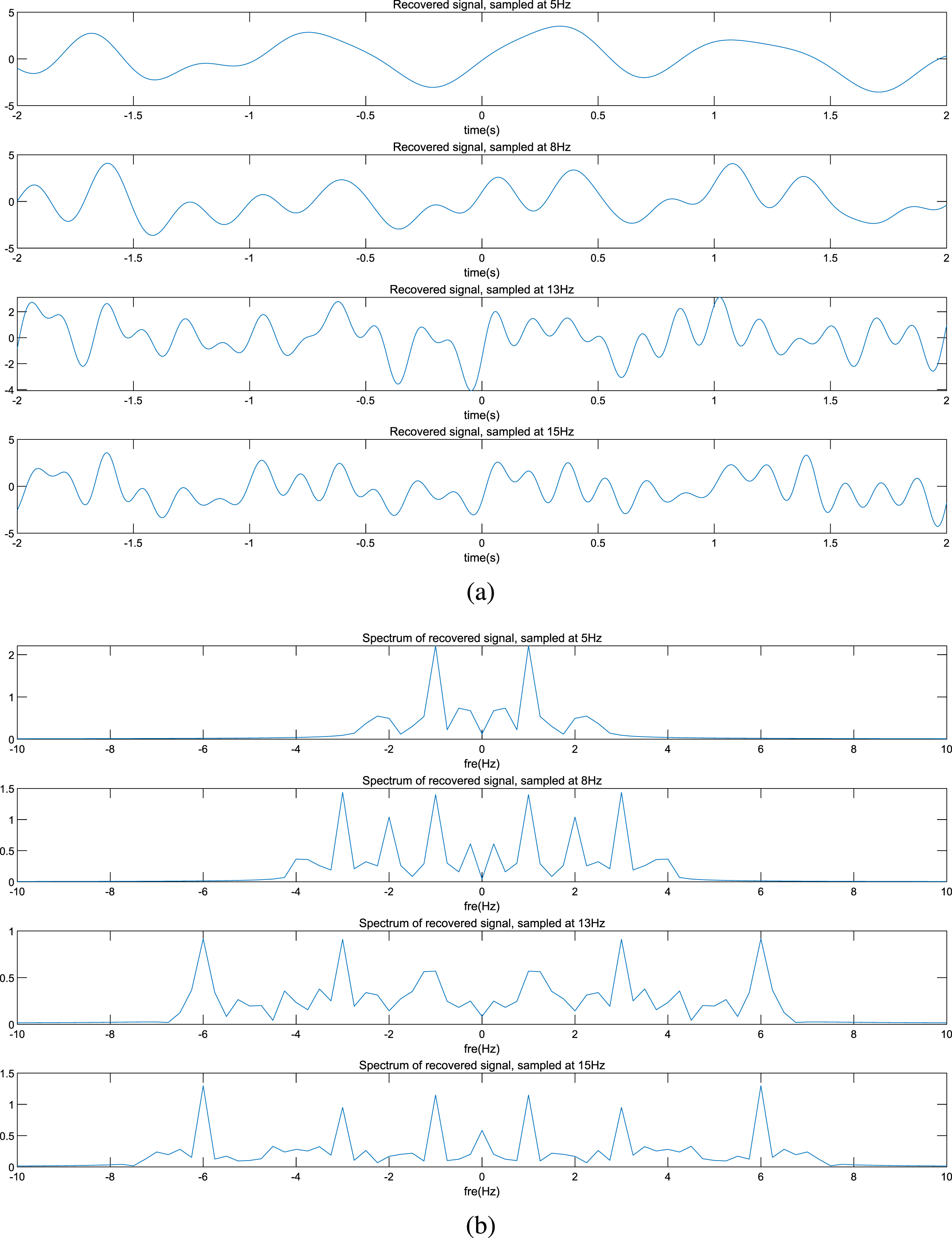
Recovered signals with different sampling rates and their spectrums, the original signal is mixed with white noise. (a) Recovered signals. (b) Spectrums of the recovered signals.
Since the initial parameters of the neural network are set randomly, we may wonder whether the learning results vary heavily at different simulations. Take the average signal of 3 times simulations as the output signal. Figure 5 displays the average signals in the time domain and their corresponding spectrums. It seems the results are nearly not affected by the initial random parameters.
This example in fact shows the equivalence between supervised learning of NN and signal recovery. Note that we employ the LM backpropagation method for NN training here, which is essentially a numerical training method. If we replace it with the standard backpropagation (BP) algorithm, we will find that it is difficult to learn the 6Hz component of the signal even if the sampling rate is 13Hz. This indicates that the least amount of training data we consider here is a theoretical guarantee, which does not suggest that the function can be learned with the least amount of training data by using a training method casually. It also shows that the numerical training methods like the LM algorithm are more effective when the samples dataset is relatively small.

Signals learned by the NN and their spectrums, data are mixed with white noise. (a) Signals learned by the NN. (b) Spectrums of the signals learned by the NN.
Data used in machine learning are always contaminated by various noises. In order to investigate the effect of noise, we examine the signal recovery and neural networks learning with noise. The gaussian white noise is adopted, where the standard deviation is σ = 1, as shown in Fig. 6.
The recovered signals and their spectrums are shown in Fig. 7(a) and (b), where the signals are recovered by passing through lower pass filters. Comparing Figs. 3(b) and 7(b), we notice that spectrums of 7(b) have non-zero amplitudes at nearly all the frequencies. It is because the spectrum of white noise is infinite theoretically.
Comparatively, the signals learned by neural networks trained with noisy data, and their spectrums are shown in Fig. 8(a) and (b). It is obvious that the learning results are affected by the noise since learned signals are distorted a little, however, the “real” frequencies of 1Hz, 3Hz and 6Hz can be recognized apparently. When the noise is heavy enough, that is σ is large enough, it is difficult to recover the signal or learn the signal from noisy training data.

The 2-D signal and its spectrum. (a) The 2-D signal. (b) Spectrum of the signal.
In practical tasks, the input data are always multi-dimensional. Similar to the one-dimensional signal recovery and the neural network learning experiments, we examine the case of two-dimensional signal recovery.
The target signal is
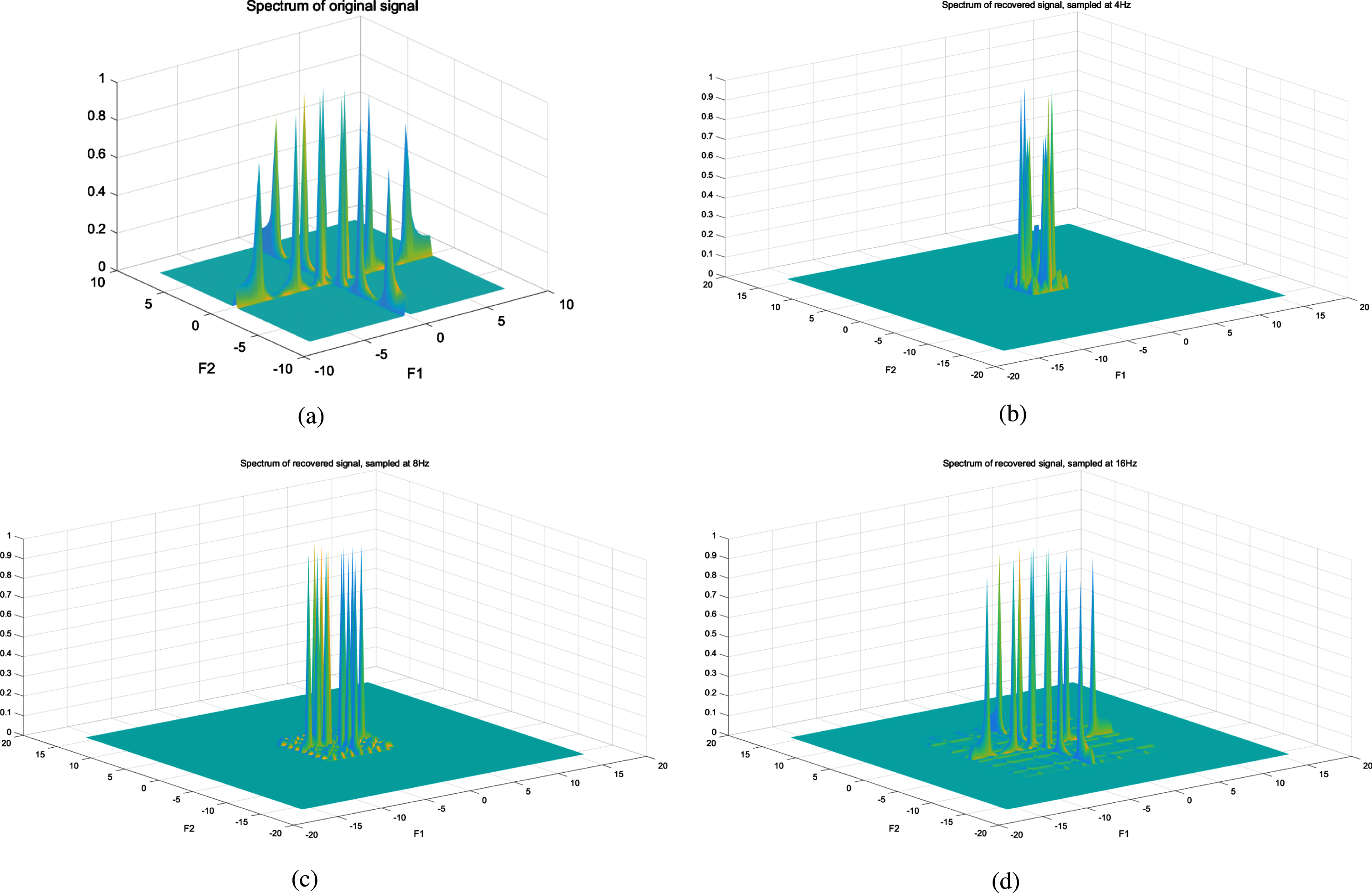
Spectrums of the recovered signals, where signals are recovered by passing through lower pass filters. (a) Spectrum of the original signal. (b) Sampling rate is 4Hz. (c) Sampling rate is 8Hz. (d) Sampling rate is 16Hz.
Figure 10 displays the recovered signals and their spectrums, where signals are recovered by passing through lower pass filters, the sampling rates are 4Hz, 8Hz, and 16Hz respectively. Figure 10(b) shows 6 peaks of the spectrum: (0, 1) , (1, 0) , (0, 1.75) , (1.75, 0), (0, 0.25) , (0.25, 0). The component of frequency 1Hz is recovered when the sampling rate is 4Hz. However, the aliasing components of 0.25Hz and 1.75Hz also appear. This phenomenon is consistent with the sampling theorem. When the sampling rate turns to 8Hz, components of 1Hz and 3Hz are recovered while an aliasing 2Hz appears. Finally, when the sampling rate is 16Hz, all the three components are recovered and there are no aliasing frequencies.
Assume s (t) has N training samples at some sampling rate, then s (x, y) has N2 training samples at the same rate. So we need a larger neural network to train samples of s (x, y). Establish a 1 × 550 × 1 neural network, and the training data are sampled by the rates of 4Hz, 8Hz and 16Hz respectively. Other parameters are the same as the neural network for s (t) in Equation (2).
Figure 11 shows spectrums of the signals learned by the neural network. When the sampling rate is 4Hz, only the low frequencies are learned, where the peak point is at (0, 0). Amplitudes of the ideal components (0, 1) and (1, 0) are about 0.1. When the sampling rate gets larger, more frequencies are learned. However, Fig. 11(b) and (c) tell us the training processes are not convergent at low sampling rates. When the rate turns to 16Hz, all the ideal components are learned. Figure 11(d) shows 3-class apparent peaks: amplitudes at (0, 1) and (1, 0) are 1 while amplitudes at (0, 3) and (3, 0) are 0.8594 and amplitudes at (0, 6) and (6, 0) are 0.3577.
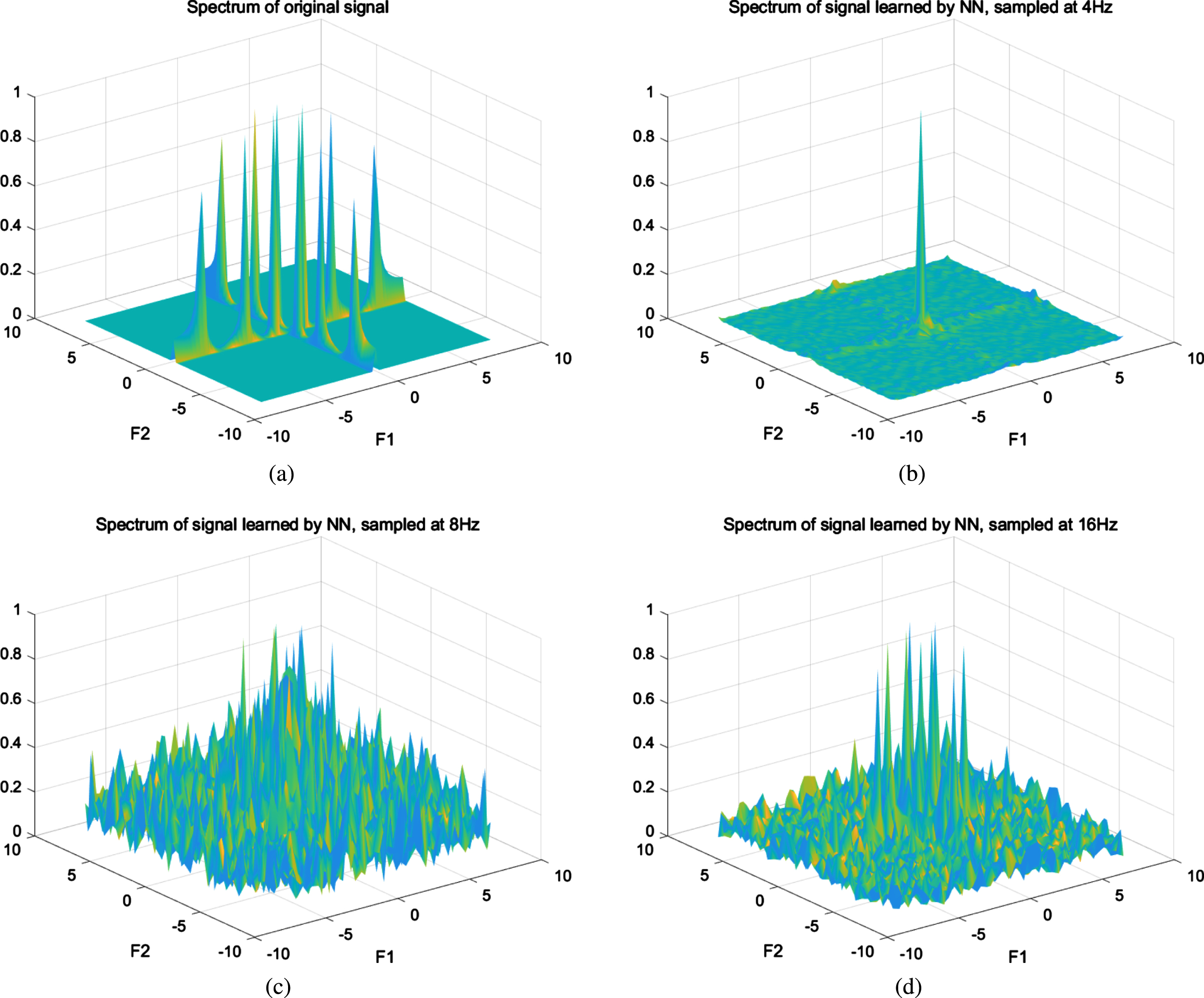
Spectrums of the signals learned by NN. (a) Spectrum of the original signal. (b) Sampling rate is 4Hz. (c) Sampling rate is 8Hz. (d) Sampling rate is 16Hz.
The Gaussian process regression (GPR) is a known machine learning method for regression tasks, which is mathematically equivalent to or closely related to many well known models under suitable conditions, including large neural networks and SVMs [32].
The target signal is also
Main parameters of GPR
Main parameters of GPR
The signals learned by the GPR and their spectrums are shown in Fig. 12 (a) and (b). Similar to Fig. 8, the components of 1Hz, 3Hz, and 6Hz are all learned correctly when the training dataset becomes larger and larger. However, when the sampling rates are 5Hz and 13Hz, the amplitudes of recovered signals are very small while the amplitudes increase to normal levels when the sampling rate is larger than 15Hz. This example also indicates that the least amount of training data we consider here is a theoretical lower bound, which is not enough for the GPR method. Meanwhile, the parameter setting will affect the results even if the training dataset remains the same. For example, if the kernel function in Table 1 is replaced by a rational quadratic function, more training data are required for the same precision level of the recovered signal.
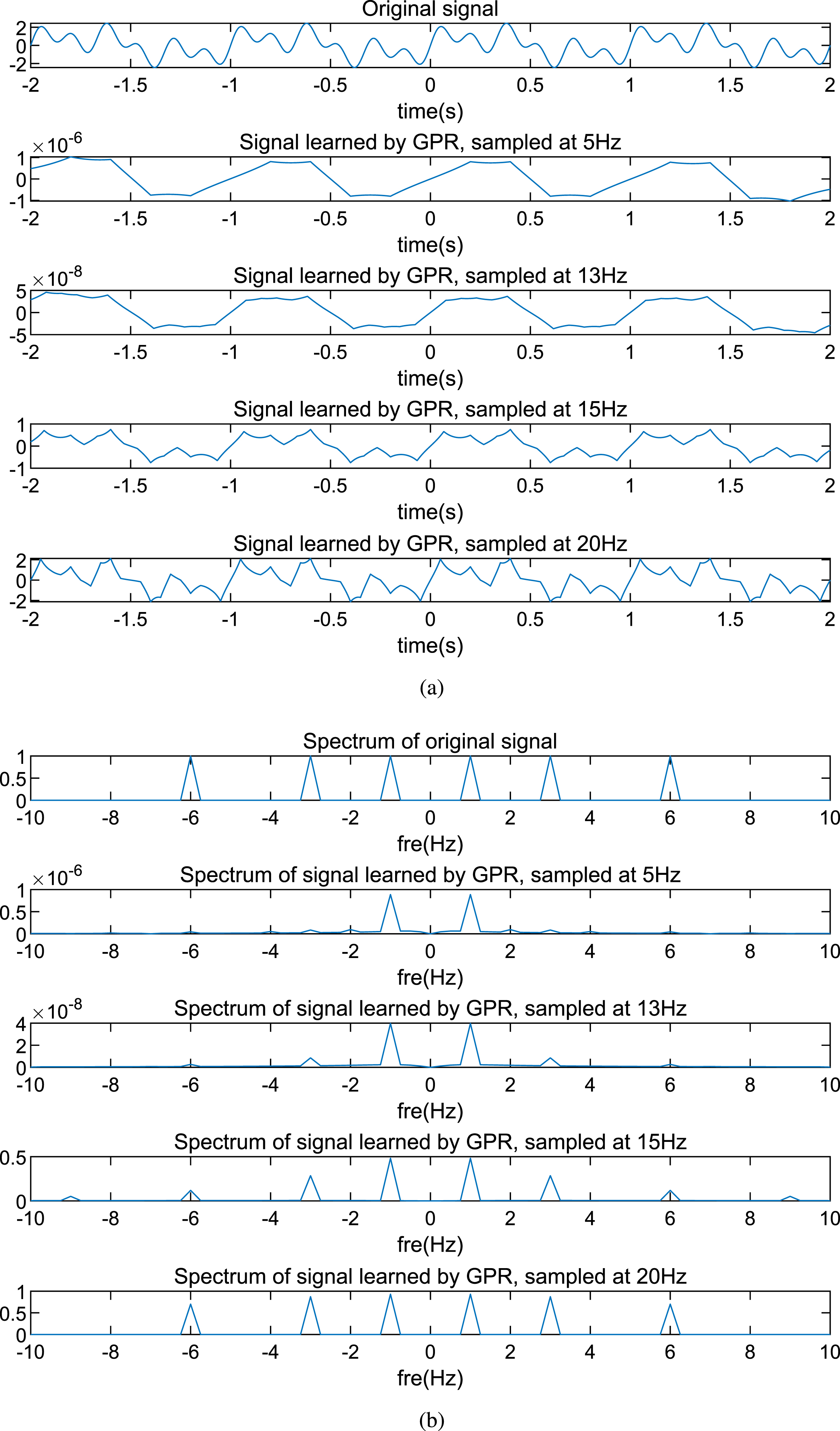
Signals learned by the GPR and their spectrums. (a) Signals learned by the GPR. (b) Spectrums of the signals learned by the GPR.
Experiments in section. 4 prove the high consistence between the signal recovery with sampling theorem and the supervised learning process. This fact inspires us to study machine learning with the help of signal processing methods and means, such as spectral analysis, time-frequency analysis and so on. Specifically, we can investigate the different stages of learning process with various initial data, learning models, and initial parameters. The aforementioned works on the F-Principle belong to this kind. Moreover, we can further apply the spectral analysis methods of signal processing to the influences of regularization methods, dropout operations [34], and so on.
Although the above experiments indicate that making the samples passing through a lower pass filter and training the samples both come to similar results, these two methods are different. On the one hand, the dimension of data for machine learning is usually far high than signal processing, then designing an appropriate filter for a high-dimensional signal is a difficult task. Meanwhile, the spectral analysis of high-dimensional signals requires huge computational costs. On the other hand, the current machine learning methods are already effective, and there exist many open-source frameworks to support these methods. However, although we do not utilize the lower pass filter to substitute the machine learning methods, investigating machine learning with the help of signal processing methods and means will provide a new perspective for the study of the internal mechanism of machine learning, and new ideas and inspiration for the design of new training methods and regularization methods.
Conclusion and future work
In this paper, we discuss the topic that what is the least amount of training data for a model from the perspective of the sampling theorem. If we take the target function of supervised learning as a multi-dimensional signal and the labeled data as samples, the training process can be regarded as a process of signal recovery. The main result is that the least amount of training data for a bandlimited task signal corresponds to a sampling rate which is larger than the Nyquist rate. Some numerical experiments are carried out to show the comparison between the learning process and signal recovery, which demonstrates the equivalence between the supervised learning and the signal recovery.
Although the spectral methods are not appropriate to apply to high-dimensional signals due to the costly computations, we can use them to reveal some underlying mechanisms of various supervised learning models, whether they are NN, kernel models, or fuzzy systems, especially those “black-box” NNs. For example, we can investigate how the influences of regularization methods act in the process of learning from the perspective of frequency domain. On the contrary, we can design new training methods and regularization methods based on the previous spectral analysis results.
Footnotes
Acknowledgments
The authors are very grateful to the reviewers for their comments and suggestions which have improved the paper. This work was supported in part by the Sichuan Science and Technology Program (No. 2021YJ0526 and No. 2022NSFSC1840), the open fund of Sichuan National Applied Mathematics Center (No. 2022-KFJJ-01-002), and the Exploration Project of Zhejiang Natural Science Foundation (No. LQ20G010004).
Conflict of interest
The authors declare that there is no conflict of interest regarding the publication of the paper.