



Abstract
Attribute significance is very important in multiple-attribute decision-making (MADM) problems. In a MADM problem, the significance of attributes is often different. In order to overcome the shortcoming that attribute significance is usually given artificially. The purpose of this paper is to give attribute significance computation formulas based on inclusion degree. We note that in the real-world application, there is a lot of incomplete information due to the error of data measurement, the limitation of data understanding and data acquisition, etc. Firstly, we give a general description and the definition of incomplete information systems. We then establish the tolerance relation for incomplete linguistic information system, with the tolerance classes and inclusion degree, significance of attribute is proposed and the corresponding computation formula is obtained. Subsequently, for incomplete fuzzy information system and incomplete interval-valued fuzzy information system, the dominance relation and interval dominance relation is established, respectively. And the dominance class and interval dominance class of an element are got as well. With the help of inclusion degree, the computation formulas of attribute significance for incomplete fuzzy information system and incomplete interval-valued fuzzy information system are also obtained. At the same time, results show that the reduction of attribute set can be obtained by computing the significance of attributes in these incomplete information systems. Finally, as the applications of attribute significance, the attribute significance is viewed as attribute weights to solve MADM problems and the corresponding TOPSIS methods for three incomplete information systems are proposed. The numerical examples are also employed to illustrate the feasibility and effectiveness of the proposed approaches.
Introduction
Multi-attribute decision-making (MADM) is usually used to analyze a set of feasible alternatives, its main aim is to ranking the alternatives or to determine the best alternative. It is a common task in human activities, which can be very simple or very complex. Generally speaking, a MADM problem can be displayed as a decision matrix with m feasible alternatives A1, A2, ⋯ , A m , that based on a attributes set C = {c1, c2, ⋯ , c n } must be ranked and the best alternative should be chosen by decision maker. In real MADM, the decision maker needs to finish the evaluation of the given feasible alternatives by various types of evaluation conditions such as crisp numbers, fuzzy numbers, linguistic values, etc. MADM has been widely used in various fields, such as supply chain network [26], business performance [3, 41], risk evaluation [4, 21], biomedical problems [50], hospital service quality evaluation [48], etc. At the same time, in order to make MADM more flexible in dealing with fuzzy or uncertain problems, MADM is often combined with other matured uncertain theories, such as rough set [9, 40], fuzzy set [15, 35], intuitionistic fuzzy set [10–12, 46] and so on.
There are some sophisticated approaches for solving MADM problem. Technique for order performance by similarity to ideal solution (TOPSIS), as an common and classical method for solving MADM problem, was proposed for the first time by Hwang and Yoon [18]. Its main idea is that the best alternative should have the shortest distance from the positive-ideal solution and the longest distance from the negative-ideal solution. In the last few decades, many of real-world case studies for TOPSIS method are established such as earth-quake risk assessment [21], healthcare services [27], optimization of composite materials [39], virtual enterprise partner selection [46], etc. Meanwhile, considering that in some cases, it is difficult to determine the exact values of the elements, a number of extended TOPSIS methods have been proposed as well [1, 49]. For example, Chu and Lin [7] proposed an interval arithmetic based fuzzy TOPSIS model to complete the fuzzy TOPSIS model. Jahanshahloo et al. [20] presented another method for solving MADM problems by TOPSIS method consisting of interval data. Kacprzak [22] proposed TOPSIS method of group decision making based on ordered fuzzy number. Palczewski and Salabun [36] briefly reviewed the application of fuzzy TOPSIS method from 2009 to 2018, and indicated that fuzzy TOPSIS method has been widely and successfully applied in the fields of supply chain, environment, energy sources, business, healthcare and so on. Keikha et al. [23] combined the Choquet integral with TOPSIS method and applied to multi-attribute group decision making (MAGDM) problems.
Whether it is a classical TOPSIS method or an extended TOPSIS method, the attribute weights plays an important role. In practical MADM problems, different attributes often have different significance even some attributes are superfluous. It is very important to determine the weight of attributes (criteria) because the weight of attributes will obviously affect the result of decision-making [6]. In general, in a MADM problem, decision maker must consider two aspects: one is attribute significance (it can be viewed as attribute weights), another is attribute reduction. Some authors have considered it, but often only one aspect is discussed. For instance, Kryszkiewicz [24] used the rough set approach, and proposed reduction of knowledge which is unnecessary in classification. Liang et at. [31] discussed the relationships among information entropy, rough entropy and knowledge granulation, a method to measure attribute significance in incomplete information systems is given as well. Lu et at. [35] discussed the influential weights of the factors and used the integrated fuzzy MADM approach to study the relationship of the factors. Sun et at. [40] constructed a ¦Ä neighborhood relation for fuzzy MADM information system and subsequently established the variable precision fuzzy rough set model to solve MAGDM problem, the attribute weight for diversified attribute fuzzy decision making information systems is given by defining the distance between alternatives. Zhang et at. [50] in order to obtain the weights of a set of criteria by means of real-world data, presented an new method based on the covering-based variable precision intuitionistic fuzzy rough set (CVPIFRS) models.
We notice that most of the existing research results are for complete information systems. The process of determining the attribute weight is to deeply mine the relationship and influence between the attributes, and then determine the attribute weight. However, in real-word situation, there are many MADM problems which some attributes values are sometimes missing [32, 33]. To represent this situation, a distinguishable value so-called null value, is usually assigned to these attributes. This information system is called incomplete information system [8, 51]. Generally speaking, incomplete information system refers to the system with unknown values which recorded as null value. Certainly, we do not consider the null value as inapplicable value. Though knowledge acquisition methods have mainly been discussed for complete information systems over the years, some important results have been also acquired for incomplete information systems [2, 51].
At present, in the MADM based on incomplete information, the literature which gives the formula of attribute significance is rare. The main purpose of this paper is to give the calculation formula of attribute significance on three kinds of common incomplete information systems (incomplete linguistic information system, incomplete fuzzy information system and incomplete interval-valued fuzzy information system) from the perspective of inclusion degree. Firstly, we define the tolerance relation, dominance relation and interval dominance relation on three kinds of incomplete information systems. Then we classify the objects in the universe according to the attribute set, and measure the influence of removing an attribute from the attribute set on the classification results. Finally, combining with the inclusion theory, we give the corresponding calculation formula of attribute significance. The advantage of our results is that we can not only get the reduction of attribute set in MADM based on incomplete information, but also get the weight of attributes, and then apply the weight of attributes to MADM problems. The framework of this paper is shown in Fig. 1.
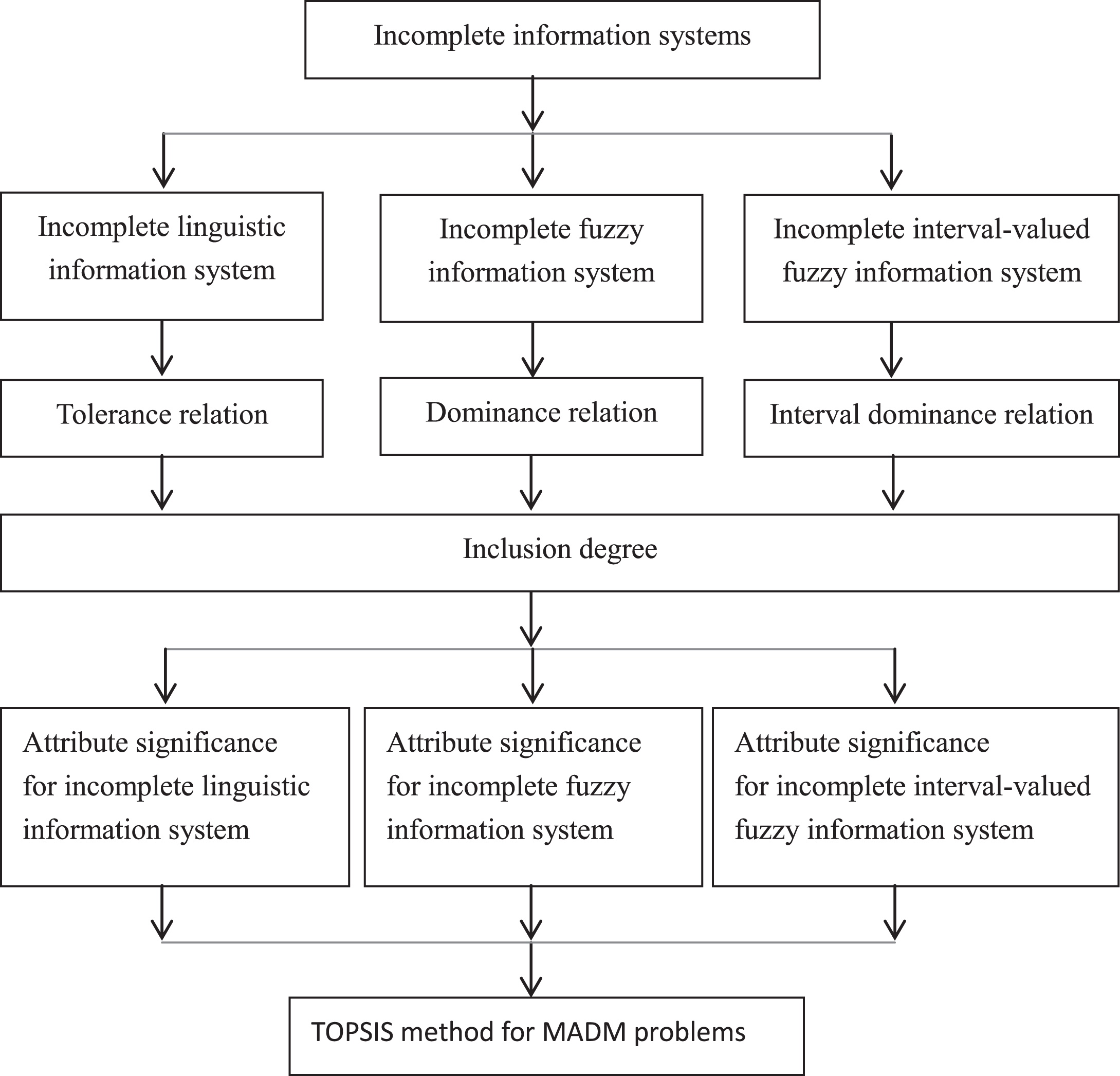
Frame diagram of the paper.
The paper is organized as follows. In the Section 2, we introduce three specific incomplete information systems, including incomplete linguistic information system, incomplete fuzzy information system and interval-valued fuzzy information system. Section 3 gives the attribute significance of incomplete linguistic information systems, incomplete fuzzy information systems and incomplete interval-valued fuzzy information systems, and the computation formulas are also got. Section 4, attribute significance presented in this paper is regarded as attribute weight, the corresponding TOPSIS methods for three specific incomplete information system are proposed. At the same time, the practical examples employed to show the effectiveness and feasibility of the proposed method. Finally, we make a conclusion for this paper and put out the future research work directions in Section 5.
Generally, an information system can be denoted as 〈U, AT, V, f〉, where U is the universe, AT represents a set of attributes, V = ∪ a∈ATV a in which V a is the value of the attribute a. f is an information function which can be represented by f : U × AT → V, that is for any a ∈ AT and x ∈ U, we have f (x, a) ∈ V a .
For every attribute A ⊆ AT, a ∈ A, an indiscernibility relation IND (A) can be determined as follows:
In fact, the above indiscernibility relation is an equivalence relation, i.e., IND (A) is reflexive, symmetrical and transitive. And then, with respect to IND (A), we can define an partition on U as follows:
Knowledge discovery in information system is a process of classifying objects in the universe according to attribute values. From the perspective of cognition, people need to recognize those object sets that can not be accurately represented by classification, which is called rough sets [30]. In the traditional Pawlak rough set model [37], equivalence relation often plays an important role. In this classical rough sets model, the upper and lower approximations are based on equivalence relation, and this rough set method is very suitable for analyzing multi-attribute decision-making problems based on complete information systems [9, 13]. We have to admit that this equivalence relation is too strict because the binary relation on the universe is often not equivalence relation in some practical problems. For this reason, some scholars have extended the equivalence relation to generalized binary relations, such as similarity relation [8], tolerance relation [24], dominance relation [44], neighborhood relation [45], covering-based relation [49], etc.
In the process of knowledge discovery, the objects in the universe should be classified according to the attribute values. But in some information system, attribute values of an object may be missing. In order to represent this situation, we usually specify a distinguishable value so-called null value to these attributes. In this paper, null value is denoted by *. If V a includes null value, then we call 〈U, AT, V, f〉 an incomplete information system.
We note that for a specific information system, in the process of knowledge discovery or multi-attribute decision-making, two aspects must be considered, one is the reduction of attribute sets and the other is the weight of attributes. Both of these aspects need to classify the objects firstly according to the attribute values. But in an incomplete information system, the objects which attribute values are missing cannot be classified. In the common process of knowledge discovery, data preprocessing is usually used to fill the missing data. For instance, in Ref. [44], for one attribute a ∈ A, if the right endpoint of an interval value is missing, then the unknown value is replaced with the maximum attribute value of a; if the left endpoint of an interval value is missing, then the unknown value is replaced with the minimum attribute value of a; if the left and right endpoints of an interval value are both missing, then the unknown upper value is replaced with the maximum attribute value and the unknown lower value is replaced with the minimum attribute value of a.
However, above method of filling data lacks its rationality. As a matter of fact, there is not a very reasonable method to fill the missing data. In the case of some information or data are missing, how to directly establish attribute reduction and attribute importance calculation method without data preprocessing, this problem is worthy to be studied. At present, there are some scholars have used rough sets method to deal with incomplete information [24, 31]. Inspired by the idea of generalizing equivalence relation to generalized binary relation in rough sets theory, the main purpose of this paper is to directly establish the calculation formula of attribute significance by means of generalized binary relation such as tolerance relation, dominance relation and interval dominance relation without data preprocessing.
In some information systems, the attribute values usually expressed by linguistic variables. For example, the safety of a car can be described by linguistic variables such as High, Middle and Low. But in practical problems, some attribute values described by such linguistic variables sometimes are missing, in this case, we call it the incomplete linguistic information system.
Suppose that U = {x1, x2, ⋯ , x
n
}, then S
A
(x
i
) is usually named the tolerance class of x
i
. Furthermore,
Incomplete linguistic information system
According to Eq. (6), we can obtain that
U/SIM (AT) = {S AT (x1) , S AT (x2) , S AT (x3) , S AT (x4) , S AT (x5) , S AT (x6)} = {{x1} , {x2, x6} , {x3} , {x4, x5} , {x4, x5, x6} , {x2, x5, x6}} .
If in an information system 〈U, AT, V, f〉, AT is the set of fuzzy attributes, and every attribute values V a ∈ [0, 1], a ∈ AT, then we call it a fuzzy information system. For the sake of simplicity, it is still denoted by 〈U, AT, V, f〉.
Furthermore, if some attribute values are unknown to us (* is also used to express unknown value), then the corresponding fuzzy information system is called an incomplete fuzzy information system and still denoted by 〈U, AT, V, f〉, without causing confusion.
According to this dominance relation, xD≽ (A) y can be interpreted as x at least as good as y with respect to A, or it can be understand as x dominates y under attribute A.
In addition,
Incomplete linguistic information system
By Definition 2.2, with respect to AT, we can obtain that
For an fuzzy information system 〈U, AT, V, f〉, if for each attribute, its attribute always be expressed as interval numbers, then 〈U, AT, V, f〉 is called an interval-valued fuzzy information system. That is to say, for any x ∈ U and a ∈ AT, f (x, a) = [a L (x) , a R (x)] is an interval number, where a L (x), a R (x) ∈ [0, 1] and a L (x) < a R (x).
Similarly, if some attribute values are lost or unknown to us, then the corresponding information system is called an incomplete interval-valued fuzzy information system and still denoted by 〈U, AT, V, f〉, without causing confusion.
For an incomplete interval-valued fuzzy information system, there are three types about unknown values: f (x, a) = [a L (x) , *] or f (x, a) = [* , a R (x)] or f (x, a) = [* , *] .
In addition, in incomplete interval-valued fuzzy information system 〈U, AT, V, f〉, with respect to attribute A, the interval dominance class of x can be defined as follows:
An incomplete interval-valued fuzzy information system
By Definition 2.3, with respect to AT, we can obtain that
In a MADM problem, the significance of attributes are usually different. For example, if we want to evaluate a car, the attribute Price is usually more important than the attribute Colour. In this section, we attempt to get the formulas to compute the attribute significance of three incomplete information systems.
Attribute significance of incomplete linguistic information system
(1) 0 ≤ I (b/a) ≤1,
(2) a ≤ b ⇒ I (b/a) =1,
(3) a ≤ b ≤ c ⇒ I (a/c) ≤ I (a/b) .
In particular, if P (U) represents the powerset of U, and for A, B ∈ P (U), let
For the convenience of calculation, in this following, we suppose that
U/SIM (AT) = {{x1} , {x2, x6} , {x3} , {x4, x5} , {x4, x5, x6} , {x2, x5, x6}}
U/SIM (AT - {P}) = {{x1, x2, x6} , {x1, x2, x6} , {x3} , {x4, x5, x6} , {x4, x5, x6} , {x1, x2, x4, x5, x6}}
U/SIM (AT - {S}) = {{x1} , {x2, x6} , {x3, x4, x5, x6} , {x3, x4, x5} , {x3, x4, x5, x6} , {x2, x3, x5, x6}}
U/SIM (AT - {M}) = {{x1} , {x2, x6} , {x3} , {x4, x5} , {x4, x5, x6} , {x2, x5, x6}}
U/SIM (AT - {W}) = {{x1, x4, x5} , {x2, x5, x6} , {x3} , {x1, x4, x5} , {x1, x2, x4, x5, x6} , {x2, x5, x6}}
Thus, according to Eq. (12), the significance of four attributes P, S, M, W can be computed as follows, respectively:
Above results show that in an incomplete linguistic information system, the indispensable attribute a can be characterized by sig (a) >0, and the superfluous attribute a can be characterized by sig (a) =0. That is to say, we can easily obtain the attribute reduction by computing the significance of attributes.
That is, in attribute sets AT, M is a superfluous attribute, P, S and W are indispensable attributes. Thus {P, S, W} is the reduction of AT.
Thus the significance of attribute a in AT can be defined as
U/D≽ (AT) = {{x1, x2, x5} , {x2, x3, x5} , {x3, x5} , {x4, x5} , {x5} , {x1, x5, x6}} .
In addition, we can obtain that
That is,
U/D≽ (AT - {a1})
= {{x1, x2, x5} , {x1, x2, x3, x4, x5, x6} , {x3, x5} , {x4, x5} , {x5} , {x1, x4, x5, x6}} .
Similarly,
U/D≽ (AT - {a2})
= {{x1, x2, x5} , {x2, x3, x5} , {x3, x5} , {x4, x5} , {x5} , {x1, x2, x3, x5, x6}} ,
U/D≽ (AT - {a3})
= {{x1, x2, x3, x5, x6} , {x2, x3, x5} , {x3, x4, x5, x6} , {x4, x5, x6} , {x5} , {x1, x5, x6}},
U/D≽ (AT - {a4})
= {{x1, x2, x5} , {x2, x3, x5} , {x1, x3, x5} , {x1, x4, x5} , {x5} , {x1, x5, x6}} .
Thus, according to Eq. (13), the significance of four attributes a1, a2, a3 and a4 can be computed as follows, respectively:
Above results show that in an incomplete fuzzy information system, the indispensable attribute a can be characterized by sig (a) >0, and the superfluous attribute a can be characterized by sig (a) =0. That is, we can also get the reduction of attribute set by computing the significance of attributes in incomplete fuzzy information system.
Thus the significance of attribute a in AT can be defined as
Theorem 3.5 shows that in an incomplete interval-valued fuzzy information system, the indispensable attribute a can be characterized by sigI (a) >0, and the superfluous attribute a can be characterized by sigI (a) =0. It implies we can obtain the reduction of attribute set by computing the significance of attributes in incomplete interval-valued fuzzy information system.
= 1 - (1 ∧ 1 ∧1 ∧ 1 ∧1 ∧ 1) =1 - 1 =0,
Therefore, in attribute set AT, a1, a3 and a4 are indispensable attributes, while a2 is a superfluous attribute. That is, {a1, a3, a4} is a reduction of AT.
In order to show the advantages of our method, this section compare the proposed method with the existing methods.
(1) In Ref. [24], Kryszkiewicz used rough set method, obtained that attribute reduction of attribute sets AT = {P, S, M, W} given by Table 1 is {P, S, W}. In Example 3.2 of this paper, by calculating the significance of each attribute, we show that M is a superfluous attribute, P, S and W are indispensable attributes. Thus {P, S, W} is the reduction of AT. Result of Example 3.2 is consistent with Ref. [24]. The advantage of presented method in this paper is that not only the significance of each attribute can be given, but also the reduction of attribute set can be obtained.
(2) In Ref. [44], if f (x, a) = [a L (x) , *], then the unknown value is replaced with the maximum attribute value of a; if f (x, a) = [* , a R (x)], then the unknown value is replaced with the minimum attribute value of a; if f (x, a) = [* , *], then unknown upper value is replaced with the maximum attribute value and unknown lower value is replaced with the minimum attribute value of a. However, this approach is unreasonable. For instance, in Table 2, f (x2, a3) = [* , 0.6], in this case, the unknown lower limit may equal to any value between 0 and 0.6 instead of equal to 0.2. In order to explain such unknown value and to classify objects reasonably, we defined the new dominance relation In Definition 2.3.
(3) If 〈U, AT, V, f〉 is a complete interval-valued information system, the interval dominance relation defined in Definition 2.3 would degenerated into the dominance relation defined in Ref. [9]. That is, the interval dominance relation proposed in Definition 2.3 is the extension of dominance relation in Ref. [9].
(4) In Ref. [38], the attribute reduction problem in incomplete ordered information systems with fuzzy decision is presented. Meanwhile, by lower approximation of each fuzzy decision class, the significance of a in B (B is condition attribute) relative to D (D is decision attribute) is defined by
(5) In Ref. [6], based on the evidential reasoning, a method of deriving attribute weights from incompatibility among attributes is developed. Ref. [6] used compatibility measure to obtain the attribute weights. In our paper, from the perspective of inclusion degree, we give a new method to calculate the attribute weights. Moreover, our method is more convenient to calculate.
The applications of attribute significance to MADM with incomplete information
In this section, we will regard the attribute significance presented in the Section 3 as the attribute weights, and apply it to the MADM problem. TOPSIS is a widely used multi-attribute decision-making method. In this method, positive ideal solution is one that maximizes the benefit attribute and minimizes the cost attribute, while negative ideal solution maximizes the cost attribute and minimizes the benefit attribute. The main idea of this method is that the final selected alternative should be as close as possible to the positive ideal solution and as far away from the negative ideal solution.
When using TOPSIS method to copy with MADM problem, we first need to determine the attribute weights and the attribute values of each alternative. However, sometimes available information is incomplete, some attribute values of an alternative may be missing or unknown. In this way, we often get incomplete information system. In an incomplete information system, how to making decision is a considerable problem for decision-makers. In this section, we view the attribute significance proposed in Section 3 as attribute weights and discuss three common MADM problems with incomplete information.
TOPSIS method for incomplete linguistic information systems
If 〈U, AT, V, f〉 is an incomplete linguistic information system, U = {x1, x2, ⋯ , x l }, attribute set AT = {R1, R2, ⋯ , R n }. The TOPSIS method for incomplete linguistic information systems is proposed as follows:
Step 1. According to practical problem, generate possible alternatives A1, A2, ⋯ , A m . Evaluate alternatives in terms of attributes as follows:
First, according to jth attribute R j (j = 1, 2, ⋯ , n), obtain tolerance class S R j (x s ) (s = 1, 2, ⋯ , l).
Furthermore, alternative A
i
(i = 1, 2, ⋯ , m) can be transformed into a fuzzy set
So, the attribute values can be determined as
Step 2. Construct the decision-making matrix N = (x
ij
) m×n, and then get normalized decision-making matrix D = (n
ij
) m×n, where
Step 3. View the attribute significance which obtained in Section 3.1 as attribute weights, obtain weighted normalized decision-making matrix D′ = (v
ij
) m×n, where
Step 4. Positive and negative ideal solutions can be determined as follows, respectively:
Step 5. Calculate the separation measures. The separation of alternative A
i
(i = 1, 2, ⋯ , m) from A+ and A- can be obtained as follows, respectively:
Step 6. The closeness of alternative A
i
closed to positive ideal solutions is defined as
Step 7. Sequencing alternatives. The alternatives can be sequenced on the basis of descending order of
In the following part, using the attribute significance of incomplete linguistic information system, we present a numerical example about proposed TOPSIS method for incomplete linguistic information system to illuminate its application in MADM with incomplete linguistic information.
A1 = {x2, x3, x5}, A2 = {x3, x5, x6},
A3 = {x2, x3, x6}, A4 = {x4, x5, x6}.
Now, we need to decide which alternative should be chosen:
Step 1. Evaluate alternatives in terms of attributes:
According to attribute P, we have
S P (x1) = {x1, x3, x4, x5} ,
S P (x2) = {x2, x3, x5, x6} ,
S P (x3) = {x1, x2, x3, x4, x5, x6} ,
S P (x4) = {x1, x3, x4, x5} ,
S P (x5) = {x1, x2, x3, x4, x5, x6} ,
S P (x6) = {x2, x3, x5, x6} .
Then, we can transform A1, A2, A3, A4 into four fuzzy sets and can obtain that
Similarly, according Eq. (14), we have
Step 2. According to the attribute values obtained above, construct decision-making matrix N and normalized decision-making matrix D as follows, respectively:
Step 3. Using the attribute significance, get the weighted normalized decision-making matrix.
Significance of attribute P, S, M and X denoted as ω1, ω2, ω3 and ω4, respectively. By Example 3.1, we have
Therefore, D′ = (v
ij
) m×n (where
Step 4. In this example, we note that S, M, W are benefit attributes, P are cost attribute. By Eq. (17) and (18), the positive and negative ideal solutions can be determined as follows, respectively:
Step 5. According to Eq. (19), the separation of alternative A1, A2, A3, A4 from A+ and A- can be obtained as follows, respectively:
Step 6. According to Eq. (20), the closeness of alternative A1, A2, A3, A4 closed to positive ideal solutions can be obtained as follows:
Step 7. Thus, the alternatives can be ranked as:
That is, A4 should be chosen finally in this MADM.
If 〈U, AT, V, f〉 is an incomplete fuzzy information system, U = {x1, x2, ⋯ , x l }, fuzzy attribute set AT = {a1, a2, ⋯ , a n }. Similar to Section 4.1, the TOPSIS method for incomplete fuzzy information systems is proposed as follows:
Step 1. According to practical problem, generate possible alternatives A1, A2, ⋯ , A m . Evaluate alternatives in terms of attributes as follows:
First, according to jth attribute a
j
(j = 1, 2, ⋯ , n), obtain tolerance class
Furthermore, alternative A
i
(i = 1, 2, ⋯ , m) can be transformed into a fuzzy set
Thus, we can determine
Step 2. Construct decision-making matrix N = (x
ij
) m×n, and then calculate the corresponding normalized decision-making matrix D = (n
ij
) m×n, where
Step 3. Uing attribute significance which obtained in Section 3.2, obtain the weighted normalized decision-making matrix D′ = (v
ij
) m×n, where
Step 4. Positive and negative ideal solutions can be determined as follows, respectively:
Step 5. Calculate the separation measures. The separation of alternative A
i
(i = 1, 2, ⋯ , m) from A+ and A- can be obtained as follows, respectively:
Step 6. The closeness of alternative A
i
closed to positive ideal solutions is defined as
Step 7. Sequencing alternatives. The alternatives can be sequenced on the basis of descending order of
From the incomplete fuzzy information given in Table 2, this company wants to form a translation team composed of three candidates.
According to the incomplete fuzzy information provided by Table 2, this company offer four possible alternatives A1, A2, A3, A4, where A1 = {x1, x2, x4}, A2 = {x1, x4, x6}, A3 = {x2, x3, x4}, A4 = {x2, x4, x6}.
Now, we decide which alternative should be chosen:
Step 1. Evaluate alternatives in terms of attributes a1, a2, a3 and a4:
According to attribute a1, we have
Then, under attribute a1, we transform A1, A2, A3, A4 into four fuzzy sets can obtain that
Similarly, we have
Step 2. According to attribute values obtained above, calculate decision-making matrix N and normalized decision-making matrix D as follows:
Step 3. Using the attribute significance, get the weighted normalized decision-making matrix.
The attribute significance of a1, a2, a3 and a4 denoted as ω1, ω2, ω3 and ω4, respectively. By Example 3.4, we have
Therefore, D′ = (v
ij
) m×n (here
Step 4. In this example, we note that a1, a2, a3 and a4 are all benefit attributes. So positive and negative ideal solutions can be determined as follows, respectively:
Step 5. The separation of alternative A1, A2, A3, A4 from A+ and A- can be obtained as follows, respectively:
Step 6. The closeness of alternative A1, A2, A3, A4 closed to positive ideal solutions can be obtained as follows:
Step 7. Thus, the alternatives can be ranked as:
So we can obtain, in this case, A1 should be chosen finally.
TOPSIS method for incomplete interval-valued fuzzy information systems
Suppose that 〈U, AT, V, f〉 is an incomplete interval-valued fuzzy information system. Similar to Section 4.2, the TOPSIS method on it can be established as follows:
Step 1. According to practical problem, generate possible alternatives A1, A2, ⋯ , A m . Evaluate alternatives in terms of attributes as follows:
First, according to jth attribute a
j
(j = 1, 2, ⋯ , n), obtain tolerance class
Furthermore, alternative A
i
(i = 1, 2, ⋯ , m) can be transformed into a fuzzy set
Thus, we can determine
Step 2. Construct decision-making matrix N = (x
ij
) m×n, and then calculate the corresponding normalized decision-making matrix D = (n
ij
) m×n, where
Step 3. Using the attribute significance obtained in Section 3.3, obtain the weighted normalized decision-making matrix D′ = (v
ij
) m×n, here
Step 4. Positive and negative ideal solutions can be determined as follows, respectively:
Step 5. Calculate the separation measures. The separation of alternative A
i
(i = 1, 2, ⋯ , m) from A+ and A- can be obtained as follows, respectively:
Step 6. The closeness of alternative A
i
closed to positive ideal solutions is defined as
Step 7. Sequencing alternatives. The alternatives can be sequenced on the basis of descending order of
Now, we decide which alternative should be chosen:
Step 1. Evaluate alternatives in terms of attributes a1, a2, a3 and a4:
According to attribute a1, we have
Then, under attribute a1, we transform four alternatives A1, A2, A3, A4 into four fuzzy sets and we can obtain that
Similarly, we can obtain that
Step 2. According to the attribute values obtained above, calculate the decision-making matrix N and the corresponding normalized decision-making matrix D as follows:
Step 3. Using the attribute significance obtained in Section 3.3, obtain the weighted normalized decision-making matrix.
Attribute significance of a1, a2, a3 and a4 denoted as ω1, ω2, ω3 and ω4, respectively. By Example 3.6, we know that
Therefore D′ = (v
ij
) m×n (here
Step 4. In this example, we note that a1, a2, a3 and a4 are all benefit attributes. So positive and negative ideal solutions can be determined as follows, respectively:
Step 5. Calculate the separation measures.
The separation of alternative A1, A2, A3, A4 from the positive-ideal and negative-ideal solutions can be calculated as follows:
Step 6. The closeness of alternative A1, A2, A3, A4 closed to positive ideal solutions can be obtained as follows:
Step 7. Thus, the alternatives can be ranked as:
Conclusions
In this paper, we try to establish a method to calculate the significance of attributes in incomplete information systems from the perspective of inclusion degree. The main contribution of this paper has two aspects. On the one hand, we can get the reduction of the attribute set by calculating the importance of the attribute. The results show that when the significance of the attribute is 0, this attribute is considered to be redundant, that is, such attribute can be removed in the decision-making process. On the other hand, the obtained attribute significance can be regarded as attribute weight and applied to MADM problems with incomplete information to obtain reasonable decision results.
In fact, we can’t deny that real-world data sets are often incomplete for a variety of reasons. Yet we usually have to make some decisions according to these incomplete information. TOPSIS method, as a classical method for solving MADM problems, have caused widespread concern and obtained lots of generalized model to solve MADM problems. The attribute value and the attribute significance must be considered in the TOPSIS method. At present, there are many methods to calculate the attribute weight on complete information system, but it is rare to determine the attribute weight on incomplete information system. In this paper, with the help of inclusion degree, the corresponding attribute significance computation formulas for three specific incomplete information systems (incomplete linguistic information system, incomplete fuzzy information system and incomplete interval-valued fuzzy information system) are given. As applications of attribute significance, we viewed these attribute significance as attribute weights and proposed the TOPSIS methods for MADM in three specific incomplete information systems. Meanwhile, the illustrative examples are given to show the effectiveness and feasibility of proposed approaches. The results in this paper can help us to understand attribute significance more deeply and obtained a novel way to determine the attribute weights in MADM problems. Furthermore, the results of this paper may have some practical application in management decision-making problems especially in cases where some attributes values in information systems are missing or unknown.
We notice that in the practical decision-making, the more complete the information, the more conducive to make a reasonable decision. The limitation of this paper is that when there are too many missing values, that is, an information system contains a large number of missing values, the rationality of the decision result can not be well explained. In the future work, we need to further check the robustness of the proposed model. In addition, we shall discuss the possibility degree measure for interval-valued q-rung orthopair fuzzy sets and apply it to MADM or MAGDM problems with incomplete information.
Footnotes
Acknowledgments
This work is supported by the Innovation Fund of Higher Education of Gansu Province (No. 2020B-118) and National Natural Science Foundation of China (No. 41661022). The authors are grateful to the editor and anonymous reviewers for their suggestions in improving the quality of the paper.