



Abstract
Since the information quality in the online health community is very important for users to obtain valuable health information, information quality evaluation is a necessary research that involves a multi-attribute decision-making (MADM) problem. However, few researches have been done to address both the construction of evaluation criteria and the expression and processing of fuzzy information, especially in online health community. This paper proposes a novel evaluation framework of information service quality combined principal component analysis (PCA) method with the TOPSIS method under q-rung orthopair fuzzy set (q-ROFS) environment. An accurate evaluation criteria system is optimized by the PCA method, and the q-ROF TOPSIS method is proposed to process larger space of fuzzy evaluation information and overcome information loss and information distortion, in which a new distance measure between q-ROFSs is defined and an entropy weight model is initiated to determine the unknown weight of attribute. Moreover, a numerical example is performed to prove the practicability and superiority of the method through comparative analysis, which gives clear results of information quality evaluation of four online health communities. This research ends with fuzzy decision-making theory and application, and provides references for standardizing and improving the information quality of online health communities.
Keywords
Introduction
The online health community makes use of information technology to construct a health ecosystem including patients, physicians and hospitals within the community network, and provides a communication platform that focuses on health-themed interactions. Researches on user behavior in these online health communities, such as physician-patient interaction [39], knowledge sharing [42], knowledge discovery [9] and patient activation and compliance [34], have been a research hotspot in this field. Information quality is also a key factor for use in the online health communities, but the information quality evaluation is still an unresolved issue. The information quality of the health services provided by the online health community is reflected in the comparison between the users’ expectations of the service and the satisfaction degree after the actual experience. It can measure the pros and cons of the information service level. There are negative issues in the quality of information services, such as information leakage and information homogeneity, reflecting that the quality of information services in the online health community needs comprehensive evaluation. In the existing literatures, the source of the criteria and the construction process of criteria system were not clear, and the dynamic and complex decision situation was also ignored, in which the precise numbers or linguistic variables were applied as the evaluation values of various indicators or criteria. However, this kind of information expression ignores the hesitating thinking habits of evaluators when assigning values to various evaluation criteria. Because the evaluation criteria lack a unified standard, and the evaluation method cannot describe the evaluators’ thinking habits, it is necessary to conduct a comprehensive evaluation and analysis to optimize and improve communities’ information quality.
Under multi-level indicators or criteria, evaluating and selecting the multiple online health communities from various aspects of information service quality is actually a typical multi-attribute decision-making (MADM) problem. MADM refers to the process of how experts or decision makers (DMs) evaluate multiple attributes and utilize appropriate method to select the optimal alternative. MADM about evaluation problems usually include three main stages. The first stage is to identify the decision-making environment, including the determination of attributes (evaluation criteria), the decision-makers (evaluators or experts) and alternative sets (online health communities). The construction of evaluation criteria system is the basic stage to solve the evaluation problem among a group of online health communities. However, few researches have been conducted on the framework for selecting and constructing proper attributes, especially in the evaluation of online health communities, the existing researches on decision-making often focus on the improvement of the evaluation method itself, but when solved the MADM problems in practice, the basis or source for selecting attributes also has an important impact on the outcome of the decision. Deveci [21] proposed a quantitative assessment framework to evaluate the service quality in public bus transportation, in which the PCA method was used to reduce the customer satisfaction criteria and the interval-valued intuitionistic fuzzy (IVIF) was integrated with the approach. Rajak and Shaw [22] combined the approach of analytic hierarchy process (AHP) and fuzzy TOPSIS to develop a model for mHealth application selection, in which the criteria were identified by referring to the existing literature directly. Liu et al. [40] established an entropy weight TOPSIS-PCA method to assess the provincial waterlogging risk. Liang et al. [33] proposed PCA-Entropy TOPSIS model to measure the sustainable capacity of scenic spots.
The expression and processing of the evaluation information is the second stage of evaluation methods. Under the complex and uncertain decision-making environment, decision-makers tend to show positive, negative, and hesitant thinking habits. To provide precise evaluation or preference with respect to some decision-making alternatives, effective methods that can transform and express fuzzy information have been constructed. Zadeh [17] first introduced the concept of fuzzy sets (FSs) and defined the characteristic function as a membership function with value in the closed interval [0,1], and its value is called the membership degree of element X to this set. Subsequently, Atanassov [15] proposed intuitionistic fuzzy sets (IFSs) that consists of membership degree, non-membership degree, and hesitation part, in which the sum of membership and non-membership degrees is not larger than one. For example, an intuitionistic fuzzy number I = (0.5, 0.2) can indicate that there are 10 votes in a decision, 5 votes for support, 2 votes for disapproval, and 3 abstentions. The part of abstention can indicate people’s indeterminacy mind while making a decision. On the basis of the theory of IFSs, scholars in this field have expanded IFSs in various forms, including information aggregation operators, similarity measure, distance measure, and MADM methods. To overcome this shortcoming in the actual application of IFSs, Yager [27, 30] proposed the Pythagorean fuzzy sets (PFSs), requiring that the sum of the squares of the membership degree and the non-membership degree do not exceed one, which provides decision-makers larger decision-making scope and broader constraints. Zhang and Xu [36] defined the concept of Pythagorean fuzzy number (PFN) and gave some detailed mathematical expressions, especially, they came up with the formula of scoring function that made the comparison among PFNs easily. However, for situations where both the membership degree and non-membership degree are very high, like facing high risks and high benefits, the degree of acceptance and rejection are also very high. Yager [28, 29] expanded the scope of expression of fuzzy information in 2017, and proposed a more generalized Pythagorean fuzzy sets (GPFS), also denoted as q-rung orthopair fuzzy sets (q-ROFSs). Under the q-ROFSs, the sum of the qth power of the membership degree and the qth power of the non-membership degree is limited to less than or equal to one. By adjusting the parameter q, the q-ROFS can be degenerated into an IFS (q = 1) or a PFS (q = 2). As shown in Fig. 1, the space of Pythagorean fuzzy information is greater than intuitionistic fuzzy information because the corresponding constraint conditions are relaxed. With the flexible parameter q, q-ROFS has stronger versatility, more complete expression space, and wider application field, so it has more advantages in expressing fuzzy information.
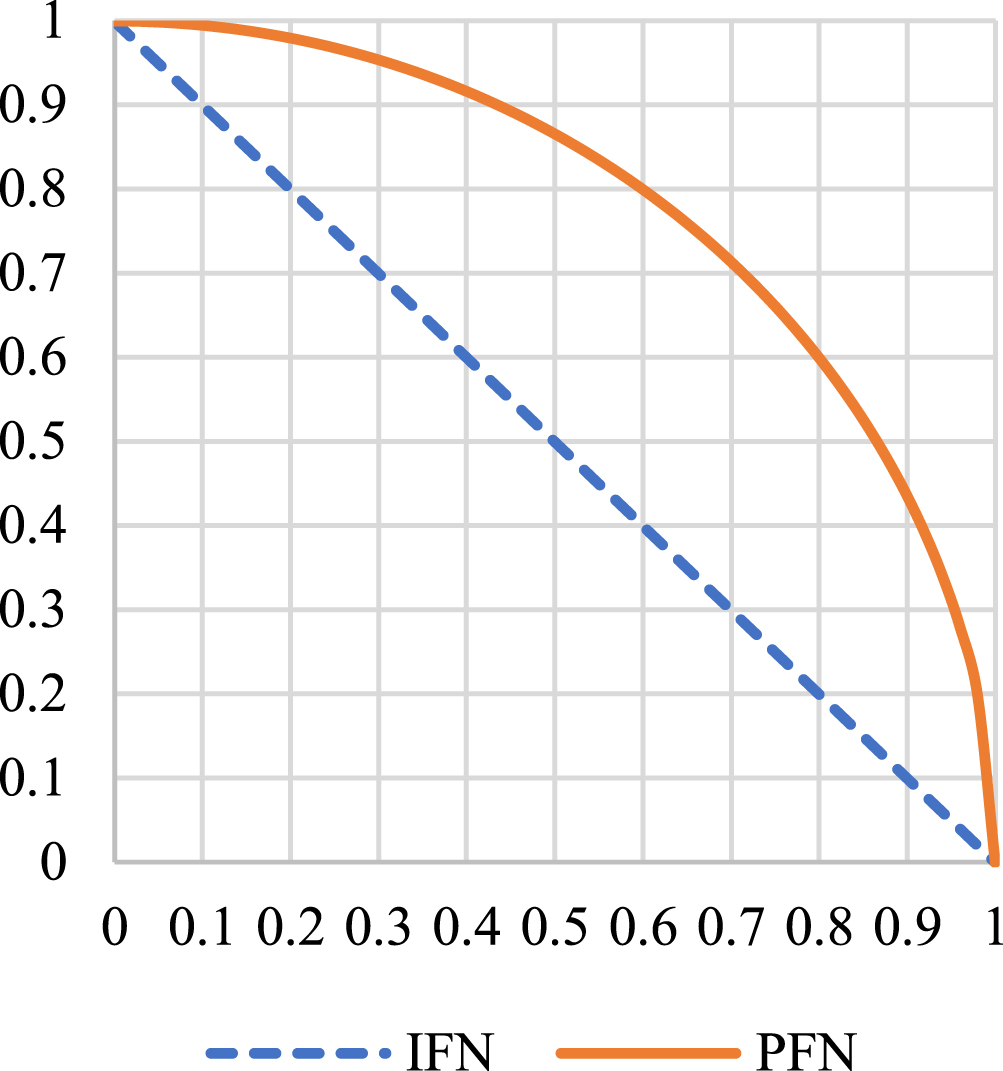
Comparison of spaces of the IFN and PFN.
The third important stage of evaluation in MADM method is to rank the result of decision-making. These extensions on the available MADM techniques can be divided into two categories, namely, the traditional evaluation methods and information aggregation operators. There exists extensive literature about traditional methods for solving the MADM problem, such as TOPSIS [20], ELECTRE [13], TODIM [26], and VIKOR [41], etc. Each of these methods is suitable for different scenarios with specific application purposes. For example, ELECTRE is based on the hierarchical priority relationship, which compares the superior relationship between two alternatives and gradually eliminates the inferior alternatives until the optimal one is left; TODIM can describe the psychological behavior of decision makers; VIKOR is based on the distance-to-target; and the principle of TOPSIS can be shown directly from the distances of the alternative values to negative and positive ideal solutions. As a typical MADM method, TOPSIS has been extended to the field of fuzzy decision making. Hwang and Yoon [5] first proposed the TOPSIS method, and the extended TOPSIS method was used to solve group decision making problems under triangular fuzzy numbers by Chen [6]. In addition, aggregation operators with simple or functional features have been continuously expanded and applied in fuzzy MADM problems [11, 24]. More specific applications of the TOPSIS method and aggregation operators are discussed in the next section.
Because the fuzzy sets theory combined with the MADM method can be applied to solve practical problems better, there have been related research on traditional information evaluation methods, such as IFS-TOPSIS [3, 43], PFS-TOPSIS [1, 36], and other expanded forms [7, 21]. Besides, the fuzzy aggregation operators with simple or functional features are also an important part of fuzzy decision making. However, the form of decision information and the process of decision-making is limited or out of date, for example, these highly aggregation operators inevitably cause information loss and information distortion during the complicated calculation. In addition, the weight of experts and attributes lack theorical basis, which affects the accuracy of decision results. Based on the above motivations, this paper proposes a q-ROF TOPSIS method to deal with the practical MADM problem about the evaluation of information quality in online health community, and the contribution and innovation of this paper are shown as follows, firstly, a complete framework including evaluation criteria system and evaluation method is constructed. Secondly, q-ROF TOPSIS method is proposed to evaluate the online health communities as a powerful and effective tool that avoids information loss and information distortion. Thirdly, a new distance measure between q-ROFSs is defined to adopt the TOPSIS method and an entropy weight model is initiated to solve the unknown weight of criteria. Finally, a comparative analysis of the existing methods has been done to prove the advantages of the methods proposed in this paper.
The rest part of this paper is organized as follows: Section 2 introduces the related research. Section 3 recalls the fundamental concepts of PFSs and q-ROFSs, including the mathematical expressions, operational laws, and the principle about TOPSIS. Section 4 proposes new operational laws for q-ROFSs to develop distance measure and entropy measure. Section 5 introduces a novel q-ROF TOPSIS method for solving MADM problems. Section 6 provides a numerical example to addresses the construction of evaluation criteria system and evaluate the information quality of four online health communities through different methods. Section 7 ends up with conclusions.
There are many related researches in applying the fuzzy TOPSIS method or fuzzy aggregation operators to solve MADM problems. Boran [10] utilized the intuitionistic fuzzy set combined with the TOPSIS method to select appropriate suppliers, and the intuitionistic fuzzy weighted averaging (IFWA) operator was used to aggregate individual opinions. Akram [20] extended the TOPSIS method to MADM problems with Pythagorean fuzzy numbers, in which this novel method can satisfy the larger expression space of uncertain information and fit people’s habits of mind precisely. Biswas [1] proposed entropy measure model to solve the unknown weight information under the Pythagorean fuzzy TOSIS method. Su [18] developed a MADM problem about project delivery systems and provided the decision-making approach based on the TOPSIS method under the Pythagorean fuzzy environment. Yu et al. [7, 8] developed a sustainable supplier selection approach with TOPSIS method under interval-valued Pythagorean fuzzy sets. In recent years, the literature involving TOPSIS method and its application under fuzzy sets has been continuously proposed. Thus, it can be found that the TOPSIS method has been widely used in various practical MADM problems.
Considering the complexity of the actual decision-making environment, most researches on MADM methods for q-ROFSs focus on the aggregation operators. Liu et al. [24, 25] proposed the q-rung orthopair fuzzy weighted averaging (q-ROFWA) operator, the q-rung orthopair fuzzy Bonferroni Mean (q-ROFBM) operator, and the q-rung orthopair fuzzy geometric BM (q-ROFGBM) operator, as well as their weighted forms. Xing et al. [37] presented dual Hamy mean (DHM) operator to capture the interrelationship among aggregated arguments. Xing [38] also proposed the point operator to control the uncertainty of valuating data from some experts. Wei [12] presented some Heronian mean (HM) operators under q-rung orthopair fuzzy sets and applied a practical example for enterprise resource planning system selection. Wei [11] extended the Maclaurin symmetric mean (MSM) operator and dual MSM operator to q-rung orthopair fuzzy sets and conducted an evaluation method of emerging technology commercialization. Bai et al. [16] proposed the partitioned Maclaurin symmetric mean (PMSM) operator to deal with interrelationships of attributes when they are partitioned into different parts. However, highly aggregated information operators do not have universality and their use needs to be switched according to the actual situation. For instance, the variations of complex aggregation operators’ parameters will lead to different results. Moreover, they are inevitable to cause information loss and result distortion during the aggregation process. As an effective information evaluation tool, the TOPSIS method is universal and rationally comprehensible. It can measure the relative performance for each alternative in a simple mathematical form with better computational efficiency, which has an intuitive and clear logic symbolizing the human decision. Therefore, this paper uses simple averaging operator to integrate multiple expert decision matrices first and then applies the q-ROF TOPSIS method to minimize information distortion and ensure the accuracy of decision results.
Although the q-ROF TOPSIS method is more reasonable, it still faces the difficulty of calculating distance measure and unknown attribute weight in practice. Zhang and Xu [36] defined the distance measure based on the PFNs and the distance measure within IFSs and PFSs has been extensively applied in the existing literatures [31, 44], the related study under the q-ROFS environment is relatively insufficient. When performing several evaluation matrices, some scholars directly set the weights of decision-makers and attributes, however, the obtained results will be greatly affected by subjectivity. In fact, decision-makers have differences in knowledge background, individual preferences, and practical experiences, so they should be given separate weights accordingly. Besides, different attributes of MADMs should also be given specific weights to ensure the accuracy and credibility of decision results. How to get the unknown weights information and aggregate them into an integrated decision matrix is worthy of studying. To deal with the uncertain weight information, entropy measure has been introduced into IFS and PFS environment. Guo and Song [14] developed a new entropy measure with unique features in the IFS context, which overcomes the drawbacks of the existing entropy. Based on their work, Biswas [1] initiated a novel Pythagorean fuzzy entropy measure and proved its basic formula and properties. According to the similarity part and the hesitancy part, Xue [32] defined the PFS entropy and interval-valued PFS entropy and explained the reason why these two parts influenced the value of entropy; this study also used one case that combined with the linear programming technique for multidimensional analysis of preference (LINMAP) method to demonstrate its suitability and reliability. Yang [23] provided two types to calculate the fuzzy entropy of PFSs, which are probabilistic and non-probabilistic methods. Based on the above discussion, this research not only puts forward a novel evaluation method to reduce the information loss, but also ensures the accuracy of the weight information within the decision steps.
Preliminaries
In this section, the fundamental concepts and operational laws about q-ROFSs are reviewed briefly, which will be the basis of the following sections.
q-Rung orthopair fuzzy sets and operational rules
where μ
A
(x) ∈ [0, 1] denotes the membership degree and ν
A
(x) ∈ [0, 1] denotes the non-membership degree, satisfying 0 ⩽ μ
A
(x)
q
+ ν
A
(x)
q
⩽ 1, q ⩾ 1. And the degree of indeterminacy is given by
For convenience, Liu and Wang [25] called (μ A (x) , ν A (x)) a q-rung orthopair fuzzy number (q-ROFN) which can be denoted by α = (μ A , ν A ).
Yager [28, 29] proposed q-ROFSs and gave the related basic operations, based on the score function, Liu and Wang [25] gave the accuracy function, as shown below.
S (p) = μ q - ν q , where S (p) ∈ [-1, 1].
An accuracy function of p is defined as
A (p) = μ q + ν q , where A (p) ∈ [-1, 1].
Then the comparison of two q-ROFNs can be calculated, suppose p1 and p2 are any q-ROFNs, then If S (p1) < S (p2), then p1 < p2. If S (p1) = S (p2), then if A (p1) < A (p2), then p1 < p2; if A (p1) = A (p2), then p1 = p2; if A (p1) > A (p2), then p1 > p2. If S (p1) > S (p2), then p1 > p2.
By taking different values of the parameter q, the q-ROFWA operator can be applied to different cases. When q = 1, the q-ROFWA operator reduces to IFWA operator [43]:
When q = 2, the q-ROFWA operator reduces to PFWA operator [35]:
Distance measure of fuzzy sets
Based on above geometrical distance model, Biswas [1] improved this distance measure between two PFNs, which can be reduced to Hamming distance (λ = 1) and Euclidean distance (λ = 2).
The principle of TOPSIS method defined by Hwang and Yoon [5] is based on the closest distance to the positive ideal solution (PIS) and the farthest distance from the negative ideal solution (NIS). The main steps of this method include: Construct the original matrix. Standardize the ordinary decision matrix. Calculate the weight of attributes. Construct the weighted standardized decision matrix. Determine the PIS and NIS. Calculate the relative closeness index.
The detailed steps of TOPSIS with q-ROFS will be described in Section 5.
The proposed distance measure and entropy measure for q-ROFS
In this section, a more generalized distance measure and a new entropy measure model are defined for q-ROFSs.
Distance measure for q-ROFS
Based on the PFS weighted generalized distance from Definition 6, this research extends the definition to q-ROFS environments.
Entropy weight model for q-ROFS
The entropy measure is an objective weighting method based on the amount of information contained in each criterion, which can measure the amount of information uncertainty in a system. Generally, the greater the amount of information, the higher the degree of variation in data criteria. Then the information entropy of this criterion is smaller; on the contrary, the criterion with larger information entropy indicates that the uncertainty of the data is greater, and the variation degree of criterion is lower. Based on the Pythagorean fuzzy entropy defined by Xue [32], a generalized q-rung orthopair fuzzy entropy (q-ROFE) is defined by the relationship between membership and non-membership and the definition of indeterminacy degree.
According to the Pythagorean fuzzy entropy (PFE) [32], it can be proved that the q-rung orthopair fuzzy entropy measure proposed in this paper can also satisfy these following properties:
E (P) =0 if and only if P is a crisp set. E (P) =1 if and only if μ
P
(x
j
) = ν
P
(x
j
) for ∀x
j
∈ X. E (P) = E (P
c
). E (P) ⩽ E (Q) if P is less fuzzy than Q, that is, μ
P
⩽ μ
Q
and ν
P
⩾ ν
Q
for μ
Q
(x
j
) ⩽ ν
Q
(x
j
), ∀x
j
∈ X or μ
P
⩾ μ
Q
and ν
P
⩽ ν
Q
for μ
Q
(x
j
) ⩾ ν
Q
(x
j
), ∀x
j
∈ X.
Since
q-Rung orthopair fuzzy TOPSIS method
This section innovatively proposes a new q-ROF TOPSIS method and introduces the basic decision-making steps.
Assuming that a MADM problem has m alternatives with n attributes, let A = {A1, A2, . . . , A
m
} be the set of alternatives, C = {C1, C2, . . . , C
n
} be the set of attributes, and ω = {ω1, ω2, . . . , ω
n
} be the weight vector of all attributes. There are also k number of decision makers (DMs), D = {D1, D2, . . . , D
k
}, and σ = {σ1, σ2, . . . , σ
n
} is the weight vector of all DMs.
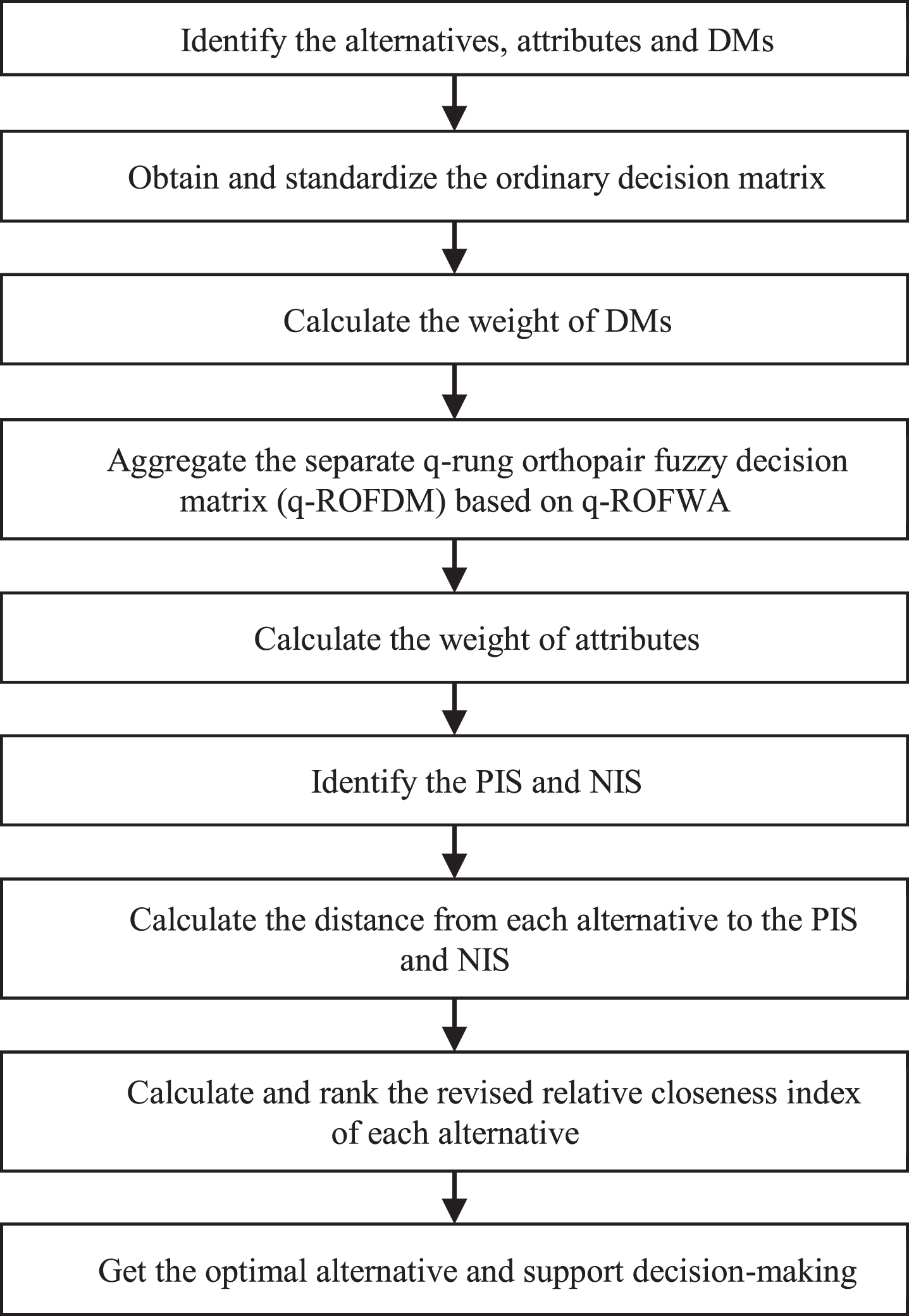
Flow chart of q-ROF TOPSIS method.
The key steps of the q-rung orthopair fuzzy TOPSIS method mainly include determining the unknown weight of DMs and attributes, integrating q-ROFDM, and calculating the closeness index of each alternative. According to the core steps of the TOPSIS method, the optimal alternative is selected from multiple alternatives based on the relative closeness index. The detailed steps are as follows.
satisfying the condition that
Simple linguistic variables are difficult to quantify the accurate weights of DMs, here shows the conversion rules [20] between linguistic variables and q-ROFNs in Table 1.
Linguistic variables for the relative importance ratings of DMs
The aggregated q-ROFDM based on q-ROFWA
Thus, the weight of attributes can be calculated by,
In the actual application of the formula, there may be cases where the distance between the alternatives and PIS and NIS is equal. In this case, this closeness function cannot accurately describe the distance relationship. The improved closeness formula proposed by Hadi-Vencheh and Mirjaberi [2] can solve the problem and the formula is as follows:
Information service quality evaluation in online health community
In this section, the performance of the proposed method is validated by a real-word case about the evaluation of information service quality in online health communities in China. Online health communities play a positive role in alleviating hospital congestion and improving medical resources utilization, especially in China with a large population base. Because the information quality in these communities is not perfect, evaluating the information service quality of the online health community has a good reference significance for ordinary users, medical enterprises and the government.
In order to ensure the validity and scientificity of the evaluation criteria system, an evaluation criteria system model was established, which adopted the previous scales from related literature and integrated additional criteria based on medical industry characteristics. This research carried out an online questionnaire survey with a 5-point Likert-type response format through Wenjuanxing, a professional and popular questionnaire platform in China. After deleting invalid data from a total of 211 responses, we received 190 valid responses, and verified that the data passed the reliability and validity test and met the requirements for PCA. The PCA method was adopted to reduce the dimensions and optimizes the criteria model. After revising and correcting the criteria model, the evaluation criteria model with 7 principal criteria and 41 sub-criteria was built, as shown in Table 3. The relevant questionnaire data and detailed result of PCA are presented in Appendix.
Revised evaluation criteria system
Revised evaluation criteria system
In this MADM problem, these seven evaluation criteria were used as evaluation attributes and the evaluation preference were obtained for four online health communities through expert interview. Then three experts with experiences in online health communities were invited to make decisions and express their evaluation degree assigned in the form of q-ROFNs, including professors and associate professors, the weight of experts is assigned according to their titles. This research set the experts’ importance degree as “very important”, “very important” and “important”, and convert linguistic variables into fuzzy numbers according to the formula [20]. The reference value can provide authoritative judgments about the quality of online health community information services, which satisfies the research needs. The evaluation results are displayed in the following q-ROFS decision matrices (q-ROFDMs). In the following, this paper adopts the proposed q-ROF TOPSIS method to deal with the practical decision-making problem. Moreover, a detailed comparative analysis with other typical methods is handled to prove the applicability and superiority of the new method.
The four domestic online health communities are denoted as A1, A2, A3, A4, respectively. According to the evaluation criteria system model established by previous questionnaire survey, the following criteria (attributes) are identified: C1: Internal quality of information. C2: External quality of information. C3: Doctor resources. C4: Retrieval and interactive services. C5: Sensory quality. C6: System performance and privacy protection. C7: Additional services.
The weight of attributes is shown as ω = {ω1, ω2, ω3, ω4, ω5, ω6, ω7}, satisfying ω
j
∈ [0, 1] and
The importance of experts and the q-ROFNs
The importance of experts and the q-ROFNs
The q-ROFDM of expert D1
The q-ROFDM of expert D2
The q-ROFDM of expert D3
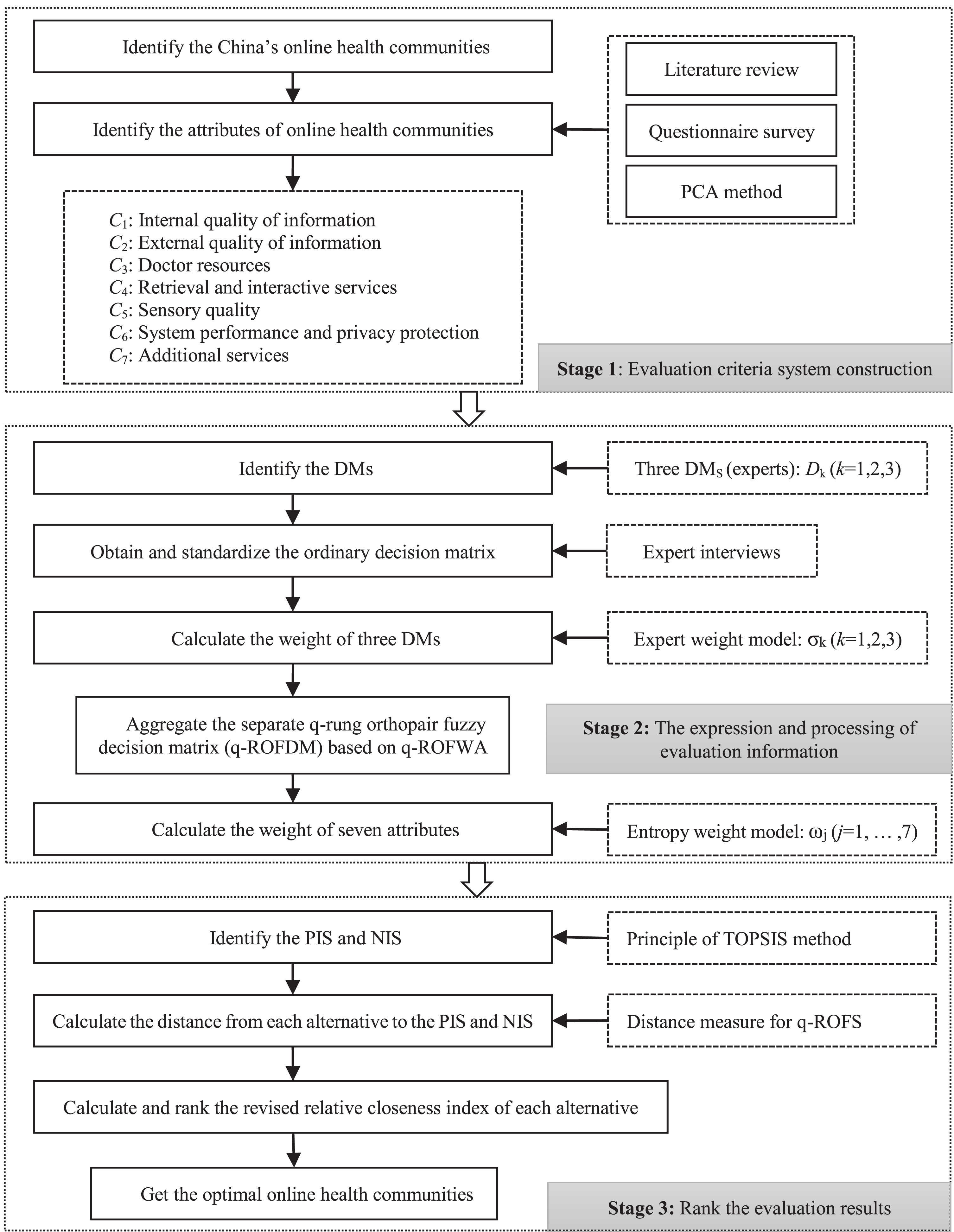
The proposed evaluation framework of online health community.
The weight of three experts
The aggregated q-ROFDM X = [x ij ] 4×7
The weights of attributes
The PIS and NIS of q-ROF TOPSIS
The ranking result of q-ROF TOPSIS
According to the revised relative closeness index of the alternatives, the final ranking of alternatives is:
Therefore, A2 is the best alternative, which means A2 has the best quality of information service among the selected online health communities. It also explains that A2 provides better references for users seeking information. Online health communities with higher evaluation scores have better information services, however, for communities with lower rankings, the seven attributes proposed in this study should be used to make up for the lack of development, improve the ability to serve users and create better service experience. As a whole, this method solves the evaluation and selection about online health communities and provides a convincing reference for users to make an optimal choice.
The above numerical example can prove the practicability of the proposed method, which can effectively solve the comprehensive evaluation problem in reality. In the following, this research compares the q-ROF TOPSIS method proposed in this paper with other existing methods to further verify this method’s optimality. The detailed comparative analysis is mainly carried out from the reduction of information loss, the determination of attribute set, the expression space of fuzzy numbers, the obviousness of ranking results, the way to determine the attribute weight, the number of decision matrices, and the simplicity of calculation process. Table 13 shows the methods selected for comparison.
Comparison with other existing methods
Comparison with other existing methods
The ranking results are shown in Table 14. Based on the above ranking result, it can be found that the result of M2-M6 is consistent, which is A2 ≻ A1 ≻ A4 ≻ A3. It is worth noting that the results of M1 are different from other methods, and the overall ranking results are same except M1. Although the result of M1 is slightly different, the best and worst alternative is still the same. The overall stable result can prove the accuracy and reliability of the method proposed in this paper. The following is a detailed analysis of each method.
The ranking result with other existing methods
The first three methods apply the highly aggregation operators and determine the optimal alternative based on the score values, the last three methods combine with traditional TOPSIS method, and rank alternatives according to the relative closeness indices. In addition, it is worth noting that the above methods did not explain the source of the attribute, but directly set the attributes (criteria) for practical application. In contrast, this paper builds an evaluation criteria system through PCA method focusing on the information quality evaluation problem, which ensures that comprehensive and accurate research results are obtained. Because the M1, M2 and M3 methods can deal with the situation where only one expert or multiple experts’ weight is known, in these methods, each expert is equally important and the weight is 1/3; The M4 method can only calculate intuitionistic fuzzy numbers, so the evaluation data is adjusted so that the sum of membership and non-membership does not exceed one for comparative analysis; The M5 method does not involve the integration of multiple experts in the first step, so this paper applies one of the most important expert decision matrices for calculation; and the M6 method is new one that proposed in this paper. The following comparative analysis explains the superiority of the proposed method (M6).
(1) Compared with the M1 method, M2 method and M3 method.
Firstly, the first three methods apply q-ROFNs to express the fuzzy information, which can describe a larger decision-making space with stronger information capacity. Secondly, these three methods use different aggregation operators to integrate multiple times and rank the alternatives, which inevitably lead to some information distortion, it can be found that the gap among scores values are not significant. In contrast, the M6 method can reduce the loss of information and ensure the accuracy of decision result by evaluating the distance between the different alternatives to the PIS and NIS. In addition, while using the q-ROFWBM operator of the M3 method, this method sets s = t = 1 and q = 2, but the final result can be influenced by the different parameters set. The aggregation operators have additional requirements and specific functions, they are suitable for specific application purposes, for example, q-ROFWBM operator is suitable for considering interrelationships between parameters. Thus, the application scope of these aggregation operators is limited and lacks universality. Thirdly, these three methods focus on proposing a new aggregation operator and directly provide the weight value, which has a certain degree of subjectivity. There is a lack of research on determining expert weights or attribute weights in actual MADM problems. The M6 method in this paper proposes an entropy measure method to determine the weight of criteria, as an objective assignment method, it determines the weight value according to the amount of information contained in each criterion, which can better ensure the scientificity and accuracy of the decision-making results.
(2) Compared with the M4 method and M5 method.
The comparison results of the M4-M6 methods are shown in Fig. 4.
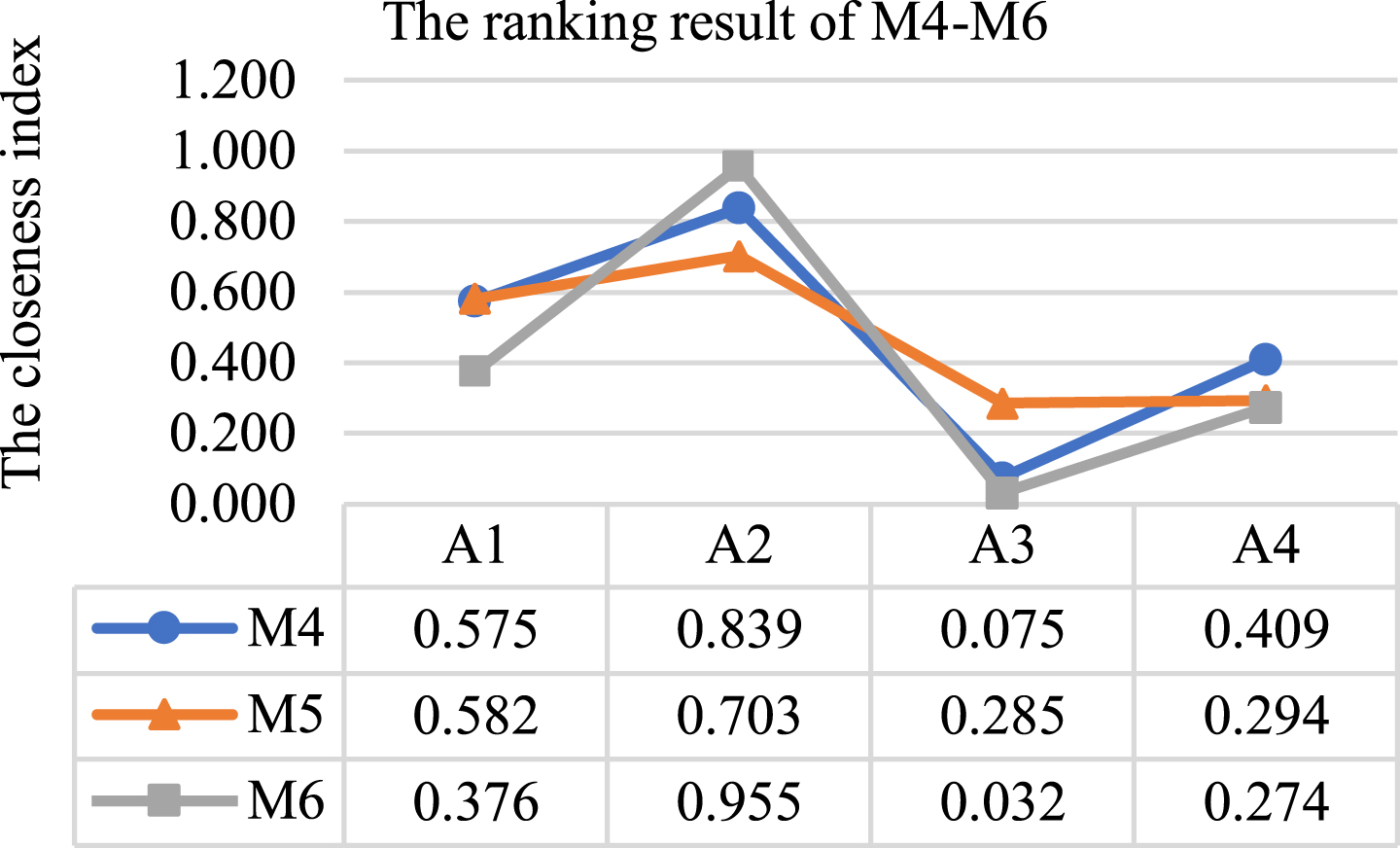
The ranking result of the M4-M6 method.
Firstly, in terms of q-ROFS, the expression space of fuzzy information is bigger and it can flexibly adjust the parameter q to over more hesitant fuzzy evaluation information and adapt to more complex and dynamic decision-making environments. The M4 method involves multiple decision matrices from a group of experts and the evaluation preference need to satisfy the tighter restrictions, that is, the sum of membership degree and non-membership degree does not exceed one, for example, the value (0.75,0.29) is hard to calculate by IFNs. Secondly, it is worth noting that the gap among four relative closeness indices from M4 is smaller than the result from M6. It is obvious that the result of M6 is easier to distinguish. Thirdly, the M5 method is similar to the case of q = 2 in this paper. However, the weight of each attribute and the decision matrices are known quantities in M5 before decision-making, so it cannot indicate the source of information and has a certain degree of subjectivity and randomness. In contrast, the M6 method utilizes the first aggregation technology to process the decision matrices of multiple experts, integrates them into a comprehensive decision matrix, which can not only avoid the inaccurate evaluation of too few experts, but also reduce the information loss and distortion. Moreover, from the perspective of practical application, especially in multi-attribute decision-making (MADM) problems, the input of multiple attributes with different weights will also affect the decision result. The M6 method uses the objective entropy measure model to determines the attribute weights, which can reduce the impact of unreasonable evaluation values and ensure the fairness and accuracy of the evaluation results.
(3) Comparing with q-ROF ELECTRE method.
Concentrate on other MADM methods, the ELECTRE, as a multi-criteria decision analysis technique, has been applied to some fuzzy MADM problems [13, 19]. Pinar [4] has proposed the q-ROF ELECTRE method and gave the decision-making steps, which involves a selection process based on the outranking relationship. Under the q-ROF ELECTRE method, the standardization and construction of decision matrix in the decision-making steps are consistent with the q-ROF TOPSIS method. The difference is that the ELECTRE method needs to determine the concordance set and discordance set and then construct the strong, moderate and weak sets. After constructing a comprehensive judgment matrix, it eliminates the inferior alternatives which are outranked by others until the best one is left. Here shows the strong concordance set C kl , moderate concordance set C kl , weak concordance set C kl of A k and A l , and the strong discordance set D kl , moderate discordance set D kl , weak discordance set D kl .
The result of concordance matrix and discordance matrix are calculated as follows,
Based on the threshold value of the concordance and discordance indexes, which is the average value of the matrix (
According to the principle of q-ROF ELECTRE, if the elements Ekl in the matrix are equal to one, then Ak is preferred to Al for both the concordance and discordance criteria, so the ranking result is A1 ≻ A3 and A2 ≻ A1, A2 ≻ A3, A2 ≻ A4 an A4 ≻ A3. Regarding the information service quality in China’s online health communities, A2 is still the optimal alternative and A3 is the least ideal alternative. However, this calculation process cannot rank all of the alternatives because of the middle alternatives A1 and A4.
This case expresses the evaluation value provided by the three DMs for four alternatives with respect to the seven attributes for selection and evaluation. It can be seen that this process begins with a comparison of the seven evaluation criteria of any two alternatives. However, if the number of alternatives and attributes is large, M7 will become complicated and hard to calculate, while the TOPSIS method applied in this paper is simple and general. Moreover, although the q-ROF ELECTRE method can also obtain the outranking results through gradual elimination and selection, it cannot express the degree of quantity. On the contrary, the q-ROF TOPSIS method can obtain the specific value through closeness indices, displaying a clear ranking and allowing decision-makers to see the specific information and make a better comparison.
Therefore, the q-ROF TOPSIS method has advantages in the expression and processing of fuzzy decision information. Based on the comparisons and analysis above, it can be verified that the method proposed in this paper is better than the other methods.
This research puts forward a more general approach combined with the q-ROFS and classical TOPSIS method to solve MADM problems, especially, it provides a complete framework from multi-attribute determination to decision-making method aimed at solving online health community information service quality evaluation.
In terms of the theoretical implications, compared with accurate numbers or other fuzzy number evaluations, the proposed method with q-ROFS in this paper provides broader constraints and wider decision-making information expression space, which has a stronger ability to describe fuzzy information. On the basis of the operational laws of the q-ROFS, it defines the entropy measure to calculate the unknown weights and proposes the distance measure to adopt the TOPSIS method, which enriches and develops the theoretical system of q-ROFS. Additionally, the collective opinion of a group of experts contributes to increasing the credibility and reliability of comparative analysis, so this research refers to the opinions of three experts and integrates them through basic fuzzy operators. This paper combines the typical TOPSIS method to effectively reduce the distortion of decision information and improve the accuracy of evaluation results. As for the evaluation theory of online health community, this paper establishes the evaluation criteria model step by step and improves the relevant theories of the evaluation criteria system through PCA methods, which provides the evaluation criteria centered on the online health community for the evaluation problem.
From the perspective of the practical implications and managerial insights, a numerical example has been provided to illustrate this method’s applicability and reliability, and it analyzes more useful suggestions for the development of the domestic online health communities. The evaluation result can help decision-makers select better platform with a high-quality for medical and health information, which has a good reference significance for ordinary users, managers and the government. In fact, this method can also be flexibly applied in other decision-making cases, such as construction site selection, risk assessment, medical institution selection and supplier selection, to help decision-makers make decisions more efficiently and accurately.
Therefore, the method proposed in this paper enriches the theory of fuzzy decision-making and has practical significance in actual decision-making scenarios, it overcomes the shortcomings of difficulties about fuzzy information expression and limited expression space in evaluation information, quantifies and ranks the quality of information service in multiple online health communities with a clear degree of closeness, and helps this research get more accurate and reliable evaluation results.
Footnotes
Acknowledgments
This work was supported by National Social Science Foundation of China (major program; grant number: 18ZDA086), and Beijing Social Science Foundation (key program; grant number: 18JDGLA017). The authors also appreciate the support of the Beijing Logistics Informatics Research Base.