



Abstract
The recently proposed q-rung orthopair fuzzy set (q-ROFS) whose main feature is that the qth power of membership degree (MD) and the qth power of non-membership degree (NMD) is equal to or less than 1, is a powerful tool to describe uncertainty. The major contribution of this paper lies to investigate power point average (PPA) aggregation operators with q-rung orthopair fuzzy information based on Frank t-conorm and t-norm. Since the existing power average (PA) operators all rely on the traditional distance measures to measure support degree between the input values, it cannot reflect decision makers’ attitude. In response, this paper introduces firstly a series of distance measures for q-rung orthopair fuzzy numbers (q-ROFNs) based on point operators, from which the corresponding support measures can be obtained. Secondly, based on the proposed point distance measures, new Frank power point average aggregation operators are proposed to aggregate q-rung orthopair fuzzy information. Finally, a novel multiple attribute decision making (MADM) technique is presented based on the proposed Frank power point average aggregation operators. The developed MADM method not only can get more objective information, but also avoid the influence of unduly high or low attribute values on the decision result, providing a new way for decision makers (DMs) under q-rung orthopair fuzzy environment.
Introduction
MADM is the process of ranking alternatives and selecting an optimal one among a set of alternatives assessed on multiple attributes, which is the essence of the decision-making science. MADM has played more and more important role in daily life and has been widely used in economics, management and other fields in recent years [1–4]. In this process, DMs’ evaluations over alternatives is very important. On the other hand, the second task in this process is to aggregate the described information. Due to the subjective nature of human thinking in real decision-making problems, DMs’ evaluations over alternatives are always imprecise and fuzzy. To appropriately describe the fuzzy information, quite a few tools, such as intuitionistic fuzzy set (IFS) [5], Pythagorean fuzzy set (PFS) [6], complex intuitionistic fuzzy set [7], interval-valued intuitionistic fuzzy sets [8] have been proposed.
Recently, Yager generalized the IFS and PFS and proposed a new concept of q-ROFS whose prominent feature is that the qth power of MD and the qth power of NMD is equal to or less than one [9]. Evidently, q-ROFS relaxes the constraints of both IFS and PFS, which makes it more powerful than IFS and PFS in the aspect of dealing with vagueness. For instance, a decision maker (DM) provides 0.9 and 0.8 as the MD and NMD, respectively. Given 0.9 + 0.8 > 1 and 0.92 + 0.82 > 1, the evaluation attribute value (0.9, 0.8) cannot be expressed by IFS and PFS. In this case, when q = 5, we can get 0.95 + 0.85 < 1 and the evaluation value can be expressed by q-ROFS. Therefore, by adjusting the value of parameter q, q-ROFS allow DMs to independently assign values to MD and NMD. Due to its higher capacity of modelling the fuzziness, quite a few of achievements on q-ROFS have been done, such as distance measures between q-ROFNs [10], integrations of q-rung orthopair fuzzy continuous information [11, 12], continuities, derivatives and differentials of q-ROFS [13], ranking technique [14], knowledge measure [15], combination of q-ROFNs and other fuzzy sets [16, 17], overview on q-ROFS [18], etc. In addition, more scholars have focused on q-rung orthopair fuzzy MADM methods based on aggregation operator theory that can aggregate a collection of individual evaluated values into one. For example, Liu and Wang [19] proposed a family of q-rung orthopair fuzzy weighted averaging and geometric operators. Peng et al. [20] proposed a new exponential operational law on q-ROFNs and then applied it to derive the q-rung orthopair fuzzy weighted exponential aggregation operator. In order to control the uncertainty of valuating data and get intensive information, by associating with classic arithmetic and geometric operators, Xing et al. [21] present a new class of q-rung orthopair fuzzy point weighted aggregation operators. Considering these aggregation operators do not take the interrelationship between q-ROFNs into account, Liu and Liu [22], and Wei et al. [23] successively extended existing operators, such as Bonferroni mean (BM), and Heronian mean to the q-ROFS. Meanwhile, Liu et al. [24] propose a new method based on the q-rung orthopair fuzzy extended BM operator and entropy measure for dealing with heterogeneous relationships among attributes and unknown attribute weight information. Liu et al. [25] put forward a novel MAGDM method based on the q-rung orthopair fuzzy power Maclaurin symmetric mean operator (MSM) to solve the decision-making problems of attribute related and unreasonable evaluating data. However, in real decision-making process, the interrelationships of arguments do not always exist in all the arguments, but in part of the arguments. In order to deal with this situation, Yang and Pang [26] developed several q-rung orthopair fuzzy partitioned BM operators and their weighted forms.
From the above analysis, we can find that researches on MADM methods with q-rung orthopair fuzzy information have achieved great success. However, all these existing methods above are based on Einstein or Algebraic t-norm and t-conorm, which makes them lack of flexibility in the process of aggregation. Currently, Frank t-conorm and t-norm proposed by Frank [27] are the only class of t-conorm and t-norm that satisfy the compatibility. The Frank t-conorm and t-norm have the same advantages as the algebraic, Hamacher, and Einstein t-conorm and t-norm do. On the other hand, they also have an additional parameter that makes aggregation process more flexible than general t-conorm and t-norm. Therefore, it is meaningful to investigate aggregation operators based on Frank t-conorm and t-norm. Besides, different q-rung orthopair fuzzy aggregation operators are used to solve different decision problems. Among them, the PA operator proposed by Yager [28] considers the information about the relationship between the input arguments, and is used to relieve the influences of unreasonable data given by DMs on the decision result. It can aggregate the input data by assigning the weighted vector based on the support degree between the input values. That is to say, the PA operator depends on the support degree of input arguments to assign weights. However, the existing PA operators all depend on the traditional distance measures, such as normalized Hamming distance, Minkowski-type distance, to obtain corresponding support degree between the input values. Considering the DMs’ risk preference, there is a need to define novel PA operators according to different distance measures to obtain more objective information from the original input arguments. Moreover, since Frank t-conorm and t-norm are flexible and powerful in the process of aggregation, it is of great meaning to combine the Frank t-conorm and t-norm and the PA operator for MADM under q-rung orthopair fuzzy environment. Therefore, the motivation of this paper is to propose new q-rung orthopair fuzzy PA aggregation operators based on the Frank t-conorm and t-norm and then apply them to MADM problems. The main contribution and innovation of this paper is the combination of point distance measure and PA operator, which can obtain more objective decision information, and also avoid the influence of too high or too low attribute value on decision result.
Based on the above comprehensive analysis, the goal of this paper are: (1) to introduce new Frank operational laws for q-ROFNs on the basis of Frank t-conorm and t-norm; (2) to define new PPA operator; (3) to develop q-rung orthopair fuzzy Frank power point aggregation operators. (4) to provide a new train of thought for MADM with q-rung orthopair fuzzy information based on the proposed operators.
In order to do this, the rest of the paper is organized as following. Section 2 reviews basic concepts. New Frank operational laws for q-ROFNs are also introduced in this section. Section 3 develops q-rung orthopair fuzzy power point aggregation operators based on Frank operational laws, including q-rung orthopair fuzzy Frank power point averaging (q-ROFFPPA)operator, q-rung orthopair fuzzy Frank power point geometric (q-ROFFPPG) operator. Section 4 introduces a novel method for solving MADM with q-rung orthopair fuzzy information based on the proposed operators. Section 5 provides a numerical example to show the performance of the proposed method.
Preliminaries
In this section, we briefly review basic concepts, such as q-ROFS, Frank t-norm and t-conorm, PA operator. Then, we introduce a series of point distance measures for q-ROFNs. Based on it, new PPA operator is also developed in this section.
q-Rung orthopair fuzzy set
Operational laws for q-ROFNs are also proposed as below.
(1)
(2)
(3) λa = ( ( 1 - ( 1 - μ q ) λ ) 1/q, vλ )
(4) aλ = ( μλ, ( 1 - ( 1 - v q ) λ ) 1/q ) .
To compare two q-ROFNs, Liu and Wang [19] proposed a comparison method for q-ROFNs.
(1) If S ( a1 ) > S ( a2 ), then a1 > a2;
(2) If S ( a1 ) = S ( a2 ), then If H ( a1 ) > H ( a2 ), then a1 > a2;
If H ( a1 ) = H ( a2 ), then a1 = a2
Frank t-norm and t-conorm introduced by Frank [27] are well-known t-conorm and t-norm, which is defined as follows:
Based on the above Frank t-norm and t-conorm, we can develop new operational rules on q-ROFNs.
(1) a1 ⊕ F a2 = a2 ⊕ F a1,
(2) a1 ⊗ F a2 = a2 ⊗ F a1,
(3) k ( a1 ⊕ F a2 ) = ka2 ⊕ F a1, k ≥ 0,
(4) k1a ⊕ F k2a = ( k1 + k2 ) a, k1, k2 ≥ 0,
(5) a k 1 ⊗ F a k 2 = ( a ) k1 +k2, k1, k2 ≥ 0,
(6)
Distance measures, as an effective tool to compare fuzzy information, have been widely used in MADM problems. Recently, Minkowski-type distance for q-ROFNs is proposed by Du [10].
Due to omitting indeterminacy degrees, the calculation result of the distance measure obtained by Du [19] is inconsistent with commonsense. Although the values of the indeterminacy are well known as the consequence of the MD and NMD, these values should not be discarded from the formulas. Szmidt and Kacprzyk [29] give an illustration from the point of both analytical and geometrical about why the three parameters should be considered. In order to overcome the drawback, we propose a modified distance measure taking into account the MD, NMD, and indeterminacy degrees.
Considering the DMs’ risk preference, there is a need to define new distance measures. As point operations can redistribute the MD, NMD in q-ROFNs according to different principle, we introduce the q-rung orthopair fuzzy point operations defined by Xing et al. [21] to reflect DMs’ attitude, and then combine the point operators with distance measures to develop new point distance measures for q-ROFNs.
where ξ + ς ≤ 1
As Xing et al. [21] point that D ξ ( a ) and Fξ,ς ( a ) can reduce the uncertainty of q-ROFS, Gξ,ς ( a ) can increase the uncertainty of q-ROFS. Meanwhile, Hξ,ς ( a ) reduce the MD and increase the NMD, which can denote a pessimistic attitude. Similarly, Jξ,ς ( a ) can denote an optimistic attitude.
Based on the above point operators, we propose new point distance measures for q-ROFNs in the following.
d
D
ξ
( a1, a2 ) = | ( 1 - ξ ) t
μ - ξt
v
|
where ξ + ς ≤ 1
Which is the distance measure defined in Definition 6.
It is easy to verify that the above point distance measures satisfy the following properties.
(1)0 ≤ d Δ ( a1, a2 ) ≤ 1;
(2)d Δ ( a1, a2 ) = d Δ ( a2, a1 );
(3) If a1 = a2, then d Δ ( a1, a2 ) = 0;
(4) If a1 ≤ a2 ≤ a3, then
Where Δ denotes D ξ ( a ) , Fξ,ς ( a ) , Gξ,ς ( a ), Hξ,ς ( a ), Jξ,ς ( a )
From the above analysis, we can see that the point distance measures defined are not only formally correct, but also since they use all the available information, they give in effect results that are correct and consistent with the essence of q-ROFS. On the other hand, the point distance measures can redistribute the MD and NMD of q-ROFS according to different principle, and thus can obtain more objective information from the original one.
By combining with point operators, the new point distances d D ξ and d F ξ,ς can reduce the uncertainty of q-ROFNs. Similarly, the point distances d G ξ,ς increases the uncertainty of q-ROFNs. Meanwhile, the point distances d H ξ,ς represents a pessimistic distance measure by increasing the membership information. Similarly, d J ξ,ς represents an optimistic distance measure by reducing the membership information. Thus, from the point view of actual needs, DMs can appropriately select different point distance measures proposed in this paper to express their pessimistic or optimistic attitude.
The PA operator was firstly proposed by Yager [28]. The advantage of PA operator is that it can reduce the effect of unduly high and low arguments on the final results.
(1) Sup ( a i , a j ) ∈ [0, 1]
(2) Sup ( a i , a j ) = Sup ( a j , a i )
(3) If d ( a i , a j ) < d ( a l , a k ), then Sup ( a i , a j ) > Sup ( a l , a k ), where d ( a i , a j ) is the distance betweena i and a j .
Obviously, the distance measure plays an important role in the PA operator. Before using the PA operator, the key step is to determine the support Sup (a i , a j ), which depends on the distance of a i from other values. The smaller the distance, the closer the two values and the more they support each other. Considering that the point distance measures can redistribute the MD and NMD of q-ROFS according to different principle and reflect the DMs’ risk preference, in the following, we define a kind of new PPA operator.
(1) Sup Δ ( a i , a j ) ∈ [0, 1]
(2) Sup Δ ( a i , a j ) = Sup Δ ( a j , a i )
(3) If d Δ ( a i , a j ) < d Δ ( a l , a k ), then Sup Δ ( a i , a j ) > Sup Δ ( a l , a k ), where d Δ ( a i , a j ) is the point distance between a i and a j defined in Definition 8.
Based on the Frank operational laws of q-ROFNs and the PPA operator in Sect. 2, this section introduces q-rung orthopair fuzzy Frank power point aggregation operators based on the Frank t-conorm and t-norm.
q-ROFFPPA aggregation operator
According to Frank operational laws defined in Definition 4, we can obtain the following Theorem.
When n = 1, according to Theorem 1, we get
Since
If Equation (9) holds for n = k, that is
When n = k + 1, we have
Since
which means that Equation (9) holds for n = k + 1.
Therefore, Equation (9) holds for all n. Thus, the proof of Theorem 4 is completed.□
And λ · F q - ROFFPPA ( a1, a2, . . . , a n )
Thus q - ROFFPPA ( a1 ⊕
F
a, . . . , a
n
⊕
F
a ) =
Based on the Theorems 4 and 5, it is easy to obtain the following Theorem 6.
It can be easily proved that the q-ROFFPPA operator has the following properties.
According to different values of the parameter θ, the following special cases can be obtained.
(1) If θ → 1, then the q-ROFFPPA operator is reduced to a q-rung orthopair fuzzy power point operator (q-ROFPPA) based on the Algebraic t-conorm and t-norm, which is defined as:
(2) If θ→ + ∞, then the q-ROFFPPA operator is reduced to the traditional arithmetic power point average operator, which is defined as:
We first prove
that
Since θ → 1, we get
By Taylor expansion, we have
Thus, we get
Based on the above, we also have
Thus,
Firstly, we prove that
As
According to the L’Hospital’s rule, we get
Similarity, we get
Thus
Thus, the score value of q-ROFFPPA operator isSq-ROFFPPA(θ) = 1 - f ( θ ) - g ( θ ). Then, we just need to prove thatSq-ROFFPPA(θ)is monotonically decreasing with respect to θ. Taking the derivative of Sq-ROFFPPA(θ) with respect to θ, we obtain
Taking the derivative off ( θ ) with respect to θ, we obtain
Since
Similarly, we get
Sinceθ ≻ 1, we have f ( θ ) ≥ 0, g ( θ ) ≥ 0 . Thus,
Furthermore, Sq-ROFFPPA(θ) is monotonically decreasing with respect to θ,which denotes q-ROFFPPA operator is monotonically decreasing with respect to θ.
The proof of the following theorem is similar to that of Theorem 4, we do not duplicate it here.
Based on the Theorems 15 and 16, it is easy to obtain the following Theorem 17.
The q-ROFFPPG operator has properties similar to the q-ROFFPPA operator, such as idempotency, monotonicity and boundedness under some conditions.
According to different values of the parameter θ, we can get the following special cases.
(1) If θ → 1, then the q-ROFFPP G operator is reduced to a q-rung orthopair fuzzy power point geometric operator (q-ROFFPPG) based on the Algebraic t-conorm and t-norm, which is defined as:
(2) If θ→ + ∞, then the q-ROFFPPG operator is reduced to the traditional arithmetic power point average operator, which is defined as:
q - ROFFPPG ( a1, a2, . . . , a
n
)
c
q - ROFFPPA ( a1, a2, . . . , a
n
)
c
q - ROFFPPA ( a1, a2, . . . , a
n
) ≥q - ROFFPPG ( a1, a2, . . . , a
n
) , θ ≻ 1
In order to prove
As
Then
Similarly, we can get
Thus, when θ ≻ 1, we have
In the present section, we introduce a novel approach to MADM problems under q-rung orthopair fuzzy environment. A MADM problem with q-rung orthopair fuzzy information can be described as: let X ={ x1, x2, . . . , x m } be a set of alternatives, G ={ G1, G2, . . . , G s } be a set of attributes. For attribute G j ( j = 1, 2, . . . , s ) of alternative x i ( i = 1, 2, . . . , m ), DMs are required to use a q-ROFN to express their preference information, which can be denoted as a ij = ( μ ij , v ij ) . Therefore, a q-rung orthopair fuzzy decision matrix can be obtained a = ( a ij ) m×s. In the following, with the aid of the above- proposed q-rung orthopair fuzzy aggregation operators, a novel approach to solve this problem is introduced. For clarity, the scheme of the application of q-ROFSs to MCDM with the aid of the proposed aggregation operators is shown in Fig. 1.
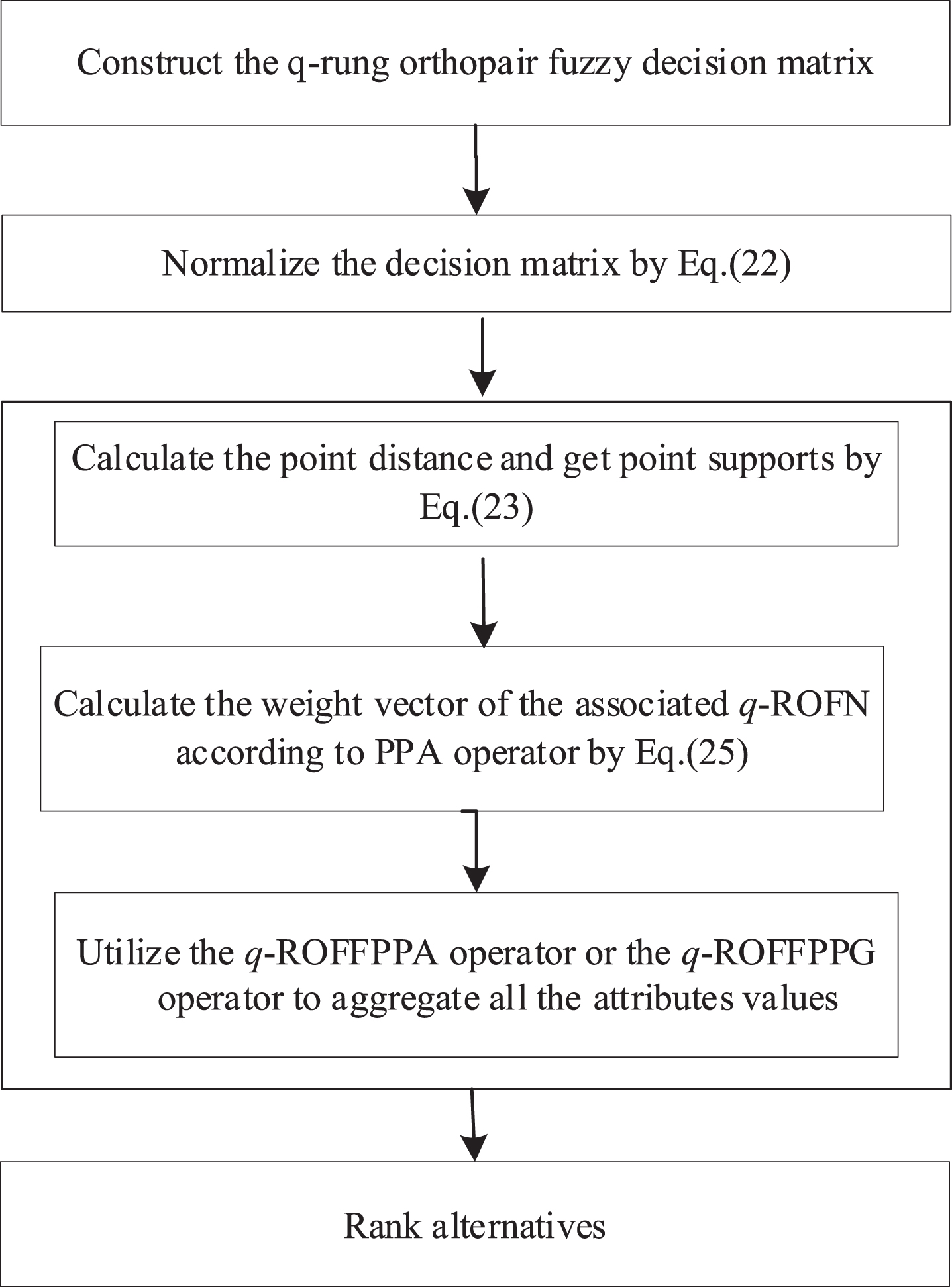
Flow chart of MADM with q-Rung orthopair fuzzy based on q-ROFFPPA and q-ROFFPPG operator.
For Fig. 1, the detailed decision making process is designed as follows:
Let us consider a real-life MADM problem to show the performance of the proposed approach as well as comparative analysis.
To explore the basic situation of the execution of the hierarchical diagnosis and treatment policy, four primary health care institutions in the hierarchical medical treatment system, denoted by x i (i = 1, 2, 3, 4), need to be evaluated after the hierarchical diagnosis and treatment’s operation. The four primary health care institutions are evaluated from the following four assessment indicators (attributes): G1: distribution of outpatient visit; G2: the number of two-way referrals and the referrals diseases; G3: satisfaction degree of patients; G4: average fee per patient. Suppose that the DM gives the rating values for the four primary health care institutions with respect to attributes G j by the q-ROFNs, and the decision matrix is shown in Table 1.
The q-rung orthopair fuzzy decision matrix
The q-rung orthopair fuzzy decision matrix
When i = 1, then
When i = 2, then
When i = 3, then
When i = 4, then
Therefore, the rank of the overall values is a2 ≻ a4 ≻ a3 ≻ a1.
Thus, according to the calculation results, the second primary health care institution is the best in implementing the hierarchical diagnosis and treatment policy. Meanwhile, the first primary health care institution is not so well. Thus, it is necessary for the first primary health care institution to strengthen the publicity of hierarchical diagnosis and treatment policies and improve the residents’ knowledge of the hierarchical diagnosis and treatment policies.
Influence of parameter θ, q on the final result
To reflect the influence of parameters q and θ on the ranking results, we utilize different parameters q to solve the MADM problem in Example 3 by the proposed q-ROFFPPA and q-ROFFPPG operators, respectively. Results are shown as Fig. 2 and Table 2.
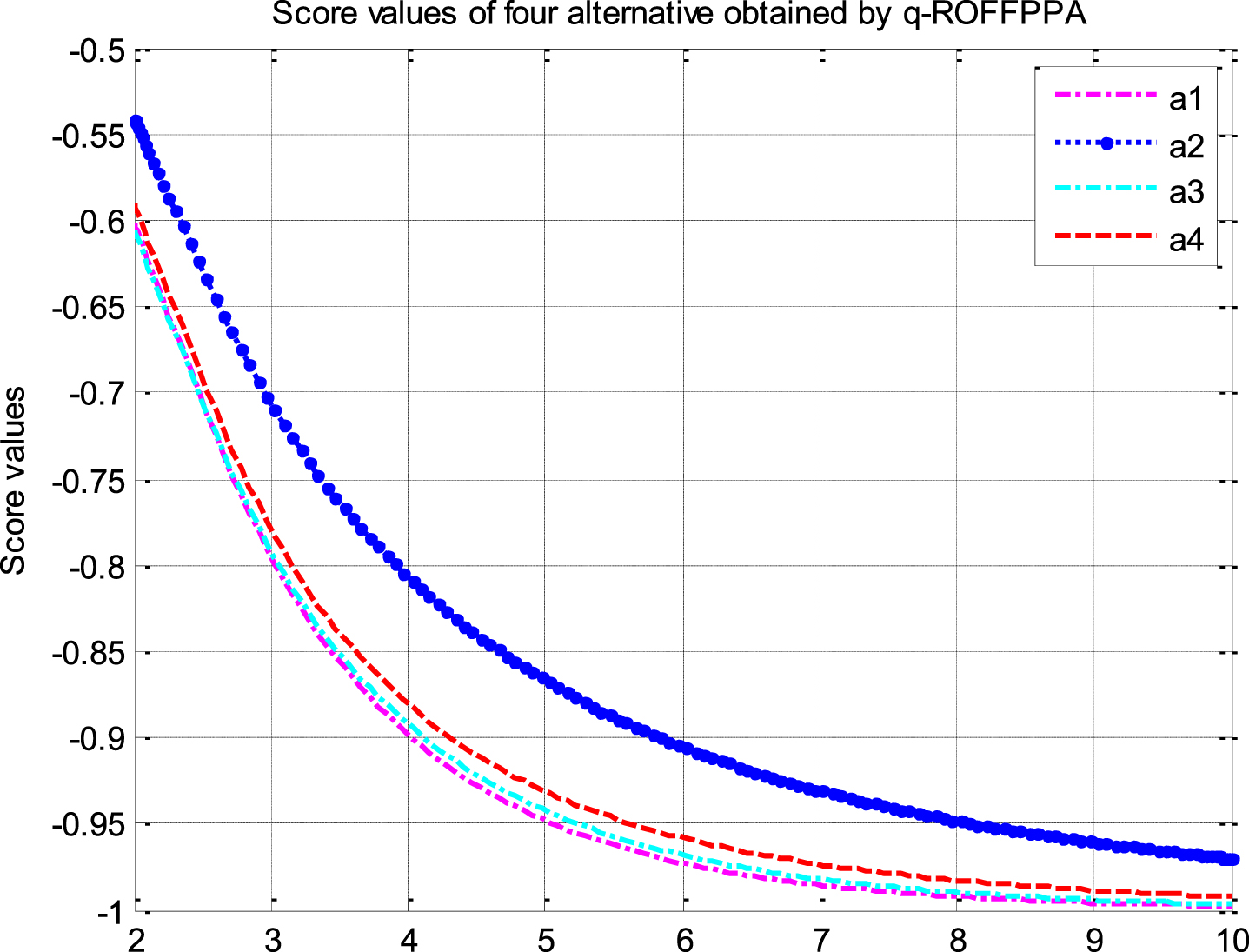
Score values of the alternatives whenq ∈ ( 2, 10 ) based on the q-ROFFPPA operator.
Ranking results by assigning different values to parameter θ in q-ROFFPPA operator
Figure 2 shows the scores values of four primary health care institutions obtained by the q-ROFFPPA operator. From Fig. 2, we can see that the scores of the overall values are different when assigning different parameters q to the q-ROFFPPA operator. However, the ranking results are alwaysx2 ≻ x4 ≻ x3 ≻ x1. Furthermore, x2 is always the best primary health care institution. In addition, the score values of the overall assessments by utilizing the q-ROFFPPA operator become smaller as q increases on [2, 10]. Therefore, the parameter q can be viewed as DMs’ attitude. The more optimistic the DMs are, the smaller values assigned to q and the more pessimistic the DMs are, the greater values assigned to q. Moreover, as the values of q become greater and greater, the score values are very close to a fixed value, no matter the value of q.
In the following, we investigate the influence of parameter θ on score values and ranking results obtained by the q-ROFFPPA operator. Here, we take q = 3. Details can be found in Table 2.
From Table 2, we find that with different parametersθin the q-ROFFPPA operator, the scores vary. However, no matter what the parameterθ, the ranking result is alwaysx2 ≻ x4 ≻ x3 ≻ x1, and thus the best primary health care institution is alwaysx2. By further analyzing Table 2, we can easily find that the score values of alternatives obtained by q-ROFFPPA operator become smaller asθincreases. Therefore, DMs can appropriately select the value of θaccording to their preference and actual needs.
In this section, some comparisons are conducted to illustrate the effectiveness and advantages of the q-ROFFPPA and q-ROFFPPA operators. Considering the q-ROFFPPA and q-ROFFPPG operators that combine Frank operational rules with PPA operator under q-rung orthopair fuzzy environment, we select the following existing approaches as reference approaches to solve the above Example 3.
(1) Comparing with the methods proposed by Xu [30], Ma and Xu [31], and Liu and Wang [19]
In this subsection, we utilize Xu’s method [30], based on intuitionistic fuzzy weighted averaging (IFWA) operator, Ma and Xu’s method [31] based on the Pythagorean fuzzy weighted averaging (PFWA) operator, and Liu and Wang’s method [19] based on the q-rung orthopair fuzzy weighted averaging (q-ROFWA) operator to solve the above example. Results are shown in Table 3.
Ranking results based on different methods for Example 3
Ranking results based on different methods for Example 3
The ranking result obtained by our method based on the q-ROFFPPA operator is the same as the ones obtained by Xu’s method [30], Ma and Xu’s method [31], and Liu and Wang’s method [19], i.e. x2 ≻ x4 ≻ x3 ≻ x1, which verifies the validity of the new method.
However, since the ranking results obtained by these methods are the same, this result cannot reflect the advantages of our method very well. To further illustrate the main advantages of our method, we do a further analysis by adjusting some of the data in the above example.
Ranking results based on different methods for Example 4
In Example 4, we adjust the dataa21 and a24 in Table 4 from (0.6, 0.2) to a too small value (0.01, 0.03) and from (0.5, 0.3) to (0.04, 0.05), respectively. From Table 4, we can find that the optimal alternative obtained by our proposed approach is changed from x2 into x4, while the ranking results obtained by other three methods are unchanged. For the above results, we can provide an explanation as follows. When we changed the attribute vales a21 and a24 to a too small value (0.01, 0.03) and (0.04, 0.05), because the proposed approach in this paper uses the power point weighted vector by measuring the point distance of the arguments, it could avoid the influence of those unduly high or low attribute values on the decision result. However, the methods based on IFWA, PFWA, q-ROFWA operators aggregate attribute values by using simple weighted averaging operators and do not consider the special situation. Thus, in this example, although the score values of the second primary health care institution A2 obtained by methods based on IFWA, PFWA, and q-ROFWA operators are becoming smaller, the ranking result obtained by these methods is unchanged whereas the best alternative identified by the proposed method become x2 from x4.
Thus, the proposed approach is more reasonable in solving practical decision-making problems where the decision data of some alternatives is unduly high or unduly low.
(2) Comparing with Xu’s method [32], Wei and Lu’s method [33] and Zhang et al.’s method [34]
In this subsection, we utilize Xu’s method [32] based on intuitionistic fuzzy power weighted averaging (IFPWA) operator, Wei and Lu’s method [33] based on the Pythagorean fuzzy power weighted average (PFPWA) operator, Zhang et al.’s method [34] based on intuitionistic fuzzy frank power weighted averaging (IFFPWA) operator to solve the above example. Results are shown in Table 5.
Ranking results based on different methods for Example 3
From Table 5, we can find that the ranking result obtained by our method based on q-ROFFPPA operator, Xu’s method [32] based on IFPWA operator, Wei and Lu’s method [33] based on PFPWA operator and Zhang et al.’s method [34] based on IFFPWA operator produce is the same, i.e. x2 ≻ x4 ≻ x3 ≻ x1. The reason is that they all adopt power weighted vector by measuring the distance of the arguments. The difference is our proposed method is based on the point distance, and thus can be viewed as DM’s pessimistic or optimistic attitude. That’s why the score values of alternatives obtained by methods based on q-ROFFPPA operator are smaller than the Xu’s method [32], Wei and Lu’s method [33] and Zhang et al.’s method [34].
However, Xu’s method, Wei and Lu’s method, Zhang et al.’s method also have some limitations. That is, they are based on the IFNs and PFNs, and thus cannot deal with the situation where the sum or square sum of the MD and the NMD is bigger than 1, whereas the proposed method can.
To further explain the advantages of the proposed approach in modeling fuzzy information comparing with Xu’s method [32], Wei and Lu’s method [33], Zhang et al.’s method [34], we give another real-life example.
The decision matrix of Example 5
Then, we apply the proposed MADM approach and Xu’s method [32], Wei and Lu’s method [33], Zhang et al.’s method [34] to address the MADM problem, respectively. Details can be found in Table 7.
Ranking results based on different methods for Example 5
From Table 7, we know the elements a22 and a43 are (0.8, 0.7), (0.9, 0.7), respectively. Given 0.82 + 0.72 > 1and 0.92 + 0.72 > 1, the evaluation attribute values (0.8, 0.7) and (0.9, 0.7) cannot be expressed by IFNs and PFNs. Thus, as shown in Table 7, Xu’s method [32], Wei and Lu’s method [33], Zhang et al.’s method [34] cannot solve the above problem as the MD and NMD do not satisfy the constraint condition of IFNs and PFNs. However, the proposed approach based on the q-ROFFPPA operator can still work as (0.8, 0.7) and (0.9, 0.7) can be represented by q-ROFNs by adjusting the value of q. According to the calculation results above, the quality of medical service in each department can be accurately reflected. The top one department is x4 with the scores of -0.3376, and the quality of medical service is better than that of other departments. The bottom one department is x3, and the quality of medical services is poor. Thus, for the third department, in the premise of guaranteeing quality, further attention should be paid to reduce the cost and length of hospital stay, strengthen the management of hospital infection and improve the emergency response system of adverse events.
Our approach provides technical support for hospital departments to make scientific and effective improvement measures and departmental delicacy management. Therefore, the applicable range of our approach is wider than the methods based on the IFPW, PFWA and IFFPWA operators.
(3) Summary about the proposed operators’ superiorities
To further illustrate the advantages of the proposed aggregation operators, we present the characteristics of proposed operators and operators in Refs. [19, 30–36]. Results can be found in Table 8.
Characteristics of different aggregation operators
From Table 8, we can find our operators have the following advantages compared with the existing operators introduced in Refs. [19, 30–34]:
From the point view of operational laws, the IFWA, PFWA, q-ROFWA, IFPWA, PFPWA and q-ROFGPWA operators in Refs. [19, 30–34] use traditional operational rules and thus there is no a parameter to reflect DMs’ attitude, whereas the q-ROFFPPA and q-ROFFPPG operators proposed in this paper adopt the Frank operational laws. Thus, the advantage of the proposed method is that it is monotonic with respect to the parameter θ, which means that DMs have the flexibility to choose values of parameter θ based on his/her attitude. In practical decision situations, if the DM’s attitude is optimistic, then we let θ → 1, if the DM’s attitude is pessimistic, then we let θ→ + ∞. From the point view of aggregation operators, IFWA, PFWA, q-ROFWA, ST-q-ROFWA, q-ROFWNA operators do not adopt the power weighted vector and thus cannot relieve the influence of the unreasonable data, whereas IFPWA and PFPWA operators [32, 33] and the proposed operators in this paper consider this situation. They allow the values being aggregated to support and reinforce each other based on the support degree between the input arguments, thereby making the opinion more reasonable. However, IFPWA and PFPWA operators [32, 33] use traditional distance to measure the support degrees, whereas the q-ROFFPPA and q-ROFFPPG operators proposed in this paper adopt the point distance measures which can reallocate the MD and NMD of q-ROFNs according to different principle. Thus, it can get more objective result from the original one and give in effect results that are consistent with the essence of q-ROFS. Moreover, our approach based on q-ROFFPPA and q-ROFFPPG operators adopt the Frank operational laws, which is the same as the IFFPWA operator [34]. However, IFFPWA operator is a special case of our proposed q-ROFFPPA (ξ, ς = 0, q=1) operator. From the point view of information expression, the scope of application of our approach is very wide. Although the IFFPWA operator [34] cannot only reduce the influence of the unduly high or low arguments but also adopt the Frank operational laws, it can only solve MADM problems expressed by IFNs. Moreover, compared with the IFFPWA operator [34], the proposed q-ROFFPPA and q-ROFFPPG operators are more functional as they can reallocate the degree of hesitance by the defined point distance. Thus, DMs can appropriately select different point distance measures proposed in this paper to express their pessimistic or optimistic attitude. Additionally, DMs can appropriately select the values of θ, q in the q-ROFFPPA and q-ROFFPPG operators according to actual needs.
In summary, because the proposed method can combine the Frank operational laws with the PPA operator, it provides a flexible and general tool to deal with MADM problems. Based on the comparisons and analysis above, our method is more functional and reasonable.
In this paper, we proposed q-rung orthopair fuzzy Frank power point aggregation operators by combining Frank operational laws and PPA operators. Then, based on q-rung orthopair fuzzy Frank power point aggregation operators, we developed a framework to the MADM problem under q-rung orthopair fuzzy environment. The strengths of the proposed method were also discussed via comparative analysis.
The main academic contributions of this paper are four aspects. First, Frank operational rules of q-ROFNs are provided. The operational rules have an additional parameter that makes aggregation operators monotonically decreasing with respect to the parameter, which makes aggregation process more flexible. Second, a series of distance measures based on point operators for q-ROFS are developed. Based on it, new PPA operators that can control the degree of hesitance by the defined point distance are proposed. Third, q-rung orthopair fuzzy aggregation operators are proposed, including q-ROFFPPA and q-ROFFPPG operators. By using the power point weighted vector, the proposed operators not only can get more objective information, but also avoid the influence of unduly high or low attribute values on the decision result. Fourth, a novel approach to MADM with q-rung orthopair fuzzy information is proposed. The proposed method has a strong practicability and dependability and can be further applied to various practical decision-making problems, such as healthcare management, supplier selection, emergency decision making, and so on.
For future study, it is worth integrating the PPA operator with other operational laws, such as Sine trigonometric operational laws [37], etc. In addition, further research can extend the proposed operators to other fuzzy sets, such as interval-valued intuitionistic fuzzy set [38], interval-valued Pythagorean fuzzy set [39] and linguistic interval-valued Pythagorean fuzzy set [40], and so on.
Footnotes
Acknowledgments
This work was supported by Fundamental Research Funds for the Central Universities.