



Abstract
Substitution boxes (S-boxes) are among the most widely recognized and fundamental component of most modern block ciphers. This is on the grounds that they can give a cipher fortifying properties to oppose known and possible cryptanalytic assaults. We have suggested a novel tool to select nonlinear confusion component. This nonlinear confusion component added confusion capability which describes to make the connection among the key and the cipher as complex and engaging as possible. The confusion can be obtained by using substitution box (S-box) and complex scrambling algorithm that relies on key and the input (plaintext). Various statistical and cryptographic characteristics were introduced to measure the strength of substitution boxes (S-boxes). With the help of the present objective weight methods and ranking technique, we can select an ideal S-box among other constructed confusion component to make our encryption algorithm secure and robust against various cryptographic attacks.
Introduction
Sending enormous measure of secret data over the correspondence media has raised the security challenges. The interest for a more secure and more dependable cryptosystem has made new examination issues in the field of cryptography. For the safe transmission of information to web, images have an incredible significance. Image encryption gives secure transmission of digital images by changing over recognizable type of image into an unrecognizable structure.
The block ciphers play a pivotal role in sharing secret information. The capability of encryption algorithm aimed at creating confusion during enciphering process is responsible for the performance of a block cipher. The confusion is attained by using nonlinear confusion component involved in many block ciphers. The substitution box (S-box) is generally utilized in symmetric encryption algorithms to add confusion to scrambled digital information. A wise choice of S-box decides necessary protection from cryptanalysis and therefore delivers the first information immense in the cipher text. The investigation and examination of the characteristics of S-box identified with its encryption strength is advantageous in enciphering applications. Several construction techniques were developed in literature so far to add confusion capability based on different selection criteria.
In the field of encryption, the development of algebraic structures and S-box statistics has become a focus of attraction. This paper has its basis on image encryption using S-boxes. Substitution box is a unique and nonlinear part of block ciphers. The best way to design an input S-box can increase the quality of cipher documents is a unique and nonlinear core component of block ciphers. S-box is a significant unit to give higher security properties. A variety of S-boxes including advanced encryption standard (AES), affine power affine (APA), Prime, S8, Gray, Xyi and SKIPJACK were used for substitution in modern block ciphers. These nonlinear confusion components are based on algebraic techniques which mainly includes Galois fields and its different modifications. Several new algebraic structures such as Galois ring and chain ring were proposed in order to construct this nonlinear confusion component. In 2013, Husain et. al., projected a new apparatus which utilized projective general linear groups and symmetry group S8 for the construction of S-boxes. This new construction is further improved by adding various other techniques with linear fractional transformation (LFT) to increase cryptographic characteristics of S-boxes [1–13]. Due to similar characteristics of chaos and cryptography, researchers utilized chaos theory to develop nonlinear confusion component of block ciphers [14–27]. The chaos theory is further combined with optimization in order to construct nonlinear component. Now various other mathematical structures likewise Latin square, LA-semigroup and LA- associative were utilized to design new mechanism which uses minimum number of properties to construct nonlinear confusion component [28–31]. In 2012, Iqtadar et. al., proposed a new technique for S-box construction using nonlinear chaotic algorithm (NCA) such S-box has the optimal values of cryptographic attributes [58].
Multi-criteria decision making methodology assists the conclusion maker in the identification of most suitable alternative from a collection of probable criteria. With the procedure with increase of decision techniques along with their variations, one must have a cognizance of their relative worth. Each strategy utilizes numeric procedures and helps the decision maker pick midst a discrete arrangement of elective choices. It gets accomplished on the premise of the effect of the options on specific models and subsequently on the in general utility of the decision maker(s). The trouble that consistently happens while attempting to look at choice techniques and pick the best one is that a mystery is reached, i.e., What dynamic technique ought to be utilized to pick the best decision making method.
Multi-criteria decision making (MCDM) is widely used to explore many conflicting approaches to decision-making. The contraindication criteria is the same in evaluating options: cost or price is usually one of the main criteria and a certain level of quality is generally another determinant that conflicts with costs [57]. Multi-criteria decision making involves three basic steps: Determination of appropriate procedure and alternatives. Connect mathematical steps with the general significance of the measures and the results of alternatives in these measures. Analyze mathematical attributes to determine the positioning of every other option.
Some Multi-criteria decision making methods have been utilized by many researchers. The Weighted Sum Model (WSM) is considered the very first and perhaps the most extensively utilized technique. The Weighted Product Model (WPM) is considered as a WSM alteration, and is suggested for the weakness of the prior one. Another method known as Analytical Hierarchy Process (AHP) has gained popularity recently. Professor Belton and Gear suggested a change in AHP in 1981 that seems much more powerful than the original method. Something more methods used by ELECTRE and TOPSIS [59].
To find out the best S-box among all the nine S-boxes, we need to use any method of MCDM. In each S-box there are some beneficial criteria and non-beneficial criteria as well. Here energy, homogeneity and average correlation are non-beneficial criteria whereas contrast, mean of absolute deviation analysis (MAD) and entropy are beneficial criteria. Each MCDM method assigns weights to both advantageous and non-advantageous criteria [32–53]. The Fig. 1 depicts some well known MCDM which are utilized in various systems to classify the best and worst component in any give data set.
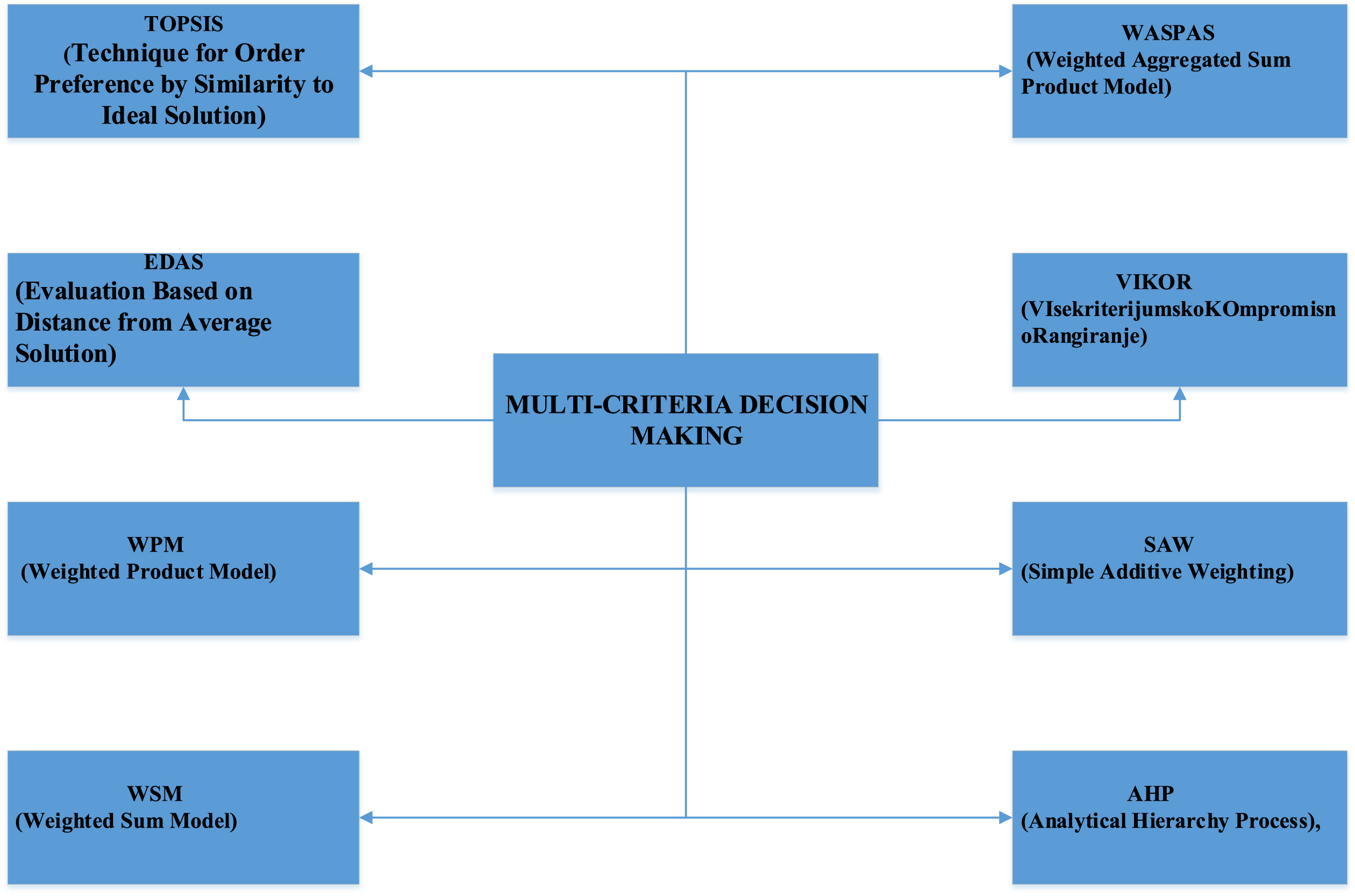
Some well-known multi-criteria decision making methods.
The principal purpose of the article is to suggest a new mechanism for the selection of best nonlinear confusion component of block ciphers by using MCDM. We have used entropy method for the selection of weight objectively. These weights were further used in SAW method for the selection of best cryptographic nonlinear component. Since the encryption scheme is highly depends on its nonlinear confusion component to add confusion characteristic in encryption scheme. According to Claude Shannon, one of the most important constituent of modern block ciphers design is confusion.
The rest article is structured as follow. In section 2, we have added various cryptographic characteristics of authenticating standard S-boxes. In section 3 is devoted to objective weight calculations namely entropy method. In simple additive weighting is used to select best S-box among other in section 4. Finally, conclusion is added in section 5.
To substantiate the cryptographic robustness of non-linear confusion component few techniques have been used which have been presented in the following section [55]. We have added some fundamental statistical and algebraic definitions related to nonlinear confusion component of block cipher. The standard cryptographic characteristics of S-boxes are nonlinearity, strict avalanche criterion, bit independent criteria, linear approximation probability and differential approximation probability. We have encrypted a standard Lena image with all available set of standard S-boxes and then analyzed its statistical characteristic which includes entropy, correlation, energy, contrast, mean absolute error and homogeneity.
Energy
It measures the energy of ciphered images administered by different S-boxes. Energy gives the total number of squares in the gray level co-event matrix gray. The mathematical expression for energy is given by the following relation:
Homogeneity
It is a measure of nearness among the dispersal of elements in the grey level co-occurrence matrix (GLCM), also known as grey tone spatial dependency matrix (GTSDM) to GLCM diagonal. It represents the statistics of a combination of values of pixel vividness or gray levels in tabular form. The homogeneity is calculated as:
Contrast
It is used to identify objects in image formation. Encrypted image has high levels of contrast due to the high random rate brought by using the S-box in the encryption process. Often, a contrast analysis enables the viewer to know clearly point to items which are present in the composition of the image. A ciphered image has high levels of contrast which is because of randomness presented with the use of the S-box in enciphering. The mathematical formula for contrast is given as follow:
Mean of absolute deviation
It is a measure of the alteration among an actual image and an enciphered image. It calculates the change between the actual image and the enciphered image. The definition of absolute deviation is limited to examining the differences among the two images. Mathematically it is given as:
Entropy
Entropy is a mathematical method that calculates the uncertainty in an image. Entropy is a measure of random statistics which is used to display the texture of an image. The calculation method of information entropy is given as:
The degree of randomness for each standard S-boxes is presented in Table 1.
Entropy value of Lena image with different S-boxes
Entropy value of Lena image with different S-boxes
It is a value that shows the relationship between the nearest pixel values in an encrypted image. The small amount of merging indicates that the encryption process achieved the highest randomness between adjacent pixels in the encrypted image. This analysis consists of three parts. First, the interaction between local and vertical pixels is calculated. To test the common similarity between the explicit image and the encrypted image, the complete image fusion is analyzed in one step. This helps us to find similarities or differences from a global perspective (See Table 2, Figs. 3–10).
Correlation coefficient of two adjacent pixels of plain image and ciphered image for different S-boxes
Correlation coefficient of two adjacent pixels of plain image and ciphered image for different S-boxes
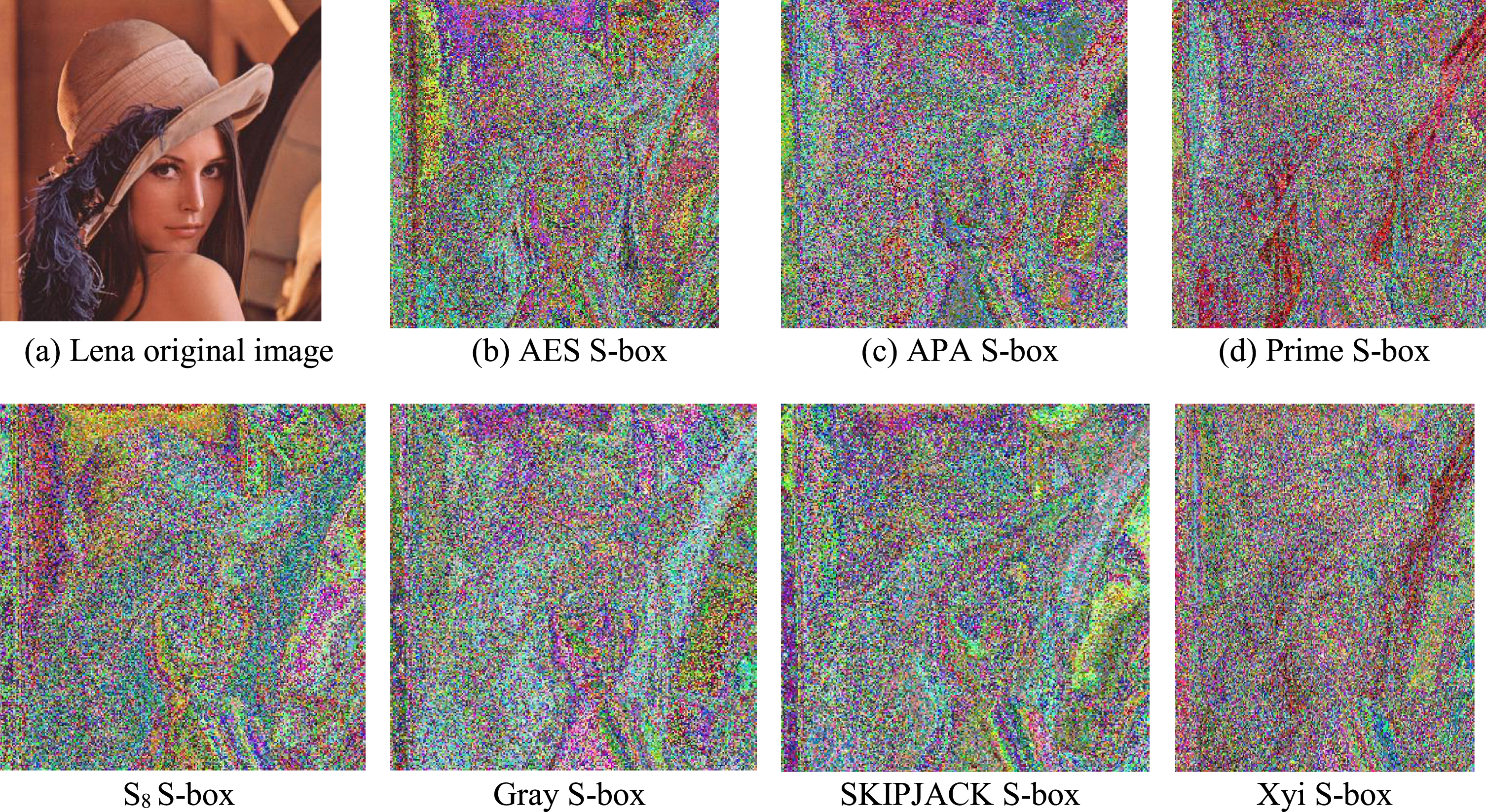
Encryption of Lena image with standard S-boxes with one round.

Correlation diagram of plain Lena image in different directions.
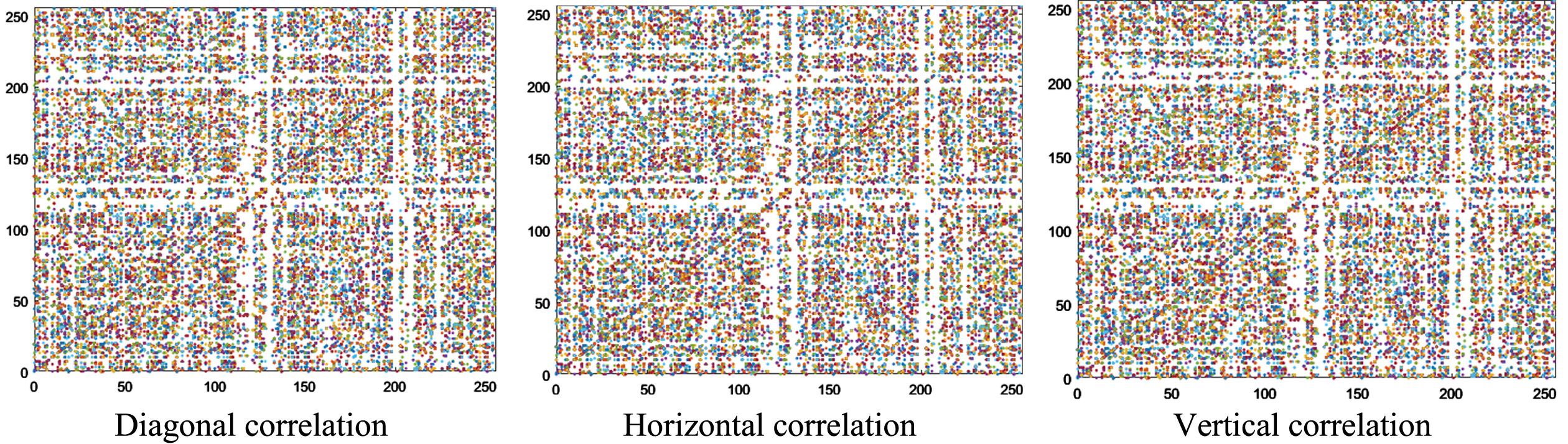
Correlation diagram of encrypted images with AES S-box.
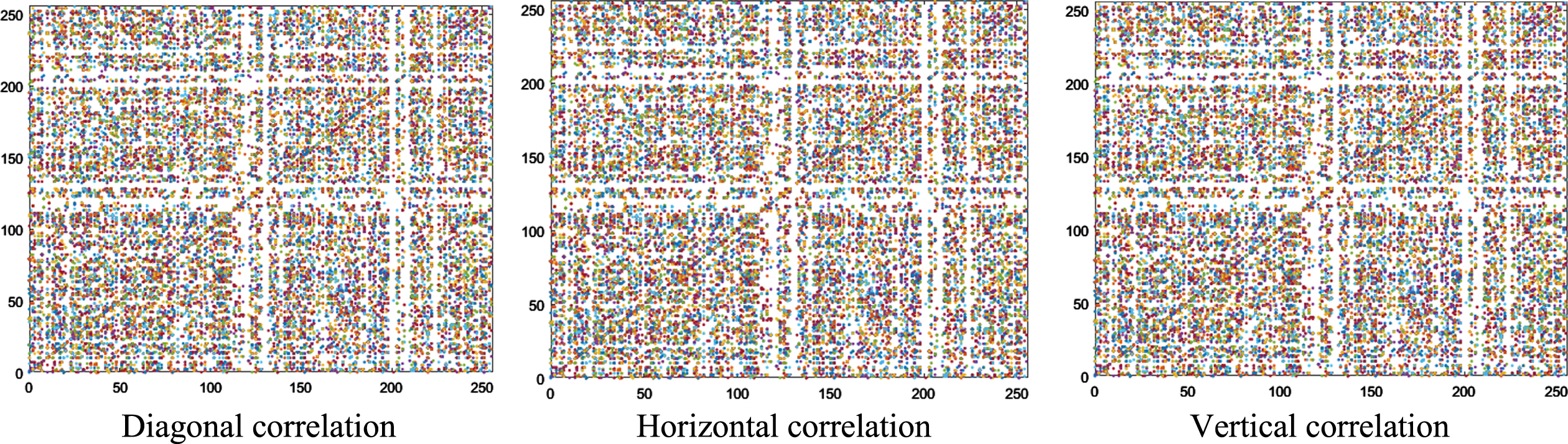
Correlation diagram of encrypted images with APA S-box.

Correlation diagram of encrypted images with Prime S-box.
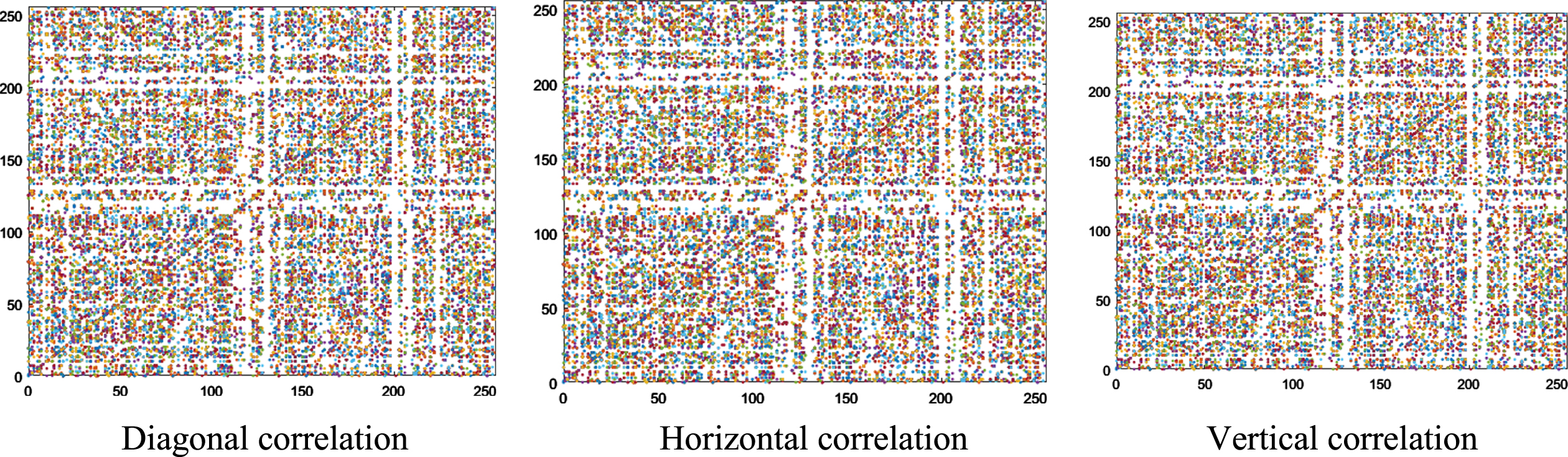
Correlation diagram of encrypted images with S8 S-box.

Correlation diagram of encrypted images with Gray S-box.

Correlation diagram of encrypted images with Skipjack S-box.
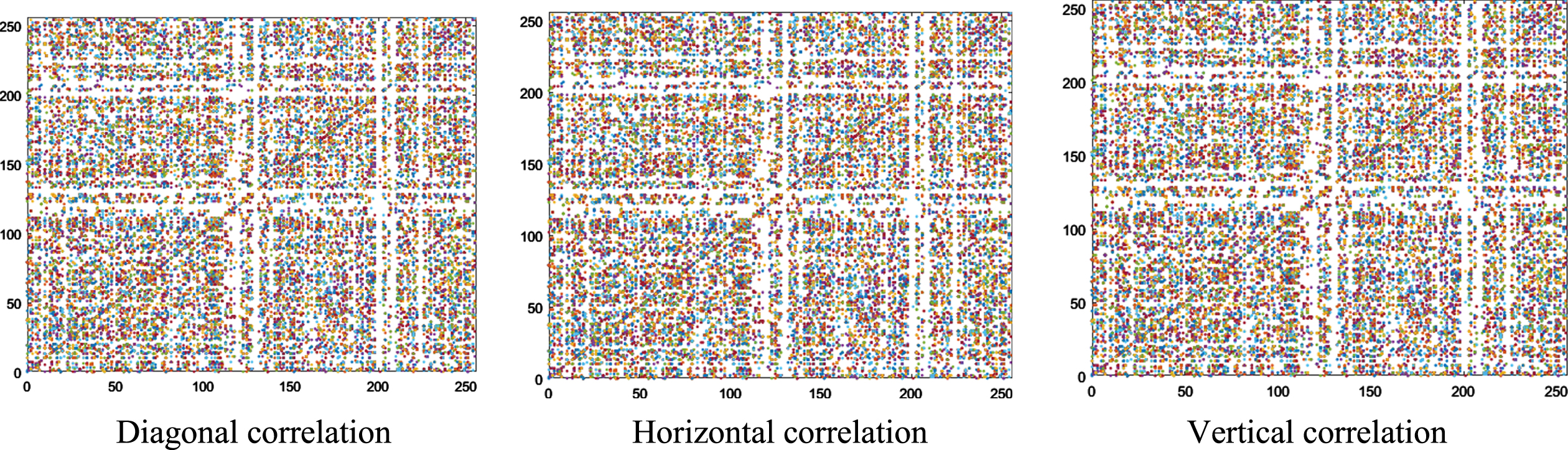
Correlation diagram of encrypted images with Xyi S-box.
The nonlinearity N
h
of a Boolean function h is defined as the lowest value of distance from any affine function. It is given by:
Strict avalanche criterion
Strict avalanche criterion is regarded as complete, on the off chance that the likelihood of change in output bits is 0.5 for single information bit change.
Bit independence criterion
Bit independence criteria of strict avalanche criteria means that the avalanche variables are pairwise autonomous for a given arrangement of avalanche vectors produced by supplementing of only the slightest bit.
Linear approximation probability
Linear approximation probability is a degree which determines the degree of unevenness of an occurrence. Mathematically written as:
Differential approximation probability
The formula of differential approximation probability is given by:
We can see in Figs. 11 and 12, the hierarchy for the weighting and ranking of our nonlinear confusion component. Initially have alternatives and criteria are decided which form the decision matrix. Next step is to identify which multi-criteria decision making technique should be adopted. Some methods require weight allocation which can be allocated using other weight assignment method. We have used entropy method for weight allocation. Next the beneficial and non-beneficial criteria are classified by the decision maker. In the end alternatives are ranked using some multi-criteria decision making method.
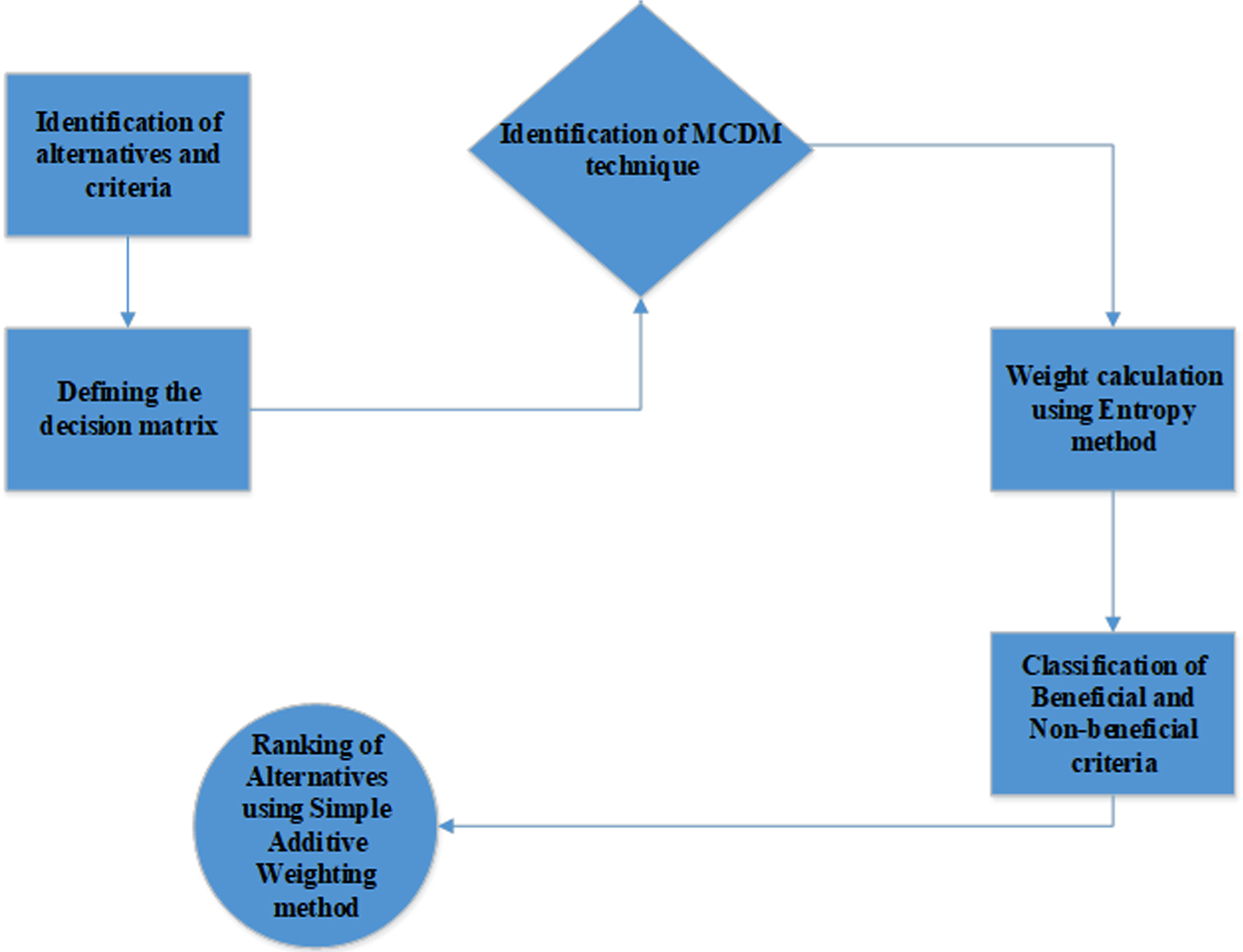
Selection mechanism of proposed MCDM scheme.

Flowchart for entropy method.
Entropy weight method (EWM) is a usually utilized estimation strategy that determines the distribution of value in decision-making. As the level of dispersion increases, the level of fragmentation increases, and more details can be obtained. In the meantime, high weight ought to be given a sign, and the other way around. Compared to the various subjective weight measuring techniques, the main benefit of EWM is to avoid distortion of the human material in the load of the displays, thus improving the observation of the full test results. Subsequently, EWM has been extensively utilized used in decision-making in recent years [56]. In the case of MCDM problems one of the most difficult tasks is to allocate weights accurately to conditions with respect to alternatives that can be ranked. Weight allocation to the beneficial criteria such as contrast, mean of absolute deviation and entropy, and non-beneficial criteria such as energy, homogeneity, and average correlation by utilizing entropy method. Table 3 shows the decision matrix of S-boxes AES, APA, Lui, Prime, S8, Gray, Xyi and SKIPJACK which are the possible alternatives of the decision maker. Let Y1 : Energy, Y2 : Homogeneity, Y3 : Contrast, Y4 : Mean absolute error, Y5 : Averagecorrelation, and Y6 : Entropy be the criteria.
Decision Matrix
Decision Matrix
On the basis of these notions entropy method consists of following steps:
In this method decision matrix is normalized, then entropy is calculated which is being utilized for the calculation of weights of beneficial and non-beneficial criteria. The steps involved in this method are as under:
In this step each criteria value
Table 3 represents the normalized values of alternatives i.e., S-boxes of AES, APA, Lui, Prime, S8, Gray, Xyi and SKIPJACK against each criterion i.e., Y1: Energy, Y2: Homogeneity, Y3: Contrast, Y4: Mean of absolute deviation, Y5: Average correlation, Y6: Entropy. The normalized values of these alternatives against each criterion are represented by {t1, t2, t3, t4, t5, t6}.
Table 5 shows the entropy values of S-boxes. The value of entropy is obtained with the help of mathematical expression given as:
Normalized decision matrix
Normalized decision matrix
Entropy value calculated
Weight vectors assigned to each criterion
Based on previous Table 4, we calculated the weights corresponding to each statistical properties of encrypted image after passing it through standard S-boxes. The tabulated results of step 3 is given in Table 5.
The weight vector
Table 5 represents the weight vector
After assigning weight next step is to figure out that which alternative is best among all the alternatives i.e. the best S-box in this case. Here simple additive weighting (SAW) technique is acquired for finding the best S-box among all the eight S-boxes namely AES, APA, Lui, Prime, S8, Gray, Xyi and SKIPJACK.
Simple Additive Weighting (SAW) which is otherwise called weighted direct mix or scoring strategies is a basic and frequently utilized multi attribute decision technique. The strategy depends on the weighted average. An assessment score is determined for every option by duplicating the scaled worth assigned to the option of that characteristic with the loads of comparative significance straightforwardly relegated by chief followed by adding of the items for all standards. The upside of this strategy is that it is a analogous straight change of the basic information which implies that the general significant degree of the normalized scores stays equivalent.
The test rating is calculated separately by multiplying the estimated value given some of that value and the estimated value given directly by the decision maker followed by summarizing the products of all the processes. The advantage of this method is that it is a uniform conversion of raw data which means that the corresponding order of the size of the guaranteed schools remains the same. The procedure of SAW consists of these steps:
Mathematical formulation of simple additive weighting
The value of bij for beneficial and non-beneficial criteria is calculated using the following mathematical relation of SAW technique are listed in Table 6.
Calculation of w
j
for beneficial criteria
Calculation of
Table 6 contains
Calculation of bij for non-beneficial criteria and a ij
In this step the alternatives are ranked based upon the value of
In Table 8, the weight vector
Ranking of the S-boxes
In this paper, an image encryption technique using some standard S-boxes has been studied. Preliminary a standard Lena image is encrypted using standard S-boxes such as AES, APA, Prime, S8, Prime, Gray, Xyi and SKIPJACK. The confusion is obtained by using substitution box (S-box) and complex scrambling algorithm. Furthermore, statistical analyses are performed such as correlation, entropy, energy, contrast, homogeneity and mean of absolute deviation of the original Lena image and encrypted image are calculated. Secondly, MCDM is applied for finding the best S-box among all, which ranked the S-box of AES as optimum. We can conclude that S-box of S8 (S8-AES) is the best choice for encrypting the standard Lena image. To achieve better encryption effects, this work can be extended to a combination of two or more MCDM methods. The strength of this technique can be analyzed through different cryptographic analyses. MCDM methods can be used to select the best algorithm for lightweight cryptographic security and in other domains like transportation, business, engineering, and banking.
Future recommendation
To achieve better encryption effects this work can be extended to a combination of two or more multi-criteria decision making methods. The robustness of these methods can be analyzed through different cryptographic analyses. Multi-criteria decision making methods can be opted for the selection of best algorithm for lightweight cryptographic security and in other domains like transportation, business, banking, and engineering.
Conflict of interest
It is declared that authors have no conflict regarding the publication of this article.
Footnotes
Acknowledgments
The second author acknowledges Ajman University for supporting the research, Internal Research Grant No: [DGSR Ref. 2020-IRG-HBS-01].