



Abstract
Neutrosophic cubic set (NCS) can process complex information by combining interval neutrosophic set and single-valued neutrosophic set. It can simultaneously describe the uncertain and certain part of information. Prospect theory (PT) is based on bounded rationality and can reflect decision maker’s different risk attitudes to gains and losses. Measurement of Alternatives and Ranking according to COmpromise Solution (MARCOS) method can measure and rank the alternatives according to compromise solution. Considering the bounded rationality of decision makers and compromise solution of alternatives, this paper combines the PT with MARCOS method to neutrosophic cubic environment to solve multi-attribute decision-making problem. First, the theoretical basis of NCS is introduced. Second, the PT and MARCOS method are combined. To reflect subjective views of decision makers and the objectivity of decision-making information, this paper uses geometric average method to combine subjective weights (calculated by the best-worst method) and objective weights (calculated ed by the entropy method). Then, the PT-MARCOS method is applied to a decision-making problem. Further, a sensitivity analysis is conducted to study the influence of different attenuation factor values and different expectation coefficient on the ranking; and through comparative analysis to illustrate the superiority of the PT-MARCOS method. Finally is the conclusion.
Keywords
Introduction
Zadeh [1] firstly introduced the concept of fuzzy set (FS) to express the truth-membership function which belongs to the closed interval [0,1]. Atanassov [2, 3] added the falsity-membership function in the FS and proposed the concept of intuitionistic fuzzy set (IFS), where the truth-membership function and falsity-membership function belong to the closed interval [0,1] respectively and the sum of them belongs to [0,1]. Atanassov and Gargov [4] proposed the interval-value intuitionistic fuzzy set (IVIFS) where the truth-membership function and the falsity-membership function are extended to the interval values. The hesitant degree in IFS and IVIFS is dependent on truth-membership function and non-membership function. Smarandache [5] introduced the neutrosophic set (NS) to depict the truth-membership function T (u), indeterminacy-membership function I (u) and falsity-membership function F (u). The T (u), I (u) and F (u) are mutually independent subsets in ]0–,1 + [ and T (u) + I (u) + F (u) ∈]0–, 3+ [. Later the NS was extended to interval neutrosophic set (INS) [6] and single-valued neutrosophic set (SVNS) [7]. Edalatpanah [8] extended the NS and proposed a novel concept of neutrosophic structured element. Later Edalatpanah et al. [9–11] applied the neutrosophic set and its extension to data envelopment analysis model. Jun et al. [12] defined the cubic set, in which the certain degree given by interval-value fuzzy set [13] and the uncertain degree given by FS. Jun et al. [14] extended the cubic set to neutrosophic set and defined the concept of NCS. Some scholars researched multi-attribute decision-making (MADM) methods in neutrosophic cubic environment. Pramanik et al. [15] combined neutrosophic cubic number (NCN) and VIKOR to solve MADM problems. Pramanik et al. [16] applied the TODIM method to neutrosophic cubic environment and proposed the NC-TODIM method. Pramanik et al. [17] introduced a new MADM method by combining an extended TOPSIS method with NCNs. Aslam et al. [18] defined the triangular linguistic neutrosophic cubic fuzzy number and combined it with TOPSIS. Fu and Ye [19] proposed the concept of cubic hesitant neutrosophic number and its similarity measure. But no scholars have combined NCS and PT to study the bounded rationality problem of decision makers in the neutrosophic cubic environment.
All the above MADM methods are based on the expected utility theory which holds that the decision maker is completely rational when making a decision. However, there are bounded rationality cases in the actual decision-making process, so Kahneman and Tversky [20] put forward the PT. PT is one of the most influential theories of psychological behavior, which considers the personal expectations and prospects of decision makers and describes the decision-making behavior of decision makers under risk and uncertainty. Later the PT is extended to the field of MADM. Guo et al. [21] combined single-valued neutrosophic linguistic sets and PT to solve MADM problems. Fang et al. [22] defined a prospect theory-based evidential reasoning approach to process uncertainty in multi-criteria group decision-making. Liu et al. [23] combined the multiattributive border approximation area comparison (MABAC) method with PT and proposed the new NWHF-CCSD-PT-MABAC method. Zhu et al. [24] defined a risk decision-making method with multiple reference points under both static and dynamic situations in the environment of PT.
MARCOS method proposed by Stević et al. [25] is a new method to measure and rank alternatives based on compromise solution. The basis of MARCOS method is to determine the utility function of alternatives by defining the relationship between alternatives and reference values (ideal and negative ideal alternatives), and finally to rank alternatives. Gong et al. [26] combined the extended MARCOS with the interval type-2 fuzzy set to describe the uncertain information and solve the evaluation problem of renewable energy accommodation potential. Biswas [27] used the MARCOS method to rank the supply chain performance of major medical institutions in India. Stanković et al. [28] proposed a fuzzy MARCOS method for traffic risk assessment. Torkayesh et al. [29] used geographic information system, BWM and MARCOS methods to measure and rank the alternatives under the grey interval set considering sustainable development factors. Celik et al. [30] integrated the BWM and MARCOS method in the environment of interval type-2 fuzzy sets. At present, there are few studies related to MARCOS, and no one has explored the combination of MARCOS and PT.
NCS provides more effective and informative information in the form of INS and SVNS, which can describe the partial uncertain and partial certain information. PT considers the psychological factor and bounded rationality of decision makers. MARCOS method is a vital tool to handle MADM problems with conflicting criteria. Considering the advantages of NCS, PT and MARCOS method, we creatively combine the PT and MARCOS method in the neutrosophic cubic environment. It is beneficial to solve bounded rationality and compromise solution problems. PT is used to get the prospect decision matrix and transform decision information. MARCOS method is used to describe the optimal alternative based on compromise solution.
There are three contributions of this paper: (1) We combine the PT with MARCOS method to solve bounded rationality of decision makers and compromise solution simultaneously. (2) In order to consider objective information and subjective perspective of decision makers, we adopt combined weights combining objective weights and subjective weights. The subjective weight is solved by the BWM method, and the objective weight is solved by the entropy method. (3) Apply the PT-MARCOS method to neutrosophic cubic environment to process complex information and extend the MADM methods about NCS.
The rest of this paper is organized as below. The Section 2 briefly introduces some theoretical bases about NCS, MARCOS and PT. The PT-MARCOS multi-attribute decision-making method is introduced in Section 3. In Section 4, a numerical example is applied to illustrate the PT-MARCOS in neutrosophic cubic environment. In Section 5, we verify the validity and superiority of PT-MARCOS by a sensitivity analysis and a comparative analysis. Finally, Section 6 gives the conclusion.
Preliminaries
A neutrosophic cubic number (NCN) can be expressed as
The PT-MARCOS multi-attribute deision-making method
Supposing there are m alternatives A = { A1, A2, . . . A i , . . . A m } , (m ⩾ 2) and n attributes C = { C1, C2, . . . C j , . . . C n } , (n ⩾ 2). The decision model of the PT - MARCOS method concludes three stages: editing the decision information by PT, calculating the combined weights, and evaluating the alternatives according to MARCOS method. The editing stage is mainly to process decision-making information and determine the value function through the PT. The weights solving stage is to calculate the subjective and objective weights separately to get the combined weights. In the evaluation stage, the compromise solution is calculated by the MARCOS method so as to rank the alternatives. The graph of general frame of the PT-MARCOS method is shown in Fig. 1.
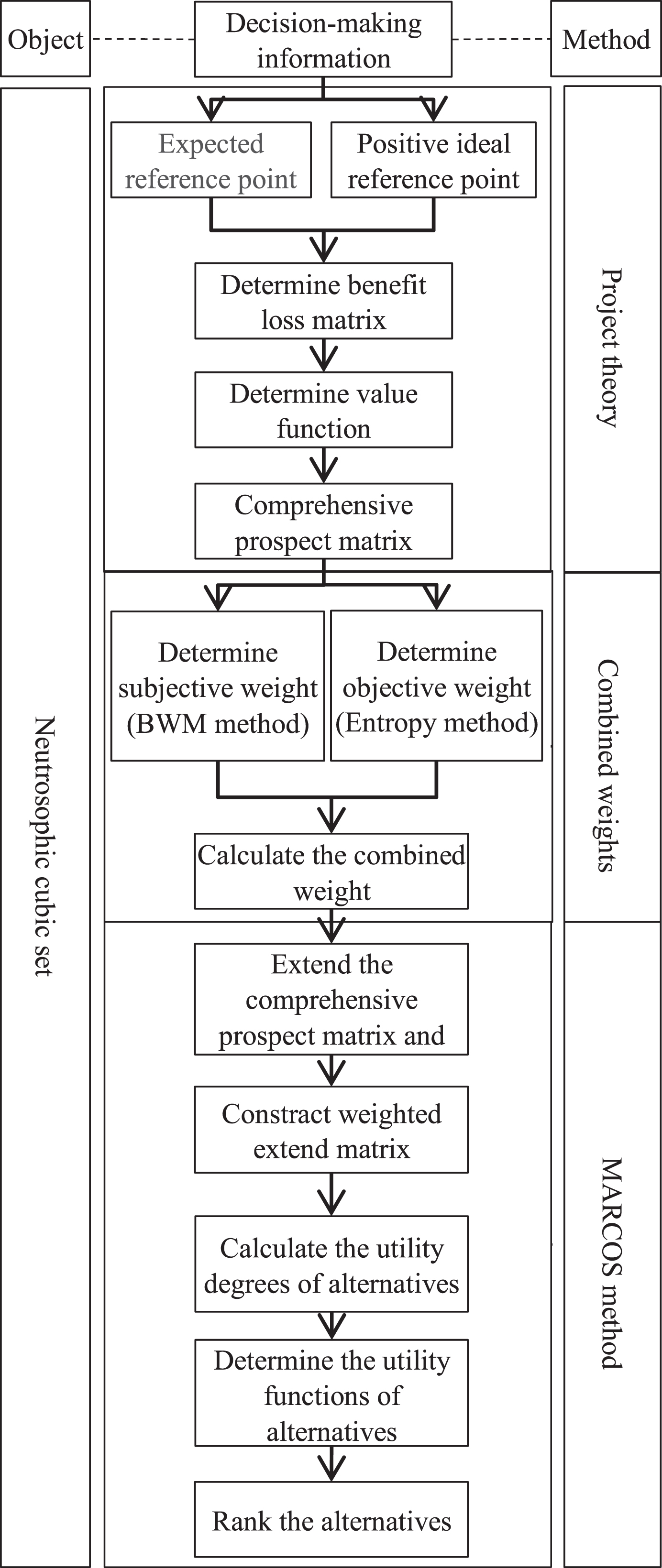
The graph of general frame.
The decision maker gives evaluation values about this problem. The evaluation value of A i on attribute C j is represented by the decision matrix P = [p ij ] m×n, where p ij is a neutrosophic cubic number.
The setting of reference point is mainly considered from the external competitive advantage and internal characteristics. The external reference point reflects the competitive advantage from the optimal value of external indicators, while the internal reference point reflects its own characteristics from the decision maker’s expectation of each attribute of the evaluated alternative.
The expected value
According to the score function in definition 7 and Hamming distance in definition 6, we construct the benefit loss matrix. The decision maker’s gain and loss decision matrix D = [d
ij
] m×n is shown as Equation (1):
In order to consider decision maker’s different attitudes towards losses and gains, it is necessary to establish decision maker’s prospect value under each attribute corresponding to each alternative based on PT. That is to say, add the psychological characteristics of decision maker facing risks to the evaluation, and establish the prospect decision matrix
We need to use the Equation (3) to combine the two prospect matrices obtained according to different reference points:
The parameter l indicates the degree of emphasis on expected value of the attribute, and the value can be adjusted according to the preference of decision makers. When l > 0.5, the decision result shows the emphasis on comparison with the expectations. When l < 0.5, emphasis is placed on comparison with the positive ideal solution. When l = 0.5, both are considered equally important. If there is no special preference, generally l = 0.5.
Determine the objective weights of attributes
Entropy method is an objective method to calculate the weights of attributes, which determines the weights according to the information provided by each attribute value. The concrete process is as follows:
BWM is a MADM method proposed by Rezaei [35]. The basis of this approach is to measure the weights of attributes through pairwise comparison. BWM method has less pairwise comparison and higher consistency ratio than AHP and ANP methods. In BWM, the weight of each attribute is determined by assigning a scale from 1 to 9 to determine the priority of all attributes to the worst attribute and the priority of the best attribute to the other attributes. The concrete steps are as follows:
We use geometric average operator to combine the objective weights and subjective weights. Therefore, we can get the attribute weight
In summary, the process of the PT-MARCOS method under the neutrosophic cubic environment is shown as follows:
The prospect matrix V = [v ij ] m×n can be obtained by Equations (1)–(3).
The objective weights are obtained based on the entropy method through Equations (4)–(6). The subjective weights are obtained based on the BWM method through Equation (7). Then we use the Equation (8) to combine the subjective and objective weights to get the combined weights.
The extension of the initial matrix V’ is performed by defining the ideal (AI) and anti-ideal (AAI) solution.
The ideal solution (AI) is an alternative with the best characteristic while the anti-ideal solution (AAI) is the worst alternative. AAI and AI are defined by Equation (9):
The element in normalized extended matrix is obtained by Equation (10):
The element in the weighted extended matrix F is obtained by multiplying the normalized extended matrix N with the weights of the attributes:
We calculate the utility degree K
i
of an alternative in relation to the anti-ideal and ideal solution by Equation (12):
The utility function f (K
i
) is the compromise of the observed alternative in relation to the ideal and anti-ideal solution.
Utility functions in relation to the ideal and anti-ideal solution are determined by Equation (15):
This step we need to rank all the alternatives according to the final values of utility functions. The bigger the value of utility function, the better the alternative.
Suppose an investment company is going to invest a sum of money to get the maximum benefit. There are four alternative companies: an automobile company (A1); a food company (A2); a computer company (A3); an arms company (A4). The investment company need to consider the following four attributes when making decisions: C1 is risk control capability, C2 is growth potential; C3 is the market prospect, and C 4 is the return on investment. The decision maker gives the decision value in the form of NCNs, and the decision matrix P is shown in Table 1.
Decision matrix P
Decision matrix P
The concrete decision-making procedure is as follows:
The decision maker assigns values to the alternatives through NCNs to form decision matrix, as shown in Table 1.
1. Firstly we determine the reference points.
The internal reference point is given by the decision maker according to his own knowledge structure, experience and subjective judgment. After full consideration, the decision maker sets the internal reference points as:
The external reference points are obtained by Equation (16):
so the external reference points are:
2. Then, we get the decision maker’s gain and loss decision matrix.
3. Next, we establish the prospect decision matrix.
4. Finally, we construct a comprehensive prospect matrix.
Here we make l = 0.5. It means that when selecting the reference points, the emphasis on the expected value and the positive ideal solution of the attribute is the same. The comprehensive prospect matrix is:
When using BWM to calculate the subjective weights, we let the risk control capability (C1) as the best attribute and the return on investment (C4) as the worst attribute. The priority of the best attribute over each of the other attribute and priority of each attribute over the worst attribute are:
According to Equations (4)–(8), we get the weight vector ω = (0.26, 0.33, 0.32, 0.09).
The extended prospect matrix is:
Due to
Sensitivity analysis - changing the parameters of the value function
To perceive the effect of the parameters α, β and γ on the decision making, we set three common different values for the parameters from [36] and rank the alternatives. The ranking results for different parameters values are given in Table 2 and Fig. 2.
Ordering of the alternatives by using different values of α, β and γ
Ordering of the alternatives by using different values of α, β and γ
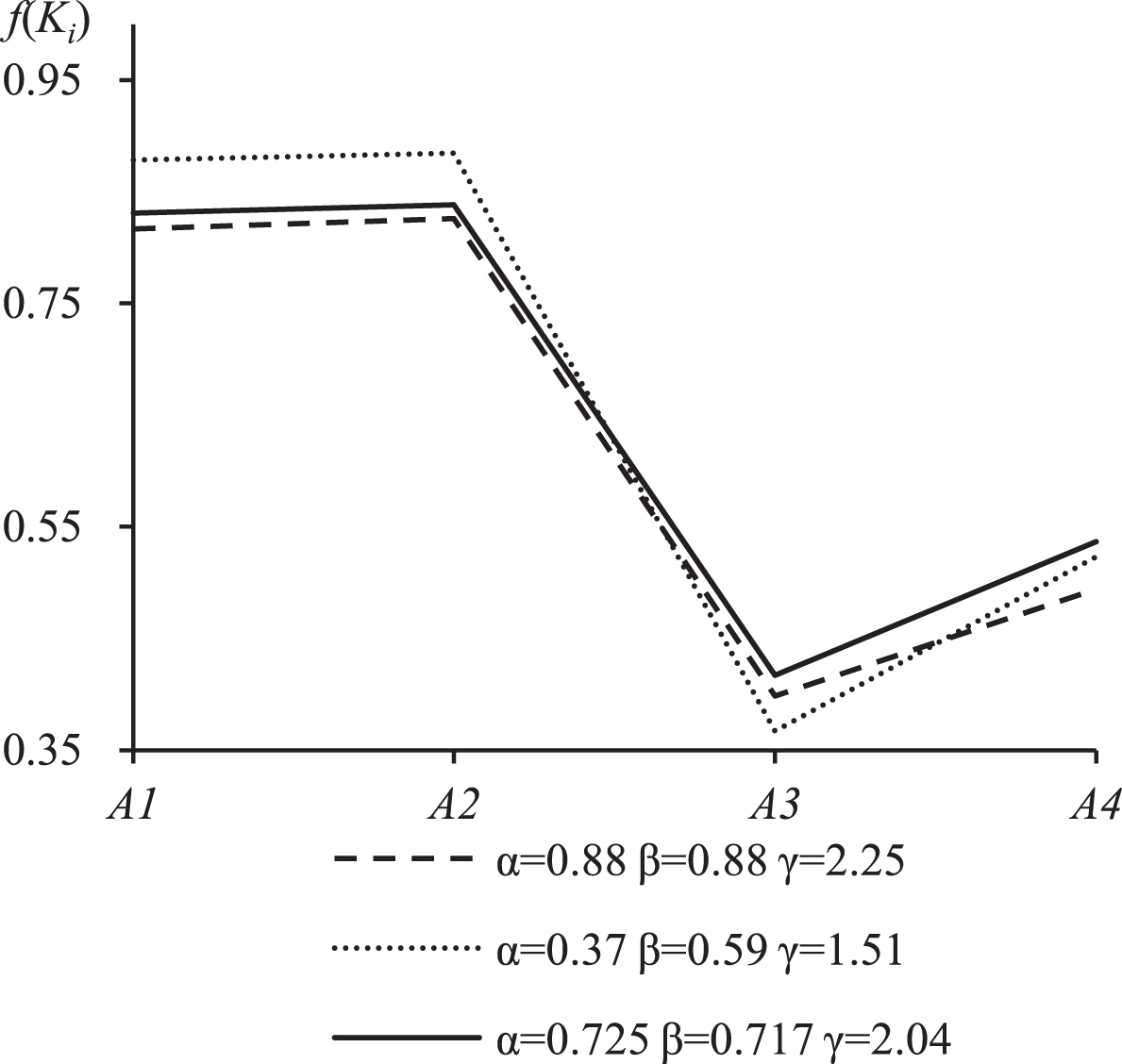
Utility function under different α, β and γ.
From Fig. 2 we can see that in the case of three typical parameter combinations, the parameters of the value function have an impact on the utility function, but the overall ranking results of the alternatives are relatively stable.
In really, the ideal reference point can not only indicate the performance value of most of the alternatives in the evaluation system, but can also express the characteristics of external reference points while taking external competitiveness into consideration. Comprehensively, expected value can measure the interior level, while positive ideal solution can express the position as a whole. So these two kinds of points should be considered in a static situation to make a more comprehensive decision. When integrate the internal and external reference points, the parameter setting of the degree of emphasis on attribute expected value plays a key role in decision-making. Table 3 shows the order of the alternatives under different parameters l.
Ordering of the alternatives by using different values of l (α=β= 0.88, γ= 2.25)
Ordering of the alternatives by using different values of l (α=β= 0.88, γ= 2.25)
In the case of a single reference point, the results of the alternative ranking are quite different. When taking the expected value of the attribute as the single reference point, the best alternative is A2, while A1 is the best alternative when the positive ideal solution is the single reference point. The reason for this difference is that, when taking the expected value as the single reference point, the ranking of alternatives takes the expected value of attributes as the only benchmark for comparison, which reflects the potential advantages of the plan. When taking the positive ideal solution as the single reference point, the ranking of the alternatives is judged from the size of the attribute value of the decision-making matrix, and the objective advantages of the external performance of the scheme are considered.
And we can also see that when it shows the emphasis on comparison with the positive ideal solution, i.e. l ∈ [0, 0.5), the ranking is the same and the best alternative is A1. While when l ∈ [0.5, 1], the ranking is the same and the best alternative is A2.
So, when setting the reference point, the emphasis on comparison with the expected value of the attribute will have an impact on the decision-making result.
In order to illustrate the effectiveness and superiority of the proposed method, we compare it with three different decision making methods. The result is shown in Table 4.
Decision results based on different MADM methods
Decision results based on different MADM methods
According to the TODIM method in [34], we calculate the overall dominance degree Ω of each alternative. We get A2 ≻ A1 ≻ A3 ≻ A4 which is different from the ranking obtained by PT-MARCOS method and A 2 is the optimal alternative which is the same as the optimal alternative obtained by the PT-MARCOS method. That is because the TODIM method is based on the PT and fully considers the decision maker’s attitude towards risk aversion but doesn’t consider the compromise solution.
According to the VIKOR method in [15] and TOPSIS method in [17], we calculate the compromise evaluation value Φ in VIKOR and the relative closeness coefficient RCC in TOPSIS respectively. We get A3 ≻ A4 ≻ A2 ≻ A1 and the best alternative is A3, which is different from the result obtained by PT-MARCOS method. The main reason is that the TOPSIS and VIKOR are based on the expected utility theory which doesn’t consider the bounded rationality of the decision maker.
In conclusion, the ranking results obtained by methods in [15, 34], and [17] are different from the result obtained by PT-MARCOS method. This is mainly due to the PT-MARCOS method in not only takes into account the psychological and behavioral characteristics of decision maker in the face of benefits and losses in the decision-making process, but also considers the compromise solution, which is more in line with the actual decision-making needs.
At present, there is no decision-making method to solve bounded rationality and compromise solution problems simultaneously, and no one has combined NCS with PT and MARCOS. Considering the influence of decision maker’s psychology, we apply the PT to the decision making; and then use the MARCOS method to solve the compromise solution. Aiming at reflecting the subjective considerations of decision makers and the objective information, we use the geometric average method to combine the subjective and objective weights to get the comprehensive weights. The subjective weights are solved by the BWM method, and the objective weights are solved by the entropy method. By a decision-making example and comparative analysis, we verify the effectiveness and superiority of PT-MARCOS method. PT-MARCOS method considers the different attitudes towards loss and gains and considers the compromise solution, which is more aligned with the actual decision-making needs.
The PT-MARCOS method under neutrosophic cubic environment has the following advantages: The proposed method can solve bounded rationality of decision makers and compromise solution of alternatives in multi-attribute decision-making problems simultaneously. When determining the weights of attributes, the proposed method adopts combined weights which consider objective information and subjective perspective of the decision maker. It is the first time to apply the NCS to PT and MARCOS method to process complex information and extend the MADM methods about NCS. NCS integrates the advantages of INS and SVNS. NCS is able to describe the mixed information of the interval neutrosophic set (relevant to the uncertain part of information) and the single-valued neutrosophic set (relevant to the certain part of information) at the same time.
The proposed PT-MARCOS multi-attribute decision-making method can also be applied to other multi-attribute decision-making problems, such as supplier selection, the investment decision, talent selection, and so forth. Besides, it is necessary to extend the PT-MARCOS method to other fuzzy environments. However, the PT-MARCOS method only considers the situation that one decision maker gives evaluation information. How to aggregate group decision-making information and make group decision-making by the PT-MARCOS method is one of the focuses of future research.
Footnotes
Acknowledgments
This work was supported in part by the Fund for Shanxi “1331 Project” Key Innovative Research Team (TD201710), and in part by “The Discipline Group Construction Plan for Serving Industries Innovation”, Shanxi, China: The Discipline Group Program of Intelligent Logistics Management for Serving Industries Innovation (XKQ201801).