



Abstract
In this research, we use the harmonic mean technique to present an interactive strategy for addressing neutrosophic multi-level multi-objective linear programming (NMMLP) problems. The coefficients of the objective functions of level decision makers and constraints are represented by neutrosophic numbers. By using the interval programming technique, the NMMLP problem is transformed into two crisp MMLP problems, one of these problems is an MMLP problem with all of its coefficients being upper approximations of neutrosophic numbers, while the other is an MMLP problem with all of its coefficients being lower approximations of neutrosophic numbers. The harmonic mean method is then used to combine the many objectives of each crisp problem into a single objective. Then, a preferred solution for NMMLP problems is obtained by solving the single-objective linear programming problem. An application of our research problem is how to determine the optimality the cost of multi-objective transportation problem with neutrosophic environment. To demonstrate the proposed strategies, numerical examples are solved.
Keywords
Introduction
Multi-level programming challenges are a collection of numerous optimization problems in which the constraint area of one is determined by the results of other DMs. There have been a number of mathematical models for analogous issues [7, 17]. Han et al. [12] gave a summary of theoretical research findings and related multilevel decision-making technique developments. Liu and Yang [11] suggested an interactive programming approach for solving multi-level multi-objective linear programming problems that found a compromise solution. Arora and Gupta [3] devised a method for determining the optimal solution to the multi-level multi-objective linear fractional programming problem.
Many researchers have developed ways to tackle MOP issues and identify Pareto solutions since Chandra’s early work [23] on the concept of multiple-objective programming (MOP) problems [9, 31]. Sulaiman and Mustafa [30] proposed a harmonic mean approach for tackling MOP problems. Muruganadam and Ambika [16] introduced a new method based on a graded mean integration representation and a harmonic mean strategy for tackling multiple objective linear fractional programming problems. To overcome MOP difficulties, Sohag and Asadujjaman [29] proposed a new average approach algorithm.
By introducing indeterminacy as an independent component, the neutrosophic set accommodates inconsistency, incompleteness, and indeterminacy from a new perspective. Smarandache [26] proposed a new notion called neutrosophic set based on neutrosophy in 1999 to deal with inconsistent, partial, and indeterminate information when indeterminacy is an independent and significant element. The idea of neutrosophic number was also proposed, with indeterminacy as a component, and its fundamental features were explained [27, 28]. In the literature, some theoretical research and application of neutrosophic numbers have been documented [4, 21]. Edalatpanah [5] proposes a new direct algorithm for solving neutrosophic linear programming with triangular neutrosophic numbers as variables and right-hand side. Pramanik and Dey [20] suggested a goal programming technique for solving multi-level linear programming problems with neutrosophic numbers. In a multi-objective linear programming problem with neutrosophic numbers, Pramanik and Banerjee [19] suggested a goal programming technique.
The transportation problem (TP) deals with moving a large number of units of goods from a number of sources of supply to a number of demand destinations while minimising the total transportation cost. Because of insufficient data fluctuations in the market environment, decision criteria such as supply, demand, and transportation cost are often not exact in a real-case TP [6, 33]. Ammar and Youness [2] computed the optimal cost of a multi-objective transportation problem with fuzzy numbers. Ammar and Khalifa have determined the cost optimality for multi-objective multi-item solid problems in [1]. TP in a neutrosophic environment is defined as a TP with neutrosophic values for cost, needs, and supplies [18, 32].
There are seven sections to this study. The next section covers the fundamental Preliminaries. This section is broken down even further into three subsections. In subsections (2.1) and (2.2), the definitions and arithmetic operations of interval and neutrosophic numbers are discussed, and in subsection (2.3), the definitions of uncertain harmonic mean are presented. We look at a neutrosophic multi-objective multi-level linear programming (NMMLP) problem in Section 3. This section is broken down even further into four subsections: A mathematical formulation of the NMMLP problem is proposed in (3.1), the NMMLP problem is described in its crisp version in (3.2), a single objective function multi-level linear programming problem is explored in (3.3), and an interactive model for the NMMLP problem is shown in (3.4). Section 4 explains a solution algorithm for the NMMLP problem. The flowchart for the suggested method is presented in Section 5. Section 6 develops an application to a transportation problem. This section is divided into two subsections: (6.1) presents the formulation of the neutrosophic multi-objective transportation (NMOT) problem, and (6.2) proposes a solution strategy for the NMOT problem. The suggested methods are illustrated numerically in Section 6. Finally, in Section 7, there is a conclusion.
Preliminaries
The basic definitions of interval numbers, neutrosophic numbers, and uncertain harmonic mean are described in this section.
Interval numbers
An interval is defined as a = [a L , a U ], where a L and a U are the left and right limits of the interval a on the real line R, respectively.
The scalar multiplication: ka = [ka
L
, ka
U
] , k ⩾ 0, ka = [ka
U
, ka
L
] , k ⩽ 0 Absolute value: |a| = [a
L
, a
U
] , a
L
⩾ 0, |a| = [0, max(- a
L
, a
U
) ] , a
L
< 0 < a
U
, |a| = [- a
U
, - a
L
] , a
U
⩽ 0. Between two interval numbers a = [a
L
, a
U
] and b = [b
L
, b
U
], the binary operation ‘*’ is defined as a* b = { α * β|α ∈ a, β ∈ b } where a
L
⩽ α ⩽ a
U
and b
L
⩽ β ⩽ b
U
Neutrosophic numbers
Addition: Subtraction: Multiplication:
Division:
Uncertain harmonic mean
Formulation of the problem
Consider the following neotrosophic multi-level multi-objective linear programming (NMMLP) problem: First-level decision maker (FLDM):
wherex2, x3, …, x n solves,
Second-level decision maker (SLDM):
wherex3, x4, …, x n solves,
⋮
wherex p , xp+1, …, x n solves,
Pth-level decision maker (Pth LDM):
wherexp+1, xp+2, …, x n solves,
subject to
where x
i
∈ R
n
i
, n
i
⩾ 1, (i = 1, 2, …, p) is a vector of decision variables representing decision makers’ control,
t = 1, 2, …, m1k for the first-level objective functions,
t = 1, 2, …, m2k for the second-level objective functions,
⋮
t = 1, 2, …, m pk for the Pth-level objective functions.
Where
The NMMLP problem can therefore be related to each level as follows:
ith-level decision maker (ith LDM):
wherexi+1, xi+2, …, x n solves,
subject to
This section demonstrates how to turn an NMMLP problem into a crisp multi-level multi-objective linear programming (MMLP) problem.
Proposition 1 [24] Consider the inequality
We solve the following problem according to Ramadan [22] to obtain the best optimal solution of the tth objective function
Upper interval multi-level multi-objective linear programming (UI - MMLP) i problem:
ith-level decision maker (ith LDM):
where xi+1, xi+2, …, x n solves,
subject to
where
The following problem, as stated by Ramadan [22], yields the worst optimal solution of
Lower interval multi-level multi-objective linear programming (LI - MMLP) i problem:
ith-level decision maker (ith LDM):
where xi+1, xi+2, …, x n solves,
subject to
where
Where
FLDM problem
Find the individual optimum solutions for each of the FLDM problem’s objective functions, as follows:
Calculate the
We use the harmonic mean technique to transform FLDM problems into the following single-objective decision-making problems in order to achieve the preferred solution.
subject to
subject to
As a result,
Find the individual solutions for each of the SLDM problem’s objective functions, as follows:
Calculate the
By setting
where x3, …, x n solves,
subject to
where x3, …, x n solves,
subject to
As a result, the optimal SLDM solution is
Find the individual optimum solutions for each of the Pth-LDM problem’s objective functions, as follows:
Calculate the
Finally, the (P-1)th-LDM decision variables are embedded in the Pth-LDM constraints. By setting
where xP+1, …, x n solves,
subject to
where xp+1, …, x n solves,
subject to
Finally, the solution
First, the FLDM uses the FLDM satisfactoriness test function to determine whether the proposed solution
As a result,
Second, the SLDM uses the SLDM satisfactoriness test function to determine whether the offered solution
So
Similarly, the (P-1)th-LDM uses the (P-1)th-LDM satisfactoriness test function to determine whether the proposed solution
As a result,
The following steps explain a solution algorithm for the NMMLP problem, in which all decision parameters in the objective functions and constraints are neutrosophic numbers: Formulate the NMMLP problem, go to Step 2. Set i = 1. Proceed to Step 21 if the ith-LDM finds the best solution. If not, proceed to Step 4. Formulate the ith-LDM problem, then go to Step 5. Use interval numbers to represent neutrosophic parameters in the objective functions and constraints of the ith-LDM. The ith-LDM employs the interval method [22] to convert all neutrosophic parameters to crisp nature, yielding two crisp MMLP problems, (UI - MMLP)
i
and (LI - MMLP)
i
. Determine the best and worst optimum solutions for each objective function in the ith-LDM problem. Formulate the (UI - MMLP)
i
problem, then go to Step 9. Calculate the Convert the (UI - MMLP)
i
problem to a single-objective decision-making problem using the harmonic mean technique. Solve the resulting linear programming problem to acquire the upper solution of the ith-LDM problem, then go to Step 12. If the (UI - MMLP)
i
problem’s optimal solution, The bounded variable constraints must be satisfied by all variables in the (UI - MMLP)
i
problem’s objective functions and constraints. Write the (LI - MMLP)
i
problem, then move on to Step 15. Calculate the Using the harmonic mean technique, convert the (LI - MMLP)
i
problem into single-objective decision-making problems. Solve the resultant linear programming problem to acquire the ith-LDM problem’s lower solution, then proceed to Step 18. If the (LI - MMLP)
i
problem’s optimal solution, The bounded variable constraints must be satisfied by all variables in the (LI - MMLP)
i
problem’s objective functions and constraints.
Move to Step 29 if i = k; otherwise, go to Step 22. Set i = i + 1, then proceed to Step 23. By setting The value of δ(i-1)U is estimated by the (UI - MMLP) i-1 problem. If The value of δ(i-1)L is estimated by the (LI - MMLP) i-1 problem. If The The optimal solution of the NMMLP problem is obtained, go to Step 30. Stop.
The proposed method’s flowchart
The following flowchart depicts the steps of the above algorithm for addressing the NMMLP problem:
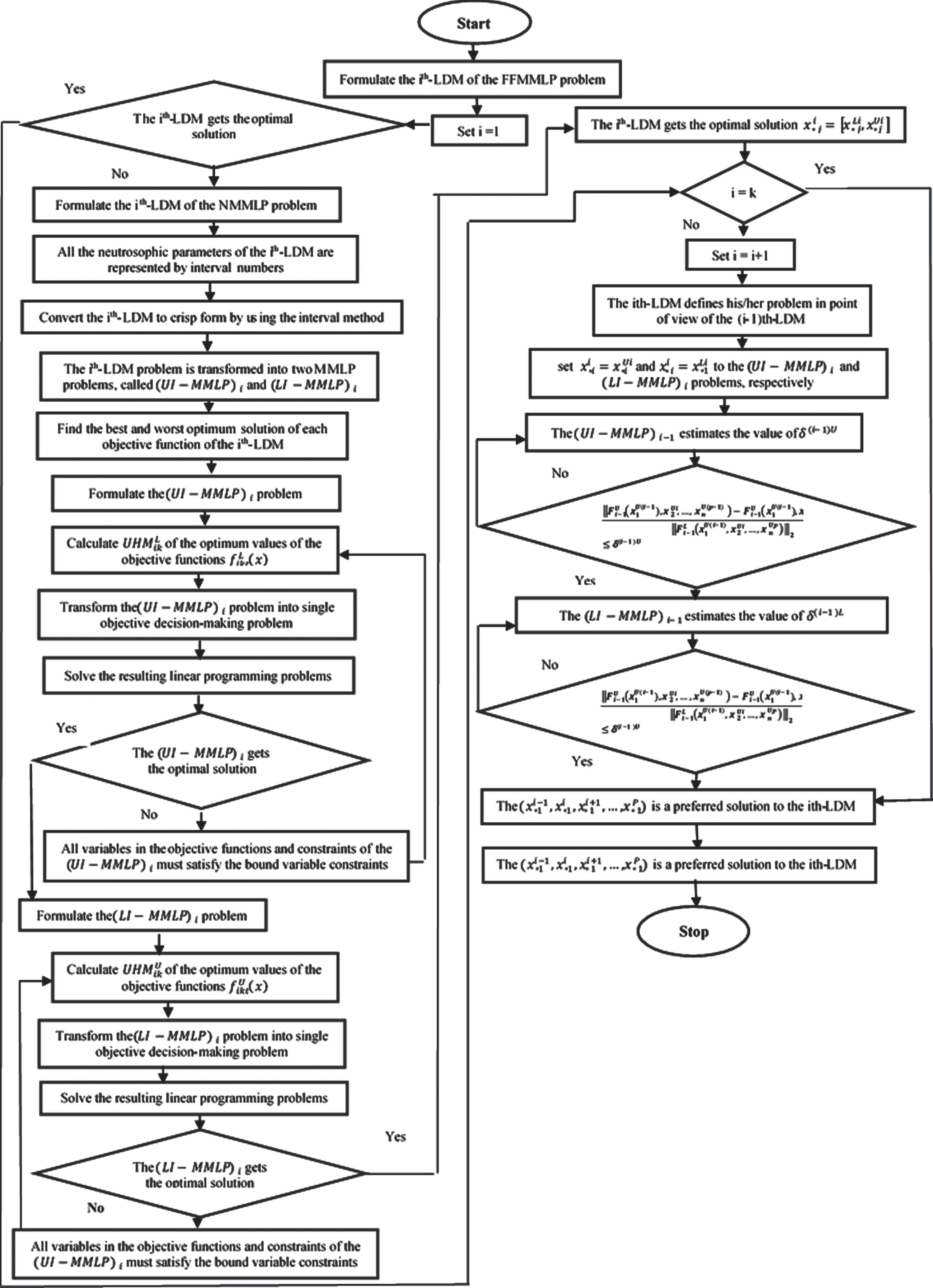
A flowchart depicting the suggested problem’s decision-making process.
This section proposes a new compromise approach for the multi-objective transportation (NMOT) problem, based on the harmonic mean technique, where the transportation cost, supply, and demand are all represented by neutrosophic numbers.
Mathematical model of (NMMTP) problem
NMOT problem is concerned with moving a product from k sources (s1, s2, …, s
k
) to n destinations (d1, d2, …, d
n
) while meeting r objectives
subject to
Allow interval numbers to be used to represent all of the neotrosophic numbers in Problem (37):
Where a
i
, b
j
,
As a result, Problem (37) can be rewritten as follows:
subject to
An NMOT problem is broken into the following two crisp multi-objective transportation problems, which are solved using classic transportation simplex algorithms, according to the methodology established in Subsection 3.2.
subject to
subject to
Find the individual optimum solutions for each objective function, as follows:
Calculate the UHM
L
and UHM
U
of the optimum values of the objective functions
UHM L and UHM U , can have positive or negative values. If they’re negative, we look at the absolute values of UHM L and UHM U .
To arrive at the optimal solution, we apply the harmonic mean technique to reduce the NMOT problem into the following single-objective transportation problems.
subject to
subject to
The optimal interval solution of the neutrosophic multi-objective transportation problem is x*I = [x*L, x*U] when solving the two crisp transportation problems, STP L and STP U , one at a time using normal transportation simplex algorithms. F*I (x*I) is the optimal interval minimum transportation cost.
To demonstrate the computational technique, we first explore a hypothetical case, followed by two examples for addressing a neutrosophic multi-objective transportation problem. It is assumed that I ∈ [0, 1] in these examples.
Consider the following neotrosophic three-level multi-objective linear programming problem.
FLDM:
SLDM:
TLDM:
subject to
[2 + 2I] x1 + [2 + I] x2 + [1 + I] x3 ⩽ [10 + 7I]
[1 + 2I] x1 + [1 + 4I] x2 + [2 + I] x3 ⩽ [8 + 10I]
x1, x2, x3 ⩾ 0
The first stage in the solution technique is to change the original NMMLP problem into an MMLP problem with crisp coefficients and crisp decision variables using the arithmetic operations defined in Definitions 2 and 4.
To begin, the FLDM can be rewritten as follows:
The following is the problem for which the best solution is sought:
subject to
2x1 + 2x2 + x3 ⩽ 10
x1 + x2 + 2x3 ⩽ 8
x1, x2, x3 ⩾ 0
The following is a problem with the worst possible solution:
subject to
4x1 + 3x2 + 2x3 ⩽ 20
3x1 + 5x2 + 2x3 ⩽ 30
x1, x2, x3 ⩾ 0
Table 1 shows the individual optimal solutions for the decision variables and the FLDM’s objective functions.
Individual optimal solutions for the FLDM problems
Individual optimal solutions for the FLDM problems
Calculate the
The FLDM problems’ equivalent single objective function can be written as follows:
The following is the problem for which the best solution is sought:
subject to
2x1 + 2x2 + x3 ⩽ 10
x1 + x2 + 2x3 ⩽ 8
x1, x2, x3 ⩾ 0
The following is a problem with the worst possible solution:
subject to
4x1 + 3x2 + 2x3 ⩽ 20
3x1 + 5x2 + 2x3 ⩽ 30
x1, x2, x3 ⩾ 0
As a result, the optimal FLDM solution is [0.4108, 0.4467], with
SLDM constraints should now have
The following is the problem that needs to be solved in order to get the best solution:
subject to
2x1 + 2x2 + x3 ⩽ 10
x1 + x2 + 2x3 ⩽ 8
x1 = 5
x2, x3 ⩾ 0 .
The problem for the worst solution is as follows:
subject to
4x1 + 3x2 + 2x3 ⩽ 20
3x1 + 5x2 + 2x3 ⩽ 30
x1 = 5
x2, x3 ⩾ 0
Table 1 shows the individual optimal solutions for the decision variables and the SLDM’s objective functions.
The SLDM follows the same steps as the FLDM to arrive at the following results: the SLDM problem’s optimal solution is [1.4302, 6.6874], where
Now, the FLDM uses the FLDM satisfactoriness test function to determine whether the proposed solution
As a result, the FLDM solution
Set
The following is the problem for which the best solution is sought:
subject to
2x1 + 2x2 + x3 ⩽ 10
x1 + x2 + 2x3 ⩽ 8
x1 = 5, x2 = 0
x3 ⩾ 0.
The following is a problem with the worst possible solution:
subject to
4x1 + 3x2 + 2x3 ⩽ 20
3x1 + 5x2 + 2x3 ⩽ 30
x1 = 5, x2 = 0
x3 ⩾ 0.
Table 1 shows the individual optimal solutions for the decision variables and the TLDM’s objective functions.
The TLDM follows the same steps as the FLDM to achieve the following outcomes:
The TLDM problem’s optimal solution is [0.5895, 7.6381], where
Now, the SLDM uses the SLDM satisfactoriness test function to determine whether the offered solution
As a result,
Consider the following features of a balanced neutrosophic multi-objective transportation (NMOT) problem:
Supplies:
Demands:
Costs:
An NMOT problem is broken into the following two crisp balanced multi-objective transportation problems:
P L : min F L (x) = (3x11 + x12 + 2x13 + 5x14 + x21 + 3x22 + 4x23 +3x24 + 7x31 + 5x32 + 6x33 + 4x34, 8x11 +2x12 + 4x13 + 3x14 + x21 + 3x22 + 2x23 +7x24 + 6x31 + x32 + 8x33 + 5x34, 9x11 +3x12 + x13 + 6x14 + 4x21 + 5x22 + 5x23 +8x24 + 2x31 + 3x32 + 6x33 + 7x34),
subject to
G L = {x11 + x12 + x13 + x14 = 18
x21 + x22 + x23 + x24 = 20
x31 + x32 + x33 + x34 = 13
x11 + x21 + x31 = 10
x12 + x22 + x32 = 12
x13 + x23 + x33 = 14
x14 + x24 + x34 = 15
x ij ⩾ 0, (i = 1, 2, 3 ; j = 1, 2, 3, 4)}.
P U : minF U (x) = (5x11 + 5x12 +4x13 + 6x14 + 8x21 + 9x22 + 9x23 + 5x24 + 11x31 +7x32 + 14x33 + 5x34, 11x11 + 9x12 + 5x13 + 8x14 + 7x21 + 7x22 + 10x23 + 14x24 + 11x31 +3x32 + 17x33 + 9x34, 10x11 + 10x12 +2x13 + 10x14 +12x21 + 11x22 + 12x23 +10x24 + 7x31 + 12x32 + 9x33 + 9x34) ,
subject to
G U = {x11 + x12 + x13 + x14 = 27
x21 + x22 + x23 + x24 = 37
x31 + x32 + x33 + x34 = 19
x11 + x21 + x31 = 14
x12 + x22 + x32 = 20
x13 + x23 + x33 = 21
x14 + x24 + x34 = 28
x ij ⩾ 0, (i = 1, 2, 3 ; j = 1, 2, 3, 4)}.
Table 2 shows the individual optimal solutions for the decision variables and the balanced NMOT problem’s objective functions.
Individual optimal solutions for the balanced NMOT problem
Calculate the UHM
L
and UHM
U
of the optimum values of the objective functions
We apply the harmonic mean technique to reduce the NMOT problem into the following balanced single-objective transportation problems.
subject to
x ∈ G L
subject to
x ∈ G U
The optimal interval solution of the balanced neutrosophic multi-objective transportation problem is
Consider the following features of an unbalanced NMOT problem:
Supplies:
Demands:
Costs:
An unbalanced NMOT problem is broken into the following two crisp unbalanced multi-objective transportation problems:
P L : min F L (x) = (4x11 + 2x12 + x13 + 8x14 +3x21 + x22 + 6x23 + 2x24 + 6x31 + 5x32 + 7x33 +4x34, 6x11 + x12 + 3x13 + 4x14 + 7x21 + 9x22 +6x23 + 6x24 + 5x31 + 4x32 + 2x33 + 7x34, 8x11 +6x12 + 4x13 + 7x14 + 5x21 + 6x22 + 9x23 + 8x24 +3x31 + 2x32 + 5x33 + 4x34)
subject to
x11 + x12 + x13 + x14 = 9
x21 + x22 + x23 + x24 = 5
x31 + x32 + x33 + x34 = 21
x11 + x21 + x31 = 13
x12 + x22 + x32 = 10
x13 + x23 + x33 = 5
x14 + x24 + x34 = 7
x ij ⩾ 0, (i = 1, 2, 3 ; j = 1, 2, 3, 4).
P U : minF U (x) = (7x11 + 6x12 + 8x13 +10x14 + 5x21 + 8x22 + 10x23 + 5x24 +11x31 + 10x32 + 8x33 + 10x34, 8x11 +6x12 + 7x13 + 6x14 + 10x21 + 15x22 +9x23 + 10x24 + 9x31 + 9x32 + 11x33 +15x34, 10x11 + 7x12 + 7x13 + 9x14 +9x21 + 8x22 + 10x23 + 9x24 + 6x31 +9x32 + 13x33 + 9x34) ,
subject to
x11 + x12 + x13 + x14 = 12
x21 + x22 + x23 + x24 = 16
x31 + x32 + x33 + x34 = 29
x11 + x21 + x31 = 18
x12 + x22 + x32 = 12
x13 + x23 + x33 = 7
x14 + x24 + x34 = 20
x ij ⩾ 0, (i = 1, 2, 3 ; j = 1, 2, 3, 4).
Table 3 shows the individual optimal solutions for the decision variables and the unbalanced NMOT problem’s objective functions.
Individual optimal solutions for the unbalanced NMOT problem
Calculate the UHM
L
and UHM
U
of the optimum values of the objective functions
We apply the harmonic mean technique to reduce the NMOT problem into the following unbalanced single-objective transportation problems.
subject to
x ∈ G L
subject to
x ∈ G U
The optimal interval solution of the unbalanced neutrosophic multi-objective transportation problem is
The neutrosophic multi-objective multi-level linear programming (NMMLP) problems were modelled using an interactive technique in this paper. Each neutrosophic problem was turned into two crisp multi-objective linear problems using the interval method in the proposed manner. The concept of harmonic means was then applied to combine the multiple objectives of each crisp problem into a single objective. Then, an interactive method for obtaining the preferred solution to the provided NMMLP problems has been devised. Finally, in a neutrosophic environment, an application to determine the optimality for the cost of multi-objective transportation problem is described. Numerical examples were presented to test the method’s validity.