



Abstract
Combine complex equipment collaborative development in military-civilian integration context not only fulfils actual development requirement, but also beneficial to the national economy. Design procedure as first stage of complex equipment military-civilian collaborative development process, select suitable design supplier is significant to whole development process of complex equipment. In order to select suitable design supplier for complex equipment, two aspects done in this paper. One is comprehensive analysis of evaluated influencing factors that affect complex equipment military-civilian collaborative design process, corresponding evaluation indicator constructed and a combination of grey correlation, entropy, DEMATEL (Decision-making Trial and Evaluation Laboratory) and VIKOR analysis theory to obtain grey entropy-DEMATEL-VIKOR, then the combined method is utilized to acquire matching attributes for followed research content. Meanwhile, satisfaction degree for matching side obtained with the help of information aggregation based on power generalized Heronian mean which on the basis of fuzzy preference information. Then, through constructed matching model, suitable design supplier obtained. Finally, a corresponding illustrative example given.
Keywords
Introduction
With the acceleration of industrialization, cooperation between enterprises becomes more and more frequent. Through the cooperation, not only more profits could produce, but also save more cost, which is beneficial to the improvement of enterprise operation efficiency. Collaborative work as a type of cooperation, it could be seen anywhere in our daily life, like collaborative design [1–4]. To the best of our knowledge, design is a necessary procedure for the followed manufacturing procedure in a whole development process. Nowadays, with the development of collaborative design conception, it is not only just regarding traditional industrial product design work [5], but also extended to new product like tourism product [6]. However, the conception of collaborative design mainly still utilized about industrial product. Therefore, we still adopt the traditional conception of collaborative design conception in this paper.
Complex equipment as a special equipment product, it has common feature of general equipment product, like the necessary development process which contains design, development, manufacturing and other major procedures. Certainly, it has some special characteristic that distinguish complex equipment from general equipment, for example, the development process is more complex, has higher technical requirement, longer development cycle and greater capital investment [5–9]. Common complex equipment could range from small car to the rockets and airplanes. Moreover, to complete a complex equipment development project, lots of resource is needed, cross department cooperation between different enterprises is also required [7, 8]. Collaborative design procedure is significant for complex equipment, due to it locates in the first position of a complete complex equipment collaborative development process. Because of the participation of multi-agent in collaborative work, conflicts often occur between different agents that based on different interest demand. Of course, collaborative design process is no exception [10]. Hence, to choose suitable group of participants to take part in the collaborative design work is significant to complex equipment, not only due to the special status of complex equipment in national economy, but also right participant group could improve the final quality of complex equipment.
Collaborative design of complex equipment is a necessary procedure, furthermore, due to collaborative mode in design work has some similarities with the collaborative mode of complex equipment, as the mode is “main-manufacturer as a leader and suppliers as followers” [10, 11]. The similarities of collaborative design mode for complex equipment could divide into two aspects, one is that main-manufacturer act as intermediary and controller, and the role of leader for main-manufacturer has not changed any more. The other one is the design supplier (institute) that could participate in complex equipment collaborative design process and it could finish corresponding design task, the role of design supplier is analogous to the supplier that could participate in the followed development work for complex equipment. That is to say, collaborative design process for complex equipment could change into a design matching process, one side is the design supplier (institute) that could provide design service, the other one is design task, which originates from the actual complex equipment collaborative development process. This matching process is similar to the marriage matching process between men and women, which proposed by Gale and Shapely in 1962 [12]. It is worth noting that, collaborative design matching between design institute and design task for complex equipment is a new research topic that not researched in any existing paper, it is also a new extension of two-sided matching that analyzed in this paper.
Two-sided matching as a branch of decision analysis, in the actual decision process, due to the ambiguity of individual’s behavior and the complexity of the research problem [13], makes it difficult to get accurate and complete information from the participants that belong to two different sides. For example, in the knowledge service process, one side is knowledge provider, the other side is knowledge demander [14], based on the characteristics of incomplete information provided in the matching process, fuzzy related theories could provide a good way to analyze the preference information provided by the decision-makers. Even large body of research work been researched for two-sided matching, not only covers model construction, but also contains theory extension. However, related research regarding collaborative design matching field that rarely involved, not only due to the complexity in the design process, but also based on fuzzy preference information to study collaborative design for complex equipment is a novel research. For the particularity of complex equipment, in the collaborative design matching market, because one side is the design provider, the other side is design task for complex equipment, which is different from general design matching between design provider and design supplier for the common equipment. In this paper, we research “the collaborative design matching” is a novel design matching, due to one side is design institute that provides design service, the other side is design task about complex equipment which controlled by the main-manufacturer. Considering this novel matching for complex equipment and the uncertain preference occur in design matching process, fuzzy theory could provide a good research perspective to describe the uncertain preference that occur in the matching process. Therefore, to express collaborative design matching process for complex equipment in a better way, relevant content seen in followed Fig. 1.

Collaborative design matching process for complex equipment.
Complex equipment design is a systematic project due to many design modules occur in the process, so it is necessary for the main-manufacturer to divide the modules into many design tasks, as to complete the collaborative design work more efficient. For every design work of complex equipment, quality requirement and loading limit, the availability and adaptability should be considered [5]. Meanwhile, for design task, task attributes also should be considered [15], like the novelty and the particularity of the design itself, of course, reducing risk communication effect is also significant [8].
Military-civilian integration promoted as national development strategy since 2017, meanwhile, with more attention paid to the development process of military-civilian integration by China’s central government and local governments in recent years, some key fields like aerospace and ship engineering has achieved great success. Military-civilian integration development, from a strategic perspective, implementing this development strategy could provide more resource to the development of national economy, and from the angle of enterprise development, through this integration could win more opportunities. Furthermore, from research perspective, it is easy to find that main contents focus on policy recommendation [16], medical service training [17, 18], little refers to certain equipment project [19]. In summary, it is necessary to choose a certain project like complex equipment development to participate in the military-civilian integration process, as it is also a new research topic in this paper, not only due to this could meet the requirements of national development strategy, but also expands the research of military-civilian integration with a detailed equipment project.
Though some researches have done about collaborative design work of complex equipment, military-civilian integration, it is easy to find out that most researches mainly focus on single design task [5], project angle [7, 8], relationship between demand and design [15]. The aforementioned studies not only neglect considering to design a comprehensive design process, but also lack necessary analysis about main factors that affect the design process. From military-civilian integration perspective, due to higher requirement of military-civilian integration development, some studies focus on the nursing training project in the military-civilian integration process [17, 18]. Complex equipment development that could involve in the military-civilian integration process is rare. However, it is natural in China, due to central Chinese government gives priority to the development of equipment industries and military-civilian integration is the national key development strategy. In order to combine the collaborative design matching process of complex equipment development process and military-civilian integration in a better way, two main problems should solve, as to select suitable design service supplier for complex equipment collaborative development process. Two questions are as follows:
Q 1: How to acquire the main affecting factors that affect complex equipment military-civilian collaborative design process?
Of course, to deal with the above question, a comprehensive analysis should approve. Of course, a comprehensive analysis could divide into many aspects, in this paper, detailed contents are: Firstly, constructs evaluation indicator system that could cover main affecting factors, that is to say, the indicators in the constructed evaluation system is relevant to the main affecting factors that we selected in the followed analyzed procedure. Of course, the main affecting factors that selected is according to design tasks and design attributes of complex equipment military-civilian collaborative development process. Secondly, a corresponding analysis method should adopt to analyze the aforementioned main affecting factors. Finally, to combine the selected main affecting factors and adopted analysis methods, could we find out the relevant attributes for the design matching process of complex equipment military-civilian collaborative development process.
Q 2: How to define a more comprehensive satisfaction degree in the design matching process and select suitable design supplier for complex equipment military-civilian collaborative development process?
This question could divide into two aspects, the second one is based on the first one. On one aspect, a better way to address preference that given by two sides in the design matching market for each other, due to the uncertain nature of preference, the fuzzy theory could provide a better way to describe the preference information. Meanwhile, in order to acquire the corresponding satisfaction degree between two matching sides, information aggregation thought is a better choice. On the other aspect, to select suitable design supplier, a matching model should construct.
To solve abovementioned two questions, as shown in Fig. 1, this research aims at selecting suitable design service supplier for complex equipment military-civilian collaborative design process. In order to solve the research problem, two steps proposed to address this. The first one is a comprehensive evaluation process to select the influencing factors. The second step is satisfaction analysis process, which based on preference information aggregation. The information aggregation process is based on the preference information that two matching sides given for each other, meanwhile, with the help of relevant matching attributes could we obtain corresponding preference information, the matching attributes is acquired in the first step. Then relevant two-sided matching model constructed, in order to select suitable design supplier. To summary, the contributions of this research concluded as follows: Firstly, to extend the traditional matching process for complex equipment project, meanwhile, give a more comprehensive analysis process for design process (Wang et, al. 2020). Secondly, to involve complex equipment into military-civilian integration process, moreover, so as to obtain corresponding matching attributes for design matching process of complex equipment, a comprehensive grey-DEMATEL-VIKOR analysis method is adopted. Finally, based on the preference information in the complex equipment design matching process, with the help of fuzzy theory, the preference information could be expressed in a convenient way, furthermore, in order to obtain satisfaction degree between two matching sides, power generalized Heronian mean operation is adopted to address to obtain satisfaction degree. Meanwhile, matching model constructed to acquire the suitable design suppliers for complex equipment.
The rest of this paper structured as follows. Section 2 presents related literature. Section 3 consists of problem description and needed theoretical foundation. In Section 4, matching mechanism designed for supplier selection, and a corresponding matching process proposed. A matching model constructed in Section 5. In Section 6, a practical numeration example is given. Section 7 is conclusion part.
As shown in Fig. 1, the difference analyzed in this paper is in the military-civilian integration context. Meanwhile, a comprehensive analysis for the main influencing factors is considered, and satisfaction aggregation process analyzed that based on the preference information. According to the aforementioned content, related literature regarding in this paper could divide into three parts, first part is complex equipment military-civilian collaborative design matching, second part is some detailed evaluation methods that researched in recent years, final part is information aggregation method. Detailed view work shown as follows.
Complex equipment military-civilian collaborative design matching
(1) Complex equipment and collaborative design
Complex equipment as a kind of special equipment, it is no doubt that plays an important role for any a country. For complex equipment, suppliers and main-manufacturer that involved in the whole development process [11], the operating relation between different types of enterprises and health management [20] and default detection [21] is relevant with development work of complex equipment. Moreover, a complete development process for complex equipment is more complex when compared with general equipment [22].
Collaborative design as the first procedure in the development work of complex equipment, it is vital to subsequent development process. With the help of CAD technique and ERP, the manufacturer could redesign a new product [23], moreover, collaborative work between main-manufacturer and suppliers could provide more convenience for quality design [5]. However, relevant research regarding complex equipment development neglects the significance of collaborative work between enterprises and lacks a comprehensive evaluation for design work of complex equipment, the reason is that complex equipment collaborative design is a research topic and this could provide a research perspective of this paper.
(2) Two-sided matching
Two-sided matching is common in our daily life, it has ranged from original marriage matching [12] to knowledge service matching [14], personnel-position matching [13] and patient-surgeon matching [43]. Meanwhile, Roth gave detailed conception for two-sided matching market in 1985 [24], then Roth continues to do lots of research work around two-sided matching [25]. Because the outstanding contributions made by Gale and Roth, the extension work of two-sided matching done from theoretical perspective and application perspective. From theoretical perspective, some researches like truncation strategies exist in the matching test process [26], preference information could impact the stability [27]. From application research perspective, some researches like combination between AHP and matching process for personnel assignment [28], fuzzy theory applied in technique transfer process [29] and human resource management [13], game theory combined in freight process [30]. Though some work done around theoretical and application for two-sided matching, applied research work lacks detailed analysis process for the influencing factors [13], meanwhile, theoretical research neglects practical problem application background. In order to make up some limitations in the existing research for two-sided matching in theoretical and applied perspective, this paper integrates the matching conception and content in the collaborative design process [44] of complex equipment.
(3) Military-civilian integration
The integration between military side and civilian side could mobilize more military and civilian resources to promote the development of national economy. In Russia, cooperation between military side and civilian side achieved good results (Bukharin 1994). Through cooperation, development cycle of new technology was shortened accordingly [31]. To involve the collaborative design process in military-civilian integration, not only could fulfil the national development strategy, but also bring about more resource to some equipment like complex equipment.
Detailed evaluation methods
If less influencing factors that occur in decision-making process, advantage of DEA theory is obvious [33]. In multi-attribute decision-making field, entropy analysis is a common research problem [34]. Other general theories that utilized in the decision-making process like Delphi [35] and AHP [36]. Moreover, in the ranking solution in the decision process, TOPSIS method [37] and VIKOR method [38] could provide a better solution, while the latter one could ensure the interests of most decision-makers. Hence, the combination of entropy weight theory and VIKOR method to analyze the significance sequence of the main influencing factors is a better choice. Furthermore, the advantage of DEMATEL method adopted in many fields especially for complex equipment [51] due to it could analyze the causality between the analyzed main influencing factors.
Information aggregation
Information aggregation method is useful to extract effective information that is consistent with the majority of decision-makers. The rudiment of information aggregation originates from the famous mathematician Shannon who put forward the concept of information entropy in 1948 [32]. Science then, large number of scholars constantly improved the information entropy theory, in order to form a complete concept and theory of information aggregation. Through studying asymmetric trading information, Lou found that relations between group trading information were arbitrary and acquired better information aggregation of equilibrium price when noisy trading information vanished [39]. Through aggregating information based on infinite intuitionistic fuzzy sets, which could approve a novel infinite aggregation method in fuzzy field [40]. The higher cognitive sophistication, the better information aggregated [41]. The segmentation of the analyzed object is helpful to extract information, as to achieve information aggregation effect [42]. From aforementioned analysis, it is easy to find information aggregation is helpful to get more accurate information analysis result, which provide a better solution for the preference information given by design matching process to obtain satisfaction degree.
Problem description and related theory
Problem description
This research focus on the supplier selection for complex equipment military-civilian collaborative design process. Two parts analyzed in this paper, one is main influencing factors analysis process, meanwhile, a comprehensive method named grey-entropy-DEMATEL-VIKOR is adopted, detailed process shown in Fig. 2. The other paper is a two-sided matching model that constructed for the design matching process, preference information expressed in fuzzy language, and satisfaction degree computed based on Heroin operator. Finally, suitable design supplier obtained for complex equipment military-civilian collaborative development process.
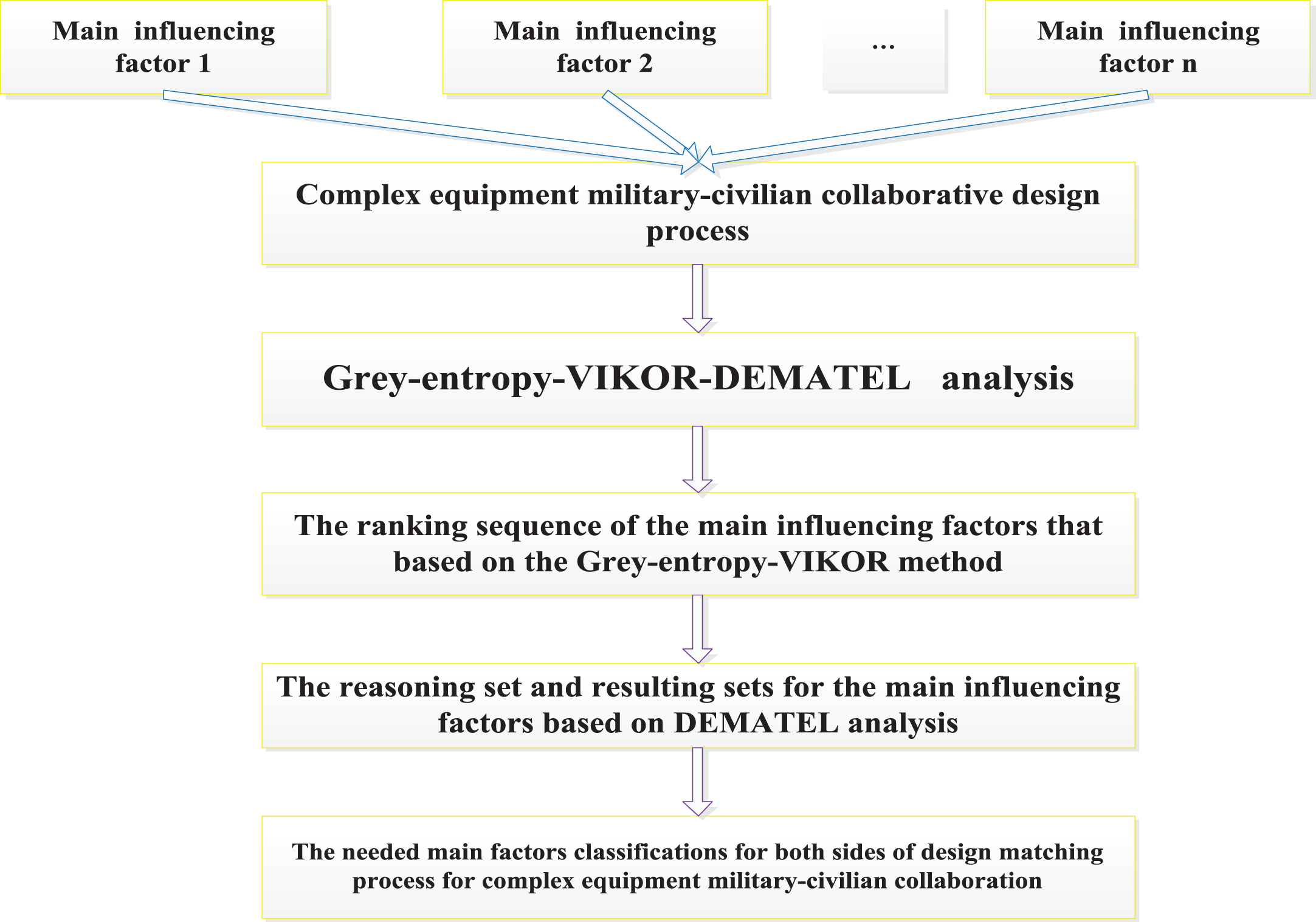
Detailed process for main influencing factors analysis of complex equipment military-civilian collaborative design.
Based on the process that shown in Figs. 1 and 2, in order to obtain satisfaction degree between design supplier and design task, related theories listed below:
Entropy analysis with grey correlation theory
In reality, due to the limitation that created by the ambiguities of decision-makers’ cognition and surrounded environment, makes decision-making problem often confronted with uncertainties. In order to describe uncertainties that confronted in a better way, grey related theory that proposed by Professor Deng is a good choice. It has been widely used in many fields, like strength predication in building area [46] and social network recommendation [47]. As information entropy is common to analyze the weight value of evaluated indicators, like Zeng [48] analyzed risk assessment of urban crowd activities. The combination of entropy analysis with grey correlation theory that proposed by Wang [30] and Deng [45] is necessary to obtain a comprehensive weight value of main influencing factors that selected for complex equipment. Hence, grey-Entropy analysis procedures are as follows:
Procedure 1: The weight analysis for main influencing factors.
In this procedure, some steps contained to analyze weight value of the main influencing factors. Main steps for weight analysis are as follows:
Step 1: Standardized process for original evaluation information.
Assuming that number i decision-maker gives evaluation information for number j evaluation indicator could use the letter e
ij
to express. All evaluation information e
ij
that given by n decision makers for all m evaluation indicators could constitute evaluation matrix, could we use the letter E to describe, all elements in matrix E fulfil the conditions E = (e
ij
) n·m, i = 1, 2, ⋯ , n, j = 1, 2, ⋯ , m. The standardization process for the evaluation information of matrix E could be expressed as b
ij
and
Step 2: Calculate the information entropy.
According to the information entropy theory proposed by Shannon, the lower value the information entropy is, the stronger ability to reflect information, it means that the evaluated object has higher significance in the analysis process and the analyzed element has larger weight value. Based on the Hasson information entropy theory, calculating formula regarding evaluation indicator is (letter E
j
represents entropy value for number j evaluation indicator):
In formula (1), the special case is that if b ij = 0, relevant information entropy E j = 0.
Step 3: Determine weight value of the evaluated indicator.
Through this step, the corresponding weight value for analyzed evaluation indicator obtained with the help of the followed formula (2).
Procedure 2: To compute grey correlation between analyzed evaluation factors, which could acquire a deeper comprehension of analyzed influencing factors. Some steps of grey correlation adopted according to the grey theory proposed by Deng. Hence, some steps involved in this procedure are as follows:
Step 1: Determine standard series and characteristic series.
With the help of the first procedure that analyzed in this part, evaluated indicators could divide into two categories, one is standardized evaluation series, evaluation information listed in standard series expressed as
Step 2: Obtain the range series.
Calculating formula for range series is:
For formula (3), one more condition Δ i = (Δ i (1) , Δ i (2) , ⋯ Δ i (m)) fulfils.
Step 3: Find out max-min value in the range series.
Relations for max-min value in the range series expressed as follows, in the followed formula (4) and formula (5), letter M represents maximum value and letter m represents minimum value:
Step 4: Calculate grey correlation coefficient.
The calculating formula is as follows:
In formula (6), letter θ presents the resolution coefficient, the value range fulfils θ ∈ (0, 1), the higher value for resolution coefficient, the stronger the correlation is. In general, the value for θ is 0.5.
Step 5: Determine correlation degree.
In this step, computing formula for correlation degree is:
In the formula (7), w k analyzed in the first procedure.
DEMATEL as an effective analysis method used to analyze the decision problem that has much more complexity and difficulty confronted in the daily life, it proposed by Gabus and Fontela in 1971 [49]. According to DEMATEL analysis method proposed by Gabus [49], followed analysis steps are detailed analysis content of DEMATEL:
Step 1: Acquire the direct influencing matrix between analyzed evaluation indicators.
The direct influencing matrix lays the foundation for followed analysis steps of DEMATEL. The elements in the direct influencing matrix is scoring information collection given by experts and based on the pairwise comparisons between analyzed evaluation indicators. In general, experts use integers range from 0 to 3 describe different influencing degrees, for example, value 0 could be expresses lowest influencing degree and value 3 represents strongest influencing degree, and value 1 and 2 describe the medium influencing degree. If we use the letter x ij to represent influencing degree information in the direct influencing matrix, and the direct influencing matrix expressed as X, and X fulfil that X = (x ij ) n·n. the value x ij reflects influencing degree between evaluation indicator i and j, meanwhile, n evaluation indicators involved. In particular, if i = j exists, the value becomes zero.
Step 2: Standardized operation for direct influencing matrix.
On basis of direct influencing matrix acquired in Step 1, the standardized matrix of direct influencing matrix could express as H, meanwhile, the matrix fulfils H = (h
ij
) n·n. The computing formula for the element in standardized matrix H shown as follows:
Step 3: Acquire comprehensive influencing matrix.
With the help of analyzed result of standardized matrix, comprehensive influencing matrix C = (c
ij
) n·n acquired through the followed equation:
In Equation (9), letter I represents an identity matrix.
Step 4: Calculate the influencing degree and affected degree, causing degree and centrality degree. Formula to compute different types of degree shown as follows:
In formula (10), the letters ID i , AD j , CAD i and CD i respectively describe influencing degree, affected degree, causing degree and centrality degree between evaluation indicators. For causing degree, if CAD i > 0, it means that the number ith evaluation indicator is reasoning factor, otherwise resulting factor. All reasoning factors constitute reasoning factor set, rest constitute resulting factor set. Furthermore, the larger value of centrality degree, it reflects that the higher significance the ith evaluation indicator is. According to the research proposed by Huang [51], two categories of main influencing factors that affect complex equipment military-civilian collaborative design matching process acquired, and these categories of influencing factors could constitute matching attributes for the design matching side.
As introduced in Section 2, we adopt VIKOR theory to analyze the negative ideal solution and positive ideal solution. According to the research proposed by [59] regarding VIKOR, basic steps for VIKOR analysis shown as follows:
Step 1: Standardized process for the evaluation value.
Assuming that quantity of the decision-maker and evaluation indicator is n and m, meanwhile, the decision-maker constitute set D and fulfil D = (D1, D2, ⋯ , D
m
). The evaluation indicator constitute the set A and fulfil A = (A1, A2, ⋯ , A
n
). Noting that number ith decision-maker gives evaluation information for number jth evaluation indicator is e
ij
, all evaluation information e
ij
constitutes the matrix E and fulfils E = (e
ij
) m·n. Furthermore, the standardized matrix expressed as G = (g
ij
) m·n and formula for the element in G shown as follows.
Step 2: Compute the positive ideal solution and the negative ideal solution.
In ordinary analysis process, two categories of evaluation indicators often confronted in our daily life, one is cost-shaping indicator, other one is benefit-shaping indicator. In this paper, in order to classify indicators more clearly, two different letters J1 and J2 adopted to represent benefit-shaping indicator and cost-shaping indicator respectively. Meanwhile, based on the aforementioned standardized matrix, positive ideal solution and negative ideal solution computed through the followed formula (12).
In Equation (12),
Step 3: Calculate the group benefit value and individual regret value.
The calculation for group benefit value and individual regret value seen in formula (13), in formula (13), the representing letters are GB
j
and IR
j
. Weight value w
j
for acquired in foregoing entropy analysis process.
Step 4: Find out maximum value and minimum value of group benefit value, individual regret value and benefit ratio value.
Calculating equation for maximum value and minimum value, group benefit value and individual regret value seen in the followed formula (14). Moreover, the computing formula for benefit ratio value also shown in formula (14).
In formula (14), u represents the value of decision mechanism. In general, the value is 0.5.
Step 5: Rank the evaluation solution.
According to the computing results like GB j , IR j and BR j , the smaller the value, the better the solution. Furthermore, if followed two conditions all fulfilled, the best solution acquired from the value of BR j , in general, the smallest is the best.
Condition 1: Acceptable advantageous threshold condition, comparable equation is
In Equation (15), k(1) and k(2) represent best evaluation solution and suboptimal solution.
Condition 2: Acceptable decision reliability condition.
k(1) locates in front position of GB or IR.
Decision rule for aforementioned two conditions: If second condition is not fulfill, the solution of k(1) and k(2) is compromise solution. Otherwise, if first condition is not fulfill, the solution k(1), k(2), ⋯, k(r) all are compromise solutions.
Due to the strong correlation for evaluation information in the evaluation process, meanwhile, in order to prevent some extreme evaluation information that may collect from the decision-makers, the advantages of Heronian mean operator and power mean operator combined together could better address aforementioned two difficulties. To the best of our knowledge, Power generalized Heronian mean operator has a range of application in decision analysis field [50]. In this paper, we adopt power generalized Heronian mean to obtain satisfaction degree based on the given preference information in the design matching process. According to the research proposed by Ju [50], the information aggregation process based on power generalized Heronian mean operation shown as follows.
Assuming that the number of evaluation indicators for design institute (provider) and design task is s and t respectively, the quantity of design institute and design task is m and n. Hence, the number ith design institute acquires preference information from different assigned design task is x
ik
and x
il
(k ≠ l and k, l ∈ [1, n]), similarly, the preference information that different design task gives to the same design institute is y
jo
and y
jv
(o ≠ v and o, v ∈ [1, m]). According to aforementioned assumptions, relevant content for power generalized Heronian mean operator regarding preference information aggregation process shown as follows (Formula (16) is used to calculate for aggregation process based on different preference information, the formula (17) is utilized to compute supporting degree between different preference information).
In formula (16), letter p and q is nonnegative integer, it could be assigned to be zero at the same time. In general, for convenience of research, we could assign p and q the same value, like p = q = 1.
Matching mechanism
In this paper, based on the comprehensive evaluation analysis for main influencing factors that involved in complex equipment military-civilian collaborative design process. Based on grey correlation and VIKOR analysis for main influencing factors, a clear ranking sequence of influencing factors acquired. Moreover, through DEMATEL analysis, analyzed influencing factors could divide into two categories, one is resulting group and the other one is reasoning group. Then needed matching attributes acquired for two sides in design matching process of complex equipment military-civilian collaborative development. Finally, followed matching model constructed and suitable design supplier acquired.
Matching process
In this paper, we research design supplier selection of complex equipment military-civilian collaborative development through design matching process. Two sides involved design matching process are design service supplier (institute) and design task. In real design matching process, two sides of design matching market choose each other based on the satisfaction degree, and satisfaction acquired on preference information that given by each other in design matching process.
Two-sided matching model for design supplier selection
As Huang [51] explored some matching problems for complex equipment collaborative production on military-civilian platform, what we research in this paper follow the same research thought to obtain matching attributes. However, what we do in this paper have two main differences for matching attributes when compared with previous research [52]. One is the combination of VIKOR adopted to obtain a more accurate analysis results for the evaluated indicators. The other one is the information aggregation process for the preference to acquire the satisfaction degree based on power generalized Heronian mean operator that could reduce the impact of different preference information in the decision-making process. Then, a corresponding matching constructed for the design matching process to select suitable design supplier of complex equipment, detailed content shown as follows.
Parameter notation
As aforementioned in Section 3, for design matching process, assuming that m design institutes and n design tasks involved. Two sides in design matching market could constitute two set, one composed of design institute (provider) candidate and described as X = (X i ) , i = 1, 2, ⋯ m. Similarly, design task candidate could express as Y = (Y j ) , j = 1, 2, ⋯ , n. Meanwhile, supposing that evaluated indicators for analyze design institute could constitute E = (e1, e2, ⋯ , e s ), the letter e g , g ∈ [1, s] expresses the number gth evaluated indicator for design institute. Evaluated indicators for design tasks are F = (f1, f2, ⋯ , f t ), letter f h , h ∈ [1, t] describes the number hth evaluated indicator for design task. Then, assuming that satisfaction degree that the number ith design institute gives for the jth design task is α ij , due to the uncertainty of preference, α ij expressed in fuzzy language and becomes fuzzy preference information that based on related evaluation indicator f h , h ∈ [1, t]. Similarly, satisfaction degree that the number jth design task gives for the number ith design provider (institute) is β ij , it also presented in fuzzy preference information that based on relevant evaluation indicator e g , g ∈ [1, s]. Finally, we set a binary variable q ij , if q ij = 1, it means that the number ith design institute matched with the number jth design task, or relevant design supplier not matched with corresponding design task.
Model construction and its analysis
Model construction
On basis of aforementioned parameter notations, a bi-objective optimization model constructed for design matching process of complex equipment, the model seen in the followed formula (18).
As shown in formula (18), objective function 1 and 2 represents the maximum satisfaction of design institute and design task. Constraint condition 1 expresses each design task only matched with one design institute (supplier). Constraint condition 2 describes each design institute only matched with one task. Constraint condition 3 is a description for binary variable.
The best way to address above bi-objective optimization model is changing it into single optimization matching model, based on linear weight analysis to combine two objective functions of the model shown formula (18) together. If we set weight value for objective function 1 is λ, then relevant weight value for objective 2 is 1 - λ. If two objective functions has the same significance in the analysis process, then the value of variable λ is 0.5. Therefore, bi-objective optimization model shown in formula (18) changed into the followed formula (19).
Through constructed matching model for design matching process, could be acquire suitable design institute for complex equipment. Different from existing two-sided model given by Yu (2020), for it lacks detailed analysis process for evaluated indicators. Based on aforementioned grey correlation entropy-VIKOR-DEMATEL analysis for influencing factors that affect complex equipment military-civilian collaborative design process and relevant matching attributes obtained; meanwhile, based on power generalized Heronian mean operator computation based on fuzzy preference information to acquire satisfaction degree for two sides in design matching market. Then substitute the satisfaction degree into constructed model shown in formula (19), suitable design supplier obtained for complex equipment. Detailed illustrative example to verify the whole analysis process given in followed section.
In order to illustrate the whole analysis process in former sections, in this case, a large production enterprise in China that has military and civilian dual background and want to launch complex equipment product collaborative development project. In order to complete this project in a smoothly way, the first step is the project pass necessary verifications by some department, the second step is relevant enterprise selection that could guarantee the long-term and effective operation of the project, the final step is the actual implementation. The second step plays a significant role of whole project, of course, design as the first procedure in the actual collaborative development process. Under this background, in order to let whole development process move smoothly and effectively, it is necessary to select suitable design suppliers for the design development stage. Followed with the aforementioned process to select design supplier for complex equipment, in this illustrative section, two parts constitute the complete illustrative example. Hence, one part is matching attribute analysis process, the other is satisfaction analysis and design supplier selection process. Detailed content shown as follows.
Comprehensive analysis for collected influencing factors
Evaluation indicator system construction
Constructed evaluation system that covers main influencing factors that affect complex equipment military-civilian collaborative design process, it not only constitutes external design features of complex equipment, internal design and its requirements, but also contains significant characteristics of military-civilian integration.
For external design of general equipment, knowledge reservation provides a fast way for design of electronic equipment configuration system [15]. Environment adaptability is a vital impacting element for the outside design process of equipment [52]. Suitable design conception is significant for complex equipment that operate under deep-sea environment [53]. Experiment process for design product could demonstrate its effectiveness [54]. Moreover, collaborative degree between different enterprises is also indispensable [5].
From internal design of complex equipment perspective, like general equipment, safety and availability of the equipment is basic requirement [55]. Basic quality is also significant [5]. Moreover, product performance plays an important role too [56]. In actual design process, design cost of the equipment should not ignore due to it could determine the whole design is successful or not [53]. Of course, design work of complex equipment should rely more on technology advancement [57].
In the military-civilian integration process, related policy [51] is significant. Professional operation [18] and implement capacity [16] is also important.
From aforementioned analysis, relevant content of constructed evaluation indicator system shown in followed Table 1.
Evaluation indicator system
Evaluation indicator system
From above constructed evaluation indicator system, it is easy to find that 14 main influencing factors that affect complex equipment military-civilian collaborative design process. All selected main influencing factors shown in Table 1 utilized to investigate the necessary matching attributes for design matching process.
Step 1: Preliminary analysis for the main influencing factors
In order to get a preliminary analysis results for main influencing factors shown in Table 1. With the help of analyzed procedures that proposed regarding entropy combined grey correlation analysis process, and the collected original analysis evaluation data given by five experts, of course, all five experts come from relevant professional fields, the analysis results could computed and shown in latter contents of this step. Assuming that the original evaluation data shown in matrix E, and followed analyzed results come in sequence according to aforementioned analysis process.
Based on the evaluation shown in matrix and proposed entropy analysis process, the computing weight value for main influencing factors shown as follows:
From above analyzed weight values, it is easy to find that the influence of product performance is minimum and technology advancement is maximum. Due to the lowest influence of product performance in the analysis process, so we ignore its influence in the followed analysis. Moreover, by means of the grey correlation analysis that introduced and according to aforementioned content of grey correlation analysis thought, we set technology advancement as the standardized series. Then the rest 12 influencing factors except product performance become characteristic series. Detailed computing results of grey correlation degree shown as follows.
Through computing results of grey correlation degree between technology advancement and other 12 main influencing factors, it is easy to find that design cost has the largest correlation and collaborative degree has smallest correlation. Moreover, professional operation has last but one correlation. The reasons are for two perspective, one is that design institute could participate in the design process to demonstrate that collaboration between them is perfect, the other is professional operation is well so that relevant project could operate smoothly. Based on the aforementioned analysis, we could neglect the influence of collaborative degree and professional operation in followed content.
Step 2: The causality between remained influencing factors
As Huang [51] mentioned, the causality of the main influencing factors could let we know the causality between analyzed factors and provide the evidence for corresponding factors of two different participants in the matching market. Hence, based on analysis procedures of DEMATEL, detailed analysis regarding remained influencing factors shown as follows.
Assuming that direct influencing matrix between remained influencing factors expressed as X, elements of matrix X shown as follows. Then based on the direct influencing matrix X and relevant analysis of DEMATEL, we could divide remained 11 influencing factors into two categories, which is corresponding with matching attributes of two sides for complex equipment military-civilian collaborative development process. Detailed computing results shown as follows and keep in accordance with the DEMATEL analysis process.
Based on DEMATEL analysis results for remained 11 influencing factors and according to the calculating results of centrality degree value of the analyzed factors, it is easy to find that the centrality degree of implement capacity is lowest and represent that the significance of implement capacity is the smallest. Therefore, the influence of the implement capacity ignored in followed analysis of the influencing factors that involved in the design matching process. Meanwhile, based on the results of influencing degree and affected degree for rest 10 influencing factors, we could acquire the reasoning group and resulting group of the rest main influencing factors. Hence, influencing factors in the reasoning group are knowledge reservation, suitable design conception, experiment process, related policy, while influencing factors in the resulting group are environment adaptability, safety and availability, basic quality, design cost, technology advancement, logical restriction.
Step 3: Acquire ranking sequence of remained influencing factors.
Based on above two steps analyzed for main influencing factors of complex equipment military-civilian collaborative design process, in order to get detailed comprehensive analysis results for rest influencing factors that acquired in step 2, necessary analysis of ranking sequence between influencing factors could provide further evidence for followed evaluated attributes. Hence, based on VIKOR analysis procedures t introduced in section 3, ranking sequence of the rest influencing factors shown as follows.
Firstly, assuming that aforementioned five decision-makers continue to participate in the evaluation process for the rest 10 influencing factors. Original evaluation value given by decision-makers shown as follows. For remained 10 analyzed influencing factors, design cost and logical restriction belongs to cost-shaping indicators, other influencing factors belongs to benefit-shaping indicators. Detailed the evaluation analysis value shown as follows.
(Based on original evaluation information given in this step and entropy analysis procedure, w
j
= [0.0216 0.0634 0.0115 0.0513 0.0380 0.1155 0.1384 0.2562 0.0829 0.2212] acquired for corresponding weight value)
Secondly, based on computing results of variable GB j , IR j and BR j shown above and with the help of the analysis of VIKOR theory. It is easy to find that the smallest the value of the suitable design conception is, the optimal evaluation solution get in the final decision. In other words, for design process of complex equipment, the influence of suitable design conception could neglect in the followed process. The reason is that the design of complex equipment is quite stable.
Finally, on account of the two conditions of VIKOR theory, with the help of the condition 1 that described, we could not get the optimal evaluation solution, moreover, based on the second condition, we acquire the final suitable comparable evaluation solution. That is the solution that given by first decision-maker.
Through comprehensive analysis for the main influencing factors collected in this paper, could we find out relevant set that constitute matching
attributes for followed matching process. In this part, the reasoning group contains knowledge reservation, experiment process and related policy, the resulting group constitutes environment adaptability, safety and availability, basic quality, design cost, technology advancement and logical restriction. According to the matching thought proposed by Huang [51] and matching process proposed in section 4, it is easy to acquire that matching attributes for design supplier (institute) originate from the reasoning group, and matching attributes for design task come from the influencing group.
Design supplier (institute) selection
Based on above analysis, satisfaction degree and design supplier analyzed in this part. Relevant analysis shown as follows.
Satisfaction aggregation that based on the fuzzy preference
In order to describe fuzzy preference between design institutes and design tasks, with the help of fuzzy theory proposed by Zadeh [58]. We adopt the interval fuzzy numbers to describe preference information due to the uncertainty of the preference.
In general, the interval for fuzzy number could range from 0 to 1. For convenience of research, we divide 0 and 1 into five parts, meanwhile, four breakpoint adopted, it could 0.2, 0.4, 0.6 and 0.8. Accordingly, five interval appears, they are (0, 0.2], (0.2, 0.4], (0.4, 0.6], (0.6, 0.8] and (0.8, 1). Numerical value 0 and 1 represent two extreme conditions of preference, 0 describes no preference occurs, 1 represents complete preference. Moreover, in order to describe preference information in a better way, relevant level of preference should give. Hence, (0, 0.2], (0.2, 0.4], (0.4, 0.6], (0.6, 0.8] and (0.8, 1) describes the preference level is very low, low, medium, high and very high respectively. The preference between design institute and design task that given to each other shown in Tables 2 and 3 respectively.
Preference information that design institutes (suppliers) give for the design tasks
Preference information that design institutes (suppliers) give for the design tasks
Preference information that design tasks give for design institutes (suppliers)
For convenience of research, we assume that 5 design institutes and 3 design tasks could participate in the design matching process of complex equipment. Furthermore, we use simple letter DI and DT to express relevant design institute and corresponding design task.
In order to acquire direct preference information for design institutes and design tasks, we use medium number to represent the interval fuzzy number for preference information shown in Tables 2 and 3. Relevant results of the medium value f shown in the followed Tables 4 and 5.
Medium preference value of design institute (supplier) that give for design task
Medium preference value of design task that gives for design institute (supplier)
With the help of the analysis procedures of generalized Heronian mean operation and relevant preference information shown in Tables 4 and 5, satisfaction degree between design institute (supplier) and design task acquired, detailed results f shown in followed Tables 6 and 7.
Satisfaction degree that design institutes (suppliers) give for design tasks
Satisfaction degree that design tasks give for design institutes (suppliers)
Combing constructed two-sided matching model that shown in formula (19) for complex equipment military-civilian collaborative design matching process and aforementioned satisfaction degree results. The final computing results shown in followed Table 8.
Calculating results between design tasks and design institutes (suppliers)
Calculating results between design tasks and design institutes (suppliers)
From computing results shown in Table 8, it is easy to find out that design task 1 matched with design institute 1, design task 2 matched with design institute 4, design task 2 matched with design institute 2. In other words, design institute 1, design institute 2 and design institute 4 are suitable design service supplier for complex equipment military-civilian collaborative design process.
Complex equipment as special equipment that significant to the development of the national economy and could promote the development of relevant industries. Military-civilian integration as national development strategy in China. To combine complex equipment collaborative development with military-civilian merging development process could provide more development opportunities for some industries that relevant with complex equipment. As design process as one important stage of collaborative development process for complex equipment, to select suitable design service suppliers is vital for followed development procedure of complex equipment. Due to aforementioned reason, we adopt comprehensive analysis and matching content to select design service supplier, through comprehensive analysis obtain corresponding matching attributes for matching model, then suitable design supplier selected based on matching model.
In reality, due to too many suppliers participate in the collaborative development process of complex equipment, while design stage as first stage in a complete development process of complex equipment, it is necessary to select suitable design supplier for development process of complex equipment as it could determine whole quality of complex equipment. To involve complex equipment development process in military-civilian not only fulfils actual development, but also it has research value [51]. Followed with the research thought proposed by Huang [51] to acquire matching attributes for followed design matching process, however, the difference of this paper is that the comprehensive analysis for the selected influencing factors. In this paper, we combine grey correlation-entropy, DEMATEL and VIKOR theory to combine grey entropy-DEMATEL-VIKOR to do comprehensive analysis for influencing factors. Through grey correlation and entropy could we do a preliminary selection for collected influencing factors based on the computing results of weight value and grey correlation value, which could obtain more accurate selection for influencing factors when compared with simple weight value. The similarity in this paper with Huang [51] is the classification content for influencing factors due to different sides in the matching market have different requirements. Moreover, in this paper, in order to acquire more adaptive matching attributes for design matching process between design supplier and design task for complex equipment, VIKOR theory adopted in this paper to analyze the influencing factors that analyzed from grey-entropy and DEMATEL procedure. Through VIKOR analysis for influencing factors is closer to actual situation for complex equipment when compared with TOPSIS analysis.
Due to the uncertainty of preference, we describe the preference information that given by two sides in the matching market based on interval fuzzy theory. For the calculation of satisfaction degree between design task and design supplier, generalized power Heronian mean operator adopted to aggregate satisfaction based fuzzy preference. Then through constructed matching model, could we find out suitable design supplier in the illustrative part.
Of course, in the above comprehensive analysis for matching attributes about design matching process of complex equipment, relevant evaluation indicator system constructed. In the constructed evaluation indicator system, all selected influencing factors are corresponding to evaluation indicator of the evaluation indictor system. For selected influencing factors, it is collection work from some relevant research and this collection has one limitation, the limitation is that it lacks some actual experiment process for complex equipment military-civilian collaborative design process. However, through above combined analysis for matching attributes and satisfaction degree of matching model to select suitable design supplier for complex equipment, it shows that different combination of decision-making analysis theory is suitable in the matching content. Moreover, information aggregation process to obtain satisfaction degree based on generalized power Heronian mean operator based on fuzzy preference information due to it could not only complete information aggregation of preference information, but also reduce the influence of information correlation and the occurrence of extreme information. From this research process to select suitable design supplier for complex equipment military-civilian collaborative development process, not only could we obtain detailed content about the influencing factors that affect complex equipment military-civilian collaborative design process, but also provide new research thought to acquire design supplier through combination between comprehensive analysis and matching process. For actual complex equipment military-civilian collaborative design process and design supplier selection, some useful suggestions could obtain from this research. To make this research appear more substantial, not only actual influencing factors collected from actual operation of similar complex equipment military-civilian process, but also more information should collect in the DEMATEL analysis to obtain matching attributes. Furthermore, more than two information aggregation methods to acquire more accurate satisfaction degree between two sides in matching market, that is what we do in the future. Though some defects exist in this research, the whole research in this paper to select design supplier for complex equipment is meaningful due to it extend two-sided matching to supplier selection of complex equipment and add information aggregation process to obtain satisfaction degree in the matching process.
Disclosure statement
There is no potential conflict of interest that reported by author(s) in the research process.
Footnotes
Acknowledgments
This work supported by National Social Science Foundation of China (No. 19BJY094).