



Abstract
An outranking procedure for Multi-Attribute Decision-Making (MADM) problems is introduced in our work that acts as a decision-aid in recommending the products to the buyers. The buyer’s product assessment is taken as Interval-Valued Intuitionistic Fuzzy Sets (IVIFS) in each attribute. The confidence level that is implicit in the buyer’s product rating is explicated in the proposed work using fuzzy entropy. As the confidence level of the buyer on the product assessment is for both satisfaction and reluctance, it is suitably distributed in membership and non-membership parts of IVIFS. Our work generates a dominance matrix that represents partial or full dominance of one product over another after scoring the products that are unified with buyer’s confidence. The proposed work suggests the product ranking after ascertaining the buyer’s flexibility. An algorithm is written in our work to validate the procedure developed. We have compared our work with other similar works to highlight the benefits of the proposed work. A numerical example is illustrated to highlight the procedure developed.
Keywords
Introduction
Background
Rating and ranking of the products are key factors in the product recommendation to the buyer in any recommender system. This is more desirable when the buyer assesses the products in multiple attributes that are conflicting, non-commensurable, and fuzzy in nature. In order to rate the products more convincingly, especially in online business, it is crucial to explicate the buyer’s attitude towards his/her assessment in terms of satisfaction, reluctance, and hesitation. Additionally, the buyer’s confidence in his/her ratings is a vital factor to represent the product holistically. By incorporating the above characteristics, our work introduces a decision model that works as a decision-aid to the recommender system. The product recommendation using this model will boost the confidence of the buyer, thus making the system more customer focussed. The above aspects motivate us to design an algorithmic-based decision aid that helps the system in recommending right products.
Consider a MADM problem with a set of alternative products that are assessed through multiple attributes. Numerous methods are available in the literature [1–8] to solve MADM problems. The buyer’s vagueness in the product rating makes the system difficult to evaluate the products with crisp numerical values. To address the vagueness in the buyer’s assessment, the realistic approach could be to consider fuzziness in the evaluation of the products. Additionally, the above product ranking (rating) will be more convincing and parallel to the real-world decisions when the buyer’s characteristics of satisfaction, reluctance, and hesitation are included in a range or interval. The Interval-Valued Intuitionistic Fuzzy Sets (IVIFS) [9] is an ideal means to represent the above hypothesis. Comparing with traditional fuzzy sets, intuitionistic fuzzy sets (IFS) [9–12] shows more flexibility and realism in dealing with the above uncertainty in the product assessment. There are well known methodologies available that uses IVIFS for handling MADM problems [4, 13].
Another dimension of product assessment is that the buyer may not be certain about his/her product valuation and may alter the decisions over the time, pointing to some level of uncertainty or anxiety in product ratings. This motivates us to explicit the implicitly defined ambiguity in the buyer’s viewpoint and subsequently arrives at a means to measure the uncertainty or risk involved in the product rating process. The concept of fuzzy entropy [14–16] is used to derive the risk corresponding to such uncertainty. Our work interprets the complement of risk as the buyer’s confidence.
To our knowledge, we have not come across any outranking method in MADM that simultaneously uses IVIFS in product assessment, integrates buyer’s confidence in the product valuation, and employs the flexibility behaviour of the buyer in the ranking of the products. The methodology given in [6] uses IVIFS and ranks the products based on the attitudinal character of the buyer. Though the procedure in [17] incorporates the confidence level of the buyer in alternative (product) assessment, the alternatives are not evaluated in IVIFS. Our work broadens the ideas given in [6] and [17] and arrives at a methodology that not only assesses the products in IVIFS but also accounts the buyer’s confidence degree and flexibility simultaneously while ranking the products in MADM problems.
The work in [6] assesses the products in IVIFS and ranks them based on the attitudinal character of the buyer. However, the attitudinal character is subjectively defined, resulting in different rankings corresponding to different attitudinal characters. This creates a confusion as it lacks the certainty in product ranking. We have mitigated this issue by integrating the level of confidence of the buyer in IVIFS. The flexible behaviour that is core in the buyer’s mind is unobserved while the ranking process is undertaken in [6]. Our work alleviates this shortcoming by integrating the confidence in product assessment and emphasizing on the inclusion of buyer’s flexibility in the final ranking of the products.
The work in [17] outranks the alternatives (products) when they are rated linguistically with a degree of confidence in each attribute. Though the work addresses the issue of outranking problem in MADM at large, the shortcoming is the subjective assumption of the confidence level in alternative valuation. Our work eliminates the subjectivity of buyer’s confidence by replacing it with the objectively derived confidence level. As the level of confidence is meant for both membership and non-membership values in IVIFS, our work assigns the confidence level to membership and non-membership with appropriate proportionality. This gives us a revised product assessment in IVIFS integrated with confidence. The other issue in [17] is with respect to the procedure of outranking of the alternatives. In the outranking method [17], an alternative either dominates another alternative totally or does not dominate at all. The partial or fuzzy dominance amongst the alternatives is not considered. As the partial dominance is very common in the buyer’s mind while comparing the products, ignoring partial dominance may lead to wrong results in business decisions. Our work bridges this gap by introducing the partial dominance amongst the products.
After integrating the buyer’s confidence in the product assessment and broadening the ideas given in [6] and [17], we have the revised valuation of products in IVIFS. The pair wise comparison of the products with revised IVIFS scores helps us to obtain a preference matrix, indicating the extent to which one product is preferred over another. The preference matrix thus obtained not only provides the preference but also specifies the degree of dominance of one product over another. The matrix entry dij in dominance matrix D represents the dominance degree of jth product by the ith product. The non-dominance of the jth product by the ith product is represented by zero value of dij. The number of zeroes in the jth column determine the non-dominance standing or credibility of product Pj. The number of zeroes corresponding to the product in the dominance matrix depends on the flexible attitude of the buyer.
We have written an algorithm Product Ranking () to logically structure and highlight the above procedure. The algorithm is validated using ‘C++’ with synthetic data sets of various input sizes corresponding to products and attributes.
The procedure of our work can be well understood from the Fig. 1 as shown:
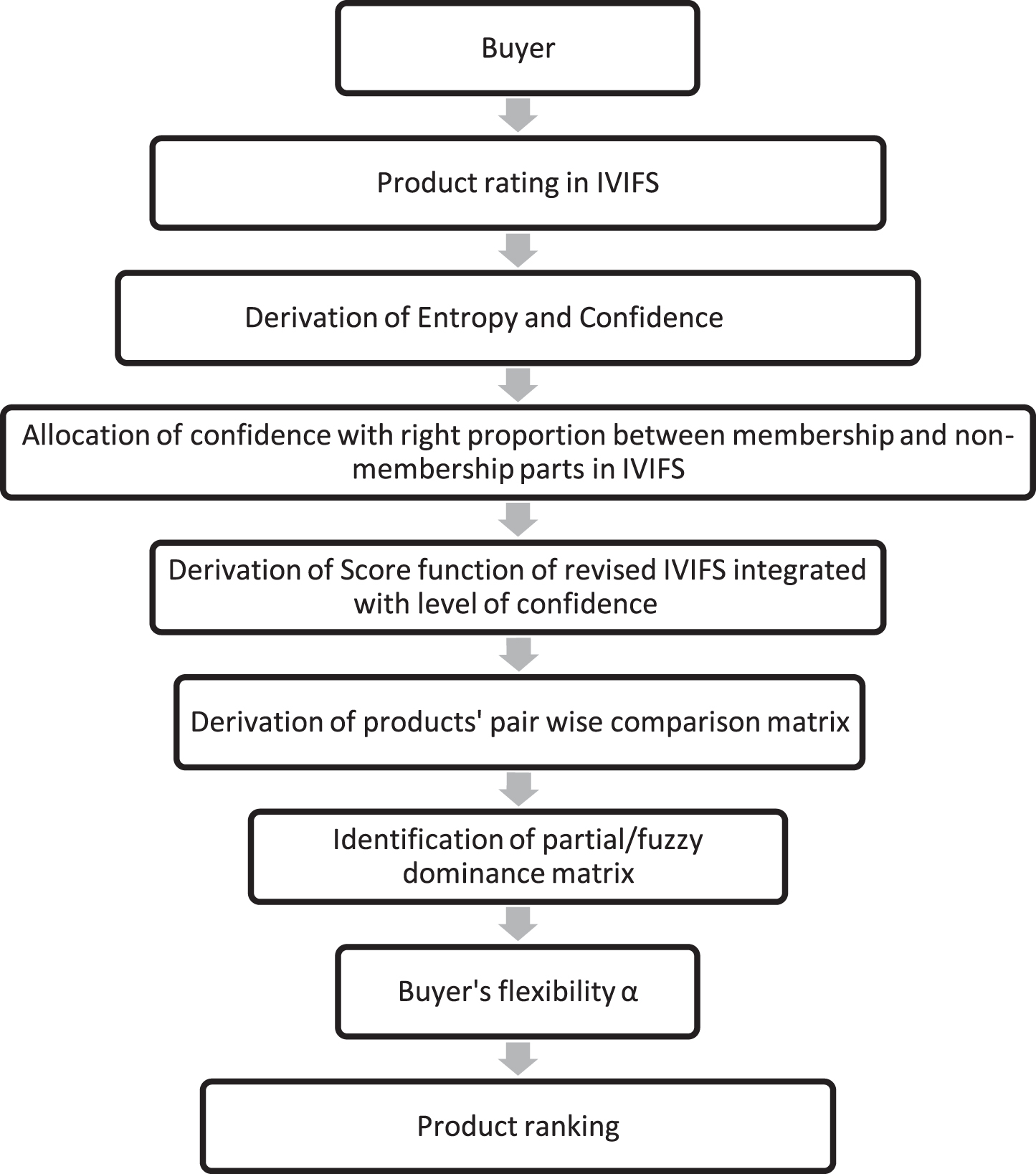
Stepwise procedure of the proposed work.
Some works that give the outranking procedures of MADM are available in [18–20]. The work given in [18] is an outranking method based on fuzzy sets that assesses the environmental leads for iron and steel making industry based on fuzzy PROMETHE. The work in [19] develops an outranking procedure using Linguistic Intuitionistic Fuzzy Numbers (LIFNs) for multi-criteria decision-making problems. In [20], an outranking sorting method for Multi-criteria group decision-making using IFS is given considering functions such as support, risk, and credibility. The work given in [21] deals with an outranking process that takes the truth-membership degree, indeterminacy-membership degree, and falsity-membership degree for alternatives. In [22], a multi-criteria group decision-making is presented using the concepts of ELECTRE, Type-2 fuzzy numbers, AHP, and entropy to rank the suppliers. In all these above works, the concept of confidence and partial dominance of the alternatives is unnoticed. The lack of confidence in the product rating makes the above works inadequate for practical decisions. Our work fills this gap by taking the product evaluations in terms of IVIFS and incorporating the decision-maker’s confidence level in the evaluation process.
The work given in [23] gives a novel methodology of MADM to evaluate performance of local government public finance expenditure in which the attribute values are considered as interval-valued intuitionistic fuzzy numbers. In [24], IVIFS is applied in MADM to assess the financial risk in rural tourism projects. The procedure given in [25] suggests a new methodology of MADM under interval-valued intuitionistic fuzzy environment to assess the traffic safety evaluation. In [26], the attribute values and weights as IVIFS is used to solve MADM problems. In [27], a group decision-making MADM model with alternative assessments as intuitionistic fuzzy numbers is considered. The work uses intuitionistic fuzzy hybrid geometric (IFHG) operator to aggregate individual opinions and intuitionistic fuzzy weighted geometric (IFWG) operator to fuse the intuitionistic fuzzy information across the attributes in evaluating the alternatives. The above process uses partial information about the attribute weights. In [28], interval-valued intuitionistic fuzzy cognitive maps is integrated with TOPSIS and applied for group decision-making problems for supplier selection. In [29], a hierarchical ranking aggregation method is given to rank the alternatives using the pairwise dominance of alternatives. However, the consideration of confidence and flexibility features of the decision-maker is lacking in the paper. In [30], IVIFS is applied to evaluate students’ answer scripts. An index of optimism λ signifying the optimistic or pessimistic behaviour of the evaluator is used in the paper for calculating the expected intuitionistic value of an IVIFS. The disadvantage is the subjectivity of λ. The works given in [31, 32] developed a novel idea of use of IVIFS to express the experts’ opinions in group decision making problems. The procedure in [31] provides a trust-based framework for building a recommendation tool to arrive at a consensus in group decision making. A structure for a dynamic feedback mechanism in group decision making is established in [32].
In the existing literature, IVIFS generally act as a decision-aid in MADM for representing the assessment of the products in terms of buyer’s satisfaction, dis-satisfaction, and hesitation corresponding to the attributes. However, there are some issues related to buyer’s cognitive aspects in the product rating that remain unresolved till date. They are:- To our knowledge, we have not come across any work in MADM that objectively evaluates the confidence of the buyer and links it to his/her product assessment. Some works consider the buyer’s confidence subjectively. But, the subjectivity in confidence creates some sort of biasness in assessing the products in real life decision-making problems. The confidence level is intended for buyer’s satisfaction as well as dissatisfaction. It is a challenging task to allocate the level of confidence between satisfaction and dissatisfaction in a right proportion. To our knowledge, the prevailing outranking procedures in MADM offer either full dominance or non-dominance of one product over another. However, the buyer’s mind does not work in the direction of complete dominance or non-dominance in reality. The non-consideration of partial dominance may lead to wrong results in business decisions.
The alleviation of above shortcomings in MADM is an inspiring task. This motivates us to provide a viable procedure bridging the above gaps.
Motivation and contributions
The above gaps in MADM inspire us to develop a new methodology and mitigate the shortcomings. The first two points, (1) and (2), below contribute with respect to the confidence level and third point (3) is with respect to the partial dominance amongst the products. The contribution of our work is summarized as follows: Our paper derives the confidence level of the product assessment with respect to the attributes objectively by using the concepts of fuzzy entropy, thereby removing the biasness of subjectivity. As the confidence is meant for both membership and non-membership, representing the satisfaction and dissatisfaction in the product evaluation, the proposed work distributes the level of confidence between membership and non-membership values of IVIFS in the right proportion, thereby integrating the level of confidence in the product assessment. The proposed procedure provides a new methodology of outranking in MADM that result in the partial dominance of alternatives according to the flexible behaviour of the buyer.
Structure of the paper
In section 2, we have given the preliminary concepts that are used in our paper. In section 3, we have explained the use of entropy to derive the buyer’s confidence levels in his/her product evaluation. The theoretical procedure is given in section 4. In section 5, we have written an algorithm that explains our methodology. A numerical example is illustrated in section 6 to highlight the procedure developed. In section 7, we have validated the algorithm by using synthetic data sets corresponding to products and attributes. This section also compares our work with other similar works. Finally, in section 8, we have given the concluding remarks along with the scope for future research.
Preliminaries
We have used the following concepts in our work.
Interval-valued Intuitionistic Fuzzy Set (IVIFS)
Let X = {x1, x2 ⋯ xn} be a set consisting of n number of elements. An IVIFS ‘A’ on X can be defined as [6, 12]
Where
Following the procedure given in [6], the hesitation degree πA (x) can be integrated with membership level μA (x) and non-membership level νA (x), resulting in the IVIFS ‘H’ in terms of membership and non-membership values only as shown in Equation (2.1).

Entropy measurement at E1, E2, and Emax.
Following the procedure given in [33], we have the score value of H(x) as follows:
We have added ‘1’ to make the score value S (H (x)) ∈ [0, 2].
Hamming distance in IVIFS
Let A and B be two IVIFSs on the set X = {x1, x2 ⋯ xn}.
The Hamming distance dh (A, B) between A and B is shown in Equation (2.4).
dh (A, B) is divided by n for normalization.
In the line of work given in [14], the entropy E associated with the IVIFS
The entropy E associated to H is zero when H has full membership <H (x) = [1, 1] , [0, 0]> or full non-membership <H (x) = [0, 0] , [1, 1]>. This is explained in Fig. 2.
The entropy is maximum at a point Emax where the membership value is same as non-membership value. It gradually decreases when E moves towards either full membership or full non-membership and finally becomes zero at points E1 and E2.
Take ‘a’ and ‘b’ as the distances (Hamming) of H(x) from E1 and E2 respectively as shown in Fig. 3.

Entropy measurement of IVIFS ‘H(x)’.
Using Equation (2.4), we have the hamming distance ‘a’ between H(x) and H (E1) as:
Similarly, we have the hamming distance ‘b’ between H(x) and H (E2) as:
Following the work given in [14] and from the discussion above, we have the Entropy of H(x) as:
Where ‘a’ and ‘b’ are the respectively nearest and farthest distance of H(x) from <H (E1) = [1, 1] , [0, 0]> and <H (E2) = [0, 0] , [1, 1]> respectively.
The Entropy can be stated as the missing information necessary to determine the confidence of the buyer in the product rating that are in IVIFS. In other words, we can say that the confidence level is a sort of guarantee the buyer has on his/her product rating with no ambiguity. The zero confidence represents full entropy or complete uncertainty in the product rating. Similarly, the full confidence signifies null entropy of the buyer on the product valuation. The state of full entropy or no entropy is rarely realized in the real-world decision-making situations. The entropy in product rating is neither full nor null but mostly partial. The partial entropy in the product rating is interpreted in the proposed work as a degree of non-confidence the buyer has on the product valuation. From the above explanation, the complement of entropy corresponding to a product rating in IVIFS is measured as the buyer’s confidence.
As the buyer’s confidence is meant for both membership and non-membership of the product evaluation that is in IVIFS, it is necessary to distribute the level of confidence between membership and non-membership values appropriately. In the proposed work, we have introduced a procedure for allocating the buyer’s confidence to membership and non-membership values of IVIFS. As the level of confidence is key for buyer’s product rating, it needs to be observed whether it is in the direction of satisfaction or reluctance. Depending on the buyer’s inclination towards satisfaction or reluctance, we have apportioned the level of confidence between membership and non-membership values of IVIFS.
From the discussion above we have the confidence level of H as follows:
‘H(x)’ is the buyer’s product rating in interval-valued intuitionistic fuzzy value (IVIFV) as:
(For convenience, we have omitted x from H(x))
ρH represents the level of confidence of the buyer has on H.
Take ‘a’ and ‘b’ respectively the distances of H from full membership value, I = [1,1],[0,0] and full non-membership value, N = [0,0],[1,1]. Our work distributes the confidence level amongst the membership and non-membership values in H depending on its closeness to I and N. The revised IVIFS, H c after integrating the buyer’s confidence in H is shown in Equation (3.2).
Full confidence level (ρH = 1) is assigned to membership
Equation (3.2) shows the product rating of the buyer in IVIFV after integrating confidence levels in membership and non-membership values.
Take an IVIFV H = [(0 . 3, 0 . 5) , (0 . 1, 0 . 2)] with confidence level 0.5. Using Equations (2.5) and (2.6), we have the distances of H from I and N as 0.375 and 0.625 respectively. Thus, we have the revised IVIFV, HC, integrated with confidence levels as:
Where HC is the revised IVIFV that is integrated with 0.5 degree of confidence.
This section introduces a new outranking methodology for MADM problems that acts as a decision aid for recommender system. As said earlier, the hypothesis of buyers’ product assessments in terms of their satisfaction, reluctance, and hesitation in a range or interval-valued values is taken in our paper. The Interval-Valued Intuitionistic Fuzzy Sets (IVIFS) [9] is an ideal means to represent the above hypothesis of the buyer. This section fulfils the above assumption and attempts to obtain the product rating/ranking as per the buyers’ mind-set.
Further, the methodology is aimed on two aspects, the derivation and implementation of buyer’s confidence in the product rating considering the above hypothesis, and the preference rankings of the products in line with the flexible attitude of the buyer. To summarize, our focus is to incorporate both the buyer’s degree of confidence and grade of flexibility in product evaluation while developing the outranking procedure. The procedure is given in the following steps.
Step-1:
Take a MADM problem with the buyer’s product rating as IVIFV in each attribute as shown in the matrix below:
Hij is the buyer’s rating of the ith product in the jth attribute.
Step-2:
Using Equation (2.7), calculate the entropy of Hij as E (Hij).
Step-3:
Using Equation (3.1), calculate the buyer’s confidence ρij
Step-4:
Using Equation (3.2), if ‘a’ and ‘b’ are the distances of Hij respectively from I=([1, 1], [0, 0]) and N=([0, 0], [1, 1]); 0 < a, b < 1 (say a < b), we have the revised rating of Hij as:
Step-5:
Using Equation (2.2), calculate the score function
Step-6:
Form the matrix S with entries
Sij represents the score of ith product in jth attribute.
Step-7:
Following [17, 34], we have the pair wise preference matrix of products as
Where
PR ij represents the grade of preference of ith product over jth product.
Step-8:
Obtain the pair wise dominance matrix ‘D’ of the products as shown below:
Where
The matrix entries d ij represent the degree at which the ith product dominates the jth product. The zero value of d ij indicates the non-dominance of jth product by the ith product. The number of zero counts in a column (jth column) corresponding to a product (Pj) shows the non-dominance degree or credibility of the product (Pj).
Step-9:
Assume the buyer’s flexibility α ∈ [0, 1].
Step-10:
Make dij = 0 when dij ⩽ α.
Step-11:
With the given value of α, count number of zeroes in each column corresponding to each product. The product with maximum number of zeros in its column is rated as the best product.
The number of zeroes in the columns of the other products determine their rank position accordingly. More zero count show the higher rank, while lesser number of zeroes indicate the product in lower rank.
In this section, we have developed an algorithm
The algorithm is given below:
Notations:
(
(
E (Hij): Entropy associated with the ith product in jth attribute.
ρij: Confidence associated with the ith product in jth attribute.
Sij: Score value associated with
PR ij = PR (i, t): Pairwise comparison of products}}
1. For i = 0,1, 2, ... ., m-1; j = 0,1, 2, ... , n-1
2. Set
3. Set Ideal Point I ← {(1, 1) , (0, 0)}
Set Anti Ideal Point N ← {(0, 0) , (1, 1)}
4. Set
5. Set
6. If
ρ ij ← (1 - E (Hij))
Set
Set
Set
Set
9.
10.
11. Set
12. For Pairwise comparison of Products PR (m, n) ; i = (0, 1, …, m - 2, (j = 0, 1, …, n - 2)) // m is the
total number of products, n is the total number of attributes
Case 1:
Case 2:
13. for i, t = 0, 1, 2, … . , m - 1
14. Set initial PR (i, t) =0, counter = 0
15. for j = 0,1, ... ,n-1
16. if (Sij > Scounter j)
17. then PR (i, t) = PR (i, t) + ((Sij - Scounter j)/Totalno . ofproducts) //
18. counter++
19. Set dominance matrix PD (i, t) ; i, t = 0, 1, …, m - 1
Case1 : PR it > PR ti set PR it ← (PR it - P Rti )
Case2 : PR it ⩽ PR ti set P it ← 0
20. PD (i, t) =0
21. if (PD (i, t) > PD (t, i))
22. {PD (i, t) = ((PD (i, t) - (PD (t, i))}
23. else PD (i, t) =0
24. for i = 0, 1, 2, … m - 1,
25. Set α=0
26. Set counter 1 = 0; Lαt← number of zeroes in tth column in the matrix PD(i, t)
27. For i = 0, 1, 2, …, m - 1
28. If (PD (i, t)< = αsetcounter1 ++
29. Lαt = counter1
30. Rank ← 1
31. Find
32. Rank ←Pt
33. Rank++
34. if {m∖ t} ≠ ∅ go to step 31
35. α = α + 0.1
36. if α = 1 STOP else
37. Go to step 27
Steps 1 & 2 of the algorithm take the product assessments in IVIFV. Steps 3, 4, & 5 calculate the distances of IVIFV from the ideal point I and anti-ideal point N. Step 6 identifies the entropy corresponding to IVIFV. Step 7 derives the buyer’s level of confidence on the product assessments that are in IVIFV. Step 8 assigns the confidence level between the membership and non-membership values suitably. Steps 9 & 10 derive the revised IVIFV that is integrated with the level of confidence of the buyer. Step 11 finds the score values of revised IVIFS. Steps 12 to 18 obtain the pairwise preferences of products according to Equation (4.6). Steps 19 to 23 obtain the dominance matrix in line with Equation (4.7). Finally, steps 24 to 29 count the number of zeroes in each column corresponding to a product in line with the flexible behaviour of the buyer α ∈ [0, 1]. Steps 30 to 37 obtain the product ranking corresponding to different α values.
Numerical example
In this section, an online Car purchasing problem is taken to illustrate the procedure introduced in our work. Let the buyer’s preferences are on three attributes: “price”, “maintenance cost”, and “mileage” in the product Car. The system needs to recommend a car out of four available cars to the buyer online. Let the buyer’s rating on each attribute is in IVIFV as shown in Table 1.
(Buyer’s attribute-wise product rating in IVIFV)
(Buyer’s attribute-wise product rating in IVIFV)
Using Equation (2.7), the entropy on the above rating is calculated as given in Table 2.
(Entropy values on the buyer’s rating)
Using Equation (3.1), we have the confidence level of the buyer in the product assessments as shown in Table 3.
(Buyer’s confidence in the product rating in each attribute)
Using Equation (3.2), we have distributed the levels of confidence to membership and non-membership values in IVIFS and obtained the revised ratings of cars integrated with confidence as shown in Table 4.
(Buyer’s product rating integrated with confidence)
From Equation (2.2), we have the Score values of product ratings as obtained in Table 5.
(Score values on the buyer’s rating of the product attributes)
Using Equation (4.6), we have the pair wise preference matrix of the products as follows:
Using Equation (4.7), we have the dominance matrix amongst the products as:
Using steps 8–10 from section 4, assuming that the buyer has no compromise attitude i.e. α = 0, we have the number of zeroes in each column as follows:
This gives the ranking of the products as P2 > P3 > P4 > P1.
Assuming that the buyer is 10% flexible, we have dij = 0 when dij ⩽ 0 . 1. Thus, we have the dominance matrix as
Corresponding to α = 0.1, we have the number of zeroes in each column as:
This gives the ranking as (P2) > (P1
(P1
Similarly, we can have the product rankings corresponding to different α ∈ [0, 1].
This section experiments Product_Ranking() algorithm using synthetic data sets consisting of different sets of attributes and products to verify the validity of the algorithm. The experimental results obtained are reasonable as far as time complexity is concerned. We have also compared our work with other similar types of works in this section.
Experiments with synthetic data sets
The proposed algorithm Product_Ranking() is implemented in ‘C++’ language. The matrix of order (m x n), representing m number of products in rows and n number of attributes in columns, is set as an input to the algorithm. The inputs are taken as IVIFV. We have taken 16 product sets consisting of product size m ∈ [4, 5, ... , 100] to run the algorithm. For each product set, varying sizes of 3 to 15 attributes are taken. The Average Run Time (in seconds) obtained in each case is shown in Fig. 4. From the figure, it can be seen that the Average Run Time is approximately linear and does not increase exponentially given the higher sizes of data sets. We have incorporated the buyer’s different flexibility levels α ∈ [0, 1] in the algorithm. The inclusion of flexibility level α does not have any significant effect on average run time. In Fig. 4, the average run time corresponding to different product sets and attribute sets is described.
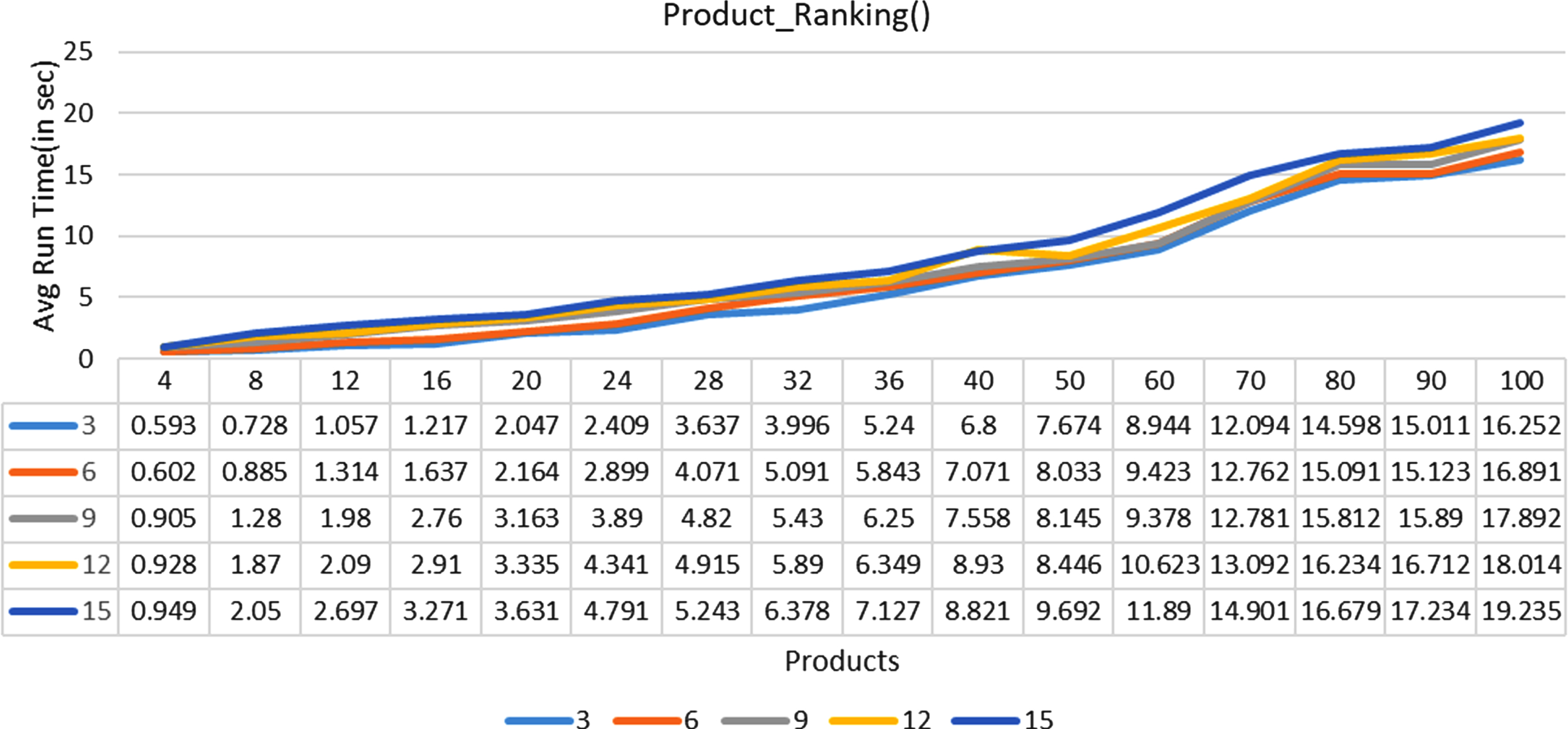
Average Run Time of Product_Ranking().
In this section, we have compared our work with other related works given in [6, 17], and [29]. The work given in [6] is compared both theoretically and numerically with the proposed work whereas with [17] and [29], the comparisons are made theoretically. This is because in [17] the alternatives are valued in linguistic terms and [29] deals with the ordinal ranking of the alternatives.
Taking the data from the numerical example of our work and using the procedure of the proposed work, we have the ranking of products as shown in Table 6:
Product ranking using proposed work
Product ranking using proposed work
Using the methodology given in [6] and solving the numerical example of the proposed work, we have the product ranking with different attitudinal degrees of the decision-maker as shown in Table 7.
Product ranking using methodology in [6]
From the result, it can be observed that the alternative ranking with zero flexibility (α=0) in our work matches to that of the ranking given in [6] for all λ values (attitudinal character of the decision-maker (buyer)). This indicates the robustness of the proposed procedure, showing the superiority of the proposed model. However, in our work, when the flexibility level is increased from α=0, the product rank position changes. This indicates the ranking of the alternatives depends not only on the attitudinal character of the buyer but also additionally on the buyer’s flexible behaviour. In [6], the alternatives (products) are valued based on the attitudinal character of the buyer only. The flexible behaviour of the buyer is ignored while assessing the alternatives. Our work removes this gap by integrating the buyer’s confidence in product assessments and additionally incorporating the flexible degree of the buyer while ranking the products.
Our work is compared with the work given in [17] mainly on the limitations concerning the level of confidence, preference relation amongst the alternatives, and the outranking process. The improvements made in our work are as shown below: In the work [17], the alternative (product) assessment over the attributes is taken in a pair of linguistic values, the first component is the basic alternative evaluation and the second is the level of confidence of the decision-maker. The alternative valuation and confidence therein varies from one attribute to another. The confidence level is taken subjectively. The subjective assessment of the confidence level may not reflect the true confidence of the decision-maker. Our work fills this gap by replacing this subjectivity by introducing a procedure for deriving the confidence objectively. The theory of fuzzy entropy is used for the purpose. The work [17] has defined mainly two types of preference relations amongst the alternatives: strong dominance and weak dominance. They are as follows: An alternative a ≡ (sa, ha) strongly dominates another alternative b ≡ (sb, hb) if ‘a’ is better than ‘b’ in both evaluation (sa > sb) and confidence (ha > hb). An alternative a ≡ (sa, ha) weakly dominates another alternative b ≡ (sb, hb) if ‘a’ is better than ‘b’ in evaluation (sa > sb) but not significantly (threshold value δ) less than ‘b’ in confidence i.e. (ha < hb) and 0 < hb - ha < δ. In case the alternative ‘a’ is above the alternative ‘b’ in evaluation but not in confidence within the threshold value, the pairwise comparison of alternatives ‘a’ and ‘b’ are either ignored or taken as zero preference. This may not be true as the decision-maker (buyer) may have some preference in his/her mind. Ignorance of preference level in these types of cases may lead to loss of information. Our work bridges this gap by aptly integrating the level of confidence with basic alternative evaluation. In the outranking process, the work [17] only considers either full dominance or no dominance of an alternative over the other. However, the partial dominance of alternatives is an essential requirement as the flexibility is intrinsic in the decision-maker’s mind-set. Our work considers this aspect of the decision-maker and incorporates the partial dominance of the alternatives according to the flexible behaviour of the decision-maker in the outranking process.
Our work is compared with the methodology given in [29]. Some shortcomings and the relevant developments therein are made. They are listed below: The pairwise comparisons of the alternatives on the above work are based on the methodology of hierarchical ranking aggregation method. This method considers only the rank position of the alternatives in different ranking. These rankings may be attributed to different attributes in a MADM problem while preparing the pairwise comparisons. This may lead to some loss of information. For example, if an alternative ‘x1’ is rated 4 and another alternative ‘x2’ is rated 1 with respect to an attribute, the work considers x1 << x2 and attaches rank 1 to ‘x1’ and 2 to ‘x2’. Note that, the preference x1 >> x2 does not alter irrespective of the rating of ‘x1’ changes and lies in the range 2 ≤ x1 < 4. Our work removes this gap by considering the numerical valuation of alternatives in IVIFS integrated with the buyer’s confidence and subsequently providing a novel procedure of outranking of alternatives. In the work, an alternative either fully dominates or does not dominate another alternative at all. The work does not undertake the flexibility behaviour of the decision-maker while analysing the dominance of an alternative over another. Our work fills the gap by considering the partial dominance according to decision-maker’s flexible behaviour.
The comparative study shown above indicates the advantages of our work in comparison to the works mentioned above.
The work investigated in our work introduces a new methodology that classifies the product into different preference classes after considering the buyer’s satisfaction, reluctance, and confidence on the product attributes. Before classifying the products into preference classes, the proposed work incorporates the buyer’s flexible behaviour into the product assessments. The proposed work uses fuzzy entropy to identify the buyer’s confidence levels in product ratings. The partial dominance of products according to the buyer’s flexibility is undertaken in our work.
Scope for future research
Our paper does not consider the interdependence or coalition amongst the attributes. However, in many practical situations, interdependence amongst the attributes in MADM cannot be ruled out. Therefore, it is worth to verify the association amongst the attributes when the attributes values are assessed in IVIFS along with a measure of confidence. This can be taken as a future research.
The other direction of future research could be to employ Interval Valued Hesitant Fuzzy sets (IVHFS) instead of IVIFS in attribute values of MADM. May be the attribute values in IVHFS will infer the decision-maker’s confidence more reasonably. Therefore, it is desirable to take buyers’ product assessments in IVHFS. The derivation of the level of confidence of the buyers when the products are assessed in IVHFS may be a scope for future research.
In order to make the product assessment more realistic, some procedures of MADM in recent days define the alternative assessments over the attributes in linguistic values. However, when the alternatives are assessed in intuitionistic fuzzy linguistic values or interval-valued intuitionistic fuzzy linguistic values [27, 35] in MADM, the solution is a challenging task and a scope for future research.
Footnotes
Acknowledgement
We thank the anonymous reviewers for their valuable comments and suggestions by which our work is significantly improved. This research received no specific grant from any funding agency in the public, commercial, or not-for-profit sectors.