



Abstract
A sustainable supply chain (SSC) is vital for company’s sustainability success, so it is imperative to identify and prioritize SSC’s design requirements (DRs) for better SSC planning. For customer-centric markets, the customer requirements (CRs) need to be integrated into SSC’s DRs. This paper thus proposes a customer-centric approach based on Analytic Network Process (ANP), Quality Function Deployment (QFD), Grey Relational Analysis (GRA), and Pythagorean Fuzzy Set (PFS) to rank SSC’s DRs, considering CRs and information ambiguity. The PFS is combined with ANP, QFD, and GRA to better handle uncertainty in the SSC. The Pythagorean fuzzy ANP is applied to analyze the correlations among the sustainable CRs and determine the corresponding weights. The sustainable CRs are transformed into the DRs using the Pythagorean fuzzy QFD. The relationships among the resulting DRs are analyzed through Pythagorean fuzzy GRA to prioritize DRs. The approach is validated through a case study. The results obtained in this paper shows that the proposed method is efficient to prioritize DRs of SSC with the consideration of sustainable CRs under uncertain environment. The novelties of proposed method are that it not only offers a customer-oriented SSC planning method through the integration of ANP, QFD and GRA, but also can reflect the uncertain information with a broader membership representation space via PFSs. Based on the proposed method, the decision-maker can conduct comprehensive analysis to prioritize DRs and design appropriate SSC to fulfill CRs under uncertain environment.
Keywords
Introduction
As environmental and ethical awareness grow, supply chain (SC) advocates are demanding higher business performance on environmental concerns, social responsibility, and economic benefits [1, 2]. Consequently, enterprises are now pro-actively integrating sustainability factors into their SC and taking steps to support management in integrating sustainability [3–5]. In this context, sustainable supply chain (SSC) design has become a critical strategy for enterprises to improve their performance on the economic, environmental and social aspects for overall business success [6, 7]. Thus, it is vital for enterprises to identify the critical design requirements (DRs) for the effective SSC design, which is the key driver of this study.
Since customer requirements (CRs) are the source and purpose of SSC development in a customer-oriented market, the CRs play an essential role in the successful design of SSC. The important goal of a successful SSC design is to fulfill the CRs and pursue higher sustainable performance. Thus, the first step of SSC development is to capture CRs and integrate them into DRs of SSC for an effective SSC design solution. As well known to all, QFD is a customer-driven method, which is effective to identify the relationship between CRs and DRs, and determine the priority of DRs considering CRs. Although there are many studies that utilize QFD to integrate CRs into SSC, QFD has difficulty to understand and analyze CRs’ hierarchical relationships and complex interrelations in a systematic and comprehensive manner due to the inherent deficiencies [8]. In addition, the understanding of DRs, especially the priority analysis of DRs is an important decision basis for SSC development [9]. The traditional QFD prioritizes DRs based on the relationships between CRs and DRs evaluated by experts, which ignores the errors caused by small sample size and cannot illustrate the intercorrelations among DRs, and may have a negative impact on the proper prioritization of DRs. Finally, the traditional QFD is insufficient in dealing with uncertainty and fuzziness of evaluation information involved in the SSC development, which may influence the priority analysis of DRs and subsequently result in an inappropriate decision support in SSC development.
To bridge the research gaps mentioned above, this study proposes an integrative methodology to prioritize DRs in customer-oriented SSC development under fuzzy environment, which is achieved by a hybrid analytical approach combining of analytic network process (ANP), quality function deployment (QFD), grey relational analysis (GRA) and Pythagorean fuzzy set (PFS). In the proposed method, PFS is applied to express the objective evaluation information through the SSC planning, including evaluation of correlations among CRs, relationship between CRs and DRs. At first, the Pythagorean fuzzy ANP (PF-ANP) is developed to prioritize sustainable CRs of SSC by analyzing the hierarchical relationships and correlations of sustainable CRs. Next, PFS is incorporated into QFD to transform sustainable CRs into SSC’s DRs using Pythagorean fuzzy numbers (PFNs), so as to effectively handle the uncertainty and fuzziness of experts’ evaluation through describing the membership and non-membership. Then, based on the integration of the developed PF-ANP and Pythagorean fuzzy QFD (PF-QFD), and the Pythagorean fuzzy GRA (PF-GRA) is adopted to analyze the interrelations among DRs considering the sustainable CRs and prioritize DRs. Finally, a case is studied to validate the proposed method and a comparative analysis is conducted.
The novelties of proposed method are described as following. Firstly, the integration of ANP, QFD and GRA offers a customer-oriented SSC planning method through incorporating CRs into DRs of SSC. Secondly, expressing evaluation information with PFSs, the proposed method can effectively handle the uncertain information with a broader membership representation space of PFSs. Thirdly, based on the analysis results obtained from PF-ANP and PF-QFD, the PF-GRA can prioritize DRs and express the interrelation of DRs through subjective analysis, which can compensate for subjective errors resulted from small sample size. Thus, with the proposed method, the decision-maker can conduct comprehensive analysis to prioritize DRs and design appropriate SSC to fulfill CRs under uncertain environment.
The structure of this paper is set as follows. Section 2 offers a review of the research status of SSC development, and integrated QFD. In Section 3, the concepts related to PFS are introduced. In Section 4, the integrative method based on ANP, QFD, GRA, and PFS is introduced in detail. In Section 5, a case study is used to illustrate the feasibility of this method. Subsequently, Section 6 discusses the effectiveness of the method and Section 7 concludes the study.
Literature review
In a customer-oriented market, successful SSC development should begin with understanding sustainable CRs and integrating them into SSC’s DRs. As well known to all, QFD is a customer-driven method, which transforms CRs into relevant attributes effectively and enables designers accurately to develop the products or services [10–13]. Thus, QFD is viewed as an effective method to incorporate CRs into strategic management and operations management [14–16], and it has been applied it in various fields, such as product development [17–21], service design [22]. In addition, QFD has been successfully applied to transform CRs into SSC’s DRs [6, 22]. Thus, QFD has great potential in integrating sustainable CRs into DRs to support customer-oriented SSC development. However, some limitations exist in QFD, which should be handled to support SSC design.
First, there are complex hierarchical relationships and interrelationships in CRs, but QFD cannot analyze CRs’ complex relationships systematically [8], which may have impact on the appropriate importance analysis of SSC’s DRs. While, ANP enables managers to deeply understand the hierarchical relationships and interrelationships in CRs, and many studies combine ANP with QFD to analyze CRs’ interrelations [20]. Aiming to select supplier based on CRs, Asadabadi Mehdi Rajabi [23] applied ANP in QFD to describe the internal dependencies of CRs, product requirements, and suppliers’ qualifications. As for the customer-oriented SSC design, ANP has been combined with QFD to prioritize CRs considering the interrelations and transform CRs into SSC’s DRs [22, 24]. The existing studies provide valuable insights into the integration of ANP and QFD to tackle the deficiency of QFD in CRs analysis.
Second, the traditional QFD determines the priority of DRs based on the relationships between CRs and DRs evaluated by experts, which may have subjective errors caused by the small sample size. Moreover, the relationships between CRs and DRs may imply the interrelations among DRs, but the traditional QFD cannot extract and utilize this information. While, GRA proposed by Julong Deng [25] can provide precise interrelationship information through the mathematical analysis of a relatively small amount of data. In this respect, GRA has been extended into multi-criteria decision making (MCDM) problems to provide more objective and accurate decision support. Avinash Samvedi et al. [26] have integrated GRA with analytical hierarchy process (AHP) to rank the alternative machine tools. Aiming at selecting the optimal aviation fuel, the fuzzy ANP and fuzzy GRA are developed to rank the alternative aviation fuels. Xu Wang et al. [9] and Wenyan Song et al. [27] have employed GRA to prioritize technical attributes in QFD. These researches indicate that GRA has advantages to analyze SSC’s DRs based on QFD.
In addition, as a typical MCDM method, various information uncertainty is involved in QFD. While, the traditional QFD mentioned in above researches are insufficient to deal with information uncertainty, which may result in a negative impact on the accuracy of DRs’ ranking results in SSC design. Recognizing the imprecise information and ambiguity issues, fuzzy set (FS) is employed into QFD to express decision maker’s evaluation [28, 29]. As FS expresses experts’ preference using only membership degree, it neglects the non-membership and hesitance degrees involved in the subjective evaluation. So, to overcome the drawbacks of FS, the intuitionistic fuzzy set (IFS) developed by Atanassov Krassimir T. [30] is extended to QFD, which can effectively describe experts’ uncertainty with membership, non-membership and hesitance degrees. However, the sum of membership degree and non-membership degree of IFS should be less than or equal to 1, and it fails to deal with the situation when the sum is greater than 1. Aiming to address the shortcomings existing in IFS, PFS proposed by Yager Ronald R. [31] is considered as an effective method, whose sum of membership degree and non-membership degree can exceed 1, but the sum of squares may not. Thus, PFS enables a larger domain to express the uncertainty, and is more powerful on the issues of uncertainty. Motivated by this, a great attention is paid toward applying PFS in MCDM issues to handle the information uncertainty. Ahme Çalık [32] has integrated AHP and the technique for order preference by similarity to ideal solution (TOPSIS) methods under the Pythagorean fuzzy environment to select the best green supplier. The Pythagorean fuzzy TOPSIS method based on similarity measure has been developed for sustainable recycling partner selection [33]. To handle the Pythagorean fuzzy information effectively in the group decision-making process, some new operational laws and operators has been established [34–37]. For example, Garg Harish [36] has developed some new operational laws and the corresponding weighted aggregation operators for Pythagorean fuzzy information to neutrally treat the membership and non-membership degrees, and applied them in multiple attribute group decision-making problems. It is observed form the above studies that the fuzzy MCDM problems can be successfully solved under PFS environment. Thus, PFS is an appropriate method to compensate for the shortcomings of QFD when dealing with information uncertainty in SSC’s DRs analysis.
Therefore, aiming to solve the shortcomings mentioned above, a novel customer-oriented method integrating ANP, QFD and GRA under Pythagorean fuzzy environment is presented to prioritize DRs of SSC.
Preliminaries of PFS
The PFS is an extension of the IFS [37]. Compared to the classical FS, the sum of membership and non-membership degrees can exceed 1, but the sum of their squares cannot exceed 1 [38]. Therefore, PFS can have a larger domain to express the uncertainty, and be more powerful on the issues of uncertainty. In this section, some basic definitions related to PFS have been presented, and more descriptions in details can be seen in the corresponding literatures.
Where u
p
(x) ∈ [0, 1] and v
p
(x) ∈ [0, 1] denote the degrees of belonging and non-belonging on the objective x ∈ X respectively, and 0 ⩽ (u
p
(x)) 2 + (v
p
(x)) 2 ⩽ 1. The degree of hesitancy is expressed as
β1 ∪ β2 = P (max {u
β
1
, u
β
2
} , min {v
β
1
, v
β
2
}); β1 ∩ β2 = P (min {u
β
1
, u
β
2
} , max {v
β
1
, v
β
2
});
This paper develops a customer-driven method to determine the priorities of SSC’s DRs under the Pythagorean fuzzy environment. In the section, the approach of combining ANP-QFD-GRA with PFS is employed to analyze SSC’s DRs. There is an assumption is that the experts involved in the evaluation process are of the same importance. First, the PF-ANP is employed to analyze the interrelated hierarchical relationships of sustainable CRs and to determine the priorities of sustainable CRs under fuzzy environment. Then, the analysis results of sustainable CRs are integrated into DRs through the PF-QFD for developing SSC more effectively, and PF-GRA is employed to determine the priority of DRs. Figure 1 shows the process. In the proposed method, the inputs of the process are including the Pythagorean fuzzy evaluation of sustainable CRs’ correlation, Pythagorean fuzzy evaluation of relationships between sustainable CRs and DRs. The priority of sustainable CRs and DRs are the outputs of the method.

The process of proposed method.
Identifying CRs is critical for enterprises to efficiently design the supply chain (SC) to satisfy CRs for greater customer satisfaction. CRs considered in this paper are sustainable requirements. As the main objectives of sustainability development for SC involve economic, environmental, and social sustainability, CRs are mainly divided into three categories, including economic requirements (CR1), environmental requirements (CR2) and social requirements (CR3). CR i denotes CRs in the ith category, i = 1, 2, 3. Then, the major CRs in each category are identified by employing questionnaires to customers, literature surveys, or expert interviews. The identified CRs in the ith category can be denoted by CR ij , j = 1, 2, ⋯ m i and m i is the number of CRs in the ith category. The hierarchy diagram of sustainable CRs for SSC is described as follows (Fig. 2).
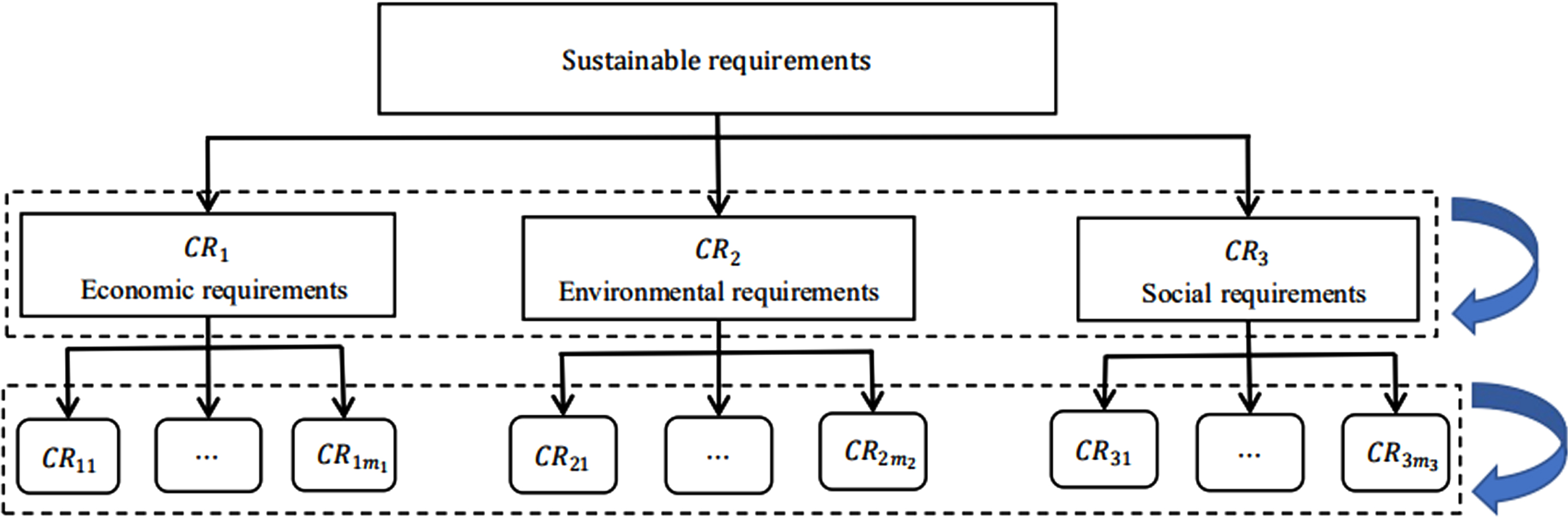
Hierarchical structure of sustainable CRs for SSC.
As the limitation of SSC’s development resources, the companies cannot fulfill all the sustainable CRs at one time. Thus, it’s important to conduct priority analysis of the identified sustainable CRs. In this section, PF-ANP is employed to understand and analyze sustainable CRs, which can effectively model the interdependency among sustainable CRs, and address the imprecision and uncertainty involved in the experts’ subjective evaluations using PFNs.
The Pythagorean fuzzy pairwise comparison matrix between sustainable CRs
In this part, experts are invited to use PFNs to conduct pairwise comparisons to evaluate the inner dependency of sustainable CRs in the ith category with respect to CR
gl
(g = 1, 2, 3 ; j = 1, 2, ⋯ , m
g
), and the corresponding Pythagorean fuzzy pairwise comparison matrix
The Pythagorean fuzzy pairwise comparison matrix of sustainable CRs in the i
th
category with respect to CR
gl
The Pythagorean fuzzy pairwise comparison matrix of sustainable CRs in the i th category with respect to CR gl
In Table 1, the PFN
Following the steps described in section 4.2.1, each CR in the gth category is taken as the criterion in turn, and the Pythagorean fuzzy pairwise comparison matrixes for the inner dependency evaluation of sustainable CRs in the ith category with respect to each criterion are constructed. Then the normalized feature vector of each Pythagoras fuzzy matrix is integrated as the Pythagorean fuzzy matrix
Following the steps mentioned above, the Pythagorean fuzzy matrixes for sustainable CRs in each category with respect to sustainable CRs in each category can be determined and they can be integrated as Pythagorean fuzzy super matrix
The Pythagorean fuzzy weight matrix
According to the steps described in section 4.2.1, taking each CR
g
as the criterion, the experts are invited to conduct the pairwise comparisons among CR1, CR2 and CR3 according to its’ correlation degree with CR
g
using the PFNs, and the Pythagorean fuzzy weight matrix
The PFN
The Pythagorean fuzzy weighted super matrix
Based on the Pythagorean fuzzy weight matrix
Where, the PFN
Based on the Pythagorean fuzzy weighted super matrix
In SSC, sustainable CRs are satisfied with related DRs. To identify the main DRs, interviews with the experts in SSC design and literature study are conducted. The identified DRs are represented as DR h (h = 1, 2, ⋯ , k), k is the number of DRs. Based on the identified major DRs, the PF-QFD and PF-GRA are integrated to analyze DRs of SSC.
Construct the Pythagorean fuzzy HoQ
To incorporate sustainable CRs into SSC design, HoQ of QFD is employed to express the relationships among sustainable CRs and DRs, which is evaluated by experts using PFNs. The established Pythagorean fuzzy HoQ (PF-HoQ) can be seen in Table 2, and
The Pythagorean fuzzy HoQ
The Pythagorean fuzzy HoQ
Then, the sustainable CRs’ Pythagorean fuzzy importance weights derived in Section 4.2.5 are extended into PF-HoQ, and the weighted Pythagorean fuzzy relationship matrix between sustainable CRs and DRs, denoted as
In the weighted Pythagorean fuzzy relationship matrix
Then, the grey relational degree of the ideal reference sequence and alternative sequence can be determined with Equations (9) and (10).
Where,
In order to illustrate the practical application of the proposed method, Company M, a household appliance manufacturer in China, is introduced to conduct the case study. Due to the increasing customer requirements on sustainability, SSC development with a strong focus on customer requirements has become an important strategy for Company M to improve the enterprise’s performance on the economic, environmental and social aspects. While, there is a lack of methods and framework to guide the managers to analyze sustainable CRs, incorporate sustainable CRs into DRs of SSC, and rank DRs of SSC, which may cause negative impact on SSC design and management. In this context, to provide reasonable decision support for SSC development, a systematic approach to prioritize SSC’s DRs with the consideration of CRs is required by Company M.
Identification of the Sustainable CRs
According to customers’ questionnaires, literature surveys and expert interviews, 12 sustainable CRs of SSC under the three sustainable aspects of economy, environment and society are identified, and the hierarchical structure is shown in Fig. 3.
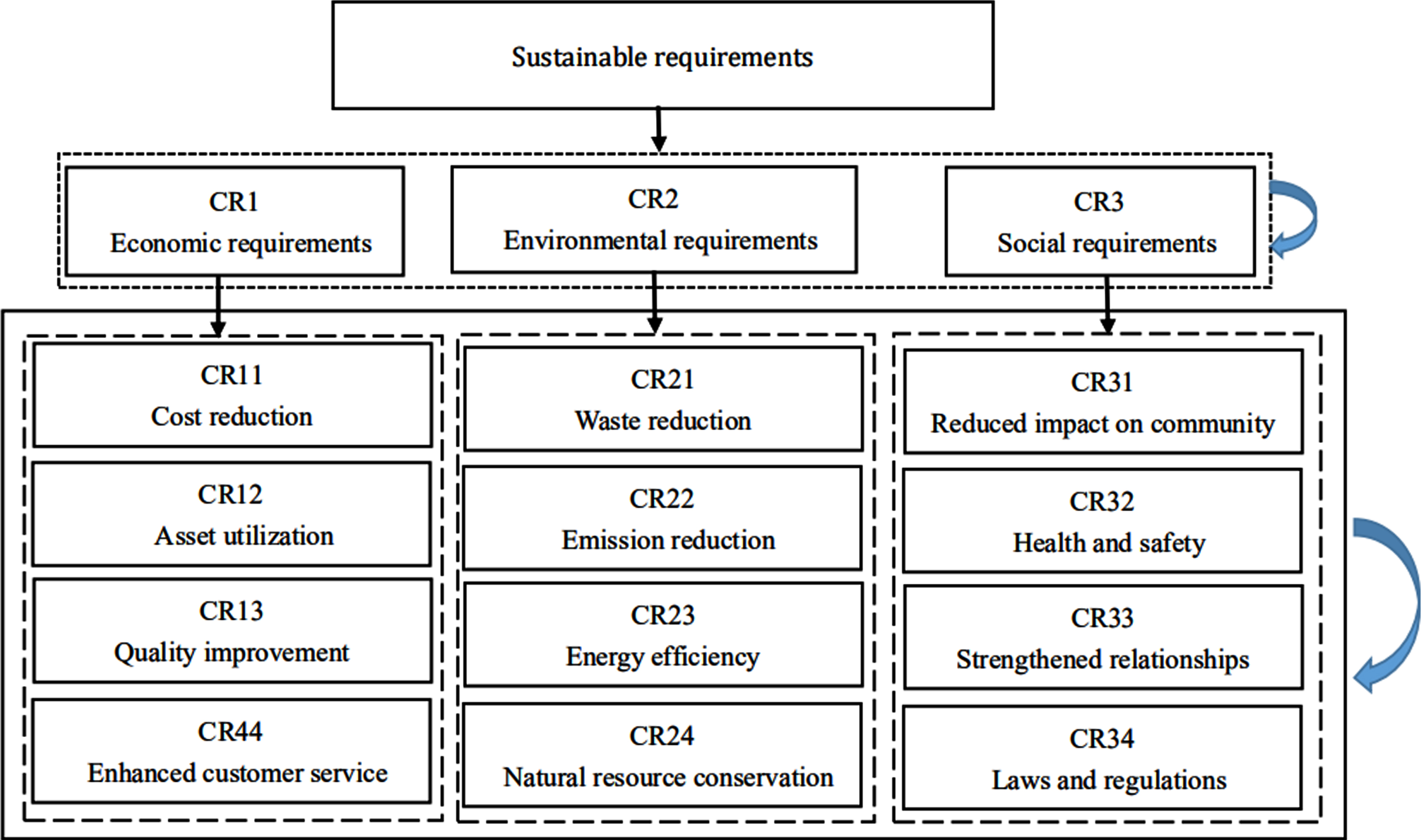
Hierarchical structure of sustainable CRs.
The Pythagorean pairwise comparison matrix between sustainable CRs
After identifying sustainable CRs, taking CR11 as criterion, experts are then invited to use PFNs to evaluate the correlation among CRs under CR1 (including CR12, CR13 and CR14) with respect to the criteria through pairwise comparison, and the Pythagorean fuzzy pairwise comparison matrix of CRs under CR1 with respect to CR11 is shown in Table 3. Next, the corresponding normalized feature vector is obtained based on the eigenvalue method, and is listed in Table 3.
The Pythagorean fuzzy pairwise comparison matrix of CRs under CR1 with respect to CR11
The Pythagorean fuzzy pairwise comparison matrix of CRs under CR1 with respect to CR11
Following the same steps, the Pythagorean fuzzy pairwise comparison matrix and the relative weight for CRs under CR2 with respect to CR11 can be obtained, and are shown in Table 4. Table 5 expresses the related information for CRs under CR3 with respect to CR11.
The Pythagorean fuzzy pairwise comparison matrix of CRs under CR2 with respect to CR11
The Pythagorean fuzzy pairwise comparison matrix of CRs under CR3 with respect toCR11
According to the steps described in Section 5.2.1, each sustainable CR is taken as the criterion in turn, and the Pythagorean fuzzy pairwise comparison matrix among sustainable CRs in each group with respect to the criterion are obtained. Then, the normalized eigenvectors of each matrix are integrated into the Pythagorean fuzzy super matrix, and the results are listed in Table 6.
The Pythagorean fuzzy HoQ
The Pythagorean fuzzy HoQ
Following the steps described in Section 5.2.1, taking CR1, CR2 and CR3 as the criterion in turn, experts are invited to construct the pairwise comparison matrix between them with respect to each criterion, and the relative weights for CR1, CR2, CR3 under each criterion are obtained, as shown in Table 7.
The Pythagorean fuzzy weight matrix for CR1, CR2 and CR3
The Pythagorean fuzzy weight matrix for CR1, CR2 and CR3
According to Equation (4), the Pythagorean fuzzy super matrix is weighted, and then the Pythagorean fuzzy weighted super matrix is obtained, as shown in Table 8.
The Pythagorean fuzzy weighted super matrix
According to Equation (5), the Pythagorean fuzzy weighted super matrix is aggregated to achieve the Pythagorean fuzzy weight of sustainable CRs. Then, the score of weight degree for sustainable CRs is obtained by Equation (1), and the sustainable CRs are prioritized by the obtained scores, as shown in Table 9. In Table 9, CR13 (Quality improvement) and CR23 (Energy efficiency) are the two most important sustainable CRs, CR33 (Strengthened relationships) is of the least importance.
The Pythagorean fuzzy weights and priority of sustainable CRs
The Pythagorean fuzzy weights and priority of sustainable CRs
According to the expert consultation and literature research, the critical DRs of SSC for Company M are identified. Table 10 expresses the detail information of the identified SSC DRs.
The critical DRs of SSC
The critical DRs of SSC
The experts are invited to evaluate the correlation strength between the identified sustainable CRs and DRs with PFNs, so as to construct the PF-HoQ of SSC, which is shown in Table 11.
The Pythagorean fuzzy HoQ for sustainable CRs and DRs
The Pythagorean fuzzy HoQ for sustainable CRs and DRs
Based on the Pythagorean fuzzy relation matrix between sustainable CRs and DRs in Table 11, the weighted Pythagorean fuzzy relation matrix can be obtained by employing Equations (6)-(7). Then, Equation (8) is applied to determine the ideal reference sequence of DRs. According to Equations (9)-(10), the grey relational degree for each DR is calculated. Finally, the importance weights of DRs based on the grey relational degree are obtained through Equation (11), and the results are shown in Table 12. The DRs of SSC can be prioritized as follows: DR10 ≻ DR2 ≻ DR12 ≻ DR11 ≻ DR20 ≻ DR13 ≻ DR18 ≻ DR9 ≻ DR15 ≻ DR7 ≻ DR14 ≻ DR19 ≻ DR5 ≻ DR1 ≻ DR4 ≻ DR3 ≻ DR8 ≻ DR16 ≻ DR6 ≻ DR17. In Table 12, the DR10 (Environmental management system), DR2 (SC optimize), DR12 (Sustainable product design) are the top three DRs considering the importance weight and the DR17 (Employee practice) is of the least importance. In the SSC planning, the managers should allocate more resource to improve the performance of DR10, DR2 and DR12.
The weights and ranking of SSC’ DRs
The weights and ranking of SSC’ DRs
Based on the case study, the developed methodology named as PF-ANP-QFD is compared with the approaches of ANP-QFD [24], QFD [44] and pairwise comparison method [45] to verify its advantages, and the results are shown in Table 13 and Fig. 4.
The comparisons among different methods
The comparisons among different methods
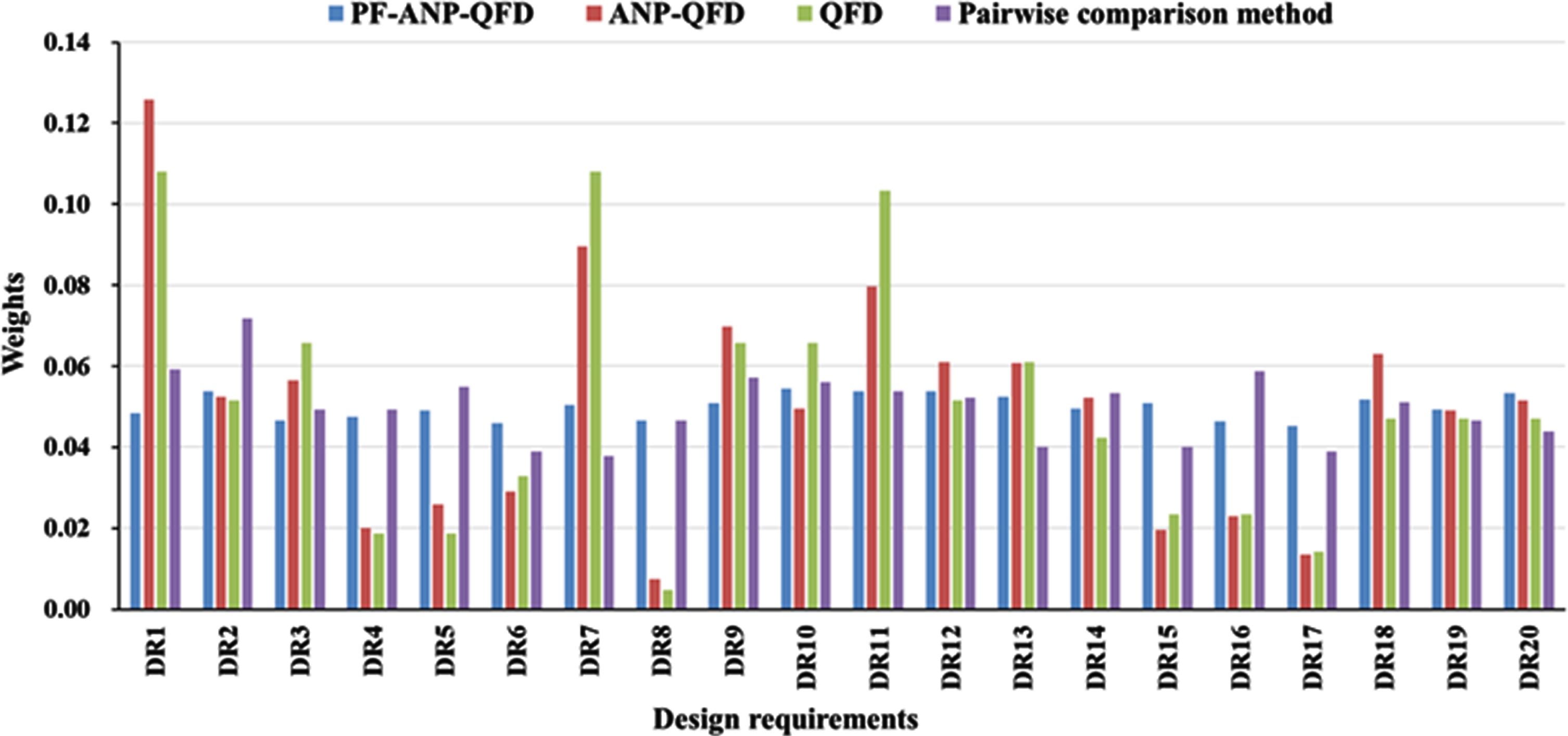
The weights of DRs determined by different methods.
As shown in Table 13, the priorities of DRs determined by the proposed method are different from those obtained through ANP-QFD, QFD and pairwise comparison method. This is because that different manners are applied to deal with sustainable CRs, analyze SSC’s DRs and tackle the uncertain information. The qualitative comparison between the proposed PF-ANP-QFD and the existing methods is summarized in Table 14. It is obvious that the proposed method can provide comprehensive analysis on sustainable CRs and DRs.
Main differences between PF-ANP-QFD and the listed methods
The first comparison is conducted with the results obtained from the AHP-QFD method. According to Table 13 and Fig. 4, the top three DRs obtained through PF-ANP-QFD are DR10 (Environmental management system), DR2 (SC optimize), DR12 (Sustainable product design). However, in AHP-QFD, the top three DRs are DR1 (Total cost management), DR7 (Flexible and clean technology) and DR11 (Renewable energy consumption). The main reasons for the differences are discussed as follows. Firstly, although ANP-QFD incorporates sustainable CRs into DRs’ analysis and analyzes the intercorrelations with sustainable CRs, it ignores the uncertainty and impreciseness in the experts’ judgment, which is now handled through PFS in the proposed method. Also, PFN applied in this paper enables a larger domain to express the uncertainty, and is more powerful on the issues of uncertainty. Secondly, the ANP-QFD has a limitation on analyzing the intercorrelations of SSC’s DRs and dealing with errors caused by small sample size in HoQ, while PF-GRA adopted in the proposed method allows for a mathematical analysis to determine the objective priorities of DRs, thus not only addresses the errors caused by small sample size, but also reflects the correlations of SSC’s DRs.
The second comparison is conducted with the results obtained from QFD method. As shown in Table 13 and Fig. 4, the DR’s ranking results of PF-ANP-QFD and QFD are different. For example, the most important DRs obtained by PF-ANP-QFD is DR10 (Environmental management system), but it is ranked the 3rd in QFD method. This is because that DR10 is considered to be influenced by other DRs in PF-ANP-QFD, and the influence is analyzed through PF-GRA. On the contrary, DR1 is considered as an independent requirement in QFD. Moreover, QFD ignores the uncertainty and fuzziness of experts’ judgment in evaluation, while it can be handled through PFS in the proposed method. The most important is that, although QFD enables integration of sustainable CRs into SSC development, it neglects the complex hierarchical relationships and complex interrelations of sustainable CRs, which has great impact on the priorities of sustainable CRs and DRs. This is now addressed by the PF-ANP in the proposed method.
The last comparative method is the pairwise comparison method. As can be seen from Table 13, except for DR19 (stakeholders’ rights), the priorities of other DRs determined by PF-ANP-QFD are different from those obtained with pairwise comparison method. The main reason for the differences between PF-ANP-QFD and pairwise comparison method is that pairwise comparison method has inner deficiency to incorporate sustainable CRs into DRs. While, sustainable CRs have a significant impact in SSC’s DRs management in customer-oriented market. In addition, pairwise comparison method has other limitations mentioned in QFD and ANP-QFD.
Thus, through the above comparison with ANP-QFD, QFD and pairwise comparison method, the integrative method can provide comprehensive insights on DRs for designing more effective SSC to satisfy sustainable CRs proactively through analyzing sustainable CRs, integrating sustainable CRs into SSC’s DRs directly, and prioritizing DRs objectively in an uncertain environment.
With the increasing CRs on sustainability and the uncertainty involving in SSC, a hybrid analytical approach integrating ANP, QFD and GRA with PFS is proposed to prioritize SSC’ DRs aiming to provide robust decision support for SSC development to proactively fulfill CRs under an uncertain environment. The PFS based method provides a larger domain to express the uncertainty, and is more powerful to deal with the uncertainty in SSC. The sustainable CRs of SSC are first prioritized using PF-ANP by considering the interrelations among them. Then, the sustainable CRs are integrated into SSC’s DRs through PF-QFD in order to achieve customer-oriented SSC development. Based on the analysis results obtained from PF-ANP and PF-QFD, the PF-GRA is developed to prioritize DRs through interrelation analysis of DRs considering the sustainable CRs, which can compensate for subjective errors resulted from small sample size. The case study and comparative analysis indicate the practical significance of the proposed approach, and it is efficient to provide decision support for customer-oriented SSC design. The proposed method is hoped to rich the literature on the improvement of QFD in SSC development.
In conclusion, the main contributions of this research are described as follows. Firstly, this study proposes a novel approach to provide decision support for SSC development under the Pythagorean fuzzy environment, which can accommodate more uncertainties involved in expert’s subjective and vague judgments. Secondly, the hierarchical relationships and correlations of CRs are explored and integrated into SSC’s DRs, which can realize customer-oriented SSC design. Thirdly, the weight of each DR is successfully determined by exploring complex interrelationships among DRs and dealing with the errors caused by small sample size, which can provide decision support for SSC development.
However, some limitations exist and need to be studied in future. First, the competitive analysis of SSC’s DRs is an important factor for SSC design, which should be taken into consideration in the future study. Next, a decision support system based on the proposed method should be developed to assist experts to conduct related activities with friendly interface and software tool. Further, the linguistic interval-valued Pythagorean fuzzy set proposed by Garg Harish [46] can be extended to the proposed method to offer even greater flexibility in analysis.
Footnotes
Acknowledgments
The work is supported by the National Natural Science Foundation of China (Grant No. 51705436), the National Science and Technology Major Project (Grant No. 2017-I-0011-0012), and Sichuan Science and Technology Program (Grant No. 2021JDRC0174). The authors would like to thank the anonymous reviewers for the valuable comments and suggestions.
Declaration of conflicting interests
The Authors declare that there is no conflict of interest.