



Abstract
Learning Management Systems is a challenge of implementing information technology (IT) in the higher educational field. This paper introduces a framework for assessing an LMS by integrating partial last squares-structural equation modeling (PLS-SEM) and fuzzy analytic hierarchic process with Z-numbers (Fuzzy Z-AHP). The objective is to propose the combination of the two approaches via results of PLS-SEM for the construction of the decision matrix for Fuzzy Z-AHP. The PLS-SEM method was used firstly to evaluate the conceptual model Unified Theory of Acceptance and Use of Technology 2 (UTAUT2) and extracting the significant connections between the independent constructs and the behavioral intention to use an LMS. Secondly is adapted the Fuzzy Z-AHP method to rank the independent significant constructs initializing from the PLS-SEM results. Using a questionnaire survey, the study sampled 530 users of LMS in 4 Albanian universities as respondents. To the best of our knowledge this paper is among the first that combines PLS-SEM with Fuzzy Z-AHP for the UTAUT2 model while using an LMS. This combination showed that the most important construct of UTAUT2 affecting behavioral intention to use an LMS was habit. This study assist the decision makers and policy makers to provide the means to obtain better managerial conclusions for the improvement and progress of an LMS.
Introduction
The rapid advances in technology have changed the way of teaching in higher education and this evolution has been realized by integrating Learning Management Systems (LMS). Web-based Learning Management System is a platform designed to assist in the management scheme of the teaching and learning process [1] facilitating interactive interaction between students and instructors [2]. An LMS ensure an online folder to efficient management for the course, where the instructor can deliver learning materials, assignments and students can access the learning content [3]. There are several LMS used in educational institutions which include Moodle, Blackboard, WebCT, Google Classroom etc. A new trend in the field of education is Google Classroom because recently it has been integrated rapidly, has advanced in popularity, and with great importance in the higher education [4]. Previous studies show that Google Classroom has offered for the students some benefits because it is more flexible with the tools such as e-mail, forums, assignments etc [5]. In the other hand the lecturers/students of the universities encountered many challenges such as: spending many hours to prepare for teaching/learning online, while not all of the students have access to the internet also teachers have to care of their emotional health [6]. Motivated by all these facts in this study has been used the online learning theory of acceptance and use of a new technology 2 (UTAUT2) to evaluate better its constructs that impact more the development of Google Classroom. The UTAUT 2 has been formulated firstly by Venkatesh [7], and consists of 8 constructs: Performance Expectancy (PE), Effort Expectancy (EE), Social Influence (SI), Facilitating Conditions (FC), Hedonic Motivation (HM), Habit (HT), Behavioral Intention (BI) and Use Behavior (UB). There are various methods that evaluate the acceptance of a new technology model. In this study is used the partial least square-structural equation model (PLS-SEM) in order to analyze how the constructs of UTAUT2 affect the behavioral intention in using an LMS such as Google Classroom. The results obtained from PLS-SEM show the importance of the constructs of UTAUT2 toward behavioral intention to use the e-learning platform Google Classroom and also the importance that the latter has toward the use behavior construct. In fact in order to have an efficient decision-making output, has been integrated a hybrid model which uses these results as initiators of the fuzzy method fuzzy analytic hierarchical process with Z–numbers (Fuzzy Z-AHP) [8]. These method belong to the group of multi criteria decision making methods (MCDM). The fuzzy AHP with Z-numbers starts with the construction of the decision matrix according to the structured problem. Exactly the results of PLS-SEM orient better a decision maker in the construction of this matrix.
Firstly in the objective of this research is to analyze the Unified Theory of Acceptance and Use of Technology 2 (UTAUT2) model to consolidate effective constructs of an LMS, by applying PLS-SEM as a strategic method, and secondly with the main idea that the PLS-SEM results will serve as a bridge for the initialization of the fuzzy method Fuzzy Z-AHP. So this study proposes the project of a systematic approach that integrates the PLS-SEM with the fuzzy method with the main scope the evaluation of the usage of an LMS. The study conclusions have a theoretical, methodological, and practical contribution in the field of LMS.
In the context of the theoretical contribution, this research will present the factors that affect the acceptance of an LMS in the Albanian Universities, because to the best of our knowledge such a study for Albania has not been conducted before. The study explores the significance of relationships Performance Expectancy (PE), Effort Expectancy (EE), Social Influence (SI), Facilitating Conditions (FC), Hedonic Motivation (HM), Habit (HT) with behavioral intention and actual use of an LMS. Is treated the total variance explained by the model in determining an LMS usage intentions. The large total variance explained of a variable is an indication that the latter should be considered for its inclusion in LMS acceptance. In terms of methodological contribution this study includes the use of a multi-analytical approach by combining Partial Least Squares- Structural Equation Modelling (PLS-SEM) and Fuzzy Z-AHP. Have been assessed the relationships between all latent constructs in the model and tested them with PLS-SEM method. This research analyzed the Unified Theory of Acceptance and Use of Technology 2 (UTAUT2) model to consolidate effective constructs of an LMS, by applying PLS-SEM as a strategic method, and secondly with the main idea that the PLS-SEM results will serve as a bridge for the initialization of the fuzzy method Fuzzy Z-AHP. The findings of this paper have a practical contribution because they confirm which factors can determine the use of an LMS. From the results obtained policy makers obtain better managerial conclusions for the improvement and progress of an LMS.
The framework below describes the approach of the study. (See Fig. 1).

The framework of the study.
Considering higher education, the acceptance and use of an LMS should be investigated via different models based on specific standards [9]. There have been several theoretical models for understanding acceptance and use of information technology: Theory of Reason Action (TRA) [10], the Technology Acceptance Model (TAM) [11], the Theory of Planned Behavior (TPB) [12], the Diffusion of Innovation Theory (DOI) [13], the Unified Theory of Acceptance and Use of Technology (UTAUT) [7] and UTAUT2 (Venkatesh et al., 2012). Through the years the UTAUT model theory was enriched with the integration of three new constructs in order to better integrate it into the new technology use framework [14]. The new constructs are hedonic motivation (HM), habit (HT) and price value (PC) respectively [14] as UTAUT2. It has been considered as a more integrative theory than other previous models and technology adoption theories [15]. UTAUT2 was obvious to be able to explain 74% of behavioral intention and 52 percent of use behavior reflecting substantial improvement over other previous models [15].
In this paper are shown the connections between the constructs of the UTAUT2 model in the context of the usage of the Google Classroom platform by students of Albanian Universities. Predictor constructs of behavioral intention (BI) are: effort expectancy (EE), performance expectancy (PE), Social influence (SI), Hedonic Motivations (HM) and Habit (HT), while the construct Facilitating Condition (FC) was removed from the study because all the statistics evaluating the measurement model were not within the acceptable intervals. Latent variable behavioral intention (BI) serves as a predictor for Use Behavior (UB). Below is the conceptual model UTAUT2. (See Fig. 2). PE is linked to the efficiency and effectiveness of retrieving information and learning by using new technology at anytime and anywhere. The effort expectancy (EE) is related to the degree of ease of use of a new technology [16]. SI is related with the impact that colleagues, instructors have on an individual in the use of a new technology [16]. HM is linked to the level of enjoyment or fun when is used a new technology. Habit is linked to automatic behaviors of an individual using a new technology [14]. BI is related with an individual‘s intention in using a new technology in the future [14].
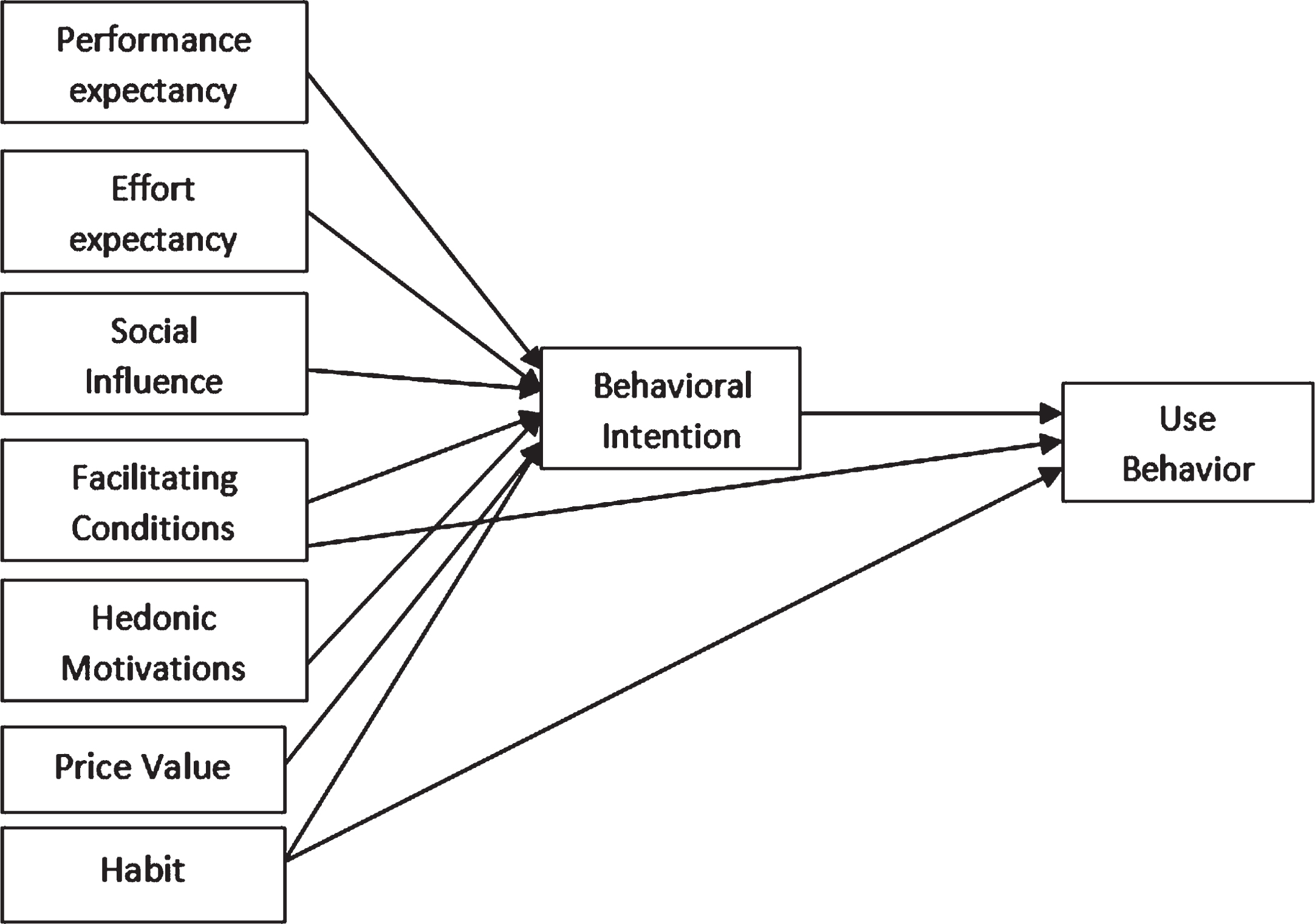
UTAUT2 model [14].
Kumar and Bervell [17] employed UTAUT2 theory to investigate the factors that influence behavioral intention (BI) to use an LMS from the students ’point of view. The findings of the study showed that habit, hedonic motivation and performance expectancy were significant predictors of behavioral intention to use an LMS while their use behavior was determined by habit. The paper of NoorUI Ain [18] identified the antecedents of LMS use from the students’ perspective. Drawing on the UTAUT2 framework the results of the study show that performance expectancy, and social influence have a positive effect on Behavioral Intention to use LMS. Additionally Behavioral Intention, facilitating conditions positively influence the Use Behavior. Also another paper that followed UTAUT2 model was handled by Arumugam Raman [19]. The research handles Teachers ’Acceptance of LMS. Proposes six determinants of intentions to use: performance expectancy, effort expectancy, facilitating conditions, hedonic motivation, habit, and social influence. The paper revealed significant factors influencing the usage intention of LMS which were hedonic motivation, performance expectancy, effort expectancy, social inclusion, facilitating condition.
The PLS-SEM modeling allows the creation of complex models, and does not impose conditions regarding the distributional assumptions [20]. In previous several studies the findings of PLS-SEM have been used as an essential input for the AHP methods with the main aim to construct the decision matrix. To the best of our knowledge there are a few studies that have integrated PLS-SEM with the Fuzzy AHP method (FAHP) for the adoption of a new technology related with the online learning. The study of Yousef A. M. Qasem predicted the determinants of cloud computing adoption in higher education institutions via PLS-SEM and artificial neural network (ANN) [21]. Some other studies have used SEM/AHP to find a best selection of a complex problem. In the study of Murugesan Punniyamoorthi was developed a composite model using structural equation modeling (SEM) and analytic hierarchic process (AHP) for the supplier selections [22]. Mohamed Mansour has integrated the partial least square-structural equation modeling (PLS-SEM) with the analytic hierarchic process (AHP) to rank the investment of the construction sector in Saudi Arabia for obtaining sustainable development [23]. Suresh Jakhar used an integrated methodology SEM and Fuzzy AHP to model the Indian textile-apparel-retail supply chain network [24]. Ali Alarjani used the AHP and the fuzzy goal programming as a fuzzy set for the sustainable goals of Saudi Arabia [25]. The Z-numbers are used in fuzzy logic to deal with the uncertainty of the information given by the humans with their reliability measure. In the study of N.J Mohd Jamal [26] are implemented the z-numbers in a fuzzy clustering algorithm for the patients of chronic kidney disease to handle with the uncertain information related to respondents and also to cluster them using fuzzy C-Means. N. Tuysuz has integrated the z-fuzzy numbers and the fuzzy AHP to evaluate the social sustainable development factors [27]. In the study of Jian Wu et al. [28] are combined two-fold personalized mechanism for social network consensus by uninorm interval to obtain an indirect trust relationship which is used to generate personalized recommendation advice based on the principle of “a recommendation being more acceptable the higher the level of trust it derives from”.
Our study proposes a hybrid approach of PLS-SEM with Fuzzy Z-AHP so that the results of PLS-SEM orient the initializing of the Fuzzy Z-AHP method to evaluate the UTAUT2 constructs that most influence behavioral intention to use an LMS.
Previous studies found PE to have a significant impact on BI to use an LMS [29]. Based on these references, the following hypotheses have been suggested:
EE significantly and positively impacts BI towards Google Classroom [17]. Based on the review literature, the following hypothesis is suggested:
BI to use Google Classroom is positively influenced by SI [30]. Based on the review literature, the following hypothesis is formulated:
There is a significant relationship of habit on behavioral intention regarding the implementation of Google Classroom [31], Based on the literature review, the following hypothesis is formulated:
HT influenced BI in many fields [32]. Based on the review literature, the following hypothesis is formulated:
Previous literature have shown positive relationship between Behavioral Intention and Use Behavior of an LMS [18]. Based on the review literature, the following hypothesis is formulated:
Methods
Sample and data collection
The research survey was adopted by Venkatesh [14], Jakkaew, P., & Hemrungrote, S. [4], Al-Maroof RAS, Al-Emran M [8], Kumar JA, Bervell B. [17]. Data were collected using an online survey. The latter was realized by the implementation of Google Form then randomly has been sent to different faculties in Albania. The survey used 5-likert scales, measuring the items from “strongly disagree”, “disagree”, “neutral”, “agree” and “strongly agree”. The higher the score is, the higher the agreement values. Students have voluntarily completed the online survey. It was conducted in the period May-June 2020 and a total of 530 students completed the survey. The full survey is shown in the appendix. PLS-SEM is a multivariate data analysis method that is used to either explore or confirm theory [33]. The research model has been evaluated with Smart PLS version 3.2.3. PLS-SEM performs in two phases which are respectively: the evaluation of the measurement model and secondly the evaluation of the structural model. In Table 1 are shown the student’s gender, university and the tool of accessing Google Classroom.
Student’s University, gender and tool of accessing Google Classroom
Student’s University, gender and tool of accessing Google Classroom
Before initializing the evaluation of the indicators of the measurement model is affirmed in advance that constructs’ item are reflectively in the research model. The evaluation of the measurement model includes: Individual Item Reliability, and the Average Variance Extracted (AVE). The item reliability can be identified by each item’s loading factor which indicates the correlations of the items with their respective latent constructs and should have values greater than 0.7 to provide satisfactory item reliability [20]. Higher values Composite Reliability (CR) generally indicate higher levels of reliability. CR values must be greater than 0.6 [20]. The average variance extracted (AVE) show how much of the items’ variance can be explained by the latent construct [34]. AVE values greater than 0.5 provide adequate convergent validity [35]. Discriminant validity indicate that two different constructs representing different notions are empirically distinct. The criterion used for discriminant validity is Heterotrait-Monotrait Ratio of correlations (HTMT). In order to have acceptable results for discriminant validity, the values of HTMT statistics must be less than 0.85 [36].
Structural model
The structural model links between constructs through a set of paths, which correspond to the hypotheses developed on the basis of the theoretical model [37]. The indicators that enable the evaluation of the structural model are: path coefficients and their significance based on p or t-values, the coefficient of determination R2.
Fuzzy Z-AHP
In order to make an optimal decision, useful and reliable are used the Z-numbers [38]. Fuzzy Z-numbers include fuzzy reliability related to the fuzzy restriction that enables to analyze the uncertainty that happened from the reliability of the decision maker [39]. The Z-number is associated with an uncertain variable Z and denoted as Z = (A, B). A is a fuzzy subset of the domain X of the uncertain variable Z, and B is a fuzzy subset that shows the probability or the reliability of A. The fuzzy set A is a restriction for the values of fuzzy variables, usually a fuzzy interval of a real-valued uncertain variable X, and B is also named a restriction or as the degree of truth of A. Assume that X ={ u1, u2, …, u n }, and A a fuzzy set in X, μ A : X → [0, 1] the membership function of the triangular fuzzy number u i = (a1(i), b1(i), c1(i)) is shown by equation [1]. The linguistic restriction number of the fuzzy set A is evaluated with the triangular fuzzy numbers as shown in Table 2 and Fig. 3, while B is a discrete fuzzy set with triangular fuzzy numbers and the membership function μ B : X → [0, 1] as shown in Table 3, Fig. 3. The elements of B are defined as u i = (a2(i), b2(i), c2(i)).
Triangular fuzzy numbers
Triangular fuzzy numbers

The Z-number Z = (A, B).
B (X) : X is A → Poss (X = u) = μ A (u i ) and B ={ u i , μ B (u i ) |μ B (u i ) ε [0, 1] , u i ∈ X }.
If the Z-number is denoted as Z = (A, B) = (u1, u2) , u1 ∈ A, u2 ∈ B, Z-number is converted into a regular fuzzy number as follow [40]:
The Z′ number as a fuzzy number is shown in the Fig. 4.

Z′ number.
The numbers Z
α
and Z′ are equal related to the fuzzy expectation [40]:
The goal of the decision problem is to answer this question: Which of the UTAUT2 constructs impacts more the use of Google Classroom toward behavioral intention BI? After converting the Z-number into a regular fuzzy number Z’ is formed the decision matrix with fuzzy numbers.
Measurement model results
Item reliability should be greater than 0.7 and its values in Table 3 show that this condition is met except items PE3 and HT3. The latters were not eliminated from the study because all other statistics of the measurement model resulted within the acceptable intervals [43]. The benchmark for composite reliability (CR) should be greater than 0.6 as shown in Table 3 since all values have a value that is greater than the benchmark. All AVE values for each construct are in the range from 0.6 to 0.925 respectively, so the criterion of Fornell and Larker [35] is met which suggests threshold value i.e. greater than 0.50. (See Table 4).
B-reliability scale with Z-fuzzy numbers
B-reliability scale with Z-fuzzy numbers
Estimation of measurement model
Table 5 shows that all values of the HTMT indicator are less than 0.85 so the condition that all constructs represent different theoretical concepts is met. Since all the evaluation parameters of the measurement model are within the acceptable limits, is continued with the evaluation of the structural model.
Discriminant validity of measurement model Heterotrait-Monotrait Ratio (HTMT)
Was applied a bootstrapping method with 5000 subsamples and 5 per cent significance to estimate significance value for each path coefficient of structural model. The path coefficients and p-values are shown in Table 6. In the Fig. 5 are shown the path’s coefficients of the model.
Testing model’s hypothesis
Testing model’s hypothesis

Path coefficients of model.
Testing the hypotheses of the model by running bootstrapping shows that all the proposed hypotheses regarding the impact that constructs have on behavioral intention have a significant influence on it. (See Table 6). Habit (β=0.27, p < 0.05) has positive significant impact on behavioral intention, and among all the constructs of the model had the highest significant level, so it is the most important construct that influenced the behavioral intention to use Google Classroom. Hedonic Motivation (β=0.223, p < 0.05) is another determinant construct which had significant and positive influence on behavioral intention. As is seen also the behavioral intention is positively influenced by PE (β=0.222, p < 0.05). The results show that SI (β=0.202, p < 0.05) has a positive and significant impact on behavioral intention. Finally EE (β=0.129, p < 0.05) had the lowest significant level on behavioral intention.
The variance in behavioral intentions to use Google Classroom is 0.648 (R2 = 0.648) that was explained by performance expectancy, effort expectancy, social influence, habit and hedonic motivation. (See Table 7). The coefficient of determination for Use Behavior of Google Classroom is 0.305 which indicates that 30.5% of the Use Behavior of Google Classroom is because of the behavioral intention to use Google Classroom. Kline claims that the values of R2 equal to 0.25, 0.50 and 0.70 show weak, moderate and high explanatory power respectively [44]. These results show that this research model has a moderate explanatory power for behavior intention to use the Google Classroom.
The main aim of the study was to start from the PLS-SEM results so that to construct the decision matrix of the relative importance of the UTAUT2 construct’s toward behavioral intention of using Google Classroom. From the results of Table 5 for discriminant validity (HTMT ratio) and also from the results of Table 6, has been evaluated the importance of the constructs PE, EE, SI, HM, HT between them considering the goal of the study which is their impact on BI. Also Table 7 is important to construct the decision matrix, and shows that this research has a moderate explanatory power (0.648). The consistency index IC= 0.09859 < 0.1, so we can apply Fuzzy Z-AHP. Using Z-numbers is constructed the decision matrix with the linguistic restriction variables from fuzzy set A and linguistic reliability variables from fuzzy set B. Table 8 shows the part of the restriction variable u i ∈ A, and the part of the reliability variable u i ∈ B thus completing the number Z.
Coefficient of determination R2
Coefficient of determination R2
Decision matrix with Z-numbers (restriction and reliability)
According to Equation (3) all expert’s reliability must be converted to a crisp number. Solving the integral (3) we find that
Z-numbers and the weight of the reliability
To convert Z-numbers into regular fuzzy numbers is applied the Equation (5). Table 10 has the results of the conversion.
Regular Z-fuzzy number (Z′)
The final step is applying the Equations (6)–(10) initializing from the results of Table 10 with regular Z-fuzzy numbers, described also in the framework of the study. The results are shown in Table 11.
Fuzzy Z-AHP results
These results show that HT construct is the most important of all that affects BI in the use of Google Classroom with normalized weight 0.41. Then the second is HM construct with normalized weight 0.23. These two results are thus confirmed also by PLS-SEM. The difference is because the third is ranked the EE construct the normalized weight 0.15, the fourth PE construct with the normalized weight 0.11 and the last is SI construct with the normalized weight 0.097.
The online learning experience using an LMS is one of the most discussed issues nowadays regarding higher education. In the last decade the number of students learning online has increased greatly. Starting from various LMS platforms, this paper aimed to study exactly the use of Google Classroom from students of Albanian Universities. This platform was quickly adapted by them during the e-learning. The paper proposed a hybrid approach of PLS-SEM and Fuzzy Z-AHP to evaluate the usage of Google Classroom. Mainly the results via PLS-SEM orient better the construction of the decision matrix that initializes the Fuzzy Z-AHP method. This evaluation for the usage of Google Classroom was performed using the unified theory of acceptance and use of technology 2 (UTAUT2) with its five constructs: performance expectancy (PE), effort expectancy (EE), social influence (SI), hedonic motivation (HM) and habit (HT), in order to rank the constructs according the importance that each of them has toward the behavioral intention (BI) of using Google Classroom. Results of the conceptual model UTAUT2 are obtained using the partial least square-structural equation modeling (PLS-SEM) method in order to extract the significant connections between the constructs toward the behavioral intention (BI) to use Google Classroom. Testing the hypotheses of the model via PLS-SEM is found out that the habit (HT) construct has the most important influence on BI. So students think they will use Google Classroom in the future and this has become a natural habit for them. The empirical findings showed that HT, HM, PE, SI and EE had a significant positive effect on behavioral intention toward the use of Google Classroom. Based on the PLS-SEM results of testing the model’s hypotheses, the decision matrix for Fuzzy Z-AHP was constructed with the fuzzy Saaty scale. This study aimed to stimulate the practice of combining PLS-SEM and Fuzzy Z-AHP for data analysis in order to have better decisions. The evaluation of the UTAUT2 model by combining these two methods lead to concrete results for ranking the constructs of the model. Results of Fuzzy Z-AHP confirmed firstly the HT construct and secondly the HM construct, that influenced mostly the BI of using Google Classroom. These two results were the same as the PLS-SEM too, while the rank of other constructs differed. Additionally the ranked constructs were EE, PE and SI, respectively. This study has limitations referred to the sample size because are not included all the Albanian Universities, and the questionnaire has not been developed among the teachers to judge also their opinion in using an LMS. The results of this study have a methodical and practical contribution combining PLS-SEM with Fuzzy Z-AHP. It will support decision makers with a new alternative framework of constructing the decision matrix for a complex problem, and will orient users of online learning to understand what influences most the behavioral intention of using an LMS. Ranking of UTAUT2 constructs will assist to increase the use of a new technology.