



Abstract
In recent years, E-Commerce is globally increasing among online purchaser, in which customer post product related queries for finding the best product in online shopping. Manually answering the product related queries in real-time, cause online traffic and practically not possible. So, automatic answering system is helpful for answering product related queries. But, the product queries are always in product-explicit, so discovering related product queries and recovering its responds is distinctly be impractical. Accordingly, we propose Hierarchical Deep Neural Network (HiDeNN) model using MOQA framework to discern the appropriate reviews based on Mixtures of Opinions Question Answering (MOQA). The Hierarchical Deep Neural Network provides discerning the most relevant review for queries and it also provides the relevant answer for specific product category queries. The proposed method is executed on Python and it provides 9.594% and 7.574% higher accuracy value for Discerning Appropriate Reviews compared with the existing method like Relevant Reviews for Answering Product-related Queries (MOQA-BERTQA+FLTR+PT) and IQA: Interactive Query Construction on Semantic Question Answering Systems (IQC-SQA). The experimental result indicates that the proposed MOQA- HiDeNN method can efficiently and accurately get the optimal global solutions for recognizing the appropriate discerning of most relevant review for queries and it also provides the relevant answer for specific product category queries.
Keywords
Introduction
Nowadays, E-commerce websites are becoming very popular, because of the support provided to customers to buy wider range of products along with saving customers’ time [1–3]. For example, Amazon, Flipkart and eBay in addition to selling products, also provide a feature for the customers to review their products before purchasing, and a platform for submitting their feedback [4–6]. Lot of questions arise to online customers before purchasing and it is impossible for sellers to give proper response to customer’s query at the specified time because of huge online traffic [7]. Since product queries tend to be explicit, it is practically difficult to identify related queries for other products and get its answers are less expedient [8–10]. A substitute solution is to trust reviews because they may give information about product-related inquiries [11]. There are numerous studies that improve reviews to provide answers to product related questions. Here, some feasible outcomes can be seen, but the proposed review is an efficient resource to response product queries [12]. This also reduces the waiting time of customers to receive response and enhances their online shopping experience [13, 14]. In addition, it is hard to instruct the answering system directly by finding relevant reviews for product queries because there is no direct correlation among product queries and reviews [15–17].
To deal with this, the best approach is used in existing and answer pairs from monitoring signals. Here, the problem is classified into two sub-tasks (1) a query, and (2) a review [16–18] can be categorized as two types: (i) extractive approaches, (ii) abstractive approaches. In both approaches, finding relevant reviews for a question is an important first step. Here, the MOQA is proposed. MOQA is trained on a huge corpus of response questions before learning an appropriate function, which may reveal appropriate reviews. MOQA depends on the use of conventional word-based significance utility and physical characteristic commerce to rank reviews [19]. There are several advantages of this application system that are (1). It helps the customers to access the sentiment score easily about the preferred and all aspects of the reviews and (2). Extracted reviews are not dependent on any particular domain.
In this proposed work, Deep Learning based Hierarchical Deep Neural Network (HiDeNN) model using MOQA framework is introduced to discover relevant reviews. The main challenge of the proposed work is language disparity between questions and reviews. Several features and word-based appropriate functionality is proposed to align questions with reviews. The major contributions of this paper are mentioned as follows: Initially input data are taken from Amazon.com, which contain products, Question with answer (Q/A) data and reviews. Then pre-processing process is done on Amazon.com dataset by removing non English word, replacing acronyms, emojis (symbolic that online product user’s feel expression) and spelling mistake. Then the features extraction and classification are done with the help of Hierarchical Learning Neural Network (HiDeNN using Mixtures of Opinions for Question Answering (MOQA). Then the comparison of assessment metrics is evaluated using several existing method like Discovering Relevant Reviews for Answering Product-related Queries (MOQA-BERTQA+FLTR+PT) and IQA: Interactive Query Construction in Semantic Question Answering Systems (IQC-SQA), Neural Networks Question Answering model with Pre-Training (NNQA+PT), Bidirectional Encoder Representation from Transformer model for Question Answering with filter (BERTQA+FLTR) model. The remaining paper is organized as below. The Literature Survey is explained in section 2. Section 3 is Proposed Methodology for Discerning appropriate Reviews based on Hierarchical Deep Neural Network for Answering Product-Related Queries. The outcomes and discussion are suggested in section 4 and finally, Conclusions are suggested in Section 5.
Literature survey
Numerous investigations were done on Answering Product-related Queries with different learning methods and some of the current investigations are presented in this section,
In 2020, Aich, P, et al. [21] have presented a knowledge-based question answering system, which strives to extract reviews associated with products and produce product reviews that are applicable to the question requested with customer. This request should be employed to any customer viewing to support critical reviews associated with the purpose of the products. Therefore, the review dataset and question answer dataset were used to provide the comparison among questions and the total reviews were computed and the top reviews are important. This method utilizes WordNet and Word Embedding’s. The output reviews of the suggested method are restricted through the answer. This method requires more knowledge in the training and also testing is ineffective when it does not have higher volume of knowledge.
In 2019, Zhang, S, et al. [22] have presented a word based significance model to align question by means of reviews and then reviews by means of answers. To provide better reviews, this method uses two neural models, simple model (NNQA) and Transformer-based model to forecast answers for product queries using reviews. This end-to-end neural model utilizes rare texts from input. Finally the suggested model outperforms compared with state-of- art methods at forecasting answers for query and get the most applicable reviews. Use of two neural networks for reviews and answering the query causes higher complexity.
In 2020, Zafar, H, et al. [23] have presented a user interaction system, which seamlessly integrates customer feedback on the process of answering semantic questions to diminish uncertainty proficiently. Semantic Question Answering Systems (SQA) automatically interprets user questions articulated on natural language. A cost-sensitive decision tree is used for balancing among usability and competence of options. To evaluate the effectiveness, efficiency, and usability of the suggested user interaction scheme, an extensive oracle-based experimental evaluation was prsented. An updated dictionary is required for constructing the semantic words and synonyms of it.
In 2020, Kandasamy, S et al. [24] have presented a method for named entity disambiguation for query expansion. Because of obtainable data, people frequently choose direct answers on various situations. For this situation, set of ranked documents were used in search engine. Query expansion should support on these situation for search engines to better understand queries. Although the queries are extended, they end with wrong outcomes based on entity mentioned in the questions.
In 2020, Bakhshi, M et al. [25] have presented a new data-driven graph comparison structure for RDF Q / A to remove query graph patterns directly as knowledge graph instead of constructing the semantically mapped elements. A graph of indeterminate questions is suggested to clarify an NLQ. The graphics alignment-based approach reduces graphics resemblance computations along with system overhead. In addition, it examines the influence on the system evaluation results. Extensive experiments on various data sets denoted that the recommended graph alignment-based technique to answer NLQ rather than knowledge graphs were more effective and hopeful method. The frequent update of knowledge graph is difficult and sub-graphs depends upon the topic is very hard to find it.
In 2020, Lobry, S et al. [26] have presented a system to remove information as remote sensing data that is available to all users. In this system, the images may be queried for maximum-level information specific to image content among the things that are noticeable in the images. The information necessary to generate questions and answers was consulted as OpenStreetMap (OSM). A training and computational database can be used for solving RSVQA task. The outcomes are obtained by using convolutional neural networks (CNN) for visual part and recurrent neural network (RNN) for testing part. The task is trained on two data sets to obtain promising outcomes. The usage of OSM with deep learning provides the promising outcomes and also it suited for the large volume of reviews. However, this does not suit for real-time reviews for users located in different geographical locations.
In 2020, Fu, C et al. [27] have presented a method to evaluate the familiarity among customers and dissimilar topics and examine the presentation of question reference on CQA. The main challenge is to select the appropriate customers answer by given question. For this, the suggested method uses a User Intimacy Approach (UIM) and LDA (Linear Discriminant Analysis) style approach includes social communication under generative process of a question-answer pair. The suggested method shows that UIM-based strategy steadily enhances the efficiency of question suggestion and enlarges question recommendation accuracy in CQA using the familiarity among customers. The result of LDA does not fit for the opinion mining and also product based review analysis.
Proposed methodology for discerning appropriate reviews based on hierarchical deep neural network for answering product-related queries
In this section, discerning the most appropriate reviews to a specific product related question with the help of proposed Hierarchical Deep Neural Network [29–31] classifier for answering the product related queries is discussed. Generally, the product related reviews and queries does not contain any correlating content, so it is not possible to directly implement the ranking model for ranking the reviews of specific product related queries. Therefore, in this research, the queries that are answered by the customers are selected and the significance between product review and product query can be determined by computing the significance between query & review
Generally, the MOQA framework deals with both binary (yes or no) questions and open-ended question. In this research work, open-ended question are taken from MOQA framework. Here proposed MOQA framework used for Hierarchical Deep Neural Network classifier, gives the score value to the appropriate answer for the given product related queries and it also reduces the margin loss and it is given in Equation (2).
Where ANSWER* is denoted as arbitrarily chosen answer, λ denotes the hyper parameter of margin. By this, the Hierarchical Deep Neural Network classifier model is trained to provide score value to the appropriate answer from an arbitrarily choosen answer with a minimum value of margin hyper parameter. The
Where
Where
In this section, the discerning the most appropriate Reviews for answering the product related queries is developed for testing and training the classifier with three stages. The three stages include input data acquisition, preprocessing, feature extraction and classification for discerning the most appropriate Reviews for answering the product related queries with the help of MOQA framework with Hierarchical Deep Neural Network (HiDeNN) model. The dataset consist of different kind of products and it’s Question with answer (Q/A) data and reviews, is given to the preprocessing stage. Here the sentence of product Question with answer (Q/A) data and reviews are pre-processed. Then the output of preprocessing is given into Feature extraction and classification method based on Hierarchical Deep Neural Network (HiDeNN) using Mixtures of Opinions for Question Answering (MOQA) framework for providing appropriate reviews. The overall work flow of proposed method for discerning the most appropriate Reviews for answering are given below in Fig. 1.
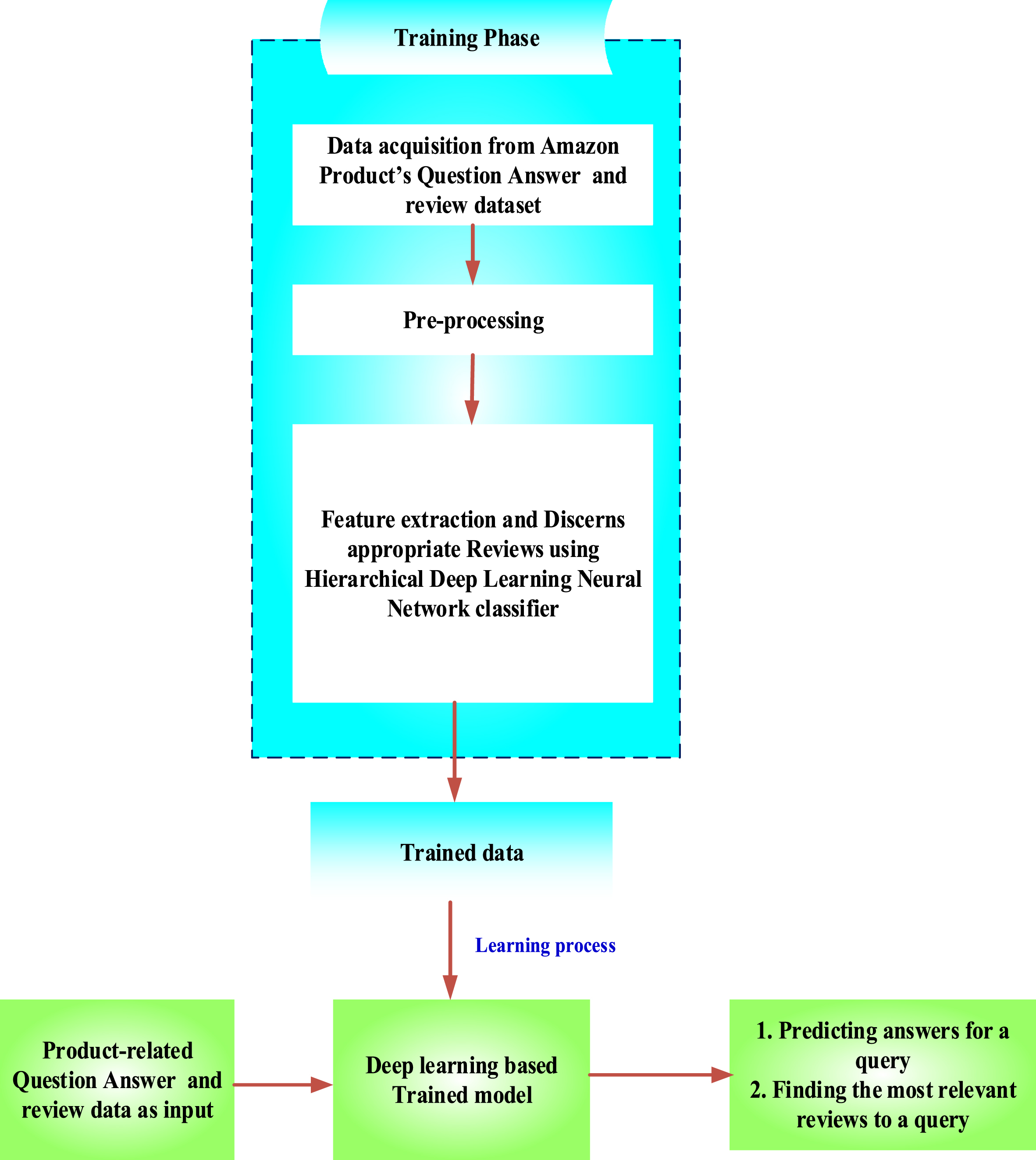
Overall work flow for discerning the most appropriate Reviews for answering the product related queries.
For data acquisition, the data from Amazon.com, which contain products, Question with answer (Q/A) data and reviews are obtained [28]. For training data, different categories of products and its review and Q/A data are taken and it is represented in Table 1.
Dataset statistics
Dataset statistics
In this step, pre-processing is done in sentence of product Question with answer (Q/A) data and reviews. Because the sentence of product Question with answer (Q/A) data and reviews, may contain acronyms, emojis (symbolic that online product user’s feel expression) and spelling mistake. In this research work, dictionaries such as Acronym Dictionary and Emojis Dictionary are used for preprocessing the sentence of product Question with answer (Q/A) data and reviews. The Acronym Dictionary is taken from online resources and it is used for restoring the acronym in sentences of product Question with answer (Q/A) data and reviews. For example, the acronym word “msg” is replaced with “message”. Then the Emojis Dictionary contains 3000 Emojis that are recorded on Wikipedia with their emotional circumstance. Then the remaining sentence of Question with answer (Q/A) data and reviews is preprocessed as follows: Initially convert the words of Question with answer (Q/A) data and reviews into lower case. WordNet is used to verify whether the words of Question with answer (Q/A) data and reviews are an English word or not. If it is an English word then it is denoted as “EN” or else it denoted as “NEN” for non-English words. Eliminate the words of Question with answer (Q/A) data and reviews are not in English. Then restore the Emojis with the help of Emojis Dictionary. Then the series of repeated characters in the Question with answer (Q/A) data and reviews words are replaced by one character. For example, the word “lottttttttssssssss” as replaced into “lots”.
Features in review sentences
In this step, the substantial features present under pre-processed review sentences are elucidated. At pre-processing review sentences content, it has significant characteristics such as part of speech (POS) feature and judgment Question with answer (Q/A) data and reviews words/phrases.
Part of speech (POS) feature
In the part of speech (POS) feature, it consists of trivial Question with answer (Q/A) data and reviews words that are allocated for sharing opinion about the product.
Judgment Question with answer (Q/A) data and reviews words/phrases feature
In the judgment Question with answer (Q/A) data and reviews words/phrases, it contains Question with answer (Q/A) data and reviews words that are generally used for expressing the product opinions involves words “good or bad” and “like or hate”.
Feature extraction and ranking method based on hierarchical deep neural network
(HiDeNN) using mixtures of opinions for question answering (MOQA) framework
In this segment, Feature extraction and ranking method based on Hierarchical Deep Neural Network (HiDeNN) classifier using MOQA framework is discussed to discern that most appropriate Reviews for answering the product. Hierarchical Deep Neural Network (HiDeNN) classifier consists of input layer, Hierarchical Deep Neural Network, solution layer, operation layer and loss function [20] and it is given in Fig. 2.
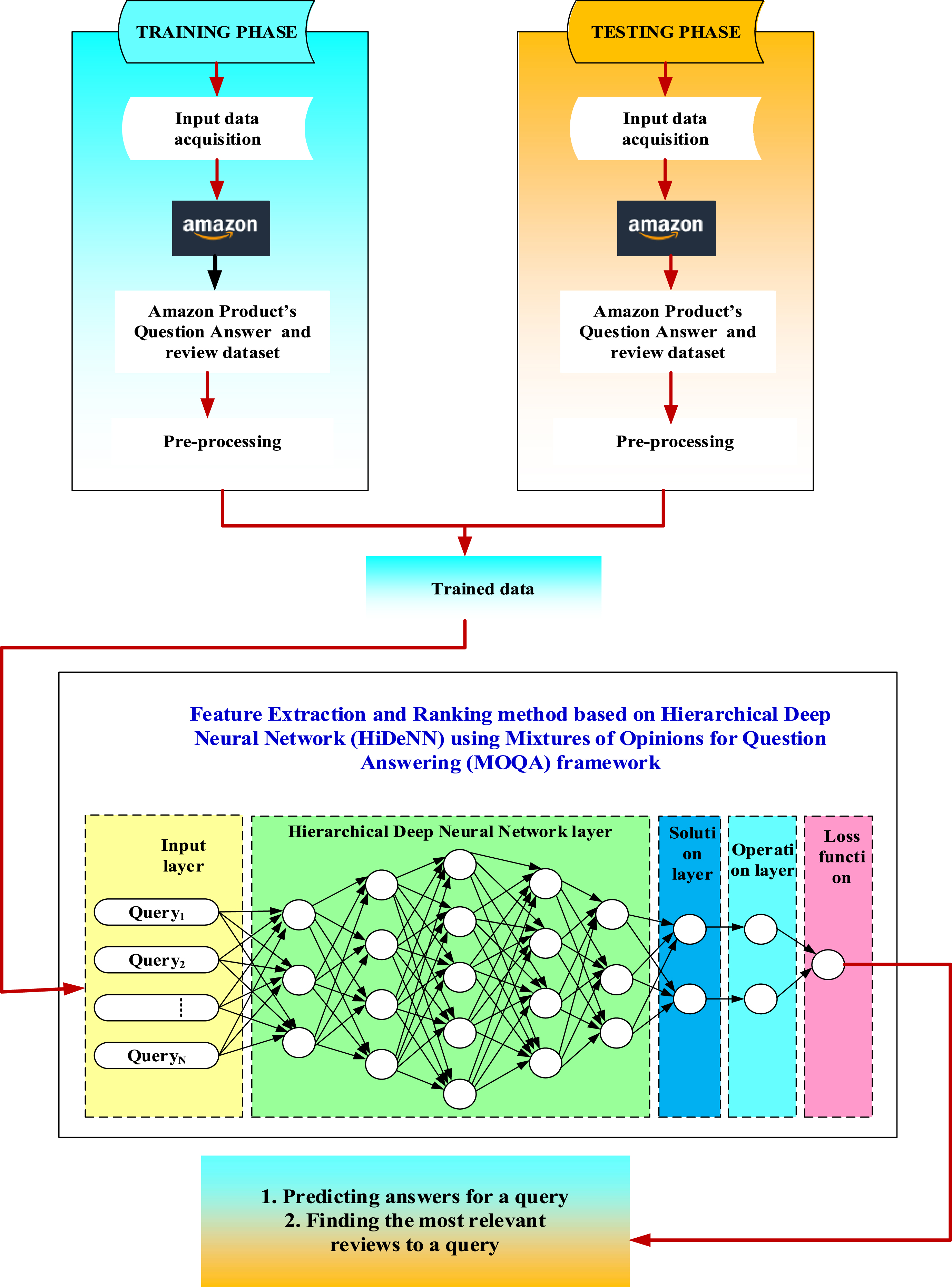
Proposed Method for discerning relevant reviews for answering product related queries.
Initially, input layers of HiDeNN classifier will take the product reviews. The input layer consists of set of neurons that are used for pre-processing functions. Generally, the Hierarchical Deep Neural Network (HiDeNN) classifier using Mixtures of Opinions for Question Answering (MOQA) framework, uses sentence of review instead of full review. When many reviews based on product query are entering into the system there may cause computational overhead. In order to reduce the computational overhead, dimensionally invariant Deep network (Dimension Net) is embedded on HiDeNN, which reduces that dimensionality of original input datas. Here the dimensionally invariant Deep network (Dimension Net) takes typical sentence embeddings processes and it is done in answer word and query words. It also optimizes the Equation (3) which provides the score value for
Hierarchical deep neural network layer
The output of input layers of HiDeNN classifier is given as input to the Hierarchical Deep Neural Networks layer. It consists of PHY-NN (physics based data for neural network) and EXP-NN (Experimental based data for neural network) which is incorpated with sub neural networks. In Hierarchical Deep Neural Network layer, the PHY-NN is assigned for encoding the score value for
This PHY-NN of Hierarchical Deep Neural Network layer is mainly used for analyzing the similarity of all token between the queries and review and it also divides the sentence of queries and reviews into pieces of words. So that, Softmax operation of Hierarchical Deep Neural Network can be easily done in score value of
In the solution layer, it is incorporated with chi-square feature extraction process, which employs for recognizing whether there is perceptible disparity between predictable features and trial distinctiveness under one or more reviews. The formula for chi-square feature extraction process is given in Equation (8).
Where TS denotes total number of review sentences used in the training. F11 denotes number of co-occurrences of the feature and the review sentences. F00 is the number of review sentences not in queries and that do not contain feature. F10 is the number of review sentences containing the feature but they are not in queries. F01 is the number of sentences in queries that do not contain feature. By this features are selected and it is given for training the classifier, which discovers appropriate reviews for answering product related queries.
Generally, the operation layer of Hierarchical Deep Neural Network (HiDeNN) classifier is pre-trained with (ANSWER, QUERY) pair to check whether the answer is correct or not. For that, Term Frequency-Inverse Document Frequency (TF-IDF) is incorpated in operation layer. It checks how often the words are frequently present in the product related answers. The operation layer mainly used for pre-ranking the product related reviews for every product queries and deemed only Top 10 reviews for this research work. Here the operation layer of HiDeNN classifier is pre-trained with (ANSWER, QUERY) pair but it is used (REVIEW, QUERY) pair.
Normally, the language disparity will happen in queries and reviews, for that operation layer of Hierarchical Deep Neural Network (HiDeNN) classifier have capability to support word-based relevance function. To check the language disparity problem in queries and reviews, in this research work, word-level Jaccard similarity among every product related queries and the most relevant review are ranked done with the help of MOQA framework and Hierarchical Deep Neural Network (HiDeNN) classifier across every product categories. By this, language mismatch can be overcome. The word-level Jaccard similarity (JSI) may be described using Equation (9).
In this research work, word-level Jaccard similarity (JSI) shows as 0.835, which has less word-based relevance operation - product reviews.
Final operation in Hierarchical Deep Neural Network (HiDeNN) classifier is loss function. In this research work, more product categories are used for training. Some product categories has same question regarding their size, cost, weight etc. For tackling this problem, loss function is used which labels this kinds of question during training process and denoted as label LF. Finally, the loss function discerns the most relevant review for queries and it also provides the relevant answer for specific product category queries and it can be checked with the evaluation metric like AUC. The AUC may be described using Equation (10).
Where Z* denotes randomly selected non-answer, Z denotes non-answer set and RA denotes real answer.
In this segment, experimental result is discussed for discerning appropriate Reviews based on Hierarchical Deep Neural Network for Answering Product-related Queries. The simulations are performed PC using 2.50 GHz CPU, Intel Core i5, 8GB RAM and Windows 7. The proposed discerning appropriate Reviews based on Hierarchical Deep Neural Network for Answering Product-related Queries is imitated with Python. Here, the assessment metrics such as, accuracy, precision, recall, F1-score, Mathew’s correlation co-efficient, and AUC are analyzed. Then the proposed discerning appropriate Reviews based on Hierarchical Deep Neural Network for Answering Product-related Queries (MOQA- HiDeNN) is analyzed and it was compared with the existing algorithm like Neural Networks Question Answering model with Pre-Training (NNQA+PT) is applied to all the existing data and then fine tuning is applied for every product categories, Bidirectional Encoder Representation from Transformer model for Question Answering with filter (BERTQA+FLTR), Bidirectional Encoder Representation from Transformer model for Question Answering with filter is pre-trained(MOQA-BERTQA+FLTR+PT) [22] is applied to utilize the top 10 most relevant reviews, IQA: Interactive Query Construction on Semantic Question Answering Systems (IQC-SQA) [23].
Dataset description
In this experiment, the data are collected from Amazon.com, which contain products, Question with answer (Q/A) data and reviews [28]. For training data, different categories of products and its review and Q/A data are taken and it is given in Table 1. In this dataset, approximately 6, 24,715 Q/A data on 1, 61,974 products and its corresponding 5,64,845 customer review. Here 15 categories of product and its Question with answer (Q/A) data and reviews are taken for both training and testing. For training, 50% of data are taken remaining 50% data are used for testing purposes. Here, the HiDeNN classifier using Mixtures of Opinions for Question Answering (MOQA) framework, it uses sentence of review instead of full review. For Hierarchical Deep Neural Network (HiDeNN) classifier, for total number of reviews is set to 100 and remaining reviews are eliminated.
Performance measures
In this section, the performance measures needed for experiment are discussed. For best classifier selection, evaluation metrics play an important role. To authenticate the performance, the most common performance measures for discerning appropriate Reviews, Accuracy, F-score, Precision, Recall, MCC are used. True Positive (TP): Discerning appropriate Reviews properly recognized into discerning appropriate Reviews. True Negative (TN): Non- discerning appropriate Reviews properly recognized into Non- discerning appropriate Reviews. False Positive (FP): Non- discerning appropriate Reviews imperfectly recognized into Discerning appropriate Reviews. False Negative (FN): Discerning appropriate Reviews imperfectly recognized into Non- discerning appropriate Reviews.
Precision
Precision for Discerning appropriate Reviews can be calculated with the help of Equation (11).
Recall for Discerning appropriate Reviews can be calculated with the help of Equation (12).
F1 Score for Discerning appropriate Reviews can be calculated with the help of Equation (13).
Accuracy for Discerning appropriate Reviews can be calculated with the help of Equation (14).
The Matthews’s correlation coefficient (MCC) for Discerning appropriate Reviews is calculated with the help of Equation (15).
Table 2 shows the Accuracy value for Discerning appropriate Reviews for answering product related queries using different methods. Here the proposed MOQA-HiDeNN method provides average accuracy as 0.9535 for discovering appropriate reviews. The top ranked reviews by proposed MOQA-HiDeNN method for some product category with alike meaning are given in Table 3.
Accuracy value for discerning appropriate reviews for answering product related queries using different methods
Accuracy value for discerning appropriate reviews for answering product related queries using different methods
Top ranked reviews by proposed MOQA-HiDeNN method with similar meanings
Figure 3(a), 3(b), 3(c) Performance of the accuracy, precision and recall factors are analyzed for the different sample size i.e. 1000, 10000, and 100000. It is evident that the result of the proposed MOQA with HiDeNN shows better performance than the existing MOQA-BERTQA+FLTR+PT and IQC-SQA method.
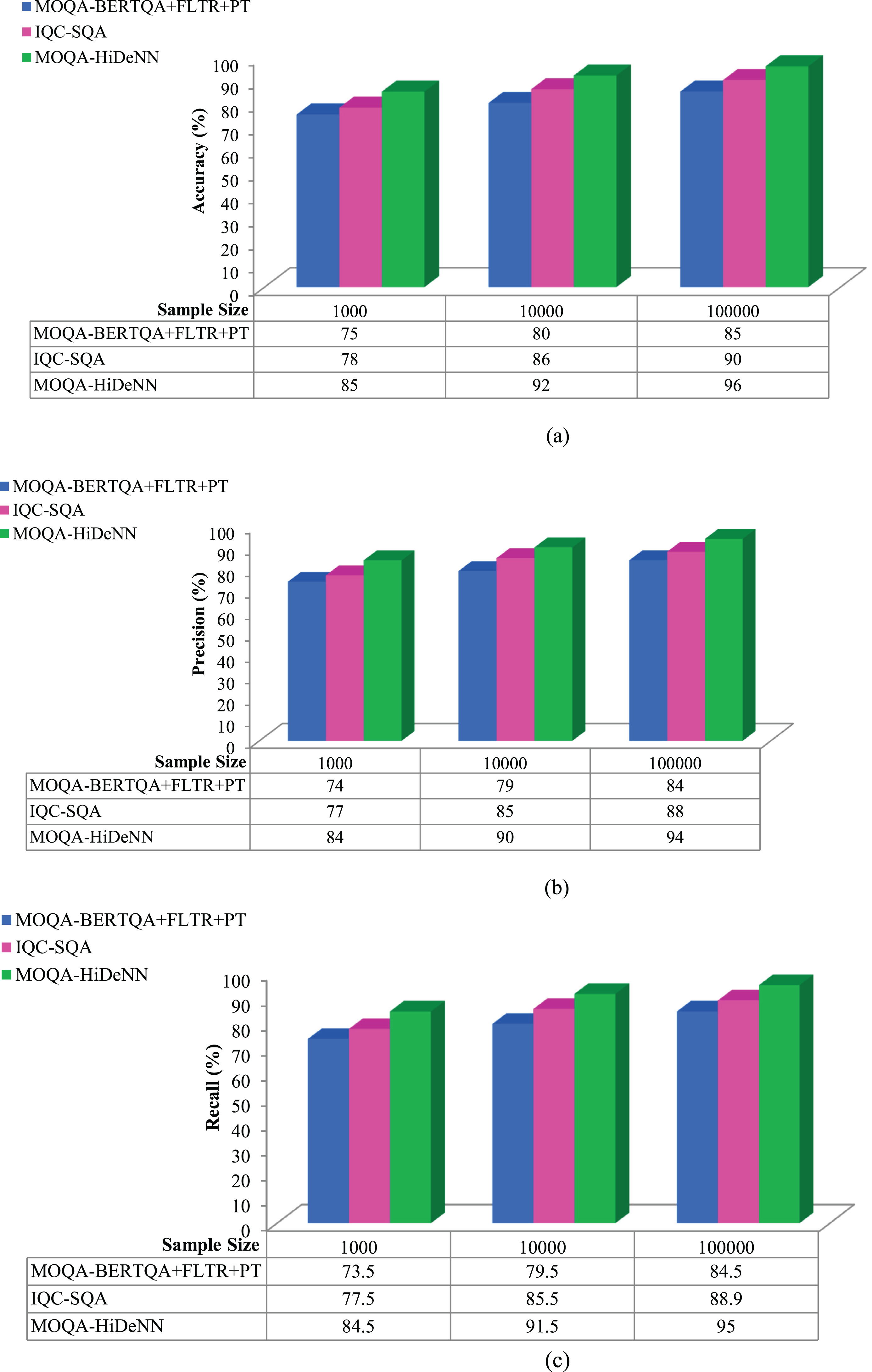
Performance Analysis of Accuracy (%). (b). Performance Analysis of Precision (%). (c). Performance Analysis of Recall (%).
Figure 4(a) shows the Accuracy, Precision and Recall Performance analysis for Discerning appropriate Reviews for answering product related queries using different methods. The proposed MOQA-HiDeNN provides higher accuracy value of 0.94, high Precision value of 0.92, high recall of 0.91 when compared with the existing methods such as NNQA+PT, BERTQA+FLTR, MOQA-BERTQA+FLTR+PT, IQC-SQA.
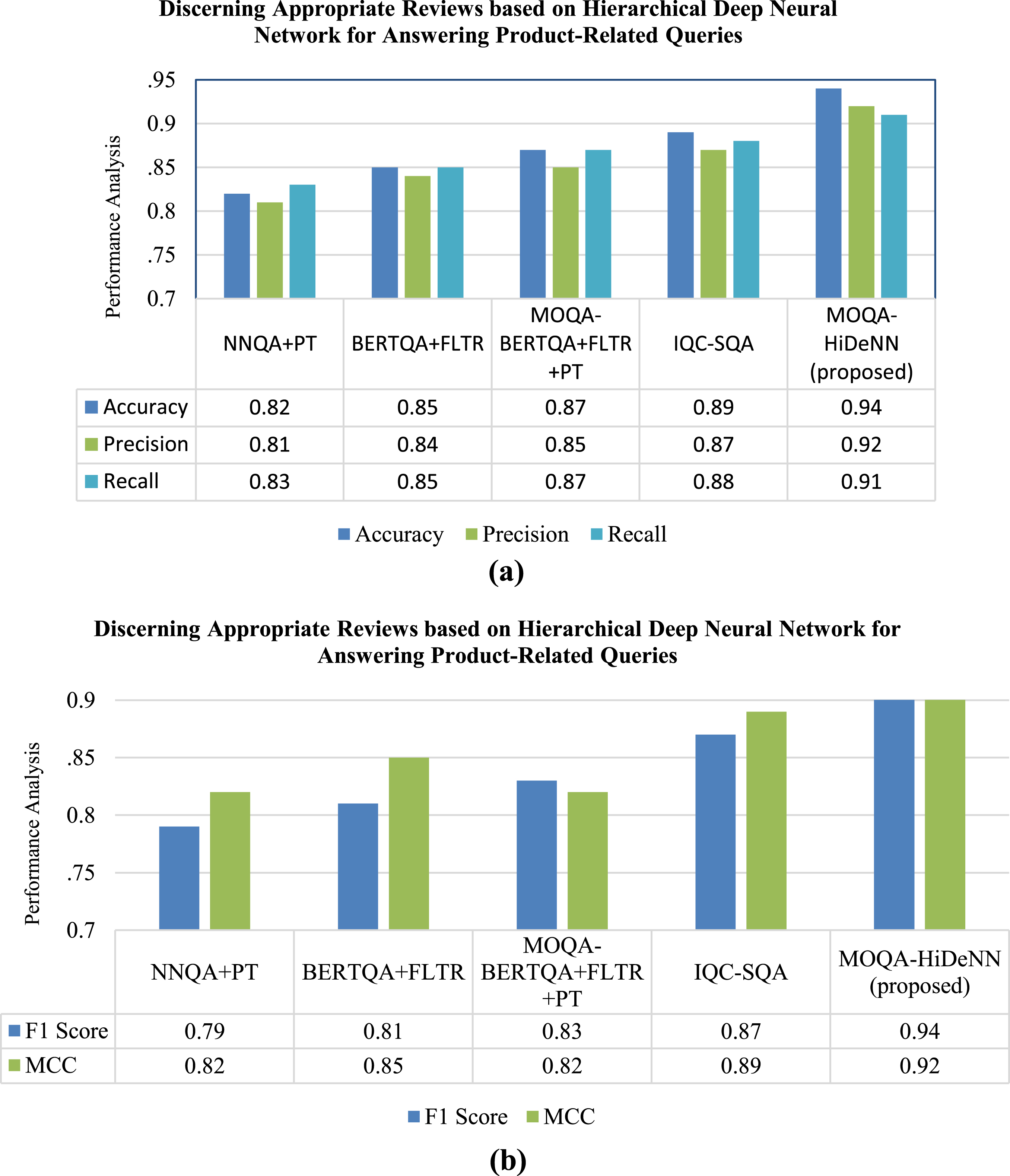
Accuracy, Precision and Recall Performance analysis. (b) F1-Score and MCC Performance analysis.
Figure 4(b) shows the F1-Score and MCC Performance analysis for Discerning appropriate Reviews for answering product related queries using different methods. For F1-Score analysis, the proposed MOQA-HiDeNN provides higher value of 0.94. For Matthews’s correlation coefficient (MCC) analysis, the proposed MOQA-HiDeNN provides 0.92 when compared with the existing method like NNQA+PT, BERTQA+FLTR, MOQA-BERTQA+FLTR+PT, IQC-SQA.
For further analysis, two models MOQA-BERTQA+FLTR+PT, IQC-SQA are considered as the base line model as it performs better and compared with the proposed MOQA-HiDeNN model. Table 4 shows the AUC value for Discerning appropriate Reviews for answering product related queries using different methods. Here the proposed MOQA-HiDeNN method provides average AUC value as 0.9845 for discovering appropriate reviews.
AUC value for discerning appropriate reviews for answering product related queries using different methods
Figure 5 shows the ROC curve analysis for Discerning appropriate Reviews for answering product related queries using different methods. For AUC analysis, the proposed MOQA-HiDeNN provides 8.056% and 6.593% higher AUC value compared with the existing method like MOQA-BERTQA+FLTR+PT and IQC-SQA respectively.
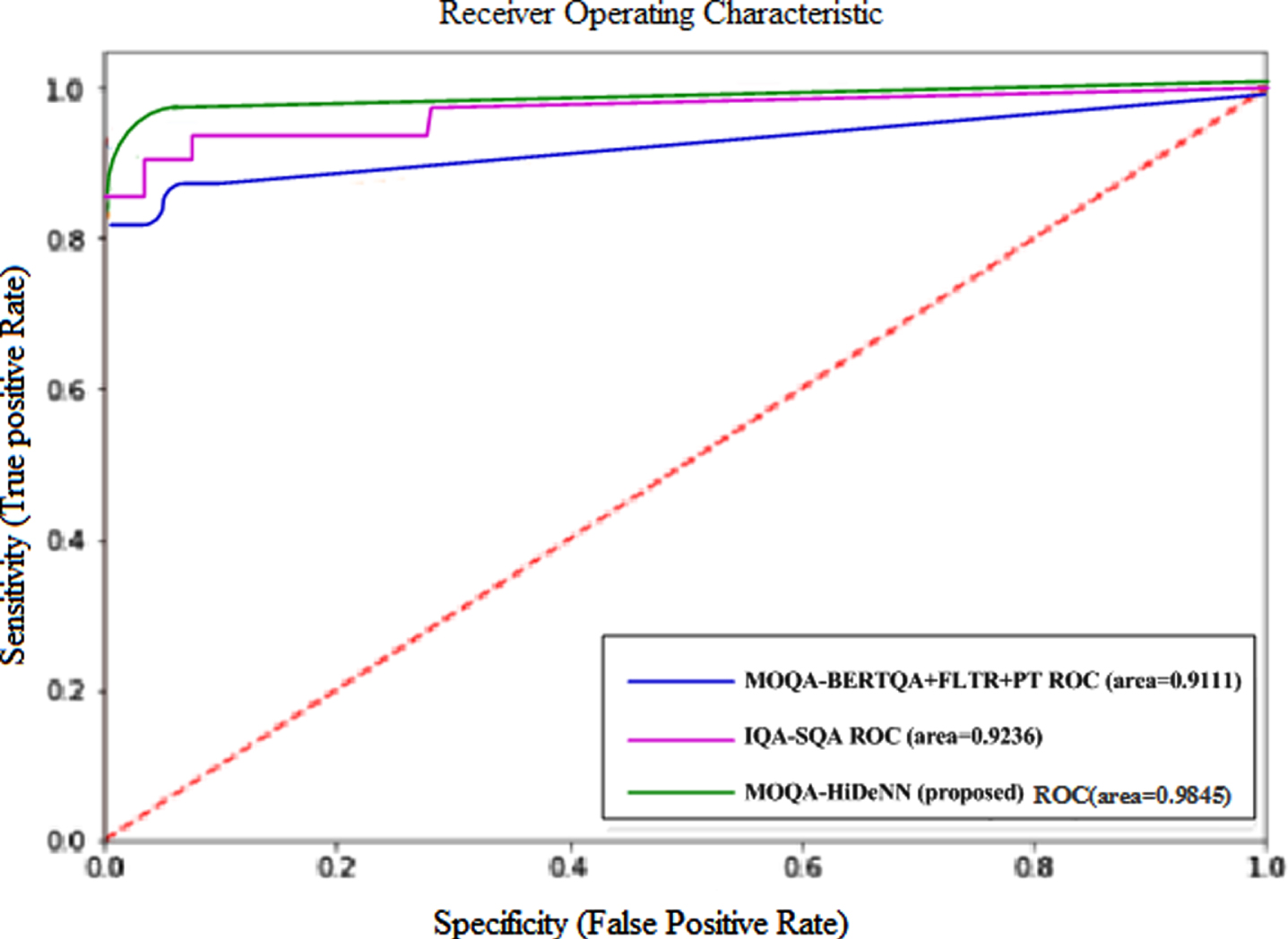
ROC Curve analysis.
Figure 6 shows the Execution time for Discerning appropriate Reviews for answering product related queries using different methods. In toys game product category, the proposed MOQA-HiDeNN provides 78.2609% and 76.9231% lower execution time compared with the existing method like MOQA-BERTQA+FLTR+PT and IQC-SQA respectively. For Arts, crafts, sewing product category, the proposed MOQA-HiDeNN provides 63.636% and 60% lower execution time compared with the existing method like MOQA-BERTQA+FLTR+PT and IQC-SQA respectively. For Tools, home improvement product category, the proposed MOQA-HiDeNN provides 72.5806% and 71.186% lower execution time compared with the existing method like MOQA-BERTQA+FLTR+PT and IQC-SQA respectively. For Automotive product category of Fig. 6, the proposed MOQA-HiDeNN provides 72.46% and 71.186% lower execution time compared with the existing method like MOQA-BERTQA+FLTR+PT and IQC-SQA respectively. For Sports, outdoors product category, the proposed MOQA-HiDeNN provides 86.8421% and 85.71% lower execution time compared with the existing method like MOQA-BERTQA+FLTR+PT and IQC-SQA respectively. For Baby product category, the proposed MOQA-HiDeNN provides 90.16% and 89.06% lower execution time compared with the existing method like MOQA-BERTQA+FLTR+PT and IQC-SQA respectively. For Cell phones, accessories product category, the proposed MOQA-HiDeNN provides 80.88% and 77.193% lower execution time compared with the existing method like MOQA-BERTQA+FLTR+PT and IQC-SQA respectively.
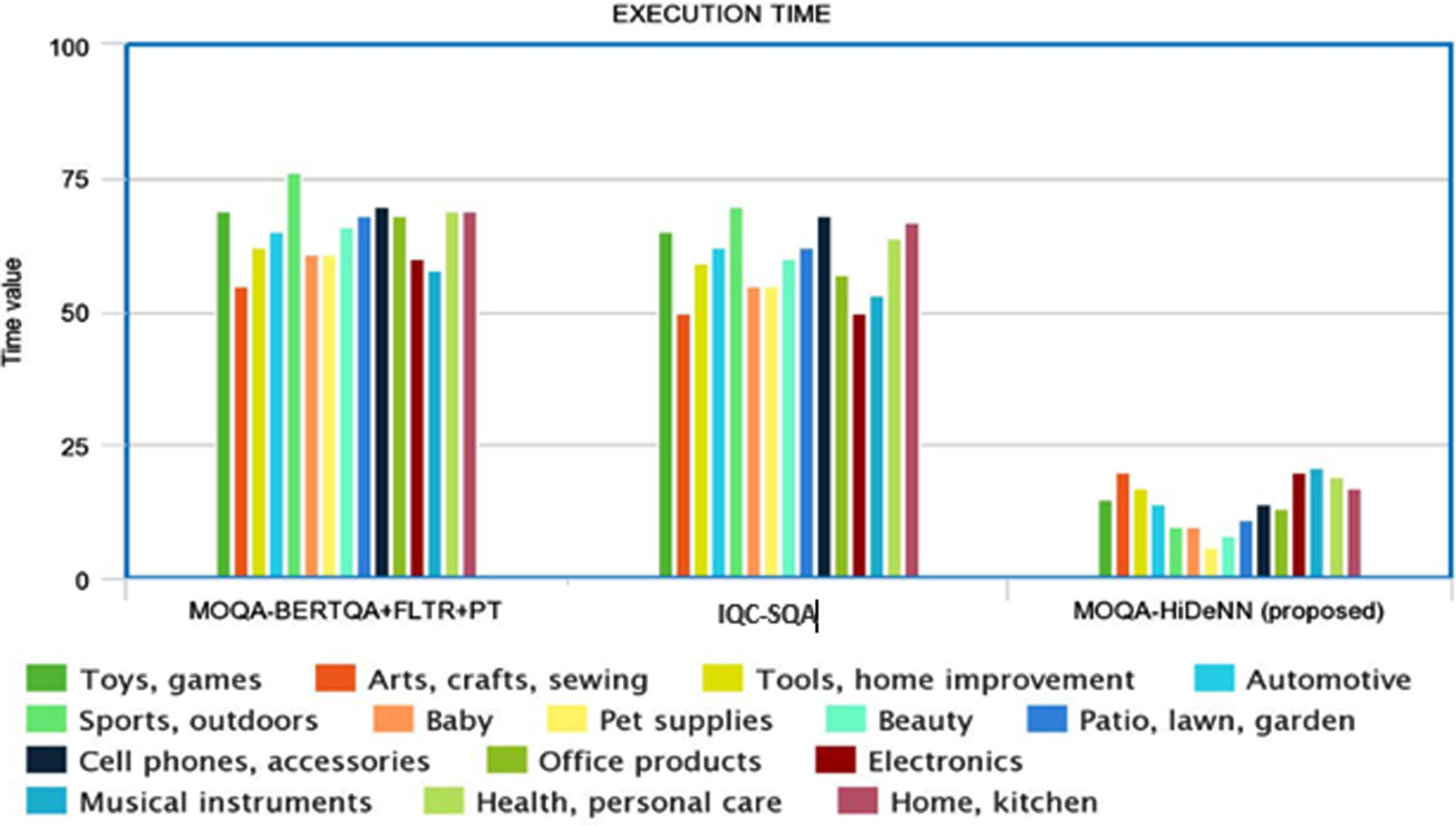
Execution Time IQC-SQA.
For Office products category in Fig. 6, the proposed MOQA-HiDeNN provides 66.667% and 60% lower execution time compared with the existing method like MOQA-BERTQA+FLTR+PT and IQC-SQA respectively. For Musical instruments product category, the proposed MOQA-HiDeNN provides 72.46% and 70.31% lower execution time compared with the existing method like MOQA-BERTQA+FLTR+PT and IQC-SQA respectively. For Home, kitchen product category, the proposed MOQA-HiDeNN provides 77.27% and 73.214% lower execution time compared with the existing method like MOQA-BERTQA+FLTR+PT and IQC-SQA respectively.
After the comparison analysis of the existing methods to the proposed work, it is obvious that the proposed MOQA-HiDeNN outperforms well. To conclude this section, the Hierarchical Deep Neural Network provides appropriate discerning of most relevant review for queries and it also provides the relevant answer for specific product category queries.
In this work, discerning the appropriate reviews based on Mixtures of Opinions for Question Answering framework with Hierarchical Deep Neural Network (MOQA- HiDeNN) is successfully implemented for Answering Product-Related Queries, which also provides the relevant answer for specific product category queries. Then the proposed model is performed in python and the performance of proposed MOQA- HiDeNN method provide 8.056% and 6.593% higher AUC value for Discerning Appropriate Reviews compared with the existing method like Discovering Relevant Reviews for Answering Product-related Queries (MOQA-BERTQA+FLTR+PT) and IQA: Interactive Query Construction in Semantic Question Answering Systems (IQC-SQA). Consequently, the outcome indicates that the proposed MOQA- HiDeNN method effectively discovers the relevant review for answering product related queries with less computation time and reduces the complexity of the system. Then the proposed model is performed on Python and the performance of proposed method is evaluated with assessment metrics as Accuracy, Precision, Recall, F1-score, AUC and Mathew’s correlation co-efficient.