Bonferroni means (BM) operator is the extended form of the arithmetic mean operator, used for simplifying non-dominant and non-feasible problems diagnosed in genuine life scenarios. A lot of aggregation operators are the specific parts of the BM operators under the consideration of different values of parameters which are the main parts of the BM operators. In the presence of the BM operator and a very well-known conception in the scenario of fuzzy set, called complex Pythagorean fuzzy (CPF) setting, the objective of this scenario is to diagnose the CPF power BM (CPFPBM) operator and utilize their beneficial results with important properties. Moreover, a multi-attribute decision-making (MADM) technique is evaluated in the presence of invented operators for CPF settings. In the last of this study, we diagnosed the superiority and efficiency of the invented works with the help of sensitive analysis and graphical illustrations to enhance the gap of the research works.
Decision-making strategy is a continuing technique that includes developing strategies to obtain themes and finding strategies under the consideration of given beneficial optimal. We all agreed that the MADM technique is the beneficial and dominant part of the decision-making strategy has used for determining the beneficial optimal from a lot of optimums. A huge number of implementations have been diagnosed in different places, but firstly Zadeh [1] employed the MADM technique in the region of fuzzy set (FS) theory. Further, the intuitionistic FS (IFS) was another form of achievement in FS theory, which was diagnosed by Atanassov [2]. The good looking of IFS is that they have includes the truth grade (TG) and falsity grade (FG) with some new strategy . Several implementations have been done by distinct individuals, likewise, [3] covers the conception of bipolar soft sets, [4] covers the conception of interval-valued IFSs, [5] covers the conception of measures in the presence of IFSs, [6] covers the conception of MADM technique in the presence of IFSs, [7] covers the conception of type-2 IFS, [8] covers the conception of GIS-IFS, [9] covers the conception of the three-way decision in the presence of IFSs, and [10] covers the conception of bipolar intuitionistic fuzzy softs sets.
After the development of an idea, they have gotten a lot of favor in the shape of utilization in distinct regions, but after time by time, all fields have improved by some specific intellectuals. They have diagnosed some limitations in the existing theory and tried to modify it. A similar situation was done with IFS because someone find the conception of IFS enable to handle such sort of data, whose sum cross the unit interval i.e., . Such a problematic scenario faced in some difficult situations, Yager [11] put forward the solution of the above problematic situation in the shape of the development of the Pythagorean FS (PFS) in 2013. The mathematical model , is the important part of the PFS. To employ the MADM technique in the region of PFS isn’t awkward, a lot of utilization have illustrated here, for example in [12] covers the conception of interval-valued PFSs, in [13] covers the conception of the ORESTE method in the presence of PFSs, in [14] covers the conception of Pythagorean m-polar FSs, in [15] covers the conception of Pythagorean m-polar fuzzy soft sets, and in [16] covers the conception of measures in the Ramot et al. [17] diagnosed the different form of FS, called the complex FS (CFS), which includes the TG in the shape of , whose real and unreal parts lies between unit interval. Several applications of CFS have been diagnosed, for instance in [18] contains the interval-valued CFSs, in [19] contains the complex multi-fuzzy sets, in [20] contains the complex fuzzy soft sets, in [21] contains the interval-valued complex fuzzy soft sets, in [22] contains the complex multi-fuzzy soft expert sets, and in [23] contains the complex multi-fuzzy soft expert set. Complexity is part of a genuine life scenario, which occurred in several decision-making processes, for illustration, sometimes we faced two-dimension data and each dimension includes two different terms which expressed the behavior of the function. To control such a difficult scenario, the conception of complex IFS (CIFS) is massive necessary which was invented by Alkouri and Salleh [24]. The mathematical useful part of the CIFS is stated: , for the real and unreal part, where and , dominated as TG and FG. To employ the MADM technique in the region of CIFS isn’t awkward, a lot of utilization have illustrated here, for example in, information measures invented in [25], correlation coefficient invented in [26], geometric aggregation operators invented in [27], robust aggregation operators invented in [28], generalized aggregation operators invented in [29], power aggregation operators invented in [30] in the presence of CIFSs, and complex intuitionistic fuzzy relations invented in [31].
We have an idea that the conception of CIFS is one of the massive dominant and consistent techniques which handle complex and problematic data which exists in genuine-life scenarios, but not in all situations especially in those cases when an expert determined or faced data in the shape if we have gotten the value from outside the unit disc, which we obtained from the sum of the real parts (also for unreal parts) of the pairs. Such sort of scenario is part of genuine life troubles, for this, the conception of complex PFS (CPFS), elaborated by Ullah et al. [32]. In the presence of the previous two-term are called TG and FG , we have gotten and . Several implementations have been done by distinct individuals, likewise, Einstein geometric aggregation operators exposed in [33], decision-making strategy for CPFSs exposed in [34, 35], complex Pythagorean Dombi fuzzy operators exposed in [36], and prioritized weighted aggregation operators exposed in [37]. Ambiguity and vague are involved in every decision-making procedure under the consideration of several strategies:
Under the presence of appropriate measures arranged the data.
Under the presence of some operators gotten the beneficial optimal from a large number of attributes.
Under the presence of the aggregated values is to determine the beneficial optimal.
In the presence of the above illustration, the foremost influence of this scenario is to employ the MADM technique under the consideration of power BM for CPF settings, several advantages of the CPF setting are diagnosed here:
In the presence of , in the CPF setting, then we pick the FS.
In the presence of , in the CPF setting, then we pick the CFS.
In the presence of , in the CPF setting, then we pick the IFS.
In the presence of with and , in the CPF setting, then we pick the PFS.
In the presence of and , in the CPF setting, then we pick the CIFS. The geometric form of the invented works is implemented in the presence of Fig. 1.
Geometrical form of invented works.
CPF data is very well-known and most dominant due to several techniques includes in the shape: and . They have a lot of usage in genuine life troubles, for simplicity, we try to explain the significance of the two-dimension data which occurred in the shape of a singleton term. If the president of ABC Prof. Dr. HHA planned to implement the biometric system for teacher attendance devices (BSTAD) in all offices of the teachers and for the attending of administrations in the admin. The attending device enterprises provide data in the shape: (i) model of the BSTAD and (ii) production dates of BSTAD. The university experts have selected the latest and well-known verity device for usage in university. Here the model has stated the real part and the production date is stated as the unreal part in the complex number. For IFSs, PFSs, and CIFSs are very awkward to handle such sort of scenario. For handling such problematic and intricate situations, the conception of the CPF set is massively useful to investigate genuine life troubles. Moreover, the BM operator is the extended form of the arithmetic mean operator, used for simplifying non-dominant and non-feasible problems diagnosed in genuine life scenarios. A lot of aggregation operators are the specific parts of the BM operators under the consideration of different values of parameters which are the main parts of the BM operators. In the presence of the BM operator and a very well-known conception in the scenario of fuzzy set, called CPF setting, the objective of this scenario is to diagnose below:
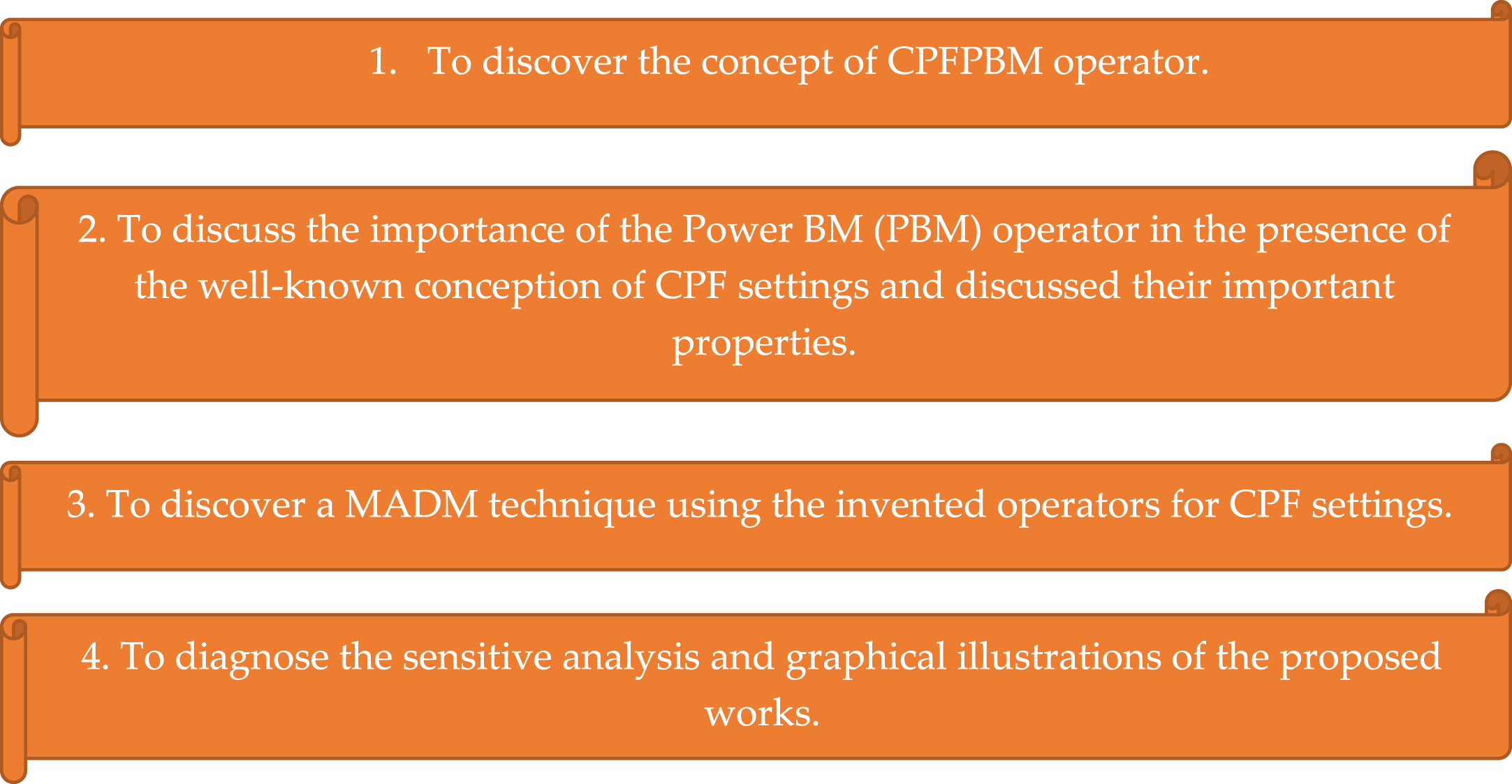
To discover the very well-known theory, called CPFPBM operator.
To discuss the importance of the Power BM (PBM) operator in the presence of the well-known conception of CPF settings and discuss their important properties.
To discover a MADM technique in the presence of invented operators for CPF settings.
To diagnose the superiority and efficiency of the invented works with the help of sensitivity analysis and graphical illustrations to enhance the gap of the research works.
The organized shape of the article is illustrated here: Section 2 covers the revised version of the existing CPFSs, algebraic laws, and the original form of the PBM operator. Section 3 discovered the CPFPBM operator and considered their significant results. In section 4, a multi-attribute decision-making (MADM) technique is evaluated in the presence of invented operators for CPF settings. In section 5, we diagnosed the superiority and efficiency of the invented works with the help of sensitivity analysis and graphical illustrations to enhance the gap of the research works. The conclusion is stated in Section 6.
Preliminaries
This scenario stated that the mathematical shown and , expressed the universal set, TG and FG. Further, some prevailing scenarios like CPFS, algebraic laws, and PBM operator, revised here.
Definition 1. [32] A CPFS ΞCP is elaborated by:
where and , stated the TG and FG with regulations such as and . Further, the term , stated the refusal degree. In all studies, the CPFN is elaborated by: , .
Definition 2. [32] Suppose , , be any two CPFNs. Then
Definition 3. [32] Suppose , , be any CPFN. Then the Score value (SV) and accuracy value (AV) is elaborated by:
where and .
Definition 4. [32] Suppose , , be any CPFN. Then, by using Equations (6) and (7), we determine the order among any number of objects under the following rules:
When ;
When ;
When
When ;
When ;
When .
Definition 5. [38] Suppose , be the group of non-negative integers, then the PBM operator is presented by:
If d (ΞCP-i, ΞCP-k) ⩾ d (ΞCP-l, ΞCP-m), then Sup (ΞCP-i, ΞCP-k) ⩽ Sup (ΞCP-l, ΞCP-m).
PBM operators under CPFSs
In the presence of the BM operator and a very well-known conception in the scenario of fuzzy set, called CPF setting, the objective of this scenario is to diagnose the CPFPBM operator and utilize their beneficial results with important properties.
Definition 6. Suppose , be the group of CPFNs, then the CPFPBM operator is presented by:
If d (ΞCP-i, ΞCP-k) ⩾ d (ΞCP-l, ΞCP-m), then Sup (ΞCP-i, ΞCP-k) ⩽ Sup (ΞCP-l, ΞCP-m).
Theorem 1.Suppose , be the group of CPFNs, then by using the Equation (10), we determine
Proof. Suppose
and
then
thus,
Additionally, under Equation (12), we determine the idempotency, permutation invariability, and boundedness to improve the flexibility and efficiency of the presented works.
Property 1.Suppose, be the group of CPFNs. If, then
Proof.
Property 2.Suppose, be the group of CPFNs. Ifis a permutation and combination of, then
Proof.
Property 3.Suppose, be the group of CPFNs. If, then
Proof.
and
From the above analysis, we determine
MADM procedure
Decision-making strategy is a continuing technique that includes developing strategies to obtain themes and finding strategies under the consideration of given beneficial optimal. We all agreed that the MADM technique is the beneficial and dominant part of the decision-making strategy has used for determining the beneficial optimal from a lot of optimums. Further, the complexity involved in several life dilemmas, to find their solution with the help of the MADM procedure, we recommended some alternatives ΞAL-1, ΞAL-2, …, ΞAL-m and the mathematical terms ΞAT-1, ΞAT-2, …, ΞAT-n, stated the attributes. In the presence of the above items, we exposed the matrix with terms in the shape of CPF numbers likewise: , under the circumstances and , with and . To explain the usage and importance of the MADM scenario, a lot of individuals have described the MADM technique in the scenario of distinct regions.
Decision-making processes
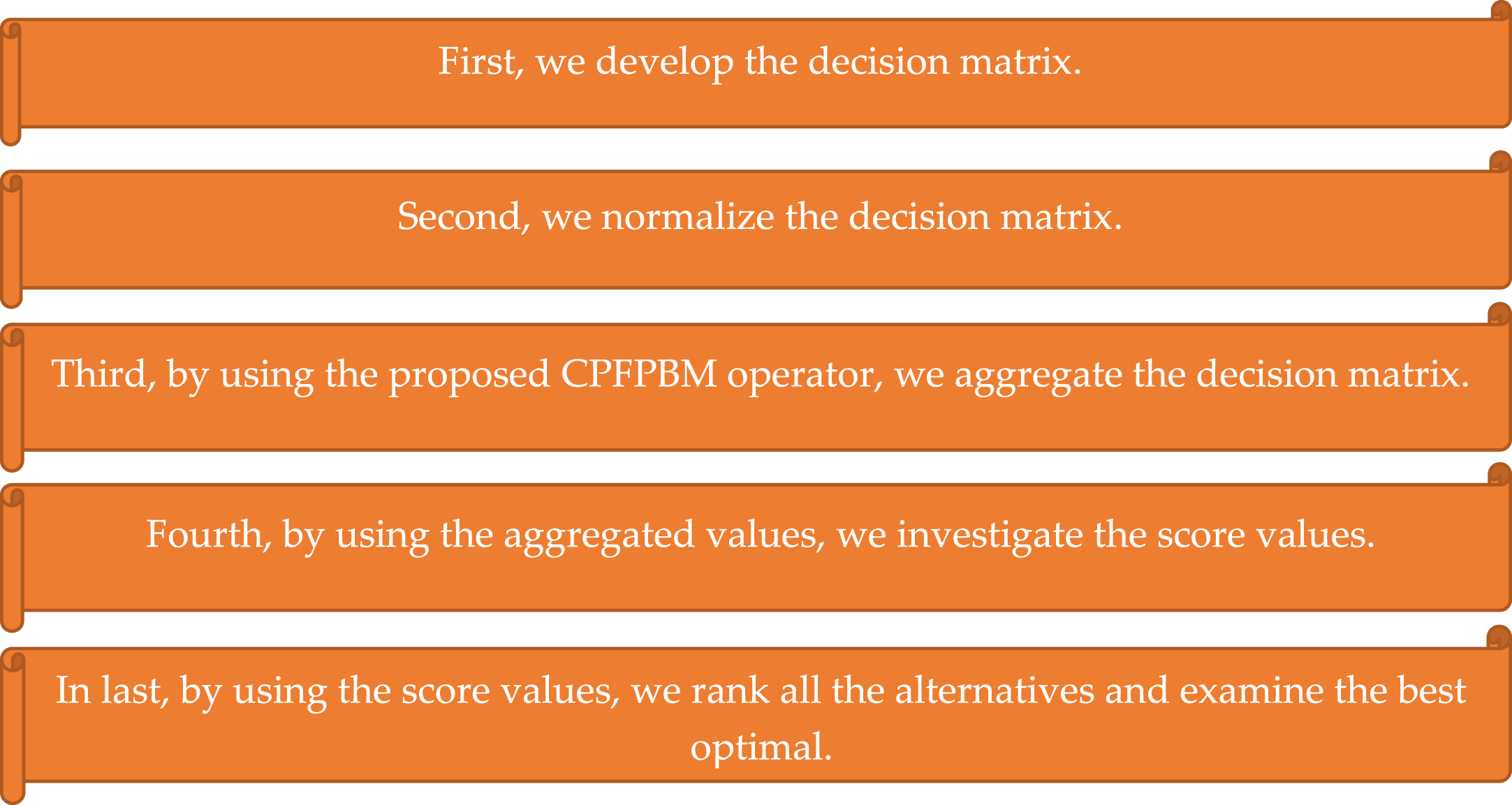
The major procedure of the MADM technique in this scenario are diagnosed with the help of the following stages:
Stage 1: In the presence of the CPF numbers , we exposed the matrix, which includes two sorts of data like benefit or cost sorts, if an expert includes the benefit types, then no issues, but if an expert suggested cost types, then homogenize the data in the presence of Equation (53), such that
Stage 2: With the presence of the CPFPBM operator (Equation 12), cumulative the matrix.
Stage 3: With the presence of aggregated values, demonstrated the SVs.
Stage 4: In the presence of the SVs, find the beneficial optimal from the large numbers of alternatives.
In the existence of the above algorithm their geometrical expressions are diagnosed here, geometrical form of the invented works is implemented in the presence of Fig. 2.
Geometrical form of invented works.
Practical illustrations
Here, we demonstrated the supremacy and effectiveness of the elaborated works under the presence of CPF settings. Several examples and their sensitivity analysis are diagnosed here.
Example 1. The mathematical five terms ΞAL-1, ΞAL-2, ΞAL-3, ΞAL-4, ΞAL-4 and four terms ΞAT-1: enterprise executive rank, ΞAT-2: financial benefit, ΞAT-3: development capability, and ΞAT-4: community influence, stated the alternatives and attributes in the presence of weight vectors 0.3, 0.3, 0.3, and 0.1. To explain the usage and importance of the MADM scenario, a lot of individuals have described the MADM technique in the scenario of distinct regions. The major procedure of the MADM technique in this scenario are diagnosed with the help of the following stages:
Stage 1: In the presence of the CPF numbers , we exposed the matrix, which includes two sorts of data like benefit or cost sorts, if an expert includes the benefit types, then no issues, but if an expert suggested cost types, then homogenize the data in the presence of Equation (53), shown in Table 1.
Stage 2: With the presence of CPFPBM operator (Equation 12), cumulative the matrix for 𝒻SC = 1, ℊSC = 1. CPFPBM𝒻SC,ℊSC (ΞAL-1) = (0.9275e2πi(0.8626), 0.6085e2πi(0.6085)) CPFPBM𝒻SC,ℊSC (ΞAL-2) = (0.6801e2πi(0.6198), 0.8419e2πi(0.9043)) CPFPBM𝒻SC,ℊSC (ΞAL-3) = (0.6081e2πi(0.6677), 0.9113e2πi(0.8861)) CPFPBM𝒻SC,ℊSC (ΞAL-4) = (0.7318e2πi(0.5492), 0.8529e2πi(0.9387)) CPFPBM𝒻SC,ℊSC (ΞAL-5) = (0.7562e2πi(0.5074), 0.7742e2πi(0.8687))
Stage 3: With the presence of aggregated values, demonstrated the SVs.
Stage 4: In the presence of the SVs, find the beneficial optimal from the large numbers of alternatives.
In the presence of the above-ranking values, we know that the beneficial term is ΞCP-1. Further, several scholars have improved their invented works with the help the finding many examples. Here, we illustrated one more example, which includes CIF sort of data.
Example 2. [29] The mathematical five terms ΞAL-1, ΞAL-2, ΞAL-3, ΞAL-4, ΞAL-4 and four terms ΞAT-1: enterprise executive rank, ΞAT-2: financial benefit, ΞAT-3: development capability, and ΞAT-4: community influence, stated the alternatives and attributes in the presence of weight vectors 0.15, 0.25, 0.2, and 0.4. To explain the usage and importance of the MADM scenario, a lot of individuals have described the MADM technique in the scenario of distinct regions. The major procedure of the MADM technique in this scenario are diagnosed with the help of the following stages:
Stage 1: In the presence of the CPF numbers , we exposed the matrix, which includes two sorts of data like benefit or cost sorts, if an expert includes the benefit types, then no issues, but if an expert suggested cost types, then homogenize the data in the presence of Equation (53), data taken from Table 3 from Ref. [29], with the presence of aggregated values, demonstrated the SVs for 𝒻SC = 1, ℊSC = 1.
In the presence of the SVs, find the beneficial optimal from the large numbers of alternatives.
In the presence of the above-ranking values, we know that the beneficial term is ΞCP-4. In the consideration of the mathematical terms 𝒻SC, and ℊSC, stated the parameters, we discussed their fluency in Tables 2 and 3.
For different values of 𝒻SC and ℊSC = 1
Parameters
Operators
Score values
Ranking values
𝒻SC = 2
CPFPBM
0.4870, –0.2554, –0.3175, –0.2978, –0.1708
ΞCP-1 > ΞCP-5 > ΞCP-2 >ΞCP-4 > ΞCP-3
𝒻SC = 4
CPFPBM
0.5691, –0.0832, –0.1458, –0.1312, 0.0038
ΞCP-1 > ΞCP-5 > ΞCP-2 >ΞCP-4 > ΞCP-3
𝒻SC = 6
CPFPBM
0.6209, 0.0169, –0.0458, –0.0327, 0.1075
ΞCP-1 > ΞCP-5 > ΞCP-2 >ΞCP-4 > ΞCP-3
𝒻SC = 8
CPFPBM
0.6553, 0.0784, 0.0158, 0.0285, 0.1725
ΞCP-1 > ΞCP-5 > ΞCP-2 >ΞCP-4 > ΞCP-3
𝒻SC = 10
CPFPBM
0.6792, 0.1199, 0.05740.07, 0.2167
ΞCP-1 > ΞCP-5 > ΞCP-2 >ΞCP-4 > ΞCP-3
For different values of ℊSC and 𝒻SC = 1
Parameters
Operators
Score values
Ranking values
ℊSC = 2
CPFPBM
0.4810, –0.2653, –0.3273, –0.3077, –0.1818
ΞCP-1 > ΞCP-5 > ΞCP-2 >ΞCP-4 > ΞCP-3
ℊSC = 4
CPFPBM
0.5573, –0.0967, –0.1587, –0.1448, –0.0115
ΞCP-1 > ΞCP-5 > ΞCP-2 >ΞCP-4 > ΞCP-3
ℊSC = 6
CPFPBM
0.6073, 0.0050, –0.0571, –0.045, 0.093
ΞCP-1 > ΞCP-5 > ΞCP-2 >ΞCP-4 > ΞCP-3
ℊSC = 8
CPFPBM
0.6413, 0.0679, 0.0058, 0.0175, 0.1593
ΞCP-1 > ΞCP-5 > ΞCP-2 >ΞCP-4 > ΞCP-3
ℊSC = 10
CPFPBM
0.6655, 0.1104, 0.0485, 0.060, 0.2045
ΞCP-1 > ΞCP-5 > ΞCP-2 >ΞCP-4 > ΞCP-3
Moreover, in the consideration of the mathematical terms 𝒻SC, and ℊSC, stated the parameters, we discussed their fluency in Tables 4 and 5.
For different values of 𝒻SC and ℊSC = 1
Parameters
Operators
Score values
Ranking values
𝒻SC = 2
CPFPBM
–0.503, –0.3094, –0.4081, –0.2253
ΞCP-4 > ΞCP-2 > ΞCP-3 > ΞCP-1
𝒻SC = 4
CPFPBM
–0.2652, –0.108, –0.2125, –0.2455
ΞCP-2 > ΞCP-3 > ΞCP-4 > ΞCP-1
𝒻SC = 6
CPFPBM
–0.1197, 0.0099, –0.0747, 0.1234
ΞCP-4 > ΞCP-2 > ΞCP-3 > ΞCP-1
𝒻SC = 8
CPFPBM
–0.0253, 0.0298, 0.0162, 0.2361
ΞCP-4 > ΞCP-2 > ΞCP-3 > ΞCP-1
𝒻SC = 10
CPFPBM
0.0402, 0.0835, 0.0793, 0.4253
ΞCP-4 > ΞCP-2 > ΞCP-3 > ΞCP-1
For different values of ℊSC and 𝒻SC = 1
Parameters
Operators
Score values
Ranking values
ℊSC = 2
CPFPBM
–0.6125, –0.3435, –0.3344, 0.0913
ΞCP-4 > ΞCP-3 > ΞCP-2 > ΞCP-1
ℊSC = 4
CPFPBM
–0.4082, –0.1602, –0.1096, 0.1221
ΞCP-4 > ΞCP-3 > ΞCP-2 > ΞCP-1
ℊSC = 6
CPFPBM
–0.2465, –0.0399, 0.0231, 0.1368
ΞCP-4 > ΞCP-3 > ΞCP-2 > ΞCP-1
ℊSC = 8
CPFPBM
–0.1361, 0.0393, 0.1066, 0.1459
ΞCP-4 > ΞCP-3 > ΞCP-2 > ΞCP-1
ℊSC = 10
CPFPBM
–0.0575, 0.0943, 0.1637, 0.1521
ΞCP-4 > ΞCP-3 > ΞCP-2 > ΞCP-1
We have gotten the beneficial term in the shape of ΞCP-4, in the presence of different values of parameters. Several comparisons are diagnosed here.
Comparative analysis
Without determining the supremacy of the invented works, any research work has no depth, in the consideration of these effects, we recommended some previous principals explored in the presence of the CIFS and CPFSs and compared it with our invented ideas. Several existing data are suggested here: in [40] studied the technique of ABM operators for IFSs, in [41] studied the Bonferroni mean (BM) operators for PFSs, in [27] dominated some generalized geometric aggregation (GGA) operators for CIFSs, in [28] invented the robust averaging-geometric aggregation (RAGA) operators for CIFSs, in [39] included the prioritized weighted aggregation (PWA) operators for CPFSs, and with diagnosed works. Using the data of Example 1, Table 6, includes the comparative works of the presented and prevailing works.
We know that the operators in [27, 39– 41] are enabled to demonstrate the solution of the data given in Example 1. Using the data of Example 2, Table 7, includes the comparative works of the presented and prevailing works.
Under the information in Tables 6 and 7, we know that the operators in [27, 39– 41] can demonstrate the solution of the data given in Example 2. Hence, our invented theory is more flexible is compared to prevailing theories [27, 39– 41].
Conclusion
One of the most dominant and flexible, called BM operator is the extended form of the arithmetic mean operator, used for simplifying non-dominant and non-feasible problems diagnosed in genuine life scenarios. A lot of aggregation operators are the specific parts of the BM operators under the consideration of different values of parameters which are the main parts of the BM operators. In the presence of the BM operator and a very well-known conception in the scenario of fuzzy set, called complex Pythagorean fuzzy (CPF) setting, the objective of this scenario is to diagnose below:
We diagnosed the CPFPBM operator and utilized their beneficial results with important properties.
A MADM technique is evaluated in the presence of invented operators for CPF settings.
We diagnosed the superiority and efficiency of the invented works with the help of the sensitivity analysis and graphical illustrations to enhance the gap of the research works
In the presence of the above illustration, the foremost influence of this scenario is to employ the MADM technique under the consideration of power BM for CPF settings, several advantages of the CPF setting are diagnosed here:
In the presence of , in the CPF setting, then we pick the FS.
In the presence of , in the CPF setting, then we pick the CFS.
In the presence of , in the CPF setting, then we pick the IFS.
In the presence of with and , in the CPF setting, then we pick the PFS.
In the presence of and , in the CPF setting, then we pick the CIFS.
In the future, we will use the principle of Probabilistic linguistic [42–44], multi-granulation linguistic set [45, 46], hesitant linguistic sets [47], complex q-rung orthopair FSs [48], T-spherical FSs [49], and Complex T-spherical FSs [50, 51] to investigate the proficiency and ability of the initiated work.
Conflict of interest
The authors declare that they have no conflict of interest.
Data availability statement
The authors declare that the data used in this manuscript are hypothetical and anyone can use it without prior permission of the authors by just citing this article.
References
1.
ZadehL.A., Fuzzy sets, Information and Control8(3) (1965), 338–353.
2.
AtanassovK., Intuitionistic fuzzy sets, Fuzzy Sets and System20(1) (1986), 87–96.
3.
MahmoodT., A Novel Approach towards Bipolar Soft Sets and Their Applications, Journal of Mathematics2020 (2020), Article ID: 4690808.
4.
LiuS., YuW., ChanF.T. and NiuB., A variable weight-based hybrid approach for multi-attribute group decision making under interval-valued intuitionistic fuzzy sets, International Journal of Intelligent Systems36(2) (2021), 1015–1052.
5.
ThaoN.X., Some new entropies and divergence measures of intuitionistic fuzzy sets based on Archimedean t-conorm and application in supplier selection, Soft Computing25(7) (2021), 5791–5805.
6.
GaoJ., GuoF., MaZ. and HuangX., A multi-criteria decision-making framework for large-scale rooftop photovoltaic project site selection based on intuitionistic fuzzy sets, Applied Soft Computing102 (2021), 107098–107113.
7.
KarmakarS., SeikhM.R. and CastilloO., Type-2 intuitionistic fuzzy matrix games based on a new distance measure: Application to biogas-plant implementation problem, Applied Soft Computing106 (2021), 107357–107387.
8.
TürkS., KoçA., and ŞahinG., Multi-criteria of PV solar site selection problem using GIS-intuitionistic fuzzy-based approach in Erzurum province/Turkey, Scientific Reports11(1) (2021), 1–23.
9.
YangJ. and YaoY., A three-way decision-based construction of shadowed sets from Atanassov intuitionistic fuzzy sets, Information Sciences577 (2021), 1–21.
10.
JanaC. and PalM., Application of bipolar intuitionistic fuzzy soft sets in decision-making problem, International Journal of Fuzzy System Applications (IJFSA)7(3) (2018), 32–55.
11.
YagerR.R., Pythagorean membership grades in multicriteria decision making, IEEE Trans Fuzzy Syst22(4) (2013), 958–965.
12.
GargH., A novel accuracy function under interval-valued Pythagorean fuzzy environment for solving multicriteria decision-making problems, & Fuzzy Systems31(1) (2016), 529–540.
13.
TaoZ., ZhuJ., ZhouL., LiuJ. and ChenH., Multi-attribute decision making with Pythagorean fuzzy sets via conversions to intuitionistic fuzzy sets and the ORESTE method, Journal of Control and Decision8(3) (2021), 372–383.
14.
NaeemK., RiazM. and AfzalD., Pythagorean m-polar Fuzzy Sets and TOPSIS method for the Selection of Advertisement Mode, & Fuzzy Systems37(6) (2019), 8441–8458.
15.
RiazM., NaeemK. and AfzalD., Pythagorean m-polar fuzzy soft sets with TOPSIS method for MCGDM, Punjab University Journal of Mathematics52(3) (2020), 21–46.
16.
ChenT.Y., New Chebyshev distance measures for Pythagorean fuzzy sets with applications to multiple criteria decision analysis using an extended ELECTRE approach, Expert Systems with Applications147 (2020), 113164.
17.
RamotD., MiloR., FriedmanM. and KandelA., Complex fuzzy sets, IEEE Transactions on Fuzzy Systems10(2) (2002), 171–186.
18.
DaiS., BiL. and HuB., Distance measures between the interval-valued complex fuzzy sets, Mathematics7(6) (2019), 549–562.
19.
Al-QudahY. and HassanN., Operations on complex multi-fuzzy sets, & Fuzzy Systems33(3) (2017), 1527–1540.
20.
ThirunavukarasuP., SureshR. and AshokkumarV., Theory of complex fuzzy soft set and its applications, Int J Innov Res Sci Technol3(10) (2017), 13–18.
21.
SelvachandranG. and SinghP.K., Interval-valued complex fuzzy soft set and its application, International Journal for Uncertainty Quantification8(2) (2018), 1–13.
22.
Al-QudahY. and HassanN., Complex multi-fuzzy soft expert set and its application, Int J Math Comput Sci14(1) (2019), 149–176.
23.
Al-QudahY., HassanM. and HassanN., Fuzzy parameterized complex multi-fuzzy soft expert set theory and its application in decision-making, Symmetry11(3) (2019), 358–372.
24.
AlkouriA.M.D.J.S. and SallehA.R., Complex intuitionistic fuzzy sets, In AIP conference proceedings, American Institute of Physics1482(1) (2012), 464–470.
25.
GargH. and RaniD., Some results on information measures for complex intuitionistic fuzzy sets, International Journal of Intelligent Systems34(10) (2019), 2319–2363.
26.
GargH. and RaniD., A robust correlation coefficient measure of complex intuitionistic fuzzy sets and their applications in decision-making, Applied Intelligence49(2) (2019), 496–512.
27.
GargH. and RaniD., Generalized geometric aggregation operators based on t-norm operations for complex intuitionistic fuzzy sets and their application to decision-making, Cognitive Computation4(1) (2019), 1–20.
28.
GargH. and RaniD., Robust averaging–geometric aggregation operators for complex intuitionistic fuzzy sets and their applications to the MCDM process, Arabian Journal for Science and Engineering45(3) (2020), 2017–2033.
29.
GargH. and RaniD., Some generalized complex intuitionistic fuzzy aggregation operators and their application to the multicriteria decision-making process, Arabian Journal for Science and Engineering44(3) (2019), 2679–2698.
30.
RaniD. and GargH., Complex intuitionistic fuzzy power aggregation operators and their applications in multicriteria decision-making, Expert Systems35(6) (2018), e12325.
31.
RaniD. and GargH., Complex intuitionistic fuzzy preference relations and their applications in individual and group decision-making problems, International Journal of Intelligent Systems36(4) (2021), 1800–1830.
32.
UllahK., MahmoodT., AliZ. and JanN., On some distance measures of complex Pythagorean fuzzy sets and their applications in pattern recognition, & Intelligent Systems6(1) (2020), 15–27.
33.
AliZ., MahmoodT., UllahK. and KhanQ., Einstein Geometric Aggregation Operators using a Novel Complex Interval-valued Pythagorean Fuzzy Setting with Application in Green Supplier Chain Management, Reports in Mechanical Engineering2(1) (2021), 105–134.
34.
AkramM. and NazS., A novel decision-making approach under a complex Pythagorean fuzzy environment, Mathematical and Computational Applications24(3) (2019), 73.
35.
MaX., AkramM., ZahidK. and AlcantudJ.C.R., Group decision-making framework using complex Pythagorean fuzzy information, Neural Computing and Applications33(6) (2021), 2085–2105.
36.
AkramM., KhanA. and Borumand SaeidA., Complex Pythagorean Dombi fuzzy operators using aggregation operators and their decision-making, Expert Systems38(2) (2021), e12626.
37.
AkramM., GargH. and ZahidK., Extensions of ELECTRE-I and TOPSIS methods for group decision-making under complex Pythagorean fuzzy environment, Iranian Journal of Fuzzy Systems17(5) (2020), 147–164.
38.
LiuP. and GaoH., Some intuitionistic fuzzy power Bonferroni mean operators in the framework of Dempster–Shafer theory and their application to multicriteria decision making, Applied Soft Computing85 (2019), 105790–105809.
39.
AkramM., PengX., Al-KenaniA.N. and SattarA., Prioritized weighted aggregation operators under complex Pythagorean fuzzy information, & Fuzzy Systems39(3) (2020), 4763–4783.
40.
ZhaoH., Multiattribute Decision-Making Method with Intuitionistic Fuzzy Archimedean Bonferroni Means, Mathematical Problems in Engineering2021 (2021), Article ID 5559270.
41.
YangY., ChinK.S., DingH., LvH.X. and LiY.L., Pythagorean fuzzy Bonferroni means based on T-norm and its dual T-conorm, International Journal of Intelligent Systems34(6) (2019), 1303–1336.
42.
JinF., LiuJ., ZhouL. and MartínezL., Consensus-based linguistic distribution large-scale group decision-making using statistical inference and regret theory, Group Decision and Negotiation4(1) (2021), 1–33.
43.
JinF., CaoM., LiuJ., MartínezL. and ChenH., Consistency and trust relationship-driven social network group decision-making method with probabilistic linguistic information, Applied Soft Computing103 (2021), 107170.
44.
JinF., NiZ., LangariR. and ChenH., Consistency Improvement-Driven Decision-Making Methods with Probabilistic Multiplicative Preference Relations, & Negotiation29(2) (2020), 1–17.
45.
ZhangZ., LiZ. and GaoY., Consensus reaching for group decision making with multi-granular unbalanced linguistic information: A bounded confidence and minimum adjustment-based approach, Information Fusion74 (2021), 96–110.
46.
ZhangZ., GaoJ., GaoY. and YuW., Two-sided matching decision making with multi-granular hesitant fuzzy linguistic term sets and incomplete criteria weight information, Expert Systems with Applications168 (2021), 114311.
47.
DongQ., ShengQ., MartínezL. and ZhangZ., An adaptive group decision-making framework: Individual and local world opinion-based opinion dynamics, Information Fusion78 (2022), 218–231.
48.
AliZ. and MahmoodT., Maclaurin symmetric mean operators and their applications in the environment of complex q-rung orthopair fuzzy sets, Computational and Applied Mathematics39 (2020), 1–27.
49.
MahmoodT., UllahK., KhanQ. and JanN., An approach toward decision-making and medical diagnosis problems using the concept of spherical fuzzy sets, Neural Computing and Applications31(11) (2019), 7041–7053.
50.
AliZ., MahmoodT. and YangM.S., TOPSIS method based on complex spherical fuzzy sets with Bonferroni mean operators, Mathematics8(10) (2020), 1739–1753.
51.
AliZ., MahmoodT. and YangM.S., Complex T-spherical fuzzy aggregation operators with application to multi-attribute decision making, Symmetry12(8) (2020), 1311–1338.