To the best of author’s knowledge, only one approach is proposed in the literature to solve fuzzy linear fractional minimal cost flow problems (minimal cost flow problems in which each known arc cost is represented either by a triangular fuzzy number or a trapezoidal fuzzy number). In this paper, the mathematical incorrect assumptions, considered in the existing approach to solve fuzzy linear fractional minimal cost flow problems, are pointed out. Also, by generalizing an existing approach for solving fuzzy linear fractional programming problems, an approach (named as Mehar approach) is proposed to solve fuzzy linear fractional minimal cost flow problems. Furthermore, two numerical examples are solved to illustrate the proposed Mehar approach.
A minimal cost flow problem is one of the most practical problems in network flows [1]. The aim of a minimal cost flow problem is to determine the optimal quantity of the commodity which is to be transported through a network to minimize the total flow cost.
The fractional minimal cost flow problem is one of the generalized forms of a minimal cost flow problem. It is pertinent to mention that all the existing methods [2, 3] for solving linear fractional minimal cost flow problems are proposed by considering the assumption that the precise value of each parameter is known. However, it is not a realistic assumption as in real-life situations, some or all the parameters may not be known precisely due to unmanageable factors such as weather, social or economic conditions. Due to the same reasons, various ways have been proposed in the literature to deal with such imprecise parameters. Fuzzy set [4] is one of the ways to deal with such imprecise parameters. In the last few years, fuzzy set has been used to represent the imprecise parameters of different types of operations research problems like linear programming problems [5], linear fractional programming problems [6–15], transportation problems [16], game theory [17] etc.
Mahmoodirad et al. [18] used a special type of fuzzy set (triangular fuzzy number or trapezoidal fuzzy number) to represent each known arc cost of a linear fractional minimal cost flow problem. Mahmoodirad et al. [18] also proposed a mathematical programming approach to solve it.
In Mahmoodirad et al.’s approach [18] firstly, a fuzzy mathematical programming problem is obtained corresponding to the considered fuzzy linear fractional minimal cost flow problem. Then, the obtained fuzzy mathematical programming problem is transformed into two equivalent crisp linearprogramming problems. Finally, the transformed crisp linear programming problems are solved to obtain an optimal solution and the fuzzy optimal value of the considered fuzzy linear fractional minimal cost flow problem.
Although, several researchers have cited Mahmoodirad et al.’s approach [18]. But, to the best of author’s knowledge, till now no one has pointed out that it is not appropriate to use Mahmoodirad et al.’s approach [18] as Mahmoodirad et al. [18] have used some mathematical incorrect assumptions in their proposed approach.
In this paper, some mathematical incorrect assumptions, considered in Mahmoodirad et al.’s approach [18] are pointed out. Also, by generalizing the existing approach [10], an approach (named as Mehar approach) is proposed to solve existing fuzzy linear fractional minimal cost flow problems [18]. Furthermore, the exact results of the fuzzy linear fractional minimal cost flow problem, considered by Mahmoodirad et al. [18] to illustrate their proposed approach, have been obtained by the proposed Mehar approach.
This paper is organized as follows: In Section 2, some basic concepts related to fuzzy set theory is reviewed. In Section 3, the linear programming formulation of a linear fractional minimal cost flow problem has been discussed. In Section 4, Mahmoodirad et al.’s approach [18] to solve fuzzy linear fractional minimal cost flow problems has been discussed. In Section 5, the mathematical incorrect assumptions, considered in Mahmoodirad et al.’s approach [18], have been pointed out. In Section 6, by generalizing the existing approach [10] an approach (named as Mehar approach) is proposed to solve existing fuzzy linear fractional minimal cost flow problems [18]. In Section 7, the exact results of the fuzzy linear fractional minimal cost flow problems, considered by Mahmoodirad et al. [18] to illustrate their proposed approach, have been obtained by the proposed Mehar approach. Section 8 concludes the paper.
Preliminaries
In this section, some basic definitions are reviewed [20, 21].
Definition 1 [20]. Let X be a universal set. Then, the set is said to be a fuzzy set defined over the universal set X, where is said to be the membership function and the value is called the degree of membership for x belongs to the set .
Definition 2 [20]. Let be a fuzzy set defined over the universal set X and α ∈ (0, 1]. Then, the crisp set is said to be the α-cut of the fuzzy set .
Definition 3 [20]. Let be a fuzzy set defined over the universal set X. Then, the crisp set is said to be the support of the fuzzy set .
Definition 4 [20]. Let be a fuzzy set defined over the universal set X. Then, the crisp number is said to be the height of the fuzzy set . If , then the fuzzy set is said to be a normal fuzzy set.
Definition 5 [20]. A fuzzy set defined over the set of real numbers is said to be fuzzy number if it satisfies the following conditions
is normal,
Aα is a closed interval for every α ∈ (0, 1],
The support of is bounded.
Definition 6 [20]. A fuzzy number is said to be triangular fuzzy number if its membership function is defined as
Definition 7 [21]. A triangular fuzzy number is said to be a non-negative triangular fuzzy number if and only if a1 ⩾ 0.
Definition 8 [21]. A triangular fuzzy number is said to be a positive triangular fuzzy number if and only if a1 > 0.
Definition 9 [21]. Let and be two triangular fuzzy numbers, then .
Definition 10 [21]. Let be non-negative triangular fuzzy number and k > 0, then .
Definition 11 [21]. Let and be two non-negative triangular fuzzy numbers, then .
Definition 12 [21]. Let be a non-negative triangular fuzzy number and be a positive triangular fuzzy number, then .
Definition 13 [21]. Let be a non-negative triangular fuzzy number, then the α-cut of the fuzzy set is given by Aα = [a1 + α (a2 - a1) , a3 - α (a3 - a2)].
Definition 14 [20]. A fuzzy number is said to be trapezoidal fuzzy number if its membership function is defined as
Definition 15 [21]. A trapezoidal fuzzy number is said to be a non-negative trapezoidal fuzzy number if and only if a1 ⩾ 0.
Definition 16 [21]. A trapezoidal fuzzy number is said to be a positive trapezoidal fuzzy number if and only if a1 > 0.
Definition 17 [21]. Let and be two trapezoidal fuzzy numbers, then .
Definition 18 [21]. Let be non-negative trapezoidal fuzzy number and k > 0, then .
Definition 19 [21]. Let and be two non-negative trapezoidal fuzzy numbers, then .
Definition 20 [21]. Let be a non-negative trapezoidal fuzzy number and be a positive trapezoidal fuzzy number, then .
Definition 21 [21]. Let be a non-negative trapezoidal fuzzy number, then the α-cut of the fuzzy set is given by Aα = [a1 + α (a2 - a1) , a4 - α (a4 - a3)].
Linear fractional minimal cost flow programming problem corresponding to a linear fractional minimal cost flow problem
The minimal cost flow problem is a fundamental network flow problem. The aim of the minimal cost problem is to determine the least cost shipment of a commodity through a network in order to satisfy demands at certain vertices from available supplies at other vertices. This model has a number of applications, e.g., the distribution of a product from manufacturing plants to warehouses or from warehouses to retailers, the flow of raw material and intermediate goods through the various machining stations in a production line, the routing of automobiles through an urban street network, and the routing of calls through the telephone system [1].
An optimal solution of a linear minimal cost flow problem consisting of a non-empty set V of vertices and a set E disjoint from V as the set of arcs, can be obtained by solving its equivalent linear programming problem (P1) [1].
Problem ( P1)
Minimize (∑(i,j)∈Ecijxij)
Subject to
∑(i,j)∈Exij -∑(j,i)∈Exji = bi ∀ i ∈ { 1, 2, …, m }
lij ⩽ xij ⩽ uij ∀ (i, j) ∈ E
where,
xij represents the amount of flow on the arc (i, j).
bi represents the difference between the amount sent from vertex i and the amount received by this vertex.
cij represents the cost for transporting one unit quantity of the commodity across the arc (i, j).
lij represents the lower bound capacity of the arc (i, j) ∈ E.
uij represents the upper bound capacity of the arc (i, j) ∈ E.
If it is assumed that the aim of a minimal cost flow problem is to minimize the efficiency of some activity, e.g., cost of production per unit of produced goods, instead of determining the least cost shipment of a commodity. Then, such a minimal cost flow problem is known as linear fractional minimal cost flow problem.
An optimal solution of a linear fractional minimal cost flow problem consisting of a non-empty set V of vertices and a set E disjoint from V as the set of arcs, can be obtained by solving its equivalent linear fractional programming problem (P2).
Problem (P2)
Subject to
∑(i,j)∈Exij -∑(j,i)∈Exji = bi ∀ i ∈ { 1, 2, …, m }
lij ⩽ xij ⩽ uij ∀ (i, j) ∈ E
where,
dij represents the profit for transporting one unit quantity of the commodity across the arc (i, j).
γ and β are given constants.
It is obvious from the problem (P1) and the problem (P2) that in the problem (P1), the objective function is a linear function. While, in the problem (P2), the objective function is the ratio of two linear functions i.e., to find an optimal solution of a linear minimal cost flow problem, there is a need to solve the linear programming problem (P1). While, to find an optimal solution of the linear fractional minimal cost flow problem, there is a need to solve the linear fractional programming problem (P2). It is a well-known fact that much computational efforts are required to solve a crisp linear fractional programming problem as compared to a crisp linear programming problem. Therefore, much computational efforts are required to solve a linear fractional minimal cost flow problem as compared to a linear minimal costproblem.
Mahmoodirad et al.’s approach for solving fuzzy linear fractional minimal cost flow problems
The aim of Mahmoodirad et al. [18] was to propose an approach to solve such linear fractional minimal cost flow problems in which each known arc cost is either represented by a triangular fuzzy number or a trapezoidal fuzzy number. To achieve this aim, Mahmoodirad et al. [18] firstly, obtained the fuzzy linear fractional minimal cost flow programming problem (P3) by either replacing each known arc costs cij and dij of the linear fractional programming problem (P2) with triangular fuzzy numbers and respectively or with trapezoidal fuzzy numbers and respectively.
Problem (P3)
Subject to
Constraints of the problem (P2).
Then, Mahmoodirad et al. [18] used the following steps to solve the fuzzy linear fractional programming problem (P3).
Step 1: Transform the fuzzy linear fractional programming problem (P3) into its equivalent crisp mathematical programming problems (P4) and(P5).
Problem (P4)
Subject to
Constraints of the problem (P2).
where,
is the lower bound of the α-cut for the fuzzy number .
is the upper bound of the α-cut for the fuzzy number .
is the lower bound of the α-cut for the fuzzy number .
is the upper bound of the α-cut for the fuzzy number .
Problem (P5)
Subject to
Constraints of the problem (P2).
Step 2: Use the following steps to transform the crisp mathematical fractional programming problem (P4) into its equivalent crisp linear programmingproblem.
Step 2a: Transform the crisp mathematical fractional programming problem (P4) into its equivalent crisp mathematical fractional programming problem (P6).
Problem (P6)
Subject to
∑(i,j)∈Exij -∑(j,i)∈Exji = bi ∀ i ∈ { 1, 2, …, m }
lij ⩽ xij ⩽ uij ∀ (i, j) ∈ E
Step 2b: Transform the crisp mathematical fractional programming problem (P6) into its equivalent crisp mathematical programming problem (P7).
Problem (P7)
Subject to
∑(i,j)∈Eyij -∑(j,i)∈Eyji = bit ∀ i ∈ { 1, 2, …, m }
∑(i,j)∈Edijyij + βt = 1
lijt ⩽ yij ⩽ uijt ∀ (i, j) ∈ E
t > 0.
Step 2c: Transform the crisp mathematical programming problem (P7) into its equivalent crisp mathematical programming problem (P8).
Problem (P8)
Subject to
∑(i,j)∈Eyij -∑(j,i)∈Eyji = bit ∀ i ∈ { 1, 2, …, m }
∑(i,j)∈Edijyij + βt = 1
lijt ⩽ yij ⩽ uijt ∀ (i, j) ∈ E
t > 0.
Step 2d: Transform the crisp mathematical programming problem (P8) into its equivalent crisp linear programming problem (P9).
Problem (P9)
Subject to
∑(i,j)∈Eyij -∑(j,i)∈Eyji = bit ∀ i ∈ { 1, 2, …, m }
∑(i,j)∈Eρij + βt = 1
lijt ⩽ yij ⩽ uijt ∀ (i, j) ∈ E
t > 0.
Step 3: Use the following steps to transform the crisp mathematical programming problem (P5) into its equivalent crisp linear programming problem.
Step 3a: Transform the crisp mathematical programming problem (P5) into its equivalent crisp mathematical programming problem (P10).
Problem (P10)
Subject to
∑(i,j)∈Eyij -∑(j,i)∈Eyji = bit ∀ i ∈ { 1, 2, …, m }
∑(i,j)∈Edijyij + βt = 1
lijt ⩽ yij ⩽ uijt ∀ (i, j) ∈ E
t > 0.
Step 3b: Transform the crisp mathematical programming problem (P10) into its equivalent crisp mathematical programming problem (P11).
Problem (P11)
Subject to
πi - πj + dijp + sij - nij ⩽ cij ∀ (i, j) ∈ E
sij, nij ⩾ 0 ∀ (i, j) ∈ E
πi, p is unrestricted ∀i∈ { 1, 2, …, m }
Step 3c: Transform the crisp mathematical programming problem (P11) into its equivalent crisp mathematical programming problem (P12).
Problem (P12)
Subject to
sij, nij ⩾ 0 ∀ (i, j) ∈ E
p > 0, πi is unrestricted ∀i∈ { 1, 2, …, m }
Step 3d: Transform the crisp mathematical programming problem (P12) into its equivalent crisp linear programming problem (P13).
Problem (P13)
Subject to
sij, nij ⩾ 0 ∀ (i, j) ∈ E
p > 0, πi is unrestricted ∀i∈ { 1, 2, …, m }
Step 4: Find the optimal solution {(xij) α=0} and the optimal value () of the crisp linear programming problem (P9).
Step 5: Find the optimal solution {(xij) α=1} and the optimal value () of the crisp linear programming problem (P9).
Step 6: Find the optimal solution {(xij) α=0} and the optimal value () of the crisp linear programming problem (P13).
Step 7: Find the optimal solution {(xij) α=1} and the optimal value () of the crisp linear programming problem (P13).
Step 8: Using the optimal values, obtained in Step 4 to Step 7, the obtained fuzzy optimal value is .
Mathematical incorrect assumptions considered in Mahmoodirad et al.’s approach
In this section, some mathematical incorrect assumptions, considered in Mahmoodirad et al.’s approach [18], have been pointed out.
It is obvious from Step 2c and Step 2d of Mahmoodirad et al.’s approach [18], discussed in Section 4, that Mahmoodirad et al. [18] have assumed and dijyij = ρij to transform the mathematical programming problem (P7) into the linear programming problem (P9) i.e., Mahmoodirad et al. [18] have assumed that the mathematical programming problem (P7) is equivalent to the linear programming problem (P9). However, the linear programming problem (P9) is not equivalent to the mathematical programming problem (P7). The following also validates this claim.
In the numerical example 1, considered by Mahmoodirad et al. [18] to illustrate their proposed approach, Mahmoodirad et al. [18] have used and dijyij = ρij to transform the mathematical programming problem (P14) into the linear programming problem (P15) i.e., Mahmoodirad et al. [18] have assumed that the linear programming problem (P15) is equivalent to the mathematical programming problem (P14).
Problem (P14)
Subject to
y13 + y14 + y15 = 30t,
y23 + y24 + y25 = 60t,
y34 + y36 + y37 - y13 - y23 = 0,
y46 + y47 - y14 - y24 = 0,
y56 + y57 - y15 - y25 = 0,
-y36 - y46 - y56 = -20t,
-y37 - y47 - y57 = -70t,
0 ⩽ y13 ⩽ 40t, 0 ⩽ y14 ⩽ 10t,
0 ⩽ y15 ⩽ 15t, 0 ⩽ y23 ⩽ 50t,
0 ⩽ y24 ⩽ 80t, 0 ⩽ y25 ⩽ 40t,
0 ⩽ y34 ⩽ 20t, 0 ⩽ y36 ⩽ 100t,
0 ⩽ y37 ⩽ 90t, 0 ⩽ y45 ⩽ 15t,
0 ⩽ y46 ⩽ 30t, 0 ⩽ y47 ⩽ 20t,
0 ⩽ y56 ⩽ 15t, 0 ⩽ y57 ⩽ 100t,
(5 + 35α) ⩽ c13 ⩽ (90 - 50α) ,
(4 + 41α) ⩽ c14 ⩽ (115 - 70α) ,
(5 + 52α) ⩽ c15 ⩽ (116 - 59α) ,
(10 + 30α) ⩽ c23 ⩽ (85 - 45α) ,
(10 + 40α) ⩽ c24 ⩽ (120 - 70α) ,
(13 + 47α) ⩽ c25 ⩽ (164 - 104α) ,
(2 + 8α) ⩽ c34 ⩽ (25 - 15α) ,
(8 + 42α) ⩽ c36 ⩽ (145 - 95α) ,
(2 + 33α) ⩽ c37 ⩽ (105 - 70α) ,
(3 + 7α) ⩽ c45 ⩽ (40 - 30α) ,
(8 + 32α) ⩽ c46 ⩽ (115 - 75α) ,
(5 + 20α) ⩽ c47 ⩽ (56 - 31α) ,
(5 + 25α) ⩽ c56 ⩽ (75 - 45α) ,
(2 + 8α) ⩽ c57 ⩽ (40 - 30α) ,
(20 + 10α) ⩽ d13 ⩽ (50 - 20α) ,
(30 + 10α) ⩽ d14 ⩽ (60 - 20α) ,
(60 + 20α) ⩽ d15 ⩽ (100 - 20α) ,
(5 + 65α) ⩽ d23 ⩽ (80 - 10α) ,
(80 + 10α) ⩽ d24 ⩽ (100 - 10α) ,
(50 + 10α) ⩽ d25 ⩽ (60 - 10α) ,
(90 + 20α) ⩽ d34 ⩽ (120 - 10α) ,
(70 + 10α) ⩽ d36 ⩽ (100 - 20α) ,
(10 + 20α) ⩽ d37 ⩽ (40 - 10α) ,
(20 + 10α) ⩽ d45 ⩽ (40 - 10α) ,
(40 + 20α) ⩽ d46 ⩽ (80 - 20α) ,
(80 + 10α) ⩽ d47 ⩽ (110 - 20α) ,
(20 + 20α) ⩽ d56 ⩽ (60 - 20α) ,
(40 + 10α) ⩽ d57 ⩽ (60 - 10α) ,
t > 0.
Problem (P15)
Subject to
y13 + y14 + y15 = 30t,
y23 + y24 + y25 = 60t,
y34 + y36 + y37 - y13 - y23 = 0,
y46 + y47 - y14 - y24 = 0,
y56 + y57 - y15 - y25 = 0,
-y36 - y46 - y56 = -20t,
-y37 - y47 - y57 = -70t,
0 ⩽ y13 ⩽ 40t, 0 ⩽ y14 ⩽ 10t,
0 ⩽ y15 ⩽ 15t, 0 ⩽ y23 ⩽ 50t,
0 ⩽ y24 ⩽ 80t, 0 ⩽ y25 ⩽ 40t,
0 ⩽ y34 ⩽ 20t, 0 ⩽ y36 ⩽ 100t,
0 ⩽ y37 ⩽ 90t, 0 ⩽ y45 ⩽ 15t,
0 ⩽ y46 ⩽ 30t, 0 ⩽ y47 ⩽ 20t,
0 ⩽ y56 ⩽ 15t, 0 ⩽ y57 ⩽ 100t,
(20 + 10α) y13 ⩽ ρ13 ⩽ (50 - 20α) y13,
(30 + 10α) y14 ⩽ ρ14 ⩽ (60 - 20α) y14,
(60 + 20α) y15 ⩽ ρ15 ⩽ (100 - 20α) y15,
(5 + 65α) y23 ⩽ ρ23 ⩽ (80 - 10α) y23,
(80 + 10α) y24 ⩽ ρ24 ⩽ (100 - 10α) y24,
(50 + 10α) y25 ⩽ ρ25 ⩽ (60 - 10α) y25,
(90 + 20α) y34 ⩽ ρ34 ⩽ (120 - 10α) y34,
(70 + 10α) y36 ⩽ ρ36 ⩽ (100 - 20α) y36,
(10 + 20α) y37 ⩽ ρ37 ⩽ (40 - 10α) y37,
(20 + 10α) y45 ⩽ ρ45 ⩽ (40 - 10α) y45,
(40 + 20α) y46 ⩽ ρ46 ⩽ (80 - 20α) y46,
(80 + 10α) y47 ⩽ ρ47 ⩽ (110 - 20α) y47,
(20 + 20α) y56 ⩽ ρ56 ⩽ (60 - 20α) y56,
(40 + 10α) y57 ⩽ ρ57 ⩽ (60 - 10α) y57,
t > 0.
While, in actual case, the linear programming problem (P15) is not equivalent to the mathematical programming problem (P14) as it is obvious from a) and b) that ρij ≠ dijyij ∀ i, j e.g., ρ13 = 0.01723 is not equal to d13y13 = 0.116. While, the condition ρij = dijyij ∀ i, j has been considered to transform the mathematical programming problem (P14) into the linear programming problem (P15).
On solving the non-linear programming problem (P14), the obtained optimal solution, for α = 0, is optimal value is 0.08989.
On solving the linear programming problem (P15), the obtained optimal solution, for α = 0, is
It is obvious from Step 3c and 3d of Mahmoodirad et al.’s approach [18], discussed in Section 4, that Mahmoodirad et al. [18] have assumed and wij = dijp to transform the mathematical programming problem (P11) into the linear programming problem (P13) i.e., Mahmoodirad et al. [18] have assumed that the mathematical programming problem (P11) is equivalent to the linear programming problem (P13). However, the linear programming problem (P13) is not equivalent to the mathematical programming problem (P11).
The following also validates this claim.
In the numerical example 1, considered by Mahmoodirad et al. [18] to illustrate their proposed approach, Mahmoodirad et al. [18] have used and wij = dijp to transform the mathematical programming problem (P16) into the linear programming problem (P17) i.e., Mahmoodirad et al. [18] have assumed that the linear programming problem (P17) is equivalent to the mathematical programming problem (P16).
Problem (P16)
Subject to
π1 - π3 + d13p + s13 - n13 ⩽ c13,
π1 - π4 + d14p + s14 - n14 ⩽ c14,
π1 - π5 + d15p + s15 - n15 ⩽ c15,
π2 - π3 + d23p + s23 - n23 ⩽ c23,
π2 - π4 + d24p + s24 - n24 ⩽ c24,
π2 - π5 + d25p + s25 - n25 ⩽ c25,
π3 - π4 + d34p + s34 - n34 ⩽ c34,
π3 - π6 + d36p + s36 - n36 ⩽ c36,
π3 - π7 + d37p + s37 - n37 ⩽ c37,
π4 - π5 + d45p + s45 - n45 ⩽ c45,
π4 - π6 + d46p + s46 - n46 ⩽ c46,
π4 - π7 + d47p + s47 - n47 ⩽ c47,
π5 - π6 + d56p + s56 - n56 ⩽ c56,
π5 - π7 + d57p + s57 - n57 ⩽ c57,
(5 + 35α) ⩽ c13 ⩽ (90 - 50α) ,
(4 + 41α) ⩽ c14 ⩽ (115 - 70α) ,
(5 + 52α) ⩽ c15 ⩽ (116 - 59α) ,
(10 + 30α) ⩽ c23 ⩽ (85 - 45α) ,
(10 + 40α) ⩽ c24 ⩽ (120 - 70α) ,
(13 + 47α) ⩽ c25 ⩽ (164 - 104α) ,
(2 + 8α) ⩽ c34 ⩽ (25 - 15α) ,
(8 + 42α) ⩽ c36 ⩽ (145 - 95α) ,
(2 + 33α) ⩽ c37 ⩽ (105 - 70α) ,
(3 + 7α) ⩽ c45 ⩽ (40 - 30α) ,
(8 + 32α) ⩽ c46 ⩽ (115 - 75α) ,
(5 + 20α) ⩽ c47 ⩽ (56 - 31α) ,
(5 + 25α) ⩽ c56 ⩽ (75 - 45α) ,
(2 + 8α) ⩽ c57 ⩽ (40 - 30α) ,
(20 + 10α) ⩽ d13 ⩽ (50 - 20α) ,
(30 + 10α) ⩽ d14 ⩽ (60 - 20α) ,
(60 + 20α) ⩽ d15 ⩽ (100 - 20α) ,
(5 + 65α) ⩽ d23 ⩽ (80 - 10α) ,
(80 + 10α) ⩽ d24 ⩽ (100 - 10α) ,
(50 + 10α) ⩽ d25 ⩽ (60 - 10α) ,
(90 + 20α) ⩽ d34 ⩽ (120 - 10α) ,
(70 + 10α) ⩽ d36 ⩽ (100 - 20α) ,
(10 + 20α) ⩽ d37 ⩽ (40 - 10α) ,
(20 + 10α) ⩽ d45 ⩽ (40 - 10α) ,
(40 + 20α) ⩽ d46 ⩽ (80 - 20α) ,
(80 + 10α) ⩽ d47 ⩽ (110 - 20α) ,
(20 + 20α) ⩽ d56 ⩽ (60 - 20α) ,
(40 + 10α) ⩽ d57 ⩽ (60 - 10α) ,
sij, nij ⩾ 0 ∀ (i, j)
p > 0, πi is unrestricted in sign ∀i
Problem (P17)
Subject to
π1 - π3 + w13 + s13 - n13 ⩽ (90 - 50α) ,
π1 - π4 + w14 + s14 - n14 ⩽ (115 - 70α) ,
π1 - π5 + w15 + s15 - n15 ⩽ (116 - 59α) ,
π2 - π3 + w23 + s23 - n23 ⩽ (85 - 45α) ,
π2 - π4 + w24 + s24 - n24 ⩽ (120 - 70α) ,
π2 - π5 + w25 + s25 - n25 ⩽ (164 - 104α) ,
π3 - π4 + w34 + s34 - n34 ⩽ (25 - 15α) ,
π3 - π6 + w36 + s36 - n36 ⩽ (145 - 95α) ,
π3 - π7 + w37 + s37 - n37 ⩽ (105 - 70α) ,
π4 - π5 + w45 + s45 - n45 ⩽ (40 - 30α) ,
π4 - π6 + w46 + s46 - n46 ⩽ (115 - 75α) ,
π4 - π7 + w47 + s47 - n47 ⩽ (56 - 31α) ,
π5 - π6 + w56 + s56 - n56 ⩽ (75 - 45α) ,
π5 - π7 + w57 + s57 - n57 ⩽ (40 - 30α) ,
(20 + 10α) ⩽ d13 ⩽ (50 - 20α) ,
(30 + 10α) ⩽ d14 ⩽ (60 - 20α) ,
(60 + 20α) ⩽ d15 ⩽ (100 - 20α) ,
(5 + 65α) ⩽ d23 ⩽ (80 - 10α) ,
(80 + 10α) ⩽ d24 ⩽ (100 - 10α) ,
(50 + 10α) ⩽ d25 ⩽ (60 - 10α) ,
(90 + 20α) ⩽ d34 ⩽ (120 - 10α) ,
(70 + 10α) ⩽ d36 ⩽ (100 - 20α) ,
(10 + 20α) ⩽ d37 ⩽ (40 - 10α) ,
(20 + 10α) ⩽ d45 ⩽ (40 - 10α) ,
(40 + 20α) ⩽ d46 ⩽ (80 - 20α) ,
(80 + 10α) ⩽ d47 ⩽ (110 - 20α) ,
(20 + 20α) ⩽ d56 ⩽ (60 - 20α) ,
(40 + 10α) ⩽ d57 ⩽ (60 - 10α) ,
sij, nij ⩾ 0 ∀ (i, j)
p > 0, πi is unrestricted in sign ∀i
While, in actual case, the linear programming problem (P17) is not equivalent to the mathematical programming problem (P16) as it is obvious from a) and b) that wij ≠ dijp ∀ i, j e.g., w36 = 151.66163 is not equal to d36p = 106.163141. While, the condition wij = dijp ∀i, j has been considered to transform the mathematical programming problem (P16) into the linear programming problem (P17).
On solving the mathematical programming problem (P16), the obtained optimal solution, for α = 0, and optimal value is 1.5166163.
On solving the linear programming problem (P17), the obtained optimal solution, for α = 0, and optimal value is 1.5166163.
It is obvious from Mahmoodirad et al.’s approach [18], discussed in Section 4, that Mahmoodirad et al. [18] have considered the linear fractional minimal cost flow problem (P3) in which each known arc cost is either represented by a triangular fuzzy number or a trapezoidal fuzzy number, whereas the decision variables are represented by crisp numbers. However, the decision variables, obtained by Mahmoodirad et al. [18] after solving numerical example 1, are neither crisp nor fuzzy numbers.
The following also validates this claim.
The optimal solution obtained by Mahmoodirad et al. [18] to illustrate its proposed approach is as follows
At α = 0, the upper bound occurring at x13 = 5, x14 = 10,
At α = 1, the upper bound and the lower bound occurring at = x56 = 0.
The fuzzy optimal value obtained by Mahmoodirad et al. [18] is given by (0. 07, 0. 47, 1. 52) corresponding to the decision variables xij are
Clearly, x23, x24, x36, x37 does not form the triangular fuzzy numbers. Thus, the decision variables obtained by Mahmoodirad et al. [18] are neither crisp numbers nor fuzzy numbers.
Also, all these mathematical incorrect assumptions stated above are valid for the numerical example 2, presented by Mahmoodirad et al. [18] to illustrate their proposed approach.
Proposed Mehar approach for solving fuzzy linear fractional minimal cost flow problems
In this section, by generalizing the existing approach [10], an approach (named as Mehar approach) is proposed to solve fuzzy linear fractional minimal cost flow problems.
Step 1: Write the fuzzy linear fractional programming problem (P18) corresponding to the fuzzy linear fractional minimal cost flow problem (P3), in which each known arc cost is represented by a trapezoidal fuzzy number.
Problem (P18)
Subject to
∑(i,j)∈Exij -∑(j,i)∈Exji = bi ∀ i ∈ { 1, 2, …, m }
lij ⩽ xij ⩽ uij ∀ (i, j) ∈ E
Step 2: Using the relation k⊗(p1,p2,p3,p4)=(kp1,kp2,kp3,kp4), where k > 0 and (p1,p2,p3,p4)⩾0, transform the fuzzy linear fractional programming problem (P18) into its equivalent fuzzy linear fractional programming problem (P19).
Problem (P19)
Subject to
Constraints of the problem (P18).
Step 3: Using the relation = , where (p1,p2,p3,p4)⩾0 and (q1,q2,q3,q4)>0, transform the fuzzy linear fractional programming problem (P19) into its equivalent crisp multi-objective linear fractional programming problem (P20).
Problem (P20)
Subject to
Constraints of the problem (P18).
Step 4: Using the lexicographic approach [19], find all the possible non-dominated optimal solutions {xij} of the crisp multi-objective linear programming problem (P20).
Step 5: Using the obtained non-dominated optimal solutions {xij}, find the value of .
Remark 1: It is pertinent to mention that in the existing approach [10], the fuzzy mathematical programming approach [6] is used to transform the crisp multi-objective linear fractional programming problem (P20) into a crisp multi-objective linear programming problem. While, in the literature [9], it is pointed out that it is inappropriate to use the existing approach [6] to transform the crisp multi-objective linear fractional programming problem (P20) into a crisp multi-objective linear programming problem. Therefore, it is inappropriate to use the existing approach [10] in its present form. The proposed Mehar approach is a generalization of Veeramani’s approach [10]. Step 1 to Step 3 of the proposed Mehar approach are same as Veeramani’s approach [10]. While, in Step 4, the lexicographic approach [19] is used to solve the crisp multi-objective linear programming problem instead of the existing approach [6].
Illustrative examples
Mahmoodirad et al. [18] solved two numerical problems to illustrate their proposed approach.
Example 1
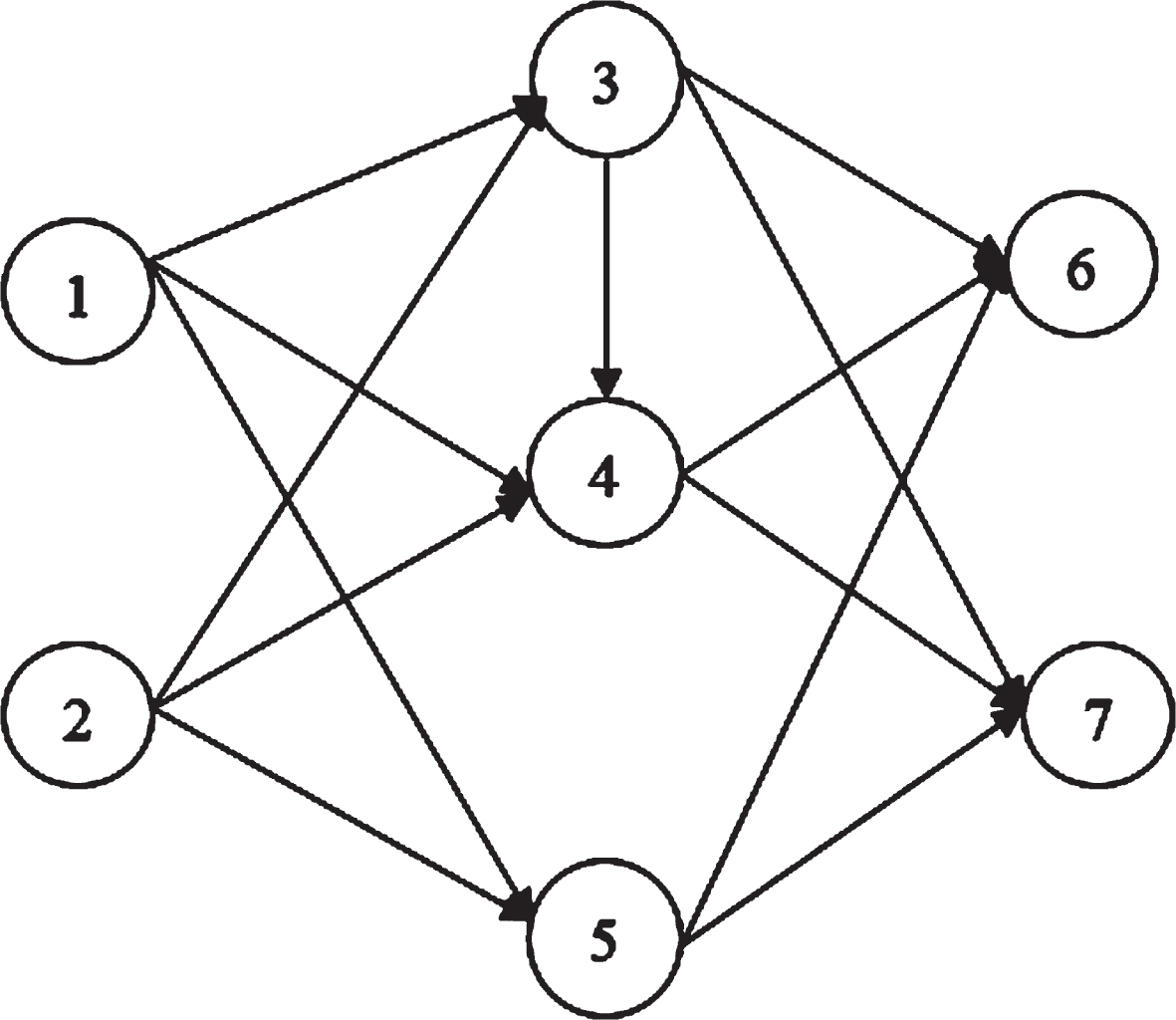
This example is a network flow problem presented by Mahmoodirad et al. [18] consisting of sevenvertices and twelve arcs. In this example, the arc costs are represented by triangular fuzzy numbers. The details of this problem are shown in Fig. 1, Tables 1 and 2.
Graph of Example 1.
Fuzzy costs, fuzzy profit and crisp capacities of network arcs
Arc index
Tail node
Head node
Arc fuzzy cost (cij)
Arc fuzzy profit (dij)
Arc capacity
1
1
3
(5,40,90)
(20,30,50)
40
2
1
4
(4,45,115)
(30,40,60)
10
3
1
5
(5,57,116)
(60,80,100)
15
4
2
3
(10,40,85)
(5,70,80)
50
5
2
4
(10,50,120)
(80,90,100)
80
6
2
5
(13,60,164)
(50,60,70)
40
7
3
4
(2,10,25)
(90,110,120)
20
8
3
6
(8,50,145)
(70,80,100)
100
9
3
7
(2,35,105)
(10,30,40)
90
10
4
5
(3,10,40)
(20,30,40)
15
11
4
6
(8,40,115)
(40,60,80)
30
12
4
7
(5,25,56)
(80,90,110)
20
13
5
6
(5,30,75)
(20,40,60)
15
14
5
7
(2,10,40)
(40,50,60)
100
Given capacities for the vertices of the Graph 1
b1
b2
b3
b4
b5
b6
b7
30
60
0
0
0
–20
–70
The same problem is solved by using the proposed Mehar approach, to obtain the following crisp non-dominated optimal solutions as
and the corresponding non-dominated fuzzy optimal values of the fuzzy linear fractional minimal cost flow problem are
(0.0878, 0.5974, 1.892)
(0.0884, 0.5683, 1.2335)
(0. 0865, 0. 5742, 1. 982)
Example 2
This example is presented by Mahmoodirad et al. [18] to illustrate their proposed approach. In this example, the arc costs are represented by trapezoidal fuzzy numbers. The details of this problem are shown in Fig. 2, Tables 3 and 4.
Graph of Example 2.
Fuzzy costs, fuzzy profit and crisp capacities of network arcs
Arc index
Tail node
Head node
Arc fuzzy cost (cij)
Arc fuzzy profit (dij)
Lower bound
Upper bound
1
1
2
(80,10,150,182)
(30,40,50,80)
155
450
2
1
3
(242,250,300,320)
(20,25,35,40)
160
600
3
1
4
(21,25,75,91)
(10,20,30,40)
20
55
4
2
3
(137,150,200,225)
(18,22,34,46)
45
470
5
2
5
(90,100,400,434)
(12,13,14,17)
105
125
6
2
6
(155,180,220,265)
(30,40,50,80)
70
800
7
3
4
(105,125,225,261)
(20,25,35,40)
0
450
8
3
5
(95,100,200,225)
(30,40,50,80)
0
250
9
3
6
(98,110,240,260)
(30,45,55,80)
0
125
10
3
7
(270,300,400,470)
(28,42,74,96)
0
725
11
4
6
(78,120,280,310)
(10,20,30,40)
105
625
12
4
7
(140,150,200,222)
(10,20,30,40)
20
100
13
5
6
(0,0,0,0)
(10,12,13,14)
0
100
14
5
8
(l66,200,400,410)
(50,55,65,70)
0
135
15
5
9
(105,125,225,265)
(10,20,30,40)
0
625
16
6
7
(195.215.235.267)
(20,25,35,40)
15
175
17
6
8
(140,150,250,272)
(72,74,80,85)
70
160
18
6
9
(82,100,300.330)
(20.24,32,38)
80
190
19
6
10
(65.75,125,147)
(15,20,25,31)
30
750
20
7
9
(19,25,75.93)
(20.23.29.34)
0
230
21
7
10
(30,50,150,182)
(40,46,49,56)
0
220
22
8
9
(115,125,175,197)
(55,62,63,68)
30
110
23
8
11
(93,115,185.195)
(20,29,35,39)
25
120
24
8
12
(7,25,75,85)
(14,18,26,29)
0
215
25
9
10
(78.110,190,206)
(22,24,30.32)
5
200
26
9
11
(155,185.215,237)
(55,64,70,72)
40
140
27
9
12
(305,325,475.515)
(50,58,63.68)
80
190
28
9
13
(65,75,125,147)
(55,62,69,78)
5
340
29
10
12
(130,150,250,290)
(51,62,63.88)
0
165
30
10
13
(90.100,200,222)
(70,80,85,89)
0
220
31
11
12
(43,55,125,145)
(80,90.100,120)
15
340
32
11
14
(255,275,325,335)
(50,60.70,80)
0
110
33
12
13
(73,100,150,160)
(62,82.102,122)
25
215
34
12
14
(88,100,150,160)
(100,120,140.150)
20
135
35
13
14
190,200,300,350)
(25,45,65.90)
0
265
Given capacities for the vertices of the Graph 2
b1
b2
b3
b4
b5
b6
b7
b8
b9
b10
b11
b12
b13
b14
350
100
–50
50
–50
100
–200
50
200
100
50
0
–100
–400
In this section, the same problem 2 is solved by the proposed Mehar approach.
Step 1: Using Step 1 of the proposed Mehar approach, the fuzzy optimal solution of the fuzzy linear fractional minimal cost flow problem can be obtained by solving its equivalent fuzzy linear fractional programming problem (P21).
Step 2: Using Step 2 of the proposed Mehar approach, the fuzzy linear fractional programming problem (P21) can be transformed into its equivalent fuzzy linear fractional programming problem (P22).
Problem (P22)
where,
Subject to
Constraints of the problem (P21).
Step 3: Using Step 3 of the proposed Mehar approach, the fuzzy linear fractional programming problem (P22) can be transformed into its equivalent crisp multi-objective linear fractional programming problem (P23).
Problem (P23)
Subject to
Constraints of the problem (P21).
Step 4: Using Step 4 of the proposed Mehar approach, there is a need to apply lexicographic approach [19] to solve the crisp multi-objective linear fractional programming problem (P23).
Using the lexicographic approach [19], the obtained crisp non-dominated optimal solutions are
Step 5: Using the non-dominated optimal solutions, the non-dominated fuzzy optimal values of the fuzzy linear fractional programming problem (P21) are
(1.59989, 2.19416, 4.22094, 5.86549)
(1.60066, 2.19335, 4.23949, 5.89031)
(1.62685, 2.21313, 3.78379, 5.85903)
(1.59927, 2.12159, 4.22464, 5.87849)
(1.60305, 2.20242, 4.31577, 6)
(1.63354, 2.19633, 4.06151, 6.05462)
(1.59987, 2.19613, 4.28278, 5.94617)
(1.60713, 2.20259, 4.23675, 5.85609)
(1.59747, 2.19696, 4.24794, 5.90112)
(1.60853, 2.14845, 4.23041, 5.86204)
(1.59974, 2.19574, 4.04527, 5.40142)
(1.60155, 2.23370, 4.45201, 6.23112)
(1.60016, 2.19535, 4.38487, 5.20228)
(1.59828, 2.19569, 4.37985, 5.20228)
(1.59886, 2.19515, 4.22741, 5.25513)
(1.59918, 2.12588, 4.26662, 5.21362)
(1.59690, 2.12647, 4.28766, 5.24240)
Conclusions
On the basis of the present study, it can be easily concluded that some mathematical incorrect assumptions are considered in Mahmoodirad et al.’s approach [18]. Hence, it is inappropriate to use Mahmoodirad et al.’s approach [18]. Also, it can be concluded that the proposed Mehar approach can be used to solve the existing fuzzy linear fractional minimal cost flow problems [18]. Furthermore, it is pertinent to mention that the proposed Mehar approach, in its present form, cannot be used to solve such linear fractional minimal cost flow problems in which all the parameters are either represented by triangular fuzzy numbers or trapezoidal fuzzy numbers. In future, to overcome this limitation, one may generalize the proposed Mehar approach.
Footnotes
Acknowledgments
The authors would like to thank the Editor-in-Chief, the handling Editor and anonymous reviewers for their insightful comments and suggestions.
ZadehL.A., Fuzzy sets, Information and Control8(3) (1965), 338–353.
5.
KaurJ., KumarA., An introduction to fuzzy linear programming problems, Springer International Publishing, Switzerland, 2016.
6.
ChakrabortyM., GuptaS., Fuzzy mathematical programming for multi objective linear fractional programming problem, Fuzzy Sets and Systems125(3) (2002), 335–342.
7.
PopB., Stancu-MinasianI.M., A method of solving fully fuzzified linear fractional programming problems, Journal of Applied Mathematics and Computing27(1) (2008), 227–242.
8.
StanojevicB., Stancu-MinasianI.M., Evaluating fuzzy inequalities and solving fully fuzzified linear fractional programs, Yugoslav Journal of Operations Reserach22(1) (2012), 41–50.
9.
StanojevićB., StanojevićM., Comment on “Fuzzy mathematical programming for multi objective linear fractional programming problem”, Fuzzy Sets and Systems246 (2014), 156–159.
10.
VeeramaniC., SumathiM., Fuzzy mathematical programming approach for solving fuzzy linear fractional programming problem, RAIRO-Operations research48(1) (2014), 109–122.
11.
VeeramaniC., SumathiM., Solving the linear fractional programming problem in a fuzzy environment: Numerical approach, Applied Mathematical Modelling40(11-12) (2016), 6148–6164.
12.
DasS.K., MandalT., EdalatpanahS.A., A new approach for solving fully fuzzy linear fractional programming problems using the multi-objective linear programming, RAIRO-Operations Research51(1) (2017), 285–297.
13.
AryaR., SinghP., KumariS., ObaidatM.S., An approach for solving fully fuzzy multi-objective linear fractional optimization problems, Soft Computing24(12) (2020), 9105–9119.
14.
DasS.K., EdalatpanahS.A., MandalT., Application of linear fractional programming problem with fuzzy nature in industry sector, Filomat34(15) (2020), 5073–5084.
15.
DasS.K., EdalatpanahS.A., MandalT., Development of unrestricted fuzzy linear fractional programming problems applied in real case, Fuzzy Information and Engineering13(2) (2021), 184–195.