



Abstract
The advancement of the Internet of Things (IoT) technologies will play a significant role in the evolution of the smart city, smart healthcare, and smart grid applications. The key objective of IoT is to allow the autonomous exchange of valuable data between invisibly embedded devices with the help of some prominent technologies. Wireless Sensor Network (WSN) is one of the emerged technologies used for sensing and data exchange processes in IoT-based applications. Network sustainability and energy stability are the most significant multi-objectives to attain an energy-efficient IoT-based WSN (IWSN). Consequently, in order to handle these multi-objectives, a novel Adaptive Regional Clustering (ARC) scheme has been proposed in this paper by exploiting two appropriate methodologies. Primarily, location-based modelling is employed to gather the location information from each sensor node in the IWSN environment. Thereafter, an effective hierarchical clustering can be carried out with the assist of the ARC algorithm. The cluster head will be chosen based on node capacity and node trust value by implementing the Enhanced Monkey Inspired Optimization (EMIO) algorithm. Finally, the optimal cluster head node acts as an energy-efficient local director for conducting inter-cluster connectivity, data transmission, and other duties. The effectiveness of the proposed ARC-EMIO scheme has been assessed using the NS-3 simulator and the results evident that the proposed scheme guarantees better performance with an improved network lifetime of 35% and energy efficiency of 22% when compared with the existing state-of-the-art clustering techniques.
Keywords
Introduction
In this modern era, the Internet of Things (IoT) has been established as a new paradigm that comprises numerous physical things, sensors, and vehicles. It intersects the things to design several smart facilities, value-added facilities, and real-time applications [1]. IoT necessitates highly sophisticated expertise to sense the physical conditions, collect the sensed information, and deliver them to human beings for pertinent action. Typically, wireless sensors can be utilized to sense and process data from the physical environment [2]. This sensed data is made manageable for remote access via the internet and hence it stratifies the targets of the IoT paradigm. Therefore, WSN will be considered as one of the significant enabling technologies for smart IoT applications [3].
The IWSN has developed its applications in various sectors like smart grid, smart city, smart healthcare, smart surveillance, environmental monitoring, etc. [4–6]. IWSN is responsible for data acquisition, communication, and decision-making. Nevertheless, prolonging the duration of wireless communication plays an indispensable responsibility since the availability of battery energy is restricted in the sensor networks. It is critical to balance energy dissipation across IWSN devices in order to prolong the lifespan of a network system. In the last few decades, several approaches have been proposed for minimizing battery usage of the sensor nodes in IWSN [7]. Because of sensory ecosystem unpredictability and variable device needs, suggested sensor node solutions seldom fulfill the requirements of a network system.
The clustering approach is utilized as one of the predominant techniques to save energy resources where the IWSN can be categorized into multiple clusters [8]. Cluster Heads (CH) are designated for every cluster to gather and consolidate data from sensor nodes within the bunch before transmitting it to the downlink in the course of a single or double broadcast. In a cross-transmission context, sensors suffer the hotspot phenomenon in IoT devices closest to the drain [9]. In a single system, sensors collect and aggregate data while also aiding adjacent regions in transferring their data to the system. An inter-cluster communication is apparently more intensive in the clustering environment. The energy demand of the sensor network is exactly related to its longevity [10].
The architecture of the cluster-based IWSN model is depicted in Fig. 1. Each cluster members in the clusters accumulate data and transfer it to the sink reliably or via other intermediate nodes. CHs will responsible for inter-cluster communication in which the information could be delivered to the user for taking appropriate action. Various sensor arrays combine individual network devices to provide manageability and reduced network utilization. Sensor nodes that act as “CHs” waste a lot of energy and run out of power quickly. As an outcome, the procedure of similar technologies for tracking purposes and retraining of CHs is necessary, which reduces the lifetime of the IWSN network [11].
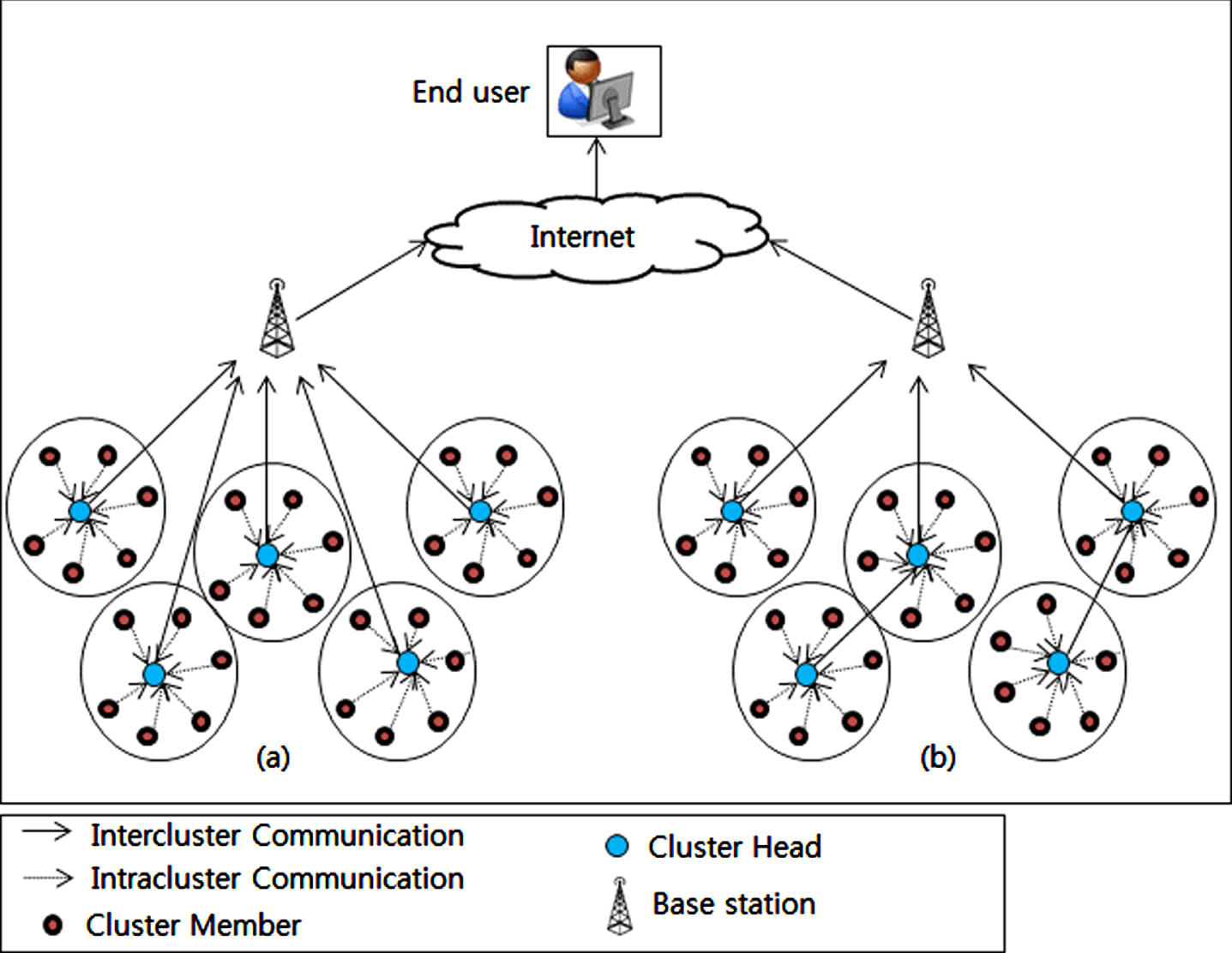
Cluster-based IWSN for inter/intra communication.
The potential of adjusting power usage amongst cluster formation derived from the disposal is investigated in this research. Because any attempt to minimize cross congestion in hotspot branched nodes disturbs the digital signal and results in lost data, this research focuses on employing multiple CHs in the groupings stated above. On a cyclic basis throughout the time-frequency domain, the location of the group leader is changed among some of the individuals of the clusters process whereby an organization. The position of cluster members is shared amongst some of the membership of the clustering group [12]. A Bluetooth headset is taken as an example for this process where it has one central server operational at a time and others serving as regular sensors.
Adjusting for potential confounders nodes are assigned to cluster based on the idea that groupings that are closest to the descent receive more clustered heads than groupings from farther away. IWSN, on the other hand, integrates with current systems to give data at the point of interaction [13]. A significant element of today’s time reporting and monitoring technologies is data collection from many databases. Adjust network placements depending on local demand and use approximation connection links.
The foundation to pile routing algorithm is the full member (CH) aggregation technique, which permits devices to maximize power usage and therefore extend the life of the IWSN [14]. As a result, in order for power used to be highly steady, the ability for the anode to CH conversions must be recognized as being reliant on the distant access point. Hence, efficient cluster formation plays a significant challenge to enhance the energy efficiency of the IWSN environment [15].
In this research, a multi-objective-based ARC scheme has been introduced to achieve effective global cluster formation which is influenced by the location of the nodes. The main objective of this work is to extend the network lifespan and energy efficiency of IWSN. Initially, the groupings are assigned with a regional-CH set via many subordinate nodes. Optimal CH selection in the proposed scheme can be obtained through the EMIO algorithm. Clustering near to the descending is provided wider geographical-cluster formation sets than groups further apart and, to mitigate for hotspots difficulties induced by multi congestion, as seen in Fig. 1. This network of links allows groups to be closer to the user, decreasing the amount of energy used by a selected CH in traditional techniques. The recommended framework will allow a limited number of hotspots to participate in the data communication that reduces energy dissipation in the network.
The numerous novel contributions of the recommended work are as follows: An efficient clustering has been formed across multi-sensor nodes using the proposed ARC and location-based modelling for the IWSN environment. This adaptive formation will bring the energy expenditure of the CHs into more stability. A new EMIO algorithm is introduced in the proposed scheme to achieve optimum CH selection across multiple clusters in the network. CH will be chosen based on node capacity and node trust value. These considerations pave the way to select a more suitable node as CH. The proposed ensemble ARC-EMIO approach formulates the finest inter-cluster and intra-cluster path for continuous packet transmission without any network partitioning in IWSN. It leads to obtaining global results which makes CH selection more efficient and prolongs the network sustainability as well as energy stability.
The remainder of the research article is arranged as follows: Section 2 anticipates the existing clustering methodologies related to CH selection and energy management. Section 3 provides a detailed overview of the proposed ARC-EMO scheme. In Section 4, the numerical results along with comparisons are demonstrated. Finally, Section 5 concludes the article with some future suggestions.
This section summarizes the various previous methodologies related to energy stability and network sustainability measures in IWSNs. In [16], the Particle Swarm Optimization-based Energy-Efficient Clustering protocol (PSO-EEC) has been anticipated to boost the network life span and performance. To identify the finest CH and relay nodes, it employed a PSO-based fitness function by adhering hop count, node degree, and energy proportion. Further, it constructed an optimal fitness value through neighbor nodes broadcasts for making a CH selection. Finally, the transmission towards the base station can be performed by electing an appropriate relay node. Since this node degree computation by considering several neighboring nodes, an optimal solution is not determined during the dense IWSN.
By considering network stability, lifespan, and throughout, the kestrel-based search algorithm and wolf search algorithm (KSWS) has been presented for having an energy proficient clustering approach [17]. It considered average energy levels for picking the CH with the consideration of the sensor position and its energy intensity. Among the two anticipated nature-inspired algorithms, performance was compared with similar existing ones, but the suggested one was not much conceptualized to predict the network optimization.
Masdari et al. [18] have introduced a Teaching Learning Based Optimization (TLBO) to provide valuable clustering procedures in the IWSN environment. The TLBO scheme employed a hierarchical clustering method to determine the best fitness value based on the local search algorithm by comparing it with the clustering threshold. When a cluster is having a number of nodes beyond the threshold, it further aggregates it to self-clustering. This eventually increases the computational complexity and execution time in the TLBO scheme.
For effective energy optimization in IWSN, a clustering technique is adopted with the Gaussian elimination method [19]. By setting initial energy parameters for sensor nodes, it propagates to find initial dead and alive nodes to find the computing probability and energy levels required for transmission. Based on that, it applies gauss elimination to include all the active nodes for packet transmission. Since it forms a matrix with the number of CH’s towards the path residual energy, it does not employ node lifetime optimization in an efficient manner.
In [20], a hybrid meta-heuristic cluster routing scheme has been proposed to predict best or near optimal solutions in IWSN. It considers energy level and node placement distance to neighbors as well as the base station for evaluating the fitness function. The process of clustering can be achieved through a brainstorm optimization with levy distribution. However, it utilized three different algorithms for clustering which lags in rapid computational ability.
Xu et al. have established the Steiner Tree Issue with Least Steiner Parts and Constrained Edge Length to represent the RFID network planning issue. A vector meta-heuristic-dependent PSO is integrated to obtain an optimal number of relay nodes. Furthermore, the different parameters are exploited for identifying the constrained edge length. These approaches rely on the Q-coverage and K-coverage scenarios which enhance the lifetime of the network and penetration simultaneously.
The neural network has lately been utilized to encourage the growth of networks by arranging the appropriate collection of relay nodes in the best locations. The most common meta-heuristic techniques used for clustering improvement are Genetic-Algorithm, PSO, Artificial-Bee-Colony, Ant Colony Optimization, etc. In multiple disjoint systems, a Genetic algorithm-based clustering scheme has been utilized to resolve the lifetime constraints of IWSN [22]. The baseline chromosomal span can be carried out by measuring the arbitrary cap of base stations. The GA then literately decreases the quantity of relay nodes while continuing to find the finest CH.
In [23], clustering connectivity has been presented to save energy resources in WSN. In this scheme, the clustered choosing gateway was added to the available low-energy adaptive clustering hierarchy (LEACH) protocol which altered the voltage here between cluster procedure components. When compared to the previously proposed method, the current LEACH protocol has increased the number of primary networks that may extend WSN to 1750 round by 67%. The fundamental algorithm outperforms existing power protocols in respect of stabilization duration and steps productivity under a number of diverse, economic, and node concentration circumstances.
Khabiri et al. [24] have introduced a cross-architecture piece to recover connectivity issues in the IWSN environment. It establishes gender-fluid interoperability and transmits information to the base station using different segmentation. This is different from previous models in that it can travel any length, even neighboring segment, lowering the lowest transportable radius, and length parameters. Nevertheless, this scheme failed to attain a better network lifetime and energy consumption in the network.
Yu et al. [25] have presented a paradigm for electricity transmission and communication in heterogeneous IWSNs. It comprises two phases: coverage and connectivity. Initially, the connected targeting k-coverage methods include the centralized connection ACTIVE if it fulfills the following three situations: (1) the network is capable of executing several goals on its own. (2) The sensor network seems to have a bigger battery (3) the sensor network defends a goal that isn’t defended by any of the IoT devices in the presently selected group. Afterward, the proper connection is formulated with the aid of the connectivity phase. The network will fall into a phase of rest if such three requirements are not satisfied. In addition, each network in the covering set will link to the destination node throughout one or more hops via adjacent routers. Table 1 depicts the Network Life span (NL) comparison of IWSN.
NL comparison based on different category
NL comparison based on different category
According to the above-mentioned analysis, IWSN simulation has been considered as a more difficult task to enlarge the network sustainability and energy stability. It has a variety of characteristics including energy, latency, packet delivery ratio, scheduling, expense, and true performance. Moreover, most of the above-stated schemes are failed to obtain optimal CH as well as global optimization results. A limited number of works will be concentrated to achieve both multi-objectives i.e., network sustainability and energy stability of IWSN. These multi-objectives have a direct impact on the overall performance of the network. Therefore, this work proposes a novel ensemble ARC- EMIO scheme to provide the proper global solutions to the multi-objective problems of the IWSN.
To overcome the inadequacies of packet transmission, a new ARC-EMIO scheme has been developed with enhanced quality of services. There are two variants of the suggested selection of the CH route discovery technique. In the first iteration, the position recognition protocol is employed for effective cluster formation by implementing the ARC method. Next, the EMIO algorithm calculates the node fitness value based on the node capacity and node trust. It estimates the best cluster formation route selection to increase the network longevity. The remaining energy, packet transfer, and transmission overhead are also considered to determine the effectiveness of the proposed ARC- EMIO scheme.
Network setup
In the IWSN environment, the following considerations are made: The nodes are all immovable and are equally distributed in a spherical sensing area. The sensing area is split into 4 sections, each with a variety of sub-regions; edges are neglected after placement. Sensor nodes are homogenous, and they all have the same identification. Sensor nodes form a network and send its information back to CH. CHs gather data and deliver it to the descendant either directly or over many hops. The position tracking of the node will be enabled which allows the sink and sensors to be synchronized.
The localized energy employs a cone-like construction that can be easily changed into the shapes of a globe, rectangle, or trapezoid by adjusting the convergence point. The detecting field is divided into sections using the ARC. In each orientation, the territory is split into sections, and the sensory edges in each instanced dungeon form a bundle. In each of these clusters, a principal bunches tip and one or so more subsidiary cluster members are utilized.
Energy modelling
The energy modelling algorithm signifies the total amount of energy essential to convey L bits of information across a distance of d [26–28]. Let d intends the transmission frequency of terminals in the empty gap and cross vanishing transfer function, fs and mpf represent the amplification strength parameters, d0 refers to the boundary gap that separates these two faded modes. In the transmitter circuitry and the RF amplification, the energy quantities of Equation (1) are monitored.
When obtaining L bits of data, Equation (2) calculates the source of power used in the recipient side.
Let N be the total number of antennas sinks in a specific region (for invariable density ‘β’).
The entire energy expenditure of the network system is calculated using the elements of the primary member nodes and cluster member as in Equation (4). While one CH is participating, the other descendant clustering algorithms function as ordinary antennas devices in the system.
A regional-CHs time is consumed by obtaining reports from group members, compiling the data, and delivering it to the supervisor. Figure 2 illustrates the CH election based on estimated energy usage.
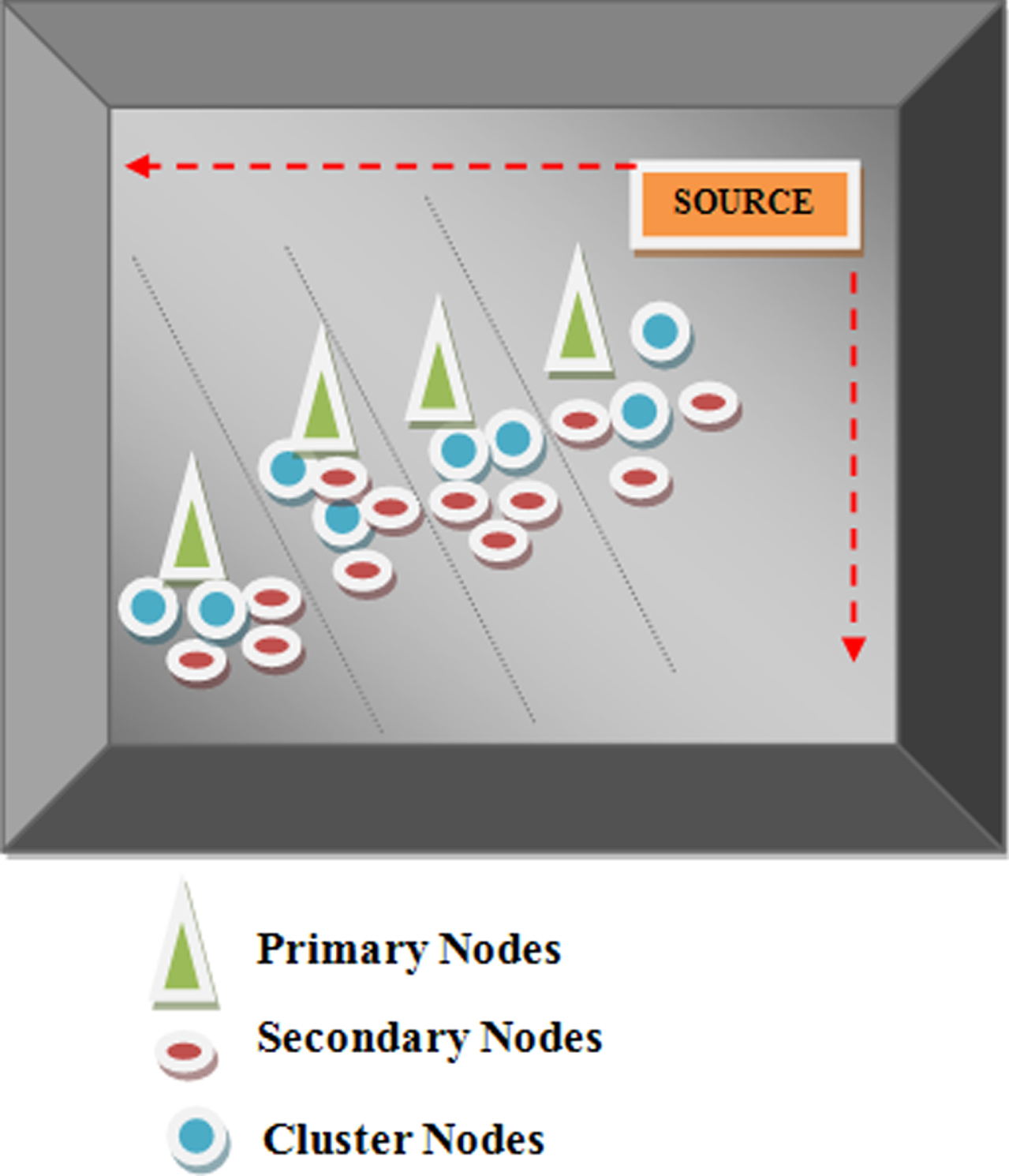
CH selection in IWSN environment.
The monitoring system is separated into different regions based on their position in respect to the outlet. The entire sensing area is split into many geographical locations, each of which is broken further into sections. Figure 3 shows that all sensing points in a subzone form a team known as a regional group. In each of these geographical, a CH is picked based on the remaining energy.
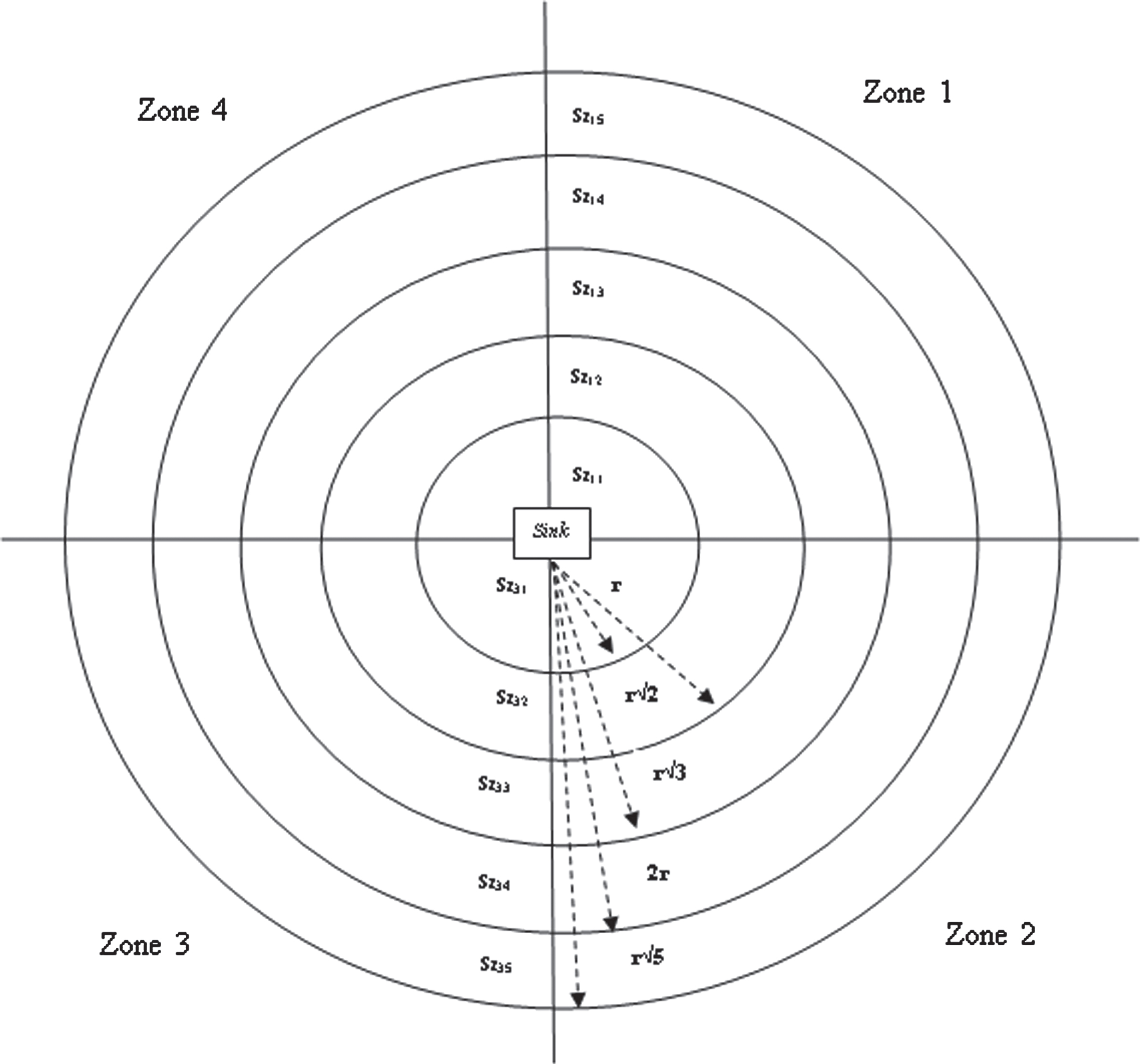
Formation of Regional cluster.
Each region is further split into segments of equivalent length. Detectors in an instanced dungeon create a region -cluster. An area in the shape of a cone is addressed in Fig. 3. In this sensor field, the rad i of each geographical is defined by the position of the descent to create ‘k’ regional clusters of similar size. It is computed the rad i of the zones deepest clustered, i.e., the cluster nearest to the region’s outlet.
A Regional-Cluster System (RCS) is a cluster of sensing vertices made up of chief member nodes and a collection of subordinate cluster members that vary their cluster member’s location on a regular basis. The secondary centroids are picked from a set of main clustered head’s nearest neighbors. In general, the geographic CH set membership is serving as an engaged CH. The remaining sensors will keep collecting information as IoT devices. The length of a geographic set is affected by the difference between the major member nodes and the sinks. To compensate and minimize the risks of the geographic location challenge, the regional clusters generated next to proceed are specified as a higher priority for the CH node.
The separation between both the main member nodes and the outflow determines the RCS scale in this experiment. The provincial with the region’s largest head Set is assigned to the provincial that is one hop away from the drain, i.e., ‘n’ subordinate cluster centers are anchored here. At the following level, n-1 subsidiary clusters are distributed to the provincial. The RCS shrinks by one with each succeeding grade. Each geographical is given at least one subordinate root node in contrast to main member nodes, regardless of its size.
The proximity here between entering and departure borders of regional clusters is used to apply criteria to provincial-based on the distances. If a zone has ’k z ’ regional clusters, the one nearest to the sink is assigned an RCS of range ’k z +1.’ The magnitude of the RCS for both of these geographic groups is evaluated as follows:
The main objective of Algorithm 1 is the formation of an optimal regional CH set. After initializing all the sensor nodes, the algorithm operates in the following three phases.
Phase 1: Electing of Primary Cluster Head (PCH)
Among the participating nodes in the clusters (CSN), the node which has the highest energy among all will be chosen as primary cluster head (PCH) and it was assigned with pch_id for easy identity.
Phase 2: Electing of Secondary Cluster Head (SCH)
The choice of a secondary cluster member is based on how far the individual nodes are positioned from the PCH node. So, its starts by predicting the distance array from cluster sensor node (CSN) to PCH. Once the distance is found, based on the ascending order, the individual CSN nodes are assigned with SCH i value to act as SCH in the regional cluster set.
Phase 3: Scheduling of Cluster Head.
At a given time, in RCS, one node will act as CH and the other will act as participating nodes. With the PCH and array of SCH’s and non-participating SCH (NSCH), based on the given time interval t k , an SCH will be chosen as PCH and existing active PCH will become SCH. Also based on the number of NSCH, this algorithm works by scheduling active CH from the available sensor nodes.
Each geopolitical sector of the sensor field will have its own devoted clustering, and inter-group communications are routed via a multi-hop technique. The member nodes collect and summarize data, which is subsequently delivered to the sinks either straight or via the previous hops cluster formation. A structure of the cross relay happens through a predefined pattern of cluster members. Only the chief CHs are connected to the development of inter and intra- transport relays, i.e., only the chief centroids are participating in the administration of intra- and internetwork relay nodes.
Algorithm 2 illustrates the Inter-cluster relay mechanism. Here, the network traffic is handled by clusters made in every region on the multi-hop basis. So, the inter- and intra-cluster traffic will be managed by active PCH in a regional cluster. Based on the data packet forwarded through the traffic, if the hop distance is equivalent to the same for active PCH and towards the sink node, then the packet is forwarded to the sink node. Otherwise, it will propagate through the next cluster sets in order to find its sink node through multi-hopping.
CH Trust level computation using EMIO
The key objective of the proposed EMIO is to find the trust level for selecting the optimal CH in the IWSN. The EMIO comprises seven phases include Startup, Local Head Phase, Global Head Phase, Local Head Training Phase, Limited Head Finishing Phase, and Universal Head Phase. The detailed description of these phases are as follows:
a) Formation
In the initialization stage, a native inhabitant of N monkeys affected optimizing is created, where MIO i denotes the i th MIO in the residents. Each MIO i is started as follows, as shown in Equation (6). Let MIOminj and MIOmaxj symbolize the minor and superior limits of the exploration breakpoint in the j th observation respectively where they are uniformly scattered arbitrary numbers in the range [0, 1].
b) Cluster member phase
All spider monkeys will be updated at this time based on the information of their local leader and restricted team member. Prepare the MIO to move to a new level of MIO testing. If exercise is excessive, the MIO will not change its position. Here, the level informs procedure is as follows:
Here, MIO ij indicates the j th length of i th MIO, LL kj represents the k th local manager of that collection and MIO rj signifies the r th MIO selected randomly within k th collection in j th length such that r¬ =i is consistently dispersed random digit in the variety [–1,1].
c) Environmental phase
Every MIO uses the information of a CH and the knowledge of its neighbor MIO to inform their location and find the superior solution. Let GL j intends the place of collection organizer in j th measurement and j = {1,2,3, . . . ..,n}. The level informs equation at this stage is as follows:
d) Region-wise phase
The MIO is considered to be the best global leader in the fitness population. If the Global Leader status is not updated, the global limit count associated with the global leader will rise to 1, otherwise, it will rise to 0.
e) Region cluster head phase
The greed will be selected from team members and the position of a local leader in the region will be renewed. If the local leader does not renew their position, the counter associated with the local leader is multiplied by the local limit count 1. The counter is set to 0. Each leader used this process respectively to find local leaders.
f) Cluster head phase
Unless a local leader varies beyond the parameters of the local leader limit, all members of this collection will be re-hired based on the expertise of random startups or global leaders.
g) CH decision phase
The foreign head divides people interested in groups or non-MIO groups until the world leader is renewed by a particular determination of the global limit leader. If the global limit count exceeds the limit, the global limit count is put to zero and the amount of groups is compared to the most number. If the current group’s size is lesser than the number of groups already identified, the foreign head divides the group further and forms a new one.
Let us first state the following general assumptions: Studying the terrain of the Levi-Airway takes just one turn; The EMIO investigates the current segment by intensely probing it with its reception with a high chance of finding a worm. This area is supposed to explore deeper, implying that the chance of success would be greater than the predetermined gap. This entails being aware of the limits of penetration. Figure 4 depicts the EMIO algorithm based on these assumptions.

Sequential flow of the Proposed ARC-EMIO framework.
The effectiveness of the proposed ARC-EMIO scheme has been analyzed using the NS-3 simulator. This experiment was run on a computer with a 3.20 GHz Intel (R) i5 CPU and 4 GB of RAM. The key simulation parameter settings are demonstrated in Table 2. All IWSN nodes are attentive about the geographic locality of the sensing area where they have been positioned. Every sensor starts its process with the initial energy of 1J. At the same time, every simulation test has been accomplished ten times and hence the average value was estimated. All the simulations were applied in a static environment, i.e., the sink and sensors were immovable.
Simulation setup
Simulation setup
Simulation result of the IWSN environment is depicted in Fig. 5. Here, the red color nodes symbolize the randomly scattered nodes in the monitoring area whereas the sink is indicated by the yellow triangle and is located at the (50 m, 50 m). The performance of the proposed ARC-EMIO scheme is compared with LEACH [23], TLBO [18], KSWS [17], and PSO-EEC [16]. The various metrics are utilized to assess the aforesaid schemes such as NL, Average Energy Consumption (AEC), Number of Alive Nodes (NAN), and Average End to End Delay (AE2D).
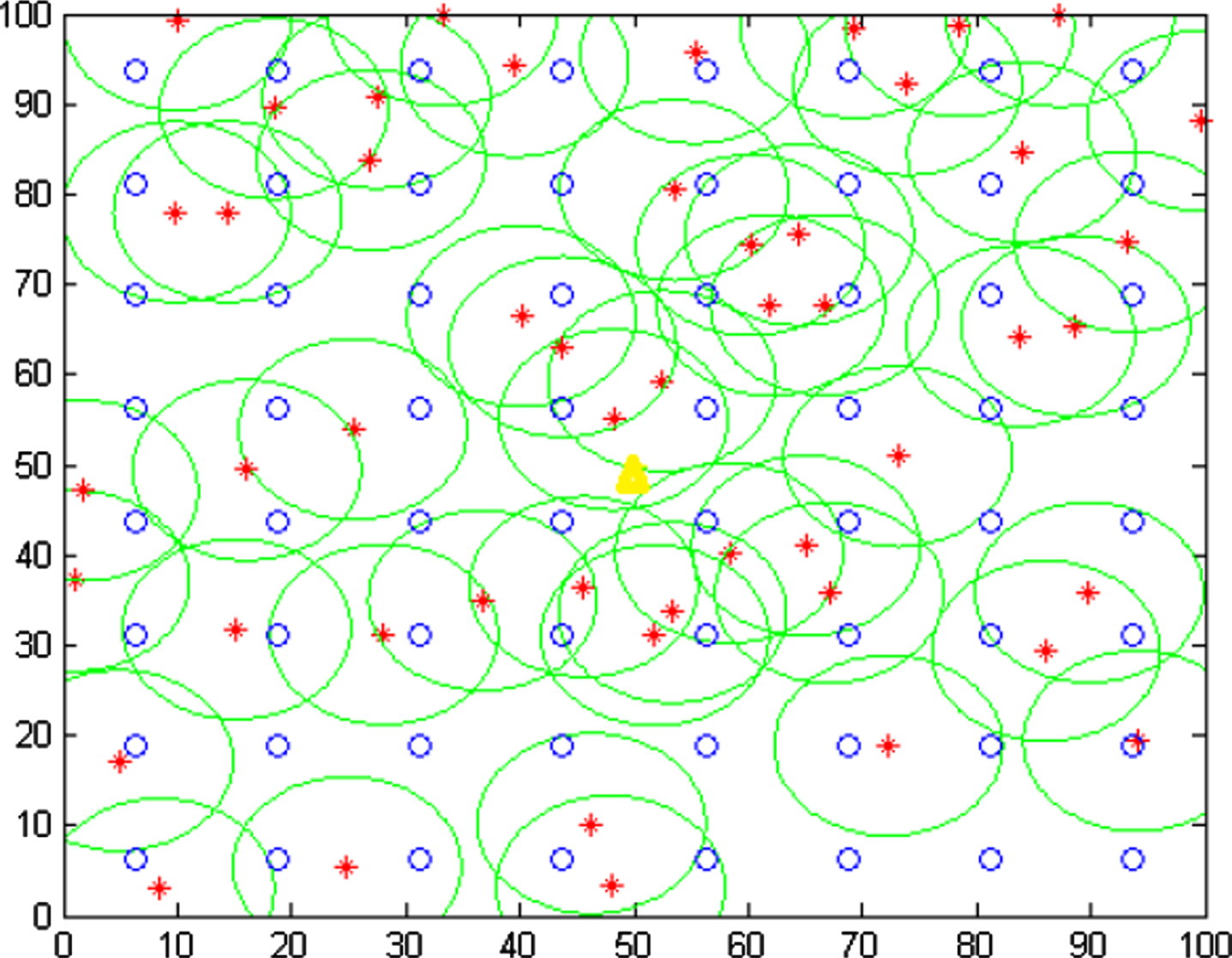
Simulation results of IWSN environment.
The NL is determined using the FND (First Node Dies) and HNA (Half of the Nodes Alive) statistics. The last node die measure is ignored since the original study competence is primarily focused on a consequence from the perspective of a hot-spot situation. Let E0 intends the node initial energy and P indicates the power value. A lifespan of node ‘i’ [29] can be calculated by using the following equation,
The number of sensor nodes in the network is varied from 50 to 300. The NL comparison in terms of FND and HNA is illustrated in Fig. 6. The NL (FND) of the proposed ARC-EMIO scheme has enlarged by 70%, 39%, 32%, and 8% as compared with LEACH, TLBO, KSWS, and PSO-EEC schemes respectively. Even if considering HNA, the proposed ARC-EMIO scheme has increased by 64%, 34%, 19%, and 7% when compared with LEACH, TLBO, KSWS, and PSO-EEC schemes respectively.
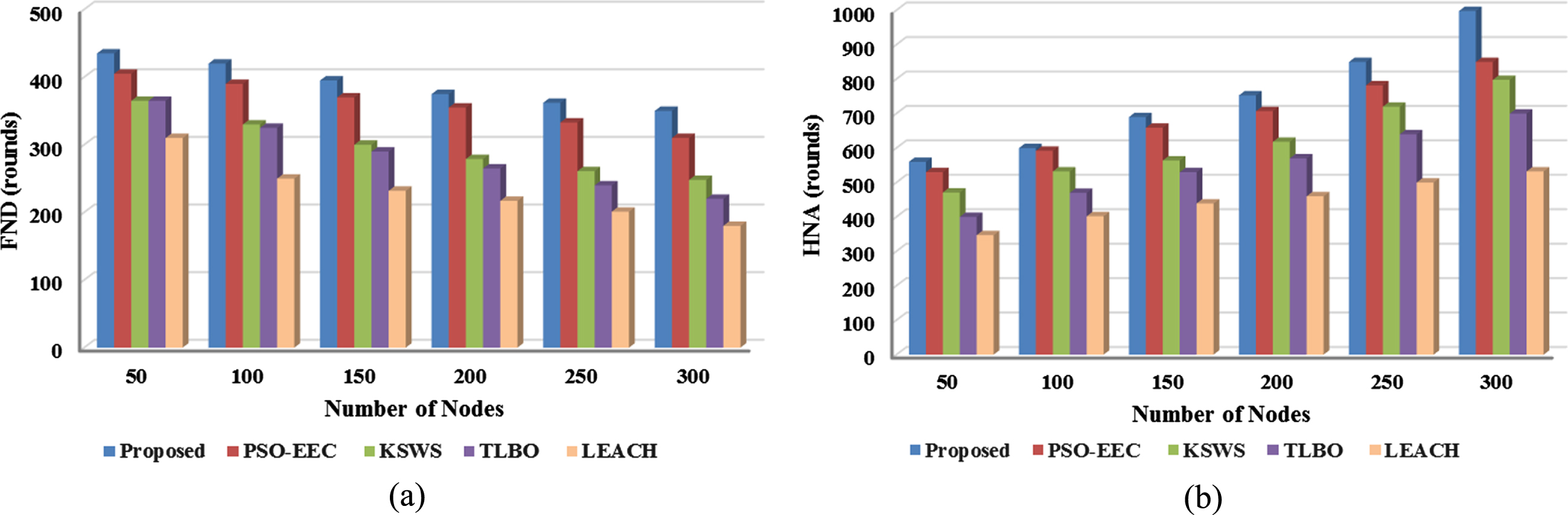
Comparison of NL under varying number of sensor nodes (a) FND, (b) HNA.
The key rationale behind this enhancement is owing to the establishment of the election of more steady nodes as CH in the proposed scheme where CH election can be carried out through the EMIO model. Besides, the proposed scheme acquired the optimal path formation from CH to sink at inter-cluster routing that facilitates the proposed scheme has the premier FND, HNA of around 435 and 998 rounds respectively. In ARC-EMIO, four zones are produced with two clusters of similar size forming in each zone. The sensor nodes are distributed uniformly among these clusters. For each cluster, different CHs are chosen depending on their abilities.
In the case of LEACH, eight groups of globular circumferences are generated at a distance of one hop from the drain. In the simulation, the round states that the amount of time it takes to choose a new CH for a cluster. The CHs are chosen for each round in LEACH protocol and clusters are reformed. This paves a way to attain lesser NL when compared with the proposed scheme. Alternatively, considering TLBO and KSWS schemes, the nodes are sited at the longest distance from the CHs and cannot be replaced regularly in some sensing regions. This causes higher energy dissipation and a lower NL in IWSN. On the other hand, the PSO-EEC is made up of eight clusters that are assembled in a multi-hop prototype. It produces better NL than LEACH, TLBO, and KSWS schemes. At the same moment, some unequal clusters are formed among eight clusters with the aid of PSO. As a result, uneven energy distribution can occur in the network which causes lower NL than the ARC-EMIO.
In this work. AEC is computed for two stages as shown in Fig. 7 (AEC for overall network and AEC for CH nodes). The AEC of the overall network in the proposed ARC-EMIO scheme has been condensed by 66%, 59%, 40%, and 26% when compared to LEACH, TLBO, KSWS, and PSO-EEC schemes respectively. This appears due to the formation of even clustering, lower control packet overhead, and the finest CH election. Moreover, the suggested model has higher residual energy than existing schemes.
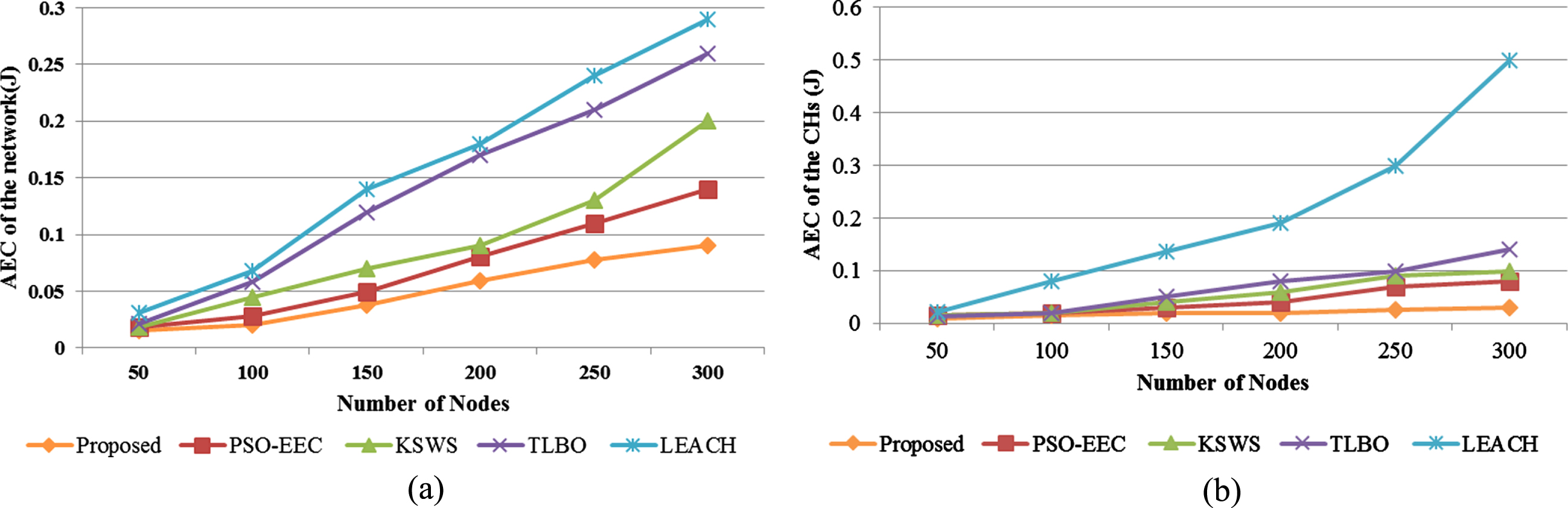
AEC comparison for different schemes (a) AEC of the network, (b) AEC of CH.
Likewise, the AEC of CH is reduced by the proposed scheme because the chief CH position is rotated in a regional-cluster head Set on a regular basis. The current round ends when every chief CH in a regional -cluster runs out of steam, and an original regional-Cluster head Set is selected in the group. The proper energy optimization will be provided by using the EMIO algorithm in the proposed scheme. This paves a way to achieve a lesser AEC of CH as 0.031J for the dense network.
The lifespan of nodes is directly proportional to the residual energy. As residual energy is higher, the lifetime of nodes is extended. But, the residual energy is minimal in the LEACH and TLBO schemes because of the implementation of the improper CH selection strategies and optimization techniques. Meanwhile, the KSWS and PSO-EEC schemes maintain better residual energy than LEACH and TLBO schemes which cause lesser AEC and increased NL in the network. These schemes compute threshold probability towards the objective function for finding the finest energy levels. The threshold probability is not properly chosen in these schemes that yield lesser AEC than the proposed scheme.
The NAN has been calculated with 100 node environments for all stated schemes by changing the number of rounds from 200 to 1200. It is noticed from Fig. 8 that the NAN of the proposed ARC-EMIO scheme outperforms well as compared with existing schemes. In particular, the proposed scheme still sustains with 36% alive nodes, whereas the existing schemes like LEACH, TLBO, KSWS, and PSO-EEC are having 0%, 2%, 8%, and 28% alive nodes respectively during the higher round. The significant reason behind this improvement is that the suggested scheme achieves accurate energy balancing in both cluster members and CH. The ARC-EMIO scheme is a decentralized, energy-efficient, and load balancing clustering mechanism. In addition, the proposed scheme formulates the fusion strategies among locally sensed information and thus it minimized the energy dissipation and prolongs more alive nodes in the dense IWSN environment.
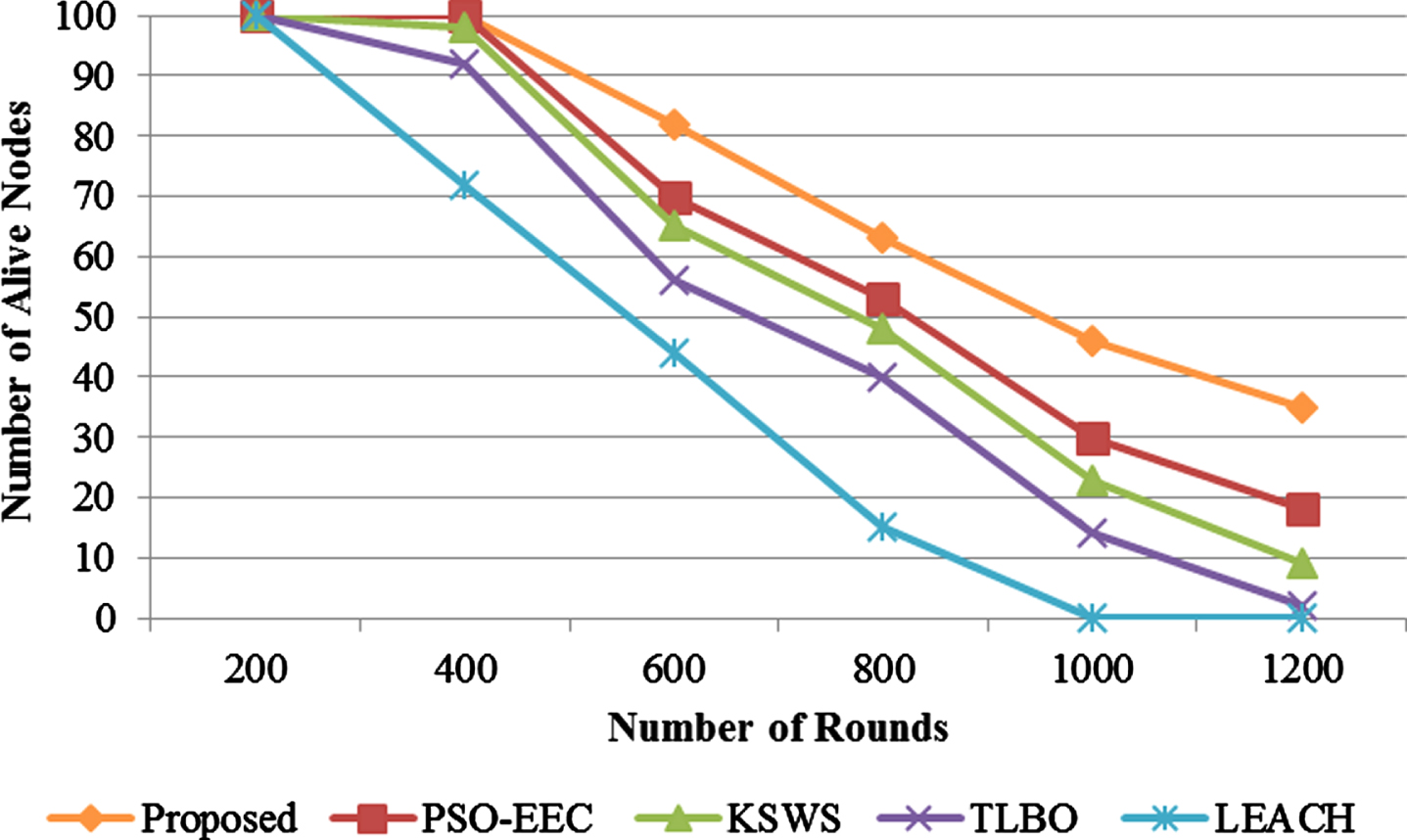
Comparison of NAN for various schemes.
In contrast, a more number of dead nodes occur in the LEACH protocol. The nodes can drain their energy rapidly due to regular changes of network topology that reduce the alive nodes in the network. In the case of the TLBO scheme, it employed a hierarchical clustering method to determine the best fitness value based on the local search algorithm by comparing it with the clustering threshold. When a cluster is having a number of nodes beyond the threshold, it further aggregates it to self-clustering. This eventually increases the NAN value than the LEACH protocol. Contrasting with LEACH and TLBO schemes, the alive period of most nodes is extended in the KSWS, and PSO-EEC schemes by executing a proper CH selection mechanism. They maintain a higher NAN value when compared with LEACH and TLBO schemes. But, they lagged to mitigate the hot-spot problem cause a lower NAN value than the proposed ARC-EMIO scheme.
An AE2D metric can be measured as the time taken by a packet from the source to CH and CH to the sink node. Let DSC is the delay for a packet to reach from source to CH. DCHS is the delay for a packet to reach sink node via CH.
As seen in Fig. 9, the proposed ARC-EMIO scheme decreases the AE2D than the existing schemes by efficiently handling the hot-spot problem around the scaling factor and thereby equally distributing energy consumption among the CHs.
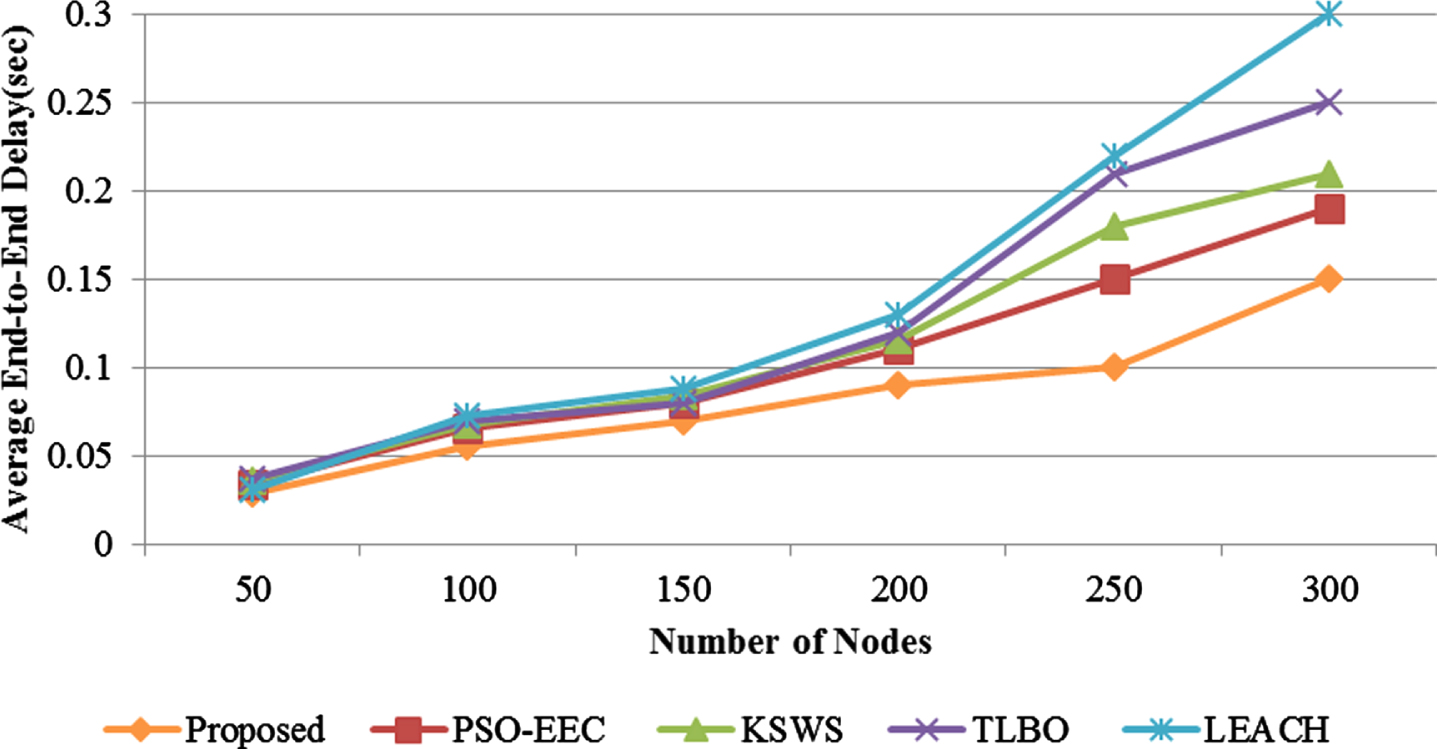
Comparison of AE2D under varying number of nodes.
Eventually, the AE2D of the proposed ARC-EMIO scheme has been shortened by 31%, 28%, 25%, and 19% as compared with LEACH, TLBO, KSWS, and PSO-EEC schemes respectively. This is because of the structural nature of the proposed ARC-EMIO scheme where the nodes are evenly scattered in the sensing area and the associated CHs are located within the structured local clusters with the best fitness scores. The formation of equal-sized clusters allows for attaining more scalability and this strategy significantly decreases the delay during data transmission. This leads to achieving the minimum AE2D value of 0.029 s in the proposed ARC-EMIO scheme.
On the contrary, CHs in LEACH send their data directly to the sink in IWSN circumstances. Direct communication increases the probability of packet drop in the LEACH protocol. At the same time, multi-hop map-reading is utilized in TLBO, KSWS, and PSO-EEC schemes to transfer information from the CHs to the central sink. This Multi-hop methodology enhances the continuous packet transmission and reduces the retransmission in the network. This paves a way to attain a better AE2D value than the LEACH protocol. Nevertheless, they are unevenly distributed the CHs which increases the control packet overhead issues during cluster formation. As a result, they obtain a higher AE2D value than the proposed ARC-EMIO scheme.
The overall performance comparison of the proposed ARC-EMIO over existing schemes is exposed in Table 3. It is apparent from Table 3 that the proposed ARC-EMIO scheme outperforms well for the dense network (300 nodes) as compared with existing schemes in terms of NL, AEC, NAN, and AE2D.
Performance comparison of proposed ARC-EMIO over existing schemes
The proposed ARC-EMIO scheme is reliable, energy-efficient, and can be easily applied for the IWSN applications. The proposed ARC-EMIO scheme enlarges the exploration and exploitation abilities of the search region by executing the EMIO algorithm. The EMIO algorithm requires lesser computational time than conventional optimization algorithms. The proper searching ability of the proposed scheme assists to obtain the global results for CH selection.
Furthermore, the proposed ARC-EMIO scheme will provide better performance due to the following reasons: (a) Easy to develop and integrate: it has a flexible optimization algorithm which means the suitable parameter is manipulated properly. (b) Competency in the multi-path scheme: provide optimum intra- and inter-cluster routing with the aid of the ARC scheme. (c) Self-organization behavior: all groups perform at the same period and there is no need for a central coordinator. (d) Global optimization: It obtains global results which make CH selection more efficient and prolongs the network sustainability as well as energy stability.
A global ARC-EMIO scheme has been suggested in this work to select the more optimum node as CH in IWSN circumstances. It also handles the hotspot state accurately with the assist of the ARC algorithm. By efficiently mitigating the hotspot concerns, the proposed ARC-EMIO scheme forms the balanced cluster throughout the network. Afterward, the EMIO algorithm is established in the proposed scheme to achieve optimum CH selection across multiple clusters.
The performance of the ARC-EMIO scheme has been simulated in the NS-3 platform. The numerical results manifest that the proposed ARC-EMIO scheme outperforms well for both dense IWSN and sparse IWSN as compared with existing schemes. In particular, the proposed scheme still sustains with 36% alive nodes, whereas the existing schemes like LEACH, TLBO, KSWS, and PSO-EEC are having 0%, 2%, 8%, and 28% alive nodes respectively. This higher NAN of the proposed scheme prolongs the network sustainability with a maximum of 1000 rounds in the sensing area.
At the same time, the mobility of the nodes is not considered in the proposed scheme. In the future, the proposed scheme can extend to meet the requirements of mobility as well as a heterogeneous environment.