



Abstract
In this paper, we introduce the notion of state monadic residuated lattices and study some of their related properties. Then we prove that the relationship between state monadic algebras of substructural fuzzy logics completely maintains the relationship between corresponding monadic algebras. Moreover, we introduce state monadic filters of state monadic residuated lattice, giving a state monadic filter generated by a nonempty subset of a residuated lattice, and obtain some characterizations of maximal and prime state monadic filters. Finally, we give some characterization of special kinds of state monadic residuated lattices, including simple, semisimple and local state monadic residuated lattices by state monadic filters.
Keywords
Introduction
Non-classical logic is more suitable than classical logic to handle uncertain and fuzzy information. In the past several decade years, various fuzzy logical algebras have been proposed as the semantic units for systems of non-classical logics. For example, MV-algebras were introduced in [2] by Chang as algebraic models of the infinitely-valued logic of Łukasiewicz, while BL-algebras were introduced in [11] by Hájek as algebraic semantics of basic fuzzy logic, a general framework in which tautologies of continuous t-norm and their residua can be captured [3]. Inspired by Hájek’s work, Esteva and Godo proposed in [8] a new formal deductive system monoidal t-norm based logic, intended to cope with left-continuous t-norms and their residua [18]. However, all the above mentioned algebras are the particular case of residuated lattices, which were introduced by Dilworth in [28] and stemmed from attempts to generalize properties of the lattice of ideals of a ring, so residuated lattices are very basic and important algebraic structures. The filter theory plays an important role in studying the subdirect representation theorem of fuzzy logical algebras and in proving the completeness of their corresponding logical systems. In view of logic, various filters have natural interpretation as various sets of provable formulas. In recent years, some types of filters on residuated lattices have been studied in [32].
Monadic Boolean algebra (L, ∃), in the sense of Halmos [14], is a Boolean algebra equipped with a closure operator ∃, which abstracts algebraic properties of the standard existential quantifier “for some”. The name “monadic” comes from the connection with predicate logics for languages having one placed predicates and a single quantifier. After that, monadic MV-algebras, the algebraic counterpart of monadic Łukasiewicz logic, were introduced and studied in [6, 23]. Monadic BL-algebras, monadic residuated lattices, monadic residuated ℓ-monoids, monadic bounded hoops, monadic NM-algebras, monadic IMTL-algebras, monadic pseudo BCI-algebras and monadic pseudo equality algebras were introduced and investigated in [1, 30]. It is noted that both MV-algebras and basic algebras satisfy De Morgan and double negation laws, in the definition of the corresponding monadic algebras, it is possible to use only one of the existential and universal quantifiers as primitive, the other being definable as the dual of the one defined. However, definitions of monadic Heyting algebras, monadic BL-algebras, monadic residuated lattices and monadic bounded hoops require the introduction of both kinds of quantifiers simultaneously, because these quantifiers are not mutually interdefinable.
The axiomatisation of probability was done by Kolmogorov in 1933 and both probability and statistics developed into major fields. But new areas of science have appeared during the last century, such as information science, which do not satisfy the Kolmogorov axioms. Inference systems require a probability theory based on non-classical logics. For example, as we know, the probability of a classical event φ is usually presented as the truth value of a modal proposition P (φ) in fuzzy logic with modality P (interpreted as probably) in [11]. But for a fuzzy event like “the height of Mary is approximately 1.6 m”, the probability of it cannot be expressed by classical approach in fuzzy logic. Thus, there is a strong motivation to revise the classical probability theory and to introduce more general probability models based on non-classical logics. With the intent of measuring the average truth-value of propositions in Łukasiewicz logic, states on MV-algebras were introduced by Mundici [20] with the intent of measuring the average truth-value of propositions in Łukasiewicz logic, which are a generalization of probability measures on Boolean algebras. Inspired by this, serval authors studied states on residuated lattices and obtained some interesting results [4, 19]. Although these way can be expanded the scope of states, they both have as codomain the closed unit interval [0, 1]. However, fuzzy logical algebras with states are not Universal Algebra and hence they do not automatically induce an assertional logic. To present a unified approach to state and introduce in the many valued context a deduction apparatus able to reason by analogy in a logical and algebraic setting, a new approach to states on MV-algebras was introduced by Flaminio and Montagna [9], where they added an unary operation τ to the language of MV-algebras as an internal state satisfying some basic properties of state. The resulting algebras structures were so-called state MV-algebras. This approach generalizes the state, as a function on the algebra taking values in the interval [0, 1] with the addition property. Consequently, the notion of internal states has been extended to other fuzzy logical algebras such as BL-algebras [5], IMTL-algebras [30]. Motivated by this, He introduced state residuated lattices and study the lattice structure of their corresponding state filters [7, 31].
In this paper, we will extend internal states to monadic residuated lattices for providing an algebraic foundation for reasoning about probabilities of fuzzy events with respect to predicate variables in monadic substructural fuzzy predicate logics. The main focus of existing research about internal states is on MV-algebras [9], BL-algebras [5], IMTL–algebras [30] and residuated lattices [17]. All the above mentioned algebraic structures are the algebraic semantics of t-norm based on fuzzy propositional logics, which are particular cases of substructural fuzzy propositional logics. However, there is few research about internal states on monadic fuzzy logical algebras, which are the equivalent algebraic semantics of substructural fuzzy predicate logics so far. Therefore, it is interesting to study internal states on monadic residuated lattices for treating a variant of the concept of internal states within the framework of Universal Algebra and provide a sold algebraic foundation for reasoning about probabilities of fuzzy events with respect to predicate variables in monadic substructural fuzzy predicate logics. These are motivations for us to investigate internal states on monadic residuated lattices.
Preliminaries
In this section, we recall some definitions and results about residuated lattices and their corresponding monadic algebraic structures, which will be used in the sequel.
(1) (L, ⊔ , ⊓ , 0, 1) is a bounded lattice,
(2) (L, ⊗ , 1) is a commutative monoid,
(3) a ⊗ b ⩽ c if and only if a ⩽ b → c, for all a, b, c ∈ L.
In what follows, by L we denote the universe of a residuated lattice (L, ⊔ , ⊓ , ⊗ , → , 0, 1). In any residuated lattice L, we define ¬a = a → 0, a ⊕ b = ¬ (¬ a ⊗ ¬ b) , ¬¬ a = ¬ (¬ a), a0 = 1 and a n = an-1 ⊗ a for n ≥ 1.
Let L be a residuated lattice and a ∈ L. Then order of a denoted ord (a) is the smallest integer n such that a
n
= 0. If there is no such n, then ord (a) =∞. An element a ∈ L is called a nilpotent element of L if a
n
= 0 for some
(1) an involutive residuated lattice if it satisfies (INV) ¬¬ a = a.
(2) an MTL-algebra if it satisfies (PRE) (a → b) ⊔ (b → a) =1 .
(3) a BL-algebra if it is an MTL-algebra and satisfies (DIV) a ⊓ b = a ⊗ (a → b).
(4) an IMTL-algebra if it is an MTL-algebra and satisfies (INV).
(5) is an MV-algebra if it is a BL-algebra and satisfies (INV)1 1
(1) a ⊔ b ⩽ (a → b) → b (in particular a ⩽ ¬¬ a),
(2) a → b ⩽ a ⊗ c → b ⊗ c,
(3) (a → b) ⊗ (b → c) ⩽ (a → c),
(4) If a ⩽ b, then a ⊗ c ⩽ b ⊗ c, c → a ⩽ c → b and b → c ⩽ a → c,
(5) a → (b → c) = b → (a → c) = (a ⊗ b) → c,
(6) a ↔ b ⩽ (b ↔ c) ↔ (a ↔ c),
(7) If ⊔i∈Ia i , ⊔ i∈Ib i and ⊓i∈I (a i → b i ) exist, then ⊓i∈I (a i → b i ) ⩽ ⊔ i∈Ia i → ⊔ i∈Ib i ,
(8) If ⊓i∈Ia i , ⊓ i∈Ib i and ⊓i∈I (a i → b i ) exist, then ⊓i∈I (a i → b i ) ⩽ ⊓ i∈Ia i → ⊓ i∈Ib i ,
(9) a ⊔ (b ⊗ c) ⩾ (a ⊔ b) ⊗ (a ⊔ c),
(10) a m ⊔ b n ⩾ (a ⊔ b) mn , m, n ⩾ 1,
(11) a ⊗ b = a ⊗ (a → (a ⊗ b)),
(12) a → b = a → (a ⊓ b),
(13) a ⩽ b if and only if a → b = 1.
(M1) a → ∃ a = 1,
(M2) ∀a → a = 1,
(M3) ∀ (a → ∃ b) = ∃ a → ∃ b,
(M4) ∀ (∃ a → b) = ∃ a → ∀ b,
(M5) ∀ (a ⊔ ∃ b) = ∀ a ⊔ ∀ b,
(M6) ∃ ∀ a = ∀ a,
(M7) ∀∀ a = ∀ a,
(M8) ∃ (∃ a ⊗ ∃ b) = ∃ a ⊗ ∃ b,
(M9) ∃ (a ⊗ a) = ∃ a ⊗ ∃ a.
Monadic residuated lattices form a variety that we will denote by 𝕄𝕃, and for simplicity, if L is a residuated lattice and we enrich it with a monadic structure, we denote the resulting algebra by (L, ∀ , ∃). It is immediate to see that for each proper subvariety S of residuated lattices the algebras in 𝕄𝕃 whose RL-reducts are in 𝕊 form a proper subvariety 𝕄𝕊 of 𝕄𝕃. These algebras will be called monadic S-algebras.
(1) ∀1 =1,
(2) ∀ ∃ a = ∃ a, ∃ ∀ a = ∀ a,
(3) ∃∃ a = ∃ a,
(4) ∀ (∃ a → ∃ b) = ∃ a → ∃ b,
(5) ∃ (∃ a → b) → (∃ a → ∃ b) =1,
(6) a ⩽ b ⇒ ∀ a ⩽ ∀ b, ∃ a ⩽ ∃ b,
(7) ∀a = a if and only if ∃a = a,
(8) ∀ (∃ a ⊔ ∃ b) = ∃ a ⊔ ∃ b, ∃ (∃ a ⊓ ∃ b) = ∃ a ⊓ ∃ b,
(9) ∃0 =0,
(10) ∃ (a ⊔ b) = ∃ a ⊔ ∃ b, ∀ (a ⊓ b) = ∀ a ⊓ ∀ b,
(11) a ⩽ ∃ b if and only if ∃a ⩽ ∃ b, ∀ a ⩽ b if and only if ∀a ⩽ ∀ b,
(12) ∀ (a → b) → (∀ a → ∀ b) =1,
(13) ∀ (a → b) → (∃ a → ∃ b) =1,
(14) (∀ a ⊗ ∃ b) → ∃ (a ⊗ b) =1,
(15) ∃ (∃ a ⊗ b) = ∃ a ⊗ ∃ b = ∃ (a ⊗ ∃ b),
(16) ∃ (a ⊗ ∀ b) = ∃ a ⊗ b, ∃ (∀ a ⊗ b) = ∀ a ⊗ ∃ b,
(17) ∃ (∃ a → b) → (∃ a → ∃ b) =1,
(18) ∃ (a → ∃ b) → (∀ a → ∃ b) =1,
(19) ∃ (∃ a → ∃ b) = ∃ a → ∃ b, ∃ (∀ a → ∀ b) = ∀ a → ∀ b,
(20) ∀ (∀ a → b) = ∀ a → ∀ b.
(M2) ∀a → a = 1,
(M5) ∀ (a ⊔ ∃ b) = ∀ a ⊔ ∀ b,
(M9) ∃ (a ⊗ b) = ∃ a ⊗ ∃ a,
(M10) ∀ (∀ a → b) = ∀ a → ∀ b,
(M11) ∀ (a → ∀ b) = ∃ a → ∀ b.
(M2) ∀a → a = 1,
(M10) ∀ (∀ a → b) = ∀ a → ∀ b,
(M11) ∀ (a → ∀ b) = ∃ a → ∀ b,
(M12) ∀ (a ⊔ ∀ b) = ∀ a ⊔ ∀ b,
(M13) ∀ (¬ a → a) = ¬ ∀ a → ∀ a,
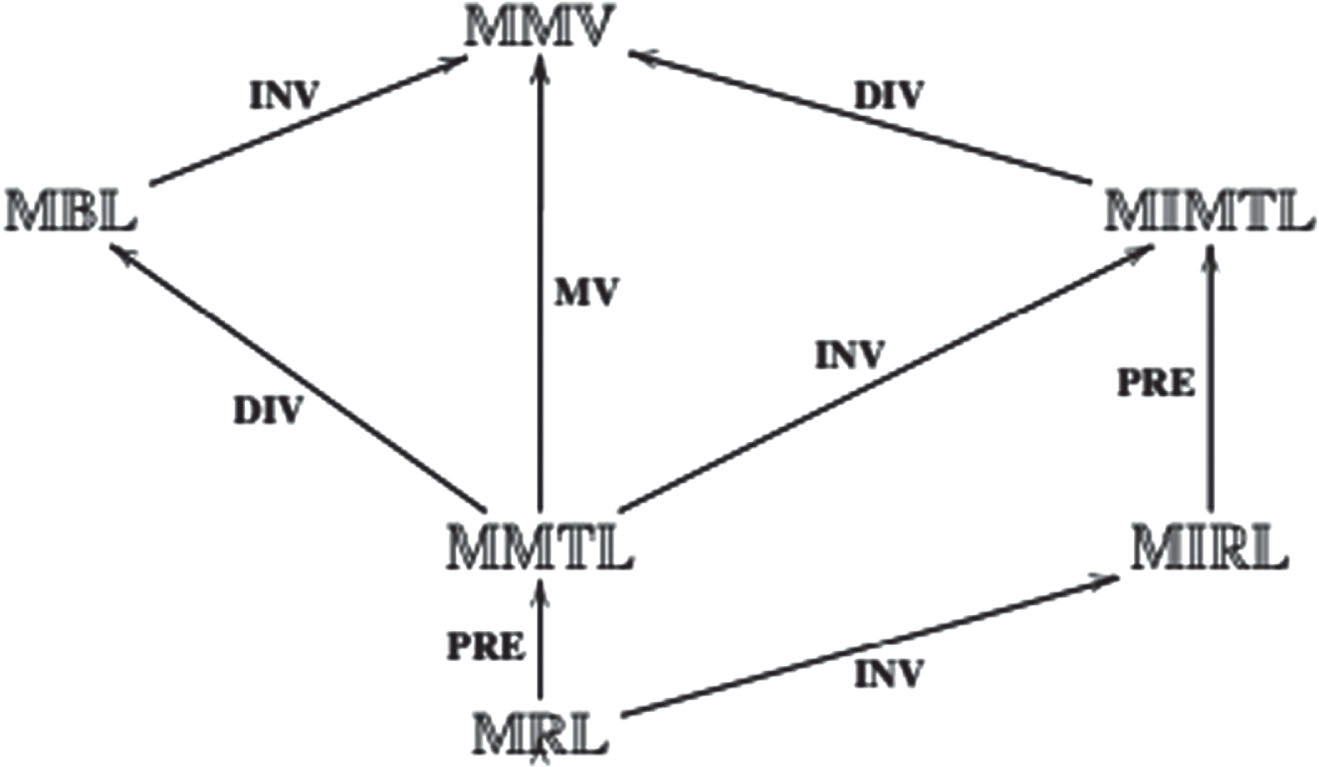
Relations between monadic algebras of substructural fuzzy logics.
Then we recall some results on monadic filters of monadic residuated lattices in [21].
Given a monadic residuated lattice (L, ∀ , ∃), a filter F is called a monadic filter of (L, ∀ , ∃) if it closed under ∀. A proper monadic filter F of (L, ∀ , ∃) is called a maximal monadic filter if it is not strictly contained in any proper monadic filter of (L, ∀ , ∃). For any nonempty subset X of L, we denote by 〈X〉∀ the monadic filter of (L, ∀ , ∃) generated by X, that is, 〈X〉∀ is the smallest monadic filter of (L, ∀ , ∃) containing X. Indeed, 〈X〉∀ = {x ∈ L|x ≥ ∀ x1 ⊙ ∀ x2 ⊙ ⋯ ⊙ ∀ x n , x i ∈ X, n ≥ 1}. In particular, 〈a〉∀ = {x ∈ L|x ≥ (∀ a) n , n ≥ 1}.
Also, if F is a monadic filter of (L, ∀) and x ∉ F, then we put 〈F, x〉∀ : = 〈F ⊔ {x} 〉∀ = {y ∈ L|x ≥ f ⊙ (∀ x) n , f ∈ F} = F ⊔ [∀ x).
The intersection of all maximal monadic filters of a monadic residuated lattice (L, ∀ , ∃) is called the radical of (L, ∀ , ∃) and it is denoted by Rad (L, ∀ , ∃). Also, let F be a proper state monadic filter of a state monadic residuated lattice (L, ∀ , ∃ , τ). Then the intersection of all maximal state monadic filters of (L, ∀ , ∃ , τ) obtaining F is called the radical of F and is denoted by Rad (F).
In this section, we introduce the notion of internal states on monadic residuated lattice and investigate some of their algebraic properties.
(SM1) τ (0) =0,
(SM2) τ (a → b) ⩽ τ (a) → τ (b),
(SM3) τ (a → b) = τ (a) → τ (a ⊓ b),
(SM4) τ (τ (a) ⊗ τ (b)) = τ (a) ⊗ τ (b),
(SM5) τ (τ (a) ⊔ τ (b)) = τ (a) ⊔ τ (b),
(SM6) τ (τ (a) ⊓ τ (b)) = τ (a) ⊓ τ (b),
(SM7) τ (∀ a) = ∀ τ (a),
(SM8) τ (∃ a) = ∃ τ (a).
The pair (L, ∀ , ∃ , τ) is said to be a state monadic residuated lattice. State monadic residuated lattices form a variety that we will denote by 𝕊𝕄ℝ𝕃 and for simplicity, if L is a residuated lattice and we enrich it with a state monadic structure, we denote the resulting algebra by (L, ∀ , ∃ , τ). It is immediate to see that for each proper subvariety S of residuated lattices the algebras in 𝕊𝕄ℝ𝕃 whose RL-reducts are in 𝕊 form a proper subvariety 𝕊𝕄 of 𝕊𝕄ℝ𝕃. These algebras will be called state monadic S-algebras.
Let (L, ∀ , ∃ , τ) be a state monadic residuated lattice. Denote Ker0 (τ) = {a ∈ L ∣ τ (a) =1},
Ker∀ (τ) = {a ∈ L ∣ τ (∀ a) =1},
Ker∃ (τ) = {a ∈ L ∣ τ (∃ a) =1}. The internal state τ is said to be 0-faithful, if Ker0 (τ) = {1},
∀-faithful, if Ker∀ (τ) = {1},
∃-faithful, if Ker∃ (τ) = {1}.
Then (L, ⊔ , ⊓ , ⊗ , → , 0, 1) is a residuated lattice.
Consider the mappings ∀ j , ∃ k , τ i : (L, ∀ , ∃ , τ) → (L, ∀ , ∃ , τ), j = 1, 2, 3, k = 1, 2, 3, i = 1, ⋯ 6, given in the tables below
Then we have
(1) (∀ i , ∃ i ) , i = 1, 2, 3 are all pairs forming monadic residuated lattices (L, ∀ i , ∃ i ). The structures (L, ∀ i , ∃ i ) , i = 1, 2, 3 are monadic residuated lattices.
(2) The mappings τ i , i = 1, ⋯ , 6 are all internal states on the residuated lattices (L, τ). The structures (L, τ i ) , i = 1, ⋯ , 6 are state residuated lattices.
(3) The following structures are all state monadic residuated lattices (L, ∀ 3, ∃ 3, τ1) , (L, ∀ 1, ∃ 1, τ2) , (L, ∀ 2, ∃ 2, τ2) ,
(L, ∀ 3, ∃ 3, τ2) , (L, ∀ 3, ∃ 3, τ3) , (L, ∀ 3, ∃ 3, τ4) ,
(L, ∀ 3, ∃ 3, τ5) , (L, ∀ 2, ∃ 2, τ6) , (L, ∀ 3, ∃ 3, τ6) .
({0, c, 1} , ⊓ , ⊔ , ⊗ , → , ∀ 3, ∃ 3, τ1),
({0, c, a, b, 1} , ⊓ , ⊔ , ⊗ , → , ∀ 1, ∃ 1, τ2),
({0, c, a, b, 1} , ⊓ , ⊔ , ⊗ , → , ∀ 2, ∃ 2, τ2),
({0, c, a, b, 1} , ⊓ , ⊔ , ⊗ , → , ∀ 3, ∃ 3, τ2),
({0, c, 1} , ⊓ , ⊔ , ⊗ , → , ∀ 3, ∃ 3, τ3),
({0, a, 1} , ⊓ , ⊔ , ⊗ , → , ∀ 3, ∃ 3, τ4),
({0, b, 1} , ⊓ , ⊔ , ⊗ , → , ∀ 3, ∃ 3, τ5),
({0, 1} , ⊓ , ⊔ , ⊗ , → , ∀ 2, ∃ 2, τ6),
({0, 1} , ⊓ , ⊔ , ⊗ , → , ∀ 3, ∃ 3, τ6), are subalgebras of state monadic residuated lattices in Example 3.3(3), respectively.
(1) τ (1) =1,
(2) τ (¬ a) = ¬ τ (a),
(3) If a ⩽ b, then τ (a) ⩽ τ (b),
(4) τ (a ⊗ b) ⩾ τ (a) ⊗ τ (b). In particular, if a ⊗ b = 0, then τ (a ⊗ b) = τ (a) ⊗ τ (b),
(5) τ (a → b) ⩽ τ (a) → τ (b). In particular, if a, b are comparable, then τ (a → b) = τ (a) → τ (b),
(6) τ2 (a) = τ (a), where τ2 (a) = τ (τ (a)),
(7) (τ (L) , ∀ , ∃ , τ) is a subalgebra of state monadic residuated lattice (L, ∀ , ∃ , τ),
(8) τ (L) = {a ∈ L ∣ a = τ (a)},
(9) If ord (a)< ∞, then ord (τ (a)) ⩽ ord (a), and in monadic residuated lattices we have τ (a) ∉ Rad (L),
(10) τ (a → b) = τ (a) → τ (b) if and only if τ (b → a) = τ (b) → τ (a),
(11) If τ (L) = L, then τ is identity on L,
(12) If τ is faithful and a < b, then τ (a) < τ (b),
(13) If τ is faithful, then either τ (a) = a or τ (a) and a are not comparable,
(14) If L is linear and τ faithful, then τ (a) = a, for all a ∈ L,
(15) τ ((∀ a ⊗ τ (∀ a)) n ) ⩾ (τ (∀ a)) 2n, for n ⩾ 1,
(16) ∀a = 1 if and only if a = 1, and ∃a = 0 if and only if a = 0,
(17) a ∈ Ker∀ (τ) if and only if ∀a ∈ Ker∀ (τ),
(18) If a ∈ Ker (τ), then ∃a ∈ Ker∀ (τ).
(15) By (4) and (6) we have τ ((∀ a ⊗ τ (∀ a)) n ) ⩾ (τ (∀ a ⊗ τ (∀ a))) n ⩾ (τ (∀ a) ⊗ τ τ (∀ a)) n = (τ (∀ a)) 2n.
(16) Form ∀a = 1 we have 1 = ∀ a ⩽ a, that is a = 1. On the other hand ∀1 =1, hence ∀a = 1 if and only if a = 1. Similarly, ∃a = 0 implies a ⩽ ∃ a = 0. Since ∃0 =0, ∃a = 0 if and only if a = 0.
(17) a ∈ Ker∀ (τ) if and only if τ (∀ a) =1 if and only if ∀ (τ (∀ a)) =1 if and only if τ (∀∀ a) =1 if and only if ∀a ∈ Ker∀ (τ) .
(18) Since ∀a ⩽ a ⩽ ∃ a, we have 1 = τ (∀ a) ⩽ τ (∃ a). It follows that τ (∃ a) =1, so τ (∀ ∃ a) =1. Hence ∃a ∈ Ker∀ (τ). □
(i) τ (a ⊓ b) = τ (a) ⊓ τ (b) if and only if τ (a → b) = τ (a) → τ (b) ,
(ii) τ (a ⊔ b) = τ (a) ⊔ τ (b) if and only if τ (a → b) = τ (a) → τ (b) ,
(iii) If τ (a → b) = τ (a) → τ (b), then τ (a ⊗ b) = τ (a) ⊗ τ (b) .
for any a, b ∈ L. But L is not a linearly ordered residuated lattice.
(1) τ (a) = τ (∀ b) , for some b ∈ L,
(2) τ (a) = τ (∃ b) , for some b ∈ L,
(3) τ (a) = τ (∀ a),
(4) τ (a) = τ (∃ a),
(5) τ (∀ a) = τ (∃ a).
(1) ⇒ (2) If τ (a) = τ (∀ (b)), then τ (a) = ∀ τ (b) = ∃ ∀ τ (b) = τ (∃ ∀ b).
(2) ⇒ (3) If τ (a) = τ (∃ b) , then τ (∀ a) = ∀ τ (a) = ∀ (τ ∃ b) = ∀ ∃ τ (b) = ∃ τ (b) = τ (∃ b) = τ (a) .
(3) ⇒ (4) If τ (a) = τ (∀ a) , then τ (∃ a) = ∃ τ (a) = ∃ (τ ∀ a) = ∃ ∀ τ (a) = ∀ τ (a) = τ (∀ a) = τ (a) .
(4) ⇒ (5) If τ (a) = τ (∃ a) , then τ (∀ a) = ∀ τ (a) = ∀ (τ ∃ a) = ∀ ∃ τ (a) = ∃ τ (a) = τ (∃ a) = τ (a) .
(5) ⇒ (1) If τ (∀ a) = τ (∃ a) , by ∀τ (a) ⩽ τ (a) ⩽ ∃ τ (a), then τ (a) = τ (∀ a). Hence τ (a) = τ (∀ b). □
(1) ∃ (τ (a) → τ (b)) ⩽ ∀ τ (a) → ∃ τ (b),
(2) ∀ (∀ τ (a) → τ (b)) = ∀ τ (a) → ∀ τ (b),
(3) τ (∀ (¬ a)) = ¬ ∃ τ (a) and τ (∃ (¬ a)) ⩽ ¬ ∀ τ (a).
Thus by Proposition 2.5(7),we have ∀τ (a) → ∃ τ (b) = ∃ (∃ τ (a) → ∃ τ (b)). Furthermore, we have τ (a) → τ (b) ⩽ ∀ τ (a) → ∃ τ (b), and hence ∃ (τ (a) → τ (b)) ⩽ ∃ (∀ τ (a) → ∃ τ (b)) = ∀ τ (a) → ∃ τ (b).
(2) The proof is a result of Proposition 3.9(10).
(3) By Definition 2.4(M3), we have ∀ (¬ a) = ¬ (∃ a) . Also, by Proposition 2.5(18), we have ∃ (¬ a) ⩽ ¬ (∀ a), and hence τ (∀ (¬ a)) = τ (¬ (∃ a)), τ (∃ (¬ a)) ⩽ τ (¬ (∀ a)).
By Proposition 2.5(2) and 3.9(2), we have τ (∀ (¬ a)) = τ (¬ (∃ a)) = ¬ (τ (∃ a)) = ¬ (∃ τ (a)),
τ (∃ (¬ a)) ⩽ τ (¬ (∀ a)) = ¬ τ (∀ a) = ¬ ∀ τ (a). □ We can also define state monadic MTL-algebras, state monadic BL-algebras, state monadic IMTL-algebras, state monadic MV-algebras, respectively, which are similar to Definition 3.1, and here hence we omit the exact definition of them.
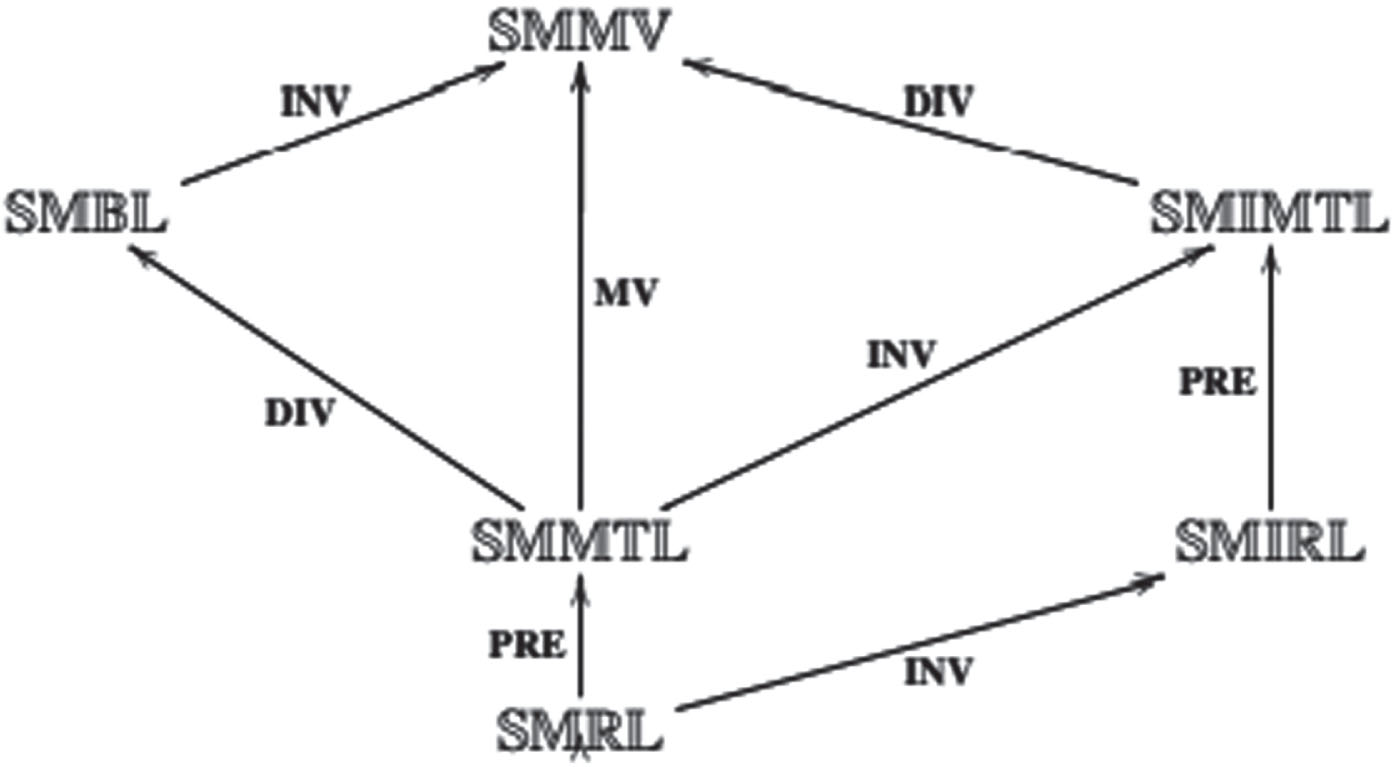
Relations between state monadic algebras of substructural fuzzy logics.
In this section, we introduce the notion of state monadic filter of a state monadic residuated lattice and characterize the state monadic filter generated by a nonempty subset, and also give some characterization of maximal and prime state monadic filters.
(F1) 1 ∈ F,
(F2) a ∈ F and a → b ∈ F imply b ∈ F,
(F3) ∀a ∈ F, for all a ∈ F,
(F4) τ (∀ a) ∈ F, for all a ∈ F.
A state monadic filter F of (L, ∀ , ∃ , τ) is called a proper state monadic filter if F ≠ L. A proper state monadic filter F of (L, ∀ , ∃ , τ) is called a maximal state monadic filter if it not strictly contained in any proper state monadic filter. We will denote the set of all state monadic filters of (L, ∀ , ∃ , τ) by F τ (L). We also denote the set of all maximal state monadic filters of (L, ∀ , ∃ , τ) by Max τ (L) and Rad τ (L) = ∩ F∈Max τ (L)F.
(i) If Ker (τ) ⊆ B (L), then B (L/Ker (τ)) = B (L)/Ker (τ).
(ii) If a is a nilpotent element of (L, ∀ , ∃), then a/Ker (τ) is a nilpotent element of L/Ker (τ).
(1) [a) τ = {x ∈ L | x ≥ (∀ a ⊗ τ (∀ a)) n , n ≥ 1},
(2) if a ≤ b, then [b) τ ⊆ [a) τ ,
(3) [τ (a)) τ ⊆ [a) τ ,
(4) [a) τ = [∀ a ⊗ τ (∀ a)) τ ,
(5) [[a) τ ∪ [b) τ ) τ = [a) τ ⊔ [b) τ = [(∀ a ⊗ τ (∀ a)) ⊗ (∀ b ⊗ τ (∀ b))) τ ,
(6) [a) τ ∩ [b) τ = [(∀ a ⊗ τ (∀ a)) ⊔ (∀ b ⊗ τ (∀ b))) τ .
(1) In (L, ∀ 3, ∃ 3, τ3), we have [a) τ 3 = {a, 1} ⊈ [τ3 (a)) τ 3 = [1) τ 3 = {1}.
(2) In (L, ∀ 2, ∃ 2, τ2) , [a)
τ
2
= [b)
τ
2
, but neither a ≤ b, nor b ≤ a hold.
(1) [F, a) τ = {x ∈ L | x ≥ f ⊗ (∀ a ⊗ τ (∀ a)) n , for some f ∈ F, n ≥ 1},
(2) [F1 ∪ F2)
τ
= {x ∈ L | x ≥ f1 ⊗ f2, f1 ∈ F1, f2 ∈ F2}.
(i) F is a maximal state monadic filter (L, ∀ , ∃ , τ),
(ii) for any a ∈ L ∖ F, there are f ∈ F and n ≥ 1 such that f ⊗ (τ (∀ a)) n = 0,
(iii) for any a ∈ L ∖ F, there is n ≥ 1 such that ¬ (τ (∀ a))
n
∈ F.
(i) If F is a (maximal) monadic filter of (τ (L) , ∀ , ∃), then τ-1 (F) is a (maximal) state monadic filter of (L, ∀ , ∃ , τ),
(ii) If F is a (maximal) state monadic filter of (L, ∀ , ∃ , τ), then τ (F) is a (maximal) monadic filter of (τ (L) , ∀ , ∃).
(i) If P1, P2 ∈ F τ (L) and P = P1 ∩ P2, then P = P1 or P = P2,
(ii) P∈ Spec
τ
(L).
we get x ∈ P. Hence P = P1 ∩ P2, so that P = P1 or P = P2, that is a ∈ P or b ∈ P. (ii) ⇒ (i) Let P1, P2 ∈ F τ (L) such that P = P1 ∩ P2. If P ≠ P1 and P ≠ P2, then there are a ∈ P1 ∖ P, b ∈ P2 ∖ P, so that ∀a ⊗ τ (∀ a) ∈ P1, ∀ b ⊗ τ (∀ b) ∈ P2.
Thus (∀ a ⊗ τ (∀ a)) ⊔ (∀ b ⊗ τ (∀ b)) ∈ P1 ∩ P2 = P. It follows that a ∈ P or b ∈ P, which is a contradiction. Thus P = P1 or P = P2. □
□
(i) There is P∈ Spec τ (L) such that F ⊆ P and a ∉ P.
(ii) F = ∩ P∈Spec τ (L),F⊆PP,
(iii) F = ∩ P∈Spec τ (L)P = {1}.
(ii) Clearly, F ⊆ ∩ P∈Spec τ (L),F⊆PP. Conversely, if a ∈ ∩ P∈Spec τ (L),F⊆PP and a ∉ F, then from (i) that there is P∈ Spec τ (L) such that F ⊆ P and a ∉ P, which is a contradiction.
(iii) It follows from (i), for F = {1}. □
(i) P∈ Spec τ (L),
(ii) for every a, b ∈ L for which ∀a ⊗ τ (∀ a) , ∀ b ⊗ τ (∀ b) ∈ L ∖ P,there is c ∈ L ∖ P such that ∀a ⊗ τ (∀ a) ≤ c and ∀b ⊗ τ (∀ b) ≤ c,
(iii) if [a)
τ
∩ [b)
τ
⊆ P, then a ∈ P or b ∈ P.
Conversely, let a, b ∈ L such that (∀ a ⊗ τ (∀ a)) ⊔ (∀ b ⊗ τ (∀ b)) ∈ P, a ∉ P and b ∉ P. Then ∀a ⊗ τ (∀ a) , ∀ b ⊗ (τ (∀ b) ∈ L ∖ P. So there is c ∈ L ∖ P such that ∀a ⊗ τ (∀ a) ≤ c and ∀b ⊗ τ (∀ b) ≤ c. Hence (∀ a ⊗ τ (∀ a)) ⊔ (∀ b ⊗ τ (∀ b)) ≤ c, that is c ∈ P, which is a contradiction.
(i) ⇔ (iii) By Proposition 4.7 (6), we have [a) τ ∩ [b) τ = [(∀ a ⊗ τ (∀ a)) ⊔ (∀ b ⊗ τ (∀ b))) τ . Thus (∀ a ⊗ τ (∀ a)) ⊔ (∀ b ⊗ τ (∀ b)) ∈ P and a ∈ P or b ∈ P.
Conversely, if (∀ a ⊗ τ (∀ b)) ⊔ (∀ b ⊗ τ (∀ b)) ∈ P, a, b ∈ L, then [(∀ a ⊗ τ (∀ a)) ⊔ (∀ b ⊗ τ (∀ b))) τ ⊆ P. Hence [a) τ ∩ [b) τ ⊆ P and a ∈ P or b ∈ P, so that P∈ Spec τ (L). □
Some classes of state monadic residuated lattices
In this section, as an application of state monadic filters, we characterize the simple, semisimple and local state monadic residuated lattices.
Conversely, let F ∈ Max
τ
(L). We must prove that F ∩ τ (L) ∈ Max (τ (L)). If F ∩ τ (L) = τ (L), then 0 ∈ F, which is a contradiction. Thus F ∩ τ (L) is a proper state monadic filter, and so there is a ∈ τ (L) ∖ (F ∩ τ (L)) = τ (L) ∖ F. Since F ∈ Max
τ
(L), by Theorem 4.10, there are f ∈ F and n ≥ 1 such that f ⊗ (τ (∀ a))
n
= 0. Thus τ (f ⊗ (τ (∀ a))
n
) =0 and so τ (f) ⊗ (τ (∀ a))
n
= 0. Since τ (a) = a, τ (f) ⊗ (∀ a)
n
= 0. We know that τ (f) ∈ F ∩ τ (L) so F ∩ τ (L) ∈ Max (τ (L)). We define Q : Max
τ
(L) ⟶ Max (τ (L)) by Q (F) = F ∩ τ (L). Let F1, F2 ∈ Max
τ
(L) such that Q (F1) = Q (F2). Suppose that there is a ∈ F1 ∖ F2. Since a ∈ F1, τ (a) ∈ F1. So τ (a) ∈ F1 ∩ τ (L) = F2 ∩ τ (L). Thus τ (a) ∈ F2. Since a ∉ F2, from the maximality of F2, there are n ≥ 1 and f ∈ F2 such that f ⊗ (∀ τ (a))
n
= f ⊗ (τ (∀ a))
n
= 0. But f ⊗ (τ (∀ a))
n
∈ F2 thus 0 ∈ F2 and F2 = L, which is a contradiction. Therefore F1 ⊆ F2, similarly F2 ⊆ F1 so F1 = F2. Hence Q is injective and |Max
τ
(L) | ≤ |Max (τ (L)) |. □
□
(i) (L, ∀ , ∃ , τ) is simple relative to F τ (L),
(ii) (L, ∀ , ∃ , τ) is simple and τ is faithful.
(ii) ⇒ (i) Let F ∈ F
τ
(L), F ≠ {1}. Then τ (F) = F ∩ τ (L) is a monadic filter of τ (L). Since τ (L) is simple, τ (F) = {1} or τ (F) = τ (L). But τ is faithful and F ≠ {1}. It follows that τ (F) ≠ {1}, hence τ (F) = τ (L). Thus 0 ∈ τ (F) and 0 ∈ F. Therefore F = L. □
Conversely, Rad (τ (L)) = τ (Rad
τ
(L)) = τ ({1}) = {1},so (L, ∀ , ∃ , τ) is semisimple. Let a ∈ L such that τ (a) =1. If a ≠ 1, then a ∉ Rad
τ
(L). There is a maximal state monadic filter M so that a ∉ M. By Theorem 4.10, there are f ∈ M and m, n ≥ 1 such that 0 = f ⊗ (τ (∀ a))
n
= f ⊗ (∀ (τ (a)))
n
= f. Therefore f = 0 and 0 ∈ M, a contradiction. So a = 1 and τ is faithful. □
□
Conclusions and future research topics
Motivated by previous research on monadic and state residuated lattices, we further investigated algebraic properties of state monadic residuated lattices. In this paper, we introduced the notion of state monadic residuated lattice and study some of their algebraic properties and discuss the relationship between state monadic residuated lattice and other state monadic fuzzy logical algebras. Then we studied state monadic filter of state monadic residuated lattices and give some characterizations of them. Since the above topics are of current interest, we suggest further directions of research: Introducing and studying state polyadic residuated lattices, namely generalizations of state monadic residuated lattices given by polyadic structures. Focusing on varieties of state monadic residuated lattices. In particular, one can investigate locally finite, finitely approximated and splitting varieties of state monadic residuated lattices as well as varieties with the disjunction and existence properties.
Footnotes
Acknowledgments
The authors are extremely grateful to the editor and the referees for their valuable comments and helpful suggestions which help to improve the presentation of this paper. This work is supported by the National Natural Science Foundation of China (12001423,12171294,61976244,11961016), Natural Science Foundation of Shaanxi Province (2020JQ-762,2021JQ-580,2021JQ-579), and Natural Science Foundation of Education Committee of Shannxi Province (21JK0963) and Innovation and entrepreneurship training program for college students in Shaanxi Province (S202110705129).
is an MV-algebra if it is an MTL-algebra and satisfies (MV) (a → b) → b = (b → a) → a.