



Abstract
With the spread of the COVID-19 pandemic, the importance of online learning has grown up worldwide and many higher education institutions used this mode of learning to save the timings of students. Just Online learning does not fulfill all the learning requirements of undergraduate students, therefore, there is a need for the blended learning (BL) method to be adopted in higher educational institutes for the enhancement of students’ learning outcomes. This research paper focuses on the development of an integrated blended learning model and the performance of the model on students’ learning has been predicted using a Bayesian network (BN) classifier. The proposed model is based on the medium impact blend of the Rotation model and the Enriched Virtual Model and applied to undergraduate computing students. The Data Structures and Algorithms course is targeted for the prediction of students’ performance. The findings of the proposed Integrated BL model show that when students properly attend the classroom lectures followed by their associated lab practical in the Rotation Model and follow the online learning activities in the Enriched Virtual Model properly, then their learning outcomes may be increased as predicted using BN method. The proposed model also reports an overall accuracy of 88.5% on the collected data.
Keywords
Introduction
Technology enriched learning is a latest research area that tends to the utilization of ICT within the perspective of collaborative learning [1, 2]. These days the use of Artificial Intelligence (AI) in learning has become significant around the world. The information required by the students has become accessible through the usage of Learning Management Systems. Teachers assess the online activities by analyzing the information from the logs and reports in such frameworks. The online students’ participation in forums and chats and students’ improvement can be easily monitored and give remarkable awareness to improve the ways of the teaching [3–5]. The research scholars use numerous data mining techniques to investigate the raw data gathered in server logs and extract significant information about the behavior and learning procedures of students. Data mining approaches like neural networks, decision trees, and Bayesian networks have been widely used in academia for educational data mining [6, 7]. The utilization of AI in learning allows teachers to examine data mined from the servers of the university and identify students’ behavior patterns and develop facilitations for struggling students [8]. Data Structures and Algorithms course is the backbone of the computer software development process. However, the abstract and logical concepts of the course are difficult to explain and to be learned by students via the traditional teaching approaches such as lecture slides and board code illustrations. The current practice is time-consuming and boring as the code illustrations require repetitive updating to denote new inputs and alterations of the algorithm [9]. With the introduction of the Integrated Blended Learning Model in the current teaching and learning practice, the instructors might be able to explain DSAs concepts more clearly and interactively without any issue of spending hours in making slides and drawing cluttered instances of algorithms by their hands.
Literature review
Nowadays with the expansion of technology the ways of education are moving from traditional learning to modern online learning styles [10]. The instructors must implement various latest learning methods to prepare the learners for their career development and also improve the students’ learning outcomes, grades, and enthusiasm for learning [11]. Most of the researchers believed that the blend of on-campus and online learning (Blended Learning) has the strength to transform higher education, as it can enhance learning outcomes efficiently [12, 13]. The authors proposed an idea for designing a predictive model dependent on a Bayesian network for the estimation of student failure with the end goal of their feasible anticipation by timely introducing strong supportive measures. The proposed approach is the viewpoint for the improvement of an early notification system for the different participants of the educational phase [14]. A flipped classroom is a blended learning method that allows the students first to learn the fundamental concepts online and then in a traditional classroom lecture. A blended course design requires defining the time frame an educator anticipates from students about spending time on the web. The purpose of an online tutor is to investigate web-based learning time frames. The authors identified the student’s weekly web-based learning behavior. By utilizing the K-means algorithm four groups of particular web-based learning behaviors are highlighted. The students’ group-wise performance is defined via week-by-week paper-based idea map posttests [15]. The Moodle server data is used to predict student success rate in the course, considering four learning workouts –correspondence thru emails, communication content creation with the help of wiki, and evaluation via online tests. Then a model dependent on a neural network is trained to forecast student performance in a blended learning course. The author claimed the students’ performance with a 98.3% classification rate [16].
The main task of the ITS (Intelligent Tutoring System) is to evaluate information acquisition by the students. Knowledge assessment is necessary to ad-just learning materials and exercises to students’ abilities [17–19]. The authors introduced a model based on a Bayesian network to predict the engineering students’ performance. The main task of the proposed model is to anticipate the students’ grades in three core subjects having a substantial effect on the retention rate of students. Prediction of students’ grading in these subjects can be useful for the identification of underachievers who require attention and the help of the instructor [20]. In the view of pandemic situations, there is a need for the Integrated Blended Learning approaches that support the Intelligent Tutoring Systems for the provision of higher education studies.
Proposed framework
The proposed framework is divided into various components as illustrated in Fig. 1.

Proposed Framework.
Exploration of Ingredients: The ingredients of the proposed integrated blended learning model are explored through a detailed literature survey.
Integrated Blended Model: The Rotation Model and the Virtual Model of the Blended Learning Taxonomy are explored as the possible ingredients of the proposed Integrated Blended Model.
Data Collection: The students’ exam results of the Data Structures and Algorithms course are collected for the training and testing of the Bayesian network classifier.
Bayesian network Model: A Bayesian network is a decision network. It is a probabilistic graphical representation model that denotes a group of variables and their conditional dependencies through a DAG (Directed Acyclic Graph). Bayes Networks are essential for predicting the probability of various identified causes [21, 22]. We have used a Bayesian network classifier for the prediction of the students’ performance. The main point is that when using a BN model whose graphical configuration often reflects the cause-and-effect relationship structure of a particular area, is a condensed demonstration of a joint probability table when the DAG is comparatively sparse. In a given particular BN model, each random variable (or node) has a finite number of states and edges and is parameterized as a probability value by a conditional probability table (CPT) [23].
Knowledge Model: The knowledge model contains the knowledge rules for the interpretation of the results.
Interpretation of Results: The results are interpreted as “Yes” and “No” where “Yes” shows the good performance and “No” shows the poor performance of the students. If the probability of the proposed BN system is less than 60%, this shows the very poor performance of the students, while the probability of more than 60% shows the good performance of the students.
Performance Prediction: The performance of the proposed integrated BL model is predicted using BN.
Data description
Table 1 shows the complete description of the data. The exam results of 500 undergraduate students were collected from the QUEST & SBBU, Nawabshah. The 300 samples were used for the training of the Bayesian network and 200 samples were used for testing the trained model.
Data Description
Data Description
In “The rise of K–12 blended learning” report, the authors recognized the six core blended learning models which are: 1. Face-to-Face Driver 2. Rotation 3. Flex 4. Online Lab 5. Self-Blend 6. Online Driver [24]. The six blended models are reduced to four models as the face-to-face driver model and online lab model seem to identify other models [25]. The condensed Blended learning Taxonomy is proposed later on, that consists of the four blended learning models that are Rotation Model, Flex Model, Self-Blend Model, and the Enriched Virtual Model [26]. In the rotation model, students switch between various learning modes on a fixed timetable and at least one of the modes is online learning [27]. The rotation model is further divided into four other models. In the Flex model, the learning is mainly done online with on-site instructor support if needed [28]. In the Enriched Virtual Model, the learners distribute their time between on-campus learning and remote learning via online content delivery [29]. In the Self-Blend model, the learners enrich traditional classroom learning by taking online classes [30]. The integration of Blended learning models is based on three design approaches. These are low, medium, and high impact blends for creating blended courses in higher education institutes: The low impact blend is selected when the instructor has no prior experience of developing blended learning courses, no experience of traditional teaching method, and no institutional support is required for designing a blended learning course. The medium-impact blend is chosen when the instructor has developed and designed a blended learning course, the experience of traditional teaching has good information of integrating technology, and also institutional support is required for designing a blended learning course. The high impact blend is selected when the instructor has several years’ experience of designing blended courses and teaching traditional courses as well, strong information of integrating technology and also high support from the institution is required for designing a blended learning course [31]. The medium-impact blend is the need of our educational institutes based on the considerable changes to the current teaching program, infrastructure, technology, and learning capabilities of students. Among the four blended learning models, the integration of only rotation and virtual models is possible according to the available resources and current learning practice in higher education. Figure 2 shows the proposed Integrated Blended Learning Model that is the medium impact blend of Rotation Model and Enriched Virtual Model based on the instructional practices and technology infrastructure.

Proposed Integrated Blended Learning Model.
Online activities diagram
Activity diagrams show the flow of online and physical classroom learning activities among the students and teachers. Figure 3. shows the online activities diagram model that consists various online learning activities as explained below:

Students’ Online Activities.
Online Lectures: Teachers conduct the online lectures through the MS Teams software that provides chat, call, meet and the collaborate facilities.
Chats: MS Teams software provides the chat facility where teachers and students communicate with each other for clarification of the concepts.
Online Courses: Online C/C++ is a prerequisite for passing the course.
Quiz/Test: Online quizzes are conducted at the end of every week.
Webinars: Online seminars and conferences are also organized for introducing the latest research trends and techniques in the computing field.
Figure 4 shows the offline activities diagram model that includes various activities as explained below.

Students’ Physical Class Room Activities.
Class Room Lectures: Teachers conduct the classroom lectures via chalk and talk method or PowerPoint presentation slides physically.
Practical Lab Sessions: The classroom lectures are followed by their associated practical sessions in a laboratory in the presence of teachers and lab instructors.
Collaborative Activities: Students are involved in many collaborative activities like algorithm writing, program creation, etc.
Group Projects: Students participate in the group projects as well for the assessment of the course learning.
Seminars: Seminars and workshops on the latest IT trends and technologies are organized in the department for keeping the students updated in the field.
Figure 5 shows the trained model of the proposed Rotational Model where probabilities have been calculated from the GPA of the students. The proposed Bayesian network for the learning outcomes of the Rotation Model consists four other sub rotation models. The sub-models are the Station Rotation Model, Flipped Class Room Model, Lab Rotation Model, and the Individual Rotation Model. The Station Rotation model includes online instruction, teacher-led instruction, forum discussions, and collaborative activities. The Flipped Class Room comprises teacher-led practice, home online instruction, and projects. Lab-Rotation Model consists of direct instruction and learning lab activities. The Individual Rotation Model involves group projects, direct instruction, intervention, and seminars. However, the combination of all four rotation models gives the overall learning outcomes of the proposed rotation model.

Proposed Bayesian network for Rotation Model.
Table 2 shows the students’ GPA relationship for prior probability.
Relationship b/w GPA and Probability Value
Relationship b/w GPA and Probability Value
Figure 6 shows the proposed Bayesian network for Enriched Virtual Model that comprises of online lectures, online courses, webinars and chat collaborations among the teachers and students. The Enriched Virtual model mainly depends on the online mode of learning.

Proposed Bayesian network for Enriched Virtual Model.
Figure 7. shows the proposed Integrated Blended Learning Model that is the medium impact blend of only two blended learning models i.e. Rotation Model and the Enriched Virtual Model.

Bayesian network for Proposed Integrated Blended Learning Model.
Table 3 shows the conditional probability table (CPT) of the proposed Integrated Blended Learning Model. As shown in the CPT, if the learning is done through the blend of the Rotation Model and Virtual Model, then the learning outcomes of the student are enhanced significantly. While, if the learning is provided only via any single model either Rotation or Virtual Model, the learning outcomes of the students are not as satisfactory as shown in the CPT.
CPT of Integrated Blended Learning Model
CPT of Integrated Blended Learning Model
Figure 8 shows the bar chart representation of the proposed Bayesian network for Rotation Model.

Bar Chart Representation of Rotation Model of a student.
Figure 9 shows the bar chart representation of the proposed Bayesian network for the Enriched Blended Virtual Model.
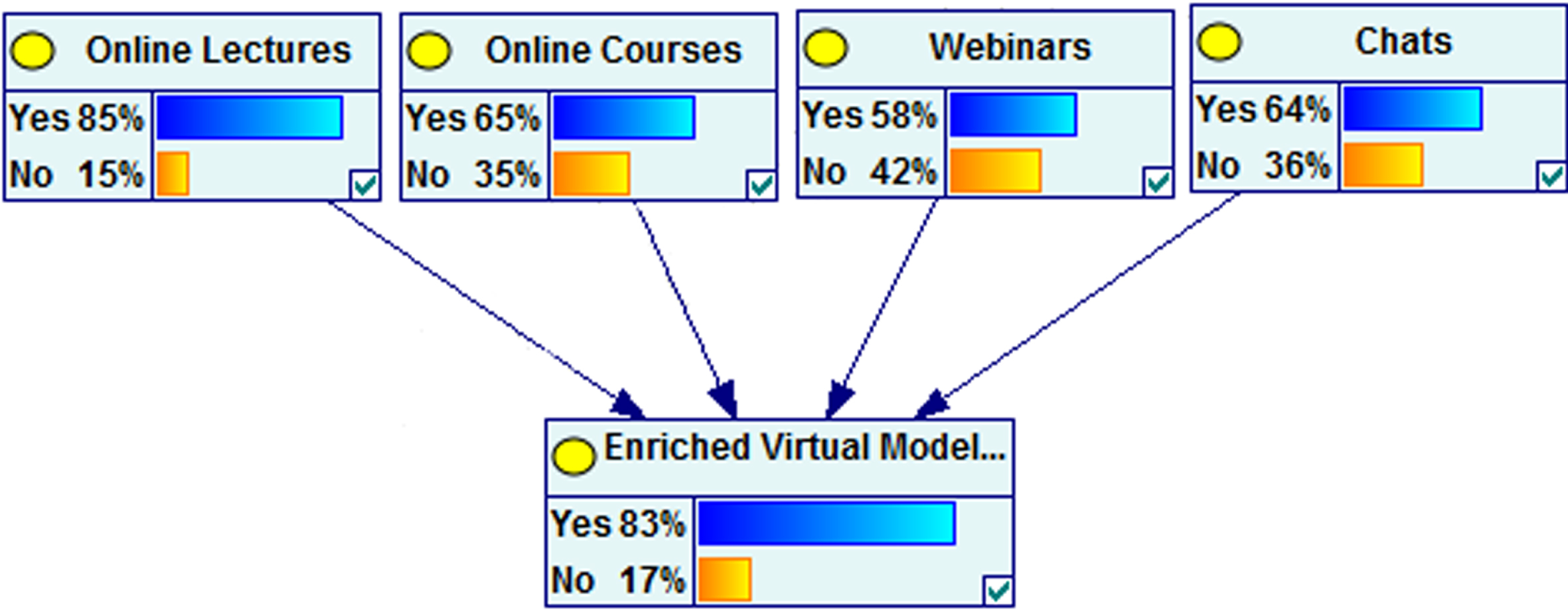
Bar Chart Representation of Enriched Blended Virtual Model of a student.
Figure 10 shows the bar chart representation of Bayesian network for the proposed Integrated Blended Learning model.
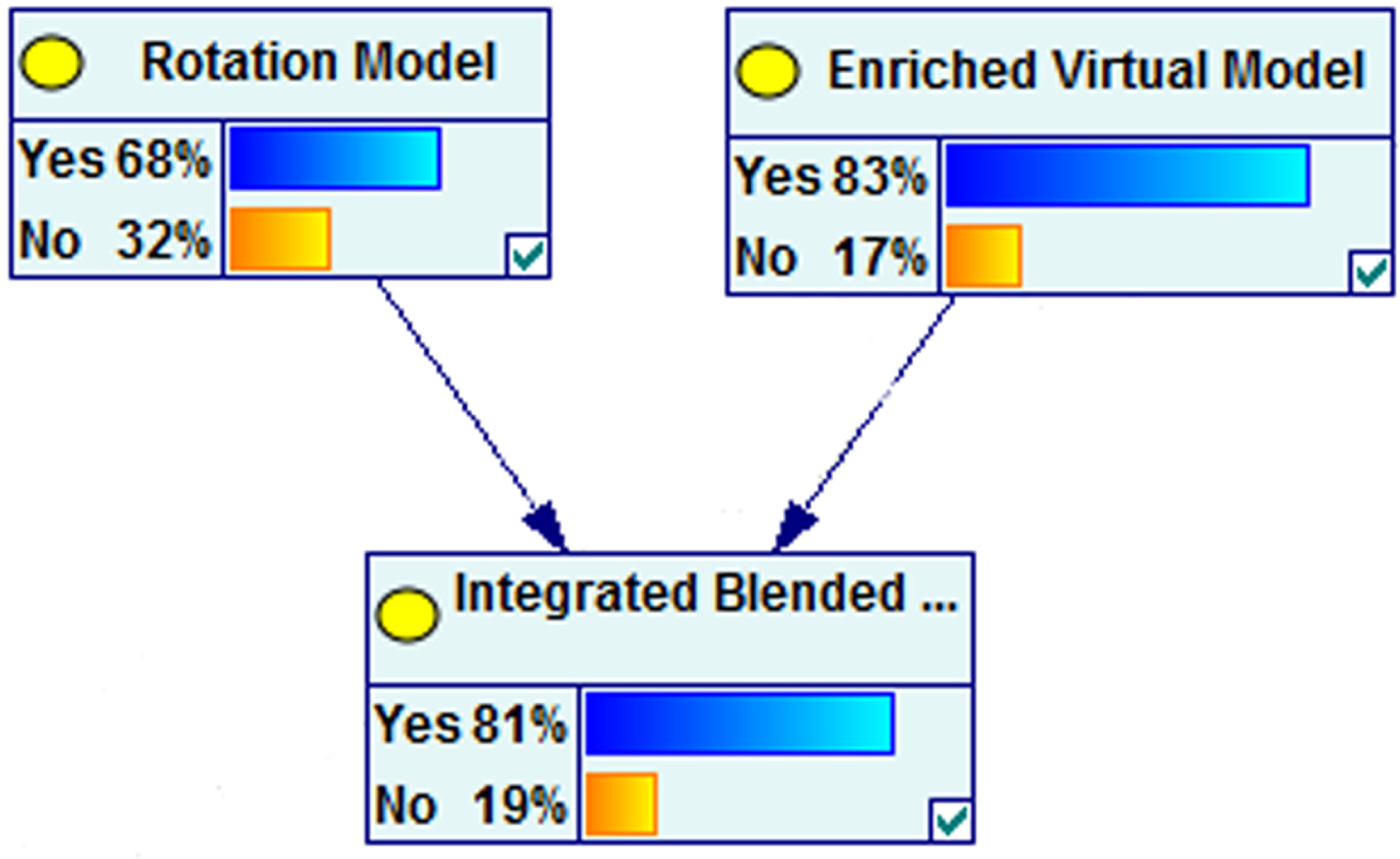
Bar Chart Representation of Integrated Blended Learning Model of a student.
After all online and offline activities, the final exams have been conducted and the results show that the integrated Blended Learning Model provides better results when evaluated using the Bayesian network Model. This shows that the Integrated Blended Learning Model may be much useful for the learning of undergraduate students in their future studies.
A confusion matrix tool is used to evaluate the proposed Blended Learning Model. The confusion matrix shows the correctly and incorrectly classified samples of particular test data. In this experiment, 200 samples of data were used to test the performance of the proposed model. The results of testing predict 177 true positives, 23 false-positives and reports 88.5% overall accuracy of the proposed Integrated Blended Learning Model using BN classifier as shown in Table 4.
Confusion Matrix showing Overall Performance of the proposed model
Confusion Matrix showing Overall Performance of the proposed model
Conclusion
The amount of research work done related to the design and use of BL is relatively very small. Still, more research is needed that will help instructors to understand the strengths and weaknesses of Blended learning methods and how to appropriately combine the different ingredients of the blends. The successful integration of the appropriate BL model in our educational institutes is a challenge that needs to be worked out. Therefore, the ingredients of the different blends need to be applied and important factors must be investigated when selecting appropriate and effective integration of different blends for the learning of the courses, especially the core computing subjects such as Data Structures and Algorithms. This paper presented the Integrated Blended Learning Bayesian Decision Network based model for evaluating students’ performance measurement and learning outcomes of the Data Structures and Algorithms course. The proposed model is based on a medium impact blend of the Rotation model and the Enriched Virtual model. The attributes of the virtual model are used to construct the network topology. GENIE/SMILE software has been used to report the results of the proposed BN model. Data were collected from 500 undergraduate computing students of the 2nd year. The results of this research study showed 88.5% overall accuracy of the proposed Integrated Blended Learning Model on students’ performance. To get better performance of the proposed model, more samples should be trained and tested. The blended learning model may be helpful for unpredicted situations like the current pandemic COVID-19 circumstances when the Blended learning systems are being adopted worldwide for the continuation of higher education.
Future recommendations
In the future, this research work may be extended to use more blended learning methods and sample size to achieve more and accurate results of the proposed model. The proposed model may also be applied as a base for the development of ITS (intelligent tutoring system) in the future.