



Abstract
With the increasing severity of the global energy crisis and environmental pollution, there is an urgent need to change the economic development model driven by certain factors and the investment scale and pursue science- and technology-driven innovative development. This study aims to improve the efficiency of scientific and technological innovation and promote the high-quality development of regional industrial enterprises. It constructs a data-driven DEA-Malmquist evaluation model to evaluate and optimize regional industrial enterprises’ scientific and technological innovation efficiency. First, we collect the panel data of regional industrial enterprises’ scientific and technological innovation input-output indexes. Second, we use the Pearson correlation coefficient method to identify and construct the evaluation index system of regional industrial enterprises’ scientific and technological innovation efficiency. Third, we build a DEA-Malmquist evaluation model to quantitatively evaluate regional industrial enterprises’ scientific and technological innovation efficiency from static and dynamic aspects. Finally, we verify the feasibility and effectiveness of the method using statistical data on scientific and technological innovation and development of Anhui industrial enterprises from 2011 to 2019 and put forth targeted countermeasures and suggestions. This study provides theoretical and methodological support for the sustainable development of industrial enterprises.
Keywords
Introduction
With the increasing severity of the global energy crisis and environmental pollution, there is an urgent need to change the economic development model driven by certain factors and the investment scale and pursue science- and technology-driven innovative development. To meet the challenges of carbon peak and carbon neutralization [1] and realize the high-quality and sustainable development of the global economy [2]. With the United States’ innovation strategy, Japan’s innovation 25 strategies, South Korea’s vision 2025, and China’s Made in China 2025, countries worldwide have strengthened the deployment of innovation strategy and placed it at the core of the overall national development context. Improving the ability of scientific and technological innovation has become the core content in the development of the world’s nations [3]. In the process of science- and technology-driven innovation development, we should pay attention to the scale and quantity of input and output of scientific and technological innovation resources and the efficiency of scientific and technological innovation. As the core subject in the composition of regional innovation systems, industrial enterprises occupy an important position in regional economic growth. They are among the important entry points to promote innovation and green and high-quality development [4]. Therefore, improving industrial enterprises’ scientific and technological innovation efficiency is a hard-core engine to promote the high-quality development of national and regional economies, which is critical for realizing the sustainable development of a country and region.
At present, scholars primarily study the efficiency of scientific and technological innovation from the perspectives of index system construction [5, 6], evaluation method selection [7], and so on. Regarding index system construction, scholars mostly construct an evaluation index system of scientific and technological innovation efficiency from the perspective of input-output [5, 8]. R&D personnel [9], R&D funds, and internal expenditures [10] are often selected as input indexes. Output indexes often select the number of invention patents [11, 12] and sales revenue of new products [13]. Lin et al. [14] used three input indexes—R&D personnel, internal expenditure of R&D funds, and technological transformation expenditure—and two output indexes—the number of invention patent applications and the sales revenue of new products—to build an evaluation index system to evaluate the scientific and technological innovation efficiency of high-tech industries. Guan and Zuo [15] constructed an evaluation index system for scientific and technological innovation from the two aspects of the knowledge-production and -commercialization processes.
In the selection of evaluation methods, the factor analysis method [16], analytic hierarchy process [17, 18], and fuzzy comprehensive evaluation method [19, 20],OLS regression model [21], fuzzy multi-attribute group decision making meth [22], DEA [23, 24],SFA [25]are widely used. The latter two methods are the most popular methods to measure the efficiency of scientific and technological innovation. They make the same behavioral assumptions when measuring the frontier. SFA is a parameter estimation method, and DEA is a nonparametric method. Compared with the two, SFA includes the measurement error into the efficiency measurement, while DEA does not. The output of DEA is generally unstable and requires high-quality data. How to obtain high-quality data has become the key to DEA application.
DEA was proposed by Charnes et al. (CCR model) [26], developed by Banker et al. (BCC model) [27], and extended by Färe et al. (DEA Malmquist model) [28]. Since then, DEA has evolved and expanded various modeling methods based on DEA. An DEA model with simplified neutral numbers is proposed by [29]. Jin et al. [30] developed a new DEA method with PHFPRs. Edalatpanah [31] designed a new DEA model using a triangular neutral number. Pantha et al. [32] used an evolutionary algorithm differential evolution (D.E.) to solve the DEA model. Soltani et al. [33] proposed a Two-stage DEA model based on fuzzy data and applied it to the efficiency evaluation of industrial workshops. Wang et al. [34] proposed a hybrid data envelopment analysis (DEA) model, which combines the DEA Malmquist method and Epsilon-Based Measure (EBM) for the first time. Yang et al. [35] evaluated Hospital Performance Measurement using angular Single Valued neutral Data Envelopment Analysis.
With time, DEA is used in the measurement and evaluation of scientific and technological innovation efficiency at the national [36], regional [37, 38], industrial [39, 40], and enterprise levels [41, 42]. At the national level, Lee and Park [43] used the DEA method to measure the scientific and technological R&D efficiency of Asian countries. They proposed a direction for the scientific and technological innovation decision-making of Asian countries. Wang et al. [44] used DEA and logistic models to explore the symbiotic relationship between scientific and technological innovation efficiency and economic benefits in China. Cao [36] used the DEA-Malmquist productivity method to measure the change of ecological efficiency in China from 2009 to 2015. Wang [45] evaluated and analyzed the performance of major cities in the world based on the DEA and Malmquist index.
At the regional level, Li et al. [46] used the Three-stage DEA model to evaluate the technological innovation efficiency of Xi’an from 2006 to 2015 under the framework of technological efficiency with environmental regulation. Xia et al. [47] used the global Malmquist-Luenberger index to evaluate the efficiency of scientific and technological innovation in China’s coastal areas based on the coefficient of variation method. Li [48] measures regional technological innovation and green economy efficiency based on the DEA model and fuzzy evaluation. Firsova and Chernyshova [49] analyzed Russia’s efficiency of regional innovation development based on the DEA Malmquist index. Zhou et al. [50] carry out China’s urban air quality evaluation with a DEA window analysis. Zeng et al. [51] evaluated the technological innovation efficiency of China’s strategic emerging industries with a five-stage DEA model.
At the industrial level, the DEA has been applied to the evaluation of scientific and technological innovation efficiency in the pharmaceutical [52], high tech industry [53, 54], patent-intensive industry [55], strategic emerging industry [56], Industry [57], real estate industry [58], forest cutting industry [59] and emerging marine industries [60]. Based on the panel data of 20 industries from 2000 to 2012, Xie and Wu [61] used the super-efficiency DEA model to explore the relationship between the level of industrial agglomeration and the innovation efficiency of industrial enterprises. Lei et al. [62] used the DEA Malmquist index method to calculate the technological progress index of the logistics industry to explore the impact of scientific and technological innovation on the logistics industry. Wang et al. [54] uses the two-stage network DEA model to evaluate industry China’s high-tech industry’s scientific and technological innovation efficiency.
At the enterprise level, Cruz-C
In summary, although the efficiency of scientific and technological innovation has attracted the attention of many scholars, attention to industrial enterprises is relatively limited, and certain challenges exist. First, most studies focus on the efficiency of countries, regions, industries, and enterprises independently. However, from the perspective of scientific and technological innovation efficiency, considering regional industrial enterprises as the research goal, research on the combination of regional and industrial enterprises is relatively scarce. Second, as is well known, different types of enterprises generally have differences in innovation environment and policies, which significantly impact the efficiency of scientific and technological innovation. Therefore, there is no unified standard for evaluating scientific and technological innovation efficiency indexes. Finally, the DEA model has become a popular technology to measure scientific and technological innovation efficiency, but modeling, data acquisition, processing, and application need further study. Therefore, there are few practical cases of data-driven DEA model application. This study constructs a data-driven DEA Malmquist scientific and technological innovation efficiency evaluation model to meet these challenges. Quantitatively evaluate the scientific and technological innovation efficiency of regional industrial enterprises, analyze the internal reasons affecting the scientific and technological innovation efficiency of regional industrial enterprises, and then make a more accurate positioning in the cultivation of scientific and technological innovation ability.
It is of great theoretical and practical significance to construct a data-driven evaluation model and conduct an empirical study on regional industrial enterprises’ scientific and technological innovation efficiency. This study proposes a comparative study of scientific and technological innovation efficiency from scientific and technological innovation efficiency. At the same time, taking regional industrial enterprises as the research goal plays a representative role and enriches the research field of scientific and technological innovation efficiency. Additionally, constructing a scientific and reasonable evaluation index system of scientific and technological innovation efficiency of regional industrial enterprises with multiple inputs and outputs expands the content of the evaluation index system of scientific and technological innovation efficiency to a certain extent. Finally, we build a data-driven DEA-Malmquist evaluation model that effectively integrates data acquisition, data processing, data modeling, and innovation application, which enriches the evaluation method system of scientific and technological innovation efficiency of regional industrial enterprises.
As for the study’s practical significance, the relevant research in this study will allow the region to accurately understand the scientific and technological innovation level of its industrial enterprises. Compare its level and high-level areas, find its advantages and disadvantages, and provide a specific reference for the formulation of corresponding countermeasures and suggestions. Additionally, this study’s proposal of countermeasures and suggestions is conducive to providing scientific decision-making references for government departments at all levels. It aids in adjusting and optimizing industrial enterprises in combination with their situation to achieve the high-quality development of industrial enterprises.
This study constructs a comprehensive evaluation model for efficiency in data-driven scientific and technological innovation. First, the input-output data of scientific and technological innovation of industrial enterprises in 16 cities of Anhui Province from 2010 to 2019 were comprehensively collected. Then the Pearson correlation test was carried out. The evaluation index system of regional industrial enterprises’ scientific and technological innovation efficiency was screened and constructed. We then build the DEA-Malmquist evaluation model to evaluate the scientific and technological innovation efficiency of industrial enterprises in the region from static and dynamic levels. To achieve the research objectives, the research framework of this study is as follows. The second section presents the method. The third provides a case study. Taking Anhui Province as an example, this study evaluates the efficiency of scientific and technological innovation in this region, verifies the effectiveness and feasibility of the model, and then proposes countermeasures and suggestions. The fourth part presents the conclusion.
Method
This study aims to evaluate the scientific and technological innovation efficiency of regional industrial enterprises through data-driven. This study does not examine the overall performance of scientific and technological innovation of regional industrial enterprises by constructing an index by combining different indexes. But regards regional industrial enterprises as production units and measure the performance of scientific and technological innovation of regional industrial enterprises when transforming their innovation input into some form of output. This brings two difficulties. First, regional industrial enterprises’ scientific and technological innovation involves multi-dimensional utilization of innovation resources and produces different types of output. Therefore, the evaluation should consider multiple inputs and outputs simultaneously. Second, regional industrial enterprises’ scientific and technological innovation is complex, so there is no ready-made result of the relationship between innovation input and output. There is no way to realize mechanism modeling. Therefore, the data-driven DEA model is an effective method to overcome this difficulty. DEA is a mathematical programming method to evaluate the relative efficiency of a group of decision-making units with multiple inputs and outputs. From practitioners’ perspective, DEA can clarify which regions should further improve industrial enterprises’ scientific and technological innovation efficiency and which regions should become the benchmark of scientific and technological innovation in other regions. Based on the DEA, the Malmquist index and its decomposition are used to reveal the law of scientific and technological innovation efficiency changing with time and the reasons for the change of scientific and technological innovation efficiency. Therefore, this study constructs a data-driven DEA-Malmquist evaluation model to measure, evaluate and optimize the scientific and technological innovation efficiency of regional industrial enterprises to promote the high-quality development of the regional industry. The flow of the method is illustrated in Fig. 1.

Data-driven evaluation method and process of scientific and technological innovation efficiency of region industrial enterprises.
Starting with the practical problem of improving the scientific and technological innovation efficiency of regional industrial enterprises, this study constructs a data-driven comprehensive evaluation method and process of regional industrial enterprises’ scientific and technological innovation efficiency.
Step 1: data acquisition and processing. Collect the scientific and technological innovation development data of regional industrial enterprises, involving the scientific and technological innovation input and output index data of regional industrial enterprises. The Pearson correlation coefficient method is used to process the collected index data and test the index correlation to construct the evaluation index system of regional industrial scientific and technological innovation efficiency.
Step 2: data modeling. Build a data-driven DEA Malmquist evaluation model. DEA-BCC model is used to measure the static efficiency of scientific and technological innovation of regional industrial enterprises, involving the comprehensive technical efficiency, pure technical efficiency, scale efficiency, and scale return of decision-making units in each period. Malmquist index is used to measure the panel data of scientific and technological innovation and development of regional industrial enterprises, and observe the productivity changes and internal motivation of decision-making units (DMUs) in adjacent and consecutive periods from the dynamic level, including technical efficiency index, technological progress index, pure technical efficiency index, scale efficiency, and total factor productivity index.
Step 3: innovative practice. The model is applied to evaluate the scientific and technological innovation efficiency of industrial enterprises in 16 cities of Anhui Province to test the model’s effectiveness. At the same time, the cluster analysis method is used to present the cluster general system diagram of the evaluation results. Finally, according to the evaluation results and cluster analysis results, this study puts forward countermeasures and suggestions to improve the scientific and technological innovation efficiency of Anhui regional industrial enterprises.
Using the DEA-Malmquist evaluation model to measure and evaluate regional industrial enterprises’ scientific and technological innovation efficiency, selecting input and output indexes is very important. Therefore, based on relevant literature [17, 37] combined with the characteristics of scientific and technological innovation of industrial enterprises and. We comprehensively collect the relevant data of scientific and technological innovation input and output indexes of regional industrial enterprises. Following the principles of scientificity, systematicness, operability, dynamics, and comparability. The relevant index data were collected from the Anhui statistical yearbook from 2010 to 2019. The selected input and output indexes must have a strong correlation to obtain reliable empirical results. This study used the Pearson correlation coefficient method to test the correlation coefficient between input and output indices. Assuming there are two variables αandβ, the relevant formula is as follows:
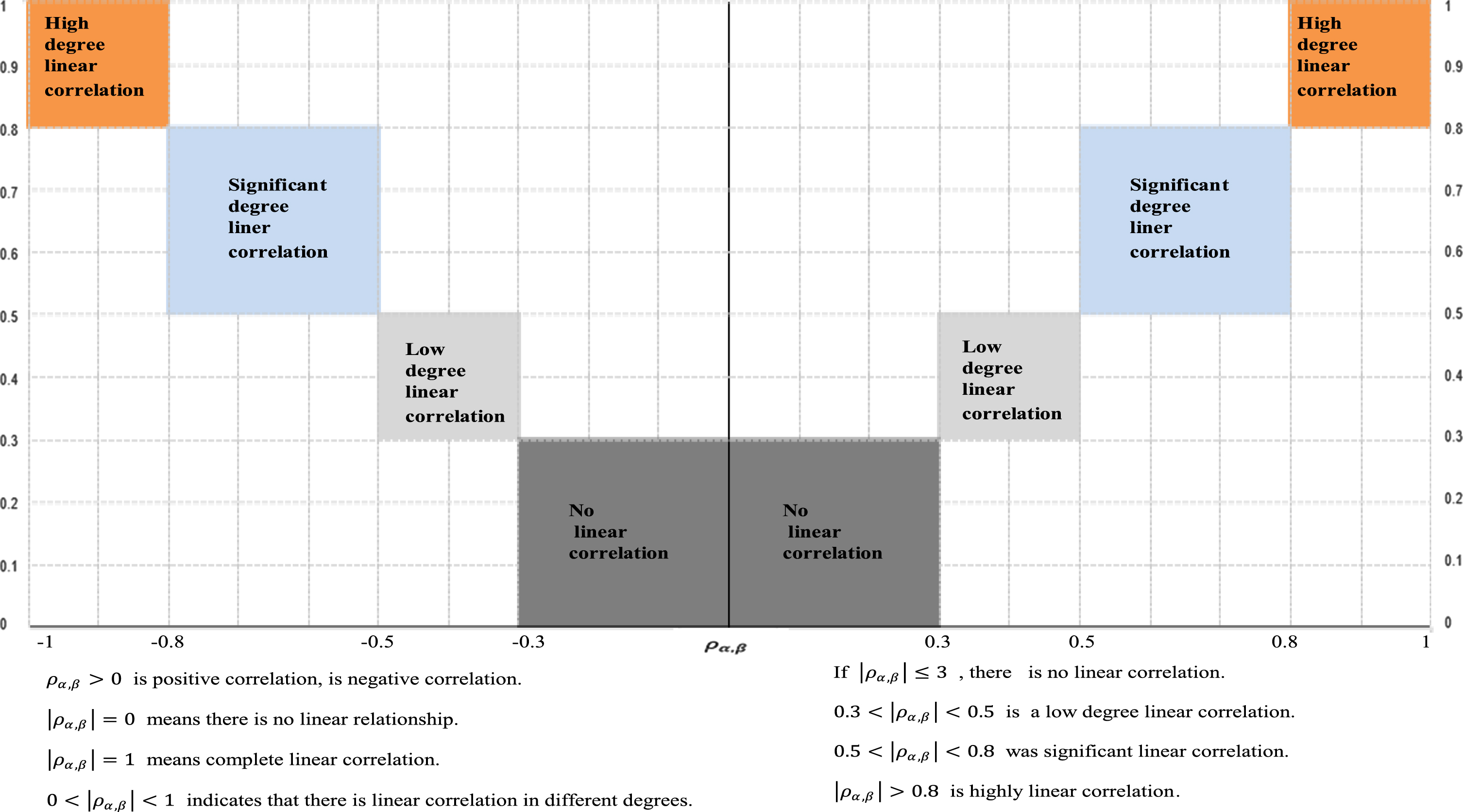
The value range of the ρα,β correlation coefficient is [–1,1]. The greater the absolute value of the ρα,β the correlation coefficient, the stronger the correlation. Generally, the correlation strength of variable α is determined by the following value range, as shown in Fig. 2. This study selects the input-output indexes with significant correlation—that is, the correlation coefficient is higher than 0.5—and constructs an evaluation index system of regional industrial enterprises’ scientific and technological innovation efficiency.
Relationship setting of correlation degree.
This study combines the DEA-BCC model with the Malmquist index to evaluate and analyze regional industrial enterprises’ scientific and technological innovation efficiency. The DEA-BCC model is used to analyze the efficiency value of enterprises industrial enterprises’ scientific and technological innovation activities in 16 cities in Anhui Province. The Malmquist index is used to make a vertical comparative study on industrial enterprises’ scientific and technological innovation efficiency in 16 cities in Anhui Province. This study discusses the development status and trend of regional industrial enterprises’ scientific and technological innovation efficiency from static and dynamic levels.
DEA-BCC model
The DEA-BCC model has advantages in evaluating the effectiveness of multiple inputs and outputs. Therefore, based on the assumption of variable scale compensation, the DEA-BCC model is proposed to evaluate the efficiency of regional industrial enterprises’ scientific and technological innovation from a static perspective.
Suppose there are n decision units (DMUs)—that is, n evaluation units. θ is the efficiency evaluation value of the decision-making unit; the input variables are α = (α1, α2, . . . , αn) T, and the output variable is β = (β1, β2, . . . , βn) T where ω represents the combination coefficient of each unit—that is, the weight of each decision-making unit — s- represents the relaxation variable of the input, and s+ represents the relaxation variable of the output.
The above model measures the efficiency of each decision-making unit from the output perspective. The objective function represents the comprehensive efficiency from the perspective of output maximization where comprehensive efficiency = pure technical efficiency × scale efficiency.
If θ = 1, s- = 0, s+ = 0, the DEA of the decision-making unit is effective. Specifically, the input and output of the decision-making unit achieve the optimal state and simultaneously achieve technical efficiency and scale efficiency.
If θ < 1, DMU is DEA invalid, which means that the technical and scale efficiency of the decision-making unit cannot reach the optimal state.
If θ = 1, s- ≠ 0 or s+ ≠ 0, DMU is weakly DEA effective. It indicates that the decision-making unit has not reached the state of technical and scale effectiveness at the same time, and DEA effectiveness can be realized by adjusting input and output.
DEA-BCC model can only measure the relative efficiency value of different decision-making units in the same period but can not measure the change of efficiency value in different periods. Therefore, this study uses the Malmquist index method to measure the total factor productivity index and then studies the dynamic change and internal motivation of scientific and technological innovation efficiency. Compared with other methods [16, 19], this method does not need various research assumptions, and the measurement results are more convincing. On the one hand, this method can clearly understand the dynamic changes of total factor productivity and its decomposition indicators in different periods. On the other hand, this method can also let us clarify the role of operation and management, technological progress, resource allocation, and other influencing factors in different regions on the improvement of total factor productivity, to know how to effectively improve the level of scientific and technological innovation through the decomposition of total factor productivity.
The Malmquist index method can dynamically reflect regional industrial enterprises’ scientific and technological innovation efficiency changes. In this study, (α
t
, β
t
) and (αt+1, βt+1) are used to represent the input-output vector in period t and period t + 1, respectively, and Dt+1 (αt+1, βt+1) are used to represent the output distance function of the input-output vector under the technical conditions of reference period t + 1; Dt+1 (α
t
, β
t
) represents the output distance function of the input-output vector under the technical conditions of reference period t, then the Malmquist index of technology and output angle in period t + 1 is
If M > 1, total factor productivity increases; if M = 1, total factor productivity remains unchanged; if M < 1, it indicates that total factor productivity decreases. The Malmquist index can be divided into two parts: efficiency change (Effch) and technology change (Tech). The specific formula is as follows:
Efficiency change can be further divided into pure technical efficiency change (Pech) and scale efficiency change (Sech). Thus, the formula of total factor productivity—that is, the efficiency of scientific and technological innovation—is translated into
Introduction to Anhui Province
Anhui is located in the eastern part of mainland China and belongs to East China. It has jurisdiction over 16 prefecture-level cities, including Hefei, Suzhou, Huaibei, Bozhou, Fuyang, Bengbu, Huainan, Chuzhou, Lu’an, Ma’anshan, Anqing, Wuhu, Tongling, Xuancheng, Chizhou, and Huangshan. Having undertaken the transfer of high-quality industries in the Yangtze River Delta and implemented the innovation-driven development strategy. Anhui firmly grasped the important strategic opportunity period of transformation and upgrading, implemented a strategy of strengthening the province through industry, and made historic achievements in industrial development. During the 13th Five Year Plan period, the added value of industries above the designated size in Anhui Province increased by 8.1% annually, ranking third in China and first in Central China, and the manufacturing high-quality development index ranked seventh in China and first in Central China. Anhui is the only central province shortlisted in the top 10. In building a new development pattern and promoting high-quality development, the supporting and leading role of industrial enterprises’ scientific and technological innovation has been further highlighted. This study measures and evaluates the scientific and technological innovation efficiency of industrial enterprises in 16 cities of Anhui Province, discusses the development status and change trend of scientific and technological innovation efficiency, and reveals the internal reasons to provide decision-making reference for realizing high-quality industrial development in Anhui Province.
Results
Construction of index system
SPSS software was used to analyze the correlation of industrial enterprises’ scientific and technological innovation data in Anhui from 2011 to 2019. The correlation coefficient of person detection was greater than 0.5 for the scientific and technological innovation input indexes, the number of R&D personnel, the full-time equivalent of R&D personnel, internal expenditure of R&D funds and scientific and technological innovation output indexes, number of valid invention patents, number of scientific papers published, and sales revenue of new products. At the same time, their significance test also showed a significant correlation at the 0.01 level, meeting the requirements of DEA data analysis. The correlation coefficient matrix is listed in Table 1. Based on this, a multi-input and -output evaluation index system of scientific and technological innovation efficiency of regional industrial enterprises was constructed, as shown in Table 2, providing a reliable index data foundation for subsequent DEA data analysis.
Correlation coefficient matrix of determined index variables
Correlation coefficient matrix of determined index variables
**There was a significant correlation at the 0.01 level (two tails).
Evaluation indexes system of scientific and technological innovation efficiency of Anhui industrial enterprises
The DEA-BCC model was selected, and DEAP2.1 was used to process the input-output panel data of the scientific and technological innovation of industrial enterprises in 16 cities of Anhui Province from 2011 to 2019 to measure industrial enterprises’ scientific and technological innovation efficiency, as shown in Table 3.
Innovation efficiency of industrial enterprises in 16 prefecture-level cities of Anhui from 2011 to 2019
Innovation efficiency of industrial enterprises in 16 prefecture-level cities of Anhui from 2011 to 2019
Table 3 reveals that the overall scientific and technological innovation efficiency of industrial enterprises in Anhui Province was not ideal. The average innovation efficiency was below 0.900, showing a fluctuating state, and peaked at 0.934 in 2014. After 2015, industrial enterprises’ average scientific and technological innovation efficiency showed an obvious downward trend. Overall, eight cities or more had a comprehensive technical efficiency index of 1 from 2011 to 2015. In 2016 and 2017, only four and three cities had a comprehensive technical efficiency index of 120. In 2017 and 2018, seven and six cities had a comprehensive technical efficiency index of 1, consistent with the downward trend of the average scientific and technological innovation efficiency of industrial enterprises. This is due to redundancy in scientific and technological innovation input by industrial enterprises in some cities. In particular, the increase in internal expenditure of R&D funds cannot improve the transformation efficiency of scientific and technological achievements of industrial enterprises, resulting in a downward trend in the average value of the pure technical efficiency index. The scale efficiency index is the primary factor affecting the decline in industrial enterprises’ scientific and technological innovation efficiency value. From 2011 to 2019, the number of cities with a scale efficiency index of less than 1 continued to increase, reaching the highest in 2017, and the scale efficiency index of 13 cities was less than 1. Since 2017, the number of cities with a scale efficiency index of less than 1 has decreased, including 8 in 2018 and 10 in 2019. Between 2011 and 2019, the number of pure technical efficiency indexes less than 1 per year was less than that of scale efficiency indexes less than 1. It can be seen that the scale efficiency of scientific and technological innovation of industrial enterprises hinders the improvement of scientific and technological innovation efficiency more than pure technical efficiency.
The Malmquist index can compensate for the deficiency of the DEA-BCC model and measure the dynamic change degree of scientific and technological innovation efficiency of industrial enterprises in 16 prefecture-level cities in Anhui Province. Therefore, DEAP2.1 software was used to analyze industrial enterprises’ scientific and technological innovation data in 16 prefecture-level cities of Anhui Province from 2011 to 2019 to examine the dynamic change and heterogeneity of total factor productivity. Using the Malmquist index, the following results were obtained:
From the perspective of overall efficiency changes, Table 4 and Fig. 3 demonstrate that the average value of industrial enterprises’ scientific and technological innovation efficiency index in Anhui Province from 2011 to 2019 was 1.022, showing an overall upward trend. Total factor productivity was not stable during the study period, sometimes high and sometimes low. The annual total factor productivity index was greater than 1 in 2011–2016 and less than 1 in 2016–2019. The decline was mainly due to the dual impact of reducing technological progress and technical efficiency indices in terms of decomposition, the average technical efficiency index of industrial enterprises’ scientific and technological innovation in Anhui Province increased by 0.2%. The average technical progress index increased by 2% from 2011 to 2019.This indicated that the impact of industrial enterprises’ scientific and technological innovation efficiency in Anhui Province on total factor productivity was stronger than that of the technical efficiency index. The technical progress index played a significant role in improving total factor productivity. The driving effect of the technical efficiency index on total factor productivity was not significant.
Malmquist index and its decomposition of scientific and technological innovation of industrial enterprises in Anhui
Malmquist index and its decomposition of scientific and technological innovation of industrial enterprises in Anhui

Malmquist index and its decomposition of scientific and technological innovation of industrial enterprises in Anhui.
Meanwhile, from 2011 to 2019, the average scale efficiency index of industrial enterprise innovation in Anhui Province was 0.997. The average pure technical efficiency index was 1.005, greater than 1, showing an increasing and decreasing trend. During the study period, the scale efficiency index in five years was less than 1, indicating that the scale efficiency index inhibited the improvement of the technical efficiency index. Improving the management level of scientific and technological innovation and using innovative resources in industrial enterprises still has a large space to improve innovation efficiency.
From the difference in efficiency change among cities, it can be seen in Table 5 that, among the 16 cities, seven prefecture-level cities—Bozhou, Bengbu, Fuyang, Chuzhou, Wuhu, Xuancheng, and Huangshan—had higher than the average total factor productivity. The lowest was Huaibei, with a decrease of 6.7%. Except for Hefei, Huainan, Lu’an, and Ma’anshan, the total factor productivity index was less than 1. The other 11 cities were greater than 1, indicating that industrial enterprises’ scientific and technological innovation efficiency in most cities of Anhui Province is constantly improving with a positive development trend. Among them, Wuhu and Bozhou witnessed an increase of more than 10% in the innovation efficiency of industrial enterprises from 2011 to 2019. In terms of increased and decreased motivation, the decline in the technological progress index in Hefei, Huaibei, and Huainan is the main reason for the decline in total factor productivity. The decline in Lu’an’s technical efficiency index leads to a decline in total factor productivity. The decrease in total factor productivity in Ma’anshan is due to the decrease in the technical efficiency index and technical progress index at this stage. The improvement of total factor productivity in Chizhou, Bozhou, and Bengbu benefits from the coordinated growth of the technical efficiency index and technical progress index. The improvement of total factor productivity in Anqing, Huangshan, Suzhou, Xuancheng, Chuzhou, Wuhu, and Tongling benefits from the technical progress index. Their technical efficiency index is less than or equal to 1, which inhibits the improvement of total factor productivity to a certain extent. On the contrary, the improvement in Fuyang total factor productivity benefits from the technical efficiency index, and the technical progress index plays an inhibitory role.
Malmquist index and its decomposition of scientific and technological innovation of industrial enterprises in various regions
Finally, from the perspective of regional layout, the total factor productivity index of industrial enterprises went from high to low from 2011 to 2019 in southern Anhui, northern Anhui, and central Anhui. The economic growth trend in southern Anhui is good. The innovation efficiency of industrial enterprises is constantly improving, which is consistent with the early economic development of cities in southern Anhui, radiated by “Nanjing metropolitan area,” “Hefei metropolitan area,” and “Hangzhou metropolitan area,” belonging to “Wanjiang urban belt,” and “Yangtze River Delta Urban Agglomeration,” and the remarkable achievements in the innovation and development of industrial enterprises. Northern Anhui has developed from behind, and the pace of development has significantly accelerated. It has become the most dynamic new growth plate in the province. This is consistent with the decision-making strategy of taking the development of Northern Anhui as an important strategic task for the rise of Anhui and placing it in the same important position as the development of areas along the river. The total factor productivity index in central Anhui was the lowest. Hefei is a city in central Anhui. Although it is the political and economic center of the whole province, it is also the second comprehensive national science center after Shanghai. Its innovation strength continues to rise, and major innovation achievements emerge. However, Hefei’s comprehensive strength is insufficient, and its economic radiation ability is weak, leading to an unsatisfactory scientific and technological innovation efficiency index for industrial enterprises in central Anhui.
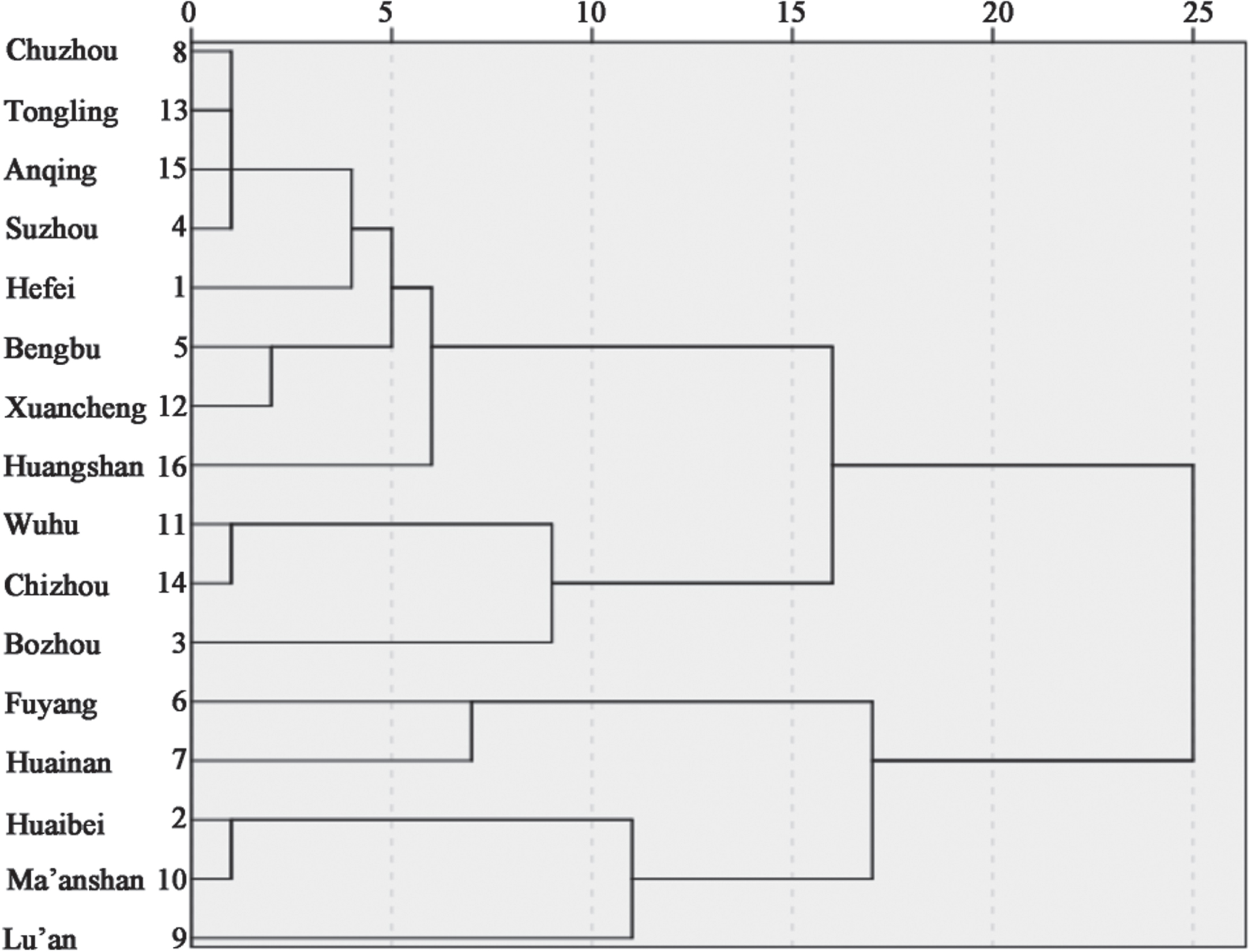
Using SPSS software, the Malmquist index and its decomposition data of innovation efficiency of industrial enterprises in 16 prefecture-level cities in Anhui Province were clustered. The innovation efficiency level of industrial enterprises in Anhui Province was divided into four categories, as shown in Fig. 4.
Cluster pedigree of innovation efficiency of industrial enterprises in 16 cities of Anhui.
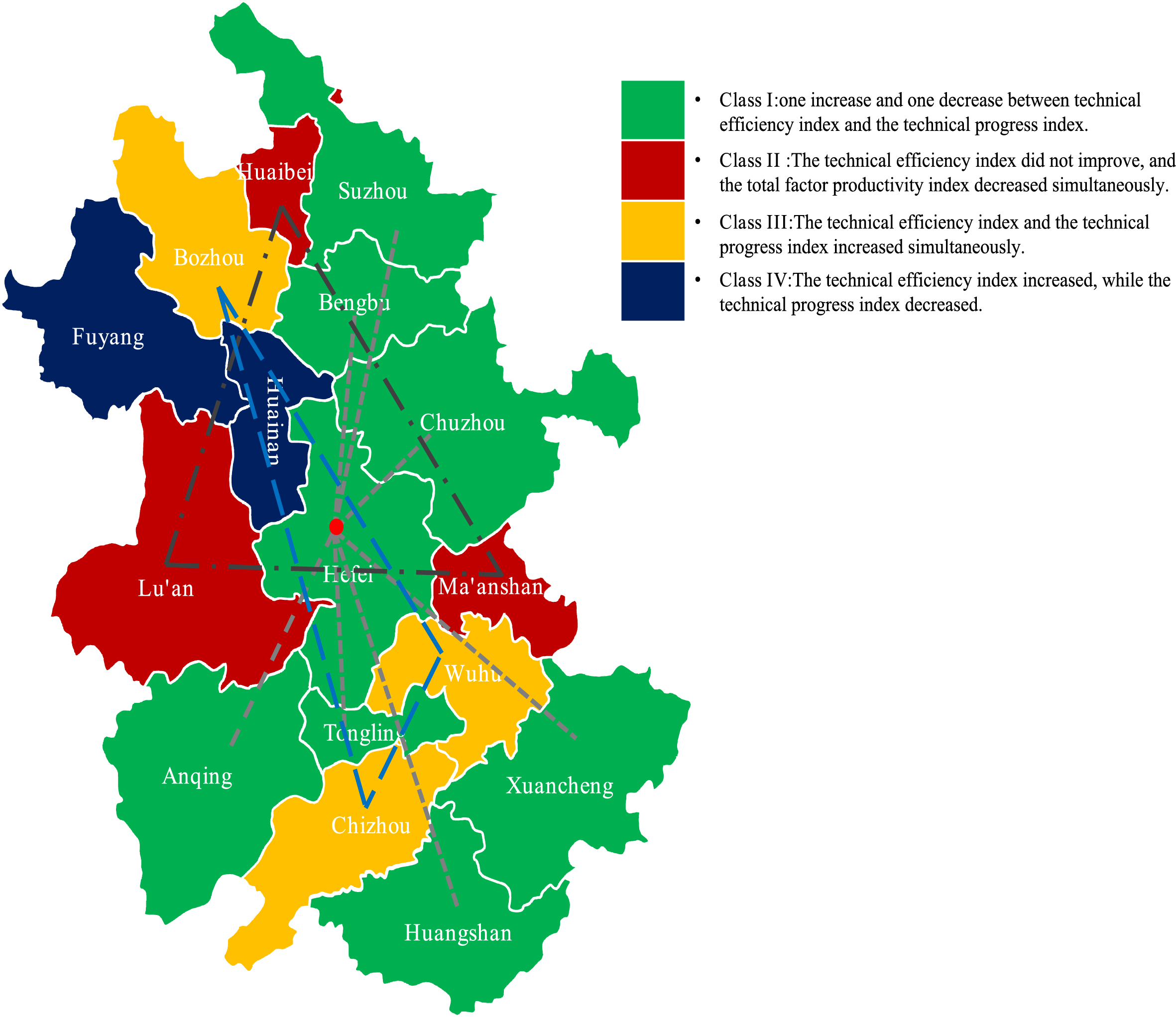
The specific classification results were obtained according to the general clustering diagram, as shown in Table 6 and Fig. 5.
Map display of scientific and technological innovation efficiency classification of industrial enterprises in Anhui.
Classification results of innovation efficiency of industrial enterprises in 16 cities of Anhui
As shown in Figs. 4 and 5 and Table 6, from the clustering results, the change in innovation efficiency of industrial enterprises in Anhui Province does not follow the pattern of southern, central, and northern Anhui. The technical efficiency index and technical progress index of Hefei, Suzhou, Bengbu, Chuzhou, Xuancheng, Tongling, Anqing, and Huangshan increase and decrease, placing them in the first category. The technical efficiency of Huaibei, Lu’an, and Ma’anshan has improved, and the total factor productivity has been reduced simultaneously, entering the second category. The innovation efficiency of Bozhou, Wuhu, and Chizhou has improved, and technical efficiency and technological progress have been improved simultaneously; thus, it has entered the third category. The technical efficiency index of Fuyang and Huainan increased, but the technical progress index decreased and entered the fourth category.
In summary, the level of scientific and technological innovation efficiency of industrial enterprises in Anhui Province developed well from 2011 to 2019, which was on the rise as a whole, and decreased in some years, but the range was very small. Although there are some differences in the change range and causes of industrial enterprises’ scientific and technological innovation efficiency in 16 cities, technological progress is the main factor causing the improvement of industrial enterprises’ innovation efficiency in Anhui Province. The unreasonable allocation structure of innovation resources has significantly inhibited the improvement of industrial enterprises’ innovation efficiency, so scale efficiency must be improved.
Many studies show that regional scientific and technological innovation is an important driving factor for regional long-term sustainable and high-quality development. As an important subject of scientific and technological innovation, industrial enterprises must pay attention to cultivating independent scientific and technological innovation energy. Developing and producing technologies and products with independent intellectual property rights to make enterprises and regional economies the power of sustainable development.
Improve the scientific and technological innovation management level of industrial enterprises
The empirical analysis results show that the growth rate of pure technical efficiency reflecting the management level is very small at only 0.5%, which shows that enterprises have some deficiencies in scientific and technological innovation management. There is a waste of innovation resources. Effectively using the human, financial, and material resources invested in scientific and technological innovation to maximize the output of scientific and technological innovation is a problem that all industrial enterprises should pay attention to. Industrial enterprises must combine scientific and technological research and development with the transformation of achievements. Therefore, optimizing the allocation structure of scientific and technological innovation investment resources and improving the utilization efficiency of scientific and technological innovation investment resources are important means to improve the efficiency of industrial enterprises’ scientific and technological innovation.
Optimize the scale of investment in scientific and technological innovation of industrial enterprises
The empirical analysis results show that the overall scale efficiency level of Anhui Province from 2011 to 2019 is low, and there is still much room for improvement. All cities should clarify the key points of scientific and technological innovation of industrial enterprises and concentrate on making up for the shortcomings of the innovation and development of industrial enterprises. Specifically, in 2019, Anqing, Maanshan, and Chuzhou were diminishing returns to scale while Bozhou, Suzhou, Bengbu, Lu’an, Xuancheng, Chizhou, and Huangshan were in the stage of increasing returns to scale. Therefore, cities should adjust measures to local conditions, and cities in the stage of diminishing returns to scale should reduce innovation resource investment and unreasonable resource allocation. Cities increasing returns to scale should increase the investment in scientific and technological innovation resources in multiple ways. Increasing the investment scale of industrial enterprises and improving the allocation efficiency of innovation resources to improve industrial enterprises’ scientific and technological innovation efficiency.
Accelerate the transformation of scientific and technological innovation achievements of industrial enterprises
The transformation and application of scientific and technological achievements can inject a strong impetus into regional development. We should actively seek scientific and technological innovation reform; establish a scientific and technological innovation system with industrial enterprises as the main body, market orientation and deep integration of industry, university, and research and promote the transformation efficiency of industrial enterprises’ scientific and technological achievement. At the same time, local governments should speed up the cultivation of market-oriented and professional high-quality scientific and technological innovation service institutions. Scientific and technological innovation service institutions should actively coordinate the effective docking of policy, information, technology, talent, and equipment resources. Establish and improve the whole chain transformation mechanism of basic application research, technology maturation, industrial incubation, enterprise docking, and achievement landing. Shorten the process of scientific and technological industrialization and comprehensively improve the vitality and efficiency of the transformation of scientific and technological achievements in industrial enterprises.
Improve the supporting policies for scientific and technological innovation in industrial enterprises
Government support plays an important role in industrial enterprises’ scientific and technological innovation [66, 67]. The government should clarify its position in the market economy and give full play to its guidance, organization, and support. First, strengthening industrial enterprises’ dominant position and leading role in scientific and technological innovation should optimize the structure of financial investment in science and technology, give play to the role of policy guidance, and give full support to industrial enterprises engaged in basic and key technologies. In addition, the government should continue to implement and strengthen fiscal and tax preferential policies for industrial enterprises, such as low interest and interest-free loans, financial subsidies, tax incentives, and other incentive policies; accelerate the transformation and industrialization of scientific and technological achievements, and boost the high-quality development of industrial enterprises. Finally, it should actively strive for angel investment funds and guidance funds for the transformation of scientific and technological achievements; guide social capital to support the industrialization of scientific and technological achievements; and continue to improve the subsidy and reward policies for relevant institutions and personnel promoting local trading, local transformation, and the local application of scientific and technological achievements.
Promote the scientific and technological innovation synergy of industrial enterprises among cities
Restricted by the administrative boundary, there are many problems in industrial enterprises’ scientific and technological innovation resources in 16 cities of Anhui, such as repeated construction, low utilization efficiency, unreasonable resource allocation, and scattered innovation investment. With China’s industrial economy entering a high-quality development stage, this “separate” industrial innovation development model has been unsustainable. To improve the competitiveness of cities, the “cluster” development model of inter-city industrial innovation has become an inevitable choice. Therefore, the development of Inter-City Industrial Innovation in Anhui should be strategically coordinated, planned, and guided. With the advantages of adjacent regions and similar industries, regional industrial innovation urban agglomerations, such as the Ma’anshan-Wuhu-Tongling industrial innovation urban agglomeration and Bengbu-Huainan industrial innovation urban agglomeration, emerge. Through the scientific and technological innovation cooperation and division of labor of industrial enterprises among cities or mutual borrowing, industrial enterprises among cities can give full play to their comparative advantages and improve the overall innovation competitiveness of industrial enterprises in the whole urban agglomeration. This is a “win-win” situation for a single city or urban agglomeration as a whole. We should actively explore the coordinated development model of scientific and technological innovation of industrial enterprises among urban agglomerations and promote the formation of a new layout of regional industrial-economic innovation and development with complementary advantages and high-quality development to realize the flow and integration of scientific and technological innovation elements of industrial enterprises, such as technology, knowledge, and information, and promote the co-construction and co-sharing of scientific and technological innovation resources of industrial enterprises.
Discussion and management enlightenment
Compared with the existing literature [16, 20], the data-driven DEA-Malmquist model constructed in this study has several advantages in evaluating the scientific and technological innovation efficiency of regional industrial enterprises: (1) This study comprehensively collects the input-output index data of scientific and technological innovation of regional industrial enterprises, screens the index data using the Pearson correlation coefficient method, and then constructs the evaluation index system of scientific and technological innovation efficiency of regional industrial enterprises to provide scientific, objective, and effective measurement standards for future quantitative research. (2) The DEA-Malmquist model characterizes and measures the decision-making unit under clear data. The combination of data-driven and DEA-Malmquist model ensures the clarity of data and ensures the objectivity of evaluation results. (3)The evaluation of scientific and technological innovation efficiency of regional industrial enterprises usually involves multiple decision-making units. Using cluster analysis to cluster decision-making units with common characteristics can better help decision-makers make targeted policy suggestions.
Combined with the above research and conclusions, we obtain the following management enlightenment.
First, global science and technology are advancing by leaps and bounds, and science and technology, as the primary productive forces, are playing an increasingly important role. Adhering to innovative development, promoting the deep integration of science and technology and economy, and striving to improve the quality and efficiency of the real economy have become the key basis for the economic development of a country or region.
Second, under the strategic background of promoting the construction of innovative countries worldwide, the main way to improve the overall scientific and technological innovation ability of the country is to construct a regional scientific and technological innovation system. Industrial enterprises are the core component of the regional innovation system. Industrial enterprises are an important pillar of the regional economy. Their scientific and technological innovation abilities represent regional enterprises’ scientific and technological innovation level. Their speed and quality determine the speed and quality of regional economic development.
Finally, with the advantages of the internet and big data, accelerating the digital transformation is undoubtedly the inevitable choice to improve the scientific and technological innovation governance system in practice, and it is also an important content to promote the modernization of scientific and technological innovation governance ability in the era of the digital economy. At the same time, the transformation and upgrading of the national economy need scientific and technological innovation as key support. Therefore, it is urgent to accelerate the transformation of scientific and technological innovation governance and realize data-driven scientific and technological innovation governance.
Conclusion
Facing the major challenge of sustainable development of economy and resources, strengthening scientific and technological innovation is a key point in changing the development model. Scientific and technological innovation is the strategic support for improving social productivity and comprehensive national strength and must be placed at the core of the overall situation of regional development. In regional scientific and technological innovation activities, industrial enterprises play a leading role. The scientific and technological innovation efficiency of industrial enterprises has become an important factor in determining whether a country or region has a competitive advantage and plays an irreplaceable role in ensuring the sustainable development of the national economy. Therefore, it is urgent to effectively evaluate and optimize the efficiency level of scientific and technological innovation of regional industrial enterprises to promote the transformation and upgrading of the regional economy and promote the sustainable and high-quality development of the regional economy.
This study proposes a data-driven method for measuring, evaluating, and optimizing the efficiency of regional industrial enterprises’ scientific and technological innovation. The main contributions of this study are as follows. (1) A scientific and reasonable evaluation index system of scientific and technological innovation efficiency of regional industrial enterprises is constructed from input-output, which enriches and develops the discipline theory and makes the scientific and technological innovation theory more universal. (2) Based on the DEA-Malmquist model, this study objectively and effectively evaluates and analyzes the scientific and technological innovation efficiency of regional industrial enterprises from vertical and horizontal, static and dynamic; reveals the characteristics and existing problems of scientific and technological innovation efficiency of regional industrial enterprises, and provides a quantitative reference for subsequent policy formulation and adjustment. (3) Based on the resource endowment and strategic opportunities of 16 cities in Anhui, we firmly grasp the focus of scientific and technological innovation of industrial enterprises, formulate relevant policy suggestions, and help government departments guide and standardize the innovation-driven development track of regional industrial enterprises. Therefore, the advantages of this study provide overall insights and useful guidelines for managers and decision makers of regional industrial enterprises with different levels of technical efficiency and technological progress, not only in Anhui, but also all over the world. In this process, we strive to help the government and relevant organizations effectively optimize the layout of scientific and technological innovation of regional industrial enterprises. In addition, the proposed data-driven DEA-Malmquist model can be used as an important guideline for any industry efficiency evaluation.
However, this study also has some limitations: (1) The above DEA-Malmquist model generally assumes that the input of scientific and technological innovation can be directly transformed into the final output of scientific and technological innovation in the process of scientific and technological innovation. It is a study of the single-stage relationship between input and output. This means that DEA-Malmquist model cannot capture the internal structure of decision-making unit. (2) DEA Malmquist model needs accurate and clear data. In many cases, data are unstable, uncertain and complex [68–70], so they cannot be measured accurately.
In the future research, on the one hand, the breakthrough only stays at the level of statistical data analysis, and deeply explores the characterization and measurement of scientific and technological innovation information of regional industrial enterprises in a neutral environment. On the one hand, the breakthrough only stays in the research on the single-stage relationship between input and output, divides the scientific and technological innovation activities of regional industrial enterprises into R & D stage and commercialization stage, constructs a Two-stage DEA model of scientific and technological innovation efficiency of regional industrial enterprises, better captures the internal structure and change trend of decision-making units, and puts forward more solid and effective suggestions for the high-quality economic development of regional industrial enterprises.
Footnotes
Acknowledgments
This research was supported by a key project of Anhui philosophy and social science planning (grant number AHSKXZX2020D13).