



Abstract
In this paper, an integrated decision-making methodology is proposed to solve the subjectivity and fuzziness in the selection of cold chain logistics service providers (LSPs). Firstly, the social network analysis (SNA) method is applied to select the evaluation criteria of cold chain LSPs, which is based on the systematic literature analysis. Then, a novel combination weighting method that combines the advantages of entropy weight (EW) method and improved analytic hierarchy process (AHP) is constructed to calculate the weight of criteria. Further, the fuzzy comprehensive evaluation (FCE) method is utilized to generate a ranking order of providers and recommend the optimal provider. Finally, the illustrative example and comparison analysis are provided to prove the validity and feasibility of the approach. In addition, a sensitivity analysis is presented to discuss the stability of the proposed method. In conclusion, this paper innovatively constructs an index system of cold chain LSPs evaluation and selection, and the process of evaluation and selection is also objective.
Keywords
Introduction
Due to the huge financial and material resources required to construct the cold chain logistics system, companies generally choose third-party cold chain logistics service providers (LSPs) as partners. In addition, with the increasing improvement of consumption level, consumers put forward higher demand for cold chain logistics services. Besides, cold chain consumes more cooling costs than conventional supply chain. However, because of the late development of cold chain logistics industry, the corresponding technical standards, supporting facilities and information system construction are insufficient, which result in the uneven strength of cold chain LSPs [1]. Therefore, select the optimal cold chain LSPs is crucial to the benign development and competitiveness enhancement of companies.
It is well known that the selection and evaluation of LSPs are multi-criteria decision-making (MCDM) problems, in which the determination of evaluation criteria and selection of decision-making methods are the keys to solve this question. The determination of evaluation criteria is the premise of logistics providers’ assessment, so it is vital to construct a scientific and reasonable evaluation index system. For this, Kannan et al. determined the third-party logistics (3PL) providers selection criteria by using the grey DEMATEL approach [2]. From the perspective of manufacturing logistics service, Wang et al. constructed an evaluation index system based on AHP method and the comparative analysis of literature [3]. Osorio Gómez et al. took the operational risks of 3PL providers in the supply chain as the research object and proposed corresponding risk evaluation criteria [4]. Moreover, through the qualitative analysis of previous literature, Wu et al. presented an evaluation index system for low-carbon LSPs from five dimensions [5]. Weng built an evaluation index system based on three dimensions and proposed an intuitive fuzzy preference decision-making method to select cold chain LSPs [6]. Sun et al. proposed a set of cold chain LSPs evaluation indexes that are consistent with the characteristics of typical food production enterprises [7]. Zhao used AHP to construct the evaluation index system of 3PL service providers for fresh e-commerce under the background of “Internet plus” [8]. It can be found that there are some limitations of the evaluation index system construction for LSPs selection in existing research. On the one hand, most of the evaluation criteria proposed in the above literature are rely on personal experience and subjective literature analysis, which cannot guarantee the scientificity and accuracy of the indexes. On the other hand, some evaluation index system is too complicated and not conducive to convenient practice.
At the same time, various decision-making models are proposed for the evaluation of LSPs. For example, Huang presented an evaluation approach by combining fuzzy matter-element model and AHP [9]. Gong proposed a group decision-making tool based on the three-parameter interval number [10]. Considering the expectation of customers, Cai constructed the LSPs selection model under the supply chain environment, which is based on the prospect theory [11]. Besides, Shu et al. applied DEMATEL method to select green reverse LSPs based on urban logistics and reverse logistics [12]. Huang et al. proposed an ANP-RBF method to evaluate the cruise ship supply LSPs [13]. Ejem et al. constructed a LSP selection and evaluation model by the TOPSIS method [14]. Qin et al. applied prospect theory and fuzzy measure theory in the decision-making model, and used TOPSIS to rank the alternative logistics providers [15]. Similarly, Chen et al. combined the intuitive fuzzy set theory and TOPSIS to establish a selection model of cross-border e-commerce LSPs [16]. Chen et al. used entropy weight TOPSIS to evaluate the low-carbon behavior ability of logistics service [17]. Kamran applied fuzzy DEA and fuzzy TOPSIS in the selection of sustainable logistics providers [18], while Govindan et al. combined FAHP and TOPSIS to select the sustainable forward and reverse logistic providers [19]. Moreover, Zarbakhshnia et al. integrated the fuzzy SWARA with fuzzy COPRAS for choosing the third-party reverse LSPs [20], and Govindan et al. developed a SMAA-ELECTRE I hybrid decision-making approach to solve the same problem [21]. In addition, Zou presented a two-stage decision-making model based on DEA-ANP approach to assess logistics suppliers [22]. Stefan et al. utilized the selection method based FAHP and TOPSIS to select 3PL providers [23]. Tavana et al. proposed a green reverse logistics provider evaluation framework based on COPRAS, MULTIMOORA and TOPSIS [24]. With respect for the selection problem of cold chain LSPs, Li et al. provided a method by combining dynamic intuitionistic fuzzy theory and VIKOR [25]. Singh et al. extended the AHP and TOPSIS to a fuzzy environment [26]. Furthermore, Ju developed a fuzzy multi-criteria group decision-making method by using evidence theory [27]. Later, Zhou used FAHP to choose the cold chain logistics providers of military fresh food [28]. Wang studied the selection problem of cold chain LSPs based on rough PSO-BP neural network [29]. Diriba et al. used a multicentered mixed-method approach to evaluate the pharmaceuticals management performance of cold chain LSPs [30]. It can be found that AHP is the most frequently used method for determining index weight, and TOPSIS is a common approach to deal with the problem of LSPs selection.
SNA is a mathematical analysis method derived from graph theory, which can effectively analyze extensive literatures and then select the key factors. Therefore, it is introduced into the research of this paper to construct the evaluation index system. The effectiveness of SNA in selecting evaluation criteria has also been well verified, for instance, Gao and Yang constructed a paper evaluation index system based on SNA [31]. Wang et al. presented the identifying method of patent essential technology based on SNA, and established a comprehensive evaluation index system in the field of semiconductor technology industry [32]. Wang et al. used SNA to construct measure index system to study the characteristics of international economic network [33]. And then, to select the optimal cold chain LSPs, this paper combines AHP method, EW method and FCE method to construct the evaluation model. Among them, EW method is an objective weight determination method, which has a wide application in the field of decision-making problems [34–36]. FCE method is a comprehensive evaluation method based on fuzzy mathematics, which is suitable for solving various uncertain and fuzzy problems, such as development ability assessment [37], management performance evaluation [38], investment project selection [39] and so on.
Previous methods have made great contributions to the problem of logistics provider selection. However, few studies have focused on the assessment of cold chain LSPs, and some limitations also can be observed as follows. Firstly, the construction process of evaluation index system is subjective, and there is a lack of a universal evaluation index system of cold chain LSPs to provide reference for more enterprises. Secondly, the data source of AHP is subjective, which cannot get the objective index weight only by using this method. Thirdly, most of the decision-making methods used for LSPs selection can only get a specific result, so it is difficult to obtain more information to help companies make final decisions. According to the preceding reviews, the motivation of this paper can be elaborated as follows: (1) Because there exists only a few research about the evaluation and selection of cold chain LSPs, it is necessary to construct an objective evaluation index system for cold chain LSPs by SNA. (2) In order to reduce the influence of subjectivity on decision-making, the EW method and FCE method are effective. Therefore, this paper focuses on the MADM problem of cold chain LSPs, and proposes an integrated decision-making methodology based on SNA and FCE method.
The main contributions of the paper can be summarized as follows: (1) A new criteria system for cold chain LSPs selection is constructed, and the comprehensiveness and authority of the criteria can be ensured by the SNA. (2) A novel weight calculation model is proposed to improve the objectivity of weight, in which the AHP method is modified by constructing the judgment matrix based on the centrality of criteria, and the EW method is used to modify the criteria weight. (3) The FCE method is applied to rank the alternative providers, which can simplify the evaluation process, and give more decision-making information. (4) The sensitivity analysis and the comparative analysis are used to verify the feasibility and superiority of the proposed method.
The rest of the paper is arranged as follows: In Section 2, the detailed decision steps of the proposed method for selecting cold chain LSPs are provided. In Section 3, the illustrative example, comparative analysis and sensitivity analysis are given to demonstrate the advantages and feasibility of the presented approach. Section 4 includes the conclusion and further research.
Problem description
To express the decision-making model constructed in this paper more clearly, the following assumptions or notations are used to depict the considered problem.
Suppose that
Decision-making model
To handle the cold chain LSPs selection problem, a MCDM method combining four methods is proposed in this section. Considering that the process of criteria selection is often subjective, SNA method is used to analyze extensive relevant literatures. Moreover, the weights of criteria are usually completely unknown, a combination weighting approach based on AHP method and EW method is established to calculate the comprehensive weights. Afterwards, optimal solution can be selected by FCE method. The novelty of the proposed method can be briefly listed as follows: (1) Form theoretical perspective, the objective evaluation index system of cold chain LSPs is constructed by SNA method, and it can provide reference for enterprises. (2) From technical perspective, the comprehensive weights are determined by AHP method and EW method, so the importance of each criteria is more scientific. Besides, in order to make the decision-making process less subjective, the evaluation and selection of cold chain LSPs are based on FCE method. The decision-making procedure is shown in Fig. 1, and the specific contents of the three stages of the decision model are as follows:
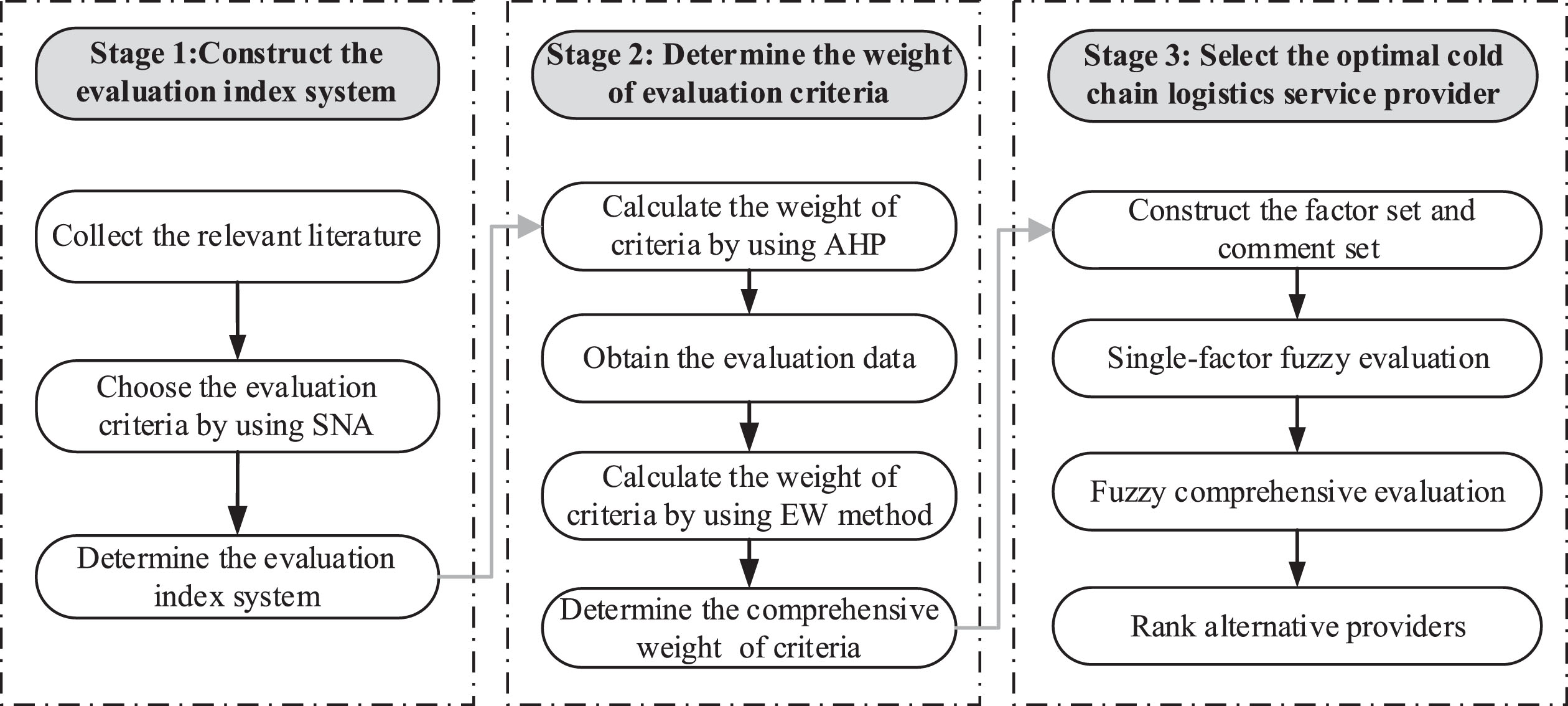
The evaluation process of cold chain LSPs.
In the
In the
Scoring standard of judgment matrix for main criteria
If the value of φ is found between two standards, the median value as follows is adopted: 8,6,4,2,1/2,1/4,1/6,1/8.
Scoring standard of judgment matrix for sub-criteria
If the value of φ is found between two standards, the median value as follows is adopted: 8,6,4,2,1/2,1/4,1/6,1/8.
In the
Illustrative example
To reduce operating costs and improve customer satisfaction, a fresh e-commerce enterprise needs to choose an optimal cold chain LSP as cooperation partner. After preliminary selection, there are four alternatives
The centrality of criteria
The centrality of criteria

Evaluation index system of cold chain LSPs.
The weight of criteria obtained through the consistency test, as shown in Tables 4 and 5.
The weight of main criteria by using AHP method
The weight of sub-criteria by using AHP method
Evaluation results of provider a1
Evaluation results of provider a2
Evaluation results of provider a3
Evaluation results of provider a4
The entropy, difference coefficient and weight are calculated respectively, as shown in Table 11.
The weight of sub-criteria by using EW method
The single-factor fuzzy evaluation results of provider a1 are as follows:
Similarly, the membership degree of other alternatives can be calculated:
Comments and scores
The scores of alternative providers
The proposed method is used to evaluate four alternative cold chain LSPs, and the highest score is a1 (53.0574), indicating that a1 has certain advantages in fresh cold chain transportation. In addition, the calculation results show that no expert is very dissatisfied with a1 and a2, and the degree of dissatisfaction with a1 is much smaller than that of other providers, so the fresh e-commerce enterprise can choose a1 as its LSP.
In the specific selection process, different weights of criteria would result in different ranking order of alternatives. In this section, a sensitivity analysis of criteria weights is conducted to verify the stability of the proposed method. According to perturbation method [43], the weights of the twelve evaluation sub-criteria in this paper are disturbed respectively, where parameter ς is in order at [0, 2] and the interval between values of ς is 0.05. Then, the FCE method is used to obtain the corresponding priority order when different parameters ς are taken, and a total of 492 experiments are conducted to obtain the sensitivity analysis results.
From Fig. 3, the alternative a1 ranked first in the 487 experiments (>98.9%), and the potential change of the weights of evaluation criteria would not lead to the deviation of decision-making results, the ranking is always a1 ≻ a2 ≻ a3 ≻ a4. In conclusion, the proposed method is insensitive to the change of weight information. In other word, the proposed method is stable enough, and it can be applied in other cold chain LSP evaluation and selection problems.
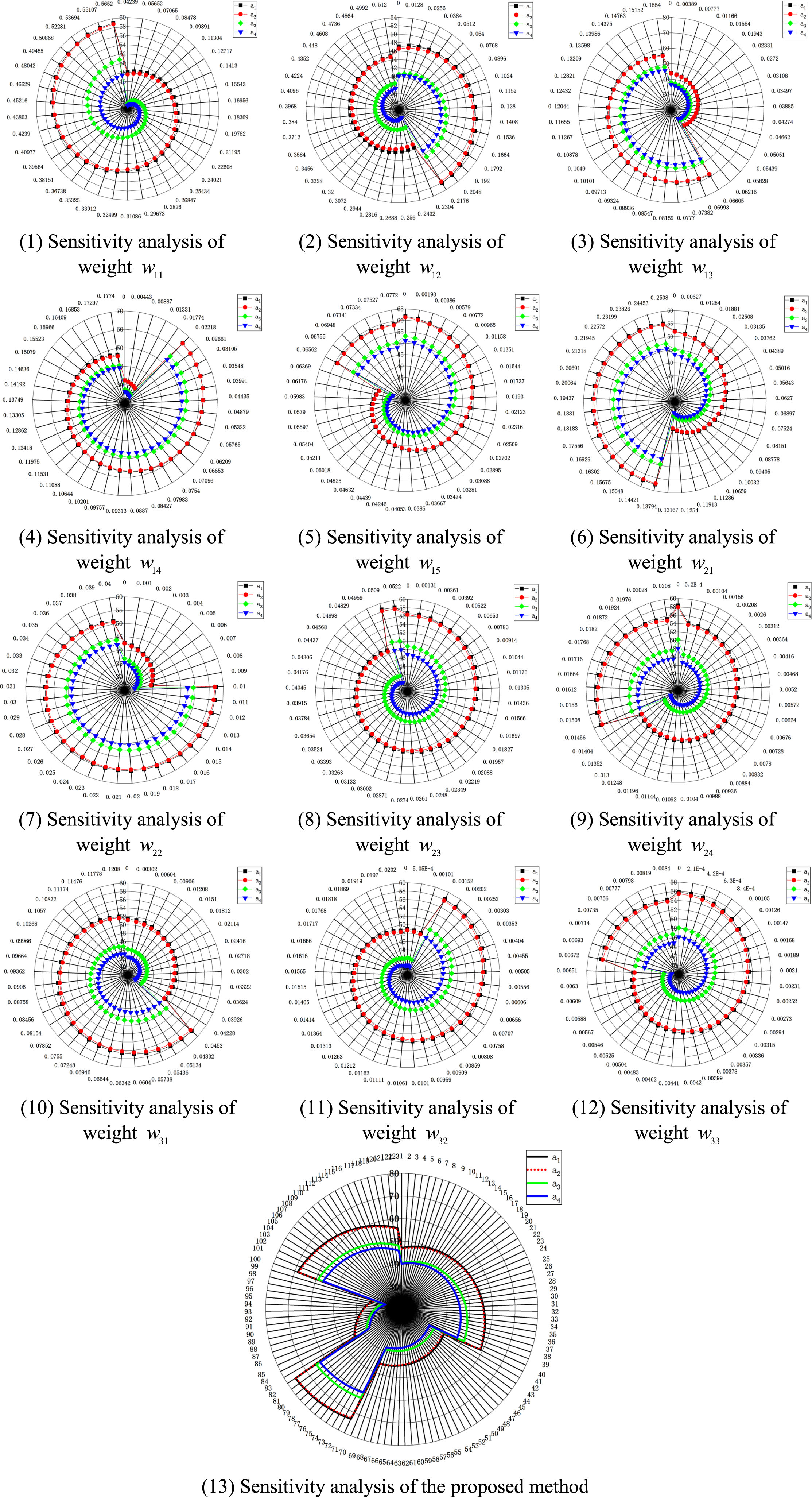
Sensitivity analysis results.
In order to further explain the feasibility of the proposed approach, a comparison of the proposed method with TOPSIS method [42] is given.
According to the relevant steps, the positive ideal solution
Then, the separation measures
Further, the relative closeness ζ of alternatives to the ideal solution is calculated.
Obviously, the ranking order of four alternatives is a1 ≻ a2 ≻ a3 ≻ a4, which is same as that obtained by the proposed method. However, compared with the method in this paper, TOPSIS method is complicated to calculate, and it is difficult to judge the alternatives with equal distances to the positive and negative ideal solutions. In addition, the evaluation results of FCE method are clearer and contain more decision-making information, which can provide better reference for enterprises, so the proposed method is more suitable for solving the decision-making problems with fuzziness and strong uncertainty.
In this part, a comparative analysis between the VIKOR method and the proposed method is presented in detail. In actual decision-making, experts may have different decision-making attitudes and then the different compromise coefficient v is adopted. With the change of v, the alternatives ranking would also be affected. Therefore, this paper values v for 10 times, and obtain 10 groups of rank order, as shown in Table 13. The results indicate that a1 is the best choice among the four alternatives, which is the same as the result obtained by the proposed method. The compromise coefficient v in VIKOR is artificially given, which would make the final decision results have a certain subjectivity. However, the method proposed in this paper is highly systematic, and the interference of subjective factors is avoided in the calculation process. In addition, when there are fewer alternatives, the results of VIKOR may be hard to distinguish and the ranking cannot be determined, but FCE method is not limited by the number of alternatives, and alternatives can be distinguished from multiple dimensions. In this paper, alternatives can be compared from six dimensions (very satisfied, satisfied, neutral, dissatisfied, very dissatisfied and total score), which has stronger applicability.
The ranking results with different values v
The ranking results with different values v
In this paper, a comprehensive approach is proposed to select the cold chain LSPs. The main work includes the following: Firstly, an evaluation index system of cold chain LSPs is constructed by using SNA method. Secondly, the improved AHP method and EW method are combined to calculate the weight of the criteria to ensure the objectivity of weight. In addition, considering the fuzziness of cold chain LSPs selection problems, the FCE method is adopted to determine the ranking of alternatives. Finally, the numerical example, comparative analysis and sensitivity analysis are given to verify the validity and feasibility of the proposed method.
The SNA method is applied to construct the evaluation index system of cold chain LSPs, and the results show that service quality, enterprise strength and transportation capacity are the main criteria. At the same time, each main criterion has three to five sub-criteria. The details are shown in Fig. 2. Since this result is extracted from the literature by the SNA method, it can be widely used in other MADM problems of cold chain LSPs evaluation. Besides, the decision-making method in this paper does not consider the DMs’ bounded rational. Therefore, the proposed method is also available for other cold chain LSP selection.
However, there are still some limitations in this paper. In real-world, the psychological behavior of DMs is considered in the process of decision-making to make the results more realistic. Besides, due to the complexity of actual decision-making process and human’s thinking, it is often difficult for experts to give a definite evaluation value based on the evaluation criteria. Therefore, in future work, we will introduce regret theory to quantify the regret psychological of DMs. And then, this method can be improved to better depict realistic decision situations. For instance, it can be extended to other data environments, such as hesitant fuzzy numbers, Pythagoras hesitant fuzzy numbers, etc. Moreover, the new method is not only applicable to cold chain LSPs selection, but also can be applied in other fields, such as comprehensive risk warning system, investment project selection.
Conflict of interest
The authors declare that they have no conflict of interest.
Footnotes
Acknowledgments
The authors would like to thank the anonymous reviewers and editors for their insightful and constructive comments on our paper. This work was supported in part by the Humanities and Social Sciences Research General Project of Chongqing Education Commission (No. 22SKJD076, No. 19SKGH051), the open topic of the Center for International Cooperation and Innovation Development of Digital Economy (P2022-37), the youth talent plan of Science and Technology think tank (20220615ZZ07110237).