



Abstract
This paper is concerned with the solution mechanism to solve the transportation problem under unpredictability by using interval valued intuitionistic fuzzy parameters. The parameters are chosen as intervals in which costs are modeled by intuitionistic fuzzy numbers, whereas source and destination are taken as crisp values. Various methods of transportation problem like VAM, Monalisha’s Approximation method, Zero point method are used to illustrate the cost in interval numbers by using the interval arithmetic operations. For each method, a solution is derived without converting into crisp expression followed by a graphical representation.
Keywords
Introduction
The fuzzy set theory has been implemented in various domains like image processing, power systems engineering, optimization etc. It is highly beneficial in interpreting indefinite data. The concept of fuzzy set theory is found by Zadeh [30] and it is a useful, effectual and operative tool that can deal with the problems relating to ambiguous, indeterminate and impressive judgements. In this state, the main flaw is that the accomplishment of the concept of fuzzy set is related to the exact real number. Recently, the data are more imprecise and complex with high uncertainty and so Interval valued fuzzy set introduced by Zadeh becomes a more significant tool to deal with the optimization problems. Further, the fuzzy set is not suitable to all conditions under uncertainty and hesitation. On that account, Atanassov [5] proposed the concept of “Intuitionistic fuzzy set”, a realistic tool to deal with the problem having both unpredictability and hesitation. Here both the degree of membership (acceptance) and non membership (rejection) is considered which eases out the real life decision making problems. For the betterment of handling unpredictability and hesitancy, the concept of “interval valued intuitionistic fuzzy set” has been introduced by Atanassov and Gargov [6], where the data are in intervals instead of stable real number.
Transportation problem is a well known optimization technique, considered to be the vital characteristic which has been deliberated in a broad span of operations especially in research field. It is helpful in replicating many real life problems. The main purpose is to cut down the expenditure on transporting products between origin and destination. Initially the formulation of transportation problem in a linear programming problem is investigated by Hitchcock [14] in 1941. Fuzzy transportation problem is developed by many authors [3, 22] to handle with the uncertainty in which only membership degrees are taken into account to obtain optimal solution. Fuzzy sets don’t always pave solution for real time problems as it cannot accept inconsistent or less information. Multiple authors [1, 12] carried out a study in solving the intuitionistic fuzzy TP being generalized from fuzzy TP. Multiple objective TP carries an important role in obtaining optimal solution since one objective can’t be inhibited. Many on-going researchers are focusing on IVIFTP, as the expenditure can be represented in intervals rather than real numbers. These researches reveal a fascinating fact that the transportation expenditure rolls up on many unreliable aspects such as climatic change and weather forecasting, traffic jams etc.
The degree of membership and non membership should fall between 0 and 1 in IFS. Contrarily, we get into a situation where the degree can’t be defined within very least, least, moderate, severe, very high etc. Resolving this, “Interval valued Intuitionistic Fuzzy set” has been proposed by‘Atanassov and Gargov’, where the degree values are subsets of [0,1] instead being the exact value in [0,1]. Allocating the parameters as Interval valued, improves the process of fuzzy and IF sets. Bharati [7] presented an illustration of solving the transportation problem under IVIF triangular number by using a ranking method. Umamageswari and Uthra [29] presented the paper solving the Interval valued intuitionistic Linguistic fuzzy TP using a new ranking technique. Bharati and Singh [8] proposed an advanced method of solving Transportation problem with “Interval valued intuitionistic fuzzy numbers” to get the optimal solution by defining the degrees of membership and non membership functions in interval instead of fixed valued function. Sujeet Kumar Singh, Shiv Prasad Yadav [27] formulated the transportation problem under triangular intuitionistic fuzzy numbers and defined the accuracy function of membership and non membership functions by using the score functions. Intuitionistic fuzzy MODI method is used for applying the optimal solution. A well organized mathematical result in deciding intui fuzzy trans problem had been suggested by Ali Ebrahimnejad, Jose Luis Verdegay [10] drew on traditional transportation process and the prices are represented as tri intui fuzzy numbers. Hunwisaia et al. [15] introduced the new method for clearing up the IFTP is accessed by Intuitionistic fuzzy generalized trapezoidal parameters. The optimal solution for intuitionistic fuzzy transportation problem is found by NWC rule and MODI technique. A fresh ranking procedure for intuitionistic fuzzy generalized trapezoidal numbers is designed by Aggarwal et al. [2] to overcome the restriction of current method and final optimal solution of TP is acquired. With the help of nanogonal intuitionistic fuzzy numbers the TP is explained by Santhi et al. [24] by employing highest cost method and it is transformed into a crisp number by exploiting ranking process.
Numerous methods of TP are introduced by many authors. Among the three basic methods of transportation problem namely North west corner rule, Least cost method and VAM, VAM gives the most optimal solution. In this proposal, various methods like VAM [4], Harmonic mean method [21] which is a method close to VAM, Zack’s Algorithm [23] is employed to find the fundamental possible solution for theTP. Monalisha’s Approximation method [28] is developed to calculate both initial possible solution alongside optimal solution for the given TP and Zero point method [26], a similar method to VAM which is evolved to identify the minimal expenditure of the transportation problem. By using these methods, the comparative study is undertaken to trade in with the formulation of new interval arithmetic operations for solving interval-valued IF Transportation problem. The main aim of this proposal is to succeed an Iterative method of “IVIFTP” without transforming into classic representation, i.e., without converting into crisp number. The subsequent are the formation of this article:
(i) In segment 2, the recollection of the basic concepts that are correlated to our study are specified.
(ii) In segment 3, the detailed explanation concerning the mathematical formulating connected to IV intuitionistic fuzzy TP is stated.
(iii) The algorithms to recognize several methods of TP like VAM, Harmonic Mean Approach, Zack Algorithm, Monalisha’s Approximation method, Zero point method are validated in the segment 4.
(iv) In segment 5, Numerical illustration is carried out to examine the concepts related to this current paper.
Preliminaries
In this segment, the basic concepts like FS, IVFS, IFS, IVIFS and arithmetic operations are explained in a detailed way.
Fuzzy set
[19] Let A be the universal set and the elements are associated with membership values between 0 to 1, then the fuzzy set
[19] An IV fuzzy set
The explanation of this generalization lies because occasionally it is not relevant to presume that the degree of membership for some elements are precisely prescribed, hence we confess a kind of further uncertainty, therefore the degree of membership is not a single number, but a whole interval.
[7] Let A be the universal set and an‘intuitionistic fuzzy set’
The value of
[29] An IF integer
i)
ii)
iii)
Interval valued intuitionistic fuzzy set
[7] Let A be the universal set and an IVIFS
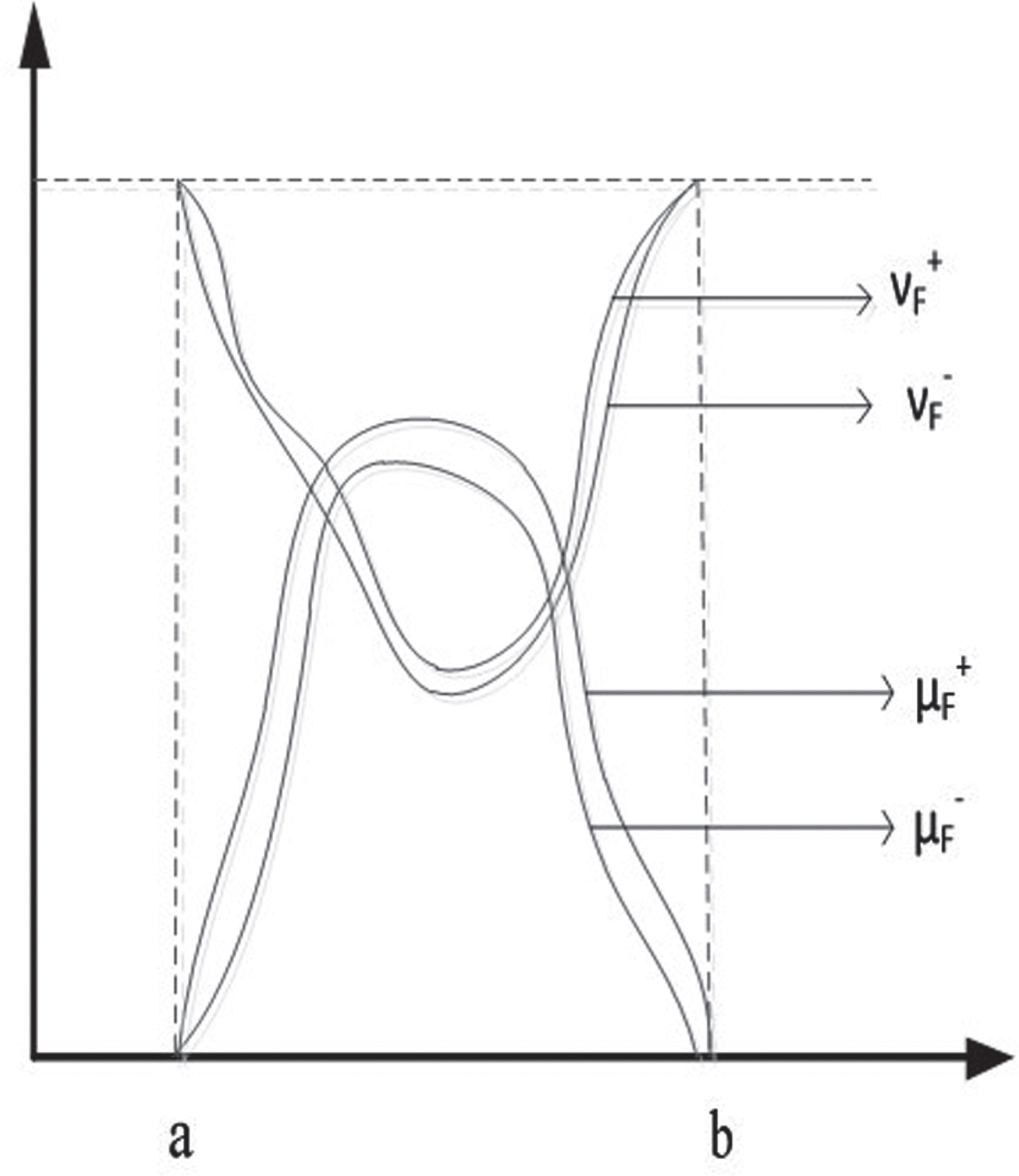
Interval valued IFS.
[29] Let Y be a finite non-empty set such that, Y = y1, y2, . . . . . , y
n
. Let R[0,1] be all subintervals of [0,1]. An IVIFS
For an IVIFS
[13] Let
Interval number
[18] An interval is considered on the real line R and it can be represented by, r = [r1, r2] = {a ∈ R : r1 ≤ a ≤ r2 and r1, r2 ∈ R} If
Relation of intervals
Sengupta and Pal [25] introduced a simple and effective index for linking any two intervals on real number and it is based on the satisfaction of decision makers. For a given two intervals
(i)
(ii)
(iii)
New interval arithmetic
Ma et al. [20] projected a new interval fuzzy arithmetic which is built on both “location index and fuzziness index functions”. The location index number is considered as the usual arithmetic, meanwhile the fuzziness index function is observed to trail the lattice rule which is least upper bound in the lattice L. Let
An IVIFTP is a very unique event of‘IVIF LP problem’ and this IVIFLPP can be solved by simplex method, but it allows a frail basic feasible solution and also it takes a huge time to compute. Hence, basic feasible solution can be attained by using Interval val intui fuzzy Vogel’s Approxi method (IVIFVAM) and the solution is compared with various methods such as zero point method, Monalisha’s Approximation method etc. In this paper, we contemplate an IVIFTP with m stocks and n requirements. The Cost
In this mode, the cost are represented in interval numbers but, the availability and requirement values are in regular crisp number. We conquire the solution of Initial BFS of TP numerous methods.
Mathematical formulation
Let us consider Supply and demand.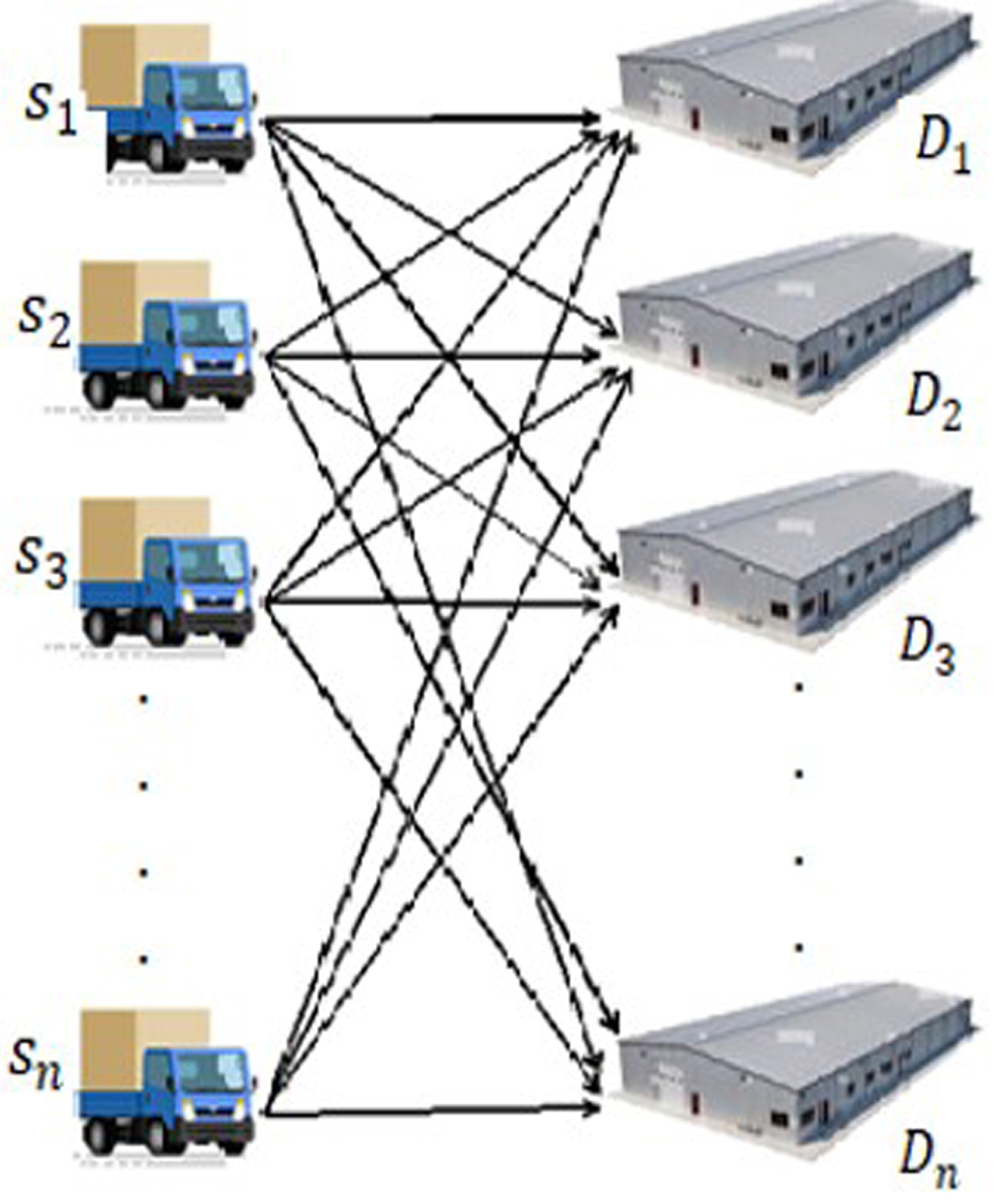
Hitchcock [14] discovered the basic TP with static parameters, and it was exhibited by standard LP except handling uncertainty and hesitancy referred in (Table 1). Many transportation models have seemed in the works in which unpredictability was a major cause to share out. In this paper, we challenge this unreliability and hesitancy by using interval valued IFS.
Indeterminate transportation
In this segment, we calculate the IBFS using IV Intuitionistic fuzzy VAM, IVIF Harmonic mean approach, IVIF Zack algorithm, IVIF Monalisha’s Approximation method and IVIF zero point method.
IVIF Vogel’s Approximation method
Vogel’s Approximation method (VAM) is the familiar method which is used to identify the initial basic feasible solution of Transportation problem.
If it is finely adjusted (i.e., the total of quantity available is identical to the total of requirement) then proceed to step 3.
If it is not in a equilibrium state, (i.e.,the total of availability is not identical to the total of necessary values) then proceed to step 2.
IVIF harmonic mean approach
Harmonic Mean Approach is the new statistical method used to discover the optimal solution. It is very nearer to VAM method. The arithmetical instance is specified to resemble with the existing methods. The steps are enumerated below:
If it is in a equilibrium one (i.e., the sum of stock is similar to sum of needed value) then proceed to step 3.
If it is not an adjusted type (i.e., the sum of available values is not uniform to the sum of desired cost) then move to step 2.
IVIF Zack Algorithm
Zack Algorithm is proposed to find an ini basic feasible solution to the TP. The main concept of Zack Algorithm is to occupy zero in the cell which has the highest cost and occupy the maximum cost in the cell which has the lowest cost. The steps are listed below:
IVIF maximum range column method
In solving problems, MRCM is a better tool to identify IBFS as analyzed with other methods along with, it can be updated based upon its attainment.
IVIF zero point method
The feasible solution is acquired by Zero point method by solving transportation problem to get minimized cost.
(i) Identify the least cell of the reduced cost members which is not shaded by any boundaries.
(ii) Subtract that cell from all the unshaded entries and sum up the least value at the meeting of any two boundaries, then move to step 4.
Numerical illustration
In this segment, numerical illustration of [29] is considered in Table 2 to prove the proposed computational method of the IVIFTP. In this case, the cost is viewed as a IVIFN and this number was acquired by the linguistic variables, whereas the supply and demand are taken as a fixed crisp numbers.
Interval valued Intuitionistic fuzzy cost table
Interval valued Intuitionistic fuzzy cost table
There are three transportation delivering companies and seven boundaries engaged during transportation. Evidently, the precise data is unknown while the lower and upper limits of such boundaries are known. At the moment, basic feasible solution can be obtained by the methods discussed in segment 4 and it is resulted in IVI fuzzy numbers.
R.M Umamageswari et al. converted the IVIF number into crisp number by using ranking technique and the cost is acquired as 1.25. In this paper, we consider the same problem and it can be solved by several methods. To get the feasible solution, it can be solved by using VAM. Let us establish all the interval parameters as
By using the new interval Arithmetic operations, the interval valued IFN is transformed into the numbers representing in midpoint and width as it is mentioned in (Table 3). The values of capacities and requirements are also assumed to be in interval and converted in terms of midpoint and width. Hence after the allocation of the respective supply and requirement, the initial basic feasible solution of the IVIFTP by using Vogel’s Approximation method is:
Interval valued Intuitionistic fuzzy membership ana non-membership costs in terms of midpoint and width
We acquire the interval valued intuitionistic cost for each allocated cells C11, C21, C22, C33, C42, C52, C63, allowC73. From the Table 4, the initial IVIF feasible total transportation cost for the allocated membership function is obtained by, = 〈2, 0〉 ∗ 〈0.85, 0.05〉 + 〈1, 0〉 ∗ 〈0.65, 0.05〉 + 〈1, 0〉 ∗ 〈0.6, 0.1〉 + 〈1, 0〉 ∗ 〈0.5, 0.1〉 + 〈1, 0〉 ∗ 〈0.7, 0.1〉 + 〈2, 0〉 ∗ 〈0.75, 0.05〉 + 〈2, 0〉 ∗ 〈0.5, 0.1〉 + 〈1, 0〉 ∗ 〈0.55, 0.15〉 = 〈7.2, 0.15〉 = [7.05, 7.35]
Allocation of Interval valued Intuitionistic fuzzy TP using VAM
The initial basic IVIF feasible total transportation cost for the allocated non-membership function is acquired by, = 〈2, 0〉 ∗ 〈0.05, 0.05〉 +〈1, 0〉 ∗ 〈0.25, 0.05〉 + 〈1, 0〉 ∗ 〈0.25, 0.05〉 + 〈1, 0〉 ∗ 〈0.15, 0.05〉 +〈1, 0〉 ∗ 〈0.05, 0.05〉 + 〈2, 0〉 ∗ 〈0.15, 0.05〉 + 〈2, 0〉 ∗ 〈0.35, 0.05〉 + 〈1, 0〉 ∗ 〈0.25, 0.05〉 = 〈2.05, 0.05〉 = [2, 2.1].
Therefore, the degrees of membership and non membership are exhibited in closed Interval and the IVI fuzzy feasible solution for the transportation problem is uttered by [7.05,7.35, 7.05,7.35] [2,2.1, 2,2.1]. The various methods by HMA, ZA, MRCM, ZPM is utilized and the costs price are produced in Table 5.
Discrimination of proposed method with existing methods\label tab:5
This paper suggests a new technique to formulate the TP by utilizing interval valued IF numbers. This method is recommended to identify the IBFS of IVIFNs derived on both requirements and availabilities, which are in real numbers. The cost in [29] is acquired by transforming the interval number into single crisp number and the price captured is 1.25. The computational methodology by using new interval arithmetic operations is undergone and finally the costs of VAM, HMM, Zack Algorithm, MRCM and ZPM are uniform, specifically pointed the degree of validity in interval as [7.05,7.35, 7.05,7.35], whereas there is a little modification in the degree of non-validity cost in the alternative methods. The Costs of IVIF membership and non-membership function are shown in Fig. 3. Moreover, IVIF sets are applicable to various domains like decision making, medicine, industry, artificial intelligence etc., where the paremeters are uncertain and not clear in nature.
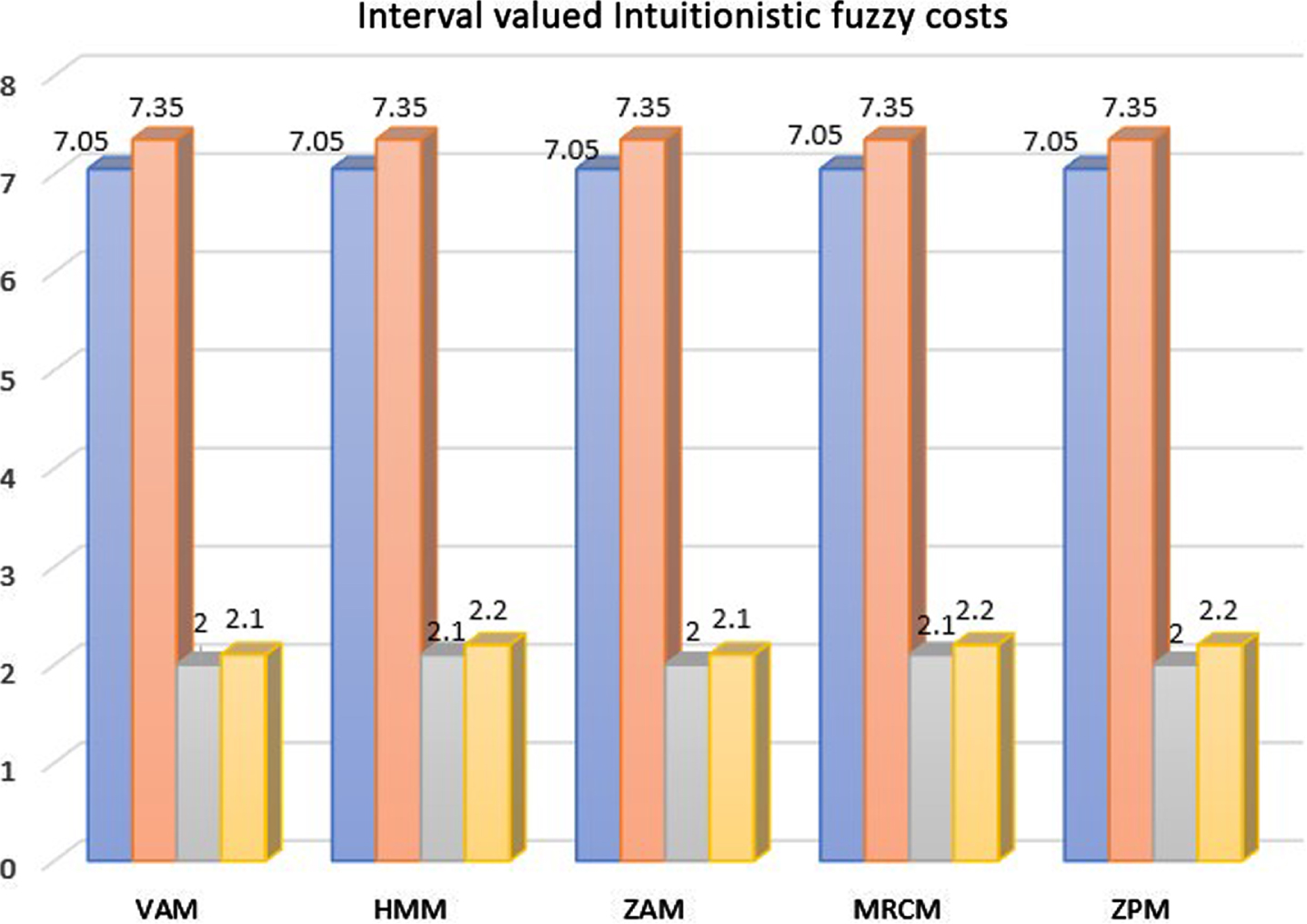
Interval valued intuitionistic fuzzy membership and non-membership costs after applying interval arithmetic operations.