



Abstract
In the resource-constrained wireless sensor network (WSN) geographic routing has been considered as an attractive method where it exploits the location data instead of global topology to transmit the data. The geographic routing protocol faces the routing issues when it is used by a heterogeneous device and utilizes high energy during the propagation of data. The lifespan of the sensor network depends on the efficiency of energy and capacity of the battery. Hence, successful data transmission, enrichment of battery capacity and energy utilization is necessary for WSN. To attain this requirements an effective change is made in the data transmission environment and network topology. In this paper proposed a dynamic cluster based duty cycle scheduling is initiated for the data transmission. The cluster-based scheduling and routing in geographic routing protocol (CSRGR) utilize the clustering mechanism which in turn reduces the consumption of energy and maximizes the throughput. The objective function of the proposed approach provides a scheduling and routing strategy. The demonstration of simulation results shows the effective cluster size balancing with data transmission range dynamically. The proposed algorithm is compared with the existing approach and from the results, the energy consumption is minimum for diverse scenarios.
Keywords
Introduction
The wireless sensor network (WSN) is a schema-less and self-configured network, which records and monitors the physical scenario of the atmosphere [1]. The emergence of WSN has made the perception of communication to the subsequent level and it is also applied in several standard applications [2, 3]. Energy preservation and routing are the two significant aspects considered in designing protocols for WSN [4]. The WSN consists of abundant sensor nodes and it is generally powered by batteries where the replacement or recharging of battery is a complicated process but they are expected to work for a long duration [5, 6]. The sensor nodes in the WSN utilize more energy during data transmission rather than calculation [7]. Prolonging the working of battery and WSN is a primary intent in designing the protocol. The geographic routing protocols [8] are localized routing or position-based [9, 10] and it is a fascinating method in the resource-constrained WSNs [11].
In the process of delivering information, it uses the local location of data in the place of global topology. The reduction of energy utilization often initiates the supplementary latency of data delivery. The energy preserving mechanism in WSN has initiated the minimal throughput which results in the ineffective data transmission. Effective routing and scheduling are needed to achieve effective data transmission with high throughput and minimal latency. In this paper, a cluster-based scheduling and routing in geographic routing protocol (CSRGR) is introduced. This approach highly reduces the energy utilization which in turn accomplished minimum latency for WSN. In the sensor node, energy utilization is affected by various aspects namely clustering the topologies, duty cycle schedule across the sensor node, transmission range at the dynamic rate, and retransmission. The CSRGR highly minimizes the end to end delay and the significant contribution of the proposed scheduling approaches is,
The available scheduling approaches in the WSN namely self-learning based scheduling method [12], lightweight scheduling [13], and sleep scheduling policy [14]. These approaches face certain shortcomings such as collision, high latency, and complicated routing. To rectify the issues, a cluster-based scheme is introduced for routing and scheduling the transmission across the WSN. The simulation examination of the CSRGR scheme is compared with the existing algorithms. The simulation outcome represents that the proposed scheme CSRGR can minimize the latency and enriches the energy usage.
This research article is emphasized as follows: The clustering and scheduling approaches are given in the related work section, the framework of cluster-based scheduling and routing in geographic routing protocol (CSRGR) is given in section 3, the diagrammatical depiction of SSA, LWS, SSP, and CSRGR is demonstrated via a graph in section 4 and the conclusions, as well as the future suggestions, are given in section 5.
Related works
In the sensor network with wireless multimedia [15] routing the data and discovering the shortest path is a mandatory process. The multimedia intensity causes traffic during data transmission and it makes the energy of the node to exhaust the power faster. This makes the breakage of the routing link and makes the halt in the data transmission. The node in the idle state also uses energy that also results in the usage of energy unnecessarily. To rectify the issues of energy-awareness, a simple synchronized sleep scheduling mechanism (EA-TPGF-SS) is initiated, which has the capability of feedback passing. EA-TPGF-SS is developed based on the geographic routing protocol and it has degradation in the rate of Packet Delivery Ratio (PDR).
The duty-cycled approach is used in the industrial sensor network [16] and the sleep schedule is incorporated with the duty cycle method, which enriches the lifetime of the network. Two-Phase Greedy Forwarding (TPGF) is effective in data transmission due to the advantages namely bypassing of a hole, multipath, and shortest path. The irregularity in the radio network causes a delay in the transmission and the rate of sleep is also minimized, which makes the transmission ineffective.
A sleep scheduling mechanism for the multicast routing geographic approach is developed to schedule the process of routing and data transmission [17]. The general issue in the wireless network is flooding that causes due to inappropriate data transmission and it causes high energy consumption. The geographic routing protocol is computationally high cost and transmission also faces limitations namely flooding, ineffectiveness, and high energy consumption. Sleep scheduling with an energy-efficient approach is developed to transmit the data with minimum energy utilization and effective transmission [18].
The shortcoming in the existing approaches is considered in designing the proposed framework cluster-based scheduling and routing in geographic routing protocol (CSRGR). In this approach cluster scheme is introduced and the nodes are arranged with the assistance of the cluster. The duty cycle mechanism is incorporated in scheduling the data transmission process.
Problem statement and proposed model
The proposed protocol cluster-based scheduling and routing in geographic routing protocol (CSRGR) is discussed in this section.
Cluster construction
The cluster construction is initiated in the geographic routing protocol and the cluster head D is assigned. The cluster formation is initiated and the cluster formation is given as,
The intra-routing path is initiated after the formation of the cluster and the routing path connects the source to the head of the cluster. The routing establishment is equated as follows,
The data source (DS) set is given and the aggregated information is received at the sink node. The inter routing is established to connect the sink node with the cluster head (D) of every source node is given as follows,
In Fig. 1, G1 to G6 signifies the cluster head, k denotes the sink and 21 nodes are arranged.
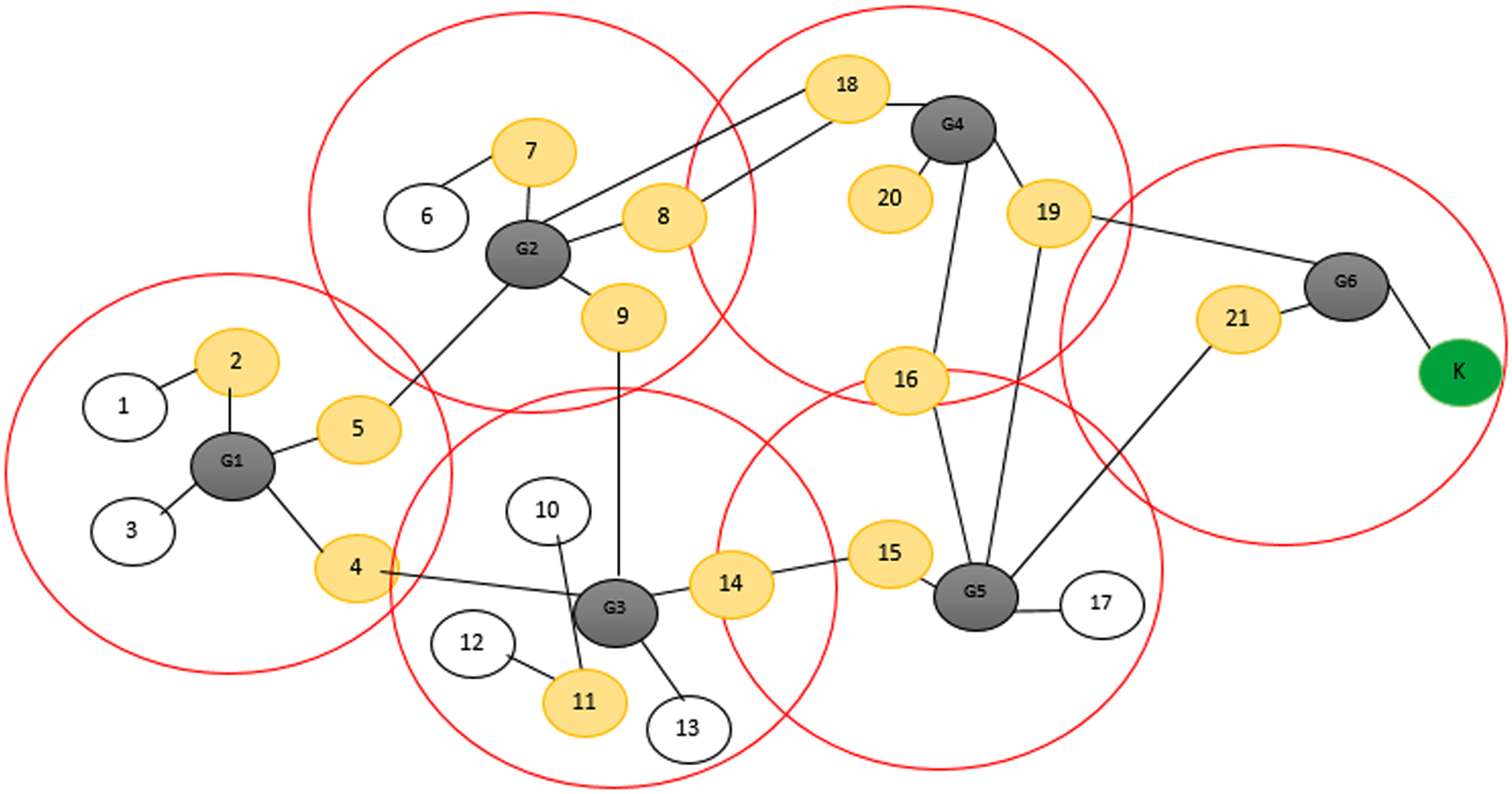
Construction of six cluster groups and the cluster-based routing.
The conjunction in the constraint is ensured from every cluster head and it also has one intra routing path to the source node that is from every cluster. The connection establishment is given in equation 4 and the transmission constraint is given in equation 5.
The sensor node D is elected as a cluster head and an intra-routing path from the source to the sink node is established with the value of 0. The candidate path in the network value is assigned with 1 otherwise the value for ηp is 0 and there is no path, which is equated as,
The inter-routing decision variable J(x,y) is assigned with the value 1 if some path on the network is elected and the indicator of cluster head is δq(x,y) whereas a link is elected in the network. The constraints on these two paths are described in equation 7,
If the cluster head is on the path, any sensor node among that path can be elected as an intermediary node on the inter-cluster routing path. The process of electing the node is given in equation 8,
Let us assume, all the data are distributed to the sink node and the constraint on the link is collected by every node, which is delivered by the relevant path. A sensor node is elected to acquire data sent from a source DS and the out-degree value is at least 1 where the link is established from the source node and it is given as,
The count of the out-degree links for every node is not greater than the value 1 and in the inter-routing region at most one link from the senor node x to y. The establishment of the scenario is given as,
The intermediary nodes are forwarded and they are received by the cluster head, which assures the establishment of a link among the cluster head to the sink for the data transmission. Thus, one relay node x is available to deliver coverage to a cluster that has members with the constraint b
dsd
⩾ 1, ds ∈ DS and the in-degree link summation to the relay node x is assigned with the value 1 is given as,
After completing the data forwarding that is data delivered to the sink node and at least a single node is available to deliver the coverage to the sink node. The in-degree link summation is assigned as 1 and it is equated as,
The data transmission among the node x and y is represented by d(x,y) and it is given in the following equation,
The data transmission among the node to node with the transmission time is denoted as ∅ (x, y), and for the active links, the range is assigned as 1. The acquiring of minimum energy utilization TU is l(x,y) and the transmission is given as,
The incoming data from the node with a predetermined limit of time is received by the clustered node and it is given in the following equation
Equation 18 comprises of utilized energy within the transmission network when the data sent and received where sensor nodes are idle.
In this section, the simulation result of the proposed protocol CSRGR is discussed and the results are compared with the approaches namely SSA, LWS, and SSP. The experiment is executed using Network Simulator (NS-2.34). The simulation parameters applied in the experiment are given in Table 1.
Simulation parameters
Simulation parameters
Packet Delivery Ratio (PDR) is calculated from the count of the data packets delivered from the total count of the data packet transferred from the source to the destination node [19]. The data transmission algorithm with the highest packet delivery is considered the best algorithm. The construction of the cluster is initiated to attain the data delivery with the proper scheduling mechanism and the rate of PDR is high when compared with the other geographic and scheduling approaches. In the CSRGR, the data transmission schedule is initiated based on precedence that provides assistance to achieve the restrictions of the delay in the data transmission. Thus, a node with maximal density in CSRGR has a higher PDR value than the SSA, LWS, and SSP methods. The performance of the CSRGR, SSA, LWS, and SSP algorithm is depicted in Table 2 and Fig. 2.
Comparison of packet delivery ratio in percentage
Comparison of packet delivery ratio in percentage
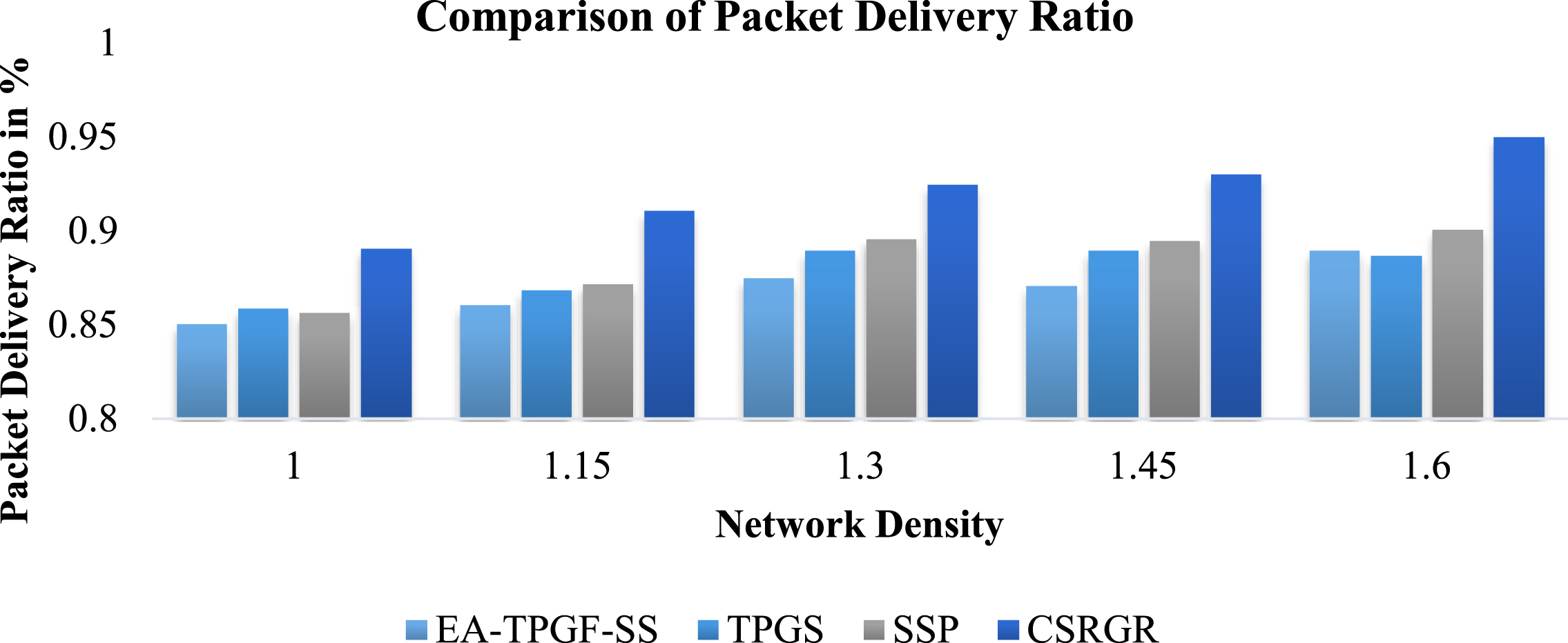
Comparison of packet delivery ratio.
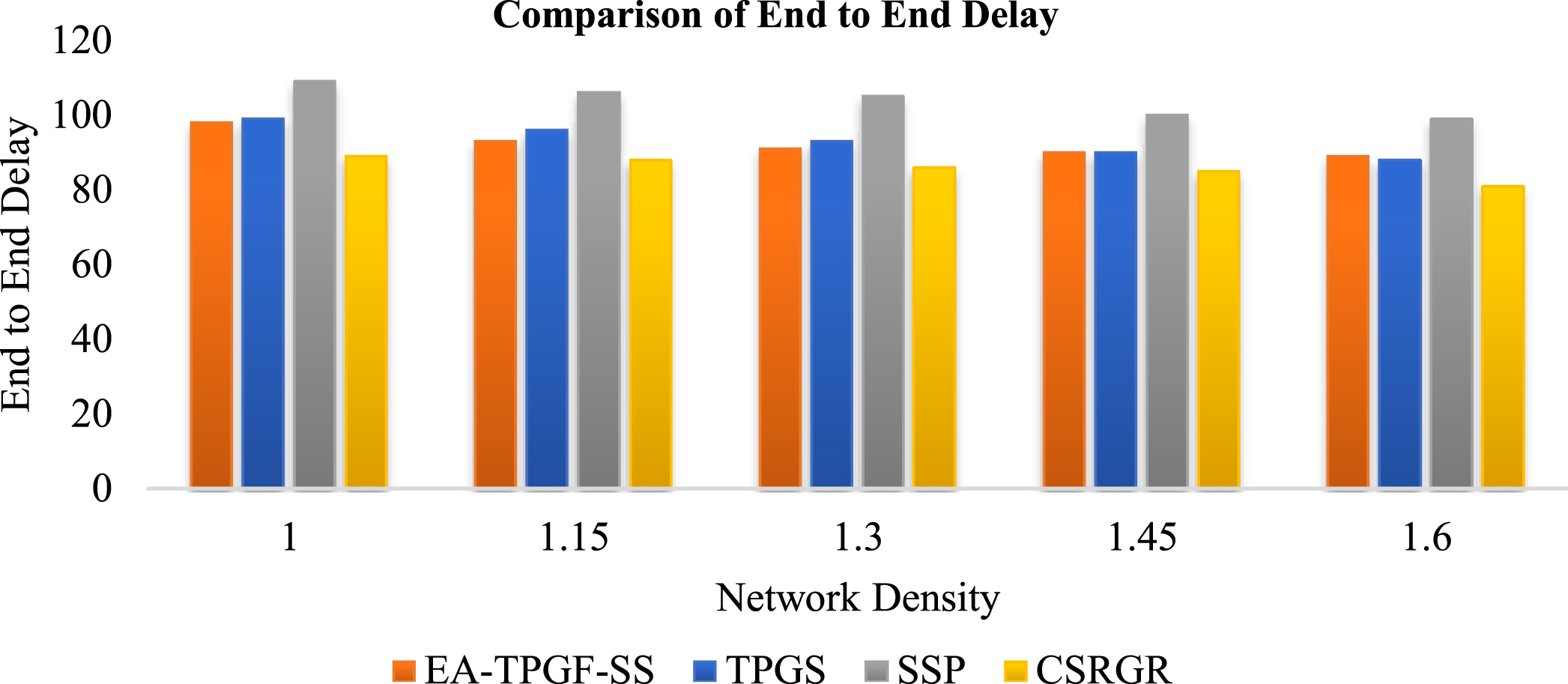
Comparison of delivery delay.
The additional time taken to transmit the data from the source to the destination node is the end to end delay [19]. The protocol with minimum transmission delay is considered as an effective protocol. In the CSRGR protocol, effective data transmission is attained by the cluster-based scheduling strategy with minimum delay. The resultant values of end to end delay of the CSRGR, SSA, LWS, and SSP algorithm is given in Table 3 and Fig. 4. The end to an end delay time of the proposed protocol CSRGR is effectively minimized with the clustering based scheduling approach.
Comparison of delivery delay
Comparison of delivery delay
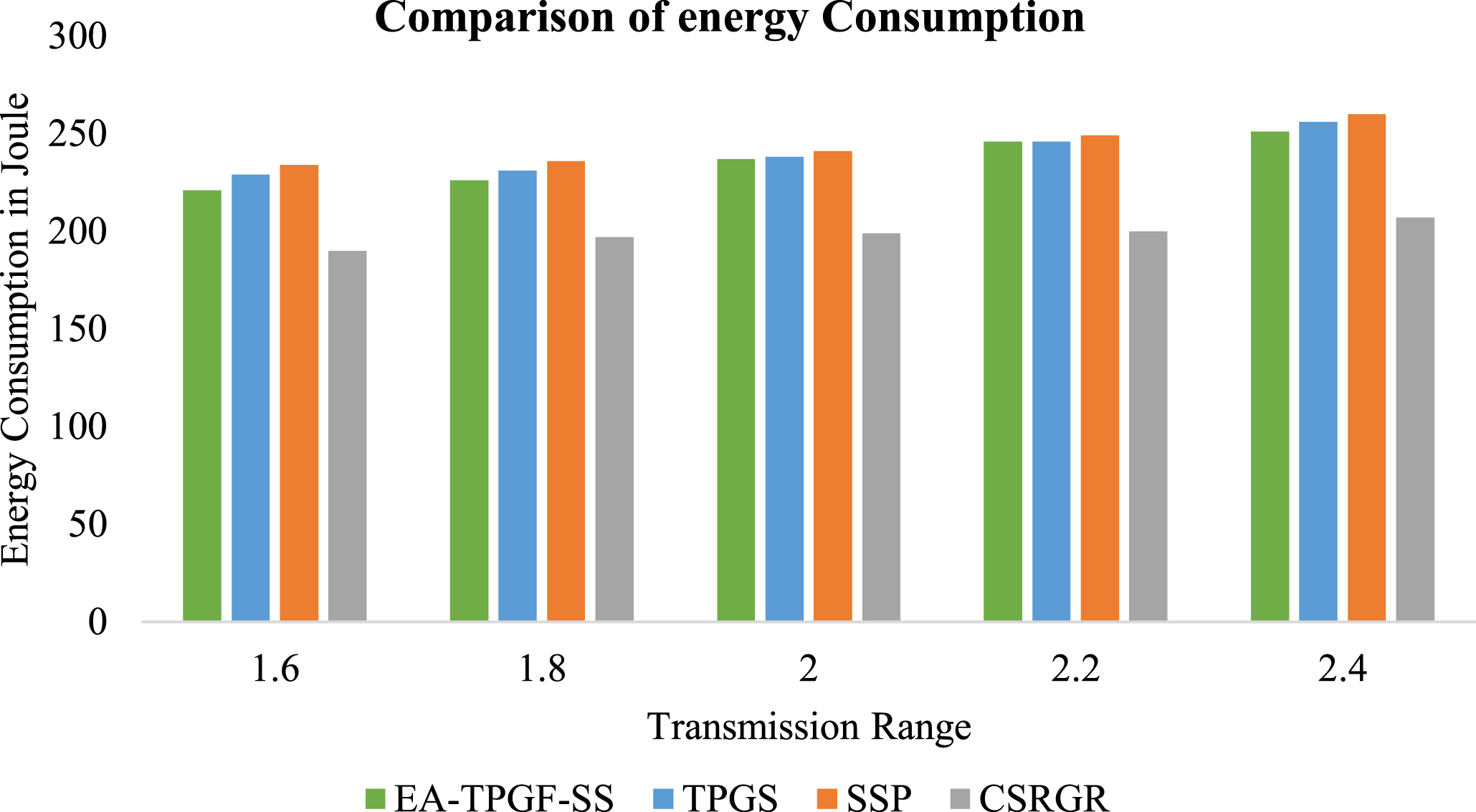
Comparison of energy consumption under different transmission range.
In the WSN, every sensor node in the data transmission environment is instilled with the rechargeable batteries, and the minimum amount of energy where recharging the batteries also difficult [20]. The data transmission is initiated by the cluster and duty cycle scheduling mechanism. The data transmission process is accomplished without any interruption and data transmission is achieved in the shortest path with effective energy utilization. This situation reduces the exhaust of energy in the transmission nodes. The CSRGR protocol has minimized the usage of energy across various transmission range and network densities. The energy consumption value of the existing and proposed algorithm is displayed in Tables 4 and 5.
Comparison of energy consumption vs. transmission range
Comparison of energy consumption vs. transmission range
Comparison of energy consumption vs. network densities
In Figs. 5 and 6, the utilization of energy across various transmission ranges and network densities is illustrated and from the observation, it is identified that the proposed algorithm utilizes minimum energy.
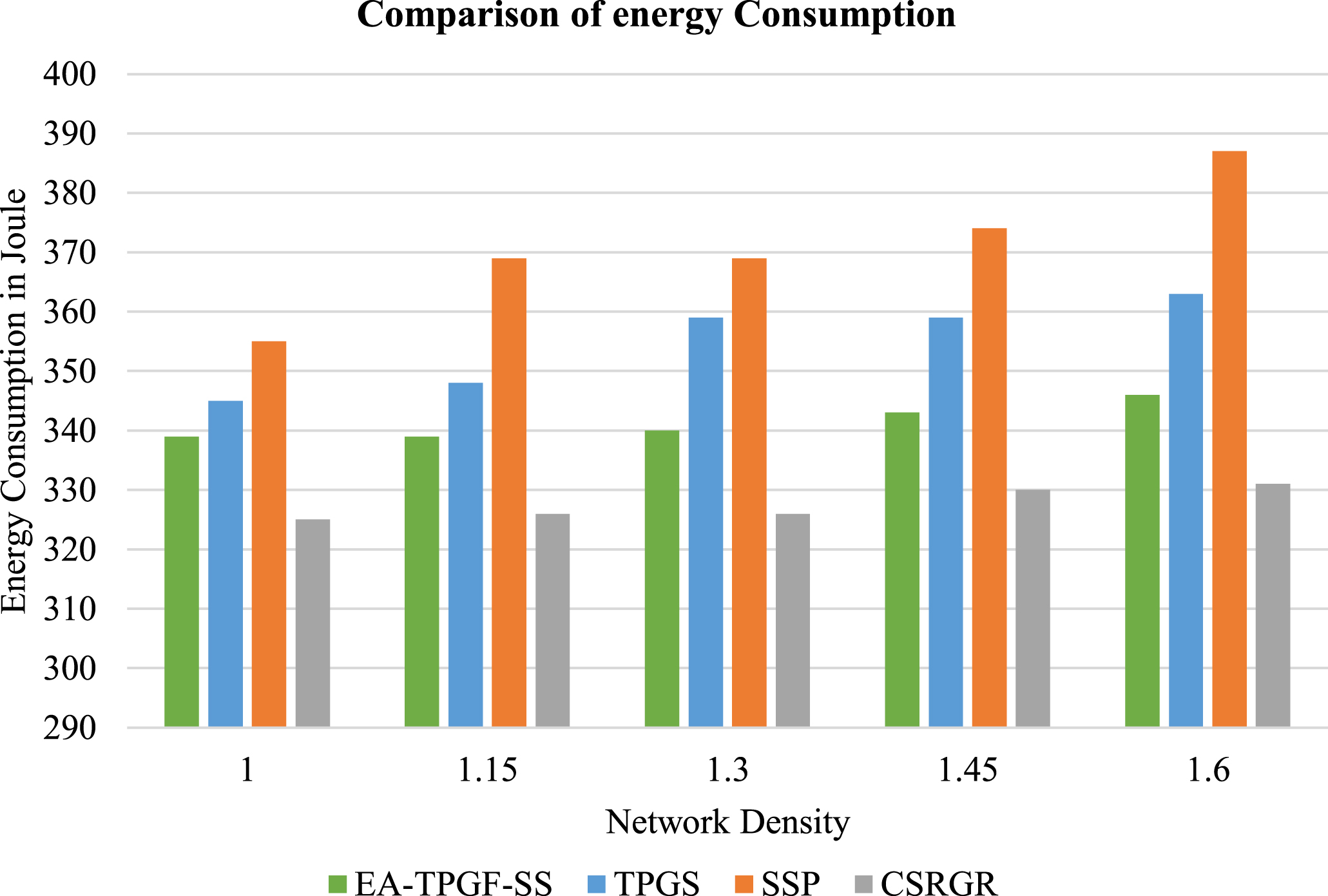
Comparison of energy consumption across various network densities.
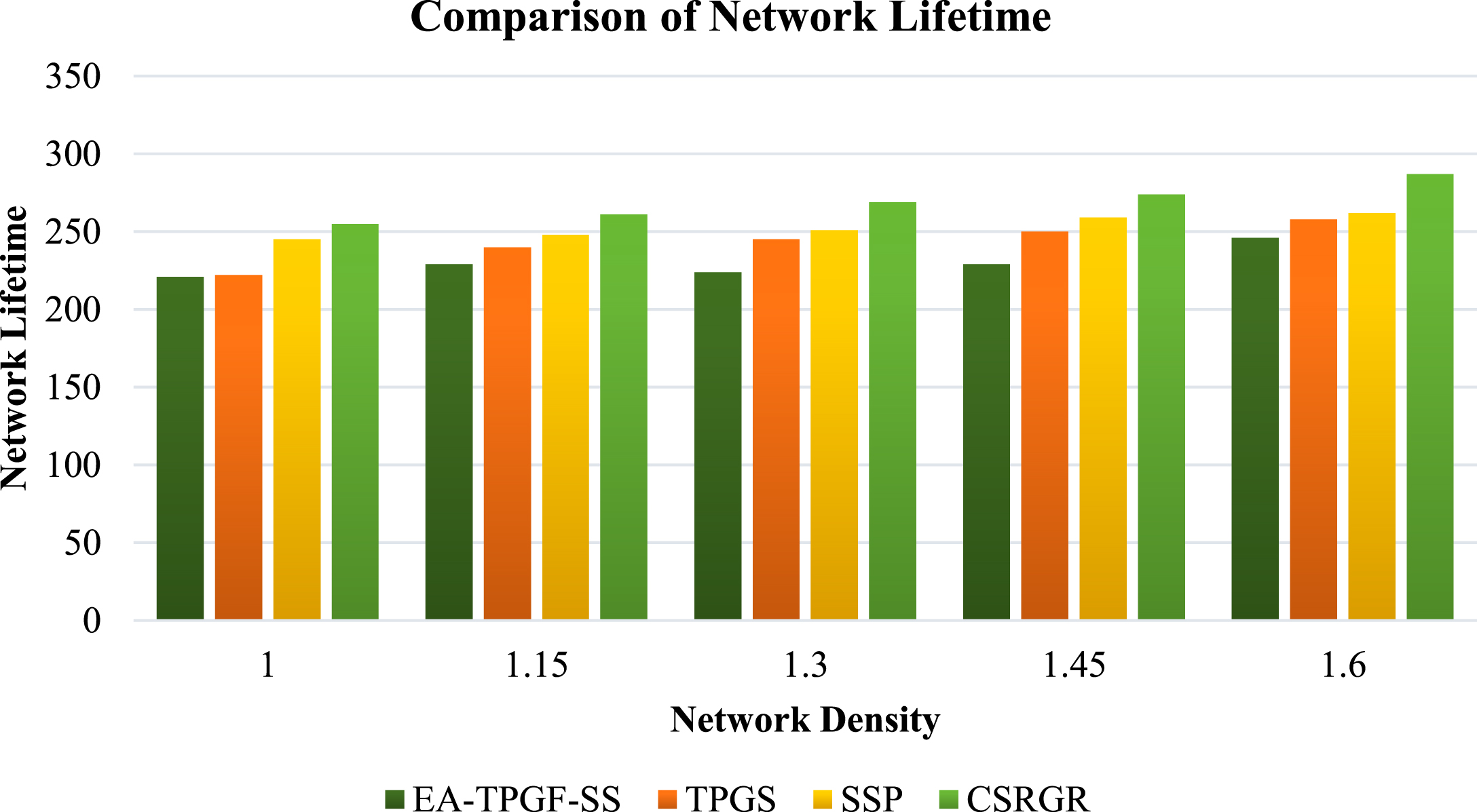
Comparison of network lifetime.
The sensor nodes in the network at some state will run of power or energy, which results in the loss of functionality, and packet delivery is not accomplished [21].
The increased network lifetime of the algorithm results in enhanced performance and the values are shown in Table 6. The comparison of network lifetime and the effectiveness of the proposed CSRGR algorithm are depicted in Fig. 6.
Comparison of network lifetime
Comparison of network lifetime
The communication overhead is the ratio of the whole count of the data packets transferred from the source location to the destination location [23, 24]. It is the proportion of time applied in communicating within the transmission network. The comparison of communication overhead and the effectiveness of the proposed CSRGR algorithm are depicted in Table 7 and Fig. 7.
Comparison of communication overhead
Comparison of communication overhead
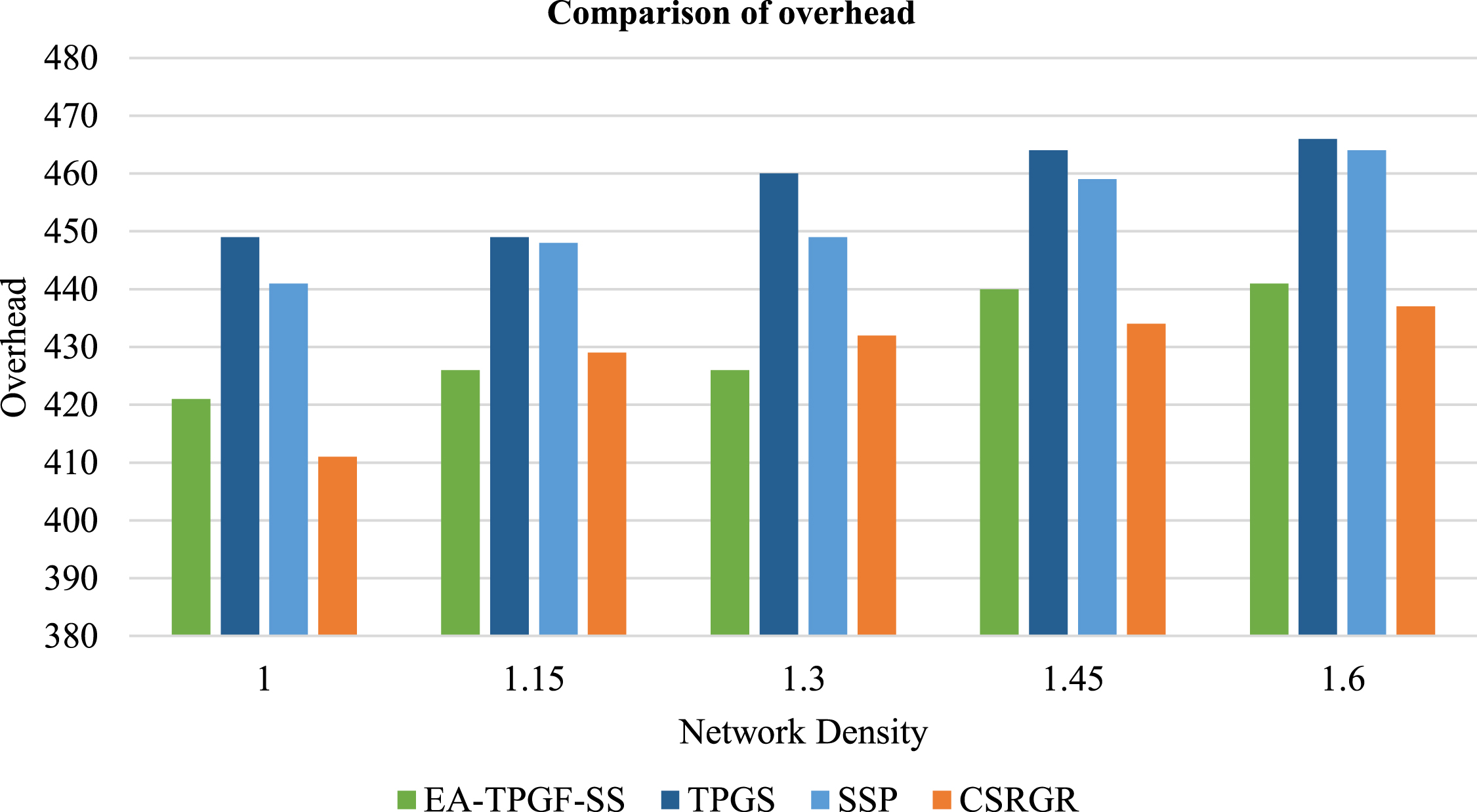
Comparison of communication overhead.
From the observation of results in Table 7 and Fig. 7, the communication overhead is minimum in the CSRGR approach.
Throughput is the definite quantity of data that is effectively sent/received over the communication link. Throughput is offered as kbps, Mbps or Gbps, and can vary from bandwidth due to a range of technical concerns, including packet loss, latency, jitter and more. Throughput denotes to how much data can be transferred from one location to another in a given amount of time.
From the observation of results in Table 8 and Fig. 8, the throughput is high in the CSRGR approach. The simulation results proves that the strategy presented by CSRGR approach is applicable in both small and large networks and the results demonstrated that the network lifetime using CSRGR approach is high when compared to other existing protocols with respect to various network densities respectively. Further, cluster based duty cycle scheduling enabled the CSRGR algorithm to decrease node energy consumption and achieved better load balancing among the nodes. From the results analysis, it has been also evidenced that the computational cost in terms of end to end delay is not improved as expected on increasing the network density. Stress testing in WSN can be considered as the process of determining that the network can continue to operate effectively under challenging circumstances or under high network densities. In this research work, the performance of the network is analyzed using various network densities which has been considered as a stress testing factor. Then, the PDR, End to End Delay, Energy Consumption, Network Lifetime, Communication Overhead and Thorughput has been analyzed and the proposed approach is found better than the existing algorithms under various network densities (stress factor).
Comparison of throughput
Comparison of throughput
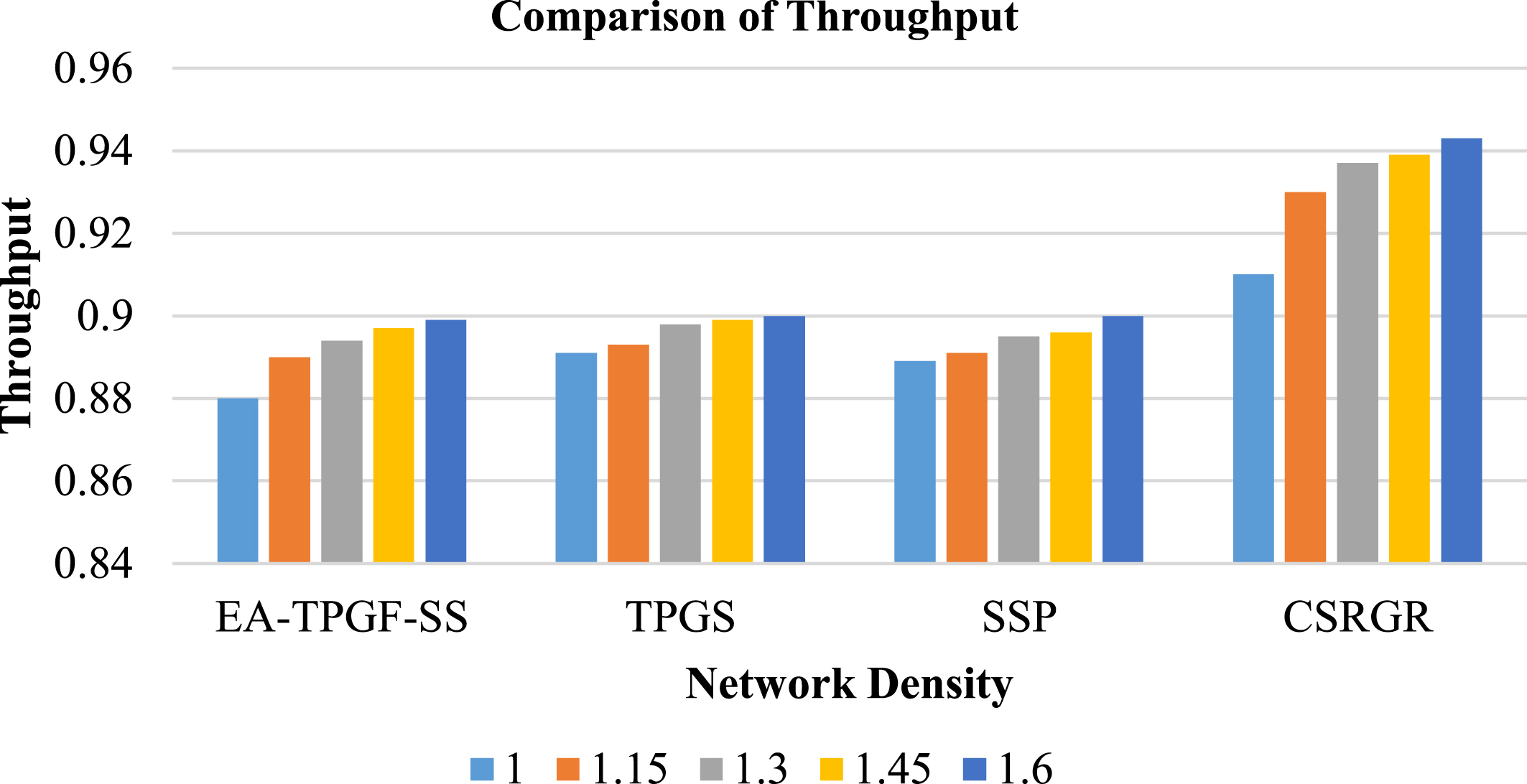
Comparison of throughput.
According to Table 9, the performance in terms of PDR, End to End Delay, Energy Consumption, Network Lifetime, Communication Overhead and Thorughput (independent variable) taken by these of the existing and proposed algorithms are significantly different with respect to the various network densities (dependent variable); the p-value concludes that the regression model is a good fit for the data.
Significance of F (P-value) obtained using ANOVA
The sensor nodes in the data transmission network exploit additional energy during the transmission of data rather than the computation. Extending the working of the battery as well as improving the lifetime is a primary goal in designing the transmission protocol. The geographic routing protocols are localized or position-based routing approaches that are developed for the resource-constrained WSNs. The geographic routing has the benefits namely bypassing of the hole, multipath, and shortest path. The existing approaches EA-TPGF-SS, TPGS, and SSP have various limitations. EA-TPGF-SS is developed has high degradation in the rate of Packet Delivery Ratio (PDR). Two-Phase Greedy Forwarding (TPGF) causes the rate of data transmission delay and sleep also reduced, which makes the data transmission ineffectual. A sleep scheduling mechanism for multicast routing in a geographic-based approach is established to schedule the process of data transmission and routing. The shortcoming in the existing approaches is rectified and designed in the proposed framework that is cluster-based scheduling and routing in geographic routing protocol (CSRGR). In this approach cluster scheme is presented and the nodes are organized with the support of the formed cluster. The duty cycle mechanism is incorporated in scheduling for the effective data transmission process. The simulation results are analyzed and compared with the available approaches, from the observation of results it is identified that the proposed CSRGR is highly effective in terms of end to end delay, throughput and PDR rate.