



Abstract
To safeguard private information, image steganography is extensively used. Research is focused on ways to enhance steganographic technologies so that they may increase compression ratio while maintaining steganography image integrity. Because of its essential qualities such as security, scalability, and robustness, Steganography is a preferred way of communicating protected secret information to prevent hacking and misuse. This proposed research offers a steganography approach based on Enhanced Chaotic Particle Swarm Optimization (ECPSO), which uses chaos theory to determine the optimal pixel positions in the cover picture to hide confidential information when keeping the steganography quality in the images. Both the cover and secret pictures are separated into blocks to increase hiding capacity, with each component storing a sufficient quantity of secret data by mapping the pixels. The suggested ECPSO-Stegano system has better results with the criteria of Mean Square Error (MSE) of 0.00018%, Peak-Signal-to-Noise-Ratio (PSNR) of 79.66%, Bit Error Rate (BER) of 0.45% in average, and Structural Similarity Index (SSI) of 0.98 in average for various input size. It’s also robust to statistical threats.
Introduction
Because of its importance in data transfer, network security is becoming a hot subject. It provides methods for securing data by preventing unauthorized access, modification, destruction, or release [1]. Cryptography and Steganography [2] reinforce the significance and relevance of data protection in everyday life operations, with Steganography preserving the database schema [3] and cryptography converting the information into toughest readable symbols [4].
Steganography, which is a Greek word derived from a latin word “Steganos”, which was emerged some 2,500 years ago [5] and has since been used as a constrain in sequence of many special formats, including texts, movies, photographs, and audio. It allows users to interact in a secure manner, avoiding suspicion and unwanted attention throughout information transfer process. It works hand over in with the subsequent advancement in the field of infrastructure networks, as seen by the increasing amount of information and users.
The efficacy of any steganography method is maximumly dependent on the intelligence and correct identification of the embedded region in the cover media [6]. It can impact the integrated availability and excellence of the cover intermediate data. In this paper, we present a novel representation of concealing strategy that improves embedding performance without sacrificing the eminence of the resulting steganography image. To accomplish the embedding stage, the proposed work employs ECPSO with pixel position selection concept.
Particle swarm optimization is a cost-effective and simple-to-use method. It is intertwined with artificial life organization and functions in a mutual and supportive technique [7]. As it is used to particle collecting, the PSO process does not consider a huge no. of organize parameter and may be simply achieved by balances processing. PSO center on a small no. of random element and seeks to discover the best solution by repeating the process [8]. It’s been used for a variety of purposes, include Steganography. PSO was used, for illustration, in [9] to establish the best image in the cover image to encoded hidden data. Determining the optimum spot for an ideal component location as well as the greatest global component distribution is crucial for PSO. However, one disadvantage of employing it is that the components are prone to convergence rate, which traps the swarm in an optimum local region and prevents it from discovering any new areas inside the local optimal resolution. As a result, right to use to the global optimum remains limited.
The motivation of use of the steganography is that people do not want the third part to know there is something important in it. A common weakness of the existing methods is that they may not work in a generic basis or work without the nature of the steganography. Hence a passive method is needed in steganographic approaches work to resolve the aforementioned problem in current digital era.
To analyze the steganography counter measures that significantly concentrates on how to prevent the illegal messages encoded by the steganograph. The proposed method provides solution with the design of a passive method. It monitors security periodically. It will detect if a steganography is used in the monitored cover media. If detected then a further classification is needed which is performed with chaos theory. The model intends to solve this challenge by using chaos theory [10] which relies on continuous motion to produce random sequences that prevent future any repeats in the research region. By more precisely establishing the position and achieving a balance among global and local positional search functionality, chaos theory can increase the search quality.
The fourth coming sections are divided as: Section 2 summarises previous research, while Section 3 provides information on PSO and chaotic maps. Sections 4 and 5 detail the suggested approach, as well as the better understanding of the project and outcomes review. Section 6 brings the article to a close and outlines future research.
Literature review
The literature analysis of the existing publications has been completed in this area. Nipanikar et al. [11] developed a technique that employs segmentation method and a particle swarm optimization (PSO) algorithm to successfully choose image for steganographically masking hidden audio signals in images. The fitness meaning, a cost-dependent characteristic, is used in the PSO-based process to choose the pixels in the digital format. The proposed method obtained superior PSNR and MSE ranges of 47.70 dB and 0.770 in the information and solutions acquired utilising provided methods and other ways. The current standard particle swarm optimization approach was compared to human-based PSO by Ziyad et al. [12]. (HPSO). According to his findings, the presentation of their suggested picture steganography using HPSO is superior to SPSO. To locate the optimum place in the photograph, they employed human-based Steganography. The findings also showed that for the purposes of collecting veiling and exposing, HPSO’s time requirements are superior than SPSO’s. Miri el Attell [13] discovered a method for data veiling in spectrum spaces based on heritably mutate method, which he previously suggested in. The authors employed K&C methods, in which the ciphered confidential documents are shrouded in minimum – occurrence components that primarily represent the vertices of the spatial field hidden picture. The creative representation utilised in the procedure does not alter much, and the generated image is better for human visualising and technology. The frequency’s space stays unsteady during the whole working process, becoming extremely reliant on the sort of hidden in sequence and the innovative image. The developers have implemented an additional protection level to ensure that eavesdroppers are unable to locate disguised information in the correct region. Their work improved by 1.8 decibels above their previous exertion in the Peak Signal of Noise Ratio standard. [14] used wavelet, PSO, and LSB techniques to implement Steganography.
With the daubauchi-1 wavelet, the cover picture is treated to 5 levels. The approximations 8 × 8 matrix is masked in the minimum bit of the creative picture at the fifth level, and the element position (x axis, y axis) is determined by means of the PSO method. According to this expert, the suggested algorithm-mechanism outperforms the prior works examined during the procedure. Hamid [15] suggested that his studied and tested approach would produce better results when a grey level picture at the rear an additional grey level image using Discrete Wavelet Transform for information veiling and a chaotic chart for improved protection problems. The author used the db1 wavelet technique to deconstruct the picture and divide it into four sub-bands (LL, LH, LL, and HH). The undisclosed picture is then crypted using logistic chaotic mapping (LCM) for increased confidentiality. Following the steps outlined above, the ciphered covert picture is placed in the HH band of the actual picture. variables of PSNR connecting the standards obtained, which are 38.36 dB and 1, correspondingly, are used to analyse the suggested technique’s principles. The authors of [16] used CNN to distinguish motions in RGB and RGB-static pictures. The data set utilised was the ASL database, and their suggested model had a 94.8 percent detection performance. The authors of [17] increase the quality of image features for three reasons: the first is to protect the minutiae template, the second is to increase appropriate application, and the third is to increase format interchange using multiple algorithms and detectors.
In [18], the authors present a simple technique for removing the haze. The haze in the photos occurs when the photograph is taken in a terrible weather. The previous code fading technique is employed to reduce haze, and the guided filtering is then filtered using weighted guide image screening. As a result, the references become variable, and a colour balancing method is used to improve the accessibility of the photographs. [19] uses six meta-heuristics methods to computerize the experiment set development process. presentation measures were used to analyse the performance, and it was discovered that ABC produced the best consequences; BA was determined to be quick, but the outcomes were not best possible. FA was the lowest of the group, whereas CS, PSO, and HCA performed well. The authors [20,25, 20,25] optimised the ABC and CSA test suites and discovered that the normal value of pathway reporting for ABC was 90.7 percent and 75.4 percent for CSA. The Optimization technique was discovered to be more trustworthy [26]. Researchers also talk about the basic ideas behind digital watermarking methods, the most important features of watermarks, their most recent uses, important temporal and transform domain techniques, important key performance metrics, and watermarking attacks [27].
The inappropriate insertion of data and the corresponding problems are more worrying with the data hiding approaches. Thus, there is a need for a novel technique to hide the process that takes place. Researchers have now been researching various approaches for steganography in learning approaches. By exploiting the communication channels as steganographic channels these approaches camouflage data communication. When it is not identified earlier, data is definitely stored in the proper place. Thus, the proposed learning approaches reduces the complexity of arbitrary data problem in real-time.
Comprehensive view of the steganographic techniques
The fundamental criterion for a Stegano technique is that it should be undetectable. The following criteria for algorithm interpretability have been suggested:
Proposed method
The PSO technique drawbacks is that it converges too quickly to the best local response. In proposed work, enchansed a chaotic PSO (ECPSO) technique to construct the novel technique more successful in the steganographic processes by selecting the optimal pixel positions in the cover image to insert the undisclosed data bits at the same time as keeping the stego-image integrity.
ECPSO algorithm
The logistic projection is used in the suggested technique to develop chaotic elements and map for the search process. The logistical equation is as following:
where Gi is a chaotic theory variable in the range (0, 1) and also is a variable that governs the behaviour of this logistically chart in the series [0, 4]. This process works in a frequent method when is in the range [3, 4].
For precise placement, we use a sigmoid purpose for particle velocity, that can be described by the equ:
Random variables are used to initialise the population particles in the classical PSO method. Due of the uneven and non-constant beginning average velocity of each particles in the swarm, certain spatial locations may be missed. Using a chaotic sequence instead of numeric codes for initiation, on the other extreme, is regarded a reliable way for increasing particle heterogeneity and improving the PSO algorithm’s performance by preventing unwanted conclusion [23–25]. When the element speed and location are initialised in the proposed method, the logarithmic map is used as an alternative of the arbitrary integers r 1 and r 2, and two chaotic episodes were constructed and used that given equation.
where p (t + 1) is a actual number produce among [0, 1]. consequently, the element speed is considered as track:
Projection of scanning order in the cover image
Here LSB substitutions to ambiguous a hidden picture in the cover image in this project. To do this, we describe the steganography problem as a nonlinear equation, with the objective of predicting the optimal pixel placements in the cover picture to hide the hidden image with the least amount of distortion. The model entails examining the pixels of the cover picture and establishing their sequence and positioning in order to implant the hidden image.) There are many orderings and places that result in varying stego-image quality. For a picture with a size of 5 × 5, Fig. 1 illustrates instances of alternative pixel scanning orders. The CPSO method is used in this study to determine the ideal order and location in the cover picture that maximises quality [26–28].
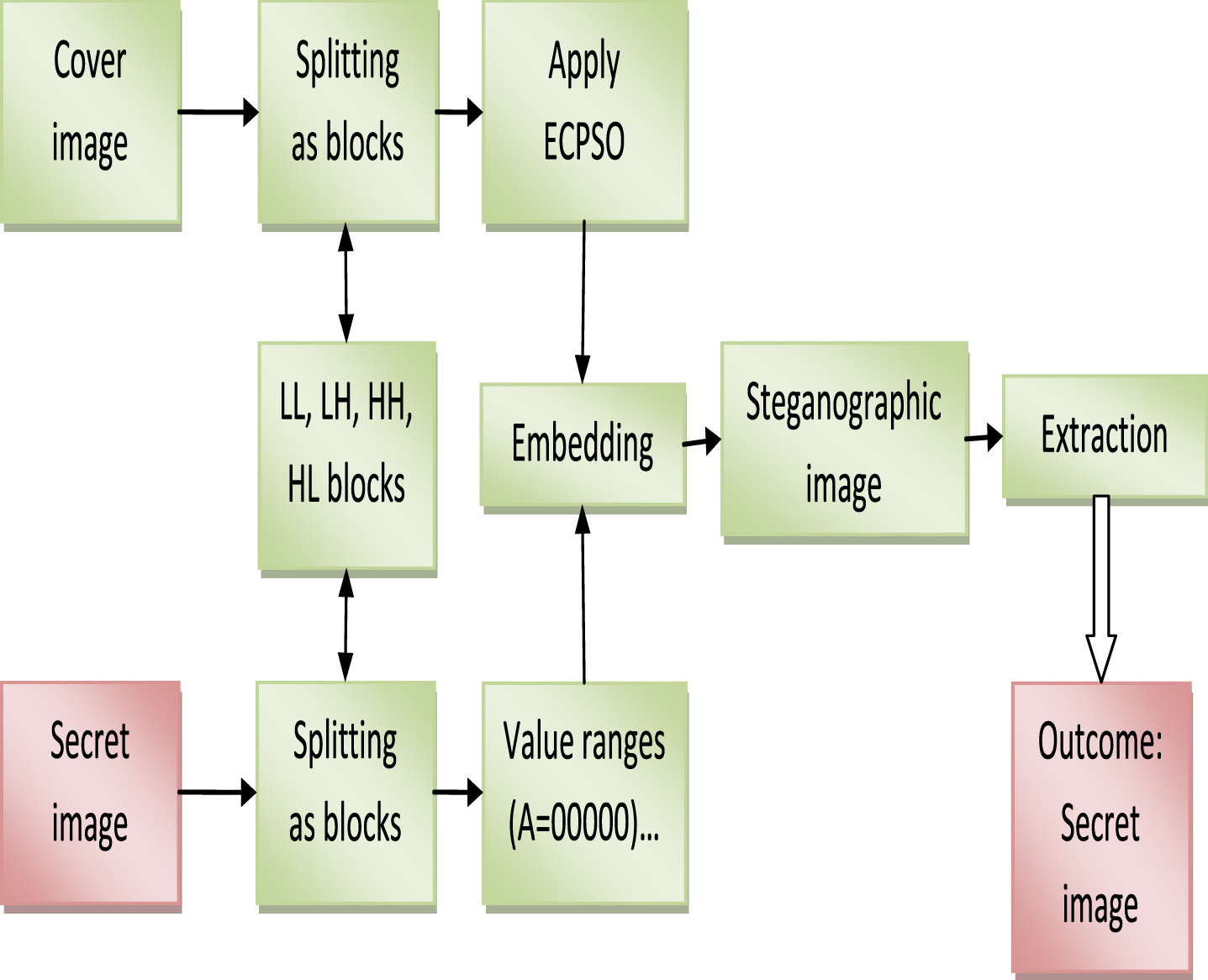
Generic flow of the proposed framework.
Nine particles are described in the CPSO algorithm, which corresponds to the characteristics listed in Table 1. In the cover picture, there are 16 different states for pixel scanning directions. The beginning point positions are represented by X-offset and Y-offset. As indicated in Table 2, planes of bit define the LS Bits in the cover picture it can be utilised for embedded. As illustrated in Table 3 [24], pole of SB and Dire of SB describe the pole and orientation of secret bits, correspondingly, whereas Dire of BP indicates the path of the LS Bits planes.
Comparison table
Comparison table
Summarization of steganography techniques
Representation of particles
To integrate the cryptic information, in this example a picture S(v k), inside the cover image C(i j), the undisclosed picture is split into 4 chunk, each one of which is transformed to double using the pole of SB and dire of SB element. The MSB of every image is then retrieved, resulting in a l-bit sequence for inclusion. The cover picture is then split into four pieces, each measuring w in length. As a result, l/w may be used to compute the no. of undisclosed bit rate that can be programmed in each chunk The CPSO method is then used to determine the optimal later versions in each frame. The number of pixels required to incorporate the hidden data in each block should really be calculated inside the swarm, as the amount of images fluctuates depending on the no. of undisclosed bits to be inserted. Ultimately, the no. of undisclosed bits is contrasted to the number of pixel bits in the cover picture. If the no. of undisclosed spot is smaller than the number of pixel bits, the stegnographic -image is created by embedding secret bits into the pixels [29].
Input data: No. of particles (m), highest iterations
Outcome: position of particles in global best (gbest)
(1) for a = 1 to N //Initialize position and velocity of particle
(2) xj ← Chaos (x mimumn, × maximum)
(3) vj ← Chaos (v minimum, v maxinum)
(4) pbest ← xj //origin particle in the place of local best
(5) gbest ←φ //origin particle in the place of global best
(6) End for loop
(7) while
(8) for a = 1 to N
(9) if f(xa)>f(pbesti)
(10) pbesti ← xj // excellent position in local most
(11) End if
(12) if f(pbesti)>f(gbest)
(13) gbest ← pbesti // place of global best
(14) end all
(15) for a = 1 to N
(16) Update xa using Equation (2)
(17) end for
(18) while (highest iterations or stop principle which is not attain)
The integrating procedure will not be possible otherwise. The method of data integration and separation is depicted in Fig. 2. The PSNR is a standard quality statistic for determining the among between the cover picture and the stego-image (PSNR). The minimumer the disparity between the cover picture and the stegnographic -image, the stronger the PSNR value. The aim of this planned CPSO method is to maximise the Peak Signal to Noise Ratio rate. The PSNR range is used as the goal function in Algorithm 1:
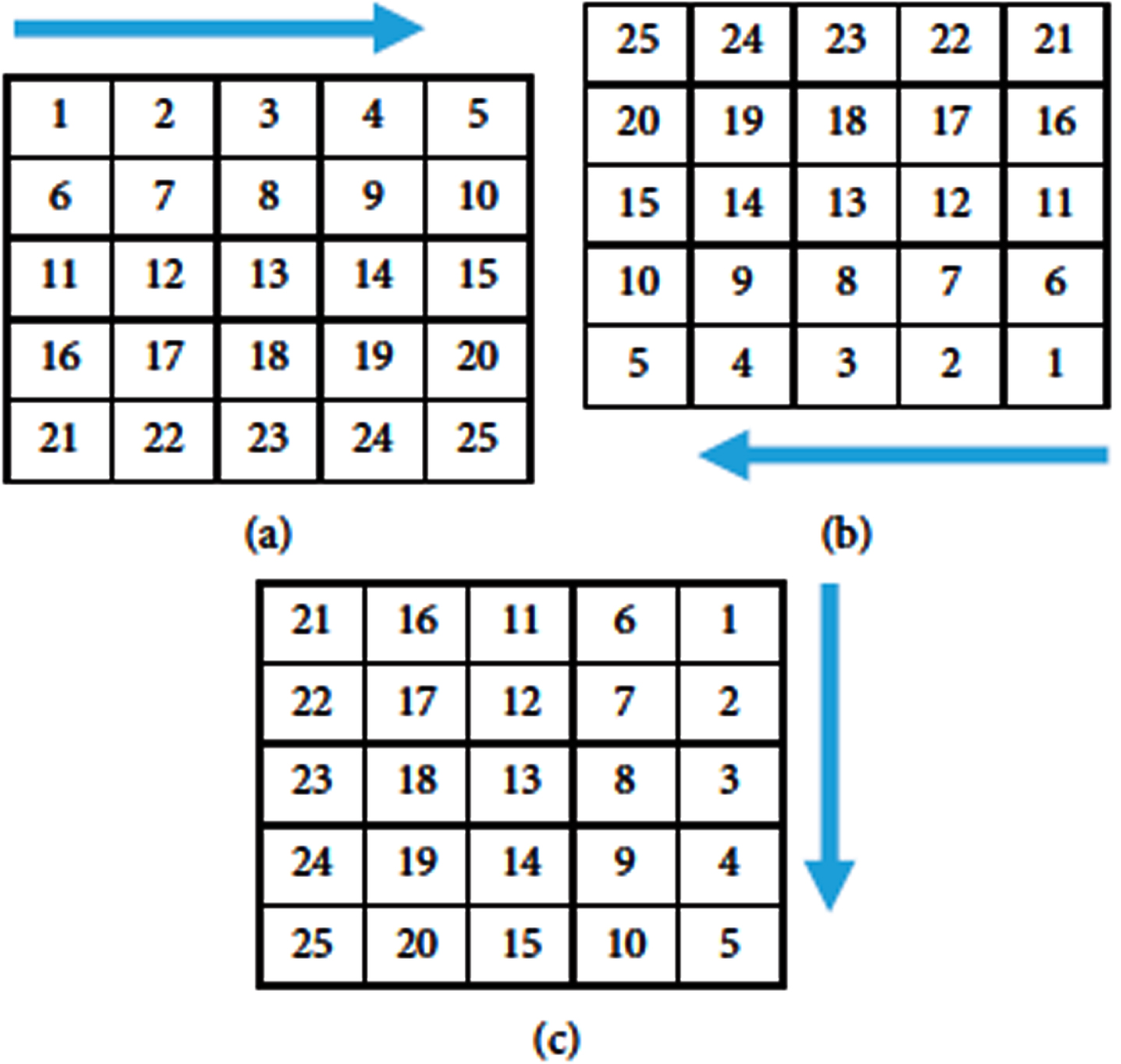
Projection of pixel scanning example.
As a result, based on the PSNR value, the pbest and gbest values are repeatedly adjusted. When the PSNR value is maximum than the original one, pbest is updated, whereas gbest is updated when the PSNR value is maximum. The pseudocode for the information hiding procedure is shown in Algorithm.
The particles are initially taken from the last row of the stego-picture in order to obtain the hidden image. The hidden picture is then created by extracting the hidden bit stream using the associated particles [30]. The pseudocode for the dataset separation process is shown in Algorithm 3.
Numerical results and discussions
Cover images
The programme utilised in this case is MATLAB. This work incorporates four RGB pictures, including “mandrill.jpg,” “peppers.jpg,” “house.jpg,” and “splash.jpg.” The table be minimum shows the original cover photos that were utilised (Table 1).
Performance measurements
The MSE, SSIM, PSNR and BER metrics, that were used to assess picture value, may be utilised to do a performance evaluation.
In the above equation
The findings are applied to a variable collection of pictures of various sizes, as well as a variable message size, using different evaluation assessment parameter such as PSNR, BER, MSE, SSIM. The suggested methods were put to the test using a variety of inputs to confirm that it worked properly. The image’s illustration appearance is just as important.
Comparison
The proposed ECPSO method is compared to the PSO technique in this paper. Table 3 illustrates the results of both techniques in terms of performance measures. The suggested technique, with a PSNR of 79.66 dB, outperforms particle swarm optimization, which has a PSNR of 42.72. The suggested system’s MSE standards are minimumer, at 0.001, and it has a minimumer error rate of 0.035. The based similarity index of the suggested method is 0.999, which is quite close to 1. This signifies that the original picture and the steganographic image have minor differences. Table 4 shows an evaluation of the proposed method to past research. To begin with, while evaluating the suggested approach to reference numbers [25], the presented algorithm’s PSNR values significantly maximumer, at 78.65 dB, whereas writers in [26] only reached 47.6 dB. MSE is the next parameter to be considered. The values of are 0.75, with 0.00019 attained using the suggested approach. The suggested algorithm’s second comparison is with supporting documents [27]. The PSNR and MSE values for are 75.12 and 0.00191, accordingly, with the suggested approach achieving a maximumer PSNR of 79.66 and a minimumer MSE of 0.00019. With the above research, that the conclusion is the ECPSO method outperforms other strategies and is superior for the aforementioned purposes:
Principles for bit-planes element
Principles for bit-planes element
Possible ranges: for SB-pole, SB-dire, and BP-dire particle
HPSO evaluation with different pics and varying sizes of inserted secret messages is shown in Table 2. ECPSO has excellent quality measures than PSO-DWT & CPSO, as seen in Table 3. Table 4 compared that developed steganography tool to previously published picture optimization techniques. In Fig. 3, steganographic pictures are when anybody to Table 1, which contain the entire cover picture.

Embedding and Extraction Process Screen.

Actual input images.
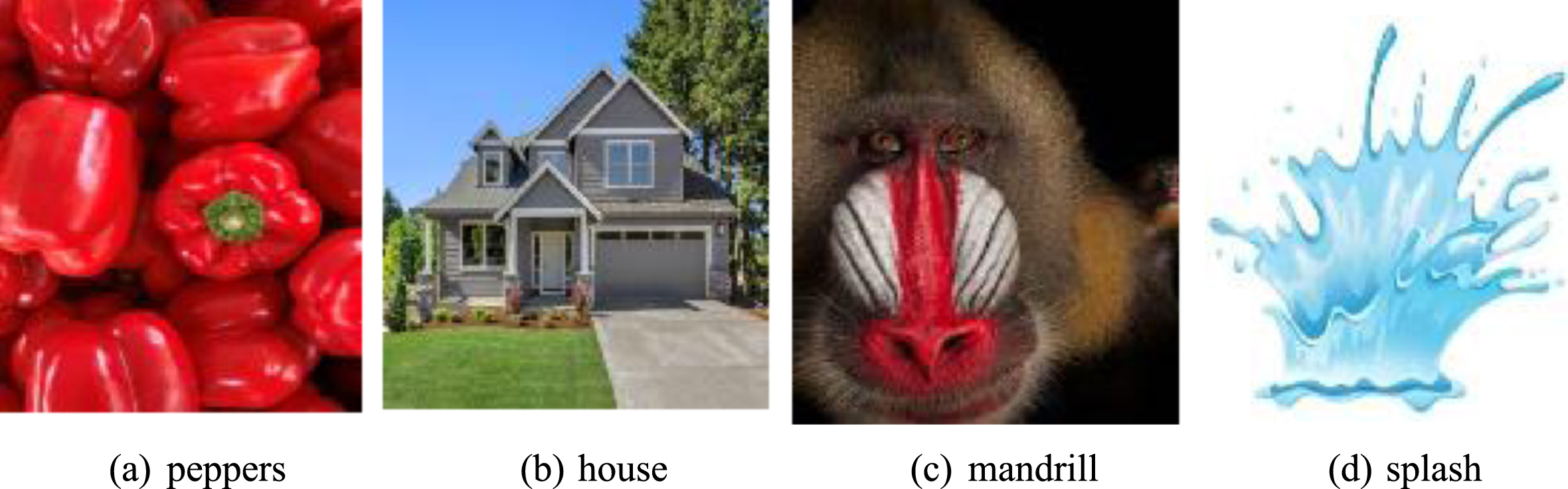
Steganographic images.
Presentation and investigation of the ECPSO technique
Different pictures (coloured) with varying image sizes, various image kinds, and variable message length-size are investigated, with performance criteria such as MSE, SSIM, PSNR and BER used. To ensure improved efficacy and accuracy, the process’s fundamental objective has been evaluated using many varied inputs. The image’s illustration superiority is just as important as the examination of other superiority attributes. The unique cover pictures are shown in Table 1, and the steganographic images after embedding are shown in Fig. 1. The initial and steganographic photos’ histograms are examined. The suggested approach is being tested on 100 pictures, with regular ideals of 0.00018, 0.065, 79.66 and 0.997 for MSE, BER, PSNR and SSIM, respectively. The photos in this paper are from the SIPI [23] record. This record houses a gathering of digitized photographs used in image dispensation, image recognition, and machine visualization development. As a result of the abovementioned facts, it can be inferred that superior embedding location with maximumly confidential exchanging data leads to more effective Steganography implementations. Finally, the suggested model’s new hybrid combination will support the Steganography cloud computing design.
Conclusion and future directives
Based on ECPSO algorithm, we predicted an effective steganography approach for obscuring a secret picture under a cover image. To incorporate the hidden information with minimal modification, the suggested ECPSO method is used to select the optimum pixel placements in the cover picture. To boost the attaching capability, we separate the cover and hidden pictures into four blocks in the suggested technique. Existing methodologies and earlier research work are evaluated to the suggested algorithm. The suggested method outperforms the competition in conditions of PSNR, SSIM MSE, BER, according to the results. The suggested approach has attained regular values of 1.036, 78.76, 1.003 and 1.998 in average for BER, PSNR, MSE, and SSIM for different parameters and situations whereas PSO-DWT and CPSO possess BER (1.048, 1.081), PSNR)51.7, 54.2), MSE (5.431, 4) and SSIM (1.978, 1.98) respectively. The main problems of picture steganography, such as data embedding capacity, resilience, and encryption techniques, are addressed in this study. The sharing of a secret key between transmission and reception is not addressed in this work because it is pre-shared among both them. As a result, we’d like to focus on crucial exchange methods in the future. We also intend to research the effects of different types of chaotic maps on pixel range in categorize to improve the ECPSO computation effectiveness and minimise payload complication. The major drawback identified in the proposed model is the complex evaluation of ECPSO with the available samples. However, in the future, the sizes of the dataset samples are improved and the complexity is reduced with the adoption of modern deep learning approaches with enhanced optimization algorithm.
Evaluation of proposed method with presented process
Evaluation of the proposed method with earlier process