In this paper the concept of soft continuity is focused on for digital images by using soft sets which is defined on κ - adjacent digital images. Also the definitions of digital soft isomorphism and digital soft retraction are given. Some theorems are obtained deal with soft isomorphism and soft retraction for digital images and some numerical examples are presented in dimension 2. Finally digital soft retraction is obtained as a soft topological invariant.
The literature of digital topology contains numerous theorems and results related with digitally continuous functions, digital homeomorphism, digital retractions, digital homotopy, digital fundamental groups, digital homology etc. For more details see [17, 40–45]. In 1986, Rosenfeld [48] gave the notion of continuity for digital pictures. In addition, Boxer investigated some properties of continuous functions, homeomorphism (isomorphism) and homotopy for digital images in [22, 23].
On the other hand soft set theory was studied by several mathematicians [1–16, 49–53]. The definition of soft set was given by Molodsov [39] in 1999. Various operations on soft sets was investigated by Maji [37]. In addition many properties of the soft set operations are investigated in [1, 5]. Soft mappings which are great importance in soft set theory are redefined in [4]. Also continuity of soft mappings was studied in [14, 53].
The motivation for this work is to construct the soft set structure in digital image and to define the soft continuity for soft sets over κ - adjacent digital images. The study of the concept of soft continuous functions occupied a wide range of their interests. However soft set theory had not been studied in digital images. So we prefer to focus on to investigate the properties and applications of soft continuity in digital images such as soft homeomorphism (in digital images, named soft isomorphism) and soft retraction.
The advantage of this paper is investigating the basic and algebraic topological properties by using soft structure in digital images unlike other studies. It will be a new tool and a new area both soft set theory and digital topology researchers.
This paper is composed of four sections. After the Introduction, in Section 2, we give some basic definitions related to digital images and soft set theory which will be used in this paper. Then, in Section 3, we present the soft set operations in digital images and in Section 4, give the soft isomorphism and soft retraction in digital images.
In this paper we present soft theoretical concepts for digital images. Through this study, suppose that is an n- dimensional Euclidean spaces. A finite subset of with an adjacency relation is considered as a digital image. Generally, in examples, we focus on 1- and 2- dimensional digital images by using κ = 2 and κ = 4, κ = 8 adjacency relations, respectively.
Prelimineries
In this section we recall some basic definitions and theorems from digital topology and soft set theory. At first we mention the adjacency relation which is used for digital images and then we recall the concept of digital image. Secondly we state the basic notions from soft set theory.
Definition 2.1 [31, 35]
Two points p and q in are 2 - adjacent if |p - q|=1.
Two points p and q in are 8 - adjacent if they are distinct and differ by at most 1 in each coordinate.
Two points p and q in are 4 - adjacent if they are 8 - adjacent and differ by exactly one coordinate.
Two points p and q in are 26 - adjacent if they are distinct and differ by at most 1 in each coordinate.
Two points p and q in are 18 - adjacent if they are 26 - adjacent and differ in at most two coordinates.
Two points p and q in are 6 - adjacent if they are 18 - adjacent and differ by exactly one coordinate.
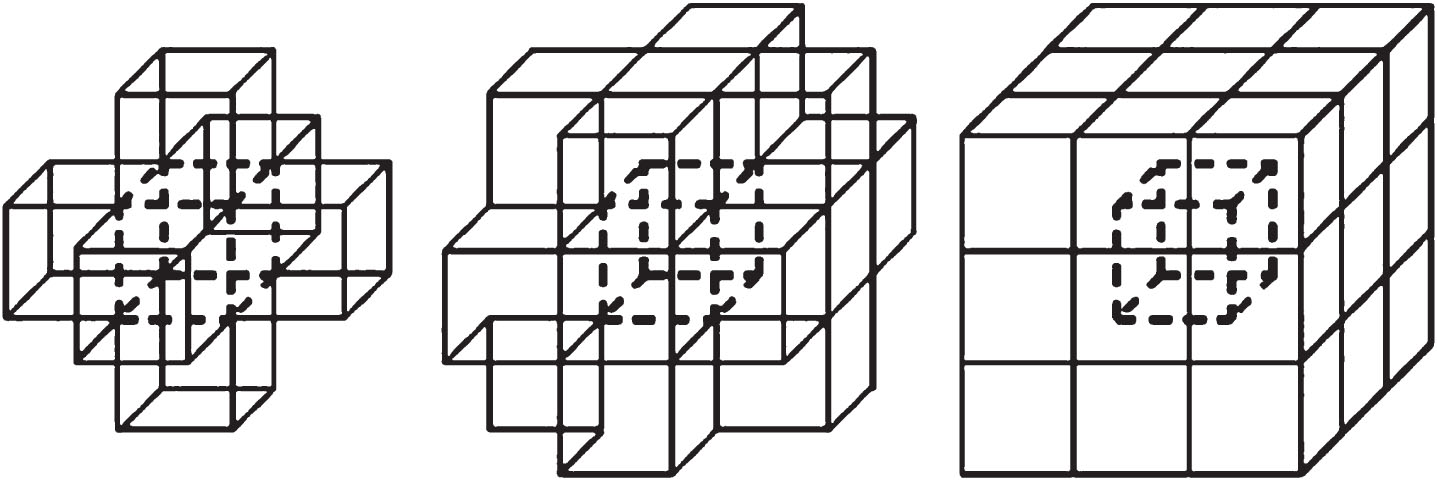
2 - adjanceny in .
4 - adjanceny and 8 - adjanceny in .
6 - adjanceny, 18 - adjanceny and 26 - adjanceny in .
Definition 2.2 [35] Let denote the set of integers. Then is the set of lattice points in Euclidean n-dimensional space. A (binary) digital image is a finite subset of with the adjacency relation κ.
Definition 2.3 [48] A k - path from x to y in X is a sequence
in X such that each point xi is k - adjacent to xi+1 for m ≥ 1 and 1 ≤ i ≤ m. The number m is called the length of this path.
Suppose that κ is an adjacency relation defined on . A digital image is κ - connected if and only if for every pair of points {x, y} ⊂ X, x ≠ y, there is a set {x0, x1, …, xc} ⊂ X such that x = x0, xc = y and xi and xi+1 are κ - neighbors, i ∈ {0, 1, …, c - 1} [31].
Definition 2.4 [22, 23] Let X and Y be digital images such that , . Then the digital function f : X → Y is a function which is defined between digital images.
Definition 2.5 [22, 23] Let X and Y be digital images such that , . Assume that f : X → Y be a function. Let κi be an adjacency relation defined on , i ∈ {0, 1}. f is called to be (κ0, κ1) - continuous if the image under f of every κ0 - connected subset of X is κ1 - connected.
Proposition 1[22, 23] Let X and Y be digital images. Then the function f : X → Y is said to be (κ0, κ1) - continuous if and only if for every {x0, y0} ⊂ X such that x0 and x1 are κ0 - adjacent, either f (x0) = f (x1) or f (x0) and f (x1) are κ1 - adjacent.
Definition 2.6 [22] Let with a < b. A set of the form
is called a digital interval.
Definition 2.7 [22, 23] Let κ0 and κ1 be adjacency relation on X and Y, respectively. Two digital images (X, κ0) and (Y, κ1) are (κ0, κ1) - homeomorphic if there is a one-to-one and onto function f : X → Y that is (κ0, κ1) - continuous such that the inverse function f-1 : Y → X is (κ1, κ0) - continuous .
In digital topology,it is suggested to use the terminology ‘isomorphic digital images’ rather than ‘homeomorphic digital images’ because, for example digital models of homeomorphic Euclidean sets need not be digitally homeomorphic. Also, all Euclidean simple closed curves are homeomorphic, but digital simple closed curves of differing cardinalities are not even of the same digital homotopy types [38].
Definition 2.8 [39] A pair (F, A) is said to be a soft set over the universe X, where F is a mapping given by F : A → P (X) and A ⊆ E. Any soft set (F, A) can be extended to a soft set of type (F, E), where F (e)≠ ∅ for all e ∈ A and F (e) =∅ for all e ∈ E ∖ A. S (X, E) indicates the family of all soft sets over X .
Definition 2.9 [1, 5, 37] Assume that (F, E) and (F′, E′) be two soft sets over X . It is said that (F, E) is a soft subset of (F′, E′) and it is denoted by if
(1) E ⊆ E′, and
(2) F (a) ⊆ F′ (a) , for all a ∈ E .
(F, E) is said to be a soft super set of (F′, E′) , if (F′, E′) is a soft subset of (F, E) . It is symbolized by
Definition 2.10 [37] Let (F, E) and (F′, E′) be two soft sets over X . The union of (F, E) and (F′, E′) is soft set (F″, E″) , where E″ = E ∪ E′ and for all c ∈ E″,
It is written
Definition 2.11 [37] Let (F, E) and (F′, E′) be two soft sets over X . The intersection of (F, E) and (F′, E′) is a soft set (F″, E″) , where E″ = E ∩ E′ and for all c ∈ E″, F″ (c) = F (c) ∩ F′ (c) . It is written
Definition 2.12 [5, 37] Let (F, E) be soft set over X . The relative complement of (F, E) is denoted by (F, E) c and is defined (F, E) c = (Fc, E) , where Fc : E → P (X) is a mapping given by Fc (e) = X - F (e) for all e ∈ E .
Definition 2.13 [37] Let (F, E) and (F′, E′) be two soft sets over X . Then (F, E) - (F′, E′) is a soft set (e, F (e)) : F (e) ∉ F′ (E′) , e ∉ E′ .
Definition 2.14 [37] Let (F, E) be soft set over X . Then
(1) (F, E) is called to be null soft set denoted by if for every e∈ E, F (e) = ∅.
(2) (F, E) is called to be absolute soft set denoted by if for every e ∈ E, F (e) = X .
Soft set structures in digital images
In this section we reorganize some notions from [32, 41] and [42].
Definition 3.1 Let κ be an adjacency relation on and E be the set of parameters. If F is a mapping from E to all κ - adjacent subset of X, then the pair (F, E)
κ is called to be a κ - adjacent soft set over , that is
where P (X) denotes the power set of X . A κ - adjacent digital soft set will be denoted by (F, E)
κ .
Example 1 Consider the 2- adjacency relation on . Let E = {e1, e2} be the parameter set and be 2- adjacent digital image. Define the map F : E → P (X) by
Then 2- digital soft set (F, E) 2 occurs as the following:
Example 2 Consider the digital image
and, κ1 = 4 and κ2 = 8 adjacency relations on . Let E = {e1, e2, e3} be the parameter set. Define the function Fi : E → P (X) , i = 1, 2 by
Then 4 - adjacent and 8 - adjacent digital soft sets are given by
Definition 3.2 Let be a κ - adjacent digital image. If F (a) =∅ for every a ∈ A with (F, A)
κ is a digital soft set over digital image X, then (F, A)
κ is said to be a digital soft null set and symbolized by Φ
κ.
Definition 3.3 Let be a κ - adjacent digital image. Assume that (F, A)
κ and (G, B)
κ be two κ - adjacent soft sets over X. Then the soft intersection of (F, A)
κ and (G, B)
κ is κ - adjacent soft set (H, C)
κ with C = A ∩ B and H (c) = F (c) ∩ G (c) for all c ∈ c. This soft intersection is demonstrated by .
Example 3 Let X = {(0, 0) , (1, 0) , (-1, 0) , (0, 1) , (0, - 1)} be a 8 - adjacent digital image in . Define the digital soft sets (F, A) 8 and (G, B) 8 with the parameter set E = {e1, e2, e3, e4} as follows:
Thus C = A ∩ B and for all c ∈ C we have
Then the digital soft set
is the soft intersection of digital soft sets (F, A) 8 and (G, B) 8.
Definition 3.4 Let be a κ - adjacent digital image. The soft union of two digital soft sets (F, A)
κ and (G, B)
κ over X is digital soft set (H, C)
κ over X, where C = A ∪ B; , and and for all c ∈ C
The soft union of two digital soft sets is demonstrated by
Example 4 Consider the digital image
with 8 - adjacency. Define the digital soft sets (F, A) 8 and (G, B) 8 as follows:
where E = {e1, e2, e3, e4, e5} is the parameter set, A, B ⊂ E, ,
On the other hand define the function where
C = A ∪ B = {e1, e2, e3, e4, e5} as the following:
Then
(H, C) 8 = {(e1, {(0, 1) , (0, 0)}) , (e2, {(0, - 1) , (1, 0)}) , (e3, {, (1, 1)}) , (e4, {(-1, 1) , (-1, 0)}) , (e5, {(-1, - 1))} is the soft union of digital soft sets (F, A) 8 and (G, B) 8.
Remark 1 Definition 3.3 and Definition 3.4 is valid for digital soft sets which have same κ - adjacency relation on a κ - adjacent digital image X. Definition 3.3 and Definition 3.4 may not been satisfied for the soft sets which have different adjacency relations or which over different adjacent digital images.
Definition 3.5 Let κ be an adjacency relation on Suppose that (F, E)
κ be a digital soft set over Then (F, E)
κ is called to be a digital soft connected set, if for every pair of points {xe, ye} ⊆ (F, E)
κ, xe ≠ ye, there exist a set
such that x (e) = x0 (e), xc (e) = y (e) and, xi (e) and xi+1 (e) are κ - neighbors, i ∈ {0, 1, …, c - 1} .
Definition 3.6 Let κ1 and κ2 be two adjacency relations on and E be the set of parameters. Assume that (Fi, E)
κ1,(i = 1, 2, …, n) are soft sets over and (Gj, E)
κ2,(j = 1, 2, …, n) are soft sets over . If the image under f of each digital soft connected set defined on X is a digital soft connected set defined on Y, then the function f : X → Y is called to be digitally soft continuous.
Example 5 Consider the 4 - adjacency relation on .
Let
and E = {e1, e2} be the parameter set. Assume that (F1, E) 4, (F2, E) 4 are digital soft sets defined on X and (G1, E) 4, (G2, E) 4 are digital soft sets defined on Y. Firstly define the function i = 1, 2 as the following:
Put the (F1, E) 4, (F2, E) 4 digital soft sets such that
Secondly, define the functions by
Put the digital soft sets (G1, E) 4, (G2, E) 4 such that
On the other hand define the function f : X → Y as follows:
Then f is digitally soft continuous, because
Example 6 Consider the 8 - adjacency relation on . Let
and
be subsets of . Put the set E = {e1, e2, e3, e4} as parameter set. Assume that (F1, E) 8, (F2, E) 8, (F3, E) 8 (F4, E) 8 are digital soft sets defined on X and (G1, E) 8, (G2, E) 8, (G3, E) 8, (G4, E) 8 are digital soft sets defined on Y. Define the 8 - adjacent digital soft sets on X as the following
where , i = 1, 2, 3, 4 defined as follows
F1 (e1) = {(-2, 1) , (-2, 0) , (-2, - 1)} , F1 (e2) = ∅ , F1 (e3) = ∅ , F1 (e4) = ∅ .
On the other hand define the 8 - adjacent digital soft sets on Y by the following:
where . Define the function f : X → Y as follows:
Then f is 8- digital soft continuous. Indeed if we calculate the images under f of digital soft sets on X, we have
Thus we obtained that the image of 8 - connected digital soft sets under f are 8 - connected digital soft sets. Hence f is digitally soft continuous due to the 8 - adjacency relation on .
On the other hand f is not 4- digital soft continuous. consider the soft set (F2, E) 8 on X. (F2, E) 8 is 4- digital soft connected, but f ((F2, E) 8) is the soft set (G2, E) 8 which is not 4- digital soft connected on Y.
Theorem 3.1The composition of digitally soft continuous functions is digitally soft continuous, that is let κ0, κ1, κ2 be the adjacency relations on the digital images , respectively. If f : X → Y and g : Y → Z are digitally soft continuous, then g ∘ f : X → Z is digitally soft continuous.
Proof: Let (F, E)
κ0 be any κ0 - connected digital soft set over X . Then f ((F, E)
κ0) is a κ1 - connected digital soft set over Y, because f is digitally soft continuous. Thus g ∘ f ((F, E)
κ0) = g (f ((F, E)
κ0)) and g (f ((F, E)
κ0)) is a κ2 - connected over Z for the κ1 - connected digital soft set f ((F, E)
κ0) over Y, since g is digitally soft continuous. Hence g ∘ f is digitally soft continuous.□
Remark 2 The sum of digitally soft continuous functions does not need to be digitally continuous.
We can give an example for the above remark.
Consider the 4 - adjacency relation on . Let
and
be digital images on and let E = {e1, e2} be the parameter set. Assume that (F1, E) 4, (F2, E) 4, (F3, E) 4 are digital soft sets over X such that Fi : E → P (X) , i = 1, 2, 3; and (G1, E) 4, (G2, E) 4, (G3, E) 4, (G4, E) 4, (G5, E) 4, (G5, E) 4 are digital soft sets over Y such that Gi : E → P (Y) , i = 1, 2, 3, 4, 5, 6. Consider the following soft sets:
Define the map f : X → Y as
Then f is digitally continuous, since
On the other hand, define the map g : X → Y such that
Then g is digitally continuous, since
Thus
Hence the sum of two digital soft continuous functions is not digital soft continuous.
Theorem 3.2The identity map is digitally soft continuous.
Proof: Let κ be an adjacency relation on Suppose that (F, E)
κ is any κ - connected digital soft set over X . Thus, I ((F, E)
κ) = (F, E)
κ and therefore I ((F, E)
κ) is κ - connected digital soft set, since (F, E)
κ is κ - connected digital soft set. Hence the identity map I : X → X is digitally soft continuous.□
Soft isomorhism and soft retraction in digital images
Definition 4.1 Consider the digital images with κ - adjancency relation. Let (Fi, E)
κ, (Gi, E)
κ, i = 1, 2, …, n be digital soft sets defined on X and Y, respectively. Assume that f : X → Y is a digital continuous function, that is one to one and onto. If f-1 : Y → X is digital soft continuous function, then f is called a digital soft isomorphism and we say X and Y are digital soft isomorphic.
We will prefer to use statement ‘isomorphism’ rather than ‘homeomorphism’, because we are working on digital images.
Example 7 Let X = [-1, 1] 2, Y = [0, 2] 2 be 2 - adjancency digital images. Put the parameter set E = {e1, e2}. Consider the digital soft sets (F1, E) 2, (F2, E) 2 defined on the digital image X and let (G1, E) 2, (G2, E) 2 be two digital soft sets defined on the digital image Y as follows: At first define the functions Fi : E → P (X) , i = 1, 2 by
and define the functions Gi : E → P (X) , i = 1, 2 by
Then the function f (x) = x + 1 is a digital soft isomorphism from X to Y . Indeed, the image of all 2-digital soft connected sets defined on X under f is 2-digital soft connected.
Therefore f is digitally soft continuous. On the other hand f is one to one and onto. f-1 (x) = x - 1 is digitally soft continuous, because
Hence f is digital soft isomorphism and the digital images X and Y are digitally soft isomorphic.
Theorem 4.1Digitally soft isomorphism is an equivalence relation.
Proof: Consider the digital soft sets (Fi, E)
κ,(Gi, E)
κ and (Hi, E)
κi = 1, 2, …, n κ - adjancent defined on , respectively.
Digital soft isomorphism is reflexive since I : X → X identity map is a digital soft isomorphism.
Let f : X → Y be digital soft isomorphism, then f is digital soft continuous, one to one and onto function and f-1 : Y → X is digital soft continuous because f is digital soft isomorphism. Therefore it is easily seen that the function f-1 : Y → X is digitally soft isomorphism. Hence symmetry property is satisfied.
Let f : X → Y and g : Y → Z be digital soft isomorphism. Then f and g are digitally soft continuous, one to one and onto functions since f and g are digital soft isomorphisms. Furthermore f-1 and g-1 are digitally soft continuous. The composition g ∘ f is digitally soft continuous since f and g are digital soft continuous. On the other hand the composition f-1 ∘ g-1 is digitally continuous since f-1 and g-1 are digital soft continuous. Therefore g ∘ f : X → Z is digital soft isomorphism since g ∘ f and f-1 ∘ g-1 = (g ∘ f) -1 are digitally soft continuous. Hence the transitivity property is satisfied.
Thus digitally soft isomorphism is an equivalence relation.□
Definition 4.2 Let X0, X be κ - adjancent digital images in with X0 ⊆ X and let E be a parameter set. Assume that (Fi, E)
κ, i = 1, 2, …, n are digital soft sets on X and (Gi, E)
κ, i = 1, 2, …, n are digital soft sets on X0 such that (Gi, E)
κ ⊆ (Fi, E)
κ . The function r : X → X0 defined by r (x) = x for all x ∈ X0 is called digital soft retraction. X0 is said to be the digital soft retract of X.
Example 8 Consider 8 - adjancency relation in . Let
and
be digital images and let E = {e1, e2} be a parameter set. Consider digital soft sets
on X and
on X0 with Fi : E → P (X) , Gi : E → P (X0) , i = 1, 2 . Define the function r : X → X0 as follows:
Then r is digital soft retraction since for ∀i ∈ {0, 1}, (Gi, E)
κ ⊆ (Fi, E)
κ and r (x) = x for all x ∈ X0.
Theorem 4.2Digital soft retraction is digitally soft continuous.
Proof: Consider the κ - adjancent digital images X0 and X in with X0 ⊂ X. Let (Gi, E)
κ be digital soft set on X0 and (Fi, E)
κ be digital soft set on X such that (Gi, E)
κ ⊂ (Fi, E)
κ, (i = 1, 2, …, n). Suppose that r : X → X0 is a digital soft retraction. Let (Fi, E)
κ be any κ - connected soft set such that r (x) = x for all x ∈ X0. Then r ((F, E)
κ) = (G, E)
κ and it follows that r ((Fi, E)
κ) is a κ - connected soft set on X0. Therefore r is digitally soft continuous since the image of every κ - connected digital soft set over X is κ - connected digital soft set over Y. □
Theorem 4.3Let X0, X and Y be κ - adjancent digital images on with X0 ⊂ X and E be a parameter set. Suppose that X0 is digital soft retraction of X and f : X → Y is digital soft isomorphism. Then f (X0) is digital soft retraction of Y.
Proof: Assume that (Fi, E)
κ, i = 1, 2, …, n are digital soft sets on X and (Gi, E)
κ, i = 1, 2, …, n are digital soft sets on X0 such that (Gi, E)
κ ⊆ (Fi, E)
κ. Let r : X → X0 be digital soft retraction. Then the composition f ∘ r ∘ r-1 : Y → f (X0) is digital soft retraction. Indeed, as the composition of digitally soft continuous functions is digitally soft continuous, by taking composition of the digitally soft continuous functions
and
, we obtain the digital soft continuous function
It follows that f ((Gi, E)
κ) ⊆ f ((Fi, E)
κ), since (Gi, E)
κ ⊆ (Fi, E)
κ. Hence f ((Fi, E)
κ) is a digital soft set over X. Now examine whether if X0 ⊂ X, then f (X0) ⊂ Y. Consider the functions
i)X0 ⊂ X and f is one to one and onto because f is digitally soft isomorphism. Hence it is clear that f (X0) ⊂ f (X) = Y .
ii)
Consequently f (X0) is digital soft retract of Y.□
Example 9 Let X0 = [0, 1] 2, X = [-1, 2] 2 and Y = [0, 3] 2 be 2 - adjancent digital images in and r : X → X0 be a digital soft retraction. Define the digital soft sets (F1, E) 2, (F2, E) 2 on X; (G1, E) 2, (G2, E) 2 on X0 and (H1, E) 2, (H2, E) 2 on Y as follows;
Define the digital soft retraction r : X → X0 such that
On the other hand define the digital soft isomorphism f : X → Y by
Then f ∘ r ∘ f-1 : Y → f (X0) is a digital soft retraction as shown in the following:
Indeed, the digital soft sets f ((G1, E) 2) and f ((G2, E) 2) on f (X0) are
Then
Hence f ∘ r ∘ f-1 is a digital soft retraction.
Corollary 1Digital soft isomorphism preserves the digital soft retraction.
Conclusion
Soft sets and soft continuous functions are studied for digital images in current manuscript. The theory is stated by using κ - adjancency relation for digital images on . Theorems are supported by various examples. We mostly preferred to use the 4 - adjancency and 8 - adjancency relations in examples. The soft isomorphism and the soft retraction are defined in digital images and it is concluded that digital retraction is digitally soft continuous and digital soft isomorphism preserves digital soft retraction. Soft continuous mappings have great importance for various areas of mathematics. For future work different properties and applications of soft continuous mappings can be investigated for digital images. However different adjacency relations can be used for higher dimensional digital images in order to examine new properties. Also, some basic concepts in algebraic topology can be expressed in soft digital spaces as a new tool for future works.
Footnotes
Acknowledgments
The authors would like to thank the anonymous referees for their valuable comments and suggestions.
References
1.
AliM.I., FengF., LiuX., MinW.K. and ShabirM., On some new operations in soft set theory, Comput Math Appl57(9) (2009), 1547–1553.
2.
Altıntaşİ. and TaşköprüK., A new approachfor soft topology and soft function via soft element, Mathematical Methods in the Applied Sciences44 (2021), 7556–7570.
3.
Altıntaşİ., TaşköprüK. and SelviB., Countable and separable elementary soft topological space, Mathematical Methods in the Applied Sciences44 (2021), 7811–7819.
4.
Al-shamiT.M., Homeomorphism and Quotient Mappings in Infrasoft Topological Spaces, Journal of MathematicsArticle ID 3388288 (2021), 1–10. https://doi.org/10.1155/2021/3388288
5.
Al-shamiT.M. and El-ShafeiM., T-soft equality relation, Turkish Journal of Mathematics44(4) (2020), 1427–1441. https://doi.org/10.3906/mat-2005-117
6.
Al-shamiT.M., Soft somewhat open sets: soft separation axioms andmedical application to nutrition, Computational and AppliedMathematics41(216) (2022), 1–22. https://doi.org/10.1007/s40314-022-01919-x
7.
Al-shamiT.M., Compactness on Soft Topological Ordered Spaces and Its Application on the Information System, Journal of MathematicsArticle ID 6699092 (2021), 1–12. https://doi.org/10.1155/2021/6699092
8.
Al-shamiT.M., On Soft Separation Axioms and Their Applications onDecision-Making Problem, Mathematical Problems in EngineeringArticle ID 8876978 (2021), 1–12. https://doi.org/10.1155/2021/8876978
9.
Al-shamiT.M., Soft Separation Axioms and Fixed Soft Points UsingSoft Semiopen Sets, Journal of Applied MathematicsArticle ID 1746103 (2020), 1–11. https://doi.org/10.1155/2020/1746103
Al-shamiT.M. and AbdelwahebM., Two Families of Separation Axiomson Infra Soft Topological Spaces, Filomat36(4) (2022), 1143–1157. https://doi.org/10.2298/FIL2204143A
12.
AlcantudJ.C.R., Al-shamiT.M. and AzzamA.A., Caliber and ChainConditions in Soft Topologies, Mathematics9(19) (2021), 1143–1157. https://doi.org/10.3390/math9192349
13.
Al-shamiT.M. and AbdelwahebM., Belong and Nonbelong Relations onDouble-Framed Soft Sets and Their Applications, Journal of MathematicsArticle ID 9940301 (2021), 1–12. https://doi.org/10.1155/2021/9940301
14.
ArasÇ.G., SonmezA. and ÇakallıH., An approach to softfunctions, Journal of Mathematical Analysis8(2) (2017), 129–138.
15.
ArasÇ.G. and PoşulH., On some new operations inprobabilistic soft set theory, European Journal of Pure andApplied Mathematics9(3) (2016), 333–339.
16.
ArasÇ.G., BayramovS. and CafarliV., Introduction to fuzzytopology on soft sets, Transactions Issue Mathematics, Azerbaijan National Academy of Sciences40(1) (2020), 41–51.
17.
ArslanH., KaracaI. and ÖztelA., Homology groups of one dimensional digital images, XXI. Turkish National Mathematics Symposium, (2008), B1–13.
18.
AygünogluA. and AygünH., Some notes on soft topologicalspaces, Neurall Computing and Applications21(Supp 1) (2012), 113–119.
19.
AzzamA.A., AmeenZ.A., Al-shamiT.M. and El-ShafeiM.E., Generating Soft Topologies via Soft Set Operators, Symmetry14(5) (2022), 914, 1–13. https://doi.org/10.3390/sym14050914
20.
BayramovS. and ArasC.G., A new approach to separability andcompactness in soft topological spaces, TWMS Journal of Pureand Applied Mathematics9(21) (2018), 82–93.
21.
CetkinV., Gradation of Continuity for Fuzzy Soft Mappings, Journal of MathematicsArticle ID 2691753 (2021), 1–12. https://doi.org/10.1155/2021/2691753
BoxerL., A classical construction for the digital fundamentalgroup, Journal of Mathematical Imaging and Vision10(1999), 51–62.
24.
BoxerL., Properties of digital homotopy, Journal ofMathematical Imaging and Vision22 (2005), 19–26.
25.
GhourS.A., Strong Form of Soft Semi-Open Sets in Soft TopologicalSpaces, International Journal of Fuzzy Logic and IntelligentSystems21(2) (2021), 159–168.
26.
GhourS.A., Some Modifications of Pairwise Soft Sets and Some ofTheir Related Concepts, Mathematics9 (2021), 1–14.
27.
GhourS.A., Soft Minimal Soft Sets and Soft Prehomogeneity in SoftTopological Spaces, International Journal of Fuzzy Logic andIntelligent Systems21(3) (2021), 269–279.
28.
GhourS.A. and HamedW., On two classes of soft sets in softtopological spaces, Symmetry12(2) (2020), 1–22.
29.
HanS.E., Computer topology and its applications, HonamMathematical Journal25 (2003), 153–162.
30.
HanS.E., An extended digital (k0, k1)–continuity, Graphical Models and Image Processing16(1-2) (2004), 445–452.
31.
HermanG.T., Oriented surfaces in digital image, Journal ofApplied Mathematics and Computing55 (1999), 381–396.
32.
İhtiyarS., The structure of soft set in digital images and soft continuity in digital images, Msc Thesis Manisa Celal Bayar University, Manisa, Turkey, 2017.
33.
KaracaI. and BoxerL., Some properties of digital covering spaces, Journal of Mathematical Imaging and Vision37 (2010), 17–26.
34.
KaracaI., BoxerL. and OztelA., Topological invariants in dijitalimage, Journal of Mathematical Sciences: Advances andApplication37 (2010), 17–26.
35.
KongT.Y., A digital fundamental group, Computers and Graphics13 (1989), 159–166.
36.
KongT.Y., RoscoeA.W. and RosenfeldA., Concepts of digitaltopology, Topology and its Applications46 (1992), 219–2626.
37.
MajiP.K., BiswasR. and RoyA.R., Soft set theory, Computers and Mathematics with Applications45 (2003), 555–562.
38.
MalgouyresR., Homotopy in 2–dimensional digital images, Theoretical Computer Science230 (2000), 221–233.
39.
MolodtsovD., Soft set theory-first result, Computers andMathematics with Applications37(4/5) (1999), 19–31.
40.
MutluA., MutluB. and ÖztunçS., On digital homotopy ofdigital paths, Research Journal of Algebra2(6) (2012), 147–154.
41.
ÖztuncS. and İhtiyarS., Properties of soft homotopy indigital images, AIP Conference Proceedings1798(020120) (2017), 1–9.
42.
ÖztunçS. and İhtiyarS., Soft retractions in digital images, International Students Science Conference Abstract Book; 5-6 May 2017, Izmir/Turkey, (2017), pp. 76.
43.
ÖztunçS., BildikN. and MutluA., The construction ofsimplicial groups in digital images, Journal of Inequalitiesand Applications143 (2013), 1–13.
44.
ÖztunçS., MutluA. and BildikN., Computing hypercrossedcomplex pairings in digital images, Abstract and AppliedAnalysis143 (2013), 1–6.
45.
ÖztunçS. and MutluA., Categories in digital images, American Journal of Mathematics and Statistics3(1) (2013), 62–66.
46.
ÖztunçS., MutluA. and SertE.A., Monomorphism and epimorphism properties of soft categories, European Journal of Pure and Applied Mathematics10(4) (2017), 850–857.
RosenfeldA., Continuous functions on digital pictures, Pattern Recognation Letters4 (1986), 177–184.
49.
ÖztürkT.Y. and ArasÇ.G., Soft pair-wise continuity insoft bitopological spaces, Journal of Mathematical Analysis13(2) (2017), 413–422.
50.
TanayB. and KandemirM.B., Topological structure of fuzzy softsets, Computers & Mathematics with Applications61(2011), 2952–2957.
51.
ThakurS.S. and RajputA.S., Connectedness between soft sets, New Mathematics and Natural Computation14(01) (2018), 53–71. Connectedness between soft sets
52.
ShabirM. and NazM., On soft topological spaces, Computers andMathematics with Applications61(7) (2011), 1786–1799.
53.
Zorlutunaİ. and ÇakırH., On continuity of softmappings, Applied Mathematics and Information Sciences9(1) (2015), 403–409.