



Abstract
This paper presents a secure image authentication scheme for tamper localization and recovery at pixel level. The proposed scheme encrypts the watermark comprising tamper localization code and self-recovery code using chaotic sequence to ensure security. This scheme uses pixel to block conversion technique for ensuring lossless recovery of the original image from an untampered watermarked image. For enhancing the localization accuracy, a multilevel tamper localization strategy is used. The experimental results show that the proposed scheme generates watermarked images with minimal information loss and can withstand copy-move, image splicing, content removal, vector quantization, collage and content only attacks. This scheme has better security, better tamper localization accuracy and better recovered image quality under extensive tampering and takes less computation time in comparison to the state-of-the-art schemes.
Introduction
Due to the tremendous growth in the field of communication technology, it is easy to transmit and distribute digital images. State-of-the-art sophisticated editing tools makes image content modification without rendering any visual artifacts very easy. Falsification of images leads to undesired or serious consequences in various fields where the images are used as supporting evidence. For example, a tampered medical image misleads the diagnosis, a tampered forensic image deludes investigation. This mandates image content authentication in sensitive applications like medical diagnosis, forensic investigation, law enforcement, etc. to ensure the integrity of images.
One of the prominent solutions for image content authentication is fragile watermarking in which embedded watermarks are sensitive towards slight modification in the contents [1]. These schemes are suitable to authenticate the images which carry sensitive and valuable information. Fragile watermarking schemes such as [2–5] can locate the tampered regions. These schemes divide the image into non-overlapping blocks and generate watermark containing authentication information from the image. The generated watermark is placed in the image to identify the tampered regions whenever it is needed. The schemes [6, 7] are capable of hiding application-specific data in addition to tamper localization. These schemes are less secure since authentication information is not protected. In addition to tamper localization, fragile watermarking schemes such as [8–18] are able to recover the tampered regions. These schemes known as self-recovery schemes generate and place the watermark containing authentication and recovery information into the cover image to enable tamper localization and recovery. We propose a secure fragile watermarking scheme that provides authentication and recovery of the original image at pixel level.
The rest of this paper is organized as follows. A brief description of related works is given in section 2. The proposed scheme is described in section 3 and its security is discussed in section 4. The experimental results including watermarked image quality, tamper detection and recovery performance under various tamper ratios, and performance comparison with state-of-the-art schemes are included in section 5 before concluding in section 6.
Related works
This section gives a brief description of fragile watermarking schemes that can locate and recover the tampered regions. Benrhouma et al. [9] proposed a fragile watermarking scheme for tamper localization and recovery in which authentication information is generated using Singular Value Decomposition (SVD) and recovery information is computed using block average. In this scheme, if the recovery information about the tampered block is lost then that block cannot be recovered.
D. Singh and S. K. Singh proposed self-recovery schemes based on Discrete Cosine Transform [8] and Block Truncation Coding (BTC) [12]. To resist the collage attack, these schemes enable block-wise dependency by placing the watermark generated for a block in another block designated as mapping block. This dependency causes misclassification of untampered blocks if their mapping block is tampered that further degrades the recovered image quality. Haghighi et al. [10] proposed a fragile watermarking scheme for tamper localization and recovery based on Lifting Wavelet Transform (LWT) and halftoning. Qin et al. [11] proposed a non-uniform reference sharing based fragile watermarking scheme in which the Optimal Iterative Block Truncation Coding (OIBTC) algorithm is used to generate recovery information. These schemes cannot resist collage attack. Rajput and Ansari [13] proposed a fragile watermarking scheme in which four copies of the recovery information are placed in the different parts of the image. The watermark placed in the four Least Significant Bits (LSB) of image pixels is not encrypted and is vulnerable to four scanning attack [19].
Gul and Ozturk [14] proposed a pixel-wise authentication scheme in which recovery information is generated using the average value of image blocks. In this scheme, authentication information of length 2 bit per pixel is generated from the 5 MSBs of that pixel and one recovery information and placed in the last 2 LSBs. From the authentication bits, an attacker can deduce the secret bits that are used to compute authentication bits and further he can authenticate any images which pass the authentication test using this scheme.
Kim and Yang [16] proposed a self-recovery scheme in which Absolute Moment Block Truncation Code (AMBTC) is used to generate recovery information. In this scheme, Optimal Pixel Adjustment Process (OPAP) is used to hide watermark for enhancing the watermarked image quality. Hussan et al. [17] proposed a self-recovery scheme for color images in which recovery information is generated using block average. Jana et al. [18] proposed an image authentication scheme with tamper localization and recovery based on AMBTC and fuzzy logic.
The schemes [8–14, 16–18] cannot completely recover the original image even if the received image is not tampered. Neena and Shreelekshmi [15] proposed an image authentication scheme for tamper localization, recovery, and data hiding. In this scheme, the cover image is prepared from the original image using Pixel to Block (PTB) conversion technique and divided into non-overlapping 4 × 4 blocks. The watermark containing authentication and recovery information is encrypted using chaotic sequences. The recovery information is generated using the average of 2 × 2 blocks in the original image and authentication information is computed using SVD and chaotic sequence. This scheme provides good watermarked image quality and ensures lossless recovery of the image.
From the above discussion, the existing schemes suffer from low tamper localization accuracy due to the use of large block size or miss-classification of untampered blocks if their mapping block is tampered. These schemes generate recovery information using average, BTC, and coefficients of DCT. The schemes except [15] cannot ensure lossless recovery from an untampered watermarked image and are designed for images with 8 bits per channel.
To improve the tamper localization and recovery, we propose an image authentication scheme based on chaotic sequence which is an extension of [15]. In this scheme, authentication and recovery information is computed for each image pixel in the original image to improve both tamper localization and recovery.
The contributions of the proposed scheme are as follows: Authentication, tamper localization and recovery at pixel level. Enhanced security due to randomness introduced using chaotic sequence in the generation, encryption and embedding of watermark. Better image quality of recovered images under extensive tampering. Less computational complexity in watermarked image generation process.
Proposed Scheme
The proposed scheme ensures complete recovery of the original image from the unaltered protected image. The cover image is created from the original image and authentication information or Tamper Localization Code (TLC) for locating the tampered regions is computed from the image pixels using chaotic sequence to make it sensitive to the changes in the image contents. The recovery information or Self Recovery Code (SRC) is computed from the MSBs of image pixels and is placed in different parts of the image to recover the tampered regions under extensive tampering. The watermark containing TLC and SRC is encrypted using chaotic sequence and placed in the three LSBs of randomly selected pixels. After embedding the watermark in the cover image, a smoothing function is applied for enhancing its perceptual quality. A multilevel tamper localization strategy is used for locating the tampered regions more precisely. Moreover, the original image is recovered from the received image in two stages to improve the quality of recovered image under extensive tampering. Table 1 shows the notations used in the proposed scheme.
List of notations and descriptions
List of notations and descriptions
Figure 1 shows the entire procedure involved in the watermarked image generation phase. Cover image generation: The cover image C of size 2h × 2w × c is created from the original image ℐ of size h × w × c with b bits per channel using Pixel to Block (PTB) conversion technique [6]. Then C is divided into 2 × 2 blocks C1, C2, …, C
N
in row-major order where N = h × w. Chaotic sequence generation: A chaotic sequence sequence = {s
i
| i = 1, 2, …, (b + 9) N} is used for block mapping sequence generation, watermark encryption, and watermark embedding. The chaotic sequence sequence is generated based on logistic map using the equation
Block mapping sequence generation: Block mapping sequence is generated to determine the mapping block in which the recovery data is to be hidden. A table L of size h × w to store these sequences is created as follows. Block permutation: In order to ensure security and randomness in block mapping, blocks are permuted as follows. Sort α in descending order Store the original indices of the elements in α in row major order in L. Elimination of self-mapping: After permutation, some cells may be mapped to the same cell. Such cells are swapped according to the operation for p = 1, 2, …, h, q = 1, 2, …, w. Watermark generation and embedding: Watermark 𝒲 of length 9 bits is generated for each channel d in Ci’s mapping block Cj and placed in the corresponding channel of Cj after encrypting the watermark. Watermark generation: Watermark 𝒲 is generated by concatenating TLC and SRC. The TLC and SRC for each block is generated as follows. TLC generation: A 2 bit tamper localization code TLC is generated as follows. For each block Ci, form an array T using b elements chosen from SA from positions br
i
+ 1 to b (r
i
+ 1), where r
i
is a random value in the range [0, N - 1]. The random values r
i
, 1 ≤ i ≤ N are generated using key K2, image ID ℐ and channel ID as seed. Compute the mean of values in T as m. Sort T in decreasing order and store the original indices of the elements in T in an array U. Compute the binary representation of j
th
pixel in original image ℐ denoted by ℐj as p. Complement p (k) if m < T (k) for k = 1, 2, …, b. Compute n1 as the number of 1s in p in positions corresponding to the first Compute n2 as the number of 1s in p in positions corresponding to the last Compute
Form TLC = a1||a2. SRC generation: The self-recovery code SRC is the 7 MSBs of i
th
pixel in the original image ℐ. Watermark encryption: Compute W′ by XORing bits in 𝒲 and v
i
, 1 ≤ i ≤ N where v
i
is a random number in the range [1, 511]. The random values v
i
, 1 ≤ i ≤ N are generated using key K3, image ID ℐ and channel ID as seed. Form an array A using 9 elements chosen from position 9r
i
+ 1 to 9 (r
i
+ 1) in SE where r
i
is a random number as described in step i.A. in TLC generation. Sort A in descending order and store the original indices of the elements in A in an array X. Permute W′ using indices in X to obtain the encrypted watermark E as
Watermark embedding: Form an array B using 4 elements chosen from positions 4r
i
+ 1 to 4 (r
i
+ 1) in SR where r
i
is a random number as described in step i.A. in TLC generation. Sort B in descending order and store the original indices of the elements in B in an array Y. Store the pixel values in Cj in the array Z in row major order. Set ω1 = Z (Y (1)) as the unchangeable pixel and others as changeable pixels to introduce randomness in positions of unchangeable pixels. Embed the encrypted W E in 3 LSBs of Z (Y (2)) , Z (Y (3)) and Z (Y (4)). Let ρ
l
, l = 2, 3, 4 be the resulting pixel values and apply smoothing function to improve the watermarked image quality as per the following steps. f = ρ
l
- Z (Y (l))
Following modification is done to overcome underflow-overflow problem.
Z (Y (l)) = ω
l
. Form block Cj in row major order from values in Z.
Figure 2 shows an illustration of TLC generation with pixel value of 59 in original image.
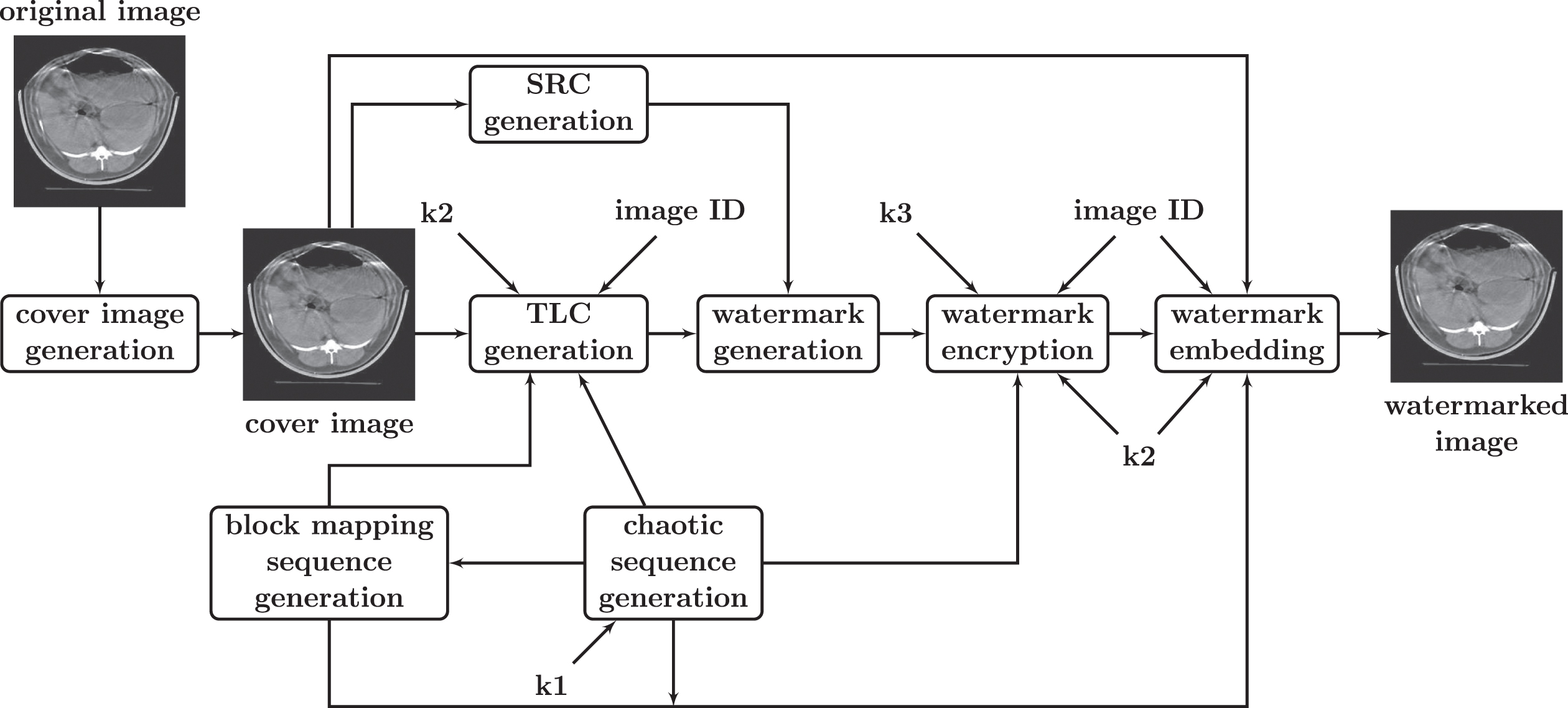
Block diagram of watermarked image generation phase.
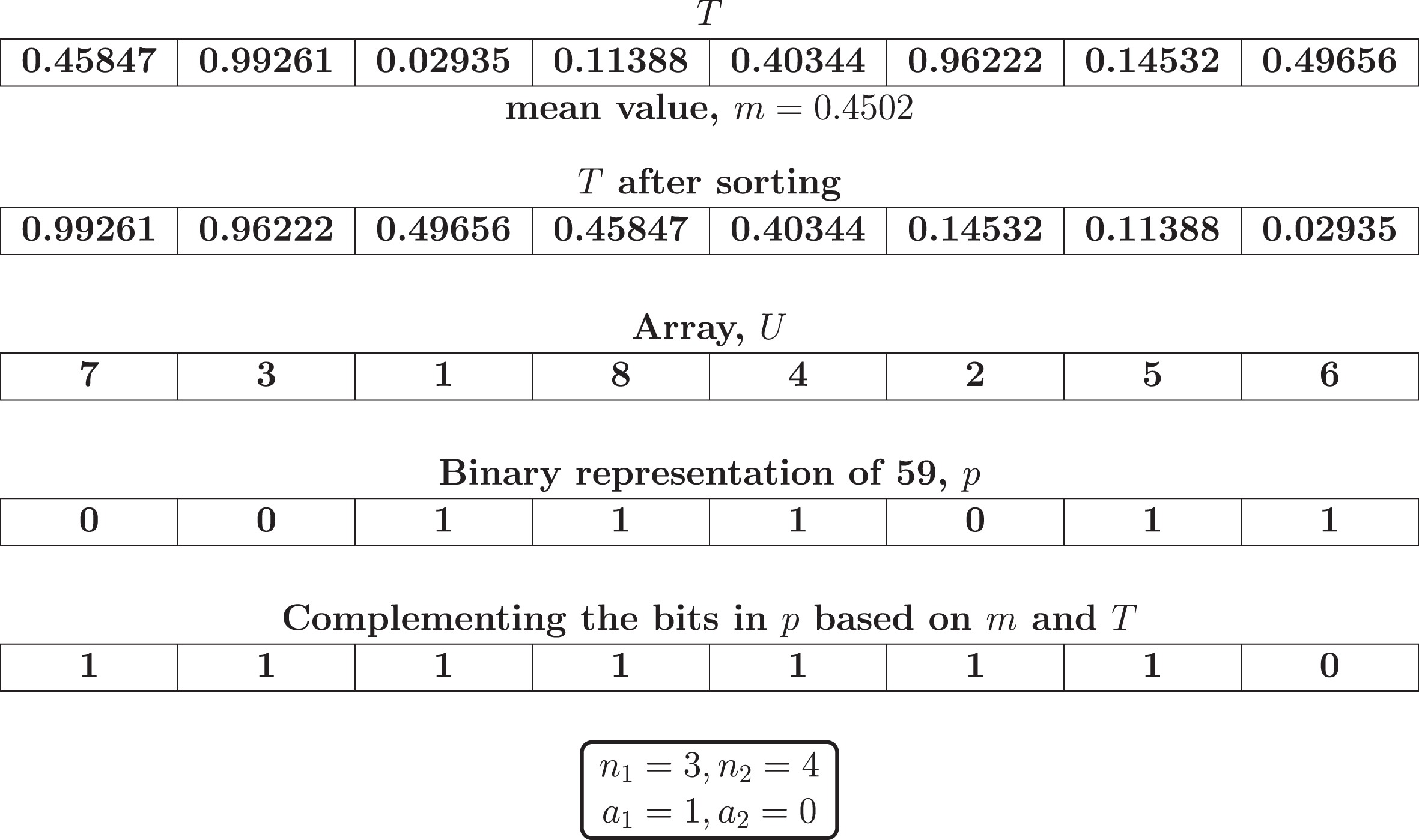
Illustration of TLC generation with pixel value of 59 in original image.
The tamper detection and localization procedure include watermark extraction, watermark decryption and a multilevel tamper localization. Let М be the received image. М is divided into non overlapping blocks Мi, i = 1, 2, …, N of size 2 × 2. Watermark extraction and decryption: For each channel, the watermark is extracted and decrypted from the mapping block Мj of Мi as per the following steps. Create the array Y according to step (c)ii. of watermark generation and embedding process in section 3.1. Store the terms of Мj in the array Z in row major order. Extract the watermark 𝒲′ from the 3 LSBs of Z (Y (2)) , Z (Y (3)) , Z (Y (4)). Create the array X according to step (b)iii. of watermark encryption process in section 3.1. Do inverse permutation on 𝒲′ using X as t (k) = 𝒲′ (X (k)) for k = 1, 2, …, 9. Compute decrypted watermark D = t ⊕ v
i
. Multilevel tamper localization: Initially, all blocks in М are considered valid and the tampered blocks are identified using a multilevel tamper localization strategy that helps to resist various tampering attacks. In this level invalid blocks are identified using changeable and unchangeable pixels. Classify the pixels in Мi as unchangeable pixel ω1 and changeable pixels ω2, ω3, ω4. Compute TLC for ω1 and compare with extracted TLC. If a mismatch occurs, the block is labeled as invalid otherwise go to next step. Extract 3 LSBs from ω2 and insert into the 3 LSBs of ω1. Apply smoothing function on ω1. If ω1 is different from ω2, Мi is considered as invalid, otherwise repeat steps iii-v for ω3 and ω4. Let A1, …, A8 be the neighboring blocks of a valid block B as shown in Figure 3. For each valid block B after level 1 if all three blocks in any one of the four triples (A2, A3, A5) , (A5, A8, A7) , (A7, A6, A4) , (A4, A1, A2) are invalid, B is considered invalid. The above step is repeated on all blocks in the image once again. All invalid blocks are considered tampered. For each valid block, 7 MSBs of the unchangeable pixel are compared with the extracted SRC from the mapping block. In case of a mismatch, the block is labeled invalid. If a block is invalid and the number of invalid neighboring blocks is greater than or equal to the number of invalid neighboring blocks of its mapped block or at most two neighboring blocks are valid, the block is considered tampered. For images with single channel, the untampered blocks are considered as tampered if the number of tampered neighboring blocks is more than four.
Image recovery
Suppose ℛ of size h × w × c represents the recovered image that is obtained from М. Initially, the pixels of ℛ are assigned with zeros. The pixels of ℛ is obtained in two stages as described below.
Stage 1:
For each pixel ℛi, If Мi is not tampered, then ℛi is assigned with the unchangeable pixel in Мi. If Мi is tampered and it’s mapping block Мj is not tampered, then ℛi is assigned with extracted 7 bit recovery information from Мj after appending with b - 7 zero bits
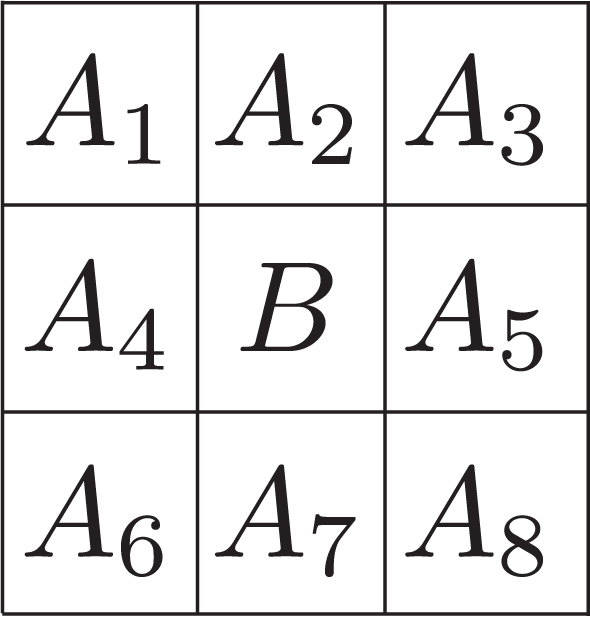
Neighboring blocks of a block B.
Stage 2:
An image inpainting algorithm [21] is adopted to recover the pixels which are not recovered in the first stage.
The security of the watermark along with the resistance of the proposed scheme against copy-move, image splicing, content removal, Vector Quantization (VQ), collage, and content only attacks are discussed in this section.
Security of the watermark:
Security of the watermark implies the difficulty to remove or modify the watermark without changing the watermarked image knowing the scheme. In this scheme, a watermark of length 9 × h × w bits is generated for an image of size h × w. The generated watermark is encrypted by first XORing with a random bit sequence generated using secret key, image identifier and channel identifier as key and then permuting using a chaotic sequence. The scheme has perfect secrecy as the random bit sequence varies for each channel for each image and chaotic sequence has infinite key space. For each channel, since the chaotic sequence is highly susceptive to the initial condition and control parameter which is used as one of the keys of the proposed scheme, the encrypted watermark is highly key sensitive. If the attacker guesses a 9-bit combination as watermark bits for a particular block, he cannot verify it without knowing the exact keys from the infinite key space since the generated watermark for that block depends on the chaotic sequence and image contents. Hence embedded watermark is highly secure for the proposed scheme.
Resistance to tampering attacks:
A multilevel tamper localization strategy is used to identify any modifications in the image contents and resist various tampering attacks. The first level identifies the modifications using TLC which depends on the image content and random number generated based on the key, image identifier and channel identifier. Also, this level uses the modifications in the changeable pixels using unchangeable pixels and the embedded watermark which in turn depends on the chaotic sequence. This helps to identify change in the block position and block contents. This resists image splicing, copy move, content removal, VQ, collage and content only attacks. Level 2 increases the tamper detection rate by identifying the unidentified tampered blocks in the first level. To further improve the resistance against VQ and collage, third level tamper localization is based on embedded recovery information that enables block wise dependency. The remaining levels help to increase the tamper detection rate by using the tamper detection status of the neighboring blocks. This shows that the proposed scheme can identify any modification in the image and have resistance to copy-move, image splicing, content removal, VQ, collage and content only attacks.
Experimental results and analysis
The proposed scheme is evaluated by conducting experiments on 96 grayscale (IS1) and 64 color (IS2) images of size 512 × 512 selected from CVG-UGR [22] database. The scheme is also tested on 50 MR images (IS3) of size 256 × 256 in DICOM format [23]. The experimental setup uses a computer with Intel 2.3 GHz processor, 4 GB memory, Ubuntu 16.04 LTS operating system and MATLAB R2017b. In the experiments, the parameters K1, K2, K3 and image identifier ℐ are set as (0.8566, 3.998), 100, 101 and filename in the database respectively. Channel ID takes values varies from 1 to 3 for color images.
Watermarked image quality analysis
Peak Signal to Noise Ratio (PSNR) and Structural Similarity Index Metric (SSIM) measures perceptual quality of watermarked image. The average PSNR and SSIM values for each image set before and after applying the smoothing function are shown in Table 2. The results show that the smoothing function helps to enhance the watermarked image quality and the proposed scheme generates watermarked images with good quality.
Watermarked image quality before and after applying smoothing function
Watermarked image quality before and after applying smoothing function
The effectiveness of the proposed scheme for tamper detection is measured by True Positive Rate (TPR) or Tamper Detection Rate (TDR), True Negative Rate (TNR), accuracy and precision (p) [1]. The recovery performance is evaluated using PSNR that measures the similarity between the recovered and original image.
To analyze the performance of the proposed scheme, tampering attacks such as copy-move, image splicing, content removal, VQ, collage, and content only attacks are simulated as follows at various tamper ratios on each watermarked image.
Copy-move attack: Image is altered by copying a portion of the image and pasting them to the same image.
Image splicing: Image is tampered by replacing the regions with portions from an external image.
Content removal: Image is tampered by replacing the pixels with grey pixels.
VQ attack: A region of the watermarked image is replaced with a region from the other watermarked image without considering the spatial location.
Collage attack: A portion of the watermarked image is replaced with the portion from the other watermarked image while preserving the spatial location.
Content only attack: Image is tampered by replacing a specified number of MSBs of each image pixels with that of other images while preserving the 3 LSBs.
Figure 4 shows the tamper localization and recovery performance of the proposed scheme on sample images from image sets IS1 and IS2.
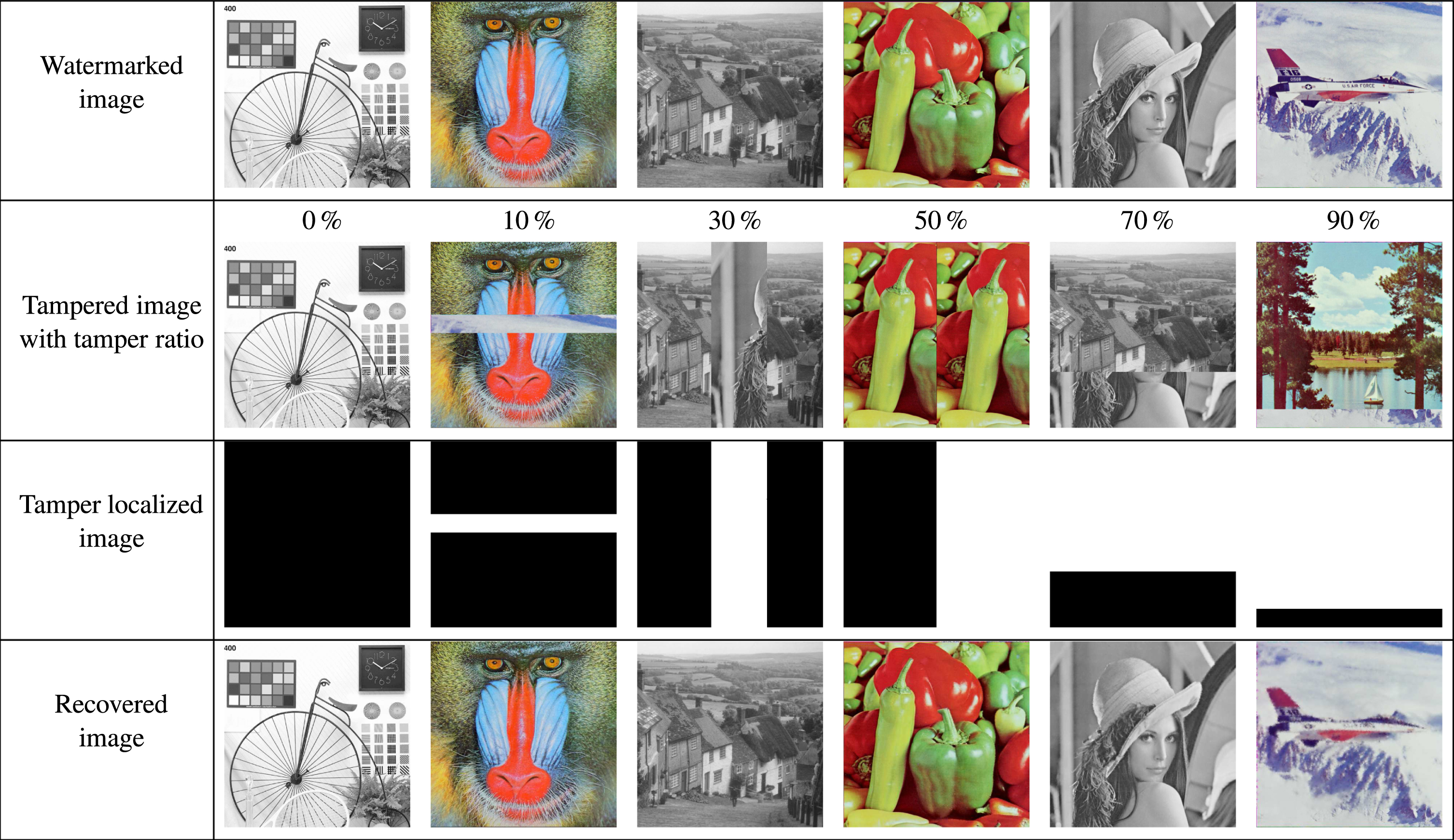
Visual performance of the proposed scheme on tamper localization and recovery on sample images from image sets IS1 and IS2.
Table 3 shows the average TPR for different tampering attacks on each image set. Since the obtained average TPR is above 99.99 % in all cases, the proposed scheme can resist copy-move, image splicing, content removal, VQ, collage and content only attacks.
Tamper detection performance for different tampering attacks on each image set in terms of TPR
Table 4 shows the average TNR for different tampering attacks on each image set. The proposed scheme achieves an average TNR of 99 % in all cases except content only attack for grayscale and MR images. This implies the proposed scheme classifies more than 99 % of the untampered pixels of extracted original image correctly.
Tamper detection performance for different tampering attacks on each image set in terms of TNR
Tables 5 and 6 show the average accuracy and precision for different tampering attacks on each image set. The average accuracy and precision are above 99.9 % for all cases except content only attack for grayscale and MR images. It is evident that the proposed scheme can locate the tampered regions precisely. In case of content only attack on grayscale and MR images, TNR, accuracy and precision are less due to the misclassification of untampered blocks at various levels of tamper localization procedure.
Tamper detection performance for different tampering attacks on each image set in terms of accuracy
Tamper detection performance for different tampering attacks on each image set in terms of precision
Table 7 shows the recovery performance of the scheme under various tampering attacks. From the table, it is clear that the proposed scheme recovers the original image completely if the received image is unaltered. The quality of the recovered image is greater than 31 dB for all image sets for tamper ratio up to 50%. The PSNR reduces to 23 dB when tamper ratio reduces to 90%. This shows that the proposed scheme achieves acceptable recovered image quality under extensive tampering.
Recovery performance under different tampering attacks
To compare the proposed scheme with Pixel to Block conversion and Checksum based scheme (PBC) [6], DCT and Linear mapping based Self-recovery scheme (DLS) [8], SVD and Linear mapping based Self-recovery scheme (SLS) [9], Lifting wavelet transform and Halftoning based Self-recovery scheme (LHS) [10], Reference Sharing based Self-recovery scheme (RSS) [11], BTC and Linear mapping based Self-recovery scheme (BLS) [12], Block Average based Self-recovery scheme (BAS) [13] and Self-recovery scheme using Chaotic sequence and SVD (SCS) [15], the schemes are tested on grayscale images.
Table 8 shows a comparison of the proposed scheme in terms of data payload, watermarked image quality, time required to generate the watermarked image, tamper localization accuracy and quality of recovered image from received image under various tamper ratios.
Performance comparison of proposed scheme with state-of-the-art schemes
Performance comparison of proposed scheme with state-of-the-art schemes
The average data payload of the proposed scheme is higher than PBC, SLS, LHS, RSS, SCS and lower than DLS, BLS and BAS. This influences the watermarked image quality and proposed scheme provides watermarked image quality greater than DLS, BLS and BAS.
The computational time complexity of all schemes is
The proposed scheme locates the tampered regions at pixel level and other schemes locate the tampered regions at block level. This influences the localization accuracy especially in noise addition attack. For illustrating the localization accuracy, salt and pepper noise with a density of 0.01 is added to the watermarked image. From Table 8, it is evident that the accuracy of the proposed scheme is high since the tamper localization is done at pixel level.
To demonstrate comparison in terms of recovered image quality under extensive tampering, each watermarked image is tampered by replacing image pixels with white pixels from left to right at various tamper ratios. Table 8 shows the average PSNR of the watermarked image and recovered image. The proposed scheme provides watermarked images with better quality as compared with recent schemes. For the proposed scheme and PBC, PSNR of the recovered image is ∞ at tamper ratio 0 %. This means that these schemes ensure 100 % recovery of the original image from an unaltered protected image. It is noticed that the quality of recovered image decreases with increase in tamper ratio for all schemes. Among the schemes, the proposed scheme provides improved recovered image quality under extensive tampering.
Table 9 summarizes resistance of the self-recovery schemes PBC, DLS, SLS, RSS, LHS, BLS, BAS, Pixel level Authentication based Self-recovery scheme (PAS) [14], SCS and the proposed scheme against various tampering attacks such as VQ, collage (CA), content only (COA), and constant feature (CFA). DLS, BLS, SCS and the proposed scheme can resist all attacks since these schemes enable block-wise dependency and authentication information depends on the image contents and its position. As compared with the state-of-the-art schemes, the proposed scheme is more secure by introducing more randomness in selecting pixel positions where watermark bits are embedded.
Comparison of resistance of self-recovery schemes against various tampering attacks
In this paper, a secure image authentication scheme that performs tamper localization and recovery is proposed. The embedded watermark is highly secure and fragile in nature. The proposed scheme provides 100% recovery of the original image if the received image is not tampered. This scheme provides pixel-wise authentication and ensures tamper localization at pixel-level. Experimental results demonstrate that the proposed scheme can resist content removal, copy-move, VQ, image splicing and collage attacks. The scheme has better security, better tamper localization accuracy and better recovered image quality under extensive tampering compared to the state-of-the-art schemes. The scheme can be used to secure the images carrying sensitive information like medical images, biometric images that demand lossless recovery of image, precise tamper localization and high recovery rate. The limitation of the scheme is that the storage requirement is high for ensuring lossless recovery. A future direction of research is to reduce storage requirements while maintaining other performance parameters at optimum.
Acknowledgment
Authors are grateful to the Department of Higher Education, Government of Kerala, for granting the research fellowship.