



Abstract
The oil and gas industry is one of the harshest environments on reinforced concrete structures. Enhancing the reliability of these industries has been identified as a critical goal to meet anticipated production targets and maintain competitiveness. The purpose of this paper is to rank and prioritize risk factors on reinforced concrete structural systems in the oil and gas industry to reduce failures and improve system reliability. The risk factors influencing reinforced concrete systems are identified based on the experts interviewed who specialized in risk analysis. In this paper, a risk assessment approach based on a hybrid fuzzy failure mode and effect analysis is developed in order to rank the factors and improve the process of reinforced concrete maintenance prioritization. The developed approach is also compared with the other two methods; namely, conventional failure mode and effect analysis (FMEA) and grey rational analysis (GRA) integrated with FMEA. The three developed approaches are designed to acquire the highest risk priority number (RPN) values; conventional RPN, GRA-FMEA RPN, and Fuzzy-FMEA RPN. These values will be utilized as the focus of improvements to reduce the possibility of some kind of failure occurring a second time and improve the deteriorated reinforced concrete structure to minimize the likelihood of failures. The results revealed that high-risk systems include the compression train, steam turbine, and combustion gas turbine generator, while the majority require maintenance of the supporting concrete foundation as soon as second-degree deterioration occurs. Furthermore, the results indicated that the Fuzzy FMEA approach was appropriate for assessing deteriorated reinforced concrete structures.. This work represents a step forward in the development of a tool that can be used to assess the risk of degraded concrete structures and improve their integrity through proper monitoring and maintenance.
Introduction
The oil and gas industry is one of the most challenging and risky environments. Maintaining oil and gas industry facilities is a critical task to ensure safe and continuous operation in order to effectively and efficiently meet demand. Oil and gas equipment are placed on reinforced concrete structures. Any equipment failures would negatively impact the reinforced concrete structures. Thus, reinforced concrete structures are important physical infrastructure assets in the oil and gas industry that need to be monitored, maintained, and evaluated regularly. Huge efforts are exerted in planning facilities maintenance schedules through implementing programs such as turnaround and inspection, preventive maintenance, and periodic surveys to ensure that conditions of equipment and facilities are monitored and duly maintained. Maintenance of these structures is usually delayed due to several factors. The budget limitation is one of the most common factors for reconsidering maintenance plans. This factor is concerned with the process of allocating required resources to finance maintenance tasks. Decision makers need to determine how urgent it is to maintain the deteriorated reinforced concrete structures to decide whether to do it or to reallocate the available resources for operational necessity. Such decisions are usually made based on economical and operational considerations while assigning low priority to the maintenance requirements.
Moreover, prioritizing and managing risks is a critical step in developing an effective maintenance plan. Risk management is a procedure for identifying the source of risk, analyzing its influences, and defining an appropriate response to risk items [1]. The primary component of risk management is risk assessment, which can assist managers in identifying and evaluating risk events [2] [3]. In the oil and gas industry, reinforced concrete structures particularly foundations are serving as a support for critical equipment. Failure to evaluate and prioritize the risks of such systems leads to deterioration progression and might results in impacting the facility operational process. Therefore, there is a need for effective approaches to risk factors prioritization and risk evaluation. This will help to develop a proper maintenance planning program.
Furthermore, for any oil and gas facility to maintain safety and profitability, healthy assets are required to be assured. The industry’s monitoring and maintenance programs of the operation facilities and other physical infrastructure aspects –particularly reinforced concrete structures –are as effective as possible. Occasionally, maintenance plans are deferred due to economic reasons mainly to afford operation related costs. The effectiveness of these programs might be jeopardized and negatively impact the overall performance of the facility if the condition of the compromised reinforced concrete structures is underestimated and left without proper maintenance.
The previous studies employed deterministic and hypothetical approaches to investigate the deterioration of reinforced concrete structures. Although deterministic investigation methods provide accurate results of the sampled structure, collecting the required sample might not be feasible at a running industrial facility and is less desirable due to cost and feedback duration. In contrast, hypothetical evaluation methods are used to estimate the probability and the risks impact. However, these methods have drawbacks in predicting accurate results due to the existence of high uncertainty. In addition, many studies used FMEA to assess the risks in different fields. Nevertheless, the traditional FMEA approach has several drawbacks, which include: For various data set points of severity (S), occurrence (O), and detection (D) in RPN analysis, the same type of identical values can be acquired; yet, the risk evaluation may be completely different. The differences in hazard representations among breakdown modes with the same RPN [4]. The relative importance of the severity, occurrence, and detection ratings [5]. The experience of the experts in calculating RPN is ignored.
Furthermore, the literature revealed that risk assessment of reinforced concrete structures in the oil and gas industry has been paid little attention. Specifically, there is a lack of developing an efficient approach to rank and evaluate risk factors in the reinforced concrete structures of oil and gas industry. Consequently, this paper proposes a risk assessment approach based on fuzzy-FMEA to evaluate the deteriorated reinforced concrete structures at an oil and gas industrial facility in Saudi Arabia considering uncertainties in experts’ judgments. The purpose of combining the fuzzy approach with FMEA is to address the shortcomings of traditional FMEA. Moreover, the proposed approach is benchmarked with traditional FMEA, and an integrated technique based on grey rational analysis and FMEA. The developed method makes use of the flexibility provided by the fuzzy belief structure in assessments delivered by subject matter experts, allowing them to provide more moderate judgments based on their expertise. In addition, it addresses the experts’ judgments rather than considering the input variables as constant. The experts use linguistic variables to reflect inaccurate and ambiguous descriptions of events. Moreover, integrating grey theory into traditional FMEA allows for the assignment of relative priority to risk variables O, S, and D. The ability to assign multiple weightings to each aspect, as well as the lack of any form of the utility function, are two of the primary benefits of using the grey technique in FMEA. The study provides an extension application of the developed approaches to the deteriorated reinforced concrete structures in an oil and gas industry, which will serve as a powerful tool for decision-makers while also addressing some of the shortcomings of the current models.
Moreover, this work is the first attempt to assess the risk of deteriorated reinforced concrete structures in an oil and gas industrial facility using a real case study. The developed approach can also assist in effectively prioritizing the maintenance process and planning of reinforced concrete structures in the industry while contributing in saving resources of laboratory financial expenses and suitably allocate maintenance fund based on firm systematic decision. Furthermore, proper risks prioritization help to establish an efficient and controlled analysis system integrated to the maintenance program. It will help professionals in the oil and gas industry to determine the urgency level of establishing a maintenance schedule to repair and monitor the deteriorated reinforced concrete structures.
This paper is organized as follows: literature review is presented in section 2, followed by methods and materials in section 3. Results and discussion are provided is section 4. Finally, the main findings of the paper are concluded in section 5.
Literature review
Unlike commercial buildings structures and foundations, industrial reinforced concrete foundations are subjected to additional factors that could contribute to the fast progression of its deterioration once defect is identified such as vibration. Precautions are made during the designing phase to account for the effect of the machine on its foundation and vice-versa. Measures are taken to reduce vibration transmission from the equipment to the foundation and the opposite, which, if not controlled, might have an impact on the surrounding equipment and structures [6]. Furthermore, it is critical in such industries to assess and evaluate risk factors. In this regard, several studies used deterministic methods to evaluate the corrosion of steel reinforcement in concrete, such as the half-cell potential method, corrosion rate method, and concrete resistivity method [7]. In this section, the previous studies are divided into two parts based on the methods used to evaluate the corrosion of steel reinforcement in concrete. The first part includes the works that utilized hypothetical approaches, whereas the second part reviews studies that used risk assessment methods.
Hypothetical methods
Several studies used hypothetical methods which employ the means of prediction, probabilistic, and numerical evaluation methods of the corrosion rate of steel reinforcement in concrete [8] [9] [10] [11]. Massive efforts were exerted on developing hypothetical methods to achieve reliable and accurate evaluation results based on numerical modelling and quantitative analysis. Yu et al. [8] proposed a probabilistic prediction model to assess the corrosion risk of concrete reinforcement steel in terms of concrete resistivity. The prediction model results were comparable to the deterministic analysis results. The authors argued that the proposed model can overcome misreading the risk of steel reinforcement corrosion that can be encountered with the deterministic approach. Krykowski & Zybura [11] used a finite element method and a transient layer growth model to analyze the concrete cover degradation as a result of reinforcement corrosion. Xu et al. [10] studied the risk of cracks presence in the reinforced concrete structures. The authors developed a numerical approach to calculate reinforced concrete. Stewart & Arnold [9] explored the possibility of predicting the fatigue of reinforced concrete structures using a combination of Semi-Markov Chain approach and advanced nonlinear Finite Element simulation methods. Chemweno et al. [12] presented a review of risk assessment methods’ dependability approaches application for maintenance decision making with considering formalisms model and treatment of uncertainty through probabilistic and statistical modelling methods.
Hackl & Kohler [13] provided a generic framework for the stochastic modelling of reinforced concrete deterioration due to corrosion. A combination of structural reliability analysis and Bayesian networks was used to predict the probability of a reinforced concrete failure. Cavaco et al. [14] emphasized the importance of considering the robustness of infrastructural assets particularly structures. The authors suggested an index used to describe the robustness of current reinforced concrete systems for rebar corrosion. Polder et al. [15] addressed the need for repair of reinforced concrete motorway bridges in Netherlands. Apparently, a backlog of postponed maintenance aggravated the problem of age distribution and in particular the relatively short life of conventional repairs. It was suggested to apply various modern techniques for assessment, prevention, monitoring, and protection that have well maintained records to mitigate the steep rise of maintenance needs although they are not widely used. Sarveswaran et al. [16] developed a method of structural reliability assessment for deteriorating reinforced concrete beams and showed the benefits of using such advanced methods.
Cheng et al. [17] developed a new risk-based evaluation model for bridge life-cycle maintenance strategy which allows transportation bodies to properly manage both aspects and effectively determine the optimal timing and budget for maintaining transportation bridges. In order to reduce anticipated life cycle costs for bridge maintenance, this model considered the three major risk factors for component deterioration, scouring and earthquakes. The simulation of Monte Carlo was used to determine the possibility of bridge repairs. Li & Melchers [18] presented a work attempting to introduce a performance-based methodology for deterioration assessment of reinforced concrete structures due to reinforcement corrosion. Two methods of sensitivity analysis were used to identify factors that significantly affect structural deterioration. The authors suggested that a time-dependent reliability approach may serve as a guide to establish a risk-informed, cost-effective technique for the management of corrosion-affected concrete structures for the structural engineers and asset managers. Piratla et al. [19] introduced and illustrated a failure risk-based culvert prioritization approach in accordance with the South Carolina DOT inspection procedures. The method proposed was explicitly designed for reinforced concrete pipe and corrugated metal pipe (materials due to their broad popularity).
Risk assessment methods
Risk assessments methods and practices are widely adopted for evaluating and prioritizing risks. Hassan et al. [20] proposed a new technique called modified FMEA, which combines the features of hybrid FMEA with fuzzy and FMEA with grey relational analysis for identifying hazard in petroleum pipeline. To incorporate experts’ various perspectives and apply a proportionate weighting to each evaluation component in the risk assessment, the study employs both the fuzzy and grey rational analysis. The risk assessment results are then utilized to prioritize the risks and rate the failure modes under various scenarios. The study indicated the effectiveness of a hybrid fuzzy FMEA approach to deal with the proposed problem. Wang et al. [21] also applied a hybrid approach based on fuzzy multi-criteria decision-making method and failure mode and effect analysis for ranking risks for the floating production storage and offloading system in oil and gas processing system. Khalilzadeh et al. [22] developed an integrated approach based on fuzzy, multi criteria decision making approach, FMEA, and mathematical model for assessing risk in petroleum construction filed. The health and safety executive risks of oil and gas construction projects were recognized and prioritized in relation to the project’s three well-known constraints of quality, cost, and time, which organizations often face. Managers were also advised on suitable risk response tactics to use in these scenarios. Khalilzadeh et al. [23] presented a systematic approach based on a hybrid multi criteria decision making approach and FMEA for measuring risk in oil and gas projects. First, the authors identified the risk factors based on the experts and literature. Then, the weight for each risk was assigned using a multi-criteria decision-making approach. After that, a combination of three methods, namely, VIKOR, grey relational analysis, FMEA were utilized to rank and identified the crucial risk factors. Another study was conducted by [24] to rank risks in the distribution of oil products. For this purpose, the author developed a hybrid approach based on fuzzy, FMEA, and a multi-criteria decision method.
Setunge et al. [25] presented a study to assess the systematic risk of failure by integrating a fault-tree-based methodology. An optimum approach is used to assure reliability and at the same time that minimize life cycle cost. Dickerson & Ackerman [26] developed and validated a Failure Modes and Effects Analysis (FMEA) system to study military systems’ malfunctions for maintenance management risk analysis for public school facilities at USA. Yu et al. [27] implemented a risk assessment approach for maintenance process of onshore oil and gas transmission pipelines under uncertainty. The study showed Interval Analytical Hierarchy Process (IAHP) method is capable of internalizing and quantifying uncertainty effectively. Hamid et al. [28] suggested a model for prioritizing the repair works for deteriorated reinforced concrete structures. The proposed model employed professionals expertise to effectively manage repair activities, systematically allocate resources such as fund, and manage repair plans. Chakhrit et al. [29] analyzed the gas turbine system’s reliability and safety to determine criticality and prioritize failure modes to select the best actions for reducing the risks of unfavorable scenarios. A method based on failure mode and criticality analysis and fuzzy approach was develop for risk evaluation. The results showed the capability of integration of these two methods in risk prioritization and evaluation. Karamoozian and Desheng [30] utilized a failure mode and effect analysis tool for considering failure modes ranking in construction projects. Fuzzy approach was also employed to account for uncertainties in expert assessments. The findings indicated that the hybrid FMEA technique is an effective approach for risk ranking. The previous studies have proven the effectiveness of using an integrated and fuzzy approach for evaluating and prioritizing risks under uncertain environments.
Table 1 illustrates the summary of the previous studies. These studies are classified based on three categories; the objective of the work, the method used, and the application area. From Table 1, it is clear that the risk assessment of reinforced concrete structures of foundations in the oil and gas industry has not yet been addressed. Most of the previous studies focused on the equipment performance/condition and operational processes rather than the foundation. Only one study addressed the failure modes of the gas turbine system in oil and gas industry. However, it focuses only on one component affecting foundation reliability and employs traditional reliability methods. In addition, the majority of these studies used laboratory experiments or simulation to assess the risk due to lack of actual data.
Summary of previous studies
Summary of previous studies
Therefore, there is a need to extend the application of reliability and risk assessment methods to encompass the reinforced concrete structures in the oil and gas industrial facilities. The objective of this paper is to construct a risk assessment approach based on fuzzy failure model and effect analysis for evaluating the deteriorated concrete structures due to reinforcement corrosion at an onshore oil and gas facility. This paper will thoroughly investigate the failure modes and causes of oil and gas plant foundations. In addition, the developed risk assessment approach is compared with the traditional failure model and effect analysis and grey rational approach integrated with FMEA. The developed approaches are applied to a real-world case study in the oil and gas industry in Saudi Arabia.
In this paper, a risk assessment approach is developed to evaluate the deteriorated reinforced concrete structures in an oil and gas industrial facility. This section discusses and sheds light on the materials and methods used in this paper to develop the risk assessment parameters that are adopted to conduct the study. An integrated risk assessment approach based on Fuzzy-FMEA is developed for prioritizing risk factors and evaluating the deteriorated concrete structures due to reinforcement corrosion in an onshore oil and gas facility. The proposed Fuzzy-FMEA is compared with the conventional FMEA, and GRA FMEA. The findings of the study will help to assist professionals in the oil and gas industry in ranking risk factors and determining the level of urgency in establishing a maintenance schedule to monitor and repair deteriorated reinforced concrete structures. The details of the problem identification and the developed approaches are explained in the subsequent sections.
Problem formulation
This study investigates the incorporation of risk assessment practices into the maintenance program of industrial reinforced concrete structures, specifically foundations at an onshore oil and gas facility. It aims to effectively evaluate and determine the necessity of maintaining the deteriorated foundation at the time of certain defect identification. Risk factors are identified and assessed for a real case study of an oil plant facility in the Saudi oil and gas industry. The facility contains a number of systems that are required to run the facility and meet production demands. A team of professionals is consulted to identify the common systems in oil and gas production. Engineers specialized in risk analysis, civil engineers and inspectors, electrical installation, mechanical equipment engineers, plant manager, were among the specialists consulted. Ten critical systems are identified as shown in Table 2. Then, the failure modes and causes corresponding to each system were determined with the aid of FMEA team. Subsequently, expert opinions are collected to estimate the impact of each cause and how severe the process disruption would be if the supporting foundation failed. The details of implementing the FMEA for identifying the systems, failure modes and causes are explained in the following subsection.
Critical systems in oil and gas facility
Critical systems in oil and gas facility
In the late 1940 s, the US army used FMEA as an evaluation tool in improving the assessment of the reliability of weapons and military systems. The National Aeronautics and Space Administration (NASA) utilized this approach for Apollo space missions in the 1960 s [31]. Ford motor company utilized FMEA in automobiles manufacturing operations in the late 1970 s [32]. Since these applications led to a significant in acceptable improvements at Ford, the method is commonly used as an evaluation tool in the automobile sector. Currently, FMEA is used effectively in different sectors, including food, semiconductors, medicine, automobiles, and aircraft. The FMEA method estimates detection (D), severity (S), and the occurrence (O) of each failure mode [33]. Detection is a method of identifying possible flaws in a product, which represents the ability of detecting the failure. Severity measures the urgency and impact of the failure mode. Occurrence is the likelihood of occurring failure and its cause. Using risk priority numbers (RPNs), the FMEA approach assesses the failure risk. The RPN value is calculated by multiplying the products of D, S, and O on a scale of 1 to 10. A greater RPN value denotes a higher importance. FMEA is a method for identifying, assessing, and avoiding process and product problems before they occur. It aims to eliminate or reduce the likelihood of a potential breakdown event, as well as to document progress reports. Although performing a FMEA at the final stages of procedures or products may produce benefits, it is preferable to do so during the design and development stage. This improves the efficiency of process and product by coordinating operations that limit the likelihood of failure [34].
In this paper, a risk assessment approach based on conventional FMEA has been developed to effectively identify failure modes, their causes, and impact. Leimeister & Kolios [35] conducted a reliability study of the offshore wind industry where they presented a review of variety of risk assessment methods which were categorized into qualitative, quantitative, and semi-quantitative methods. FMEA was selected to develop the risk assessment approach due to limitation of physical data derived from practical field tests. FMEA has proven to be a valuable and effective risk assessment tool widely used in different industries and organizations. If applied correctly through employing the knowledge of experts, it will result in an improved safety, quality and reliability. The steps of FMEA used in this study of risk assessment are illustrated in Fig. 1.
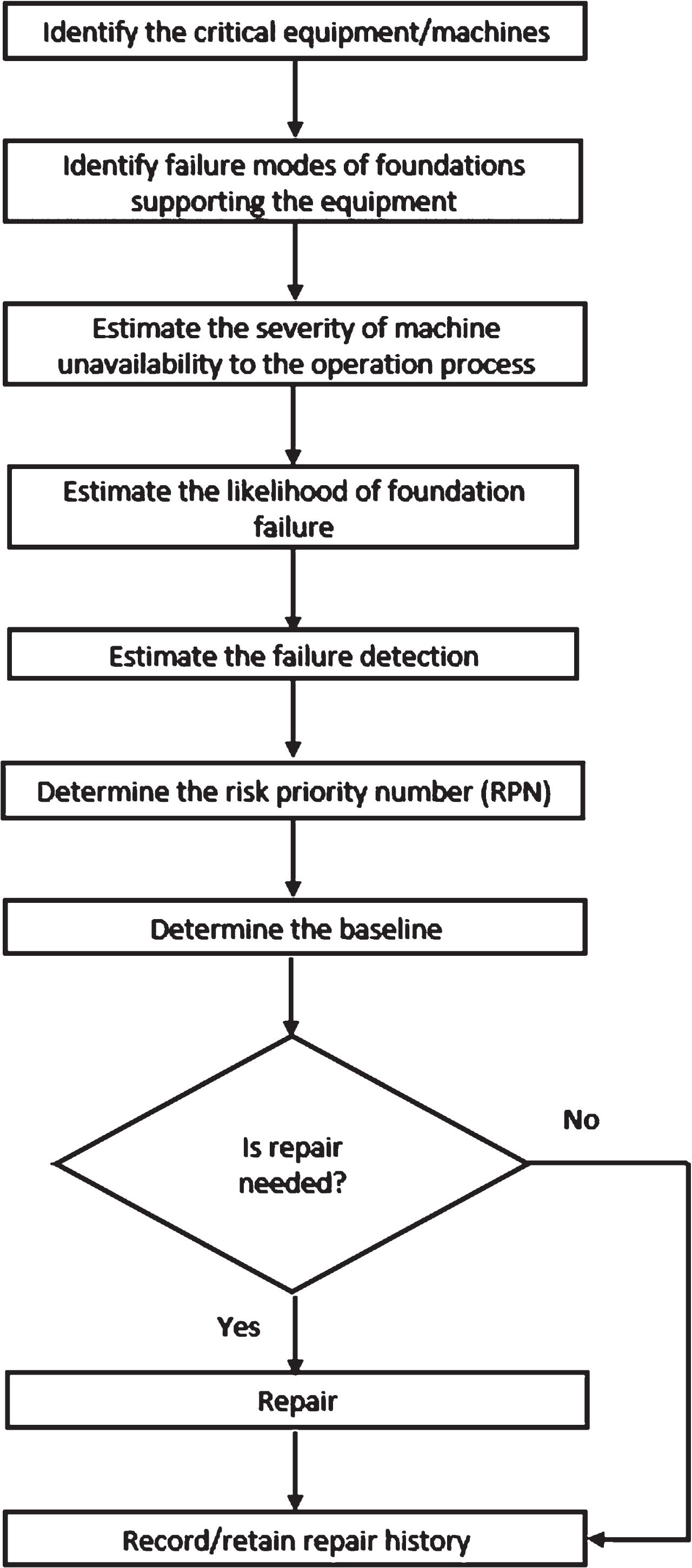
FMEA risk assessment approach.
The first step of implementing FMEA is to identify the critical components in the oil and gas industry that have a high impact on the reliability of the entire industry. The oil and gas facility contains many systems which are required to operate the facility and achieve its production demand. In this paper, common systems that are related to the oil & gas production are identified through consulting professionals in the oil and gas facility. With the consultancy of subject matter experts, nine systems that have direct influence on the oil and gas facility operation were identified in addition to other supporting systems. These systems are divided into three categorize as shown in Table 2. This part is concerned with determining the important role that foundations play in providing a stable and reliable support for those systems.
Identifying the failure modes of reinforced concrete
Reinforcement steel corrosion in reinforced concrete (RC) structures is one of the leading causes of deterioration in concrete. Reinforced concrete foundations are designed to withstand the load imposed on them, however, industrial systems experience different factors that may contribute to their deterioration process [6]. The standard deterioration stages/ failure modes presented in Table 3 are adopted for the sake of this work. Frequent field assessments at the oil and gas facility revealed that these failure modes are consistently encountered with aforementioned systems foundations.
Reinforced concrete deterioration/failure modes
Reinforced concrete deterioration/failure modes
To determine the impact of systems unavailability to the operation process of the oil and gas facility, experts’ opinions are collected as they rated the level of importance of these systems to their facility. This step is conducted to gauge the importance of these systems in order to find out how sever would be the process interruption due to failure of the supporting foundation since it will not be fit to provide the support which is designed to provide.
Estimate the likelihood of foundation failure
Likelihood or frequency of occurrence of industrial reinforced concrete foundations failure is assigned subjectively based on the experience of practitioners at this field. While considering the possible state of the foundation based on the failure modes presented in Table 2, practitioners’ assessment was sought to determine the chance that the foundation will completely fail if no corrective actions are taken at the stage under consideration.
Estimate the failure detection
The third input parameters to calculate the RPN is detectability. It entitles the ability to detect the failure of reinforced concrete foundation which depends on two factors including the practiced means of failure checking and evaluation, and accessibility and ease of failure mode monitoring. Accordingly, numerical indicators are assigned to each failure mode to set its detectability degree.
Determine the risk priority number
The risk priority number (RPN) is the product of severity (S), occurrence (O), and detection (D) ratings. RPN is used to rank the criticality of risk and failure modes [35]. The RPN value is computed using the following formula: size812
The baseline is essential to be able to evaluate the established risk levels. The baseline is selected based on the RPN level. Corrective action is deemed to be necessary for critical items with risk priority number that exceeds the baseline.
Risk acceptance
This step is concerned with making a decision relating the encountered risks, which are referred to as critical systems associated with their foundation failure mode. Upon the completion of the risk assessment, the calculated risk values (RPN) are to be compared with the established baseline. In case the RPN value exceeds the baseline, corrective actions will be taken. Conversely, if the RPN value falls below the baseline, risk will be monitored.
Documentation
Documents will be retained to record all risks including acceptable risks where monitoring is satisfactory or unacceptable risks that require further corrective action. The risk assessment approach was planned to cover all equipment reinforced concrete foundations in the oil and gas facility however pipelines foundations were excluded in the current study due to lack of sufficient information, complexity, and numerous factors that would affect expert decision such as transferred fluid, speed of flow, fluid receiving equipment or process, size, length, etc.
Fuzzy FMEA
The fuzzy set method, developed by Zadeh [36], is a theory for dealing with theoretical relations’ vulnerability by converting them into quantitative systems. Instead of considering the input variables as constant, it is addressed as a fuzzy number to deal with the uncertainty in making decisions. Experts use linguistic variables to reflect events that are inaccurately and ambiguously described, and they can also be used to convert subjective knowledge into quantitative form. A membership function is used to define the linguistic variables in fuzzy set theory. The fuzzy set’s membership function can be represented in a variety of ways, with trapezoidal and triangular being the most commonly utilized. In this paper, triangular membership function is used. The steps of implementing fuzzy process are described in the subsequent subsections.
In this paper, Fuzzy approach is integrated with failure mode and effect analysis to evaluate the risk of deteriorated concrete structures due to reinforcement corrosion. Integrating fuzzy belief structure with FMEA assists in overcoming the limitations of traditional FMEA assessments in order to improve the assignment of the unknown. It makes use of the flexibility provided by the fuzzy belief structure in assessments delivered by subject matter experts, allowing them to provide more moderate judgments based on their expertise. The developed fuzzy FMEA system has three primary modules: input interface module (fuzzification), knowledge base module (rules base), and output interface model (defuzzification), as illustrated in Fig. 2. The input parameters correspond to the fuzzy FMEA parameters S, O, and D, while the output variable belongs to the fuzzy RPN. To determine the degree of membership, the inputs (S, O, and D) are fuzzified using membership functions. The Fuzzy interface system evaluates the fuzzy inputs using a well-defined rule basis. These rules are the “IF-THEN” that are used with fuzzy logic operations to estimate the level of risk of failure. To obtain the fuzzy RPN, the fuzzy conclusion is defuzzified. The greater the risk, the greater the value of the fuzzy RPN, and vice versa.
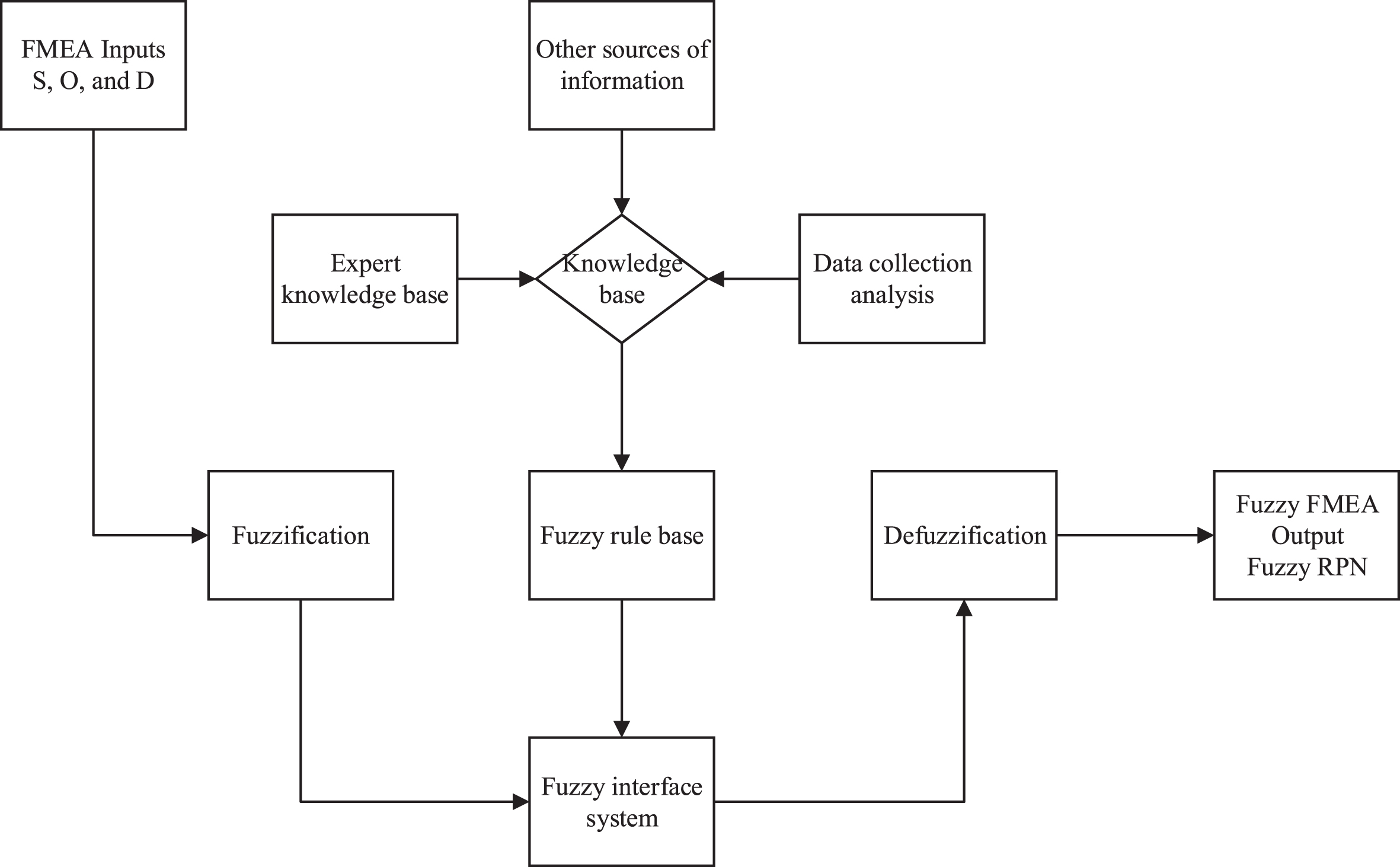
Fuzzy inference system.
Fuzzification is a technique for converting input variables into quantities of membership degree, which are then expressed in quantifiable linguistic terms [37]. The membership function degree for a certain variable can be described using expert judgment and knowledge. A fuzzy logic controller captures input data in addition to Fuzzification. A triangular function membership transfers the linguistic form of the input parameters in the range of 0, 1 using the following Equations:
Where a, b, c are the linguistic scale of the input parameters, and x is the input linhuistic parameter.
For any combination of input variables, the fuzzy rule base describes the criticality system’s degree. In general, a linguistic form of the input parameters combination can be generated, for instance, by employing rule-based logic such as “if –then,”. This can be achieved as follows: (i) a specialist’s familiarity and expertise, and (ii) the Fuzzy based model’s process [38]. “If” is used to describe an antecedent that is compared to the inputs, and “Then” is used to describe a consequent, which is the outcome [39–41]. For example,
Where M i is the preceding linguistic constants (qualitatively defined functions), y is the output linguistics parameter, and Ni is the linguistic constants that result. Every rule that has any truth in its antecedent will be applied, which helps to build the fuzzy conclusion.
Based on Zadeh’s compositional rule of inference, fuzzy inference mechanisms are used. The rules and the input parameters are used to generate an output fuzzy set using the inference mechanism. For example, a fuzzy relation R: (X, Y) is used to represent a fuzzy rule expressed by equation (4) and is computed using equation (5): From the rules and the input variables, the inference mechanism produces an output fuzzy set.
Where I can be a conjunction or an implication operator (t-norm).
In this study, Mamdani max-min interface is utilized. Mamdani’s fuzzy inference method is used in the study because it is commonly used in modeling human expert knowledge. The “MIN” operator is used in the Mamdani model for operations involving combinations and implication. A fuzzy logic controller scales the membership functions of an output linguistic parameter using an implication method that takes the rule weight of the associated rule into account. The “MAX” operator is used to combine the fuzzy outputs. Equation (6) is the outcome of Zadeh’s compositional rule of inference:
Where β k = min αi,k, and αi,k = sup min(μA′(x i ) , μ A (x)
In the fuzzy mechanism, the first step is to fuzzify the numerical input variables (severity, detection, and occurrence) using the proper membership functions. Then the conjunction and implication operations are performed using the min operator. The outputs (individual fuzzy sets) are aggregated using the max operator before being defuzzifed to produce a crisp value.
The output that the fuzzy inference system produces will always be Fuzzy in nature. Consequently, defuzzification is required to transform the fuzzy output into crisp output. For determining the output, the centroid of the area defuzzification method [42] is expressed in Equation (7):
Where B′ is the fuzzy set output and μB′ is the membership function.
Grey Theory, as defined by [35], is an approach for solving uncertainty problems that allows one to cope with situations that have poor or incomplete information, or even lack information. Grey Theory consists of grey numbers, grey relations, and grey elements. Classical mathematics is replaced with these three key components [43]. The grey system offers solutions to situations including limited, insufficient, or uncertainty in information. In the last two decades, grey theory has become a common technique for providing transdisciplinary ideas. Incorporating Grey Theory to the classic FMEA, allows to assign relative priority to risk variables O, S, and D. The ability to assign multiple weightings to each aspect and the lack of any form of utility function are two of the key advantages of using the grey technique in FMEA [44]. Figure 3 illustrates the flowchart of grey rational analysis incorporated in FMEA.
Several steps are required to construct GRA [45–48], which are described as below:
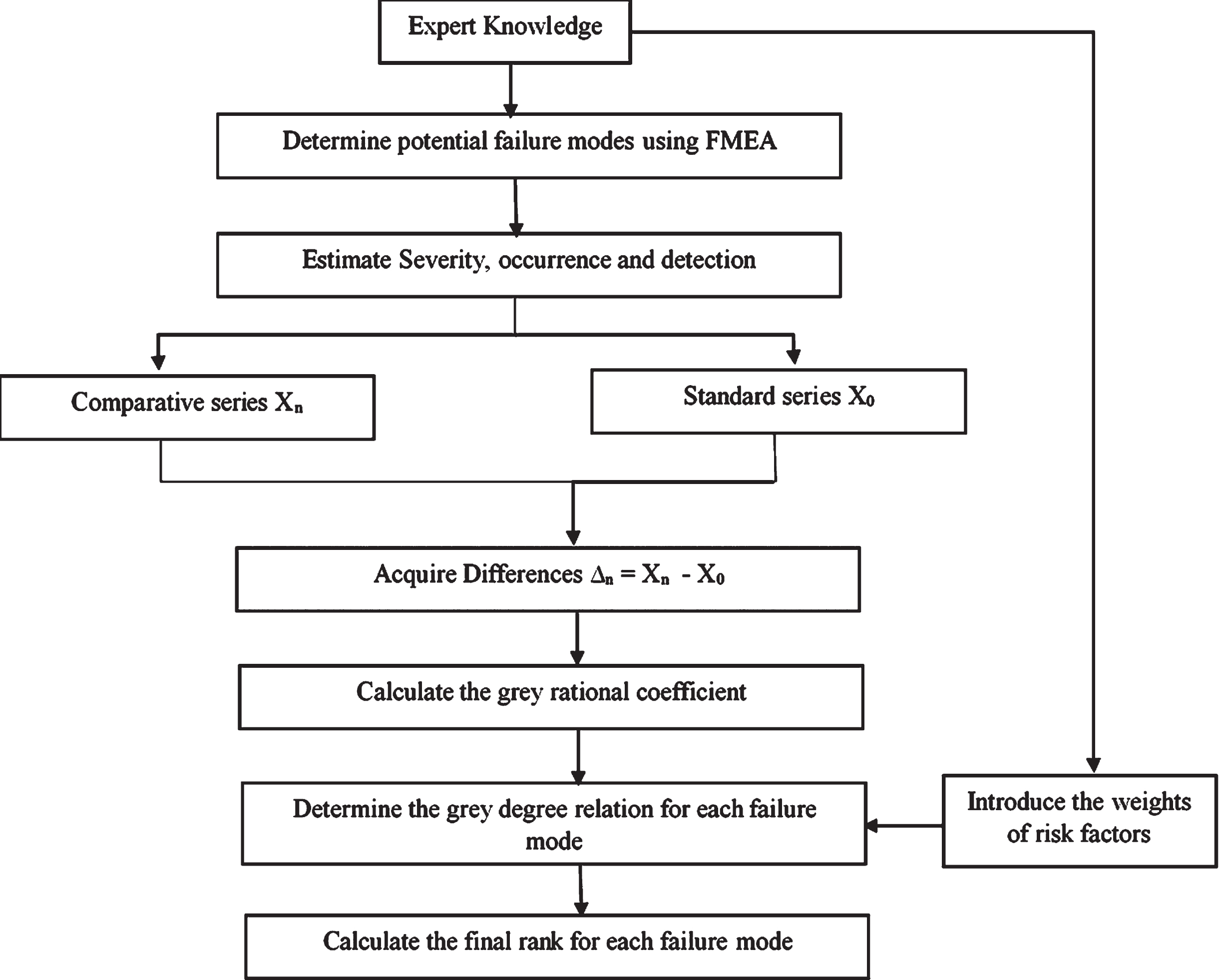
FMEA and grey rational analysis approach.
1. Establish a norm matrix X. It is supposed that n data sequences contain m criteria:
2. Normalize the solution because multi-criteria decision-making problems may include a variety of different criteria. Process of normalization based on the characteristics of three different types of criteria, with nominal the best, smaller the better, and larger the better:
For target is the best, the following formula is used: size812
For the smaller is the better, the formula is given as follows:
For the larget is the better, the formula is given as follows:
3. Establish a reference sequence based on Eqs. 8 to 10 and normalize the data set. The normalized matrix is written as:
4. Establish an absolute value table. Calculations are made to determine how different a normalized entity is from its reference value. The difference is given as Δ0i(j), where
5. Apply the following grey relational equation to determine the grey relational coefficient γ0i(j):
Where
6. Determine the gray relational degree. The degree of similarity or correlation is indicated by the gray relational scale. By finding the average value of the grey relational coefficients, the overall grey relational degree, 0i, is computed using the following formula:
Where w(j) is the weight of the criterion j, and
Failure Modes Identification
In this study, the failure modes for each component of the oil and gas foundation systems are identified by a group of professional experts as described in section 3.1. The expert opinions are collected to estimate the impact of each cause and how severe the process disruption would be if the supporting foundation failed. A 10-point scale was used, with 1 representing low severity and 10 representing high severity. The professionals’ evaluation was used to determine the likelihood that the foundation would fail completely if no corrective action was taken at the stage under consideration. A 10-point scale was used, with 1 indicating unlikely and 10 indicating most likely. Furthermore, a 5-point scale was used to determine the ability to detect failures, with 1 indicating that the failure can be detected easily and 5 indicating that the failure is difficult to be detected.
In this study, professionals’ opinions are collected to evaluate the importance of critical equipment at the oil and gas facility. Then they are translated into the potential inherited negative impact on the operation process as a result of unexpected suspension of the equipment process. Moreover, professionals’ feedback is used to identify probability of progression of deteriorated industrial reinforced concrete foundation. Their responses lead to determine the likelihood of foundation failure. Table 4 demonstrates the systems, failure modes of each system, and input parameters of FMEA.
FMEA application
FMEA application
Risk priority number is computed by multiplication of the three parameters, which are severity, occurrence, and detection using Equation 1. Table 5 shows the RPN for all failure modes. The RPN illustrates the relative significance of failure causes. A high RPN value indicates that the failure cause is of high relative importance and must be improved first. The decision-makers can determine which cause needs to be improved first using the rank of RPN values that results.
RPN of the failure modes
RPN of the failure modes
Based on the occurrence, severity, and detection values of each failure obtained by failure model and effect analysis approach, the grey RPN values are computed by utilizing the grey relational analysis. The first six failure causes are used as an example in this section to summarize the grey relational coefficient calculation procedure. Table 10 shows the grey relational coefficient calculations for all failure causes. The first step in grey relational analysis is to compute the RPN matrix and the difference matrix. These two matrices are constructed using the steps outlined in section 3.4:
Comparison of RPN values and ranking for conventional FMEA, GRA FMEA, and Fuzzy FMEA
Comparison of RPN values and ranking for conventional FMEA, GRA FMEA, and Fuzzy FMEA
Based on the matrix of the diffidence, Δ
min
= 2 and Δ
max
= 10 . in this study, the values of δis0.5 . after that, the coefficients of grey relational are computed using equation 11.
In order to generate the matrix below, grey relational coefficients are used:
Finally, the grey RPN values are calculated for each failure using equation 12. In this study, it is assumed that all the three criteria have the same weight.
Table shows the weight grey RPN of each failure mode.
In addition to the previous two methods, a hybrid fuzzy approach an FMEA is developed through employing practitioners and subject matter expert’s knowledge. in this analysis, the fuzzy system includes three input factors, which are severity, occurrence, and detection. The MATLAB Fuzzy logic toolbox is used to analyze them using well-defined “If –Then” rules. Initially, the membership function is used to construct the fuzzy rule basis. The Fuzzy Interface System can be used to add input variables and membership functions, as shown in Fig. 4.
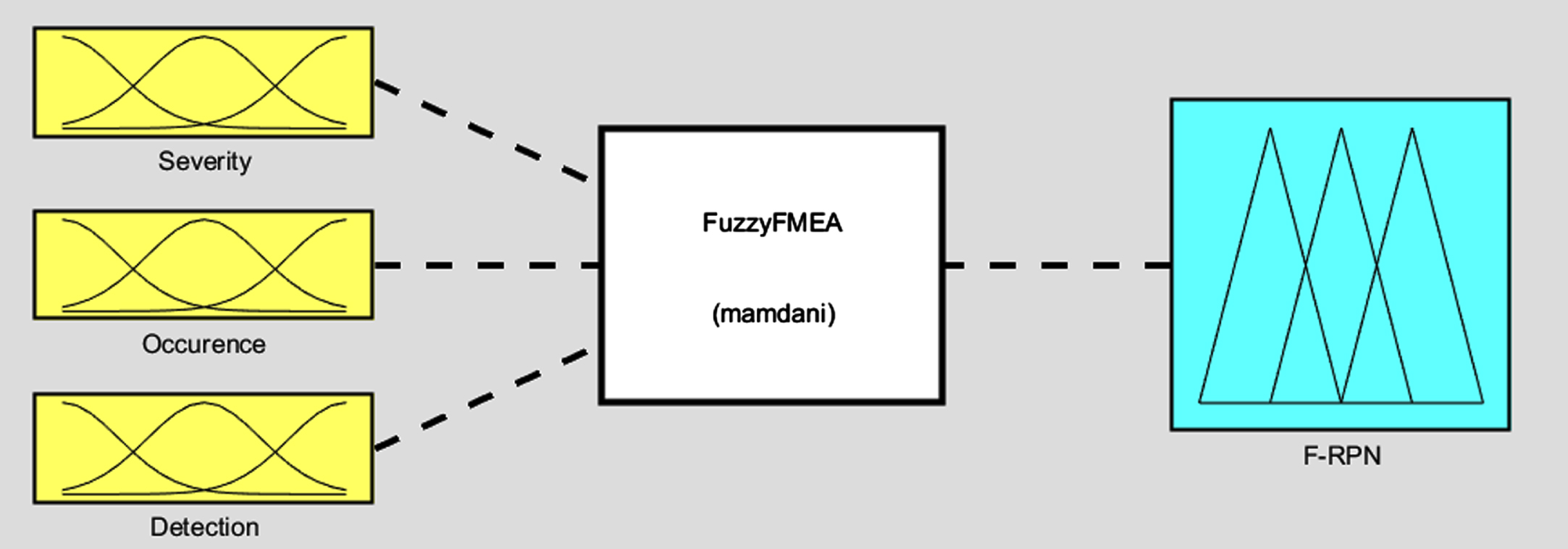
Fuzzy interface system.
The S, O, and D of a failure mode are used as input variables in the analysis, as shown in Fig. 5. The term severity, in general, refers to the hazard/ risk/severity degree of the failing component. Severity ranking is assigned a 10-point scale based on the degree of significance. The severity level is evaluated based on the FMEA specialist’s familiarity and proficiency. The exact failure probability occurring during a given period of time is known as occurrence. This can be calculated using the frequency with which a breakdown occurs. The occurrence level is also assigned on a scale of 1 to 10. The number 10 denotes the larges likelihood of occurrence, while 1 denotes the smallest likelihood of occurrence. In addition, a scale of 1 to 5 is used to estimate detectability. When the failure mode has no active control action, the greatest detectability rating is assigned. These variables are utilized to calculate the risk priority fuzzy RPN. The membership functions of the input parameters and outputs used in fuzzy FMEA approach are presented in Tables 6–9. The fuzzy RPN values outputs are divided into five interval classes, low, moderate, high, critical, and high critical.
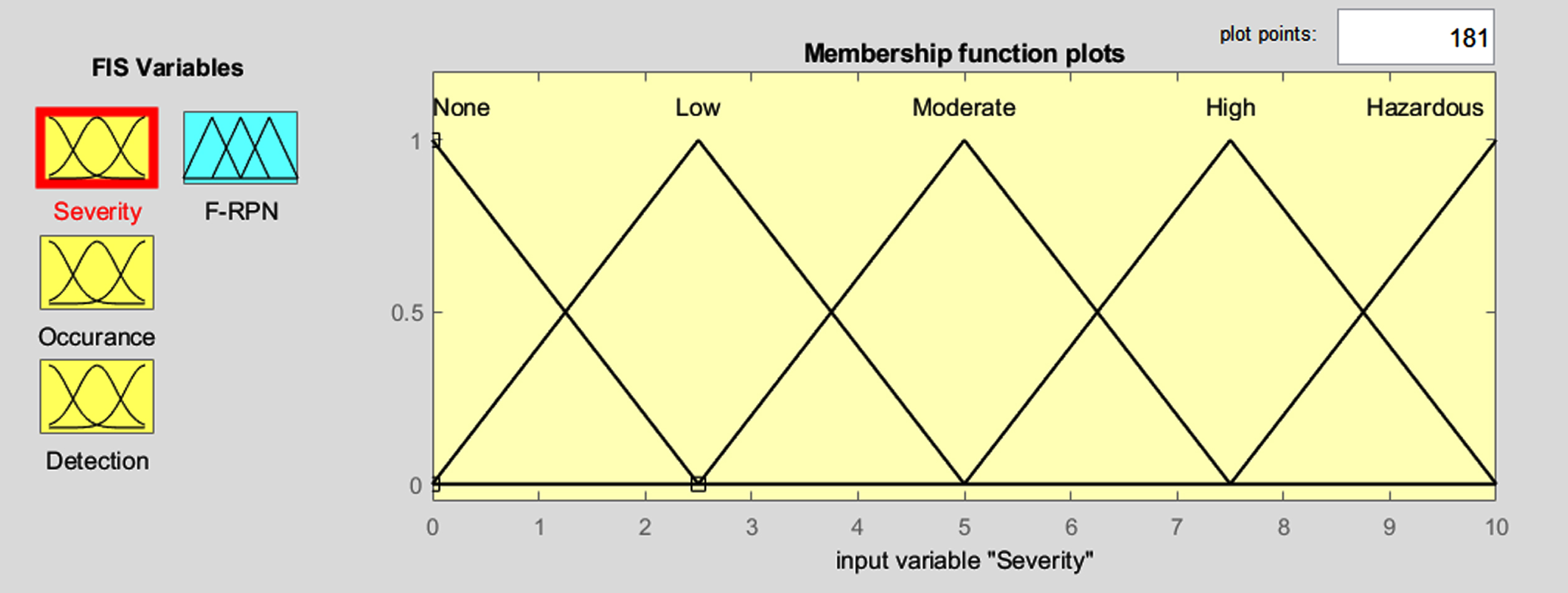
Membership function.
Linguistic variables and severity membership functions
Linguistic variables and occurrence membership functions
Linguistic variables and detection membership functions
Linguistic variables and output membership functions
The fuzzy rules (IF-THEN) are used to assess the generated fuzzy input. Severity, occurrence, and detection are the input variables, with five levels (None, Low, Moderate, High, and Very High/ Hazardous) to generate a combination of 125 fuzzy rules. A sample of these combination is given in Fig. 6.
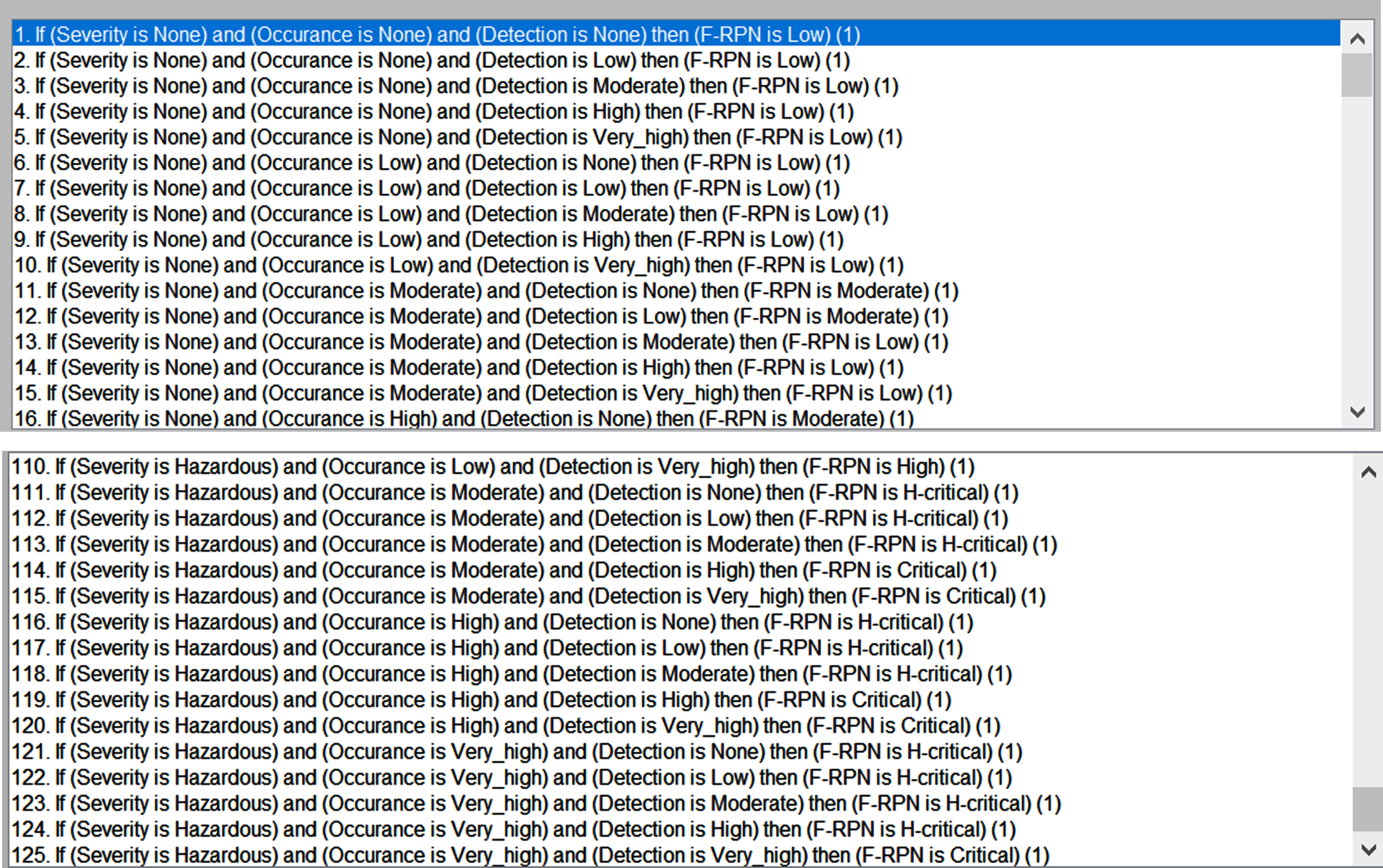
A sample of the MATLAB inference rules.
In this study, fuzzy FMEA is developed to assess the deteriorated concrete structures due to reinforcement corrosion in an onshore oil and gas facility. It is also compared with the conventional FMEA, and a combination of grey rational analysis and FMEA approaches. The findings of the fuzzy FMEA technique, the conventional FMEA, and a hybrid of grey rational analysis and FMEA are illustrated in Table 10. According to Table 10, all equipment reviewed in this study are deemed critical. However, the results indicate that some might be in more critical position than others or their foundations need to be paid closer attention. Based on the average of the conventional RPN, GRA-FMEA RPN and fuzzy RPN values of the three techniques, the most critical systems in oil and gas industry are compression train, steam turbine, and combustion gas turbine generator. In addition, the traditional FMEA and GRA-FMEA failure types of FF5 and FG5 and the fuzzy ranking failure numbers of FA5, FB5, FC5, FC4, FE5, FF5, FG4, FG5, and FH5 are essential at the top failure modes. Since failure modes of FF5 and FG5 are overlapped in both approaches, corrective actions are required. Moreover, the results show that rotating systems foundation such as compression train, steam turbine, and combustion gas turbine generator fall under the high-risk category, followed by spherical separation tank (spheroid), and stripper column.
Based on the results of the comparative study between the RPN values of the three proposed approaches, it is possible to verify that the differences in the results of the models are not significant in the most of failure modes. However, given the minor differences in some failure mode rankings, the proposed fuzzy FMEA technique must be distinguished. The tie that occurs in the RPN value for failure modes with different values of S, O, and D is one of the major limitations of the traditional FMEA. In a traditional FMEA, for example, the failure modes ranking of FA3 and FC1 have the same RPN of 36, despite the diversity in the risk implications of the three failure modes. The referred to draws did not occur in the fuzzy FMEA analysis. The fuzzy RPN values, on the other hand, are comparatively distributed from one another. Because events with various parameters are provided the same priority, the traditional FMEA demonstrates insensitive in the tiebreaker requirement. As a result, it can lead to waste of resources in adaptation and prevention actions, or even cause a high-risk event to go unobserved.
However, there have been some variations in the classification of failure modes based on their priority. The most critical failure types stay the same, but with a changed order of priority. This adjustment in failure mode ranking demonstrates FMEA’s contradictions in the face of the specialists’ actual intention. As a result, traditional FMEA can lead in preventative and corrective measures in failure modes with lower implicit risk, contradicting to the intention to act on those that truly pose a higher risk to the process.
To summarize, maintenance of industrial reinforced concrete foundations is important since its failure would cause undesirable operation disturbance besides potential life and assets losses. Techniques of monitoring and evaluation of the reinforced concrete foundations conditions at the oil and gas industrial facility are sufficient, however, maintenance process and recommendations can be improved. This approach tends to be conservative and keeps the facility in good condition. However, maintenance plans are sometimes required to be rescheduled due to economic reasons. There is always a risk of underestimating the criticality of the reinforced concrete foundation failure when the maintenance plan is rescheduled. In order to avoid this dilemma, the maintenance plans have to be systematically revised with considering possible risks. In this regard, this paper introduced a list of critical systems in the oil and gas industry which might significantly impact the operation process if its foundation was to fail. A risk assessment approach was developed using collective experts and practitioner’s knowledge to determine how critical is the equipment and when its foundation shall not be ignored.
Sensitivity analysis
The sensitivity analysis is performed to evaluate the impact of changing the importance rate of the three parameters (S, O, D). The weights of risk assessment parameters play an important role in the failure model ranking. In the traditional FMEA, the importance rates of these parameters are the same, which is the main disadvantage of traditional FMEA. To overcome this drawback, a hybrid grey rational analysis and FMEA is developed. In the above calculations, it is assumed that the parameters (S, O, D) have the same weight w(j), which is taken the value of 0.333. However, the weight can take any value between 0 and 1, and the summation of all weights must be 1. Table 11 illustrates the sensitivity analysis for changing the importance rates of the three parameters. It is clear that, the first two top ranks of the failure modes when the three parameters have equal weights (wS = 0.333, wO = 0.333, wD = 0.333) is FG5-FF5-FB5- FA5- FC5- FE5- FH5. On the other hand, if the severity has more importance than the occurrence and detection (wS = 0.5, wO = 0.25, wD = 0.25), the first two top ranks of the failure modes is FF5- FG5- FB5. In contrast, if the focus is on the detection (wS = 0.25, wO = 0.25, wD = 0.5), FC2- FG2 have the highest risk. This means that the importance rate of the parameters has a significant impact on the failure modes ranking. This analysis offers a list of failure modes ranks that help the decision makers to prioritize the modes based on the importance of the three input parameters.
Sensitivity analysis
Sensitivity analysis
This paper proposed a hybrid risk assessment approach based on fuzzy and failure model and effect analysis for the risks of different failure modes in oil and gas industry. The approach’s uniqueness originates from its capability to take into account failure modes and the uncertainty of expert assessment. In this work, several critical systems in the oil and gas industry that have a high impact on the reliability of the entire industry have been identified. Then, the FMEA team determined the failure modes that lead to deteriorate these systems. Fuzzy priority risk numbers for ranking risks factors are considered to deal with the uncertainty of expert judgment. Moreover, the proposed approach is compared with traditional FMEA and gray rational analysis FMEA approach. The aim is to identify the critical failure modes and crucial systems on the deteriorated concrete foundations in oil and gas industry.
The findings indicated that the proposed risk assessment approaches are effective to prioritize the risk factors of the identified deteriorated concrete foundations. It also provides insights of the priorities of repair requirements for critical equipment in the industry. The tools proposed in this paper can be implemented by professionals in the oil and gas industry to improve the reinforced concrete foundation maintenance schedule to avoid risks of catastrophic disasters and enhance economic standing. Using the demonstrative application, the following are the most important practical implications of the proposed approach: The treatment of bias caused by hesitancy in risk factor evaluation It deals with a variety of decision-makers of various levels of importance. It is able to deal with group decision-making while taking individual opinions into account. It provides risk assessment solutions in situations where information is limited, insufficient, or uncertain. Proper risk prioritization assists in the development of an efficient and controlled analysis system that is integrated into the maintenance program.
The proposed approach can be used to assess the risk of reinforced concrete structures in a variety of industries, including oil and gas, manufacturing, and other industrial buildings. Although the proposed approach showed its ability for evaluating risk assessment in the oil and gas industry, the model does not address relationship between failure modes and does not validate the relationship between risk factors. In addition, experts in the field are required to accurately implement the proposed risk assessment. The proposed model can be extended to consider the relationship between the risk factors as a future work. It could also include foundations of other systems in the industry such as pipelines and can be extended to cover variety of reinforced concrete structures such as concrete walls. Moreover, a hybrid fuzzy FMEA and multicriteria decision making method might be used to assign weights to risk factors as a future work.
Footnotes
Acknowledgments
The authors gratefully acknowledge the assistance of King Fahd University of Petroleum and Minerals.