



Abstract
In a cloud computing system, resources can be accessed at a minimal cost whenever users raise request needs. The primary goal of cloud computing is to provide cost-efficiency of service scheduling to clients fast while using the least number of resources. Cloud Service Provisioning (CSP) can match consumer needs with minimal use of resources. There are several metaheuristic optimization algorithms have been developed in the field of CSP resource minimization and adequate computing resources are required to ensure client satisfaction. However, it performs poorly under a variety of practical constraints, including a vast amount of user data, smart filtering to boost user search, and slow service delivery. In this regard, propose a Black Widow Optimization (BWO) algorithm that reduces cloud service costs while ensuring that all resources are devoted only to end-user needs. It is a nature-inspired metaheuristic algorithm that involved a multi-criterion correlation that is used to identify the relationship between user requirements and available services and thereby, it is defined as an MS-BWO algorithm. Thus finds the most efficient virtual space allocation in a cloud environment. It uses a service provisioning dataset with metrics like energy usage, bandwidth utilization rate, computational cost, and memory consumption. In terms of data performance, the proposed MS-BWO outperforms exceed than other existing state-of-art-algorithms including Work-load aware Autonomic Resource Management Scheme(WARMS), Fuzzy Clustering Load balancer(FCL), Agent-based Automated Service Composition (A2SC) and Load Balancing Resource Clustering (LBRC), and an autonomic approach for resource provisioning (AARP)
Keywords
Introduction
Cloud service providers employs a variety of techniques to optimize the cloud resource for improving the cloud user accessibility for requested service. However, they are limited by the higher price and consumption of resources. Therefore, having sufficient computing resources is essential for big data processing, several methods have been required by the cloud service providers to meet the needs of their client. To fulfil incoming client requests, Minimum-Provisioning-Cost (MPC) resource provisioning is used. This method overlooks vital resources, such as VM space capacity, when providing cloud services for big data required by cloud customers [22, 37]. Self-provisioning cloud service resources have been outlined to decrease network latency, improve network sustainability, enhance path connection, and cut costs. The problem is that it doesn’t consider every possible way to enhance the circulation of resource funds [7]. Genetic algorithms [8] (GAs) are used to create cost-aware service request scheduling (CSRS) for the cloud. The emphasis is on catering individually to each user who makes a legitimate service request. On the other hand, as the number of valid user requests grows, the complexity of the system rises because of the increased exhaustive search.To address this issue, an optimization algorithm known as Particle Swarm Optimization(PSO) techniques [26, 30] for cloud resource selection is introduced. Particles explore the problem space in search of an optimal or near-optimal solution. Makespan, Flowtime, and task execution cost are all minimized by the algorithms. However, it was unable to find a solution for global optimization [36].
An effective prediction system, especially useful in the massive data centers that provide cloud-computing services, makes use of the cloud’s infrastructure, which features adaptive resource consumption. Further, improvement of managing a resource allocation is reached by using Autoregressive Neural Networks (AR-NNs) in the prediction system [4]. Augmented Shuffled Frog Leaping (ASFL)-based technique simplifies cloud resource provisioning and process structure used for validation purposes, it simply considers the cloud-computing energy-efficiency, security, and scheduling cost. Due to limited overheads, easier and faster deployment, and higher portability, containers are widely used in cloud architectures [17]. The term "Automated Service Composition" (A2SC) is used to explain how to keep virtual machine costs low while maintaining service. An improved optimal solution can be reached in a reasonable amount of time, reducing the risk of task failure, and increasing reliability. However, it cannot ensure the availability of the necessary resources to deliver the services in a cloud environment [38].
Revenue maximization is a technique introduced in the later period to facilitate the provision of multiple services in a cloud infrastructure. It runs heterogeneous, realistic, and synthetic workloads in a simulated environment and simulates energy-efficient monolithic and parallel-scheduling models [17]. This algorithm for scheduling uses 20% less power while increasing processing speed by 8%. Nevertheless, it was not able to provide the services at the lowest computational cost by combination method includes PSO [29] and Simulated Annealing (SA). In order to schedule multiple objectives at once, cloud computing makes use of a modified version of the bat algorithm and makes its resources available on-demand[?]. The method is effective because it optimizes resource utilization, service quality, performance, and the user experience. Individually, offered more effective on provision cloud computing resources [34]. The cost and memory space of the various services were not considered. Therefore, optimized cloud resource provisioning (OCRP) helps cloud computing systems achieve the lowest cost of service possible [9]. The storage capacity could not be reduced enough using this approach. Similarly, Load Balancing Resource Clustering (LBRC) is presented to effective utilization of the resource through cluster formation where each cluster center is clustered optimally, the meta-heuristic Bat-algorithm can be used to achieve faster convergence [1]. Additionally, it includes a new dynamic task assignment policy to ensure the shortest possible makespan and execution cost [13].
The lack of resource optimization, high computational cost, VMs memory capacity, and other errors arise during resource optimization.Though there are several algorithms available [12, 33], a natural-inspired optimization technique provides a reasonable better outperformer that could tackle the above-mentioned problems [10]. Therefore, in this paper, Nature-inspired Metaheuristic Search Black Widow Optimization (MS-BWO) algorithm is presented which reduces the cost of cloud computing services and normalized resource allocation. MS-BWO’s primary goal is to provide cloud customers with a wide range of services while consuming a low number of resources. CSP is a two-step process that maximizes resource use. When a user makes a request, a multi-criterion cloud server matches them up with the services that are available in the cloud. End-user services are identified by the correlation. Multi-criteria black widow optimization is developed to ensure that requested services are delivered to customers quickly.
The main contribution of the paper is summarized as follows: To identify the relationship between user requirements and accessible services using the multi-criterion correlation principle. Also on the cloud, a metaheuristic search black widow optimization algorithm determines the most efficient cloud virtual machine. Securing the user’s requested cloud services for big data processing through a virtual machine with minimal resource and computational cost use.
The outlining of the paper structure as a follow-up: Section 2 examines related efforts to address the problems of cloud computing. Section 3 provides an architectural and flow schematic of the MS-BWO technique. Section 4 provides a brief overview of multi-criteria correlation metrics and nature-inspired metaheuristic optimization algorithms. For the proposed MS-BWO method, the performance evaluation is presented in Section 5. Section 6 sums up the study’s findings and suggests further research avenues.
Related Works
In this section, cloud computing consumption models such as Software as a Service (SAAS), Infrastructure as a Service (IAAS), and Platform as a Service (PAAS) are organized hierarchically [20], including resource cost-efficient algorithm, cloud computing task scheduling algorithms and an optimization algorithm of round-robin resource allocation mechanism for a better understanding of the proposed MS-BWO method’s progression.
Resource cost-efficient algorithms
For every properly governed client service request, server resources will respond to data requests from external clients via storage and server datasets. Cloud computing has potential applications in many different areas, but it also faces unique challenges in each of these settings. Applications that are time- and location-sensitive pose a special threat to IoT devices [19, 28]. Quality of service (QoS) over target times is typically found to be faster at some point during an E-health credential restore [15, 24]. As a means of reducing the computational complexity of cloud computing and, by extension, the energy and cost required to run it, a new clonal selection strategy is introduced [31]. The simulator for cloud optimization of resources and energy (SCORE) tool [6] can be used to determine how efficiently cloud resources are being used. To make the best use of both public and private computing resources within the constraints of time and money, we discuss an ant colony optimization-based multi-objective scheduling (ACO-MOS) approach [21]. However, other resources such as memory or bandwidth are ignored.
Task scheduling algorithms
Cloud delivery cost per user service is significantly increases to proliferate to meet user needs. The cloud’s complex infrastructure requires efficient resource management and periodic monitoring. Thus, it can provide hardware and on-demand apps over web networks. Task scheduling improves cloud performance by reducing resource use and allocating tasks efficiently. Multi-cloud SLA-based task scheduling achieves efficient resource allocation consider for both the cloud vendor and user [13, 37]. It is kind of a hybrid method for initializing PSO particles instead of randomly. This strategy can minimize cloud user task execution time and maximize cloud provider resource usage. Results are quite impressive as compared on standard PSO and other heuristic PSO initialization approaches to reduce makespan, execution time, waiting time, and virtual machine imbalance. Subsequentially, studies on multi-tenancy scheduling on cloud platforms to determine the primary Graphics Processing Units (GPUs) scheduling approaches used and addressing key multi-tenancy scheduling issues such as cloud computing, quality of service, and cloud storage [14, 33]. For an effective computing paradigm needs to be benefits modern IoT frameworks supporting dynamic changes of cloud resource of different tasks require different cloud allocations may cause load and power imbalances, affecting cloud based IoT resource utilization and task scheduling. A hybrid bio-inspired algorithm finds discrete and continuous solutions from multiple sources. Thus, it effectively schedules tasks in 2.18-second average response time and 3.6-second average waiting time, respectively [16, 24]. Cloud computing’s on-demand provisioning and resource availability are ideal for scientific workflows. Based on the demand on apps, an Augmented Shuffled Frog Leaping Algorithm (ASFLA)-based technique for resource provisioning and workflow scheduling in IaaS cloud environments. It uses a custom Java-based simulator for testing ASFLA’s efficiency by varying the sizes. The simulation results improve minimum execution cost and schedule deadlines [17, 21]. Dynamic voltage-enabled energy-efficient workflow task scheduling (DV-EWTS) can be used to solve the problem of critical spare time after integrating numerous servers. The heterogeneous-earliest-finish-time (HEFT) algorithm is used to determine the initial scheduling order for all activities. Tasks can be distributed across lower voltage and frequency slots using the DV-EWTS to allow the makespan to be extended [34]. In comparison to traditional virtualization, the container system was introduced in 2013 for sorting out computer resources quickly. Thus, a general-purpose scheduling framework enables cloud service providers or researchers to organize resources more effectively [35].
Cloud optimization algorithms
To benefit cloud providers who use the most resources while keeping costs low, a multi-objective cuckoo search optimization (MOCSO) algorithm is presented that reduces the time it takes to make decisions. Because of its low production time and low resource requirements, it is well-suited for use in the cloud [18]. Using the cuckoo search algorithm in tandem with meta-heuristic and optimization strategies yielded positive results in cloud computing. The cuckoo-search algorithm is employed to cut back on the time and energy spent on computation. Due to its success in cloud computing, which relies heavily on optimization and meta-heuristics, the provision of cuckoo-search services requires a larger investment of time and money. Shorter wait times for customer support are achieved through a modified round-robin resource allocation mechanism [25]. There was no link discovered between consumer needs and provided services using this method. Using fitness constraints, cloud tasks can be scheduled using the whale optimization algorithm (WOA). Energy, resource effectiveness, and service quality have all been included. Task implementation time and cost on virtual machines are negligible because the scheduled task is contingent on the three constraints. A higher quality of service guarantees a more efficient system and a more logical scheduling of tasks [30]. It was proposed [16] that a hybrid approach using elite-based differential evolution could help with the difficulties of multi-objective work scheduling in cloud computing systems (EDE). It was implemented to broaden exploration possibilities and prevent getting stuck in local optimum solutions. The presented method has been refined to increase its time commitment. The best solution accuracy, algorithm convergence capabilities, and cloud computing performance can all be increased with the help of multi-objective optimization [3], which is based on enhanced particle swarm. The issue of multi-objective optimization has been addressed by the development of a new algorithm. Stochastic optimization of cloud virtual machine and network resource allocation is now complete [2]. If this option had been taken, time and money could have been spared during the process of setting up cloud services. Hadoop Map Reduce now employs cutting-edge methods for determining the optimal allocation of resources for individual tasks [14]. To provide the required application service to customers, it is necessary to manage the load balancing across multiple VMs. Using fuzzy logic and the K-means clustering scheme, manage load balancing across multiple VMs to provide the customer application service. It simply optimizes the selection of VMs from available cloud resources for scheduled service cost. However, it failed to assign multiple service requests from different customers, reducing performance redundancy [11]. In order to provide the application service requested by the customer while utilizing grey wolf optimization in a cloud environment, it is necessary to manage the load balancing on multiple VMs. It is as simple as optimizing the computational speed and convergence rate of the VMs to reduce the cost of providing scheduled services using the resources that are available in the cloud. On the other hand, it was unable to assign multiple service requests from multiple customers, which decreased the resource efficiency and increased the cost [5].
Using the methodologies discussed above, it is difficult to achieve resource-optimized service provisioning in the cloud. The MS-BWO approach is utilized to overcome these cloud-related issues and obstacles.
Motivation
Effective decision-making processes over metaheuristic cloud space finding search for user requests are necessitated by the virtual space allocation in a cloud environment, which has a major effect on big data resource allocation. A user can be expected to seek out more storage space in the cloud as their big data population expands. A user’s allotment of cloud storage can be increased as necessary without negatively impacting the service’s efficiency. Trying to keep up with the current level of user demand is incredibly difficult. If the current user requests an increase in the utility space, an efficient pre-task service scheduling is initiated to deal with the problem by finding alternative cloud space for the neighbouring big data of others.
Research gaps identified
The research gap has been identified to include different perspectives on the cloud resource allocation problem to improve cloud base service request accessibility by cloud users. To effectively allocate resources considering big data factors like volume, value, and veracity over cloud space utilisation, an MS-BWO algorithm should be introduced. It does adequately support maintaining a consistent storage footprint across disparate types of big data.
Problem formulation
Table 1 displays list of notations and its definition helps to understand variables and terms for future use.
List of Notations
List of Notations
Consider the state vector of all participating virtual machine (VM) in the scene present is taken as VM p , which includes VM mapping state VM m ap, and VM observing state VM o bs, respectively. Therefore, it is typically written as VM p = (VM m ap, VM o bs). Finding the optimal distribution of cloud-based virtual space, denoted by S v , is the mission at hand. The pattern of interactive service allocation is observed, and pre-task scheduling information is provided for each service that has been requested from the acquired database. The allocation pattern for interactive services is determined by a combination of factors, which is given in equation (1).
If an interactive service request is raised from a user I
req
, and an available resource in a cloud server R
av
. This is achieved by deciphering the shared distribution resulting from the occurrence of a request and the allocation of a given resource. Therefore, the computational complexity of providing access to a distributed service is reduced. The prediction of the marginal service is as follows if the interaction service is not performed:
In the presence of an interactive service request operation, as shown by equation (2), the condition correction terms exist. Even if there are multiple interactive service requests involved in the scene’s trajectory, the looping terms are included in equation(3). Because of the interplay between user requests and cloud services, the marginal and conditional distributions are computed and identify the relation probability together.
Where, M represents the total number of service requests. Considering a set of influencers in a cloud-based virtual space
This section describes the operational flow of the proposed MS-BWO system architecture, in which the user requesting service is handled appropriately by evaluating multi-criterion correlation metrics and the optimal resource management criterion. Each individual criterion’s mathematical description is discussed in detail below.
System model
CSPs in distributed cloud computing infrastructures provide a great deal of flexibility to Internet-based services that are tailored to match the needs of the customer. Whatever the cost of resource consumption mandatory service provisioning in the cloud is a huge concern since it involves everything from power usage to memory consumption to network bandwidth. The cloud server is configured to utilize as minimal resources as possible to provide the user with a variety of services. Figure 1 depicts the MS-BWO architecture, a cloud resource and cost optimization technique based on customer service demand requests. In order to provide more services to its clients, CSP can use fewer resources by providing a variety of services via a cloud server (CS) by accepting access requests from many different users denoted as U i = {U1, U2, …, U n } where, i=1,2,...,n. The MS-BWO method compares the quantity of services requested by consumers with the number of services already offered by a cloud server. As an illustration, consider the case of a service request with a resource criterion Ureq(i) = {Ureq(1), Ureq(2), …, Ureq(n)}.

Architecture diagram of proposed MS-BWO.
When a user’s needs are correlated, they are identified. The best resources for delivering the required services to the user are then determined. The basic task of container-based scheduling is to construct different containers for different tasks. The task scheduler is responsible for capturing specified data and always accepting server resource availability. This helps determine the appropriate server for storing the chosen containers. The task schedule oversees auto-scaling servers based on resource availability and task arrival rate in the cloud data center. The cloud environment includes service providers and users’ infrastructures. When more requests for similar resources reach the cloud, there is a resource deficit, and the issue is contemplating resource allocation to users. Each virtual machine has its own specifications, such as memory, cost, and task size. The MS-BWO method is described in detail in the sections that follow.
When it comes to determining the availability of cloud services, BM-BWO is a key factor. In a cloud context, it uses a multi-criterion correlation metric to match the user’s requested service to the available resources. Service quality and accessibility are examples of factors that can be correlated using this method. Furthermore, the two variables’ link is quantified using more than one criterion in its analysis. Correlation is a typical approach that assesses the cost of bandwidth and memory. The user first sends a series of queries to the cloud server, each with a unique identifier. As far as the cloud server is concerned, users’ requests for additional bandwidth, memory, and other resources are considered. Energy utilization is the amount of electricity a virtual machine uses to provide services to a certain user at a given time. The formula for calculating energy is given in equation (4)
When computing the total amount of power required to deliver the services, utilize P
s
(Ureq(n)) and T
s
be the delivery time. In the first step, the bandwidth is calculated based on a communication path’s average request transfer rate. Measurement is carried out in Bps (bits per second) (5).
Second, when a customer requests a cloud service, the virtual machine’s memory consumption is the total amount of storage space it takes to provide the service. The units of measurement are megabytes (MB). Third, the amount of time it takes for the cloud server to respond to a user’s request is an important aspect. An evaluation is done using Eqn. (6) to guarantee that the user is looking for services that use as little of these resources as possible.
A correlation coefficient lies in the interval of γ ∈ (-1, + 1) used to represent the ‘n’ number of cloud services, and the set of available cloud services for big data processing denoted as S a . Thus, the server can identify the relationship between user requests and the available resources to speed up the process of responding to them. As you can see, the MCM evaluation is laid out in the following manner.
Multi-criterion correlation metrics
1: Input: Number of user requests Ureq(1), Ureq(2), …, Ureq(n-1), Ureq(n)
2: Output: Identify the services that are requested by the user
3:
4:
5: Perfect matches exist between user request and service
6:
7: Irregular matches infer with respect to user request and service
8:
9: The service does not have the capacity to handle user requests.
10:
11:
12: end
The correlation coefficient (γ) yields three different outcomes when used. In other words, there is a one-to-one correlation between the requested and provided services. This means that if the user’s request and the services are perfectly aligned, the condition is denoted as γ = +1. Thereby, Positive correlation is the term used to describe it. Otherwise, the correlation is negative, with γ = -1. Consequently, response times to user requests are reduced.
To provide optimal user services, VMs are optimized after determining the user’s needs using the multi-criteria correlation metrics. The proposed MS-BWO technique allows the cloud server to provide efficient services with minimal energy, bandwidth, memory, and computational costs. Thus, optimization of cloud servers is based on humpback black spider hunting behavior. Hence, it replicates characteristics when the spider looks for prey and swirls around it, crossing seven important stages namely recognition, orientation, approach, grasp, envenomation, prey paralysis, and final digestion.
Each stage encrusted with a unique characterize function is taken place which is clearly shown in Fig. 2. Multitask scheduling has a significant impact on the scheduling algorithm’s performance in terms of execution time and cost. As a result of the MS-BWO technique, many user arrival requests are effectively answered by making the virtual machine and task execution optimally useful. Consider a specific number of virtual machines (VM1, VM2, . . . , VM m ) in order to explain this function. Users’ requests for services are treated as prey by a CSP, which then provides cloud computing as a service through the usage of a VM. To find the best VM option for supplying user-requested services, we followed the siblings of the user’s most often used path with the least number of resources allocated.

Nature-inspired Metaheuristic Search Black Widow Optimization (MS-BWO) technique.
Figure 2 depicts the influence of MCM on MS-BWO flow that was inspired by nature. It finds the most efficient virtual machines for users. For the user service request assignation problem, the black spider’s nature-inspiring phenomime is considered as a variable row vector, indicated as 1 × R var . Variable vector quantity is then used to determine the windows of the available virtual machine’s establishment which is given in equation (7).
The number of VMs started has a direct impact on the fitness condition (FC), which is displayed in a window with floating integer values. Then, it is expressed as in equation (8).
Initializing the spider population creates a candidate widow matrix of size R var × R pop , which is then used to begin the optimization process. The reproductive stage is then carried out via mating, in which the female spider eats the male one after completing the mating process.
Given that the pairings are self-contained, they begin to mate with the aim of spawning a new generation. Although each pairing produces thousands of eggs, the number of muscular spider infants remains constant. In the MS-BWO algorithm, the term (β) refers to the arbitrary numbers of windows array, and then offspring are made by using the equation (9), where M bs and F bs represent the parents, and S1 and S2 represent the offspring.
Where
Nature-inspired Metaheuristic Search Black Widow Optimization (MS-BWO)
1: Input: Number of user requests Ureq(1), Ureq(2), …, Ureq(n) (i.e., prey), Virtual machines VM1, VM2, …, VM m (i.e., black spider)
2: Output: Select resource-efficient virtual machines for user requests
3:
4: Set A, B, R var , R m r , r, s
5:
6: Compute VM window
7:
8: Calculate the current best solution’s fitness condition using ((7))
9:
10: β < 1
11: Update the position to pick the offspring’s utilizing ((10))
12:
13: Allow a black spider at random X r (j)
14: The current best offspring growth is updated ((14))
15:
16:
17: M bs is still alive, updating the current best solution ((12))
18:
19: Repeat till max iteration is reached.
20: Obtain the greatest service solution.
21:
22:
23: Perform a new cannibal operation executed
24: Compute mutation rate
25: Update optimal service solution
26: k = k + 1
27:
28: Assign R0 = 0
29:
30: R = R0 + 1
31:
32:
33: end
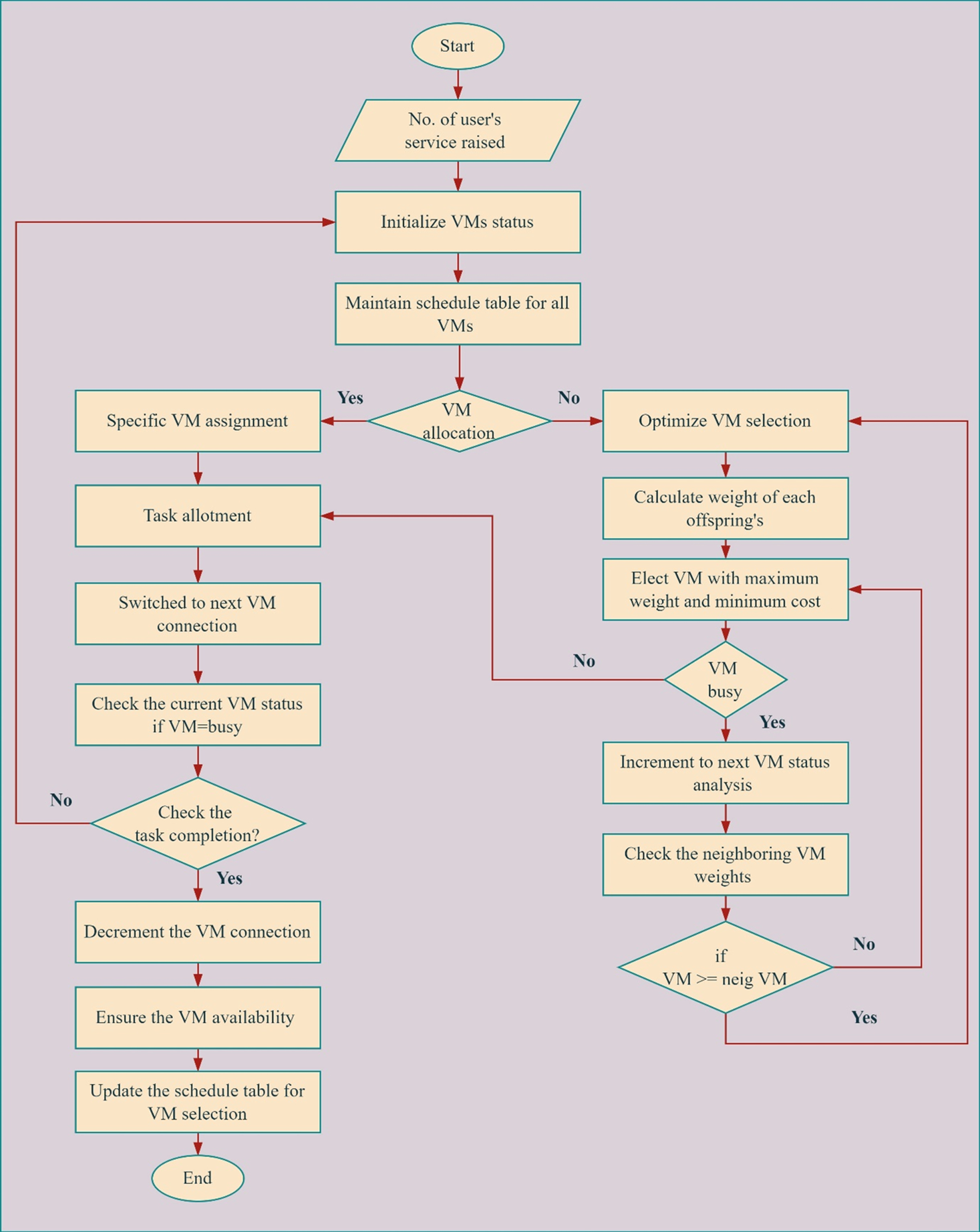
The Proposed MS-BWO algorithm flowchart for optimizing resource and computational cost.
Based on user demands, the aforementioned algorithm 2 selects the most efficient virtual machine from a pool of available virtual machines. The black-spider numerals (VM) are first set up. When the fitness level is established, the best ideal virtual machine is selected. Position update behavior results in initializing the most optimal black spider. There’s a better black-spider position now, thus the best solution gets selected. To choose a black spider, the location is changed if the likelihood is larger than 0.5. To find the best solution, this process is performed many times. In the end, a resource-optimized virtual computer is the most ideal alternative. According to the proposed model, 0.5 is maintained in terms of likelihood for sufficient optimization. To maintain this condition, the proposed MS-BWO algorithm defines four optimistic points that direct resource allocation based on the service requested by the user. If it exceeds 0.5, the system’s performance for resource allocation in big data processing is suffered. Afterward, the service provider offers the needed cloud services for big data processing using the virtual machine’s optimized resources. The proposed MS-BWO technique algorithm is summarized as a flowchart 3, which is more effective since it makes better use of cloud resources.
In this section, we analyze the performance of the proposed MS-BWO technique by assessing several QoS metrics such as energy consumption, bandwidth utilization rate, computational cost, memory consumption, and resource utilization efficiency. We investigate the proposed MS-BWO further by contrasting it with other state-of-art algorithms already in existence, including WARMS [5], FCL [11], A2SC [38], LBRC [1], and AARP [7], respectively.
Experimental Setup
To evaluate the efficiency of the proposed MS-BWO algorithm,the simulation parameters are presented in Table 2. 100 IoT devices performing numerous activities of size (100000 at maximum extent) are equivalent to 3000 MIPS and 512 MB of processing and memory capacity. Long-term communication is adequate to separate cloud access and data storage server memory data in the cloud space of the speed range of 2 to 5 Mbps correspondingly, in the cloud environment. Using the Java programming language and the cloudsim simulator, an experimental evaluation of the proposed MS-BWO technique has been implemented. In addition, resource-efficient service delivery through the utilization of personal cloud datasets (http://cloudspaces.eu/results/datasets).
Simulation parameters
Simulation parameters
The proposed MS-BWO algorithm is tested on five simulated datasets namely (DS1, DS2, DS3, DS4, DS5) of varying number of user requests which can be trace out by Google trace log dataset. It’s a data set containing the log entries for six different Google compute clusters over the course of five days. Table 3 shows the number of user service requests can be analyzed, and the best VMs for carrying out those services’ respective tasks can be assigned and displays the costs of the various VM instances hosted on each server, as well as the varying individual sever CPU capacity and RAM size of each VM instance. The tasks’ sizes, expressed in Millions of Instructions (MI), are generated arbitrarily during runtime for experimental purposes. Ten servers with varying loads and capacities are used in this experiment. Task separation and the allocation of available resources identifying the numerical limits of each cluster and categorizing tasks based on how much of a given resource is used. The five created synthetic datasets generating the energy consumption and computing time for the operating devices (containers and VM instances). The MS-BWO algorithm’s two key parameters are and, with anticipated values of 0.2, 0.4, 0.6, 0.8, and 1.0. In the experiment, the population size is [0, 100], and the population values are chosen at random from 20, 40, 60, 80, and 100. An empirical test is used to fix the parameter values. The suggested technique is performed for 100 iterations with each parameter set to a fixed value, recording the
Simulation parameters
Where Euclidean distance between previous and present best solutions are denoted as
This dataset is utilized in the process of active personal cloud measurement, and it accepts two arguments, which are a provider and test type respectively. The script runs the respective files, which are referred to as load-and- transfer and service-variability, depending on the type of test being conducted. The term "service variability" refers to differences in the quality of services of a similar nature that are provided by various virtual machines. For carrying out resource optimal service delivery, certain measurement traces are obtained through the utilization of personal cloud datasets. To account for service unpredictability, the dataset contains 20 columns of field information. During the process of executing resource-optimized service provisioning, out of a total of 17, only a few columns out of the field’s multiple columns are used.
The results of the performance metric evaluation as seen in the following sub-sections, which displays the cloud services big data processing that were requested by users. Consider user request (services) range between 10 and 100 for the simulation purpose.
Effect of energy consumption
In computing, the task’s energy consumption is determined by the amount of energy needed by the forwarding channel and the computing server’s resources.
The level of energy consumption is determined based on the required services of the cloud user using equation (4). Existing approaches such as WARMS [5], FCL [11], AARP [7], A2SC [38], and LBRC [1], respectively, are shown to consume significantly more power than the proposed MS-BWO method, which, as can be shown in Figure 4a, saves a significant amount of energy while delivering a variety of cloud services. There are ten runs, each with a different set of user requirements. After every 10 iterations, the energy consumption of the proposed MS-BWO methodology is significantly reduced when compared to that of other methods. According to the findings, the MS-BWO technique is superior to WARMS [5], FCL [11], AARP [7], A2SC [38], and LBRC [1] in terms of its ability to cut overall energy consumption by 42%, 39%, 37%, 33.5%, and 29.5% percentages respectively.
Effect of bandwidth utilization rate
A virtual machine’s bandwidth utilization rate (BUR) is the percentage of total available bandwidth that the machine is using to deliver requested services to its customers. Measurement of bandwidth utilization (B
ur
) is done as per equation (19).:
The results of utilizing the bandwidth are displayed in Figure 4b. The proposed MS-BWO approach uses less bandwidth than the other methods, such as WARMS [5], FCL [11], AARP [7], A2SC [38], and LBRC [1], respectively, when applied in a cloud environment. This is the case. The user makes a number of queries to the server that is hosted in the cloud. The CSP offers services that require a relatively little amount of bandwidth. Within this context, black spider optimization chooses a virtual machine with optimal bandwidth. During optimization, the bandwidth consumption of a single virtual machine is broken down to determine the optimal setting. After that, it looks for the most effective response to the user’s problem. When there are 100 user requests being processed, the virtual machine consumes 36 percent of the available bandwidth. According to WARMS [5], FCL [11], AARP [7], A2SC [38], and LBRC [1], the percentage of bandwidth that is being utilized is, respectively, 56%, 47%, and 45%. When compared to AARP [7], A2SC [38], and LBRC [1], the suggested MS-BWO method has been shown to reduce bandwidth utilization rate by 38.2%, 35.4%, 33.5%, 27.5%, and 25% percentages respectively, after every iteration.
In computing cost, the length of time it takes for a virtual machine to provide a service to the user is quantified [8]. The following equation (20) is used to calculate the computing cost.
Figure 4c illustrates the relationship between the number of user requests and the cost of the calculations (i.e., services). Assume that the consumer requested anything between 10 and 100 different services. The total number of individuals who make service requests to a cloud server. The CSP delivers services on-demand that are determined by the available resources. The necessary data can be determined by using the correlation metric. The MS-BWO technique that has been proposed finds the connection between user requests and the services that are offered. As a result, it shortens the amount of time it takes for the cloud server to respond. After determining which services were requested by the user, the MS-BWO chooses a VM that can provide a quicker response. The chosen virtual machine (VM) makes the services readily available to end-users. As a result, the MS-BWO technique requires far less computational effort than other methods. The computational cost of responding to one hundred user requests takes ten milliseconds while using WARMS [5], FCL [11], AARP [7], A2SC [38], and LBRC [1], respectively. The remaining 9 cycles are used to obtain the average results of the comparison. When compared to WARMS [5], FCL [11], AAARP [7], A2SC [38], and LBRC [1], the suggested MS-BWO technique has a computational cost that is reduced by 48.2%, 45.7%, 43%, 37.6%, and 30.4% respectively.
It is defined as storage space a virtual machine use in order to provide services for its users. Megabytes (MB) is the unit of measurement, and it is expressed as in equation (21).
Memory utilization is compared to the services that users have requested in Figure 4d. When compared to WARMS [5], FCL [11], AARP [7], A2SC [38], and LBRC [1], it is abundantly obvious that the suggested MS-BWO approach has a lower impact on memory consumption performance. Due to the fact that MS-BWO chooses the virtual machine (VM) in the population that uses the least amount of memory. Therefore, the virtual machine (VM) that requires the least amount of storage space is selected to provide the services that the user has requested. Take into consideration 100 user requests, 12 MB of storage for the MS-BWO technique, 43MB, 41MB, 39 MB, 32 MB, and 28 MB respectively for the WARMS [5], FCL [11], AARP [7], A2SC [38], and LBRC [1] techniques respectively. When deploying cloud services, this should be kept in mind. When compared to WARMS [5], FCL [11], AARP [7], A2SC [38], and LBRC [1], the MS-BWO approach requires 35% fewer bytes of storage space, 32% fewer bytes of storage space, and 27% fewer bytes of storage space, respectively.
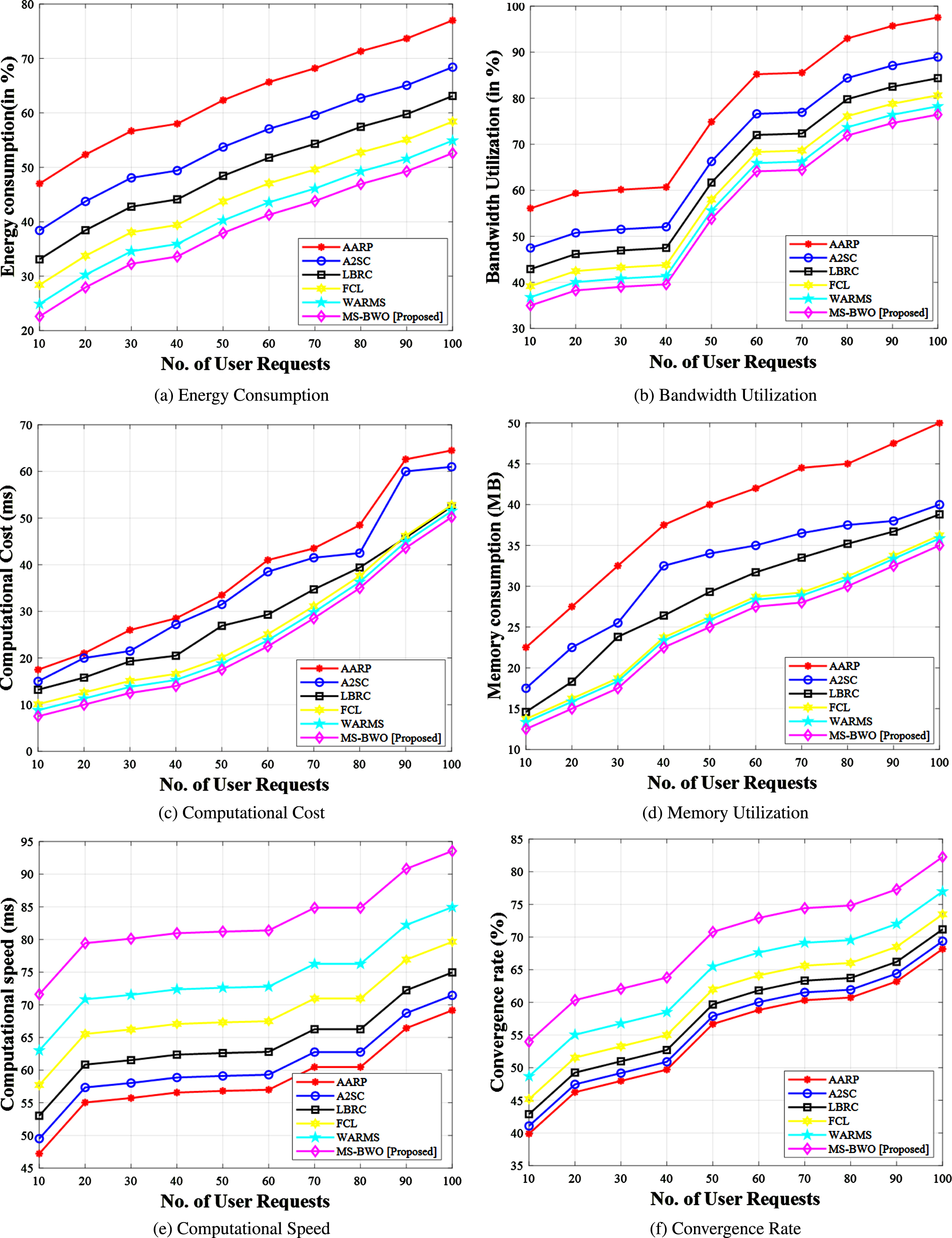
Comparative analysis of Cloud service optimization factors.
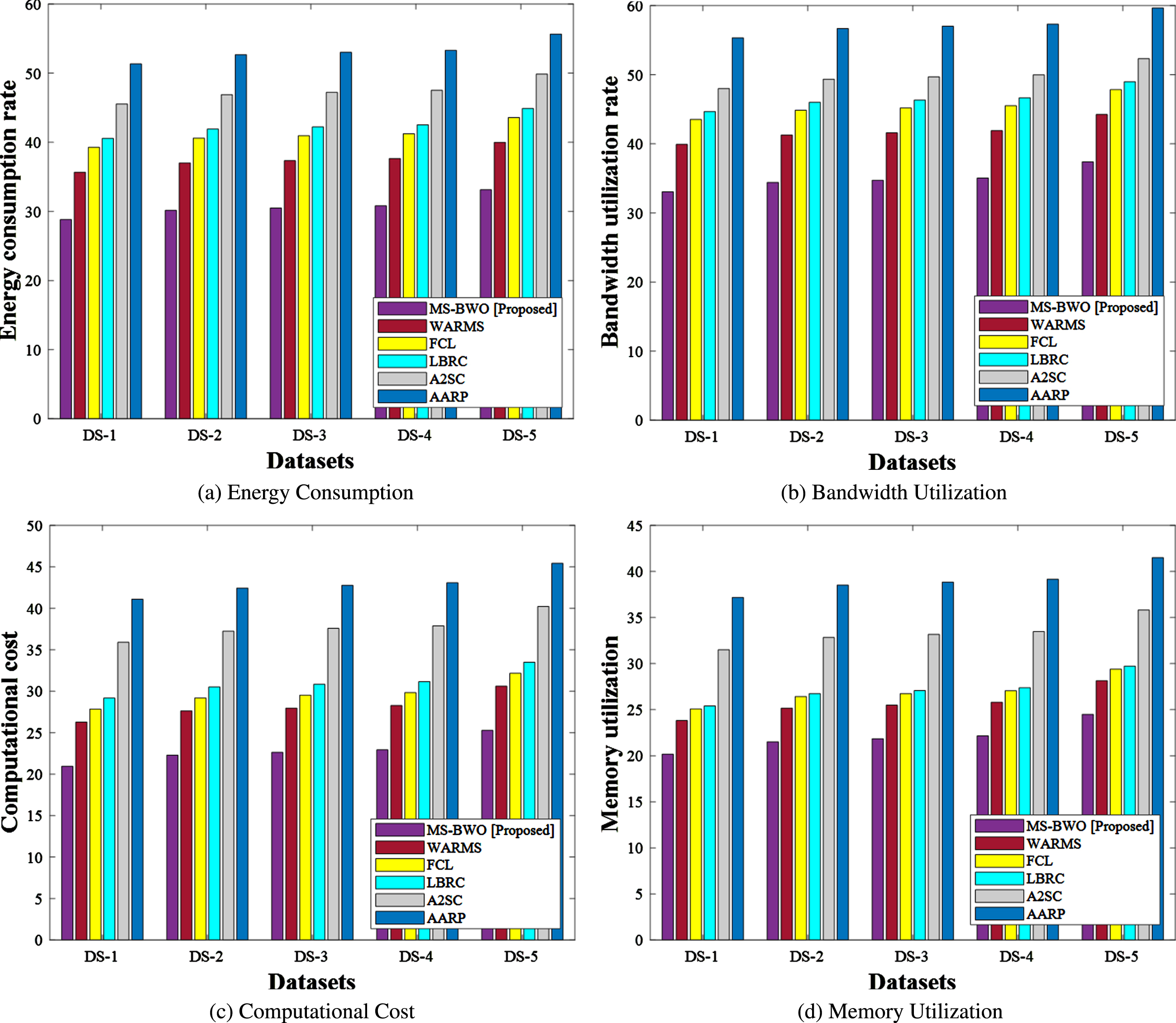
Execute resource-optimized service provisioning using five different personal cloud datasets.
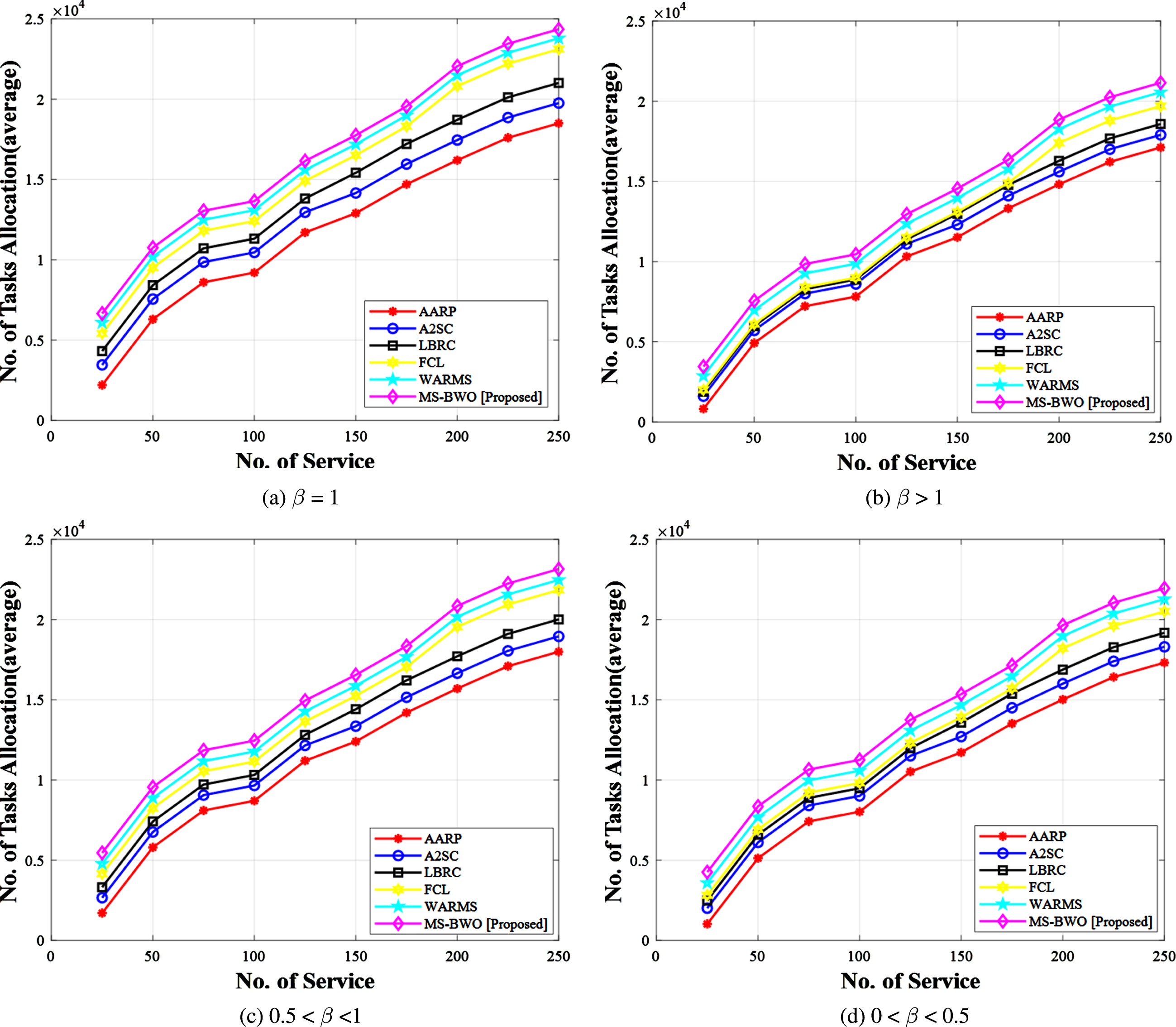
Performance evaluation of task allocation with respect to number of service affordable in the stack queues using proposed MS-BWO set points.
The number of VMs is operated for given number of users requested services because ongoing performance of the running application over the VMs makes a request that requires internal memory CPU capacity of ∼4000 MIPS to the virtual machine. All of which are allowed by the VM because the Individual server’s CPU capacity of the VM can execute up to 12,500 user requested services. The storage bandwidth limits for virtual machines with premium storage and premium storage caching enabled are distinct. The computational speed of responding to one hundred user requests takes ten milliseconds while using WARMS [5], FCL [11], AARP [7], A2SC [38], and LBRC [1], respectively. The remaining 9 cycles are used to obtain the average results of the comparison as in Figure 4e. When compared to WARMS [5], FCL [11], AARP [7], A2SC [38], and LBRC [1], the suggested MS-BWO technique has a computational speed that is increased by 46.5%, 43.4%, 41%, 38.6%, and 35.4%, respectively.
Convergence rate
The goals of both pipelining and retiming are to speed up computations by decreasing and/or levelling out delays between user requested services. When there is no more than one combinational operation between any two user-requested services, performance is maximized for a given granularity. When there are 100 user requests being processed, the virtual machine consumes 36 percent of the available bandwidth. According to WARMS [5], FCL [11], AARP [7], A2SC [38], and LBRC [1], the percentage of convergence rate that is being utilized is, respectively, 56%, 47%, 43%, 39% and 38%. When compared to WARMS [5], FCL [11], AARP [7], A2SC [38], and LBRC [1], as in Figure 4f, the suggested MS-BWO method has been shown to reduce bandwidth utilization rate by 35.2%, 32.4%, 29.5%, 26.5%, and 24.2% respectively, after every iteration.
Dataset computation
As shown in Tables 4–7, the suggested MS-BWO method was statistically compared to currently available state-of-the-art methods in a cloud environment. Using data from the WARMS [5], FCL [11], AARP [7], A2SC [38], and LBRC [1] datasets and their corresponding energy consumption, bandwidth use rates, computational costs, and memory utilization, the performance metrics of minimum value, maximum value, and average are stated and calculated. When it comes to scheduling and executing a maximum number of user requests in CDC, existing algorithms all performed much worse than the MS-BWO technique.
Statistical analysis of energy consumption across five datasets
Statistical analysis of energy consumption across five datasets
Statistical analysis of bandwidth utilization rate across five datasets
Statistical analysis of computational cost across five datasets
Statistical analysis of memory utilization across five datasets
The simulation is carried out for 100 user requests for IoT device cloud service, and it is computed for every 10-iteration made in the five different datasets. After 10 runs, the energy usage and bandwidth utilization rate of the proposed MS-BWO technique are comparatively lower than other methods. Its evidently shown in Figs. 5a and 5b. The results demonstrate that the MS-BWO strategy reduces energy usage and bandwidth utilization rate by around (38-30%) and (34-25%) as compared to WARMS [5], FCL [11], AARP [7], A2SC [38], and LBRC [1], respectively. Tables 5 clearly show that the proposed MS-BWO is reasonably better for the progressive nature of the datasets. Further, it is evidently operated for non-IoT device efficiency analysis to accommodate the cloud service on the demand of the user request.
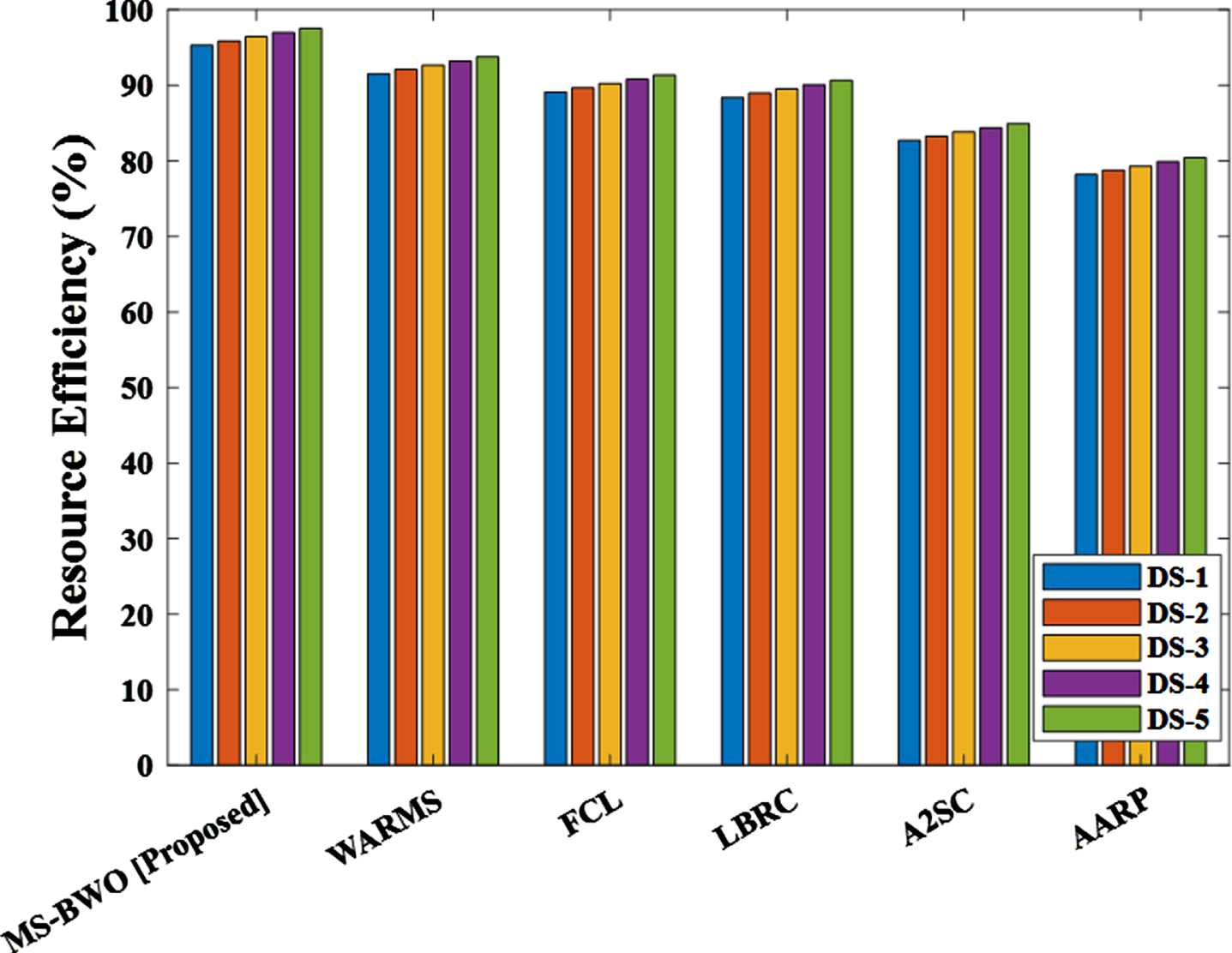
Comparative chart of Resource efficiency with other state-of-the-art-methods.
The proposed MS-BWO approach links user queries to available services. So, it speeds up cloud server response time. Then it selects the fastest VM to provide the requested services. The chosen VM serves consumers promptly. Thus, MS-BWO is less computationally expensive than other approaches. Because MS-BWO selects the memory-efficient VM from the population. Thus, the user’s request is served by the VM with the least storage space. The results demonstrate as in 5c, 5d that the MS-BWO strategy reduces the computational cost and memory utilization around by (44-28%) and (35-24%) as compared to WARMS [5], FCL [11], AARP [7], A2SC [38], and LBRC [1], respectively. Tables 7 clearly demonstrate that the suggested MS-BWO is reasonably superior for datasets with progressive nature.
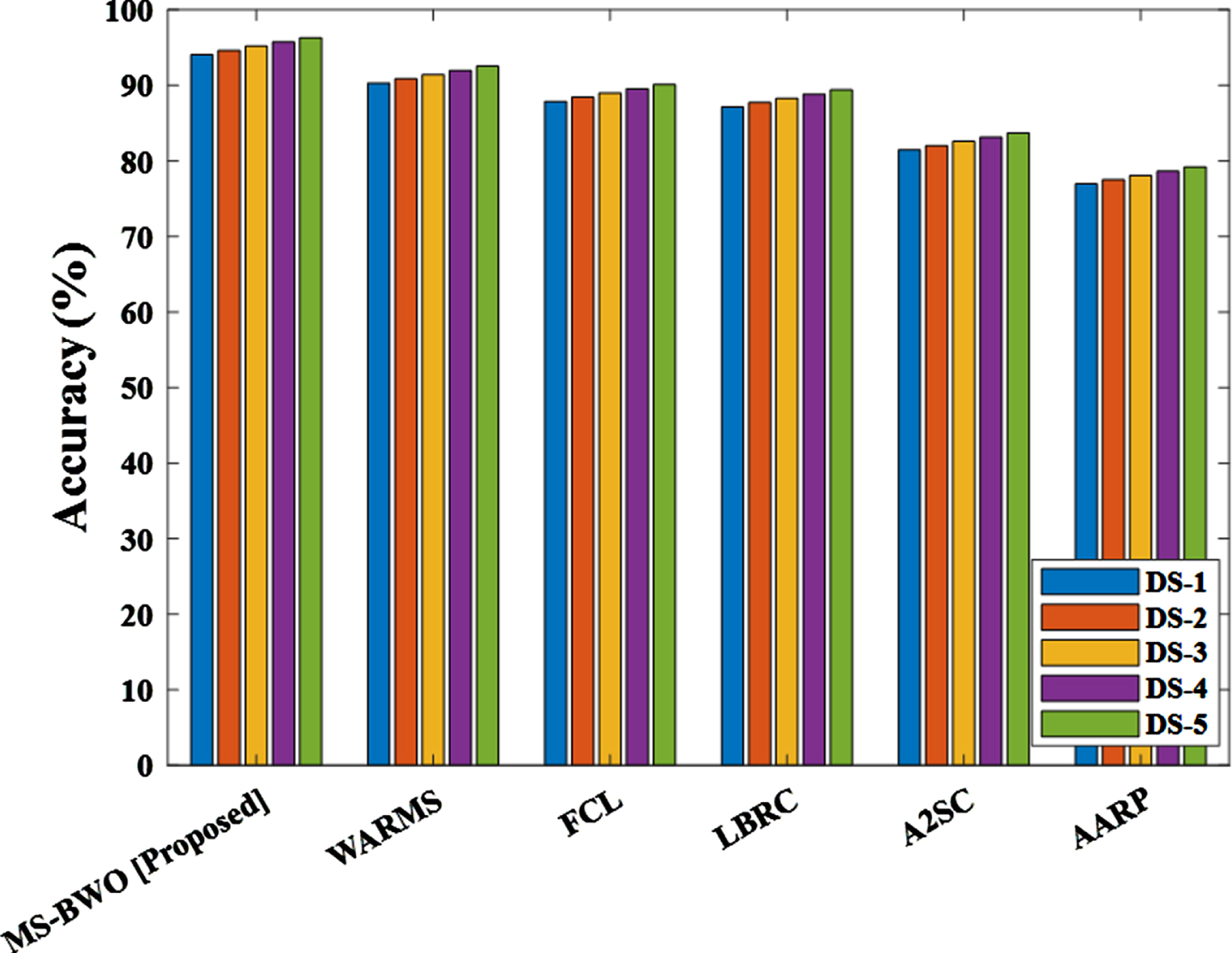
Comparative chart of Accuracy with other state-of-the-art-methods.
In this subsection, a description of the task allocation of the cloud customer requested services is provided to ensure that the services are properly accessed in terms of making the most efficient use of the resources that are available. The performance evaluation of the task allocation is depicted in Figure 6a, with the optimistic point set at β = 1. At this point, the number of offspring that can grow is restricted, and as a result, the maximum number of tasks that can be allocated within the average amount of resources is also restricted. However, when compared to the proposed MS-BWO, other already-existing methods have a significantly lower cost. The reason for this is that the number of offspring chances are restricted to stop any further mutations from occurring, which also implies that other cloud customer services are limited while the task at hand is being carried out as required. On the other hand, if there are more offspring than expected, the point will say β > 1, indicating that there are more than 1. After that, the task allocation is tweaked ever-so-slightly, but the proposed MS-BWO technique maintains performance just slightly above the anticipated threshold. To accomplish this, the location of the spider is rapidly changed for a brief period while the storage space allocated to the task that is currently being processed remains unchanged. The proposed MS-BWO is significantly superior to other methods, even under the critical offspring condition. This is the case even though other methods have been used. Figure 6b demonstrates this point very clearly. In a similar manner, an alternative action is being carried out while the male spider has become mutated, and the results may result in a low or high chance of offspring. It is represented as two distinct conditions, which are 0.5< β<1 and 0< β<0.5. As a result, the number of tasks that are allocated is changed without disrupting the cloud’s existing customer service. It can be seen in Figure 6c, as well as in Figure 6d, respectively.
Impact of resource efficiency and accuracy
The ratio of the number of ideal cloud resources consumed by the virtual machine for producing cloud services big data processing from the overall number of cloud resources is known as resource efficiency. It is expressed as a percentage, and the corresponding formula (22) to this measurement is as follows:
The overall performance of the five different datasets in terms of their resource efficiency and accuracy are estimated. Other techniques, such as WARMS [5], FCL [11], AARP [7], A2SC [38], and LBRC [1], do not compare well to the suggested MS-BWO method’s superior resource use efficiency. Because while delivering cloud services, MS-BWO considers a wide variety of elements, including energy consumption, bandwidth, memory, and the cost of computation. The originally built-up population of virtual machines (VMs) can be optimized by the usage of these characteristics. Then, each VM is checked to ensure that it satisfies the fitness criteria, and that its position is compared to the best solution that is currently available. If the new virtual machine is found to be more effective than the best option already available, then it will be selected. And so on, until a virtual machine is chosen that is both resource and cost-efficient. A VM is used by the CSP to deliver the services that the user has requested. This results in the more effective use of resources. The results of a comparison between the proposed MS-BWO approach and current WARMS [5], FCL [11], AARP [7], A2SC [38], and LBRC [1] are presented in Figure 8. According to these results, MS-BWO improves the use of resource efficiency by 36%, 34%, 33%, 17%, and 12%, respectively.
\The analysis then extrapolates the VMs’ utilization across a range of user-requested service counts. The health of virtual machines can be determined by comparing them to one of three predefined threshold levels: underfitting, normal, or overfitting. To get the most precise reading of users’ service demand, we put five datasets through their paces by analyzing underfitting and overfitting thresholds. Furthermore, we used Equation 23 to evaluate the proposed MS-BWO models’ precision in identifying VMs’ states with minimal resource and computational cost use. From what can be seen in Figure 8, the optimal underfitting and overfitting thresholds are 75% and 95%, respectively.
In this paper, an efficient technique called a nature inspired black window optimization with multi-criterion correlation metrics is developed for obtaining resource and cost minimized cloud services big data processing through metaheuristic search phenomena. Therefore, it has achieved an accurate relationship between user requirements and accessible services. Additionally, it has determined the most efficient cloud virtual machine and user’s requested cloud services big data processing availed by minimal resource and computational cost. The MS-BWO approach is tested for energy consumption, bandwidth utilization, computational cost, memory consumption, and resource utilization efficiency. Optimization allows the cloud service provider to provide desired services while maximizing cloud resource usage. The simulation has executed for 100 customer requests for IoT device cloud service, and the results are generated for every 10-iteration in the five different datasets. After ten runs, the proposed MS-BWO methodology uses less energy and has a lower bandwidth use rate than existing methods. The results show that the MS-BWO method reduces energy usage and bandwidth utilization rate by (38-30%) and (34-55%), respectively, when compared to WARMS [5], FCL [11], AARP [7], A2SC [38], and LBRC [1]. Similarly, on the other hand, the MS-BWO technique connects user queries to available services. Thus, it reduces the time it takes for cloud servers to respond and the chosen VM provides prompt service to customers. As a result, MS-BWO is less computationally expensive than other methods. MS-BWO chooses the most memory-efficient VM from the population. Thus, the VM with the least amount of storage space serves the user’s request. The results show that the MS-BWO technique reduces the computational cost and memory use by (44-28%) and (35-24%), respectively, when compared to WARMS [5], FCL [11], AARP [7], A2SC [38], and LBRC [1]. In future work, balance the storage space continuity and reduce user data conservation by enhancing intelligent filtering for the user discovery and faster service delivery over heterogeneous big data. Consequently, it derives conceptual information from machine data to support the business commodity.