



Abstract
Expert group decision-making in the process of engineering consulting is an important part of the smooth development of engineering projects. Whether the conceptual design scheme of the project is reasonable or not will directly affect the construction quality of the project. After the preliminary selection of a river ecological governance project, four conceptual design schemes were obtained. The owner invited 20 experts in relevant fields to make decisions on the four schemes collected in the early stage. The experts gave preference information for each scheme after reading the relevant materials of the project and clarifying the actual needs of the project. Based on this background, this paper uses a combination of quantitative and qualitative methods to construct a model for group decision-making and conflict resolution in the engineering consulting process. We use the preference relationship to reflect the degree of experts’ preference for the scheme, cluster them through similarity calculation, calculate the conflict degree of group preference and personal preference respectively, and comprehensively use the sequence difference method and personal preference correction method to resolve the conflict, so that their opinions can be quickly agreed within the specified time. The results calculated by model are consistent with the actual situation of the project, which verifies the effectiveness of the model proposed in this paper and can provide a reference for similar project decision-making and conflict resolution process.
Keywords
Introduction
With the rapid growth of the global economy, large-scale engineering projects continue to emerge, and the complexity and dynamics of the projects gradually increase, which intensifies the difficulty of project management. As an important part of the field of construction engineering, engineering consulting has always played the role of a “think tank” in the smooth progress of the project since its development in the second half of the 19th century. It is mainly dedicated to providing intellectual services such as consulting and management for the engineering construction process, and it plays an indispensable role in the improvement of the management level of construction projects. At present, the scale of the engineering consulting industry continues to expand with the increase in market demand. More and more consulting companies are vigorously promoting the whole process of engineering consulting, and its service scope covers the whole life cycle of the project including preliminary project approval stage, survey and design stage, construction stage, operation stage, etc. Decision-making activities also run through the entire process. However, in recent years, engineering decision-making errors have changed from accidental to frequent. Due to the complexity of the project itself, it is difficult to carry out high-quality and efficient decision-making activities in the engineering consulting process. The failure of major project construction or operation caused by decision-making errors often occurs, causing huge losses to the national economy and society. The reason lies in the unscientific decision-making process. As an activity based on the preference of decision makers to select the best scheme from a group of feasible schemes, group decision-making has been widely used in computer science [1], supply chain management [2], engineering [3], health / medicine [4] and other fields in recent years. It is characterized by a large number of participants, a large number of groups and a large amount of decision-making data provided by participants [5].
For engineering consulting units, in the process of group decision-making (GDM), the decision-making subjects mainly involve professionals in many fields and levels, such as government departments, planning experts, construction experts, structure experts, technical economy and management experts. Due to the differences in the identity, status, ideological cognition, decision logic and interest demands of decision-making experts, and the personal preference and persistence of experts may lead to difficulties in unifying opinions [6], stalemate and even conflict in the decision-making process. It mainly includes the following issues: The limitations of individual cognition are easy to cause information asymmetry among decision-makers and it is difficult to reach a decision-making consensus in a short time. The time for expert is limited, and with the passage of time, the level of information exchange and full communication among experts will be improved. The time for each negotiation will gradually decrease with the increase of the number of consultations. Some experts may be unable to make judgments due to insufficient knowledge reserves, insufficient practical experience and tight decision-making time. The experts have a tendency to agree with the experts whose opinions are similar to their own, which is easy to produce several “small groups” with consistent preferences.
Therefore, the engineering consulting industry urgently needs a set of scientific and effective decision-making system and conflict resolution methods to provide strong support for the development of decision-making activities in the process of engineering consulting, and greatly improve the efficiency and accuracy of decision-making. The optimal conflict resolution method is to ensure that the decision-making experts reduce the conflict with the group consensus on the basis of maximizing their own opinions, so as to achieve consensus. Taking into account all of the foregoing, there is a need for a method that requires: When the preference information of experts is incomplete, it needs to be supplemented. Clustering experts with similar opinions. Quickly unify expert opinions and form scientific results.
Accordingly, the model has been developed and the following goals of this paper have been set. The first goal of the paper is using an algorithm to complete the incomplete information of experts in the decision-making process. The second goal of the paper is to calculate the similarity of expert preference information and cluster it. The third contribution of the paper is to define a method that enables quickly resolve conflicts in expert decision-making process in a limited time. The advantages of the model presented in this paper in relation to the existing models in the literature are hereinafter explained in detail.
The rest of this paper is organized as follows: Section 2 provides a literature review of GDM Models and conflict resolution methods. Section 3 builds a model of group decision-making and conflict resolution. Section 4 verifies the applicability and feasibility of the model through an actual engineering case. And Section 5 provides the concluding observations and the directions for future research.
Literature review
The engineering consulting industry in developed countries has a history of more than 100 years since the middle of the 19th century, and has roughly gone through three stages such as individual consulting, partnership consulting, and comprehensive consulting. At present, the engineering consulting industry has developed into a fairly mature industry, involving a wide range of professional fields and business, including consulting services for issues that require decision-making at the stages of project decision-making, design, bidding, construction, completion, and operation and maintenance. Scholars have conducted discussions and researches on decision-making behavior, decision-making methods to solve different engineering decision-making problems. The earliest research on GDM originated from the Borda number rule, which is the rule that decision makers rank plans. The advantages, disadvantages and their main applications of the existing GDM methods are summarized in the Table 1.
Main GDM method
Main GDM method
Through the literature review of research on GDM methods, it is found that they are widely used in the fields of scheme selection, supplier selection, spatial location selection, project evaluation and so on. They have many advantages, such as: (1) Easy to be combined with other methods; (2) The calculation process is simple; (3) The results are objective and stable; (4) Maximize the utility of the majority. But the existing research and methods still have the following shortcomings:(1) There is less research on how to establish consensus in the decision-making process; (2) Most research lack systematic and in-depth discussion on GDM process control and how to form a unified opinion. For conflict resolution, Zhou, SH et al. proposed a multi-stage interactive GDM method based on Markov chain approximation for the multi-stage GDM problem in which each decision maker uses interval fuzzy numbers to make decisions. The group substitution conflict degree is defined, and the conflict degree threshold is determined through numerical simulation [24]. Liao, HC et al. proposed a multi-attribute GDM model to determine two conflicts between experts, introduce a feedback mechanism, and proposed a multi-attribute GDM algorithm based on triangular fuzzy numbers and heterogeneous experts [25]. In addition, scholars have also carried out a lot of research on GDM in other fields, adopted different methods to construct decision-making matrix and determine expert weight [26], established GDM model [27], some studies also measured the conflict in the decision-making process [5, 28–30], and gave the methods for decision-making groups to establish consensus and reduce conflict.
Based on the above, this paper studies the problems of GDM and conflict resolution in the engineering consulting process, in order to promote decision makers to quickly reach consensus. We used a combination of quantitative and qualitative methods to construct a GDM and conflict resolution model in the engineering consulting process and studied how to negotiate and resolve major differences between experts in the process of large GDM. The applicability and feasibility of the model was demonstrated through the case of the plan review in the actual project, aiming to improve the decision-making efficiency and quality of the engineering consulting process and provide a basis for the scientific and efficient engineering decision-making.
GDM problem
Suppose that an engineering consulting agency faces a large GDM problem. The agency has M (M≥20) decision-making experts, and each expert gives his own evaluation matrix, and all preference evaluation matrices constitute the group preference set Ω. Each decision stage provides Q alternatives. Matrix P
n
is the fuzzy preference judgment matrix given by decision expert n, where

Preference matrix generation process.
Due to the complexity of different stages of engineering projects, in the actual process of GDM by engineering consulting experts, a certain conflict degree will definitely occur within the group. In order not to hinder the smooth progress of GDM, conflicts must be negotiated and resolved. Decision-making groups need to quickly resolve conflicts between decision-making experts in the shortest possible time and achieve the unity of decision-making results. Therefore, it is necessary to set time constraints on the conflict resolution process. With the passage of decision-making time, the level of information exchange between decision-making experts improves and full communication, the negotiation time of each round theoretically decreases as the number of negotiations increases. Assuming that the maximum number of negotiations is f, then the time required for each negotiation is:
Among them, T i represents the time constraint given for each round of conflict resolution and negotiation, T0 represents the specified total conflict resolution and negotiation time, and f represents the maximum number of negotiations.
In addition, the conflict degree constraint can be represented by the conflict degree threshold β. The higher the conflict degree threshold β, the smaller the number f of conflict resolutions, and the easier it is for the decision-making group to reach a consensus quickly. Therefore, the upper limit T0 of the conflict resolution time, the number of resolution coordination times f and the conflict degree threshold β should be set reasonably according to actual problems.
And in the whole process of GDM conflict resolution, a decision-making expert in charge of the overall situation is needed to ensure that each negotiation process can be completed within the specified time limit, and the conflict level of GDM will develop better after each round of negotiation, so as to finally achieve group consensus and complete the decision-making task. The structure of the proposed methodology for decision-making and conflict resolution as shown in Fig. 2.

Structure of the proposed methodology.
The conflict resolution negotiation framework is shown in the Fig. 3, the specific steps are as follows:
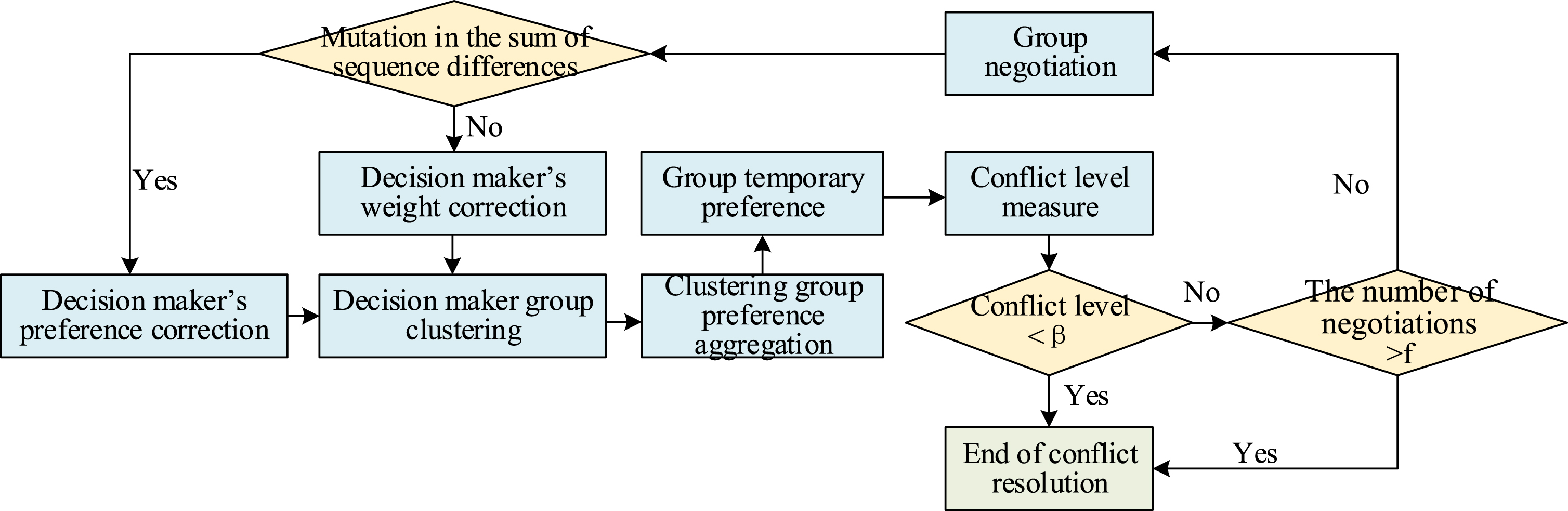
Conflict negotiation framework for GDM.
Estimation of preference value with incomplete information
In any decision-making problem, once the set of alternatives X is to be determined, experts will be assembled to express their personal opinions or preferences on these options. GDM by experts in the engineering consulting process is a dynamic and complex process involving multiple decision-making subjects, and the subjective opinions given by decision-making experts cannot be quantified. The information form of fuzzy preference relation has been widely used in the GDM process. Its ambiguity conforms to the subjectivity of the decision-making expert in the expert GDM process. Experts compare the two alternatives in X, and can conclude that one of the alternatives is better (or inferior) to the other, and obtain the corresponding numerical information.
Incomplete information means that some experts may not be able to make judgments due to insufficient knowledge reserves, insufficient practical experience, and too tight decision time, resulting in partial information missing. In this paper, the additive transitivity proposed by Tanino is used to supplement the missing incomplete information in the preference matrix. The calculation formula for the missing estimated value
Assuming that the set of options for a certain decision-making problem is (X1, X2, X3, X4), the fuzzy preference matrix for pairwise comparison of the options given by the decision-making group and the complete matrix after supplementation are as follows:
Large GDM is complicated. Different knowledge backgrounds, individual preferences, mental states, and comprehensive abilities among decision-making experts will lead to differences in individual preferences, and it is difficult to ensure the accuracy and credibility of decision-making information. Therefore, it is necessary to check the consistency of the fuzzy preference matrix. A more ideal fuzzy relationship judgment matrix generally has three conditions: (1) the elements on the diagonal of the matrix are all 0.5; (2) the sum of two elements symmetric about the diagonal is equal to 1; (3) The decision preference value of each position in the matrix is in the range of [0, 1].
Calculate the consistency level ρ of each decision-making expert’s fuzzy preference relation matrix. The consistency level of the m-th decision-making expert is represented by ρ m . The consistency calculation method [33] is as follows:
After calculating the consistency level of the decision-making experts, compare it with the preset consistency level threshold. This paper selects ρ0=0.85. When ρ > ρ0, the consistency level of the fuzzy preference matrix is considered to meet the requirements, otherwise, the fuzzy preference matrix is not satisfied, and the fuzzy preference matrix is eliminated or revised until the matrix of all decision-making experts meets the consistency requirements, thereby improving the rationality of the decision result.
The size of the decision-making group will affect the quality of the decision. Studies have shown [34] that when the size of the decision-making group is 5 to 11 people, the decision result is the most effective. When the group size is 4 to 5 people, the decision result is most likely to satisfy the decision group. When the group size is 2 to 5 people, it is the easiest to get the result. Therefore, in order to achieve better decision-making effects in large GDM, it is very important to transform the large group into several small groups and cluster them. Group clustering based on similarity is to use systematic analysis to cluster the similarity of preferences between two decision-making experts, which perfectly interprets the clustering phenomenon of decision-making experts with similar opinions in the GDM process. In the actual decision-making situation, decision-making experts have a great tendency to agree with experts with similar opinions, which is easy to produce a number of “small groups” with consistent preferences. The number of decision-making experts in a small group should not be greater than N/2.
In the formula, ∥A ∥ 2 =(ρ(A T . A)) 1/-2, ρ(A T . A) is the spectral radius of the preference relation judgment matrix A T · A.
This paper selects the method of determining the threshold value based on the pedigree diagram. It is necessary to calculate the similarity between the preference matrix of two decision-making experts according to the formula, obtain the similarity matrix, use the SPSS software to draw the expert clustering pedigree diagram, and select the appropriate average distance within the group to get the corresponding number of clusters. If there are large conflicts between clusters and small intra-cluster conflicts, the clustering effect is better, otherwise, the clustering effect is not good.
The degree of similarity or difference between two objects can be represented by distance. According to the literature [38, 39], Jaccard distance can be used to measure similarity. The greater the distance, the greater the feature difference, that is, the smaller the similarity. On the contrary, the greater the similarity. The concept of distance is also widely used in multi-attribute GDM. To a certain extent, it can objectively reflect the importance of the evaluation object based on the dispersion degree, which has the characteristics of high efficiency and speed, but it is only a measure and cannot reflect the information of the system. According to the explanation of the basic principles of information theory, the system degree of order is measured by information, and the degree of disorder is measured by entropy. The greater the entropy value, the greater the degree of index dispersion. Therefore, combining the concepts of distance and information entropy to calculate the weights of decision-making experts within and between clusters can effectively avoid the limitation of using a single method to calculate weights.
Suppose the weight vector of decision-making experts in a certain cluster is ω
k
=(ω1, ω2, . . . , ω
i
, . . . , ω
n
k
)
T
, where
In general, the initial weights substituted into the group preference matrix of decision-making experts are: ω k =(ω1, ω2, . . . , ω i , . . . , ω n k ) =(1/n k , 1/n k , . . . , 1/n k )
The difference between the group preference matrix and the preference matrix given by each decision expert is calculated, and then the preference conflict level of each decision expert in the cluster is measured based on the distance entropy model, and the preference conflict level of the cluster is obtained:
This paper uses distance ratio instead of probability. The larger the distance ratio, the greater the distance the group can reach a consensus. According to the deviation
After normalizing the above formula, the weight of decision-making expert i in the cluster is obtained. The calculation formula is as follows:
In the same way, the weights of decision-making experts between clusters can be calculated, but considering that the number of decision-making experts included in each “small group” between clusters will affect the decision-making results, the weighting factors of decision-making experts between clusters are idealized so that they are only related to the number of decision-making experts. The initial weight is represented by
Among them, the variable coefficient χ ∈ [0, 1], which depends on the actual situation. If the number of decision-making experts in the cluster has a greater impact on the decision-making result, it is selected within the range of χ ∈ [0, 0.5). If the distance entropy has a greater impact on the decision-making result, then it is selected within χ ∈(0.5, 1].
The weighted average of the decision-making experts’ weights between clusters and within clusters can be used to obtain the group comprehensive judgment matrix, which can be represented by
Basic assumptions
In view of the differences between theoretical research and actual problems, it is often impossible to directly quantify actual problems and obtain solutions. Therefore, this paper postulate three assumptions, and construct a GDM negotiation model on this basis to provide a basis for the settlement of GDM conflicts. Details as follows: Every decision-making expert is a “rational person”. When making a decision, one considers his own interests first, and on the premise that his own interests are basically satisfied, according to the actual situation of the decision-making problem, he makes appropriate adjustments to his preferences for the plan; In order to reach agreement on the decision-making results, each decision-making expert agrees to adjust their preferences toward the overall optimal direction within a reasonable range, so as to improve the efficiency of GDM; In order to reduce the asymmetry of information between individuals and increase the exchange of information, each decision-making expert should clarify the reasons and basis when giving his own preference for the plan.
GDM negotiation model based on conflict measure
In the formula, Δ k represents the conflict degree between any cluster C k and the judgment matrix of the group comprehensive preference relation. The larger the value, the greater the conflict degree of the cluster C k .
In this paper, the weights of decision-making experts are redistributed based on the sequence difference. This method helps to achieve the convergence of the conflict degree between clusters and within clusters. First, the initial comprehensive weight of each expert is represented by the product of the intra-cluster and the inter-cluster weights. The weight after the previous correction is used as the initial data, and the weight values are sorted from small to large to obtain the weight sequence of the experts. First, the initial comprehensive weight of each expert is represented by the product of the intra-cluster and the inter-cluster weights. The weight after the previous correction is used as the initial data, and the weight values are sorted from small to large to obtain the weight sequence of the experts. Then, according to the conflict degree calculation formula, the conflict degree between the preference judgment matrix of each decision-making expert and the group comprehensive judgment matrix is obtained, and the order is sorted from large to small, and the conflict sequence of the decision-making expert is obtained. Decision-making experts with a lower conflict degree tend to be more towards the overall intention of the group. Therefore, it can be considered that a decision-making expert with a lower conflict degree has a greater weight, that is, the greater the conflict degree, the smaller the conflict serial number, and the smaller the weight in decision-making.
Sort the conflict degree sequence from largest to smallest, sort the weight sequence from smallest to largest, calculate the difference between the two sequences, and use the difference to correct the weight of the decision-making expert. If the difference is positive, it is a positive series difference; if it is negative, it is a negative series difference. The change in the weight of decision-making experts can be represented by the penalty coefficient and the reward coefficient. The calculation formula is as follows:
Penalty Coefficient:
Reward Coefficient:
Among them,
Updating the weights of decision-making experts through the above methods can adjust group preferences to make them more consistent, but at the same time there are certain limitations. This paper first uses the sequence difference to resolve conflicts. After each weight change is calculated, the group comprehensive preference matrix A k and its conflict degree Δ are calculated according to the weights, and they are compared with the threshold β: If Δ ⩽ β, the weight correction ends, indicating that the decision result is more ideal; if Δ > β, when the two sequences tend to be consistent or the sum of the positive sequence differences is less than twice the number of experts involved in the correction decision-making, the preference correction method will be used. Otherwise, the weight continues to be corrected until the conflict resolution is completed.
The preference correction adopts the following iterative algorithm:
Among them, t represents the number of iterations, t0 = 0; and φ =(Δ - β)/β, the greater the value of φ, the faster the conflict will decrease.
Individual preference correction assumes a compromise coefficient and adjusts the tendency degree of the decision-making experts with the greatest conflict degree to the group’s comprehensive preference. In the actual decision-making process, it is often difficult to agree with the opinions of other decision-making experts due to the unique opinions of individual decision-making experts. Preference correction method can correct the preference tendency of the decision-making expert and make it partly sacrificed to improve group consensus. When the compromise coefficient is large, it indicates that the decision-making expert has largely abandoned his opinions; on the contrary, when the compromise coefficient is small, it indicates that the decision-making expert has minimized the conflict with the group consensus on the basis of maximizing the retention of his own opinions. This method is consistent with the actual GDM process and is simple and easy to operate.
Case background
In this section, a case study is used to prove the feasibility of the proposed method. A company entrusts an international tendering company to organize an international competition for the conceptual design of a river ecological governance project. Participants that have passed the prequalification are required to submit design results within a specified time. A total of four plans participated in the review, and the optimal design plan is selected by the expert GDM. The project convened 20 experts of different professions and backgrounds to form a large decision-making group.
GDM process
First, use O =(o1, o2, o3, o4) to denote the above four options, and use P =(p1, p2, p3, . . . , p20) to denote 20 decision-making experts. Each expert made a pairwise comparison of the 4 proposed alternatives based on the premise of a full understanding of the project background and information, combined with on-site surveys. The preference information for each alternative is given as the original data in the form of a preference matrix. The matrix given by some experts due to personal reasons has some missing values (red area in the table), and it is necessary to supplement the incomplete information according to formula (1), and then conduct a consistency test on it. Due to space limitations, the process is omitted here, and the preference matrix adjusted by the consistency test is shown in Table 2.
Preference matrix adjusted by consistency test
Preference matrix adjusted by consistency test

In the case that the preference matrix of all decision-making experts met the consistency level, calculate the similarity of preference matrices between the two experts according to formula (4) to obtain the similarity matrix, and import the similarity matrix into the SPSS software to cluster the experts participating in GDM. Since choosing different average distances within the group can get different clustering results, considering the number of clusters and the number of decision-making experts in the cluster, this paper selects the average distance within the group as 6 and the number of groups as 3 for clustering. The 20 decision-making experts are divided into 3 categories. Among them, cluster C1 contains 6 experts {P1, P2, P3, P8, P14, P17}; cluster C2 contains 7 experts {P4, P5, P7, P10, P12, P18, P19}; cluster C3 Contains 7 experts {P6, P9, P11, P13, P15, P16, P20}. Use formula (5) to calculate the initial preference matrix of each cluster and get the preliminary program ranking as shown in Table 3.
Clustering results and clustering preference ranking
It can be seen from the above table that there are certain differences in the preferences of each cluster for the four alternatives of the decision-making problem. Cluster C1 considers the plan O3 to be the best, cluster C2 considers the plan O2 to be the best, and cluster C3 considers the plan O4 to be the best.
Using the distance entropy model, according to formula (6)~(9), the weights of decision-making experts in the cluster are calculated as shown in the Table 4.
Weights of decision-making experts within clusters
Through the above intra-cluster weights of decision-making experts, a new group preference judgment matrix within the clusters is obtained, and on this basis, the distance entropy method is used to determine the weights of the three clusters respectively. Considering the influence of the number of decision-making experts in each cluster on the decision-making effect, this paper selects variable coefficient, and combines the weight based on the distance entropy method and the weight based on the number of decision-making experts. According to formula (10), the weight of each cluster is calculated as shown in Table 5.
Weights of decision-making experts between clusters
Using the above weights between clusters, a new group comprehensive preference matrix can be calculated. According to the preference judgment matrix, the ranking of alternatives and the total scores of the options under different variable coefficients can be obtained. The sum of the preferences of the options is the total score of the options. The higher the score, the better the plan, as shown in Table 6.
Group comprehensive preference matrix and plan ranking
It can be seen from Table 7 that when the variable coefficients χ are respectively 0.3, 0.5, 0.7, plan ranking is consistent as O3 > O1 > O2 > O4, which is consistent with the ranking results of clustering C1, and the plan three is considered to be the best. However, cluster C2 and cluster C3 hold different opinions. Cluster C2 thinks that plan two is the best, and cluster C3 thinks that plan four is the best, indicating that conflicts have occurred in the GDM process.
Conflict degree between clusters and group comprehensive conflict degree
In this case, take T0 = 90 min, β = 0.28, f = 6. According to formula (11)~(13), the conflict levels between individual decision-making experts, each cluster and the group comprehensive preference matrix are respectively measured, and the final group comprehensive conflict degree can be obtained.
It can be seen from the above table that under the preliminary decision results, there is no significant difference in the conflict level between the clusters corresponding to different variable coefficient χ, and one of the situations can be selected for discussion. This paper selects the situation of χ = 0.7 for conflict resolution, when χ = 0.7, the group comprehensive conflict degree is Δ = 0.29998 > β = 0.28.
The maximum negotiation time selected in this paper is T0 = 90min, and the maximum negotiation times is f = 6. After judging that it meets the conditions of using the sequence difference method, the first group negotiation (t = 1) is carried out, and the time for the first group negotiation is calculated according to formula (1) as T1 = 15min, and the weight change of each expert after the first negotiation can be obtained. The weight value of the expert at this time is calculated, as shown in the Table 8.
Weight Correction for the first Iteration based on Sequence Difference (t = 1)
Weight Correction for the first Iteration based on Sequence Difference (t = 1)
Using the expert weights shown in the above table to recalculate the group comprehensive preference matrix, the group comprehensive conflict degree after the first negotiation is calculated as Δ = 0.29957, which is lower than the value of 0.29998 when t = 0, indicating that the preferences of decision-making group have shown a consistent trend, and a second negotiation is still needed.
The time limit for the second negotiation is T2 = 12.5min, which is the same as the above steps. However, after judgment, it is found that the applicable conditions for the update weight of the sequence difference are not satisfied, and the preference correction method is used for correction. The expert P19 with the largest conflict degree is selected according to the formula (18), and the adjustment coefficient φ = 0.06191 is calculated. The adjusted group comprehensive conflict degree Δ = 0.29734 > β, which has not reached the specified threshold range, and the conflict resolution is continued.
The time limit for the third negotiation is T3 = 10min. After the judgment, the preference correction method is still used to correct the weight of the expert P10 with the largest conflict degree, the adjustment coefficient is φ = 0.05911, and the adjusted group comprehensive conflict degree Δ = 0.29655 > β, which does not reach the specified threshold range, and continues to be resolved.
The time limit for the fourth negotiation is T4 = 7.5min. The preference correction method is continuing to use to correct the weight of the expert P7 with the largest conflict degree, the adjustment coefficient is φ = 0.05537, and the adjusted group comprehensive conflict degree Δ = 0.29550 > β.
The time limit for the fifth negotiation is T5 = 5.0min. After judgment, the sequence difference method can be used for correction. The group comprehensive conflict degree after the end of the negotiation is calculated to be Δ = 0.29299 > β, and the conflict resolution is continued.
The time limit for the sixth negotiation is T6 = 2.5min, and the preference correction method is used to correct the weight of the expert P18 with the largest conflict degree, the adjustment coefficient is φ = 0.04508, the adjusted group comprehensive conflict degree Δ = 0.29262 > β. But at this time, the maximum number of negotiations f = 6 has been reached, and the conflict resolution is over. After each negotiation, the global weight value, the individual conflict degree and the group comprehensive conflict degree of each expert can be obtained, and the change trend chart of the group comprehensive conflict degree is drawn. As can be seen from Fig. 4, after each negotiation between the experts, the level of group comprehensive conflict degree converges and the speed of reduction tends to be flat, which proves that using the sequence difference method combined with the expert preference correction method to adjust the weight is effective for conflict resolution within the decision-making group.

Trend of Group Conflict Degree.
According to the variable coefficient of 0.7 in the previous article, the plan ranking obtained by calculating the initial expert preference is: O3 > O1 > O2 > O4, and plan ranking obtained after conflict resolution is: O3 > O1 > O4 > O2. The comparison result of the two is shown in the Table 9. We can see that the traditional scheme ranking and the ranking after conflict resolution have obvious changes in the positions of O2 and O4. Theoretically, the first three expert clusters of conflict resolution have great differences on the selection of the optimal scheme. Although the suboptimal scheme given by clustering C1 and clustering C2 is O1, the preference information given by experts in these two clusters is incomplete, which has a certain impact on the results. In the subsequent conflict resolution process, the preferences of experts P19, P10, P7 and P18 were corrected respectively. It is easy to know that the four experts belong to the clustering C2, and the initial information given by the two experts P19 and P10 is incomplete, which affects the tendency of the clustering decision-making results. Therefore, in order to make the whole group reach consensus, a compromise was made until the coordination was successful, and a unified result was obtained, that is, O3 > O1 > O4 > O2. The result is consistent with the ranking result of the actual competition of the project, which shows that the GDM and conflict resolution model constructed in this paper is scientific, reasonable and effective for scheme selection, and can effectively resolve the conflict problems in GDM in reality.
Ranking comparison of decision-making plan
This study points to a solution for expert GDM and conflict resolution in complex engineering consulting process. The contributions of this research are as follows. This study focuses on GDM problems under incomplete information, considering the real-life decision environment in which decision makers may give incomplete preference information for many reasons when making decisions. The fuzzy preference relationship judgment matrix is selected to quantify the individual preference, and the missing incomplete information is supplemented, tested and corrected to avoid the deviation caused by the individual differences of decision makers. So as to provide support for the successfully implementation of decision-making activities. The decision groups are clustered according to the similarity, and the advantages of distance in dealing with group consistency and entropy in describing information quality are combined. The decision weight determination method based on distance entropy is used to determine the expert weight within and between clusters, which effectively avoids the limitations of the traditional weight determination method. Aiming at the situation that experts are prone to conflict in the process of GDM in the process of engineering consulting, this study proposes a conflict resolution model of GDM under time constraints, measures the conflict, and redistributes the expert weight based on the combination of sequence difference and preference correction, which is helpful to realize the convergence of conflict degree between clusters and within clusters, promote the rapid consensus of group opinions, so as to improve the efficiency of GDM. This can offer decision makers an alternative method to deal with related decision problems in real life.
However, no approach can be perfect. Thus, the method has some limitations. First, the premise of applying the method proposed in this paper for the number of decision-making group members is≥20, the applicability of the model to the case of small number needs to be further discussed. Second, the termination of conflict resolution depends on the preset conflict threshold and the maximum number of negotiations. However, there is no authoritative method for how to set the conflict threshold at this stage. In the future, we should further study the conflict threshold setting method applicable to different decision problems and different decision scenarios. And the other one direction for future research should be towards establishing a GDM and conflict resolution system and platform to simulate GDM problems in different situations combined with computer decision-making simulation technology, so as to make the group decision-making and conflict resolution process more intelligent and automatic, to realize the maximum utilization of individual opinions and the rapid unification of group opinions, and to improve the efficiency and effectiveness of GDM.